

- Industry Size (2026)
- USD 693.1 Mn
- Forecast (2036)
- USD 1301 Mn
- CAGR (2026 to 2036)
- 6.5%
Net-Zero Apartment Multi-Zone Thermostats Market Forecast and Outlook 2026 to 2036
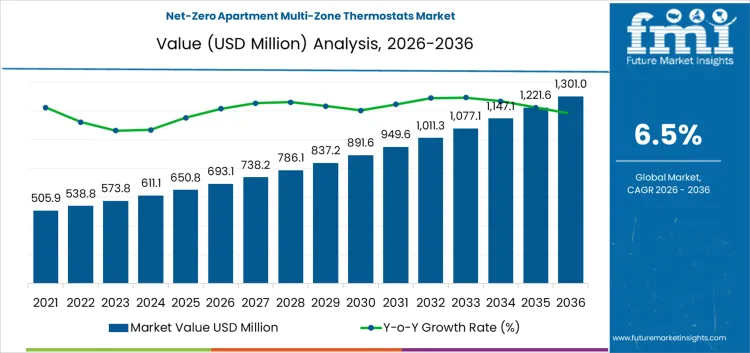
The net-zero apartment multi-zone thermostats market is valued at USD 693.1 million in 2026 and is projected to reach USD 1,301 million by 2036, expanding at a CAGR of 6.5% over the forecast period. Adoption is being shaped by who can navigate compliance-heavy building environments while keeping retrofit disruption and commissioning risk low. In multi-family projects, regulatory oversight is effectively enforced through building codes, energy performance standards, and audit-ready documentation requirements, which raise the bar for vendors selling into professional property management.
Compliance cost shows up in product certification, cybersecurity expectations for connected controls, and integration testing with HVAC and BMS layers often making “approved” ecosystems more attractive than best-in-class standalone devices. Certification complexity also influences deployment choices: wired retrofits remain preferred in many buildings because stable connectivity simplifies verification, fault tracing, and long-term maintenance obligations. Vendors with established installer networks, standardized submittals, and proven interoperability are positioned to win repeat rollouts across portfolios. Smaller providers can compete, but typically only where they can reduce compliance friction or align with mandated platforms.
Quick Stats for Net-Zero Apartment Multi-Zone Thermostats Market
- Net-Zero Apartment Multi-Zone Thermostats Market Value (2026): USD 693.1 Million
- Net-Zero Apartment Multi-Zone Thermostats Market Forecast Value (2036): USD 1,301 Million
- Net-Zero Apartment Multi-Zone Thermostats Market Forecast CAGR 2026 to 2036: 6.5%
- Leading Control Type in Net-Zero Apartment Multi-Zone Thermostats Market: Smart Zoning Control
- Leading Retrofit Method in Net-Zero Apartment Multi-Zone Thermostats Market: Wired Retrofit
- Key Growth Regions in Net-Zero Apartment Multi-Zone Thermostats Market: Europe, North America, Asia Pacific
- Top Key Players in Net-Zero Apartment Multi-Zone Thermostats Market: Honeywell Home, Schneider Electric, Siemens, Johnson Controls, Ecobee, Tado
Net-Zero Apartment Multi-Zone Thermostats Market Key Takeaways
| Metric | Value |
|---|---|
| Industry Value (2026) | USD 693.1 Million |
| Forecast Value (2036) | USD 1,301 Million |
| Forecast CAGR 2026 to 2036 | 6.5% |
How Is the Global Net-Zero Apartment Multi-Zone Thermostats Market Advancing?
The global net-zero apartment multi-zone thermostats market is advancing steadily, driven by increasing adoption of energy-efficient building designs and the need for precise temperature control in multi-unit residential complexes. Multi-zone thermostat systems enable independent climate control across different apartment zones, improving occupant comfort while optimizing overall building energy usage.
A key driver supporting market growth is the growing focus on reducing energy consumption in large residential buildings through smarter heating and cooling management. Multi-zone thermostats allow property managers and residents to control temperatures at the room or zone level, minimizing unnecessary heating or cooling in unoccupied spaces. This capability is particularly valuable in apartment buildings where usage patterns vary significantly across units and times of day.
Advancements in connected thermostat technologies and building automation integration are further strengthening market adoption. Improved sensors, wireless connectivity, and centralized control platforms are enabling real-time monitoring and coordinated HVAC operation across entire apartment complexes. As residential developers and building operators increasingly prioritize efficient thermal management and regulatory compliance, the multi-zone thermostats market for net-zero apartment projects is expected to register consistent growth over the forecast period.
What Is the Segment-Wise Overview of the Net-Zero Apartment Multi-Zone Thermostats Market?
The net-zero apartment multi-zone thermostats market is shaped by advanced control functionality and retrofit feasibility across existing residential buildings. Smart zoning control leads with a 36% share, driven by its ability to independently manage temperature across multiple apartment zones, improving energy efficiency and occupant comfort. These systems are well suited for net-zero housing projects that require precise thermal control and reduced energy waste. On the retrofit side, wired retrofit methods account for 46% of demand, reflecting their reliability, stable connectivity, and compatibility with legacy HVAC infrastructure in multi-family buildings. While wireless and hybrid retrofits are gaining traction, wired solutions remain preferred for large-scale upgrades where long-term performance and system integration are critical.
Why Does Smart Zoning Control Lead the Net-Zero Apartment Multi-Zone Thermostats Market?
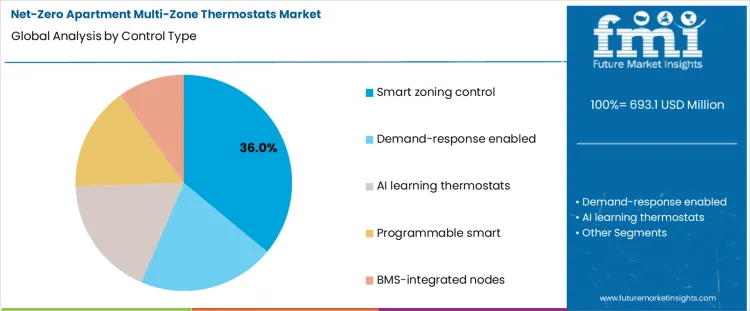
Smart zoning control accounts for 36% of the net-zero apartment multi-zone thermostats market due to its ability to optimize heating and cooling at the individual zone level. In multi-family apartment buildings, energy consumption patterns vary significantly across units and rooms, making centralized temperature control inefficient. Smart zoning systems allow independent regulation of multiple zones based on occupancy, usage patterns, and thermal load differences. This improves overall energy efficiency while maintaining occupant comfort, which is critical for achieving net-zero performance targets. Smart zoning controls also integrate effectively with building energy management platforms and renewable energy systems. As apartment developers and property managers prioritize precise energy optimization and compliance with net-zero building standards, smart zoning control remains the preferred control architecture.
Why Do Wired Retrofit Methods Dominate the Net-Zero Apartment Multi-Zone Thermostats Market?
Wired retrofit methods represent 46% of retrofit demand in the net-zero apartment multi-zone thermostats market, driven by their reliability and compatibility with existing HVAC infrastructure. Many apartment buildings rely on centralized heating and cooling systems where stable, interference-free communication is essential. Wired retrofits provide consistent connectivity, lower latency, and reduced risk of signal disruption compared to wireless alternatives. They also support seamless integration with building management systems and long-term monitoring platforms. Although installation may require higher upfront effort, wired solutions offer greater durability and predictable performance over time. For large-scale apartment retrofits focused on achieving net-zero efficiency targets, wired retrofit methods continue to be the preferred deployment approach.
What Are the Key Dynamics for the Net-Zero Apartment Multi-Zone Thermostats Market?
The net-zero apartment multi-zone thermostats market is driven by the increasing adoption of energy-efficient building technologies that support net-zero operation goals in residential properties. Multi-zone thermostats enable precise climate control across different apartment zones, optimizing heating and cooling based on occupancy patterns and environmental conditions. Key market dynamics include the rising emphasis on reducing energy consumption and utility costs, stringent energy performance standards for buildings, and growing construction of net-zero and low-energy residential complexes. As developers and residents seek to improve comfort while minimizing carbon emissions, demand for advanced multi-zone thermostat solutions continues to rise.
Why Is the Net-Zero Apartment Multi-Zone Thermostats Market Growing?
The market is growing as governments, building codes, and green building certifications increasingly promote technologies that reduce energy demand and support net-zero building operation. Energy control systems that offer fine-tuned temperature management contribute to optimized HVAC usage, lower energy bills, and improved occupant comfort. Expansion of smart home technologies and integration with building management systems enhances functionality, making thermostats more effective in multi-unit dwellings. In addition, incentives for energy efficiency upgrades, higher awareness of energy costs, and broader adoption of electrification in residential buildings are supporting the uptake of sophisticated thermostat controls in net-zero apartment projects.
How Are the Key Drivers Shaping the Net-Zero Apartment Multi-Zone Thermostats Market?
Key drivers shaping the market include the need to improve energy performance and reduce operational costs for residential buildings pursuing net-zero targets. Technological advancements in sensor capabilities, connectivity, and artificial intelligence are enabling thermostats to learn occupant behavior, adjust settings dynamically, and integrate with renewables and energy storage systems. Utilities and policymakers offering rebates and performance-based incentives are encouraging widespread deployment of energy management systems. Enhanced occupant demand for personalized comfort settings and smart controls within apartments, combined with property owners’ interest in differentiating net-zero living spaces, are also motivating adoption.
What Is the Growth Outlook for the Net-Zero Apartment Multi-Zone Thermostats Market by Country?
| Country | CAGR (%) |
|---|---|
| Germany | 6.5% |
| USA | 6.2% |
| UK | 6.0% |
| Australia | 5.8% |
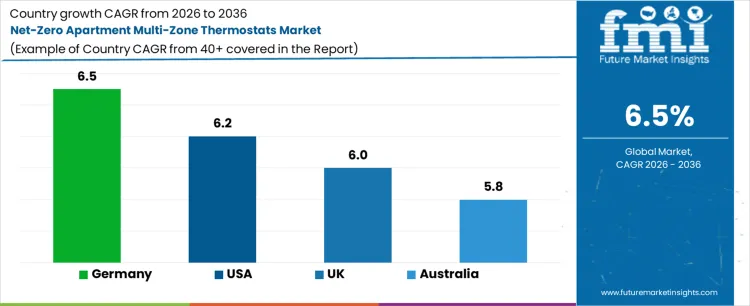
The net-zero apartment multi-zone thermostats market is expanding steadily as residential developers prioritize energy efficiency and precise climate control. Germany leads with a 6.5% CAGR, driven by strict building standards and strong retrofit activity. The USA follows at 6.2%, supported by smart apartment construction and HVAC modernization. The UK grows at 6.0%, benefiting from decarbonization targets and smart heating adoption. Australia expands at 5.8%, driven by urban apartment growth and rising energy costs. As net-zero housing gains traction, demand for multi-zone thermostat solutions is expected to increase across these regions.
What Is Driving the Growth of the Net-Zero Apartment Multi-Zone Thermostats Market in Germany?
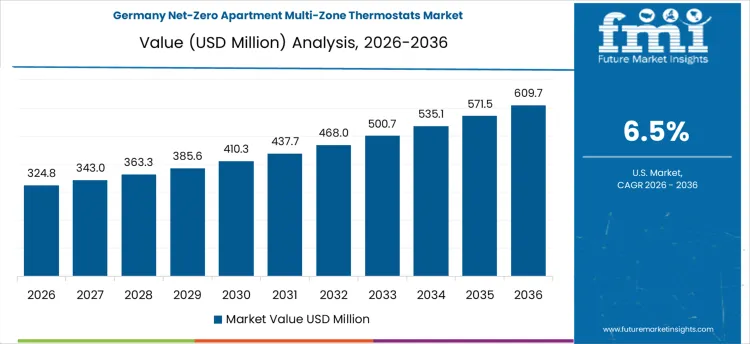
The net-zero apartment multi-zone thermostats market in Germany is growing at a CAGR of 6.5%, driven by strong regulatory focus on building energy efficiency and low-carbon residential construction. Germany’s apartment housing sector is increasingly adopting multi-zone thermostat systems to optimize heating control across individual units and shared spaces. These systems enable precise temperature management, reduce energy waste, and support compliance with stringent building performance standards. Rising renovation activity in older apartment buildings is also contributing to demand, as property owners retrofit smart climate control solutions to improve efficiency. Integration with heat pumps and district heating systems further strengthens adoption. In addition, growing awareness among property managers about long-term operating cost reduction is encouraging deployment. As Germany continues to prioritize energy-efficient residential infrastructure, demand for multi-zone thermostat solutions in net-zero apartment developments is expected to grow steadily.
How Is the Net-Zero Apartment Multi-Zone Thermostats Market Expanding in the USA?
The net-zero apartment multi-zone thermostats market in the USA is expanding at a CAGR of 6.2%, supported by increasing construction of energy-efficient apartment buildings and growing interest in smart HVAC controls. Multi-zone thermostat systems are being adopted to manage temperature variability across apartments, reduce energy consumption, and improve tenant comfort. Developers and property owners are increasingly integrating these systems into new net-zero and near-net-zero residential projects. Rising energy costs and utility efficiency programs are further encouraging investment in advanced thermostat technologies. In addition, compatibility with building management systems and IoT-based monitoring platforms is enhancing system value. Retrofitting activity in existing apartment complexes is also supporting market growth. As energy efficiency becomes a central focus in residential construction and operations, demand for multi-zone thermostats is expected to increase across USA apartment developments.
What Is Supporting Growth of the Net-Zero Apartment Multi-Zone Thermostats Market in the UK?
The net-zero apartment multi-zone thermostats market in the UK is growing at a CAGR of 6.0%, driven by national decarbonization targets and rising adoption of smart heating solutions in multi-family housing. Apartment developers are increasingly deploying multi-zone thermostats to improve energy efficiency and enable precise control over individual living spaces. These systems support integration with low-carbon heating technologies such as heat pumps and hybrid systems. Government initiatives promoting energy-efficient residential buildings and retrofit programs are further supporting adoption. In addition, growing tenant demand for comfort control and transparent energy usage is influencing property management decisions. Multi-zone thermostat systems also help landlords optimize heating performance while controlling operating costs. As the UK accelerates its transition toward energy-efficient housing, demand for multi-zone thermostat solutions in apartment buildings is expected to grow steadily.
How Is the Net-Zero Apartment Multi-Zone Thermostats Market Developing in Australia?
The net-zero apartment multi-zone thermostats market in Australia is expanding at a CAGR of 5.8%, supported by rising interest in energy-efficient apartment developments and smart building technologies. Australia’s growing urban population is increasing demand for multi-unit residential buildings that emphasize efficient climate control. Multi-zone thermostat systems help apartment owners manage cooling and heating loads more effectively across different units and zones. High electricity costs and climate variability are encouraging adoption of advanced temperature management solutions. Integration with solar-powered systems and energy monitoring platforms further supports demand. In addition, building codes and sustainability-focused design practices are influencing developers to adopt smarter HVAC controls. As apartment construction continues and energy efficiency becomes a higher priority, demand for multi-zone thermostat systems is expected to rise gradually across Australia.
How Are Companies Competing in the Net-Zero Apartment Multi-Zone Thermostats Market?
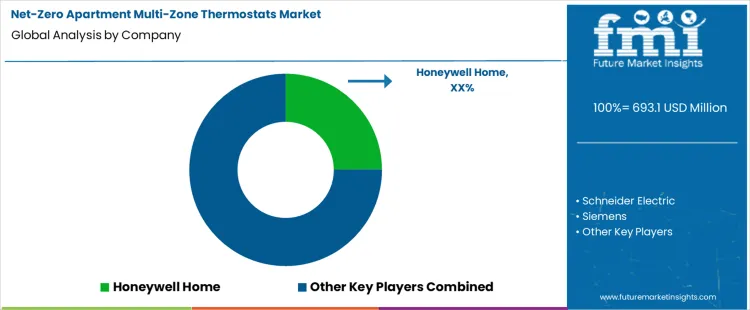
Competition in the net-zero apartment multi-zone thermostats market is driven by energy optimization accuracy, zone-level control intelligence, and seamless integration with building management systems. As multi-family developments pursue net-zero energy targets, demand is rising for thermostats that can coordinate heating and cooling across multiple zones while minimizing energy waste and maintaining occupant comfort. Vendors differentiate through advanced sensing, adaptive algorithms, and cloud-based control platforms that enable real-time optimization at both unit and building levels.
Honeywell Home, Schneider Electric, and Siemens compete through deep HVAC control expertise and enterprise-grade system integration. Honeywell Home emphasizes reliable multi-zone temperature control paired with smart scheduling and learning capabilities tailored for residential apartments. Schneider Electric differentiates by integrating multi-zone thermostats with broader energy management and automation platforms, enabling centralized monitoring and optimization across entire apartment complexes. Siemens leverages its building technologies portfolio to deliver thermostats that integrate tightly with building management systems, supporting predictive control strategies and compliance with stringent energy performance standards.
Johnson Controls, Ecobee, and Tado compete by combining smart thermostat innovation with user-centric design and analytics. Johnson Controls focuses on scalable HVAC control solutions suited to large multi-family buildings, emphasizing reliability and lifecycle support. Ecobee differentiates through intuitive interfaces, occupancy sensing, and AI-driven comfort optimization that reduces unnecessary energy use. Tado competes with app-driven, geofencing-enabled thermostats designed to optimize zone-level control and occupant engagement. Across the market, competitive advantage is shaped by control precision, interoperability with building systems, analytics-driven energy savings, and the ability to support scalable, compliant deployment across multi-family portfolios.
Key Players in Net-Zero Apartment Multi-Zone Thermostats Market
- Honeywell Home
- Schneider Electric
- Siemens
- Johnson Controls
- Ecobee
- Tado
Scope of Report
| Attributes | Description |
|---|---|
| Quantitative Unit (2026) | USD Million |
| Control Type | Smart Zoning Control, Demand-Response Enabled, AI Learning Thermostats, Programmable Smart, BMS-Integrated Nodes |
| Retrofit Method | Wired Retrofit, Wireless Retrofit, Hybrid Retrofit |
| Regions Covered | Asia Pacific, Europe, North America, Latin America, Middle East & Africa |
| Countries Covered | China, Japan, South Korea, India, Australia & New Zealand, ASEAN, Rest of Asia Pacific, Germany, United Kingdom, France, Italy, Spain, Nordic, BENELUX, Rest of Europe, United States, Canada, Mexico, Brazil, Chile, Rest of Latin America, Kingdom of Saudi Arabia, Other GCC Countries, Turkey, South Africa, Other African Union, Rest of Middle East & Africa |
| Key Companies Profiled | Honeywell Home, Schneider Electric, Siemens, Johnson Controls, Ecobee, Tado |
| Additional Attributes | Dollar sales by control type and retrofit method; regional market size and forecast analysis; growth outlook across major regions; adoption trends for multi-zone thermostat systems in net-zero apartment buildings; assessment of demand drivers linked to energy efficiency mandates, retrofit feasibility, BMS integration intensity, and resident comfort optimization. |
Net-Zero Apartment Multi-Zone Thermostats Market by Key Segments
Control Type
- Smart zoning control
- Demand-response enabled
- AI learning thermostats
- Programmable smart
- BMS-integrated nodes
Retrofit Method
- Wired retrofit
- Wireless retrofit
- Hybrid retrofit
Region
- Asia Pacific
- China
- Japan
- South Korea
- India
- Australia & New Zealand
- ASEAN
- Rest of Asia Pacific
- Europe
- Germany
- United Kingdom
- France
- Italy
- Spain
- Nordic
- BENELUX
- Rest of Europe
- North America
- United States
- Canada
- Mexico
- Latin America
- Brazil
- Chile
- Rest of Latin America
- Middle East & Africa
- Kingdom of Saudi Arabia
- Other GCC Countries
- Turkey
- South Africa
- Other African Union
- Rest of Middle East & Africa
Bibliography
- European Parliament and Council of the European Union. (2024). Directive (EU) 2024/1275 on the energy performance of buildings (recast). EUR-Lex / Official Journal of the European Union.
- UK Government. (2023). Explanatory Memorandum to the Product Security and Telecommunications Infrastructure (Security Requirements for Relevant Connectable Products) Regulations 2023 (UKSI 2023/1007). The National Archives (legislation.gov.uk).
- Federal Communications Commission. (2024). Cyber Trust Mark Program: Report and Order and Further Notice of Proposed Rulemaking (FCC 24-26). Federal Communications Commission.
- European Commission. (2025). Commission Implementing Decision on harmonised standards in support of the Radio Equipment Directive (2014/53/EU), including the EN 18031 cybersecurity standards series (consolidated text reflecting 2025 amendments). EUR-Lex / Official Journal of the European Union.
Frequently Asked Questions
How big is the net-zero apartment multi-zone thermostats market in 2026?
The global net-zero apartment multi-zone thermostats market is estimated to be valued at USD 693.1 million in 2026.
What will be the size of net-zero apartment multi-zone thermostats market in 2036?
The market size for the net-zero apartment multi-zone thermostats market is projected to reach USD 1,301.0 million by 2036.
How much will be the net-zero apartment multi-zone thermostats market growth between 2026 and 2036?
The net-zero apartment multi-zone thermostats market is expected to grow at a 6.5% CAGR between 2026 and 2036.
What are the key product types in the net-zero apartment multi-zone thermostats market?
The key product types in net-zero apartment multi-zone thermostats market are smart zoning control, demand-response enabled, ai learning thermostats, programmable smart and bms-integrated nodes.
Which retrofit method segment to contribute significant share in the net-zero apartment multi-zone thermostats market in 2026?
In terms of retrofit method, wired retrofit segment to command 46.0% share in the net-zero apartment multi-zone thermostats market in 2026.
Preview the report firsthand - request a free sample
Get SampleGet the brochure for pricing and purchase details.
Get PDFTable of Content
- Executive Summary
- Global Market Outlook
- Demand-side Trends
- Supply-side Trends
- Technology Roadmap Analysis
- Analysis and Recommendations
- Market Overview
- Market Coverage / Taxonomy
- Market Definition / Scope / Limitations
- Market Background
- Market Dynamics
- Drivers
- Restraints
- Opportunity
- Trends
- Scenario Forecast
- Demand in Optimistic Scenario
- Demand in Likely Scenario
- Demand in Conservative Scenario
- Opportunity Map Analysis
- Product Life Cycle Analysis
- Supply Chain Analysis
- Investment Feasibility Matrix
- Value Chain Analysis
- PESTLE and Porter’s Analysis
- Regulatory Landscape
- Regional Parent Market Outlook
- Production and Consumption Statistics
- Import and Export Statistics
- Market Dynamics
- Global Market Analysis 2021 to 2025 and Forecast, 2026 to 2036
- Historical Market Size Value (USD Million) Analysis, 2021 to 2025
- Current and Future Market Size Value (USD Million) Projections, 2026 to 2036
- Y-o-Y Growth Trend Analysis
- Absolute $ Opportunity Analysis
- Global Market Pricing Analysis 2021 to 2025 and Forecast 2026 to 2036
- Global Market Analysis 2021 to 2025 and Forecast 2026 to 2036, By Control Type
- Introduction / Key Findings
- Historical Market Size Value (USD Million) Analysis By Control Type , 2021 to 2025
- Current and Future Market Size Value (USD Million) Analysis and Forecast By Control Type , 2026 to 2036
- Smart zoning control
- Demand-response enabled
- AI learning thermostats
- Programmable smart
- BMS-integrated nodes
- Smart zoning control
- Y-o-Y Growth Trend Analysis By Control Type , 2021 to 2025
- Absolute $ Opportunity Analysis By Control Type , 2026 to 2036
- Global Market Analysis 2021 to 2025 and Forecast 2026 to 2036, By Retrofit Method
- Introduction / Key Findings
- Historical Market Size Value (USD Million) Analysis By Retrofit Method, 2021 to 2025
- Current and Future Market Size Value (USD Million) Analysis and Forecast By Retrofit Method, 2026 to 2036
- Wired retrofit
- Wireless retrofit
- Hybrid retrofit
- Wired retrofit
- Y-o-Y Growth Trend Analysis By Retrofit Method, 2021 to 2025
- Absolute $ Opportunity Analysis By Retrofit Method, 2026 to 2036
- Global Market Analysis 2021 to 2025 and Forecast 2026 to 2036, By Region
- Introduction
- Historical Market Size Value (USD Million) Analysis By Region, 2021 to 2025
- Current Market Size Value (USD Million) Analysis and Forecast By Region, 2026 to 2036
- North America
- Latin America
- Western Europe
- Eastern Europe
- East Asia
- South Asia and Pacific
- Middle East & Africa
- Market Attractiveness Analysis By Region
- North America Market Analysis 2021 to 2025 and Forecast 2026 to 2036, By Country
- Historical Market Size Value (USD Million) Trend Analysis By Market Taxonomy, 2021 to 2025
- Market Size Value (USD Million) Forecast By Market Taxonomy, 2026 to 2036
- By Country
- USA
- Canada
- Mexico
- By Control Type
- By Retrofit Method
- By Country
- Market Attractiveness Analysis
- By Country
- By Control Type
- By Retrofit Method
- Key Takeaways
- Latin America Market Analysis 2021 to 2025 and Forecast 2026 to 2036, By Country
- Historical Market Size Value (USD Million) Trend Analysis By Market Taxonomy, 2021 to 2025
- Market Size Value (USD Million) Forecast By Market Taxonomy, 2026 to 2036
- By Country
- Brazil
- Chile
- Rest of Latin America
- By Control Type
- By Retrofit Method
- By Country
- Market Attractiveness Analysis
- By Country
- By Control Type
- By Retrofit Method
- Key Takeaways
- Western Europe Market Analysis 2021 to 2025 and Forecast 2026 to 2036, By Country
- Historical Market Size Value (USD Million) Trend Analysis By Market Taxonomy, 2021 to 2025
- Market Size Value (USD Million) Forecast By Market Taxonomy, 2026 to 2036
- By Country
- Germany
- UK
- Italy
- Spain
- France
- Nordic
- BENELUX
- Rest of Western Europe
- By Control Type
- By Retrofit Method
- By Country
- Market Attractiveness Analysis
- By Country
- By Control Type
- By Retrofit Method
- Key Takeaways
- Eastern Europe Market Analysis 2021 to 2025 and Forecast 2026 to 2036, By Country
- Historical Market Size Value (USD Million) Trend Analysis By Market Taxonomy, 2021 to 2025
- Market Size Value (USD Million) Forecast By Market Taxonomy, 2026 to 2036
- By Country
- Russia
- Poland
- Hungary
- Balkan & Baltic
- Rest of Eastern Europe
- By Control Type
- By Retrofit Method
- By Country
- Market Attractiveness Analysis
- By Country
- By Control Type
- By Retrofit Method
- Key Takeaways
- East Asia Market Analysis 2021 to 2025 and Forecast 2026 to 2036, By Country
- Historical Market Size Value (USD Million) Trend Analysis By Market Taxonomy, 2021 to 2025
- Market Size Value (USD Million) Forecast By Market Taxonomy, 2026 to 2036
- By Country
- China
- Japan
- South Korea
- By Control Type
- By Retrofit Method
- By Country
- Market Attractiveness Analysis
- By Country
- By Control Type
- By Retrofit Method
- Key Takeaways
- South Asia and Pacific Market Analysis 2021 to 2025 and Forecast 2026 to 2036, By Country
- Historical Market Size Value (USD Million) Trend Analysis By Market Taxonomy, 2021 to 2025
- Market Size Value (USD Million) Forecast By Market Taxonomy, 2026 to 2036
- By Country
- India
- ASEAN
- Australia & New Zealand
- Rest of South Asia and Pacific
- By Control Type
- By Retrofit Method
- By Country
- Market Attractiveness Analysis
- By Country
- By Control Type
- By Retrofit Method
- Key Takeaways
- Middle East & Africa Market Analysis 2021 to 2025 and Forecast 2026 to 2036, By Country
- Historical Market Size Value (USD Million) Trend Analysis By Market Taxonomy, 2021 to 2025
- Market Size Value (USD Million) Forecast By Market Taxonomy, 2026 to 2036
- By Country
- Kingdom of Saudi Arabia
- Other GCC Countries
- Turkiye
- South Africa
- Other African Union
- Rest of Middle East & Africa
- By Control Type
- By Retrofit Method
- By Country
- Market Attractiveness Analysis
- By Country
- By Control Type
- By Retrofit Method
- Key Takeaways
- Key Countries Market Analysis
- USA
- Pricing Analysis
- Market Share Analysis, 2025
- By Control Type
- By Retrofit Method
- Canada
- Pricing Analysis
- Market Share Analysis, 2025
- By Control Type
- By Retrofit Method
- Mexico
- Pricing Analysis
- Market Share Analysis, 2025
- By Control Type
- By Retrofit Method
- Brazil
- Pricing Analysis
- Market Share Analysis, 2025
- By Control Type
- By Retrofit Method
- Chile
- Pricing Analysis
- Market Share Analysis, 2025
- By Control Type
- By Retrofit Method
- Germany
- Pricing Analysis
- Market Share Analysis, 2025
- By Control Type
- By Retrofit Method
- UK
- Pricing Analysis
- Market Share Analysis, 2025
- By Control Type
- By Retrofit Method
- Italy
- Pricing Analysis
- Market Share Analysis, 2025
- By Control Type
- By Retrofit Method
- Spain
- Pricing Analysis
- Market Share Analysis, 2025
- By Control Type
- By Retrofit Method
- France
- Pricing Analysis
- Market Share Analysis, 2025
- By Control Type
- By Retrofit Method
- India
- Pricing Analysis
- Market Share Analysis, 2025
- By Control Type
- By Retrofit Method
- ASEAN
- Pricing Analysis
- Market Share Analysis, 2025
- By Control Type
- By Retrofit Method
- Australia & New Zealand
- Pricing Analysis
- Market Share Analysis, 2025
- By Control Type
- By Retrofit Method
- China
- Pricing Analysis
- Market Share Analysis, 2025
- By Control Type
- By Retrofit Method
- Japan
- Pricing Analysis
- Market Share Analysis, 2025
- By Control Type
- By Retrofit Method
- South Korea
- Pricing Analysis
- Market Share Analysis, 2025
- By Control Type
- By Retrofit Method
- Russia
- Pricing Analysis
- Market Share Analysis, 2025
- By Control Type
- By Retrofit Method
- Poland
- Pricing Analysis
- Market Share Analysis, 2025
- By Control Type
- By Retrofit Method
- Hungary
- Pricing Analysis
- Market Share Analysis, 2025
- By Control Type
- By Retrofit Method
- Kingdom of Saudi Arabia
- Pricing Analysis
- Market Share Analysis, 2025
- By Control Type
- By Retrofit Method
- Turkiye
- Pricing Analysis
- Market Share Analysis, 2025
- By Control Type
- By Retrofit Method
- South Africa
- Pricing Analysis
- Market Share Analysis, 2025
- By Control Type
- By Retrofit Method
- USA
- Market Structure Analysis
- Competition Dashboard
- Competition Benchmarking
- Market Share Analysis of Top Players
- By Regional
- By Control Type
- By Retrofit Method
- Competition Analysis
- Competition Deep Dive
- Honeywell Home
- Overview
- Product Portfolio
- Profitability by Market Segments (Product/Age /Sales Channel/Region)
- Sales Footprint
- Strategy Overview
- Marketing Strategy
- Product Strategy
- Channel Strategy
- Schneider Electric
- Siemens
- Johnson Controls
- Ecobee
- Tado
- Honeywell Home
- Competition Deep Dive
- Assumptions & Acronyms Used
- Research Methodology


