

- Industry Size (2026)
- USD 4.4 Bn
- Forecast (2036)
- USD 44.5 Bn
- CAGR (2026 to 2036)
- 25.9%
Climate Tech Outlook in the UK 2026 to 2036
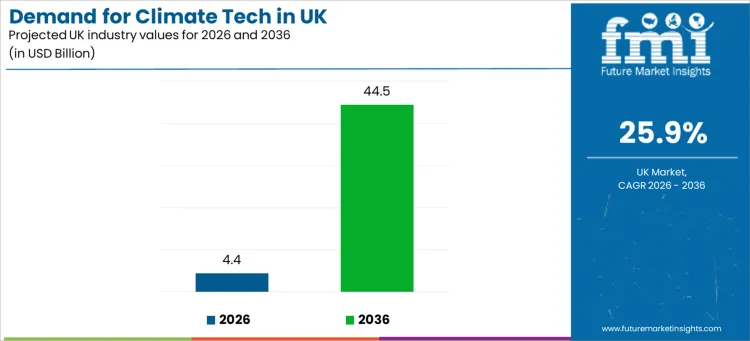
Demand for climate tech in the UK is projected at USD 4.4 billion in 2026 and is expected to reach USD 44.5 billion by 2036, expanding at a 25.9% CAGR. This surge reflects a shift from pilot-driven adoption to system-scale deployment across power generation, grid operations, industrial decarbonisation, circular economy infrastructure, and enterprise-level emissions governance.
In executive decision-making, climate tech is increasingly treated as operational infrastructure. Utilities prioritise uptime, dispatch predictability, and network resilience. Enterprises focus on energy cost exposure, carbon reporting credibility, and site-level efficiency.
Industrial leaders evaluate the pathway to cleaner production without compromising reliability and throughput. Technology service providers and integrators are positioned at the center of this demand curve because delivery success depends on interconnection readiness, data fidelity, cybersecurity alignment, and systems integration.
UK institutions are also moving into delivery mode. The Climate Change Committee’s 2024 report to Parliament emphasises that the UK should be in a phase of rapid investment and delivery, with many indicators for low-carbon rollout needing to ramp up. This creates a practical pull for hardware that decarbonises physical systems and software that makes those systems measurable, controllable, and auditable.
Quick Stats for Climate Tech Demand in the UK
- Climate Tech Valuation in the UK (2026): USD 4.4 billion
- Climate Tech Forecast Valuation in the UK (2036): USD 44.5 billion
- Climate Tech Forecast CAGR 2026 to 2036: 25.9%
- Leading Regional Growth: England (28.5%)
- Leading Hardware Segment: Renewable Energy Devices (21.4% share)
- Leading Software Segment: Renewable Energy Management (26.1% share)
- Leading End User Segment: Utilities & Energy Providers (26.6% share)
- Key Companies Profiled: Tesla, Inc.; Siemens AG; Schneider Electric; General Electric (GE); Vestas Wind Systems
Climate Tech Industry in the UK Key Takeaways
| Metric | Value |
|---|---|
| Industry Value (2026) | USD 4.4 billion |
| Industry Forecast Value (2036) | USD 44.5 billion |
| Forecast CAGR (2026 to 2036) | 25.9% |
Why is the UK Accelerating Demand for Climate Tech?
The UK is scaling climate tech because decarbonisation has become a delivery requirement, not a vision statement. The legal basis for a net-zero 2050 target was strengthened through the Climate Change Act 2008 (2050 Target Amendment) Order 2019, raising the 2050 target to a 100% reduction from the 1990 baseline. This pushes capital allocation toward technologies that cut emissions while keeping energy systems secure, affordable, and operationally stable.
Government policy also supports investment pathways. The Department for Energy Security and Net Zero’s Powering Up Britain: Net Zero Growth Plan sets out steps intended to support energy independence and a low-carbon energy system. For technology executives, this reinforces a theme: major upgrades in generation, networks, flexibility, and industrial decarbonisation are expected to proceed in parallel.
Enterprise adoption is rising because disclosure and operational governance are tightening. UK government guidance on environmental reporting includes Streamlined Energy and Carbon Reporting requirements, supporting consistent approaches to energy and emissions reporting across qualifying organisations. This builds demand for carbon accounting platforms, monitoring tools, and auditable data pipelines.
Strategy teams spreading investments across decarbonisation levers often align planning with climate tech positioning, then connect grid modernisation priorities to smart grid infrastructure when forecasting network readiness for electrification.
How is Climate Tech Demand Segmented by Hardware, Software, and End User Segment?
The segment structure in the climate tech industry in UK reflects how physical decarbonisation assets are deployed, how digital control layers are built, and which stakeholder groups hold the largest spending authority.
Why are renewable energy devices setting the pace for hardware-led deployment cycles?
Renewable energy devices hold a 21.4% share, making them the leading hardware segment. The driving factor is scale. Utilities and developers are expanding low-carbon generation assets while aligning project delivery with grid connection constraints, system balancing requirements, and long-term operating economics. Hardware selection is evaluated through reliability, servicing model strength, and expected performance under UK operating conditions.
Energy storage systems hold 19.4% share, reflecting how grid operators and asset owners value stability as variable generation increases. Storage enables load shifting, frequency response, and improved dispatch control when renewable supply is intermittent. Waste management and recycling technologies account for 17.7% share, showing that climate infrastructure includes circularity systems, not only energy.
Carbon capture and storage (CCS) technologies account for 16.2% share, tied to heavy industry needs and cluster-based infrastructure buildout. Building and construction technologies hold 15.5% share, driven by retrofit pathways, building performance upgrades, and site-level efficiency improvements.
Project teams calibrating investment logic across these pathways frequently coordinate generation and storage planning through energy storage systems while matching clean power expansion approaches to renewable energy.
What makes renewable energy management the most purchased software layer across decarbonisation programs?
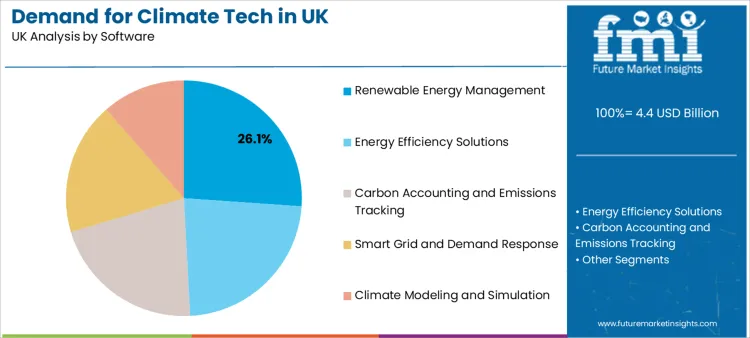
Renewable energy management leads software demand with a 26.1% share. As renewable capacity expands, operational teams need forecasting, dispatch support, asset performance monitoring, and maintenance optimisation. Digital systems that increase predictability reduce curtailment risk and improve revenue stability across operating portfolios.
Energy efficiency solutions represent 21.4% share, reflecting enterprise focus on direct cost savings and energy intensity reduction. Carbon accounting and emissions tracking hold 19.8% share, supported by the requirement for credible measurement, reporting, and decision-grade governance. Smart grid and demand response accounts for 17.3% share, reflecting growing demand flexibility requirements.
Ofgem’s guidance on demand connections highlights a sharp rise in demand connection applications since November 2024, far exceeding ambitious forecasts, creating urgency in connection readiness and network planning. Software that helps manage flexibility, connections, and capacity planning becomes a core enabler in this environment.
Climate modeling and simulation holds a 15.4% share, supporting scenario planning, operational resilience, and investment sequencing for both infrastructure owners and research-backed innovation programs. Many stakeholders balancing operational control with carbon governance extend platform strategy through carbon accounting tools and enterprise energy optimisation through energy management systems.
Why do utilities and energy providers command the largest share of climate tech spending authority?
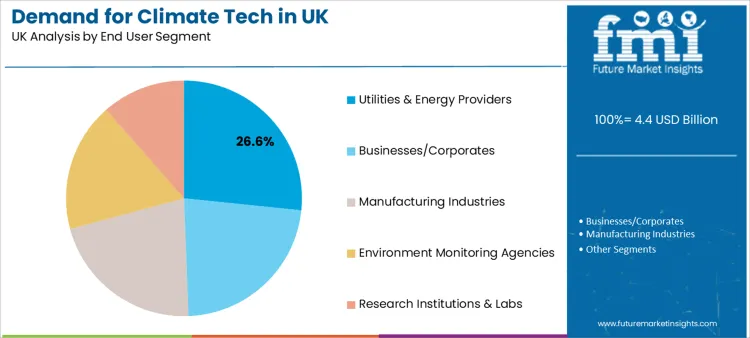
Utilities and energy providers represent a 26.6% share, making them the leading end user segment. They sit at the center of electrification, grid resilience, renewable integration, and demand flexibility. Their investments cascade across the broader economy by enabling connections for industrial sites, data centers, EV infrastructure, and heating electrification.
Businesses and corporates hold a 21.7% share, driven by energy costs, carbon disclosure expectations, and customer-facing sustainability commitments. Manufacturing industries account for 17.6% share, reflecting heavy energy use and the need for efficiency, process decarbonisation, and emissions control.
Environment monitoring agencies hold 13.5% share, anchored in measurement requirements and compliance oversight. Research institutions and labs hold 10.8% share, strengthening innovation pathways and field validation of next-generation solutions.
Digital demand flexibility is gaining attention across end users. The UK government’s smart metering policy framework notes that smart meters support access to the demand flexibility service and optional smart tariffs that reward flexible electricity use. This creates demand for software layers that coordinate signals, incentives, and device-level response.
What are the Dynamics, Restraints, Opportunities, and Threats Shaping this Space?
What dynamics are driving rapid scaling across the UK?
Policy, infrastructure urgency, and operational economics are pushing adoption. The CCC highlights the need for rapid investment and delivery, signalling that deployment pace must increase across multiple sectors. Net-zero obligations provide the long-term direction, anchored in the 2019 amendment to the Climate Change Act target.
Grid connection pressure is another major driver. Ofgem notes a sharp rise in demand connection applications since November 2024, creating a practical need for network readiness, flexibility tools, and planning discipline.
What restraints can slow delivery even when budgets are available?
Interconnection delays, supply chain constraints, and planning approvals can slow hardware deployment. Skills and integration capacity can slow software rollouts, especially when legacy systems require careful change management. Data quality and reporting consistency can also limit platform adoption if emissions and energy data are not decision-grade.
Where are the strongest opportunities for stakeholders?
- Grid flexibility and demand response: Smart metering policy and year-round flexibility services increase the relevance of demand-side tools and consumer-led flexibility integration.
- Enterprise carbon governance: SECR-aligned reporting expectations strengthen demand for emissions tracking, auditable reporting, and governance workflows.
- Industrial decarbonisation pathways: CCS deployment and efficiency retrofits strengthen demand for engineering, monitoring, and operational control.
Investment teams building technology roadmaps often pair grid modernisation with smart grid deployment priorities smart grid deployment priorities and connect emissions governance layers to carbon accounting software adoption when ensuring reporting and performance control are designed together.
What threats could disrupt scaling momentum?
Policy uncertainty can delay investment decisions. Delivery risk increases when connection lead times extend and when supply bottlenecks limit equipment availability. Cybersecurity risk also rises as more assets become connected and remotely controllable. A final threat is stakeholder trust erosion if reporting outcomes are questioned due to weak data governance.
How is Climate Tech Demand Evolving across Key Regions in the UK?
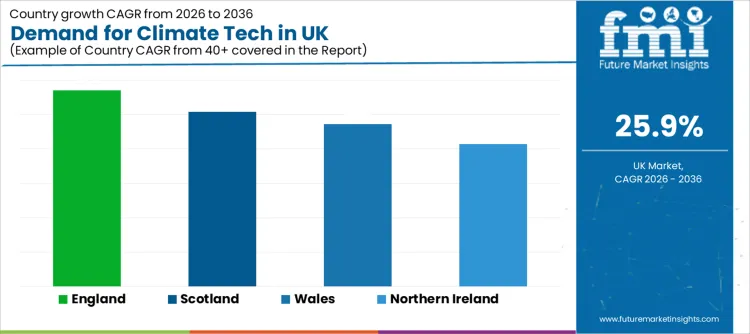
| Region | CAGR 2026 to 2036 |
|---|---|
| England | 28.5% |
| Scotland | 25.4% |
| Wales | 23.6% |
| Northern Ireland | 20.7% |
Why is England expanding fastest through grid upgrades and enterprise-led deployment scale?
England grows at 28.5%, supported by higher density of demand connection requests, larger-scale electrification programs, and stronger concentration of enterprise decarbonisation investment. Grid planning intensity increases demand for smart grid software, demand response, and asset management systems that support faster operational control.
How is Scotland advancing through clean power leadership and system integration needs?
Scotland expands at 25.4%, supported by clean energy ambitions and a strong pull for renewable asset optimisation. Demand strengthens for renewable energy management platforms, grid stability tools, and storage integration pathways that improve reliability and dispatch performance.
What is driving Wales toward high-impact efficiency solutions and industrial decarbonisation upgrades?
Wales grows at 23.6%, driven by corporates prioritising energy efficiency solutions and manufacturing operations strengthening emissions reduction programs. Investment tends to focus on solutions with measurable cost impact and clear operational performance improvements.
Why is Northern Ireland building demand through targeted investments and measured rollout discipline?
Northern Ireland rises at 20.7%, shaped by staged deployment where programs prioritise proven technologies, manageable integration complexity, and stable vendor support. Demand builds steadily for carbon tracking tools, monitoring systems, and infrastructure upgrades tied to practical delivery capacity.
What Defines the Competitive Landscape for Climate Tech in the UK?
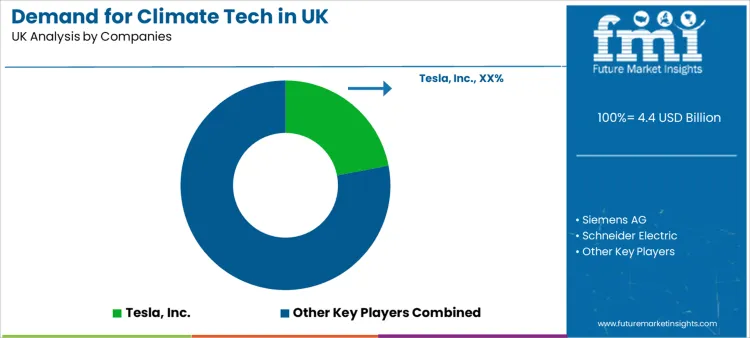
Competition is shaped by delivery credibility, integration strength, and lifecycle support. Buyers increasingly look for providers that can deliver end-to-end results across hardware, software, commissioning, and ongoing optimisation. Performance guarantees, service availability, cybersecurity alignment, and interoperability define purchasing confidence.
Tesla, Inc. competes strongly in energy storage and distributed energy integration themes. Siemens AG and Schneider Electric are positioned across industrial automation, energy efficiency platforms, and grid-facing solutions. General Electric (GE) competes through infrastructure-grade engineering capabilities and asset-focused systems. Vestas Wind Systems is closely associated with renewable generation supply and performance optimisation priorities.
For CEOs and investment teams, vendor selection trends toward partners that can integrate data from multiple asset types, support operational analytics, and help organisations demonstrate measurable progress under reporting requirements and regulatory scrutiny.
Key Industry Participants
- Tesla, Inc.
- Siemens AG
- Schneider Electric
- General Electric (GE)
- Vestas Wind Systems
Scope of Report
| Items | Values |
|---|---|
| Quantitative Units | USD Billion |
| Hardware | Renewable Energy Devices; Energy Storage Systems; Waste Management and Recycling Technologies; Carbon Capture and Storage (CCS) Technologies; Building and Construction Technologies |
| Software | Renewable Energy Management; Energy Efficiency Solutions; Carbon Accounting and Emissions Tracking; Smart Grid and Demand Response; Climate Modeling and Simulation |
| End User Segment | Utilities & Energy Providers; Businesses/Corporates; Manufacturing Industries; Environment Monitoring Agencies; Research Institutions & Labs |
| Regions Covered | England; Scotland; Wales; Northern Ireland |
| Key Companies Profiled | Tesla, Inc.; Siemens AG; Schneider Electric; General Electric (GE); Vestas Wind Systems |
Climate Tech Demand in the UK by Segment
By Hardware:
- Renewable Energy Devices
- Energy Storage Systems
- Waste Management and Recycling Technologies
- Carbon Capture and Storage (CCS) Technologies
- Building and Construction Technologies
By Software:
- Renewable Energy Management
- Energy Efficiency Solutions
- Carbon Accounting and Emissions Tracking
- Smart Grid and Demand Response
- Climate Modeling and Simulation
By End User Segment:
- Utilities & Energy Providers
- Businesses/Corporates
- Manufacturing Industries
- Environment Monitoring Agencies
- Research Institutions & Labs
By Region:
- England
- Scotland
- Wales
- Northern Ireland
Bibliography
- Climate Change Committee. (2024). Progress in reducing emissions: 2024 report to Parliament.
- Department for Energy Security and Net Zero. (2023). Powering Up Britain: The Net Zero Growth Plan.
- HM Government. (2019). The Climate Change Act 2008 (2050 Target Amendment) Order 2019.
- Office of Gas and Electricity Markets. (2025). Demand connections update.
- UK Government. (2019). Environmental reporting guidelines: including Streamlined Energy and Carbon Reporting requirements.
- UK Government. (2025). Smart metering policy framework post 2025: Consultation document.
- National Energy System Operator. (n.d.). Demand Flexibility Service (DFS).
Frequently Asked Questions
How big is the demand for climate tech in uk in 2026?
The demand for climate tech in uk is estimated to be valued at USD 4.4 billion in 2026.
What will be the size of climate tech in uk in 2036?
The market size for the climate tech in uk is projected to reach USD 44.5 billion by 2036.
How much will be the demand for climate tech in uk growth between 2026 and 2036?
The demand for climate tech in uk is expected to grow at a 25.9% CAGR between 2026 and 2036.
What are the key product types in the climate tech in uk?
The key product types in climate tech in uk are renewable energy devices, energy storage systems, waste management and recycling technologies, carbon capture and storage (ccs) technologies and building and construction technologies.
Which software segment is expected to contribute significant share in the climate tech in uk in 2026?
In terms of software, renewable energy management segment is expected to command 26.1% share in the climate tech in uk in 2026.
Preview the report firsthand - request a free sample
Get SampleGet the brochure for pricing and purchase details.
Get PDFTable of Content
- Executive Summary
- UK Market Outlook
- Demand-side Trends
- Supply-side Trends
- Technology Roadmap Analysis
- Analysis and Recommendations
- Market Overview
- Market Coverage / Taxonomy
- Market Definition / Scope / Limitations
- Market Background
- Market Dynamics
- Drivers
- Restraints
- Opportunity
- Trends
- Scenario Forecast
- Demand in Optimistic Scenario
- Demand in Likely Scenario
- Demand in Conservative Scenario
- Opportunity Map Analysis
- Product Life Cycle Analysis
- Supply Chain Analysis
- Investment Feasibility Matrix
- Value Chain Analysis
- PESTLE and Porter’s Analysis
- Regulatory Landscape
- Regional Parent Market Outlook
- Production and Consumption Statistics
- Import and Export Statistics
- Market Dynamics
- UK Market Analysis 2021 to 2025 and Forecast, 2026 to 2036
- Historical Market Size Value (USD Million) Analysis, 2021 to 2025
- Current and Future Market Size Value (USD Million) Projections, 2026 to 2036
- Y-o-Y Growth Trend Analysis
- Absolute $ Opportunity Analysis
- UK Market Pricing Analysis 2021 to 2025 and Forecast 2026 to 2036
- UK Market Analysis 2021 to 2025 and Forecast 2026 to 2036, By Hardware
- Introduction / Key Findings
- Historical Market Size Value (USD Million) Analysis By Hardware , 2021 to 2025
- Current and Future Market Size Value (USD Million) Analysis and Forecast By Hardware , 2026 to 2036
- Renewable Energy Devices
- Energy Storage Systems
- Waste Management and Recycling Technologies
- Carbon Capture and Storage (CCS) Technologies
- Building and Construction Technologies
- Renewable Energy Devices
- Y-o-Y Growth Trend Analysis By Hardware , 2021 to 2025
- Absolute $ Opportunity Analysis By Hardware , 2026 to 2036
- UK Market Analysis 2021 to 2025 and Forecast 2026 to 2036, By Software
- Introduction / Key Findings
- Historical Market Size Value (USD Million) Analysis By Software, 2021 to 2025
- Current and Future Market Size Value (USD Million) Analysis and Forecast By Software, 2026 to 2036
- Renewable Energy Management
- Energy Efficiency Solutions
- Carbon Accounting and Emissions Tracking
- Smart Grid and Demand Response
- Climate Modeling and Simulation
- Renewable Energy Management
- Y-o-Y Growth Trend Analysis By Software, 2021 to 2025
- Absolute $ Opportunity Analysis By Software, 2026 to 2036
- UK Market Analysis 2021 to 2025 and Forecast 2026 to 2036, By End User Segment
- Introduction / Key Findings
- Historical Market Size Value (USD Million) Analysis By End User Segment, 2021 to 2025
- Current and Future Market Size Value (USD Million) Analysis and Forecast By End User Segment, 2026 to 2036
- Utilities & Energy Providers
- Businesses/Corporates
- Manufacturing Industries
- Environment Monitoring Agencies
- Research Institutions & Labs
- Utilities & Energy Providers
- Y-o-Y Growth Trend Analysis By End User Segment, 2021 to 2025
- Absolute $ Opportunity Analysis By End User Segment, 2026 to 2036
- Market Structure Analysis
- Competition Dashboard
- Competition Benchmarking
- Market Share Analysis of Top Players
- By Regional
- By Hardware
- By Software
- By End User Segment
- Competition Analysis
- Competition Deep Dive
- Tesla, Inc.
- Overview
- Product Portfolio
- Profitability by Market Segments (Product/Age /Sales Channel/Region)
- Sales Footprint
- Strategy Overview
- Marketing Strategy
- Product Strategy
- Channel Strategy
- Siemens AG
- Schneider Electric
- General Electric (GE)
- Vestas Wind Systems
- Tesla, Inc.
- Competition Deep Dive
- Assumptions & Acronyms Used
- Research Methodology


