

- Industry Size (2026)
- USD 2.2 Bn
- Forecast (2036)
- USD 25.1 Bn
- CAGR (2026 to 2036)
- 27.5%
Insurtech Industry Forecast and Outlook in the UK 2026 to 2036
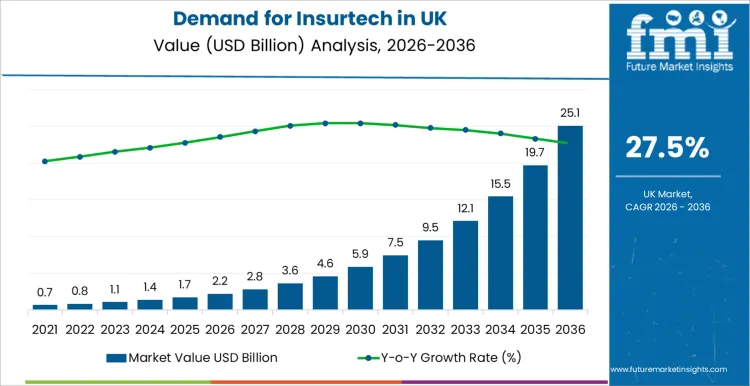
The demand for Insurtech solutions and services in UK is projected to reach a valuation of USD 2.2 billion in 2026. This sector is anticipated to experience explosive, transformative growth, achieving a size of USD 25.1 billion by 2036, advancing at a compound annual growth rate of 27.5%.
This unprecedented expansion is fundamentally anchored in the UK's position as a global leader in both financial services and technological innovation, creating a perfect catalyst for the digital disruption of the traditional insurance landscape. Growth is driven by the urgent need for legacy insurers to modernize, rising consumer demand for personalized and seamless digital experiences, and the entry of agile, tech-native challenger brands.
The critical demand spans core operational modernization, customer engagement transformation, and the creation of entirely new, data-driven insurance products. This creates a dynamic market focused on leveraging artificial intelligence, IoT, and blockchain to optimize pricing, automate claims, prevent fraud, and deliver insurance as a flexible, embedded service within broader digital ecosystems.
Quick Stats for Insurtech Demand in the UK
- Insurtech Sales Valuation in the UK (2026): USD 2.2 billion
- Insurtech Sales Forecast Valuation in the UK (2036): USD 25.1 billion
- Insurtech Industry in the UK Forecast CAGR (2026-2036): 27.5%
- Leading Regional Growth: England (CAGR 30.2%)
- Leading Insurance Type: Health Insurance (32.0%)
- Leading End User: Insurance Companies (39.7%)
- Leading Technology: Artificial Intelligence (40.0%)
- Key Companies Profiled: Entrust, Onfido, IDEMIA, Transmit Security, Secret Double Octopus
Why is the UK a Global Epicenter for Insurtech Demand?
The UK's demand for Insurtech stems from its unparalleled confluence of a deep, mature insurance market, and a world-leading fintech and tech startup ecosystem, particularly in London.
This environment fosters intense collaboration and competition between incumbent insurers and disruptive newcomers. A supportive regulatory approach from bodies like the Financial Conduct Authority (FCA), through its innovation sandbox, allows for the testing of new ideas, accelerating market readiness.
Furthermore, UK consumers are highly digitally literate and exhibit strong demand for transparency, customization, and instant service, pushing the entire industry toward digital-first models. High penetration of smartphones and broadband creates the ideal infrastructure for deploying mobile-centric insurance products and services. The pressing need for efficiency gains and cost reduction within the traditional insurance industry, coupled with opportunities in underserved markets, creates a powerful economic imperative for technological adoption.
How is the Insurtech Landscape Segmented by Insurance Type, End User, and Technology?
The line of business being disrupted, the primary entity deploying the technology, and the core enabling innovation, categorizes this sector. This segmentation reveals a market tackling transformation across the entire insurance value chain, from risk assessment and customer onboarding to claims processing and fraud prevention.
Which Insurance Type is at the Forefront of Digital Adoption?
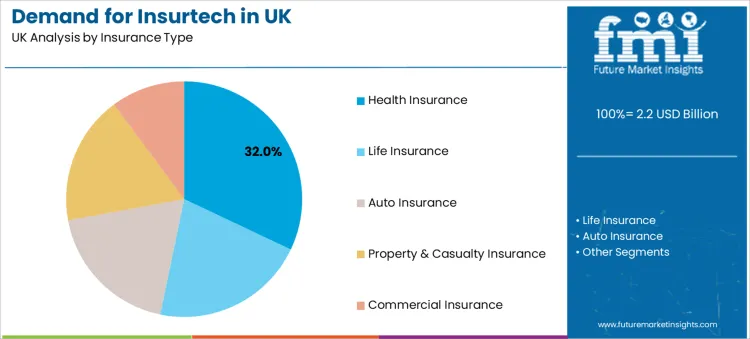
Health insurance holds a significant 32.0% share. Its prominence is driven by the sector's complexity, high frequency of interactions, and the immense potential for wearable IoT data to enable personalized wellness and preventative care policies.
The integration of digital health services, telehealth, and data analytics for risk assessment makes health insurance a primary arena for Insurtech innovation, aimed at improving outcomes and controlling costs.
Which End User is the Primary Engine of Investment?
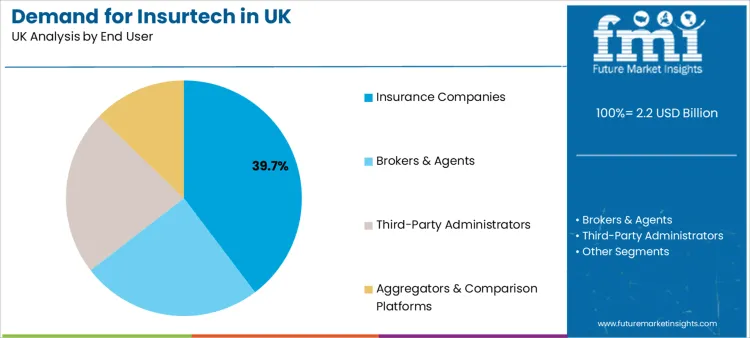
Insurance companies themselves constitute the leading end-user, with a 39.7% share. This reflects the massive internal investment by incumbent carriers in modernizing legacy systems, building digital front-ends, and deploying AI for underwriting and claims automation to remain competitive.
Brokers, agents, and third-party administrators are critical adopters, leveraging technology to enhance their advisory role and operational efficiency, while Aggregators are inherently tech-driven platforms.
Which Technology is the Cornerstone of Innovation?
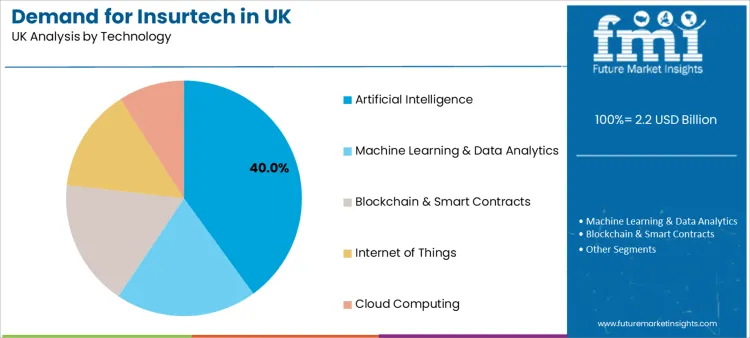
Artificial intelligence commands the leading share among technologies, estimated at 40.0%. AI is the fundamental tool for automating underwriting decisions, powering chatbots for customer service, detecting fraudulent claims patterns, and providing hyper-personalized pricing.
Its dominance underscores that intelligent data processing and automation are the bedrock applications for improving efficiency and accuracy across both legacy insurance companies and new entrants.
What are the Dynamics, Restraints, Opportunities, and Threats Shaping this Sector?
How are Digital Consumer Expectations and Operational Efficiency Driving Exponential Demand?
The primary growth driver is the irreversible shift in consumer behavior, which now demands the same seamless, app-based experience from insurers as they receive from other digital services.
The urgent need for legacy insurers to achieve radical operational efficiency and reduce combined ratios creates a continuous need for process automation and data-driven decision-making. The emergence of embedded insurance opens vast new distribution channels and market volume.
Do Legacy System Integration and Regulatory Compliance Restrain Pace?
A significant restraint is the monumental challenge and cost of integrating new, agile Insurtech solutions with decades-old legacy policy administration and core systems, which can slow implementation. Evolving regulatory frameworks around data privacy (UK GDPR), algorithmic transparency, and fair pricing require careful navigation and can delay product launches. Cybersecurity risks associated with vast new datasets and digital interfaces also necessitate substantial ongoing investment in protection.
How are Parametric Insurance and IoT Telematics Creating New Potential?
Substantial opportunities are emerging from parametric insurance products, which use verifiable data triggers to enable instant, automated payouts, transforming the claims experience.
The proliferation of IoT devices, from telematics in cars to sensors in homes and wearables on individuals, provides a continuous stream of data for dynamic risk assessment and personalized pricing models. Furthermore, blockchain technology offers potential for streamlining complex multi-party transactions in reinsurance and wholesale markets.
What External Factors Could Challenge Sector Growth?
The sector faces threats from economic downturns that could reduce capital available for innovation and depress consumer spending on insurance products. A potential loss of consumer trust due to perceived over-surveillance via IoT data or controversial uses of AI in claims denial could lead to regulatory backlash.
Intense competition could lead to price wars and unsustainable customer acquisition costs. Furthermore, the risk of major cyber-attacks on insurers or their technology partners remains an existential threat.
How is Insurtech Demand Evolving across Key Regions in the UK?
Growth is influenced by the concentration of insurance headquarters, strength of the tech ecosystem, availability of investment capital, and regional regulatory initiatives. The projected compound annual growth rates from 2026 to 2036 illustrate these geographic distinctions.
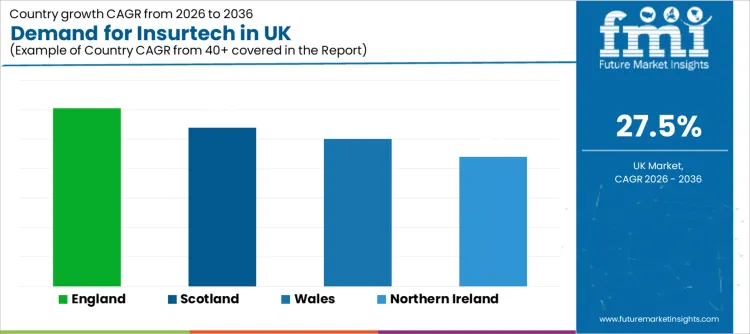
| Region | CAGR (2026 to 2036) |
|---|---|
| England | 30.2% |
| Scotland | 26.9% |
| Wales | 25.0% |
| Northern Ireland | 22.0% |
What is Fuelling Premier Growth in England?
England leads with a projected CAGR of 30.2%. This is overwhelmingly driven by London's status as the historic global insurance capital (Lloyd's of London) and a world-leading fintech hub. This unique collision of industries creates unparalleled demand for Insurtech solutions from both established giants and new MGAs. The concentration of venture capital, specialist talent, and the FCA's headquarters in London makes it the definitive testbed and launchpad for the UK's and Europe's Insurtech innovation.
Why is Scotland a Key Centre for Specialist Insurance and Data Analytics?
Scotland exhibits a very strong CAGR of 26.9%, powered by its significant and specialist insurance sector in Edinburgh, which has deep expertise in areas like life and pensions. This is complemented by world-class university research in data science, informatics, and actuarial studies at institutions like the University of Edinburgh. The region's growing reputation as a technology and financial services center creates a fertile environment for Insurtech development, particularly in data-centric and risk-modeling innovations.
What Factors Underpin Strong Demand in Wales?
Wales shows robust growth with a CAGR of 25.0%. This is fueled by proactive government support for its fintech sector, particularly in Cardiff, and a focus on digital skills development. The presence of major financial services operations centers and a growing community of tech startups provides a strong base for Insurtech adoption and development. Initiatives to modernize public services also create relevant use cases and pilot opportunities for insurance-adjacent technologies.
What Factors Underpin Growth in Northern Ireland?
Northern Ireland, with a projected CAGR of 22.0%, reflects solid growth supported by its strong cybersecurity industry, and a talented software engineering workforce. The region's financial services sector and efforts to attract foreign direct investment in technology contribute to a growing market for digital transformation solutions, including those tailored for insurance operations and regulatory technology (RegTech).
What Defines the Competitive Landscape of the Insurtech Industry?
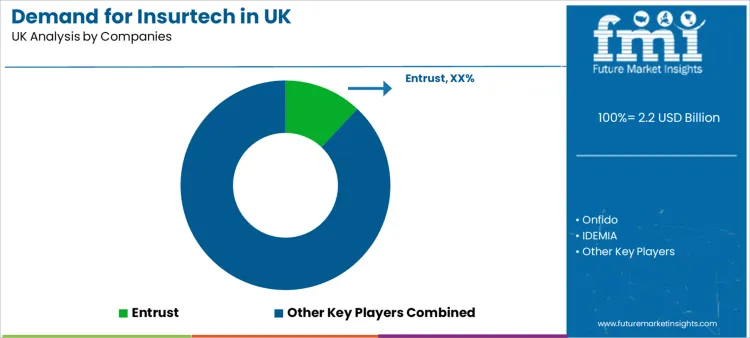
The competitive environment is hyper-dynamic and collaborative, characterized by a complex web of partnerships, investments, and acquisitions between traditional insurers, pure-play Insurtech startups, and broad-based technology vendors. Rivalry is based on technological sophistication, speed to market, quality of user experience, and depth of insurer partnerships.
Success for Insurtech startups depends on securing pilot projects and long-term contracts with established insurers to gain scale and credibility. For incumbents, success hinges on the ability to selectively partner with, invest in, or acquire the most promising technologies and integrate them effectively.
Differentiation is achieved through deep specialization in a niche such as cyber insurance or pet insurance, proprietary algorithms, or mastery of a specific process like claims triage or fraud detection. The competitive landscape is constantly reshaped by the flow of venture capital and strategic corporate investments.
Key Industry Participants
- Entrust
- Onfido
- IDEMIA
- Transmit Security
- Secret Double Octopus
Scope of Report
| Items | Values |
|---|---|
| Quantitative Units | USD Billion |
| Insurance Type | Health Insurance, Life Insurance, Auto Insurance, Property & Casualty Insurance, Commercial Insurance |
| End User | Insurance Companies, Brokers & Agents, Third-Party Administrators, Aggregators & Comparison Platforms |
| Technology | Artificial Intelligence, Machine Learning & Data Analytics, Blockchain & Smart Contracts, Internet of Things, Cloud Computing |
| Regions Covered | England, Scotland, Wales, Northern Ireland |
| Key Companies Profiled | Entrust, Onfido, IDEMIA, Transmit Security, Secret Double Octopus |
Insurtech Demand in the UK by Segment
By Insurance Type:
- Health Insurance
- Life Insurance
- Auto Insurance
- Property & Casualty Insurance
- Commercial Insurance
By End User:
- Insurance Companies
- Brokers & Agents
- Third-Party Administrators
- Aggregators & Comparison Platforms
By Technology:
- Artificial Intelligence
- Machine Learning & Data Analytics
- Blockchain & Smart Contracts
- Internet of Things
- Cloud Computing
By Region:
- England
- Scotland
- Wales
- Northern Ireland
Bibliography
- Financial Conduct Authority (FCA). (2023). Innovation and Regulatory Sandbox Annual Report.
- Association of British Insurers (ABI). (2024). Digital Transformation in UK Insurance.
- UK Insurtech Board. (2023). Market Analysis and Investment Trends.
- Department for Science, Innovation & Technology (DSIT). (2024). UK Fintech Sector Strategy.
- Lloyd's of London. (2023). Future of Insurance Report.
Frequently Asked Questions
How big is the demand for insurtech in uk in 2026?
The demand for insurtech in uk is estimated to be valued at USD 2.2 billion in 2026.
What will be the size of insurtech in uk in 2036?
The market size for the insurtech in uk is projected to reach USD 25.1 billion by 2036.
How much will be the demand for insurtech in uk growth between 2026 and 2036?
The demand for insurtech in uk is expected to grow at a 27.5% CAGR between 2026 and 2036.
What are the key product types in the insurtech in uk?
The key product types in insurtech in uk are health insurance, life insurance, auto insurance, property & casualty insurance and commercial insurance.
Which end user segment is expected to contribute significant share in the insurtech in uk in 2026?
In terms of end user, insurance companies segment is expected to command 39.7% share in the insurtech in uk in 2026.
Preview the report firsthand - request a free sample
Get SampleGet the brochure for pricing and purchase details.
Get PDFTable of Content
- Executive Summary
- UK Market Outlook
- Demand-side Trends
- Supply-side Trends
- Technology Roadmap Analysis
- Analysis and Recommendations
- Market Overview
- Market Coverage / Taxonomy
- Market Definition / Scope / Limitations
- Market Background
- Market Dynamics
- Drivers
- Restraints
- Opportunity
- Trends
- Scenario Forecast
- Demand in Optimistic Scenario
- Demand in Likely Scenario
- Demand in Conservative Scenario
- Opportunity Map Analysis
- Product Life Cycle Analysis
- Supply Chain Analysis
- Investment Feasibility Matrix
- Value Chain Analysis
- PESTLE and Porter’s Analysis
- Regulatory Landscape
- Regional Parent Market Outlook
- Production and Consumption Statistics
- Import and Export Statistics
- Market Dynamics
- UK Market Analysis 2021 to 2025 and Forecast, 2026 to 2036
- Historical Market Size Value (USD Million) Analysis, 2021 to 2025
- Current and Future Market Size Value (USD Million) Projections, 2026 to 2036
- Y-o-Y Growth Trend Analysis
- Absolute $ Opportunity Analysis
- UK Market Pricing Analysis 2021 to 2025 and Forecast 2026 to 2036
- UK Market Analysis 2021 to 2025 and Forecast 2026 to 2036, By Insurance Type
- Introduction / Key Findings
- Historical Market Size Value (USD Million) Analysis By Insurance Type , 2021 to 2025
- Current and Future Market Size Value (USD Million) Analysis and Forecast By Insurance Type , 2026 to 2036
- Health Insurance
- Life Insurance
- Auto Insurance
- Property & Casualty Insurance
- Commercial Insurance
- Health Insurance
- Y-o-Y Growth Trend Analysis By Insurance Type , 2021 to 2025
- Absolute $ Opportunity Analysis By Insurance Type , 2026 to 2036
- UK Market Analysis 2021 to 2025 and Forecast 2026 to 2036, By End User
- Introduction / Key Findings
- Historical Market Size Value (USD Million) Analysis By End User, 2021 to 2025
- Current and Future Market Size Value (USD Million) Analysis and Forecast By End User, 2026 to 2036
- Insurance Companies
- Brokers & Agents
- Third-Party Administrators
- Aggregators & Comparison Platforms
- Insurance Companies
- Y-o-Y Growth Trend Analysis By End User, 2021 to 2025
- Absolute $ Opportunity Analysis By End User, 2026 to 2036
- UK Market Analysis 2021 to 2025 and Forecast 2026 to 2036, By Technology
- Introduction / Key Findings
- Historical Market Size Value (USD Million) Analysis By Technology, 2021 to 2025
- Current and Future Market Size Value (USD Million) Analysis and Forecast By Technology, 2026 to 2036
- Artificial Intelligence
- Machine Learning & Data Analytics
- Blockchain & Smart Contracts
- Internet of Things
- Cloud Computing
- Artificial Intelligence
- Y-o-Y Growth Trend Analysis By Technology, 2021 to 2025
- Absolute $ Opportunity Analysis By Technology, 2026 to 2036
- Market Structure Analysis
- Competition Dashboard
- Competition Benchmarking
- Market Share Analysis of Top Players
- By Regional
- By Insurance Type
- By End User
- By Technology
- Competition Analysis
- Competition Deep Dive
- Entrust
- Overview
- Product Portfolio
- Profitability by Market Segments (Product/Age /Sales Channel/Region)
- Sales Footprint
- Strategy Overview
- Marketing Strategy
- Product Strategy
- Channel Strategy
- Onfido
- IDEMIA
- Transmit Security
- Secret Double Octopus
- Entrust
- Competition Deep Dive
- Assumptions & Acronyms Used
- Research Methodology


