

- Industry Size (2026)
- USD 1.0 Bn
- Forecast (2036)
- USD 4.7 Bn
- CAGR (2026 to 2036)
- 17.3%
Virtual Event Platform Industry Forecast and Outlook in the UK 2026 to 2036
The demand for virtual event platforms in the United Kingdom is projected to reach a valuation of USD 1.0 billion in 2026. This sector is anticipated to experience exceptional growth, achieving a size of USD 4.7 billion by 2036, advancing at a remarkable compound annual growth rate of 17.3%.
This expansion is fundamentally anchored in the permanent structural shift towards hybrid and remote work models, the digital transformation of marketing and corporate communications, and the relentless pursuit of scalable, measurable, and inclusive audience engagement strategies.
The critical need for sophisticated digital event solutions is being driven by the demand for global reach, deep attendee analytics, and significant cost savings compared to traditional in-person events. This creates a dynamic market for platforms that can seamlessly blend live streaming, interactive networking, virtual exhibition halls, and robust data capture to serve corporations, academic institutions, and professional event organizers.
Quick Stats for Virtual Event Platform Demand in the UK
- Virtual Event Platform Industry Valuation in the UK (2026): USD 1.0 billion
- Virtual Event Platform Industry Forecast Valuation in the UK (2036): USD 4.7 billion
- Virtual Event Platform Industry in the UK Forecast CAGR (2026-2036): 17.3%
- Leading Regional Growth: England (CAGR 19.0%)
- Leading Solution: Virtual Event Platforms Software (70.0%)
- Leading Enterprise Size: Medium-sized Enterprises (19.3%)
- Leading End User: Enterprises/Corporates (34.3%)
- Key Companies Profiled: Cisco Systems, Zoom Video Communications Inc., Microsoft Corporation, vFairs, Cvent Inc.
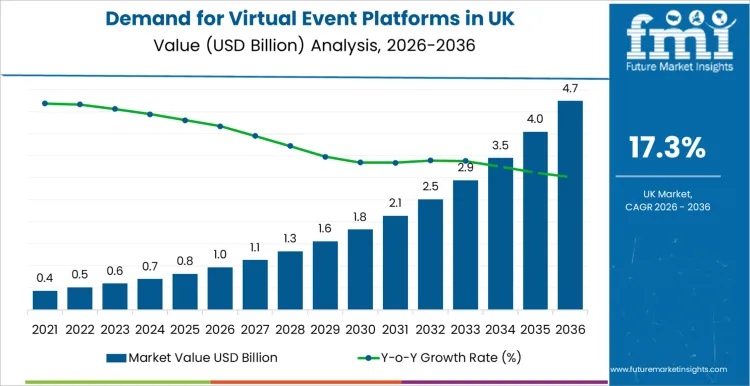
Quick Stats for Virtual Event Platform Demand in the UK
- Virtual Event Platform Industry Valuation in the UK (2026): USD 1.0 billion
- Virtual Event Platform Industry Forecast Valuation in the UK (2036): USD 4.7 billion
- Virtual Event Platform Industry in the UK Forecast CAGR (2026-2036): 17.3%
- Leading Regional Growth: England (CAGR 19.0%)
- Leading Solution: Virtual Event Platforms Software (70.0%)
- Leading Enterprise Size: Medium-sized Enterprises (19.3%)
- Leading End User: Enterprises/Corporates (34.3%)
- Key Companies Profiled: Cisco Systems, Zoom Video Communications Inc., Microsoft Corporation, vFairs, Cvent Inc.
Why is the UK a Sophisticated Hub for Virtual Event Platform Demand?
The UK's demand for virtual event platforms stems from its position as a global hub for finance, professional services, technology, and academia. London is a natural epicenter for international conferences, product launches, and shareholder meetings, all of which have irreversibly adopted a digital-first or hybrid component. The nation's high concentration of multinational corporation headquarters, world-class universities, and innovative marketing agencies creates a dense cluster of early adopters and power users.
The UK's strong digital infrastructure and high internet penetration enable the reliable, high-quality streaming required for premium virtual experiences. The competitive business landscape pushes organizations to leverage virtual events for lead generation, employer branding, and continuous professional development, ensuring that investment in this technology is viewed as a critical component of growth strategy and audience engagement.
How is the Virtual Event Platform Landscape Segmented by Solution, Enterprise Size, and End User?
This sector is categorized by the core offering, the size of the purchasing organization, and the industry of the primary user. This segmentation reveals a market where scalable software is paramount, and adoption is widespread across organizations of all sizes, tailored to solve distinct challenges from internal all-hands meetings to large-scale public trade shows.
Which Solution Type Forms the Foundation of the Market?
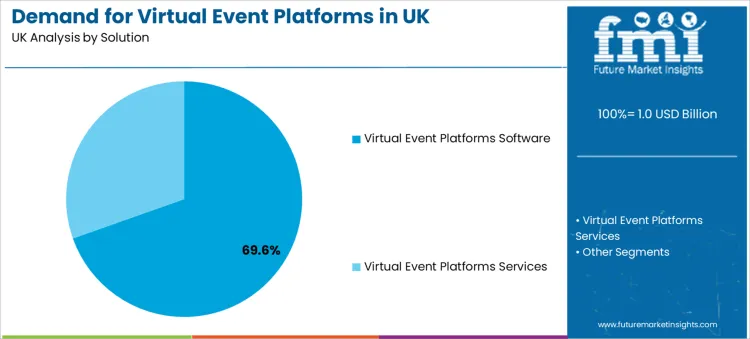
Virtual event platforms software holds a dominant 70.0% share. This core technology encompasses the applications for event creation, registration, hosting, networking, and analytics.
Its prominence is driven by the need for a centralized, scalable, and brandable technological foundation to execute digital events. The associated services segment, including implementation, support, and event production, remains crucial for success but orbits this essential software core.
Which Enterprise Size is Most Active in Adoption?
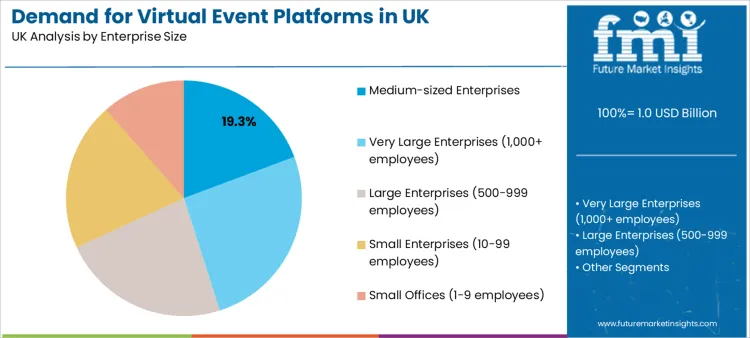
Medium-sized enterprises represent the leading segment among enterprise sizes, with a 19.3% share. These organizations are large enough to have significant audience engagement needs and dedicated marketing budgets but are often more agile than very large enterprises, allowing for quicker adoption of new technologies to compete effectively. The market also sees strong, fragmented demand from small offices to very large enterprises, indicating universal relevance.
Which End-User Sector is the Foremost Investor in this Technology?
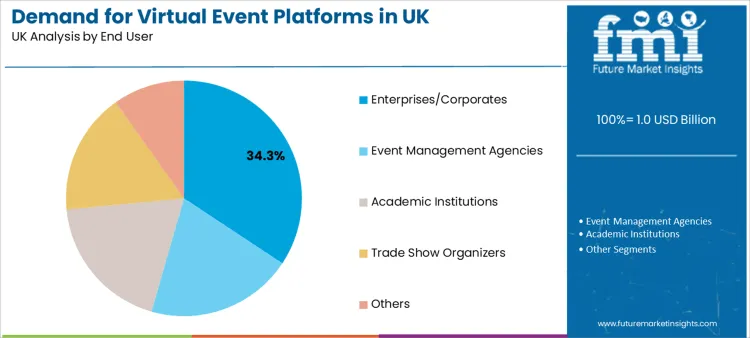
The enterprises/corporates sector stands as the largest end-user, with an estimated 34.3% share. This is a direct result of corporations utilizing virtual platforms for a wide array of functions, including sales kick-offs, global team meetings, customer onboarding webinars, product launches, and hybrid AGMs.
Event management agencies are a critical high-value segment, utilizing these platforms as the delivery mechanism for client services. Academic Institutions and Trade Show Organizers contribute substantial and growing demand as they permanently digitize their outreach and monetization models.
What are the Dynamics, Restraints, Opportunities, and Threats Shaping this Sector?
How are Hybrid Work Models and ROI Focus Driving Meteoric Demand?
The primary growth driver is the entrenched hybrid work culture, which necessitates digital tools for internal and external collaboration. The demonstrated return on investment from virtual events, through detailed analytics, lower cost per lead, and expanded global reach, is securing ongoing budget allocation. The demand for integrated marketing technology stacks is also pushing platforms to offer deeper CRM and marketing automation integrations.
Do Platform Fatigue and Integration Complexity Restrain Optimal Use?
A significant restraint is virtual attendee fatigue, making engagement and retention a persistent challenge that platforms must continuously innovate to solve. The technical complexity of choosing, integrating, and mastering a feature-rich platform can be a barrier, creating a reliance on skilled internal teams or agency partners. Security and data privacy concerns, especially for corporate and academic events, also necessitate robust, sometimes costly, platform features and compliance checks.
How are AI and Advanced Interactivity Creating New Potential?
Substantial opportunities are emerging from the integration of generative AI for personalized agenda creation, real-time speech translation, AI-powered matchmaking for networking, and automated content summarization.
The growth of immersive experiences through VR and AR integrations presents a new frontier for high-value events. The expansion of platform capabilities to manage complex hybrid events, with seamless integration between physical and digital audiences, is becoming a critical differentiator and growth avenue.
What External Factors Could Challenge Sector Growth?
The sector faces threats from intense competition leading to price pressure and feature saturation, potentially squeezing margins. Economic downturns could lead businesses to cut marketing and event budgets temporarily.
Rapid technological evolution risks making specific platforms obsolete, requiring continuous R&D investment from vendors. Data sovereignty regulations could also complicate cloud service delivery for international events.
How is Virtual Event Platform Demand Evolving across Key Regions in the UK?
Growth is influenced by the concentration of corporate HQs, the strength of the tech sector, academic density, and regional digital adoption strategies. The projected compound annual growth rates from 2026 to 2036 illustrate these geographic distinctions.
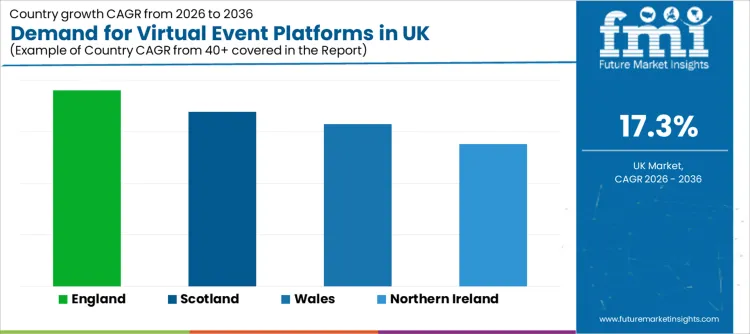
| Region | CAGR (2026-2036) |
|---|---|
| England | 19.0% |
| Scotland | 16.9% |
| Wales | 15.7% |
| Northern Ireland | 13.8% |
What is Fuelling Premier Growth in England?
England leads with a projected CAGR of 19.0%. This is driven by London's status as a global corporate and financial capital, generating immense demand for high-stakes virtual and hybrid meetings, investor relations, and international conferences.
The concentration of technology company HQs in London and the Southeast, alongside the Oxford-Cambridge research arc, creates a dense ecosystem of both providers and sophisticated enterprise customers.
Why is Scotland a Key Centre for Tech and Academic Adoption?
Scotland exhibits a very strong CAGR of 16.9%, powered by its thriving technology startup scene in Edinburgh and Glasgow, and its world-renowned academic institutions. These universities are heavy users of virtual platforms for remote learning, international research symposiums, and student recruitment. The presence of a strong financial services sector also contributes to steady demand for corporate virtual events.
What Factors Underpin Strong Demand in Wales?
Wales shows robust growth with a CAGR of 15.7%. Significant government and EU-funded initiatives to boost the digital economy and support business innovation fuel this. The region's strong academic sector, along with a growing number of knowledge-based industries and a focus on inward investment events, creates a healthy and expanding market for virtual event solutions.
What Factors Underpin Growth in Northern Ireland?
Northern Ireland, with a projected CAGR of 13.8%, reflects solid growth supported by its universities, a burgeoning cybersecurity and tech hub, and an increasing focus on digital connectivity for business development. The region's active use of virtual platforms to connect with global diasporas, attract foreign direct investment, and host cross-border academic and business events aligns with broader regional digital development strategies.
What Defines the Competitive Landscape of the Virtual Event Platform Industry?
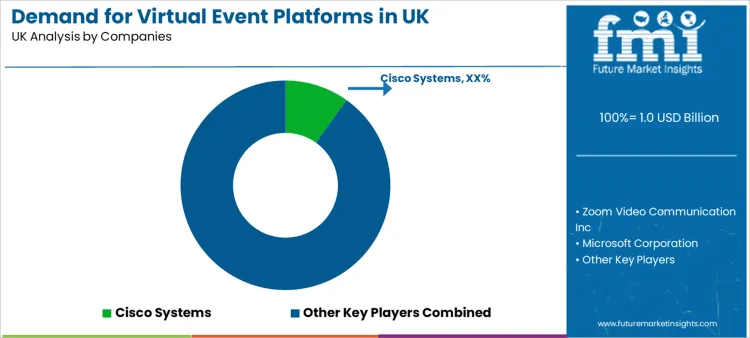
The competitive environment is fiercely dynamic and rapidly evolving, characterized by rivalry on the basis of feature richness, user experience, reliability, analytics depth, and integration capabilities.
Established communications giants with broad unified communications suites compete with pure-play virtual event specialists and emerging startups leveraging AI. Differentiation is achieved through niche specialization, such as academic conferences, virtual job fairs, or premium corporate broadcasts, or through superior, intuitive design that reduces the need for technical support.
Success depends not only on a robust technical platform but on providing an exceptional client onboarding experience, comprehensive professional services, and a demonstrable ROI framework. Forming strategic partnerships with major event agencies, marketing firms, and corporate IT consultants is a critical tactic for channel sales and influencing purchasing decisions at the enterprise level.
Key Industry Participants
- Cisco Systems
- Zoom Video Communications Inc.
- Microsoft Corporation
- vFairs
- Cvent Inc.
Scope of Report
| Items | Values |
|---|---|
| Quantitative Units | USD Billion |
| Solution | Virtual Event Platforms Software, Virtual Event Platforms Services |
| Enterprise Size | Medium-sized Enterprises, Very Large Enterprises (1,000+ employees), Large Enterprises (500-999 employees), Small Enterprises (10-99 employees), Small Offices (1-9 employees) |
| End User | Enterprises/Corporates, Event Management Agencies, Academic Institutions, Trade Show Organizers, Others |
| Regions Covered | England, Scotland, Wales, Northern Ireland |
| Key Companies Profiled | Cisco Systems, Zoom Video Communications Inc., Microsoft Corporation, vFairs, Cvent Inc. |
Virtual Event Platform Demand in the UK by Segment
By Solution:
- Virtual Event Platforms Software
- Virtual Event Platforms Services
By Enterprise Size:
- Medium-sized Enterprises
- Very Large Enterprises (1,000+ employees)
- Large Enterprises (500-999 employees)
- Small Enterprises (10-99 employees)
- Small Offices (1-9 employees)
By End User:
- Enterprises/Corporates
- Event Management Agencies
- Academic Institutions
- Trade Show Organizers
- Others
By Region:
- England
- Scotland
- Wales
- Northern Ireland
Bibliography
- UK Events Industry Board (UEIB). (2023). The Future of Events: Hybrid and Virtual Strategy Report.
- Department for Digital, Culture, Media & Sport (DCMS). (2024). UK Digital Adoption in Business and Society.
- Martech Alliance. (2023). Marketing Technology Landscape and Engagement Tools.
- Universities UK. (2024). Digital Innovation in Academic Outreach and Teaching.
Frequently Asked Questions
How big is the demand for virtual event platforms in uk in 2026?
The demand for virtual event platforms in uk is estimated to be valued at USD 1.0 billion in 2026.
What will be the size of virtual event platforms in uk in 2036?
The market size for the virtual event platforms in uk is projected to reach USD 4.7 billion by 2036.
How much will be the demand for virtual event platforms in uk growth between 2026 and 2036?
The demand for virtual event platforms in uk is expected to grow at a 17.3% CAGR between 2026 and 2036.
What are the key product types in the virtual event platforms in uk?
The key product types in virtual event platforms in uk are virtual event platforms software and virtual event platforms services.
Which enterprise size segment is expected to contribute significant share in the virtual event platforms in uk in 2026?
In terms of enterprise size, medium-sized enterprises segment is expected to command 19.3% share in the virtual event platforms in uk in 2026.
Preview the report firsthand - request a free sample
Get SampleGet the brochure for pricing and purchase details.
Get PDFTable of Content
- Executive Summary
- UK Market Outlook
- Demand-side Trends
- Supply-side Trends
- Technology Roadmap Analysis
- Analysis and Recommendations
- Market Overview
- Market Coverage / Taxonomy
- Market Definition / Scope / Limitations
- Market Background
- Market Dynamics
- Drivers
- Restraints
- Opportunity
- Trends
- Scenario Forecast
- Demand in Optimistic Scenario
- Demand in Likely Scenario
- Demand in Conservative Scenario
- Opportunity Map Analysis
- Product Life Cycle Analysis
- Supply Chain Analysis
- Investment Feasibility Matrix
- Value Chain Analysis
- PESTLE and Porter’s Analysis
- Regulatory Landscape
- Regional Parent Market Outlook
- Production and Consumption Statistics
- Import and Export Statistics
- Market Dynamics
- UK Market Analysis 2021 to 2025 and Forecast, 2026 to 2036
- Historical Market Size Value (USD Million) Analysis, 2021 to 2025
- Current and Future Market Size Value (USD Million) Projections, 2026 to 2036
- Y-o-Y Growth Trend Analysis
- Absolute $ Opportunity Analysis
- UK Market Pricing Analysis 2021 to 2025 and Forecast 2026 to 2036
- UK Market Analysis 2021 to 2025 and Forecast 2026 to 2036, By Solution
- Introduction / Key Findings
- Historical Market Size Value (USD Million) Analysis By Solution , 2021 to 2025
- Current and Future Market Size Value (USD Million) Analysis and Forecast By Solution , 2026 to 2036
- Virtual Event Platforms Software
- Virtual Event Platforms Services
- Virtual Event Platforms Software
- Y-o-Y Growth Trend Analysis By Solution , 2021 to 2025
- Absolute $ Opportunity Analysis By Solution , 2026 to 2036
- UK Market Analysis 2021 to 2025 and Forecast 2026 to 2036, By Enterprise Size
- Introduction / Key Findings
- Historical Market Size Value (USD Million) Analysis By Enterprise Size, 2021 to 2025
- Current and Future Market Size Value (USD Million) Analysis and Forecast By Enterprise Size, 2026 to 2036
- Medium-sized Enterprises
- Very Large Enterprises (1,000+ employees)
- Large Enterprises (500-999 employees)
- Small Enterprises (10-99 employees)
- Small Offices (1-9 employees)
- Medium-sized Enterprises
- Y-o-Y Growth Trend Analysis By Enterprise Size, 2021 to 2025
- Absolute $ Opportunity Analysis By Enterprise Size, 2026 to 2036
- UK Market Analysis 2021 to 2025 and Forecast 2026 to 2036, By End User
- Introduction / Key Findings
- Historical Market Size Value (USD Million) Analysis By End User, 2021 to 2025
- Current and Future Market Size Value (USD Million) Analysis and Forecast By End User, 2026 to 2036
- Enterprises/Corporates
- Event Management Agencies
- Academic Institutions
- Trade Show Organizers
- Others
- Enterprises/Corporates
- Y-o-Y Growth Trend Analysis By End User, 2021 to 2025
- Absolute $ Opportunity Analysis By End User, 2026 to 2036
- Market Structure Analysis
- Competition Dashboard
- Competition Benchmarking
- Market Share Analysis of Top Players
- By Regional
- By Solution
- By Enterprise Size
- By End User
- Competition Analysis
- Competition Deep Dive
- Cisco Systems
- Overview
- Product Portfolio
- Profitability by Market Segments (Product/Age /Sales Channel/Region)
- Sales Footprint
- Strategy Overview
- Marketing Strategy
- Product Strategy
- Channel Strategy
- Zoom Video Communication Inc
- Microsoft Corporation
- vFairs
- Cvent Inc.
- Cisco Systems
- Competition Deep Dive
- Assumptions & Acronyms Used
- Research Methodology


