

- Industry Size (2026)
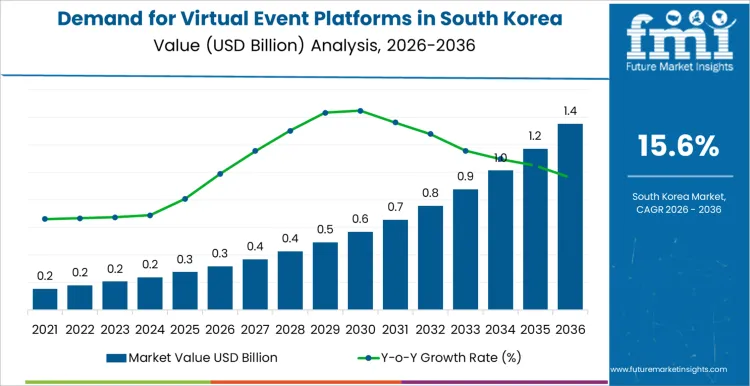
- USD 0.3 Bn
- Forecast (2036)
- USD 1.4 Bn
- CAGR (2026 to 2036)
- 15.6%
Virtual Event Platforms Sector in South Korea: Forecast and Outlook 2026 to 2036
The virtual event platforms landscape in South Korea is projected to achieve a valuation of USD 0.3 billion in 2026. This landscape is anticipated to expand dramatically to USD 1.4 billion by 2036, propelled by an exceptional compound annual growth rate of 15.6%. This explosive growth trajectory is anchored in a permanent structural shift in how organizations communicate, collaborate, and conduct commerce.
The accelerated adoption of hybrid work models, the globalization of business outreach, and the relentless pursuit of cost-effective and scalable marketing channels have converged to establish virtual and hybrid events as a core component of corporate and institutional strategy.
South Korea's advanced digital infrastructure, high smartphone penetration, and culturally ingrained technological fluency create a uniquely fertile environment for platforms that facilitate immersive online experiences, from large-scale international conferences to targeted product launches and virtual career fairs.
Quick Stats for the Virtual Event Platforms Arena in South Korea
- Digital Virtual Event Platforms Value in South Korea (2026): USD 0.3 billion
- Digital Virtual Event Platforms Forecast Valuation in South Korea (2036): USD 1.4 billion
- Forecast CAGR of the Digital Virtual Event Platforms Landscape in South Korea: 15.6%
- Leading Regional Growth: Jeju (CAGR 18.7%)
- Leading Solution: Virtual Event Platform Software (73.2%)
- Leading Enterprise Size: Medium-sized Enterprises (20.3%)
- Leading End User: Enterprises/Corporates (36.1%)
- Key Industry Participants: Cisco Systems (Webex), Zoom Video Communications Inc., Microsoft Corporation (Teams), vFairs, Cvent Inc.
Why is South Korea Experiencing a Paradigm Shift Towards Virtualized Engagement?
The pivot toward virtual event platforms in South Korea is not a transient trend but a strategic realignment driven by profound changes in business conduct and audience expectations. The proven efficacy of digital events in drastically reducing logistical overheads and carbon footprints while simultaneously expanding potential audience reach from regional to global has solidified their value proposition.
Organizations are now leveraging these platforms not merely as substitutes for in-person gatherings but as sophisticated tools for enterprise digital marketing and lead generation, capable of delivering rich analytics on attendee behavior and engagement that physical events cannot match.
The integration of these platforms with existing martech stacks for CRM and marketing automation is creating seamless workflows for nurturing leads and measuring concrete ROI, transforming event management from a logistical task into a data-driven growth engine.
How is the Virtual Event Solutions Arena Segmented by Offering, Organization Size, and User?
The core type of offering, the size of the deploying organization, and the primary industry of the end user delineates the sector. This segmentation reveals critical insights into procurement drivers, with software capabilities being paramount, and highlights how organizations of all scales are leveraging this technology for different strategic objectives.
The end-user segmentation further distinguishes between internal corporate communications, client-facing marketing events, and specialized professional gatherings, each with distinct feature requirements and success metrics.
Which Solution Component Forms the Foundation of the Virtual Experience?
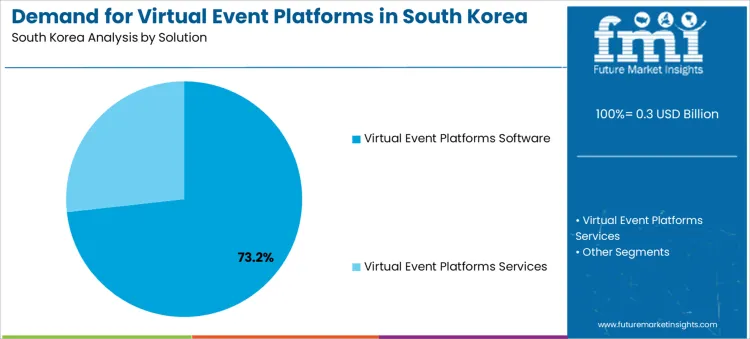
Virtual Event Platform Software constitutes the overwhelming majority of the market, commanding a 73.2% share. This dominance underscores that the core value resides in the technology suite itself, the software that provides the virtual venue, registration tools, interactive stages, networking lounges, and exhibitor booths.
Investment is heavily focused on platforms that offer stability, scalability for thousands of concurrent users, and a rich suite of interactive features like live Q&A, polls, and gamification. The surrounding virtual event platforms services segment, encompassing planning, technical production, and moderation, remains essential for successful execution, especially for complex, high-stakes events, but is inherently tied to the procurement of the core software platform.
Which Enterprise Size Category is Demonstrating Agile Adoption?
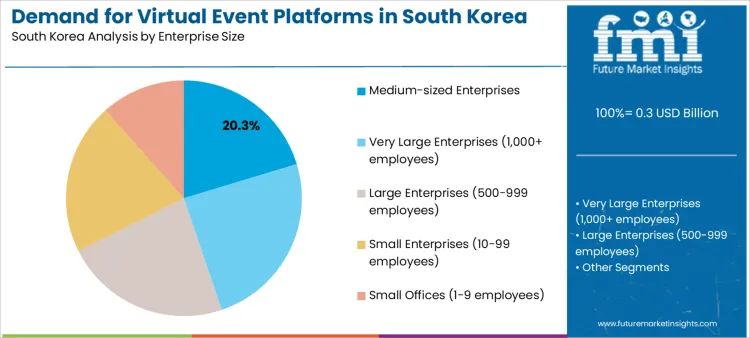
Medium-sized enterprises (20-499 employees) represent a leading segment with a 20.3% share. These organizations are particularly agile in adopting virtual platforms, as they offer a powerful means to compete with larger rivals by extending brand reach and engagement without the prohibitive costs of major physical events. They seek cost-effective, user-friendly platforms that do not require large internal IT teams to manage.
The adoption distribution across Very Large, Large, Small, and Micro enterprises illustrates a broad-based demand, with each segment utilizing platforms for different primary use cases, from global all-hands meetings to niche community webinars, reflecting the diverse needs within the South Korean SME digital transformation landscape.
Which End-User Segment is the Primary Strategic Investor?
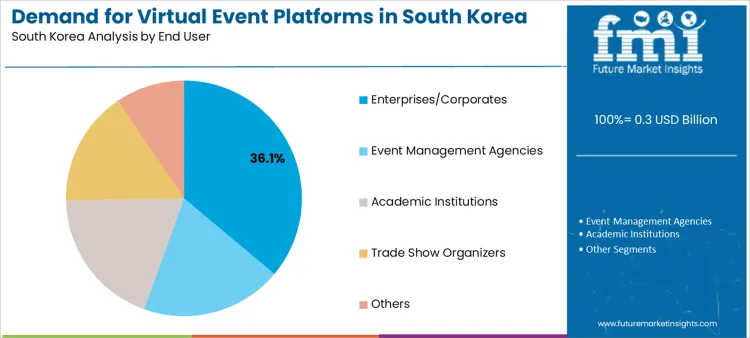
Enterprises and Corporations stand as the primary end-users, holding a 36.1% share. For these organizations, virtual platforms are strategic tools for internal communications (global town halls, training), external marketing (product launches, user conferences), and partner engagement. The demand is for enterprise-grade security, seamless integration with tools like Salesforce or Microsoft 365, and sophisticated data capture.
Following closely, event management agencies are critical adopters, leveraging these platforms to deliver services to clients, while Academic Institutions and Trade Show Organizers utilize them for virtual learning and hybrid exhibitions, respectively.
What are the Dynamics, Restraints, Opportunities, and Threats Shaping the Sector?
How are Hybrid Work Models and Globalization Fueling Exponential Demand?
The permanent embrace of hybrid and remote work policies has fundamentally altered corporate communication, making virtual events a default channel for employee engagement and training. Concurrently, the imperative to access global markets and talent pools without travel constraints makes virtual conferences and recruiting fairs indispensable.
The ability to repurpose event content into on-demand libraries for continuous lead generation and education provides a compelling, enduring ROI that continues to drive investment and platform innovation across the corporate learning and development sector.
Do Platform Fatigue and Technical Barriers Restrain Optimal Engagement?
A significant restraint is the emerging challenge of virtual fatigue among attendees, which can suppress participation rates and engagement levels for poorly designed events. The technical complexity of producing a seamless, high-production-value event can be a barrier, requiring specialized skills that some organizations lack internally.
Concerns regarding data privacy, especially for events with international attendees, and the challenge of integrating a virtual platform with a dozen other best-in-class software tools can create friction and slow adoption for some enterprises.
How is the Rise of the Metaverse and AI Creating the Next Evolution?
Substantial opportunities lie in the integration of immersive technologies like VR and metaverse-style 3D environments to create more engaging and memorable event experiences that combat fatigue. The application of Generative AI is poised to be transformative, offering capabilities for real-time multilingual translation, automated content summarization, AI-powered matchmaking for networking, and even virtual host avatars.
The growth of hybrid event production solutions, which seamlessly blend in-person and virtual audiences into a single cohesive experience, represents a massive frontier for platform providers to capture the future of events.
What External Factors Could Challenge Sustained Hyper-Growth?
The sector faces the threat of intense feature commoditization, where competing platforms offer similar core functionalities, leading to price-based competition that erodes margins. A deep economic downturn could see organizations slash marketing and event budgets, temporarily stalling growth.
The rapid pace of innovation risks fragmenting the market with niche platforms, causing confusion for buyers and potentially leading to consolidation. Data sovereignty regulations could also complicate service delivery for global platform providers operating within South Korea.
How is the Virtual Event Platforms Sector Evolving Across Key Regions in South Korea?
Adoption and growth intensity vary significantly across South Korea, shaped by regional economic specialization, the concentration of corporate headquarters, and local digitalization initiatives. The projected compound annual growth rates from 2026 to 2036 highlight these geographic disparities.
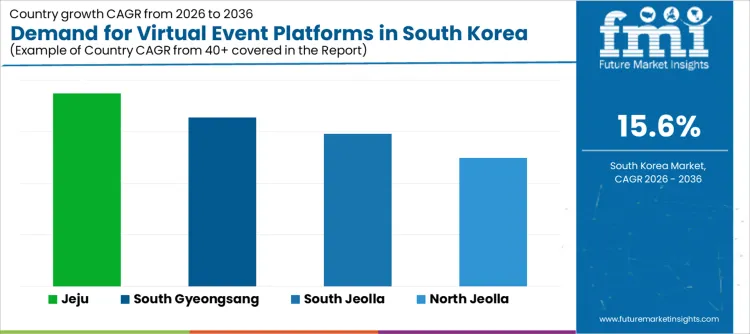
| Region | CAGR (2026 to 2036) |
|---|---|
| Jeju | 18.7% |
| South Gyeongsang | 16.4% |
| South Jeolla | 14.8% |
| North Jeolla | 12.5% |
What is Catalyzing Supreme Growth on Jeju Island?
Jeju Island is forecast for the highest CAGR of 18.7%. This exceptional rate is directly tied to its dual identity as a world-class tourist destination and a special regulatory zone for technology and international business. Jeju is becoming a preferred host location for hybrid international conferences and corporate retreats, where the physical component is held on the island for a global virtual audience.
Furthermore, local government and tourism boards actively utilize virtual platforms for global destination marketing. Its focus on becoming a smart city and international business hub drives local enterprises and startups to adopt these platforms for global outreach from day one.
Why is South Gyeongsang a High-Growth Corporate Hub?
South Gyeongsang exhibits a very strong CAGR of 16.4%. The region’s dense cluster of heavyweight industrial conglomerates, advanced manufacturing firms, and the bustling port metropolis of Busan power this. These large corporations are at the forefront of adopting virtual platforms for global supply chain coordination, B2B technical symposiums, and international sales kick-offs.
The presence of major corporate headquarters creates a concentrated demand for enterprise-level, feature-rich platform solutions and the professional services that accompany them.
What Factors Underpin Strong Growth in the Jeolla Provinces?
The Jeolla provinces demonstrate robust, above-average growth. South Jeolla, with a 14.8% CAGR, benefits from its growing reputation in renewable energy and eco-industries, where international knowledge-sharing and investment events are increasingly conducted virtually.
North Jeolla, projected at 12.5% CAGR, shows strong adoption driven by its prestigious universities and research institutions in Jeonju, which leverage virtual platforms for international academic collaborations, virtual open days, and global research symposia, a trend aligned with the digitalization of the academic and research collaboration ecosystem.
What Defines the Competitive Landscape of the Virtual Event Platforms Industry?
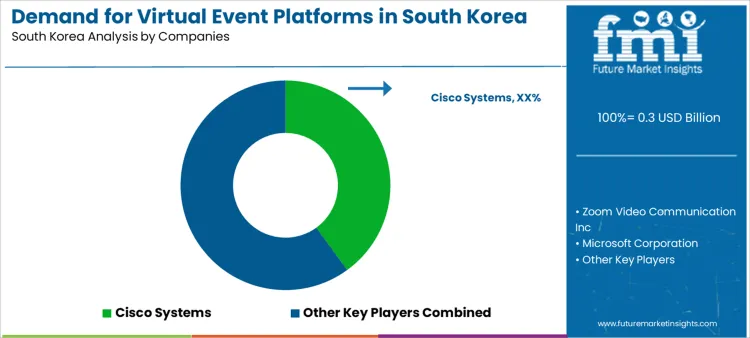
The competitive environment is characterized by a fierce clash between generalized communication giants and best-of-breed specialized platforms. Titans like Cisco, Zoom, and Microsoft compete by leveraging their vast existing user bases and deep integration with unified communications ecosystems, offering event capabilities as a natural extension of daily workflow. Specialists like vFairs and Cvent compete on depth of features tailored specifically for large-scale conferences, trade shows, and complex ticketed events, with advanced exhibition hall and sponsor management tools.
Competition hinges on reliability at scale, richness of interactive features, depth of analytics, and ease of use for both organizers and attendees. The ability to offer a flexible hybrid event solution and transparent, value-based pricing are increasingly critical differentiators in a crowded and rapidly evolving market.
Key Industry Participants
- Cisco Systems, Inc. (Webex Events)
- Zoom Video Communications, Inc. (Zoom Events)
- Microsoft Corporation (Microsoft Teams Live Events)
- vFairs
- Cvent, Inc.
Scope of Analysis
| Items | Values |
|---|---|
| Quantitative Units | USD Billion |
| Solution | Virtual Event Platforms Software, Virtual Event Platforms Services |
| Enterprise Size | Medium-sized Enterprises, Very Large Enterprises, Large Enterprises, Small Enterprises, Small Offices |
| End User | Enterprises/Corporates, Event Management Agencies, Academic Institutions, Trade Show Organizers, Others |
| Regions Covered | South Gyeongsang, North Jeolla, South Jeolla, Jeju |
| Key Companies Profiled | Cisco Systems, Zoom Video Communications Inc., Microsoft Corporation, vFairs, Cvent Inc. |
Virtual Event Platforms Sector in South Korea by Segment
By Solution:
- Virtual Event Platforms Software
- Virtual Event Platforms Services
By Enterprise Size:
- Medium-sized Enterprises (20-499 employees)
- Very Large Enterprises (1,000+ employees)
- Large Enterprises (500-999 employees)
- Small Enterprises (10-99 employees)
- Small Offices (1-9 employees)
By End User:
- Enterprises/Corporates
- Event Management Agencies
- Academic Institutions
- Trade Show Organizers
- Others
By Region:
- Jeju
- South Gyeongsang
- South Jeolla
- North Jeolla
Bibliography
- Korea Internet & Security Agency (KISA). (2023). Report on Digital Communication Trends and Platform Adoption in Korean Enterprises.
- Ministry of Science and ICT (MSIT). (2024). Digital New Deal Policy Implementation and Hybrid Work Infrastructure Assessment.
- Korea Association of Convention & Exhibition (KACE). (2023). Annual Report on the Evolution and Economic Impact of Hybrid and Virtual Events.
Frequently Asked Questions
How big is the demand for virtual event platforms in south korea in 2026?
The demand for virtual event platforms in south korea is estimated to be valued at USD 0.3 billion in 2026.
What will be the size of virtual event platforms in south korea in 2036?
The market size for the virtual event platforms in south korea is projected to reach USD 1.4 billion by 2036.
How much will be the demand for virtual event platforms in south korea growth between 2026 and 2036?
The demand for virtual event platforms in south korea is expected to grow at a 15.6% CAGR between 2026 and 2036.
What are the key product types in the virtual event platforms in south korea?
The key product types in virtual event platforms in south korea are virtual event platforms software and virtual event platforms services.
Which enterprise size segment is expected to contribute significant share in the virtual event platforms in south korea in 2026?
In terms of enterprise size, medium-sized enterprises segment is expected to command 20.3% share in the virtual event platforms in south korea in 2026.
Preview the report firsthand - request a free sample
Get SampleGet the brochure for pricing and purchase details.
Get PDFTable of Content
- Executive Summary
- South Korea Market Outlook
- Demand-side Trends
- Supply-side Trends
- Technology Roadmap Analysis
- Analysis and Recommendations
- Market Overview
- Market Coverage / Taxonomy
- Market Definition / Scope / Limitations
- Market Background
- Market Dynamics
- Drivers
- Restraints
- Opportunity
- Trends
- Scenario Forecast
- Demand in Optimistic Scenario
- Demand in Likely Scenario
- Demand in Conservative Scenario
- Opportunity Map Analysis
- Product Life Cycle Analysis
- Supply Chain Analysis
- Investment Feasibility Matrix
- Value Chain Analysis
- PESTLE and Porter’s Analysis
- Regulatory Landscape
- Regional Parent Market Outlook
- Production and Consumption Statistics
- Import and Export Statistics
- Market Dynamics
- South Korea Market Analysis 2021 to 2025 and Forecast, 2026 to 2036
- Historical Market Size Value (USD Million) Analysis, 2021 to 2025
- Current and Future Market Size Value (USD Million) Projections, 2026 to 2036
- Y-o-Y Growth Trend Analysis
- Absolute $ Opportunity Analysis
- South Korea Market Pricing Analysis 2021 to 2025 and Forecast 2026 to 2036
- South Korea Market Analysis 2021 to 2025 and Forecast 2026 to 2036, By Solution
- Introduction / Key Findings
- Historical Market Size Value (USD Million) Analysis By Solution, 2021 to 2025
- Current and Future Market Size Value (USD Million) Analysis and Forecast By Solution, 2026 to 2036
- Virtual Event Platforms Software
- Virtual Event Platforms Services
- Virtual Event Platforms Software
- Y-o-Y Growth Trend Analysis By Solution, 2021 to 2025
- Absolute $ Opportunity Analysis By Solution, 2026 to 2036
- South Korea Market Analysis 2021 to 2025 and Forecast 2026 to 2036, By Enterprise Size
- Introduction / Key Findings
- Historical Market Size Value (USD Million) Analysis By Enterprise Size, 2021 to 2025
- Current and Future Market Size Value (USD Million) Analysis and Forecast By Enterprise Size, 2026 to 2036
- Medium-sized Enterprises
- Very Large Enterprises (1,000+ employees)
- Large Enterprises (500-999 employees)
- Small Enterprises (10-99 employees)
- Small Offices (1-9 employees)
- Medium-sized Enterprises
- Y-o-Y Growth Trend Analysis By Enterprise Size, 2021 to 2025
- Absolute $ Opportunity Analysis By Enterprise Size, 2026 to 2036
- South Korea Market Analysis 2021 to 2025 and Forecast 2026 to 2036, By End User
- Introduction / Key Findings
- Historical Market Size Value (USD Million) Analysis By End User, 2021 to 2025
- Current and Future Market Size Value (USD Million) Analysis and Forecast By End User, 2026 to 2036
- Enterprises/Corporates
- Event Management Agencies
- Academic Institutions
- Trade Show Organizers
- Others
- Enterprises/Corporates
- Y-o-Y Growth Trend Analysis By End User, 2021 to 2025
- Absolute $ Opportunity Analysis By End User, 2026 to 2036
- Market Structure Analysis
- Competition Dashboard
- Competition Benchmarking
- Market Share Analysis of Top Players
- By Regional
- By Solution
- By Enterprise Size
- By End User
- Competition Analysis
- Competition Deep Dive
- Cisco Systems
- Overview
- Product Portfolio
- Profitability by Market Segments (Product/Age /Sales Channel/Region)
- Sales Footprint
- Strategy Overview
- Marketing Strategy
- Product Strategy
- Channel Strategy
- Zoom Video Communication Inc
- Microsoft Corporation
- vFairs
- Cvent Inc.
- Cisco Systems
- Competition Deep Dive
- Assumptions & Acronyms Used
- Research Methodology


