

- Industry Size (2025)
- USD 4.1 Bn
- Forecast (2035)
- USD 17.6 Bn
- CAGR (2025 to 2035)
- 15.6%
Demand for Virtual Event Platforms in USA 2025 to 2035
The USA virtual event platforms demand is valued at USD 4.1 billion in 2025 and is forecasted to reach USD 17.6 billion by 2035, recording a CAGR of 15.6%. Demand is driven by continued use of digital event formats across corporate communication, education, training, and marketing functions. Virtual platforms support large-scale attendee engagement, streamlined content delivery, and reduced logistical costs, making them integral to hybrid work structures and distributed organisational models. Growth is reinforced by rising adoption of interactive features including real-time chat, analytics dashboards, breakout rooms, and integrated registration tools.
Virtual event platforms software represents the leading solution category, reflecting its role in enabling end-to-end digital event management. These platforms provide configurable interfaces, multimedia content support, and secure access controls suitable for conferences, webinars, trade shows, and internal corporate events. Improvements in video rendering, cloud scalability, and engagement tracking continue to strengthen reliability and user experience.
Demand is highest in the West, South, and Northeast, where enterprise activity, technology adoption, and remote collaboration requirements are most concentrated. Major suppliers include Cisco Systems, Zoom Video Communications Inc., Microsoft Corporation, vFairs, and Cvent Inc. Their development priorities focus on platform stability, integration with productivity tools, and enhanced interaction features suitable for high-attendance events.
Quick Stats for USA Virtual Event Platforms Demand
- USA Virtual Event Platforms Sales Value (2025): USD 4.1 billion
- USA Virtual Event Platforms Forecast Value (2035): USD 17.6 billion
- USA Virtual Event Platforms Forecast CAGR (2025 to 2035): 15.6%
- Leading Solution in USA Virtual Event Platforms Demand: Virtual event platforms software
- Key Growth Regions in USA Virtual Event Platforms Demand: West, South, Northeast
- Top Players in USA Virtual Event Platforms Demand: Cisco Systems, Zoom Video Communications Inc., Microsoft Corporation, vFairs, Cvent Inc.
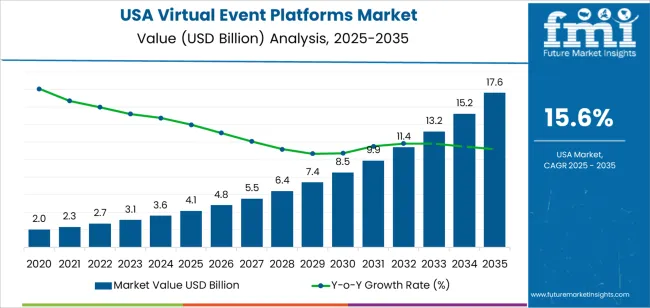
What is the Growth Forecast for Virtual Event Platforms Industry in USA through 2035?
Growth rate volatility analysis indicates a moderate-to-high volatility index during the early years, driven by fluctuating enterprise adoption patterns and varying levels of hybrid-event activity. Between 2025 and 2028, annual growth may shift more noticeably as organisations rebalance physical and virtual formats, adjust event budgets, and refine platform requirements related to scalability, engagement tools, and data security. Demand from technology, education, and professional-services sectors will anchor early expansion despite these shifts.
From 2029 to 2035, the volatility index is expected to decline as virtual and hybrid formats become institutionalised components of corporate communication, training, and marketing. Adoption will stabilise through subscription-based usage, long-term licensing, and integration with CRM, learning-management, and collaboration systems. Improvements in analytics, accessibility features, and multi-device performance will support consistent procurement. While cyclical event activity may create minor variations, baseline demand will remain strong across enterprises seeking flexible, cost-efficient engagement channels. The long-term volatility profile reflects a maturing digital-engagement ecosystem moving from rapid experimentation toward stable, structured operational use across USA organisations.
USA Virtual Event Platforms Key Takeaways
| Metric | Value |
|---|---|
| USA Virtual Event Platforms Sales Value (2025) | USD 4.1 billion |
| USA Virtual Event Platforms Forecast Value (2035) | USD 17.6 billion |
| USA Virtual Event Platforms Forecast CAGR (2025 to 2035) | 15.6% |
Why is the Demand for Virtual Event Platforms in the USA Growing?
Demand for virtual event platforms in the USA is growing because organisations need flexible, scalable and remote ways to host events, conferences and training without the constraints of physical venues. Companies operating across multiple time zones, industries and stakeholder groups increasingly adopt platforms that enable webinars, hybrid events and fully virtual gatherings. Advances in streaming technology, interactive features like chat rooms, polling, virtual exhibitor booths and data analytics make these platforms attractive for marketers and event planners seeking to maximise engagement and reach.
The growing focus on cost efficiency, reduced travel and environmental impact further supports usage of virtual solutions. Post-pandemic shifts toward hybrid models where live and virtual audiences participate concurrently drive continuous investment in platform capabilities. Constraints include the challenge of replicating the in-person network experience online, concerns about attendee fatigue during prolonged virtual sessions and the need for strong internet infrastructure and technical support. Some smaller organisations may lack the budget or expertise to deploy high-feature platforms at scale.
Which Solution, Enterprise-Size, and End-User Segments Lead Demand for Virtual Event Platforms in the USA?
Demand for virtual event platforms in the United States reflects continued use of digital communication tools across corporate, academic, and professional environments. Adoption patterns vary by solution type, organisational scale, and the specific needs of end-user groups. Demand distribution highlights reliance on software-driven event infrastructure, broad enterprise participation, and diverse applications ranging from corporate meetings to academic programming and trade-show coordination.
By Solution, Virtual Event Platforms Software Accounts for the Largest Share of Demand
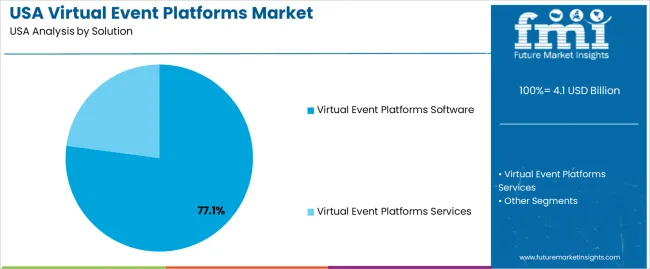
Virtual-event software holds 77.1% of USA demand, making it the dominant solution category. Software platforms support live streaming, attendee interaction tools, analytics dashboards, content hosting, and multi-session management. Organisations prioritise software due to its scalability, integration with collaboration systems, and ability to support hybrid or fully digital event structures. Services account for 22.9%, including technical support, event design, moderation, and platform management. Service demand remains significant among enterprises requiring external expertise for complex events or large attendee volumes. Solution distribution reflects reliance on software capability for consistent event performance and the continued need for service-based operational support during large-scale events.
Key drivers and attributes:
- Software enables content delivery, analytics, and interactive functions.
- Service components support technical execution and event coordination.
- Adoption reflects the shift toward permanent digital-event infrastructure.
- Choice depends on event complexity, internal resources, and deployment scale.
By Enterprise Size, Very Large Enterprises Account for the Largest Share of Demand
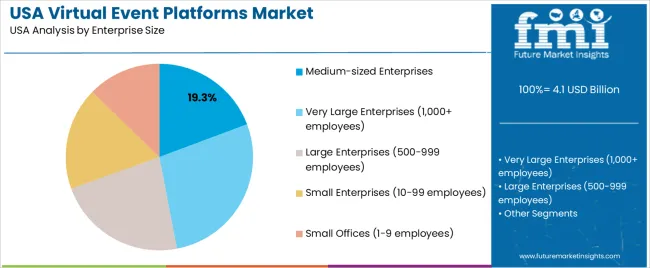
Very large enterprises with 1,000+ employees hold 27.7% of USA demand. These organisations conduct frequent internal meetings, stakeholder briefings, training sessions, and large cross-regional events requiring stable virtual-event platforms. Large enterprises (500-999 employees) hold 22.5%, using virtual platforms for structured communication and departmental coordination. Medium-sized enterprises account for 19.3%, representing sustained adoption for product launches, client engagement, and team collaboration. Small enterprises (10-99 employees) hold 17.8%, often selecting platforms for cost-efficient outreach and remote collaboration. Small offices (1-9 employees) represent 12.7%, using virtual platforms for meetings, workshops, and localised training.
Key drivers and attributes:
- Very large enterprises require high-capacity and multi-session capability.
- Large and medium firms depend on virtual formats for operational continuity.
- Small enterprises adopt platforms for cost-effective communication.
- Usage reflects organisational structure and communication frequency.
By End User, Enterprises and Corporates Represent the Largest Share of Demand
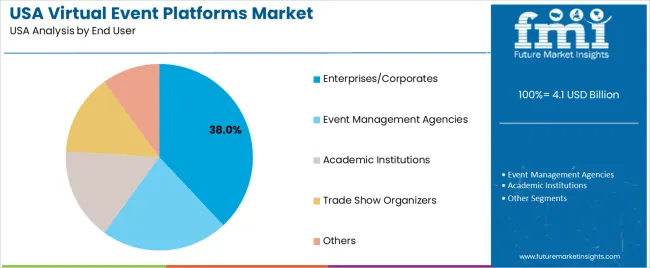
Enterprises and corporates account for 38.0% of USA demand. They use virtual platforms for internal communications, client events, onboarding, training, and annual business activities. Event-management agencies hold 22.0%, coordinating multi-client virtual conferences, product showcases, and branded digital experiences. Academic institutions represent 16.0%, using platforms for lectures, academic fairs, and remote learning events. Trade-show organisers hold 14.0%, adopting digital tools to support exhibitor sessions, virtual booths, and remote attendee engagement. The remaining 10.0% includes non-profits, community groups, and professional associations conducting virtual programmes.
Key drivers and attributes:
- Corporates rely on digital platforms for structured internal and client-facing events.
- Agencies use platforms to deliver multi-client event portfolios.
- Academic institutions depend on stable systems for instructional delivery.
- Trade shows use virtual components to expand reach and accessibility.
What are the Drivers, Restraints, and Key Trends of the Demand for Virtual Event Platforms in the USA?
Growth in hybrid work, increased remote collaboration needs, and expanding digital marketing efforts are driving demand.
In the United States, demand for virtual event platforms is rising as companies support distributed workforces and frequent online interactions across internal teams, clients, and partners. The expansion of corporate webinars, product launches, global conferences and remote training drives adoption of platforms that can host large-scale events, manage registrants, and deliver live streaming with engagement tools. Marketing departments are increasingly using virtual events to reach global audiences cost-effectively and collect data on attendee behavior. The ability to scale events without physical venue constraints supports increased usage of virtual platforms across enterprise segments.
Saturation of in-person events returning, cost pressures and platform fatigue among users are restraining growth.
As in-person events resume in many industries, some organizations reduce spending on purely virtual events or shift to hybrid models instead of fully virtual formats. The cost of advanced event platform subscriptions, integration with enterprise IT systems, and production quality (such as video and interactive features) may deter smaller organizations from investing. Users may experience fatigue from frequent virtual gatherings, lowering attendance and engagement over time which can reduce the perceived value of virtual-only events. These factors moderate the pace of growth in this industry.
Shift toward hybrid event models, enhanced analytics and personalization, and increased use among small and mid-sized enterprises define major trends.
Virtual event platforms are evolving to support hybrid formats that combine physical and virtual participation, enabling organizers to widen their reach while maintaining in-person components. Platform vendors are adding detailed analytics, AI-driven matchmaking, interactive networking, and personalised content delivery to improve attendee engagement and ROI. Small and mid-sized enterprises are increasingly adopting lower-cost, self-service virtual event platforms to run customer webinars, partner presentations and community-oriented sessions. These trends support continued demand for virtual event platforms in the USA.
Analysis of the Demand for Virtual Event Platforms in the United States by Region
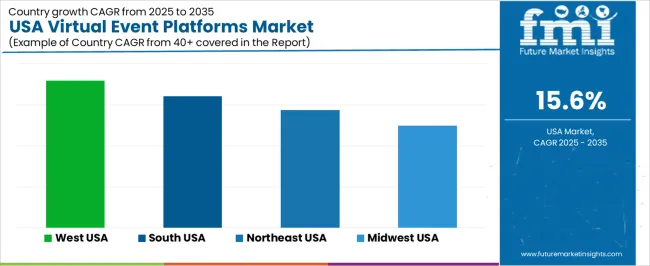
Demand for virtual event platforms in the United States is rising through 2035, driven by continued use of hybrid formats, expanded remote-work structures, and steady adoption of digital engagement tools across corporate, education, healthcare, and public-sector environments. Organizations use virtual event platforms for conferences, training programs, product demonstrations, and large-scale communication workflows.
Growth varies by regional technology adoption, industry concentration, and demand for distributed collaboration. The West leads with a 17.9% CAGR, followed by the South (16.0%), the Northeast (14.3%), and the Midwest (12.5%). Demand is reinforced by analytics-enabled platforms, improved content-delivery systems, and broader use of cloud-hosted event infrastructure.
| Region | CAGR (2025-2035) |
|---|---|
| West | 17.9% |
| South | 16.0% |
| Northeast | 14.3% |
| Midwest | 12.5% |
How is the West driving demand for virtual event platforms?
The West grows at 17.9% CAGR, supported by strong adoption among technology firms, digital-media companies, universities, and distributed enterprise teams. States such as California, Washington, Oregon, and Colorado rely on virtual event platforms for product launches, developer summits, corporate communication, and hybrid educational programs. Tech-sector organizations use data-driven engagement tools, breakout-session management, and integrated registration systems to support global participation.
Entertainment and creative-industry users adopt platforms for virtual premieres, workshops, and large-scale community events. Universities and research institutions deploy virtual-learning solutions for seminars and multi-campus coordination. Widespread remote-work practices reinforce recurring procurement of scalable platforms.
- Strong use across technology, digital-media, and enterprise teams
- Consistent adoption for product launches and global summits
- Broad deployment of hybrid education and research-coordination tools
- High demand driven by remote-work and distributed collaboration models
How is the South advancing demand for virtual event platforms?
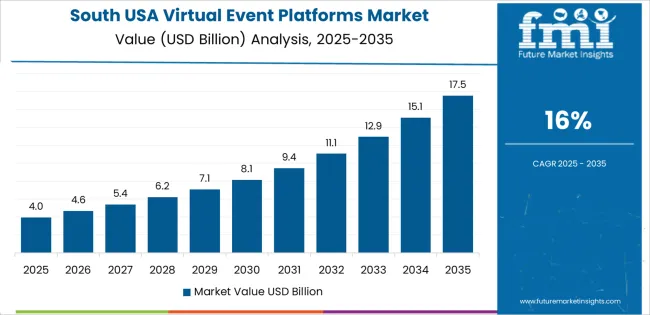
The South grows at 16.0% CAGR, supported by expanding corporate hubs, strong service-sector activity, and widespread adoption of virtual platforms for workforce training and customer-engagement programs. Texas, Florida, Georgia, and North Carolina maintain strong demand for enterprise meetings, hybrid sales events, and training sessions across healthcare, telecom, and financial-services providers. Regional universities use virtual platforms for continuing-education programs and multi-campus academic events. Large corporations adopt platforms for onboarding, compliance training, and communication with distributed teams. Growth is reinforced by competitive operating conditions that favor digital engagement tools over frequent travel-based coordination.
- Broad usage across corporate training and service-sector operations
- Strong adoption in healthcare, finance, telecom, and education
- High demand for hybrid sales, onboarding, and compliance events
- Expansion driven by large regional workforce and enterprise presence
How is the Northeast shaping demand for virtual event platforms?
The Northeast grows at 14.3% CAGR, supported by major financial, healthcare, academic, and consulting organizations that rely on virtual platforms for structured communication and professional events. States including New York, New Jersey, Massachusetts, and Pennsylvania use virtual platforms for investor briefings, medical education, policy discussions, and specialized training. Universities conduct conferences and academic symposiums through hybrid formats that require integrated scheduling, streaming, and interactive tools. Consulting firms use virtual platforms for multi-client briefings and knowledge-transfer programs. Corporate headquarters maintain steady deployment for cross-regional communication, reducing travel dependency and improving event scalability.
- Strong use in finance, consulting, healthcare, and academia
- Hybrid academic conferences and professional-development events
- Corporate teams using platforms for cross-regional coordination
- Stable demand tied to high information-intensive activity
How is the Midwest influencing demand for virtual event platforms?
The Midwest grows at 12.5% CAGR, supported by manufacturing, healthcare, education, and service organizations that use virtual platforms for training, internal communication, and customer-support events. States such as Illinois, Michigan, Ohio, and Wisconsin rely on digital platforms for workforce-development programs, equipment-training sessions, and supply-chain coordination. Universities and community colleges adopt hybrid event systems for academic outreach and institutional communication. Healthcare providers employ virtual platforms for continuing-education clinics and administrative coordination across regional networks. Although growth is slower than in coastal regions, steady digital transformation in legacy industries supports continued adoption.
- Strong use in manufacturing, healthcare, and education
- Adoption for workforce development and operational coordination
- Steady use in hybrid academic and institutional events
- Consistent growth driven by digital modernization in established industries
What is the competitive landscape of the demand for virtual event platforms in the USA?
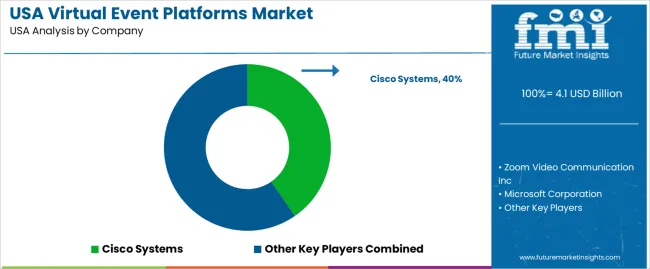
Demand for virtual event platforms in the USA is shaped by a concentrated group of technology providers supporting conferences, webinars, hybrid events, corporate communication, and large-scale digital gatherings. Cisco Systems holds the leading position with an estimated 40.4% share, supported by the long-standing presence of Webex, stable video infrastructure, and strong adoption across enterprise and public-sector organizations. Its position is reinforced by reliable security features, controlled latency performance, and integration with corporate collaboration ecosystems.
Zoom Video Communications Inc. and Microsoft Corporation follow as major participants, supplying scalable platforms used for webinars, live events, and hybrid communication programmes. Their strengths include intuitive interfaces, dependable streaming quality, and alignment with broader productivity suites. Microsoft benefits from seamless integration with Teams and enterprise identity systems, while Zoom remains strong among small and mid-sized organizations requiring flexible event hosting and audience-engagement tools.
Specialist providers such as vFairs and Cvent Inc. maintain notable positions through event-focused platforms designed for multi-session conferences, virtual expos, attendee networking, and analytics-driven engagement. Their systems are adopted for academic events, recruitment fairs, and large organizational gatherings requiring structured content delivery and detailed post-event reporting.
Competition across this segment centers on platform stability, audience-capacity management, security controls, engagement features, integration with CRM and marketing systems, and hybrid-event capability. Demand remains supported by continued use of virtual and hybrid formats for corporate training, academic conferences, and distributed workforce communication, as organizations prioritize scalable, secure, and analytics-enabled digital event solutions across recurring and large-audience applications.
Key Players in USA Virtual Event Platforms Demand
- Cisco Systems
- Zoom Video Communication Inc
- Microsoft Corporation
- vFairs
- Cvent Inc.
Scope of the Report
| Items | Values |
|---|---|
| Quantitative Units | USD billion |
| Solution | Virtual Event Platforms Software, Virtual Event Platforms Services |
| Enterprise Size | Medium-sized Enterprises, Very Large Enterprises (1,000+ employees), Large Enterprises (500-999 employees), Small Enterprises (10-99 employees), Small Offices (1-9 employees) |
| End User | Enterprises/Corporates, Event Management Agencies, Academic Institutions, Trade Show Organizers, Others |
| Regions Covered | West, Midwest, South, Northeast |
| Key Companies Profiled | Cisco Systems, Zoom Video Communication Inc., Microsoft Corporation, vFairs, Cvent Inc. |
| Additional Attributes | Dollar sales by solution type, enterprise size, and end-user categories; regional adoption trends across West, Midwest, South, and Northeast; competitive landscape of virtual event software and service providers; advancements in AI-driven networking tools, immersive 3D event environments, and hybrid event integrations; integration with corporate communications, academic programs, digital trade shows, and large-scale virtual conferences in the USA. |
USA Virtual Event Platforms Demand by Segments
Solution:
- Virtual Event Platforms Software
- Virtual Event Platforms Services
Enterprise Size:
- Medium-sized Enterprises
- Very Large Enterprises (1,000+ employees)
- Large Enterprises (500-999 employees)
- Small Enterprises (10-99 employees)
- Small Offices (1-9 employees)
End User:
- Enterprises/Corporates
- Event Management Agencies
- Academic Institutions
- Trade Show Organizers
- Others
Region:
- West
- South
- Northeast
- Midwest
Frequently Asked Questions
How big is the demand for virtual event platforms in USA in 2025?
The global demand for virtual event platforms in USA is estimated to be valued at USD 4.1 billion in 2025.
What will be the size of demand for virtual event platforms in USA in 2035?
The market size for the demand for virtual event platforms in USA is projected to reach USD 17.6 billion by 2035.
How much will be the demand for virtual event platforms in USA growth between 2025 and 2035?
The demand for virtual event platforms in USA is expected to grow at a 15.6% CAGR between 2025 and 2035.
What are the key product types in the demand for virtual event platforms in usa?
The key product types in demand for virtual event platforms in USA are virtual event platforms software and virtual event platforms services.
Which enterprise size segment to contribute significant share in the demand for virtual event platforms in USA in 2025?
In terms of enterprise size, medium-sized enterprises segment to command 19.3% share in the demand for virtual event platforms in USA in 2025.
Preview the report firsthand - request a free sample
Get SampleGet the brochure for pricing and purchase details.
Get PDFTable of Content
- Executive Summary
- USA Market Outlook
- Demand-side Trends
- Supply-side Trends
- Technology Roadmap Analysis
- Analysis and Recommendations
- Market Overview
- Market Coverage / Taxonomy
- Market Definition / Scope / Limitations
- Market Background
- Market Dynamics
- Drivers
- Restraints
- Opportunity
- Trends
- Scenario Forecast
- Demand in Optimistic Scenario
- Demand in Likely Scenario
- Demand in Conservative Scenario
- Opportunity Map Analysis
- Product Life Cycle Analysis
- Supply Chain Analysis
- Investment Feasibility Matrix
- Value Chain Analysis
- PESTLE and Porter’s Analysis
- Regulatory Landscape
- Regional Parent Market Outlook
- Production and Consumption Statistics
- Import and Export Statistics
- Market Dynamics
- USA Market Analysis 2020 to 2024 and Forecast, 2025 to 2035
- Historical Market Size Value (USD Million) Analysis, 2020 to 2024
- Current and Future Market Size Value (USD Million) Projections, 2025 to 2035
- Y-o-Y Growth Trend Analysis
- Absolute $ Opportunity Analysis
- USA Market Pricing Analysis 2020 to 2024 and Forecast 2025 to 2035
- USA Market Analysis 2020 to 2024 and Forecast 2025 to 2035, By Solution
- Introduction / Key Findings
- Historical Market Size Value (USD Million) Analysis By Solution , 2020 to 2024
- Current and Future Market Size Value (USD Million) Analysis and Forecast By Solution , 2025 to 2035
- Virtual Event Platforms Software
- Virtual Event Platforms Services
- Y-o-Y Growth Trend Analysis By Solution , 2020 to 2024
- Absolute $ Opportunity Analysis By Solution , 2025 to 2035
- USA Market Analysis 2020 to 2024 and Forecast 2025 to 2035, By Enterprise Size
- Introduction / Key Findings
- Historical Market Size Value (USD Million) Analysis By Enterprise Size, 2020 to 2024
- Current and Future Market Size Value (USD Million) Analysis and Forecast By Enterprise Size, 2025 to 2035
- Medium-sized Enterprises
- Very Large Enterprises (1,000+ employees)
- Large Enterprises (500-999 employees)
- Small Enterprises (10-99 employees)
- Small Offices (1-9 employees)
- Y-o-Y Growth Trend Analysis By Enterprise Size, 2020 to 2024
- Absolute $ Opportunity Analysis By Enterprise Size, 2025 to 2035
- USA Market Analysis 2020 to 2024 and Forecast 2025 to 2035, By End User
- Introduction / Key Findings
- Historical Market Size Value (USD Million) Analysis By End User, 2020 to 2024
- Current and Future Market Size Value (USD Million) Analysis and Forecast By End User, 2025 to 2035
- Enterprises/Corporates
- Event Management Agencies
- Academic Institutions
- Trade Show Organizers
- Others
- Y-o-Y Growth Trend Analysis By End User, 2020 to 2024
- Absolute $ Opportunity Analysis By End User, 2025 to 2035
- Market Structure Analysis
- Competition Dashboard
- Competition Benchmarking
- Market Share Analysis of Top Players
- By Regional
- By Solution
- By Enterprise Size
- By End User
- Competition Analysis
- Competition Deep Dive
- Cisco Systems
- Overview
- Product Portfolio
- Profitability by Market Segments (Product/Age /Sales Channel/Region)
- Sales Footprint
- Strategy Overview
- Marketing Strategy
- Product Strategy
- Channel Strategy
- Zoom Video Communication Inc
- Microsoft Corporation
- vFairs
- Cvent Inc.
- Cisco Systems
- Competition Deep Dive
- Assumptions & Acronyms Used
- Research Methodology


