

- Industry Size (2026)
- USD 1250.4 Mn
- Forecast (2036)
- USD 5516.1 Mn
- CAGR (2026 to 2036)
- 16.0%
Virtual Sleep Clinics Market Forecast and Outlook 2026 to 2036
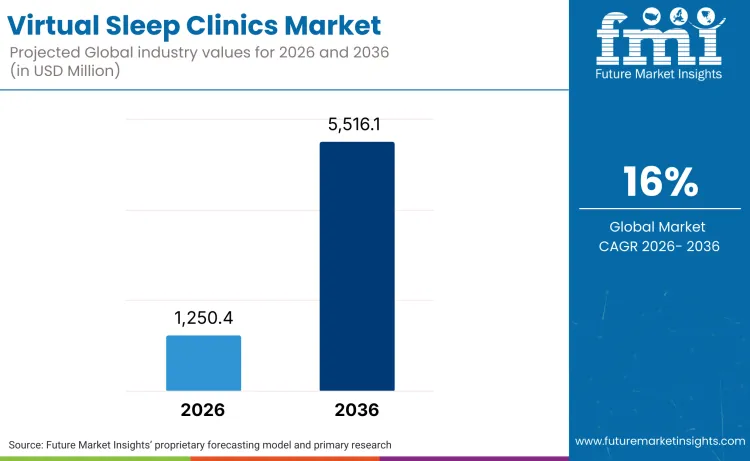
The global virtual sleep clinics sector is on track to achieve a valuation of USD 5,516.1 million by 2036, accelerating from USD 1,250.4 million in 2026 at a CAGR of 16.0%. As per Future Market Insights, expansion is structurally underpinned by payer recognition of remote patient monitoring reimbursement codes that validate telemedicine-delivered sleep care within traditional medical billing frameworks. ResMed Inc. reported in its fiscal 2024 annual filing that the company's digital health and software-as-a-service offerings continue expanding, with management noting that connected care solutions are addressing the substantial unmet need in sleep disorder diagnosis and treatment adherence, though specific virtual clinic revenue was not disclosed separately as it represents an integrated component of the broader sleep health ecosystem.
AI is strengthening virtual sleep clinics by automating sleep staging, detecting apnea from home monitoring data, and enabling continuous remote assessment through connected wearables. Predictive models personalize therapy pathways and adherence support, while automation streamlines clinical workflows. These capabilities expand access to specialist-grade sleep care without dependence on physical sleep laboratories.
"AI is reshaping healthcare - but its future depends on trust, transparency and collaboration with clinicians and patients," said Jeff DiLullo, Chief Region Leader, Philips North America. "Together, we can unlock AI’s potential to reduce provider burnout and elevate patient care."
The operational reality for healthcare providers is defined by the need to balance clinical workflow integration with technology platform selection, as physicians require virtual sleep systems that synchronize with existing electronic health records rather than creating parallel documentation systems. Food and Drug Administration regulatory pathways for Software as a Medical Device continue expanding qualification criteria for digital sleep therapeutics, creating compliance advantages for platforms that secure FDA clearance or approval rather than operating as unregulated wellness applications. This regulatory evolution is accelerating investment in clinical trial data generation that validates algorithmic diagnostics and digital interventions through randomized controlled studies rather than retrospective observational research.
Summary of Virtual Sleep Clinics Market
What Is Growth Outlook for Virtual Sleep Clinics Market as per Future Market Insights Projection?
Future Market Insights projects the virtual sleep clinics market to expand at a CAGR of 16.0% from 2026 to 2036, increasing from USD 1,250.4 Million in 2026 to USD 5,516.1 Million by 2036.
FMI Research Approach: FMI proprietary forecasting model based on telemedicine adoption curves, sleep disorder prevalence data, reimbursement policy analysis, and connected medical device penetration rates across Medicare and commercial payer populations.
How Do FMI Analysts Perceive Virtual Sleep Clinics Market to Evolve?
FMI analysts perceive the market evolving toward integrated sleep health ecosystems where diagnostic home testing, telehealth consultation, remote device monitoring, and digital cognitive behavioral therapy operate through unified platforms that connect patients, primary care physicians, sleep specialists, and durable medical equipment suppliers within continuous care coordination workflows.
FMI Research Approach: Healthcare delivery model transformation tracking and chronic disease management digitalization trend analysis across respiratory and neurological therapeutic areas.
Which Country Holds Largest Share in Global Virtual Sleep Clinics Market?
The United States holds a significant share of the global virtual sleep clinics market by value which is supported by Medicare remote patient monitoring reimbursement codes implemented in 2019-2022 and commercial insurer telemedicine parity laws enacted across 48 states that mandate coverage equivalence between virtual and facility-based sleep services.
FMI Research Approach: FMI country-level revenue modeling by telemedicine regulatory frameworks, sleep disorder diagnosis rates, physician reimbursement structures, and digital health infrastructure maturity. Digital health market analysis informs cross-category telemedicine adoption modeling.
How Large Will Virtual Sleep Clinics Market Be by 2036?
The global virtual sleep clinics market is projected to reach USD 5,516.1 Million by 2036.
FMI Research Approach: FMI long-term revenue forecast derived from sleep disorder treatment gap analysis, telehealth penetration projections, connected device ecosystem expansion, and payer coverage policy evolution across government and commercial insurance segments.
What Is Definition of Virtual Sleep Clinics Market?
The virtual sleep clinics market comprises revenue generated from telemedicine-delivered sleep disorder diagnosis, treatment initiation, and ongoing management services that utilize home sleep apnea testing devices, telehealth consultation platforms, remote positive airway pressure therapy monitoring systems, and digitally-delivered cognitive behavioral therapy for insomnia programs coordinated through integrated care platforms.
FMI Research Approach: FMI market taxonomy and inclusion-exclusion framework aligned with telemedicine classification standards
and remote patient monitoring service definitions established by Centers for Medicare & Medicaid Services billing guidelines.
What Are Globally Unique Trends Shaping Virtual Sleep Clinics Market?
Globally unique trends include integration of consumer wearable sleep tracking data from Apple Watch and Fitbit devices into clinical decision workflows where physicians utilize longitudinal sleep pattern data for diagnosis refinement, the emergence of hybrid care models where patients alternate between virtual consultation and in-person visits based on clinical complexity, and artificial intelligence-powered automated sleep study interpretation that reduces specialist physician time requirements for home sleep test analysis from 45 minutes to under 10 minutes per case.
FMI Research Approach: Consumer health technology convergence tracking and medical device ecosystem analysis
examining professional-grade diagnostic equipment integration with consumer wellness platforms.
Virtual Sleep Clinics Market Key Takeaways
| Metric | Value |
|---|---|
| Market Value (2026) | USD 1,250.4 million |
| Market Forecast Value (2036) | USD 5,516.1 million |
| Forecast CAGR (2026-2036) | 16.0% |
Source: Future Market Insights (FMI) analysis, based on proprietary forecasting model and primary research
Which Factors Propel Adoption of Virtual Sleep Clinics?
Reimbursement policy evolution serves as the primary catalyst for virtual sleep clinic adoption, as government and commercial payers implement billing codes that compensate physicians for remote patient monitoring, telehealth consultation, and home sleep test interpretation at rates approaching traditional facility-based polysomnography services. Centers for Medicare & Medicaid Services introduced CPT codes 99453-99454 for remote physiologic monitoring device supply and initial patient education combined with codes 99457-99458 for treatment management services, creating predictable revenue streams that justify healthcare system investment in virtual sleep infrastructure. This payment framework eliminates earlier economic barriers where telemedicine services generated professional satisfaction but negative operating margins, converting virtual care from mission-driven programs into financially sustainable service lines that compete favorably with traditional sleep lab economics.
Physician workforce shortages in sleep medicine are accelerating virtual clinic adoption as healthcare systems confront 3-6 month wait times for facility-based sleep studies that delay treatment initiation and worsen patient outcomes. Virtual platforms enable primary care physicians to initiate diagnostic evaluation and uncomplicated obstructive sleep apnea treatment without specialist referral, reserving sleep medicine consultations for complex cases involving multiple sleep disorders or treatment-resistant patients. This care pathway redesign is expanding diagnostic capacity through workforce multiplication rather than specialist recruitment. Manufacturers are also devising advanced conversational apps to enhance patient experience due to the advent of conversational AI in healthcare.
Patient preference for home-based care is amplifying virtual clinic adoption as consumers avoid facility overnight stays that disrupt sleep routines and create childcare complications. Sleep studies conducted in unfamiliar laboratory environments frequently produce first-night effects where anxiety and environmental factors artificially reduce sleep quality, potentially generating false-negative results that delay diagnosis. Home sleep apnea testing performed across multiple nights in patients' natural sleep environments produces representative data while eliminating facility scheduling constraints. Direct-to-consumer platforms including Lofta and SleepTest.com are demonstrating market demand for self-initiated sleep evaluation outside traditional physician-referral pathways, indicating consumer willingness to pay USD 189-399 out-of-pocket for convenient home testing when insurance authorization processes create access delays.
How is the Virtual Sleep Clinics Market Segmented?
The overall segmentation outlook reveals a market concentrated in obstructive sleep apnea diagnosis and treatment monitoring, which represents 58% of clinical indications due to high disorder prevalence and established evidence supporting home testing equivalence to laboratory polysomnography for uncomplicated cases. While service volume is driven by tele-consultation and home sleep testing that initiate patient engagement, the value is increasingly concentrated in remote positive airway pressure monitoring and care coordination services that generate recurring monthly revenue through chronic disease management rather than episodic diagnostic fees. The industry is currently witnessing integration across service components where platforms that initially offered single services like home testing or telehealth consultation are building comprehensive ecosystems that bundle diagnosis, treatment initiation, device monitoring, and behavioral therapy into integrated care pathways. This shift is most visible among medical device manufacturers including ResMed and Philips Respironics that are leveraging installed bases of connected PAP devices to offer virtual clinic services directly to patients and healthcare systems, creating vertical integration that captures diagnostic and therapeutic service revenue alongside traditional equipment sales.
Why Does Tele-Consultation Hold a Dominant Service Component Share?
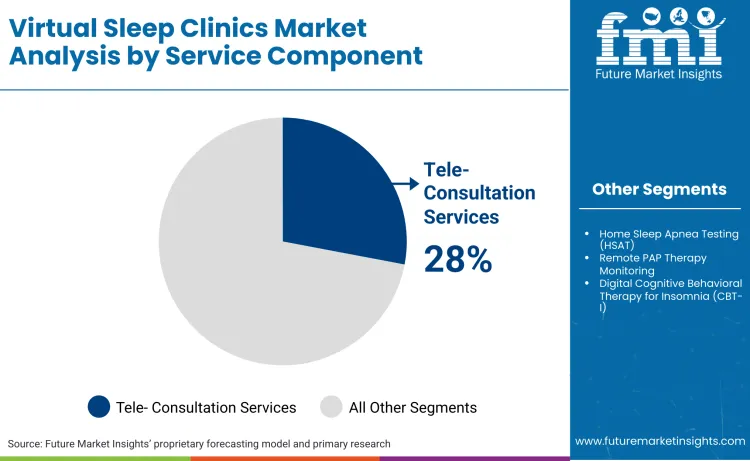
The dominance of tele-consultation services, capturing 28% of the service component market, is fueled by reimbursement parity laws across 48 USA states that mandate commercial insurers compensate virtual physician visits equivalent to in-person consultations, eliminating payment differentials that previously disadvantaged telemedicine. This broad adoption positions tele-consultation as the entry service that initiates patient engagement before additional virtual clinic components including home testing, device monitoring, or digital therapy are introduced, creating sequential service attachment opportunities that increase per-patient lifetime value beyond initial consultation revenue. ResMed’s platform explicitly includes virtual sleep consultations and partnerships with telehealth providers to connect patients with licensed clinicians for remote sleep care and diagnostics.
Why Does Obstructive Sleep Apnea Dominate Clinical Indication Segments?
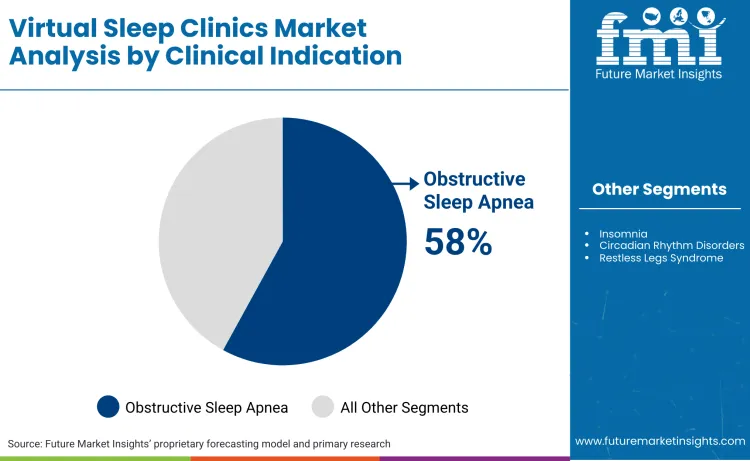
Obstructive sleep apnea maintains 58% of clinical indications share due to the condition's prevalence among adults aged 50-70 years, combined with established clinical validation that home sleep apnea testing achieves diagnostic accuracy comparable to laboratory polysomnography for patients with high pre-test probability and no significant comorbid conditions.
Food and Drug Administration clearance for multiple home sleep testing devices creates regulatory pathways that support virtual OSA diagnosis, whereas insomnia and circadian rhythm disorders lack equivalent home diagnostic technologies and require clinical assessment through patient-reported outcomes. Medicare coverage for home sleep testing since 2008 under Local Coverage Determinations provides payment certainty that supports virtual OSA care workflows, positioning this clinical indication as the anchor application that subsidizes platform development for additional sleep disorders requiring more complex evaluation approaches.
What Trends Are Shaping Industry Evolution?
The psychology of the patient has shifted toward expecting on-demand access to medical expertise, as experience with retail telemedicine for acute care conditions including urinary tract infections and upper respiratory infections establishes consumer expectations that all medical services should offer virtual options. This behavioral shift is driving healthcare systems to offer virtual sleep consultations within 48-72 hours of patient request rather than traditional 8-12 week scheduling windows for facility sleep studies, eliminating wait times that historically resulted in diagnostic abandonment rates exceeding 30% among referred patients who never completed facility appointments. The trend toward immediate access particularly favors commercial virtual sleep clinic operators like Lofta that fulfill home testing device orders within 24 hours using distributed warehouse networks, competing directly with hospital-based programs constrained by centralized equipment inventories and weekday-only shipping operations.
The regulatory frontier is focused on artificial intelligence applications where machine learning algorithms interpret home sleep study data, identify sleep stage patterns, and recommend treatment approaches with minimal physician oversight. Platforms achieving FDA clearance for automated sleep study interpretation are capturing competitive advantages, as physicians preferentially adopt validated technologies over unregulated wellness applications lacking clinical evidence. EnsoData's FDA-cleared sleep scoring algorithm demonstrates this trend, processing home and laboratory sleep studies in under 5 minutes compared to 45-minute manual interpretation, enabling sleep centers to increase diagnostic throughput without proportional physician workforce expansion.
How Will Virtual Sleep Clinics Market Expansion Unfold Across Key Global Regions?
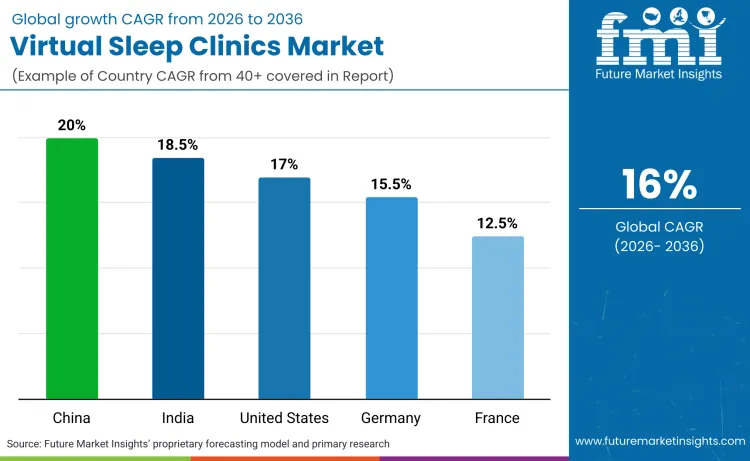
The virtual sleep clinics market is poised for significant expansion across key global regions, with varying growth rates projected from 2026 to 2036. China leads the way with a CAGR of 20.0%, driven by government digital health infrastructure investment and expanding urban populations experiencing sleep disorder prevalence increases linked to work stress. India follows at 18.5%, benefiting from smartphone penetration enabling telemedicine access and private healthcare system technology adoption.
The United States records 17.0% growth, reflecting Medicare remote monitoring reimbursement and commercial insurer telemedicine parity laws. Germany is anticipated to grow at 15.5%, driven by Digital Healthcare Act reimbursement frameworks and social health insurance system digital therapeutic adoption. France at 12.5% growth reflects public health system evaluation of virtual care effectiveness. The United Kingdom at 11.0% demonstrates National Health Service digital health integration initiatives. Brazil at 9.5% growth shows private insurance expansion and metropolitan hospital system telemedicine infrastructure investments.
| Country | CAGR (2026-2036) |
|---|---|
| China | 20.0% |
| India | 18.5% |
| United States | 17.0% |
| Germany | 15.5% |
| France | 12.5% |
Source: Future Market Insights (FMI) analysis, based on proprietary forecasting model and primary research
How is Government Digital Health Infrastructure Fueling China's 20.0% Growth?
With a projected expansion rate of 20.0% annually, China stands as the fastest-growing market for virtual sleep clinics globally. The connectivity foundation is attracting domestic technology companies including Alibaba Health and Tencent Healthcare to develop virtual sleep clinic platforms integrated with existing online pharmacy and health management applications that serve 480 million registered users. Provincial governments are establishing internet hospital licenses that authorize online consultation and electronic prescription issuance, removing regulatory barriers that previously restricted telemedicine to follow-up care for established patients.
Virtual platforms are positioning themselves as diagnostic capacity solutions that extend specialist sleep physician expertise through supervised primary care provider networks rather than requiring facility-based polysomnography for every suspected case. Ambitious plans such as the Healthy China Initiative 2030 are boosting the demand for virtual sleep clinics.
Why is Smartphone Penetration Enabling India's 18.5% Expansion?
India's market growth at 18.5% CAGR shows accelerating adoption of mobile-first telemedicine platforms where virtual sleep clinics operate through smartphone applications that eliminate desktop computer and broadband internet requirements that limit rural access. This mobile connectivity is enabling asynchronous consultation models where patients record symptom videos, upload sleep diary data, and receive physician responses within 24 hours rather than requiring synchronous video appointments constrained by mutual scheduling availability.
The government’s eSanjeevani national telemedicine service continues to scale, providing widespread outpatient teleconsultations and transforming primary healthcare delivery. It is a cutting-edge cloud-based telemedicine platform that has redefined the landscape of healthcare accessibility in India.
How Does Medicare Reimbursement Support USA's 17.0% Growth?
The USA market maintains substantial scale with 17.0% CAGR, driven by Centers for Medicare & Medicaid Services' establishment of Remote Patient Monitoring CPT codes 99453-99458 in 2019-2022 that compensate physicians monthly for each patient receiving continuous device monitoring and clinical data review. The American Academy of Sleep Medicine successfully advocated for permanent telehealth flexibility following COVID-19 public health emergency expiration, securing legislation that maintains virtual sleep medicine consultation reimbursement without geographic restrictions or originating site requirements that previously limited telemedicine to rural areas and institutional facilities. This regulatory permanence provides healthcare systems confidence to invest in virtual clinic infrastructure knowing payment policies will remain stable rather than reverting to pre-pandemic constraints, accelerating capital allocation toward integrated care platforms that combine home testing, telehealth, and remote monitoring into complete sleep disorder management pathways.
How is DiGA Framework Driving Germany's 15.5% Growth?
Germany's market expansion at 15.5% CAGR is structurally supported by the Digital Healthcare Act (Digitale-Versorgung-Gesetz) implemented in 2020 which created the DiGA (Digitale Gesundheitsanwendungen) pathway where approved digital therapeutic applications receive statutory health insurance reimbursement equivalent to pharmaceutical medications.
Germany is seeing rising demand for virtual sleep clinics as sleep disorders gain wider clinical attention. Urban lifestyles, extended screen exposure, and work related stress are increasing reports of insomnia and sleep apnea. Public awareness campaigns and physician guidance encourage early diagnosis, while digital triage tools make access easier for patients who face long waiting times for specialist appointments. Teleconsultations help extend reach into semi urban regions where sleep labs remain limited. Employers and insurers are also supporting remote care models to reduce productivity losses linked to fatigue.
What Drives France's 12.5% Public Health System Evaluation?
France's growth at 12.5% CAGR demonstrates growth in the virtual sleep clinics market as awareness of sleep related conditions increases among both patients and healthcare providers. Busy urban lifestyles and stress associated with work contribute to rising incidence of insomnia, sleep apnea, and other disorders. Patients seek convenient access to specialist care without long travel times or waiting lists. Telehealth adoption is increasing as digital confidence grows across age groups and healthcare systems expand remote consultation services.
Healthcare reforms and improved reimbursement for telemedicine services support provider participation. Integration of connected devices and home based sleep testing enables accurate monitoring and personalised follow up care, enhancing patient engagement and outcomes. Healthcare reforms and improved reimbursement for telemedicine services support provider participation. Integration of connected devices and home based sleep testing enables accurate monitoring and personalised follow up care, strengthening continuity of treatment. Digital literacy among older adults is improving, which supports broader adoption of remote sleep care pathways.
What Strategic Moves Are Defining Competitive Landscape?
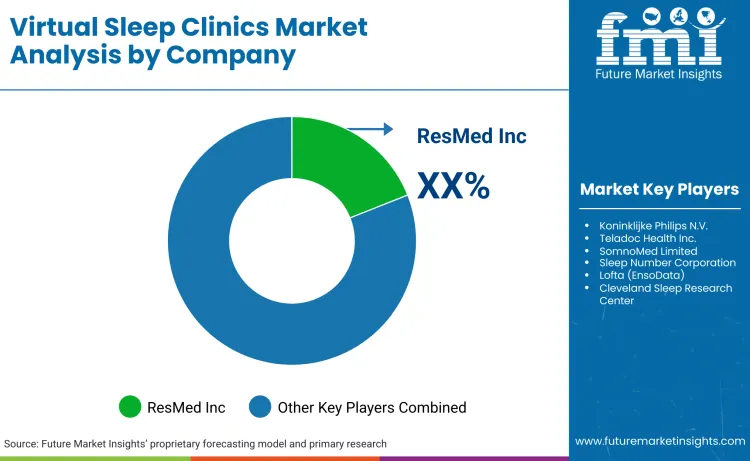
The competitive landscape is experiencing vertical integration as medical device manufacturers acquire telehealth platforms and digital therapeutic companies to build comprehensive sleep disorder management ecosystems that generate recurring subscription revenue beyond one-time equipment sales. ResMed's strategic investments in software development and cloud-based monitoring platforms demonstrate industry movement toward integrated solutions that combine hardware, software, and clinical services. Manufacturers are establishing direct-to-consumer channels that bypass traditional durable medical equipment supplier distribution, enabling brands to control patient relationships from initial diagnosis through long-term therapy management while capturing service margins historically retained by intermediaries.
Operational strategies are shifting toward artificial intelligence deployment where machine learning algorithms automate sleep study interpretation, reducing specialist physician time requirements from 45 minutes to under 10 minutes per case while maintaining diagnostic accuracy validated through FDA clearance processes. Sleep disorder treatment
Partnership models are emerging between technology companies and healthcare delivery systems where platforms provide software infrastructure while hospital networks contribute clinical expertise and patient populations. Healthcare IT ecosystem integration requirements are driving interoperability investments that enable virtual sleep platforms to exchange data with electronic health records, billing systems, and population health management tools rather than operating as isolated point solutions.
Recent Developments:
- In May 2025, Resmed acquired VirtuOx, a leading independent diagnostic testing facility (IDTF) for sleep, respiratory, and cardiac conditions.
- In April 2025, Teladoc Health acquired UpLift, an innovative and tech-enabled provider of virtual mental health therapy, psychiatry and medication management services to broaden its portfolio.
Key Players in Virtual Sleep Clinics Market
- ResMed Inc.
- Koninklijke Philips N.V.
- Teladoc Health Inc.
- SomnoMed Limited
- Sleep Number Corporation
- Lofta (EnsoData)
- Cleveland Sleep Research Center
- American Academy of Sleep Medicine
- SleepScore Labs
- Nox Medical
Market Definition
The virtual sleep clinics market represents revenue generated from telemedicine-delivered sleep disorder diagnostic evaluation, treatment initiation, ongoing therapy monitoring, and care coordination services utilizing integrated platforms that combine home sleep testing devices, video consultation software, remote patient monitoring systems, and digital therapeutics. The market measures professional service fees, technology platform subscriptions, device rental revenue, and care coordination charges billed to patients, insurance payers, and healthcare institutions for remotely-delivered sleep medicine rather than facility-based polysomnography and in-person consultation.
Inclusions cover tele-consultation services where sleep specialists conduct remote patient evaluation and treatment planning via video platforms, home sleep apnea testing device provision and interpretation services, remote positive airway pressure therapy monitoring generating recurring per-patient monthly fees, digital cognitive behavioral therapy for insomnia delivered through software applications, and care coordination services managing patient engagement across diagnostic and therapeutic phases. It encompasses clinical indications including obstructive sleep apnea diagnosis and treatment management, insomnia evaluation and behavioral therapy, circadian rhythm disorder assessment, and restless legs syndrome management when delivered through virtual care platforms. End user segments include individual patients accessing services through physician referral or self-initiated pathways, healthcare provider organizations contracting for institutional virtual sleep programs, and insurance payers developing network alternatives to facility-based sleep services.
Exclusions include facility-based attended polysomnography conducted in hospital sleep laboratories and in-person sleep medicine consultations without telemedicine components. Consumer wellness applications providing sleep tracking without medical diagnostic claims fall outside scope. Pharmaceutical medications for sleep disorders are excluded. Surgical interventions and dental appliance therapy for sleep-disordered breathing are not included even when initial diagnosis occurs virtually. Durable medical equipment sales are excluded when devices are sold through traditional channels without integrated virtual care services, though connected devices generating remote monitoring revenue are included.
Scope of the Report
| Items | Values |
|---|---|
| Quantitative Units | USD million |
| Service Component | Tele-Consultation Services; Home Sleep Apnea Testing (HSAT); Remote PAP Therapy Monitoring; Digital Cognitive Behavioral Therapy for Insomnia (CBT-I); Care Coordination Services |
| Clinical Indication | Obstructive Sleep Apnea (OSA); Insomnia; Circadian Rhythm Disorders; Restless Legs Syndrome; Other Sleep Disorders |
| End User | Individual Patients; Healthcare Provider Organizations; Insurance Payers |
| Technology Platform | Integrated Virtual Clinic Platforms; Standalone Telehealth Solutions; Remote Monitoring Systems; Digital Therapeutic Applications |
| Regions Covered | North America, Europe, East Asia, South Asia, Latin America, Middle East & Africa |
| Countries Covered | United States, Canada, Mexico, Germany, France, United Kingdom, Italy, Spain, Netherlands, China, Japan, South Korea, India, Australia, Brazil, Argentina, and 40+ countries |
| Key Companies Profiled | ResMed Inc.; Koninklijke Philips N.V.; Teladoc Health Inc.; SomnoMed Limited; Sleep Number Corporation; Lofta (EnsoData); Others |
| Additional Attributes | Revenue analysis by service component, clinical indication, and end user; performance in telemedicine delivery and remote patient monitoring across healthcare provider organizations, individual patient populations, and insurance payer networks; virtual care efficiency enhancement, diagnostic accuracy optimization, and platform benefits under telehealth applications; impact on patient outcomes, clinical workflow integration, and care coordination effectiveness during implementation processes; compatibility with electronic health records and reimbursement frameworks; adoption dynamics driven by Medicare coverage policies, physician workforce constraints, and patient preference for home-based care delivery models. |
Virtual Sleep Clinics Market by Segments
By Service Component:
- Tele-Consultation Services
- Home Sleep Apnea Testing (HSAT)
- Remote PAP Therapy Monitoring
- Digital Cognitive Behavioral Therapy for Insomnia (CBT-I)
- Care Coordination Services
By Clinical Indication:
- Obstructive Sleep Apnea (OSA)
- Insomnia
- Circadian Rhythm Disorders
- Restless Legs Syndrome
- Other Sleep Disorders
By End User:
- Individual Patients
- Healthcare Provider Organizations
- Insurance Payers
By Technology Platform:
- Integrated Virtual Clinic Platforms
- Standalone Telehealth Solutions
- Remote Monitoring Systems
- Digital Therapeutic Applications
By Region:
- North America (United States, Canada, Mexico)
- Europe (Germany, France, United Kingdom, Italy, Spain, Netherlands, Nordic Countries)
- East Asia (China, Japan, South Korea)
- South Asia (India, Australia & New Zealand, Southeast Asia)
- Latin America (Brazil, Argentina, Chile, Colombia)
- Middle East & Africa
Bibliography
- Centers for Medicare & Medicaid Services. (2022). Remote Patient Monitoring CPT Codes 99453-99458. CMS, USA Department of Health and Human Services.
- Food and Drug Administration. (2022). Software as a Medical Device (SaMD) Regulatory Framework. FDA, USA Department of Health and Human Services.
- American Academy of Sleep Medicine. (2023). Sleep Medicine Workforce and Access Report. AASM.
Frequently Asked Questions
What is the current global market size for virtual sleep clinics?
The global market is valued at USD 1,250.4 Million in 2026, driven by reimbursement policy evolution, physician workforce shortages, and patient preference for home-based care that eliminates facility overnight stays.
What is the projected Compound Annual Growth Rate (CAGR) for the market over the next 10 years?
The market is projected to grow at 16.0% CAGR from 2026 to 2036, reaching USD 5,516.1 Million by 2036.
Which regions are experiencing the fastest expansion?
China leads with 20.0% growth, followed by India at 18.5% and the United States at 17.0%, driven by digital health infrastructure investment, smartphone telemedicine access, and Medicare remote monitoring reimbursement respectively.
What are the primary market drivers?
Reimbursement policy evolution establishing billing codes for remote patient monitoring and physician workforce shortages creating 3-6 month wait times for facility-based sleep studies are fueling virtual clinic adoption across government and commercial insurance populations.
Who are the leading suppliers in the industry?
ResMed Inc., Koninklijke Philips N.V., Teladoc Health Inc., SomnoMed Limited, and Sleep Number Corporation are key players, differentiating through integrated device-software-service ecosystems, FDA-cleared AI diagnostic algorithms, and direct-to-consumer channels that bypass traditional distribution intermediaries.
Preview the report firsthand - request a free sample
Get SampleGet the brochure for pricing and purchase details.
Get PDFTable of Content
- Virtual Sleep Clinics Market Size and Share Forecast Outlook (2026 to 2036)
- Virtual Sleep Clinics Market Forecast and Outlook (2026-2036)
- Virtual Sleep Clinics Market Key Takeaways
- Key Shifts in the Virtual Sleep Clinics Market from 2026 to 2036
- Virtual Sleep Clinics Market Segmentation Analysis
- By Service Component
- Tele-Consultation Services
- Home Sleep Apnea Testing (HSAT)
- Remote PAP Therapy Monitoring
- Digital Cognitive Behavioral Therapy for Insomnia (CBT-I)
- Care Coordination Services
- By Clinical Indication
- Obstructive Sleep Apnea (OSA)
- Insomnia
- Circadian Rhythm Disorders
- Restless Legs Syndrome
- Other Sleep Disorders
- By End User
- Individual Patients
- Healthcare Provider Organizations
- Insurance Payers
- By Technology Platform
- Integrated Virtual Clinic Platforms
- Standalone Telehealth Solutions
- Remote Monitoring Systems
- Digital Therapeutic Applications
- By Region
- By Service Component
- Market Dynamics and Growth Analysis
- Growth Drivers
- Market Restraints
- Strategic Trends
- Virtual Sleep Clinics Market Global Analysis
- East Asia
- South Asia
- North America
- Europe
- Latin America
- Middle East & Africa
- Competitive Landscape Analysis
- Key Players in the Virtual Sleep Clinics Market
- Market Definition, Inclusion, and Exclusion Criteria
- Scope of the Virtual Sleep Clinics Market Report
- Virtual Sleep Clinics Market by Segment
- Bibliography
- Frequently Asked Questions (FAQs)


