

- Industry Size (2026)
- USD 0.74 Bn
- Forecast (2036)
- USD 3.5 Bn
- CAGR (2026 to 2036)
- 19.0%
Sleep Fragmentation Analytics Market Forecast and Outlook 2026 to 2036
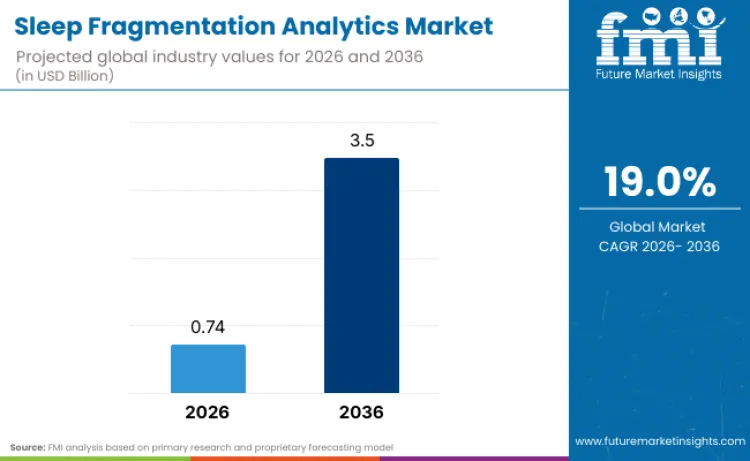
The global sleep fragmentation analytics market is forecasted to reach USD 0.74 billion in 2026 and expand to USD 3.5 billion by 2036, advancing at a CAGR of 19.0%. As per FMI, this outlook shows a transformation in digital health toward sleep-first approaches, where traditional wellness monitoring pipelines are transitioning toward sleep fragmentation-based health platforms. Expansion is driven by the rising complexity of sleep disorder identification pipelines, with consumer technology companies and healthcare organizations embracing specialized sleep analytics across research institutions globally.
By leveraging machine learning algorithms and continuous monitoring, researchers can now perform comprehensive sleep pattern analysis that evaluates millions of micro-arousal events for health risk correlation and sleep quality assessment before any clinical intervention occurs. This computational insight allows for the rapid identification of high-risk sleep patterns and the design of personalized sleep optimization protocols that were previously considered impossible to implement, effectively shortening diagnosis timelines and reducing the heavy clinical burden of undiagnosed sleep disorders.
Companies are also investing heavily in AI to enhance sleep analytics capabilities. Sleep technology providers are integrating advanced signal processing algorithms with consumer-grade sensors to deliver clinical-quality sleep fragmentation analysis directly to users. In September 2025, ResMed launched Sleep Institute to elevate sleep health as a global priority.
“There is a clear and urgent need to close the diagnosis gap in sleep disorders such as OSA,” said Michelle R. Zeidler, MD, symposium panelist. “Sleep Institute’s focus on translating evidence into action will help clinicians, policymakers, and health systems take meaningful steps toward earlier detection and more personalized care.”
The industry's value proposition is shifting from basic sleep tracking toward precision-focused health monitoring positioning. Advanced analytics providers are integrating comprehensive arousal detection techniques, streamlined data visualization systems, and flexible platform designs to reduce diagnostic standardization challenges while improving sleep quality specificity. Health-positioned brands and specialized analytics organizations are gaining preference, enabling direct consumer partnerships and customized monitoring services across healthcare and wellness channels.
Summary of Sleep Fragmentation Analytics Market
What is the growth outlook on the sleep fragmentation analytics market? Future Market Insights projects the market to grow at a 19.0% CAGR from 2026 to 2036, expanding from USD 0.74 billion to USD 3.5 billion.
FMI research approach: Bottom-up analytics revenue modeling, platform-weighted consumer technology analysis, wearables adoption intensity assessment, and AI-led sleep analysis scenario modeling.
How do FMI analysts perceive the sleep fragmentation analytics market to evolve? The market is expected to move from basic sleep tracking services toward AI-enabled precision platforms integrating arousal detection, risk scoring, and autonomous health monitoring.
FMI research approach: Machine learning integration transition analysis, AI workflow mapping, wearable device demand assessment, and predictive health analytics benchmarking.
Which country holds the largest share in the sleep fragmentation analytics market? The United States accounts for the largest global value share.
FMI research approach: Country-level consumer technology and healthcare revenue modeling, digital health adoption concentration analysis, wearables penetration scoring, and healthcare spending density evaluation.
How large will the sleep fragmentation analytics market be by 2036? The global market is forecast to reach USD 3.5 billion by 2036.
FMI research approach: Long-term forecasting by analytics type and health application focus, optimization demand scaling, consumer technology revenue inclusion, and historical adoption validation.
What is the market definition of sleep fragmentation analytics? It covers technology services supporting sleep pattern analysis, arousal detection, health risk scoring, and sleep quality assessment for consumer and clinical use.
FMI research approach: Market taxonomy validation, inclusion-exclusion structuring, application mapping by health condition, and platform scope filtering.
What globally unique trends are shaping the sleep fragmentation analytics market? Key trends include consumer wearables integration, AI-driven pattern recognition, and healthcare momentum toward preventive sleep medicine.
FMI research approach: Wearable platform adoption tracking, machine learning algorithm expansion analysis, healthcare pathway monitoring, and consumer-focused competitive assessment.
Sleep Fragmentation Analytics Market Key Takeaways
| Metric | Value |
|---|---|
| Market Value (2026) | USD 0.74 billion |
| Market Forecast Value (2036) | USD 3.5 billion |
| Forecast CAGR (2026-2036) | 19.0% |
Source: Future Market Insights (FMI) analysis, based on proprietary forecasting model and primary research
What is Driving the Demand for Sleep Fragmentation Analytics?
Demand for sleep fragmentation analytics services is being propelled by the broad consumer shift toward healthcare analytics, proactive health monitoring paradigms, and the escalating complexity of sleep-related health conditions such as sleep apnea, insomnia, and cardiometabolic disorders, which require advanced detection, analysis, and monitoring platforms. The rapid integration of artificial intelligence and machine learning into consumer wearables has amplified demand for real-time sleep analysis and predictive health assessment, enabling users to identify sleep issues early and optimize sleep quality.
The healthcare momentum toward preventive medicine, exemplified by increased focus on sleep health in clinical guidelines, is driving widespread adoption of consumer sleep monitoring and professional-grade analytics systems in healthcare workflows, increasing procurement of specialized analytics services. At the same time, consumer technology investment patterns, including expanded wearable device capabilities in global markets, are shifting innovation toward accessible, high-accuracy sleep monitoring, underscoring a sustained demand trajectory rooted in precision health monitoring and predictive wellness.
How is the Sleep Fragmentation Analytics Market Segmented?
The sleep fragmentation analytics market has been segmented based on analytics products, use cases, end user, and region. In terms of analytics products, the market is divided into wearable-derived sleep fragmentation algorithms, clinical sleep lab analytics software, population health sleep risk scoring, API/data platforms for digital therapeutics, and research-grade analytics services.
By use cases, the market is divided into sleep apnea severity and arousal burden analytics, insomnia micro-arousal and efficiency tracking, cardiometabolic risk stratification, mental health/stress monitoring, and athletic recovery and performance analytics. By end user, the market is segmented into consumer wearables platforms, hospitals/sleep labs, digital health/DTx companies, payers/employers, and research institutions. Regionally, the market is divided into North America, Europe, East Asia, South Asia, Latin America, and Middle East and Africa.
Why Do Wearable-Derived Sleep Fragmentation Algorithms Dominate the Sleep Fragmentation Analytics Market?
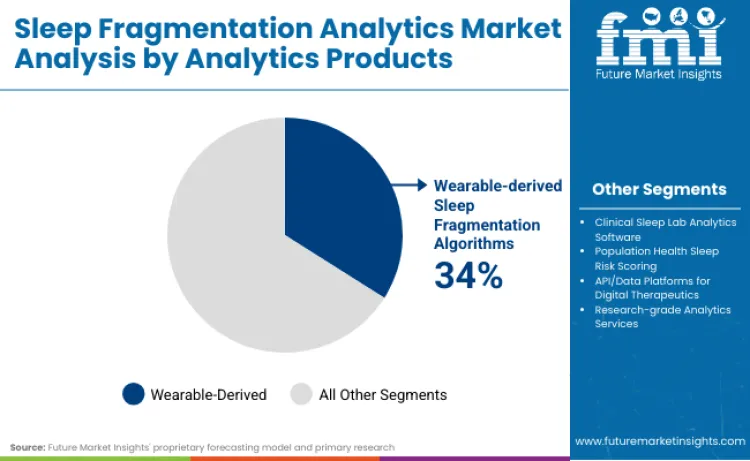
Wearable-derived sleep fragmentation algorithms continue to lead the market, accounting for 34.0% of the share, driven by their widespread use in consumer health monitoring, sleep quality optimization, and early health risk detection. This analytics type offers the foundation needed for all subsequent health monitoring activities, making it essential for consumer technology, healthcare, and wellness organizations. Clinical sleep lab analytics software captures 22.0% of the market, supporting the conversion of consumer sleep data into clinical-grade assessments for diagnostic applications.
Their precision is critical for bridging consumer monitoring with professional healthcare while maintaining clinical accuracy. Population health sleep risk scoring services, holding 16.0% of the market, remain a popular choice for healthcare organizations, offering scalable solutions for population health studies where comprehensive sleep health assessment is required.
These services are popular because they serve as a critical health monitoring strategy in an increasingly prevention-focused healthcare market. Specialized service providers integrate advanced signal processing, machine learning algorithms, and clinical validation to identify high-quality sleep patterns while filtering out measurement artifacts and false positives early. This approach reduces costly healthcare interventions and enables proactive health management, allowing healthcare organizations to remain cost-effective and focus resources on preventive care rather than reactive treatment protocols.
How Do Use Case Requirements Influence Sleep Fragmentation Analytics Service Selection?
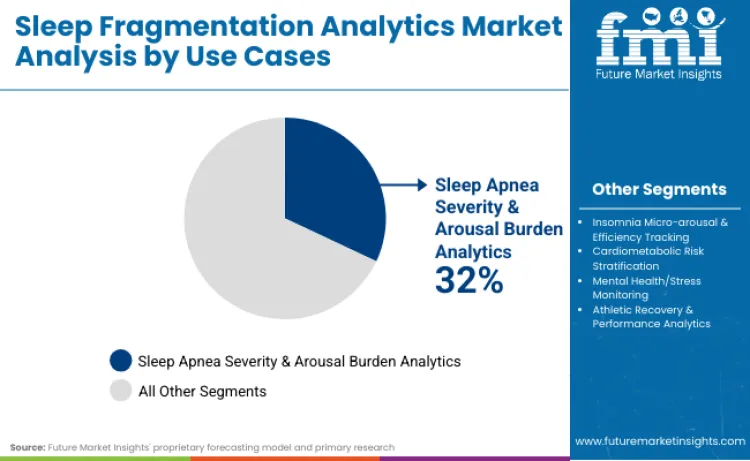
Sleep apnea severity and arousal burden analytics stands as the dominant segment, commanding 32.0% of the market share. Sleep fragmentation analytics remains centered on sleep apnea due to the critical health implications these conditions have for cardiovascular health and quality of life.
Sleep apnea patients often display unique arousal patterns and fragmentation signatures that serve as specific indicators for condition severity, allowing for targeted monitoring that identifies progression before clinical symptoms worsen. Analytics platforms are essential in this field to validate how these sleep patterns correlate within complex physiological systems, ensuring they can detect subtle changes and effectively support clinical decision-making to prevent serious complications.
The market is also heavily shaped by the development of next-generation analytics like multi-parameter sleep scoring and personalized health risk algorithms which require comprehensive validation to establish accurate diagnostic thresholds. Analytics platforms help researchers optimize the sensitivity of detection algorithms and the specificity of health risk predictions to prevent false alerts that could lead to unnecessary healthcare utilization. By using advanced systems such as continuous monitoring and machine learning validation, developers can predict health outcomes and identify potential complications long before symptoms appear, making these services a critical investment for modern preventive healthcare.
How Is Technological Evolution Reshaping Sleep Fragmentation Analytics?
The sleep fragmentation analytics sector is shifting from traditional sleep study approaches to integrated consumer platforms that combine continuous monitoring, AI-driven pattern recognition, and real-time health assessment. Strategic collaborations between wearable manufacturers and healthcare organizations are accelerating this transition.
This evolution brings sleep analytics workflows closer to clinical relevance by enabling more predictive health monitoring and earlier intervention using computational and consumer technology tools. Improved continuous monitoring reduces healthcare costs during diagnosis and treatment phases. The ability to advance sleep health insights with defined accuracy and clinical validation profiles is reshaping healthcare decision making, allowing providers to prioritize interventions with stronger preventive and patient engagement readiness.
What Role Does Regulatory and Standards Maturation Play in Technology Innovation?
Greater regulatory clarity around consumer health monitoring is stabilizing investment conditions for sleep analytics laboratories and enabling more confident platform expansion. Clearer regulatory expectations are lowering entry barriers for specialized technology companies to deploy advanced sleep analytics technologies such as AI-driven pattern recognition, multi-parameter health scoring, and real-time risk assessment for clinical integration. Companies are increasingly adopting platform-based workflows that can be validated once and reused across health applications, supporting faster commercialization pathways and sustained innovation in complex sleep analytics formats.
How Is the Sleep Fragmentation Analytics Market Evolving Globally?
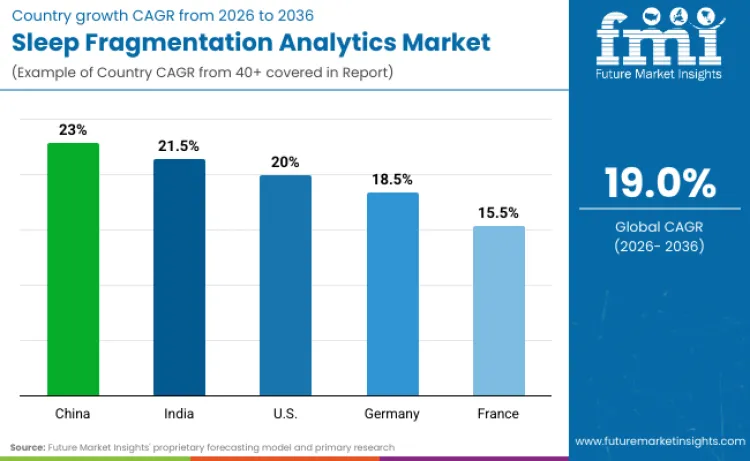
Global demand for sleep fragmentation analytics services is increasing as consumers expand health monitoring capabilities while addressing sleep optimization, health risk assessment, and wellness tracking application requirements. Growth demonstrates rising use of AI-driven analytics platforms, consumer-focused service positioning, and accuracy-optimized monitoring specifications across healthcare institutions, consumer technology companies, and wellness organizations.
Service selection focuses on analytics accuracy, health insight comprehensiveness, and platform performance under various consumer scenarios. China records 23.0% CAGR, India records 21.5% CAGR, U.S. records 20.0% CAGR, Germany records 18.5% CAGR, and France records 15.5% CAGR. Adoption remains driven by precision monitoring requirements and health analytics capabilities rather than volume expansion alone.
| Country | CAGR (2026-2036) |
|---|---|
| China | 23.0% |
| India | 21.5% |
| U.S. | 20.0% |
| Germany | 18.5% |
| France | 15.5% |
Source: FMI historical analysis and forecast data
China: How is the Rising Consumer Technology Development Infrastructure Driving Advanced Analytics Adoption?
The primary driver in China is the significant growth of domestic consumer technology development capabilities and digital health research institutions. With the expansion of wearable technology manufacturing facilities, Chinese metropolitan areas are now experiencing millions of new analytics platform implementations, making traditional sleep monitoring methods insufficient.
It has promoted advanced analytics platform adoption for domestic healthcare development to ensure monitoring capabilities and health innovation. Driven by this national scale of technology capability expansion, the Chinese sleep fragmentation analytics market is set to grow at a 23.0% CAGR during the study period, led by massive demand in consumer technology and healthcare sectors.
Over the next five years, the most significant opportunity lies in the integration of artificial intelligence-powered analytics platforms with mass-market wearable hardware. As China targets manufacturing leadership in consumer health technology, there is a burgeoning demand for specialized services that support complex monitoring like continuous sleep analysis and personalized health scoring.
India: Is the Digital Health Excellence Elevating Analytics Standards?
In India, the market is dominated by the evolution toward digital health excellence and precision-positioned analytics categories. This precision-first approach is essential for Indian consumers currently competing with international health monitoring standards in domestic healthcare applications. Reflecting this maturity, the Indian sleep fragmentation analytics market is projected to grow at a 21.5% CAGR during the study period.
Over the next five years, the rise of affordable wearable technology, supported by expanded manufacturing infrastructure, will necessitate high-precision sleep analytics services for real-time health monitoring and preventive care. Second, India's growing role as a global hub for healthcare technology outsourcing creates a massive opening for cost-effective analytics services tailored to consumer health optimization.
U.S.: How is the Consumer Health Focus Strategy Driving Wellness Technology?
The U.S. market is increasingly focused on the innovation and diversity of consumer health monitoring applications. This transition aims at reducing dependence on traditional healthcare models while improving domestic preventive care competitiveness. Supported by these health innovation mandates, the U.S. sleep fragmentation analytics market is set to grow at a 20.0% CAGR during the study period.
Over the next five years, the most significant opportunity lies in the mass adoption of AI-driven predictive health analytics and personalized wellness platforms. As healthcare organizations increasingly validate consumer monitoring for clinical applications, there is a burgeoning market for high-accuracy, sleep-based health analytics that can simulate clinical assessments. The integration of consumer wearables into healthcare workflows will allow U.S. firms to leverage vast, secure health data networks to design optimized wellness programs, effectively reducing traditional healthcare costs and establishing a new global benchmark for preventive health productivity.
Germany: Is the Health Technology Innovation Strategy Revitalizing Analytics Capabilities?
In Germany, the market is being revitalized by the "Health Technology Innovation" initiative, which integrates advanced analytics methods and automated monitoring integration into consumer health platform positioning. A major development is healthcare institutions and technology companies upgrading to precision-positioned analytics platforms that feature innovation excellence to compete against standard monitoring methods in domestic health applications. As German institutions prioritize technology innovation and health excellence, the German sleep fragmentation analytics market is set to grow at an 18.5% CAGR during the study period, focusing heavily on precision and analytics capability enhancement.
Over the next five years, the most lucrative opportunities reside in the convergence of digital health and preventive medicine. As the German government streamlines regulatory barriers for consumer health technology, there is a significant opening for firms to develop artificial intelligence-integrated services that support personalized wellness and chronic disease prevention.
Who are the Major Players Active in the Sleep Fragmentation Analytics Market?
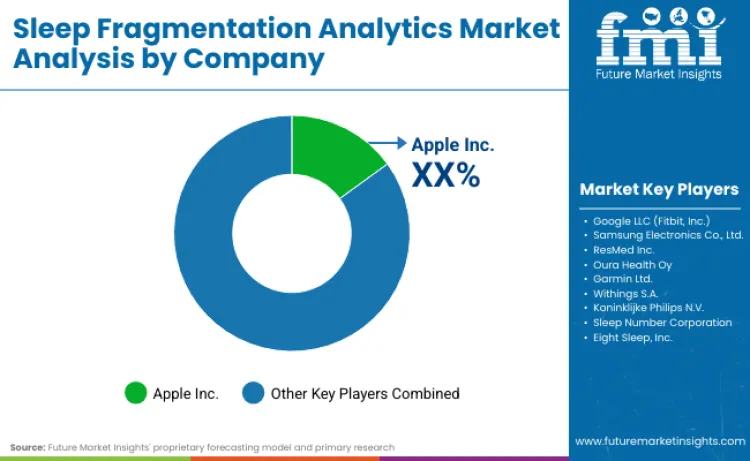
As consumer health monitoring becomes dominated by AI-driven analytics and continuous monitoring platforms, major players like Apple, Google (Fitbit), and Samsung Electronics are competing on their ability to offer comprehensive consumer health ecosystems. These technology giants are aggressively integrating artificial intelligence and machine learning to offer sleep analytics services, allowing smaller health technology firms to operate as specialized service providers without comprehensive hardware development. Success in this landscape is no longer measured just by a provider's sensor accuracy, but by their ability to generate actionable health insights using AI algorithms, thereby bypassing traditional clinical sleep study requirements.
The market is also witnessing a distinct regional divergence in competitive strategy. While North American firms like Apple and ResMed maintain dominance through high-value health integration and proximity to major healthcare systems, Asia-Pacific players, led by Samsung Electronics and emerging wearable manufacturers, are rapidly scaling their consumer analytics and affordable monitoring capabilities. This has created an "innovation arms race" where service providers are diversifying into niche areas such as personalized sleep coaching and advanced health risk prediction to capture the growing consumer health monitoring market.
Key Industry Developments:
- In July 2025, Garmin Ltd. acquired MYLAPS, a leading Dutch provider of integrated timing, live tracking and performance analysis tools to broaden its offerings.
- In May 2025, Resmed acquired VirtuOx, a leading independent diagnostic testing facility (IDTF) for sleep, respiratory, and cardiac conditions.
Key Players in the Sleep Fragmentation Analytics Market
- Apple Inc.
- Google LLC (Fitbit, Inc.)
- Samsung Electronics Co., Ltd.
- ResMed Inc.
- Oura Health Oy
- Garmin Ltd.
- Withings S.A.
- Koninklijke Philips N.V.
- Sleep Number Corporation
- Eight Sleep, Inc.
Market Definition
The sleep fragmentation analytics market refers to the global consumer technology and healthcare applications of specialized analytics platforms designed to support sleep pattern analysis, arousal detection, health risk assessment, and sleep optimization activities. It includes both consumer and clinical analytics offerings, with segments that cater to various health applications such as sleep disorders, cardiovascular health, and wellness optimization. The market size is measured in USD billion and analyzed over the 2026 to 2036 period.
The sleep fragmentation analytics market includes analytics types such as wearable-derived algorithms, clinical software, population health scoring, and API platforms, utilized through both consumer technology applications and healthcare monitoring applications. The market is expanding due to growing interest in preventive health monitoring, analytics platform innovations, and evolving consumer requirements toward higher-efficiency and more specialized sleep health assessment capabilities.
Market Inclusion
Included in the sleep fragmentation analytics market scope are analytics services categorized by type (wearable algorithms, clinical software, health scoring, and specialized platforms), with segmentation based on use cases (sleep disorders, cardiovascular health, wellness monitoring), user focus (consumer, healthcare, research), and monitoring requirements (accuracy, comprehensiveness, real-time capability). The scope includes sleep analytics platforms with a focus on health precision, monitoring capabilities, and analytics innovation, particularly those marketed through consumer technology providers, healthcare institutions, and wellness organizations.
Geographically, the market encompasses key regions such as North America, Europe, East Asia, South Asia, Latin America, and the Middle East and Africa, with country-level analysis for significant markets like China, India, U.S., Germany, and France.
Market Exclusion
Excluded from the sleep fragmentation analytics market scope are non-sleep health analytics platforms and monitoring methods not designed for sleep pattern assessment, such as general fitness tracking services, cardiac monitoring systems, and mental health-focused platforms. Additionally, services not intended for health or wellness applications are not included.
The market excludes non-analytics sleep products, as well as sleep-related products that are not marketed as analytics platforms, such as sleep aids or basic sleep tracking without fragmentation analysis. Products with non-compliant monitoring specifications or those that do not meet regional regulatory standards for health monitoring applications are outside the market's defined scope.
Scope of the Report
| Items | Values |
|---|---|
| Quantitative Units | USD billion |
| Analytics Products | Wearable-derived Sleep Fragmentation Algorithms; Clinical Sleep Lab Analytics Software; Population Health Sleep Risk Scoring; API/Data Platforms for Digital Therapeutics; Research-grade Analytics Services |
| Use Cases | Sleep Apnea Severity & Arousal Burden Analytics; Insomnia Micro-arousal & Efficiency Tracking; Cardiometabolic Risk Stratification; Mental Health/Stress Monitoring; Athletic Recovery & Performance Analytics |
| End User | Consumer Wearables Platforms; Hospitals/Sleep Labs; Digital Health/DTx Companies; Payers/Employers; Research Institutions |
| Regions Covered | North America, Europe, East Asia, South Asia, Latin America, Middle East & Africa |
| Countries Covered | China, India, U.S., Germany, France, and 40+ countries |
| Key Companies Profiled | Apple; Google (Fitbit); Samsung Electronics; ResMed; Oura Health; Others |
| Additional Attributes | Revenue analysis by analytics products, use cases, and end user; performance in health monitoring applications and assessment capabilities across consumer technology institutions, healthcare facilities, and wellness applications; analytics efficiency enhancement, assessment optimization, and platform benefits under health applications; impact on health outcomes, monitoring precision, and platform differentiation during procurement processes; compatibility with health protocols and monitoring preferences; procurement dynamics driven by precision positioning, health innovation programs, and long-term wellness partnerships. |
Sleep Fragmentation Analytics Market by Segment
Analytics Products:
- Wearable-derived Sleep Fragmentation Algorithms
- Clinical Sleep Lab Analytics Software
- Population Health Sleep Risk Scoring
- API/Data Platforms for Digital Therapeutics
- Research-grade Analytics Services
Use Cases:
- Sleep Apnea Severity & Arousal Burden Analytics
- Insomnia Micro-arousal & Efficiency Tracking
- Cardiometabolic Risk Stratification
- Mental Health/Stress Monitoring
- Athletic Recovery & Performance Analytics
End User:
- Consumer Wearables Platforms
- Hospitals/Sleep Labs
- Digital Health/DTx Companies
- Payers/Employers
- Research Institutions
Region:
- East Asia
- China
- Japan
- South Korea
- Taiwan
- Rest of East Asia
- Europe
- Germany
- United Kingdom
- France
- Italy
- Spain
- BENELUX
- Nordic
- Rest of Europe
- North America
- USA
- Canada
- Mexico
- South Asia
- India
- Australia & New Zealand
- Southeast Asia
- Rest of South Asia
- Latin America
- Brazil
- Chile
- Colombia
- Argentina
- Rest of Latin America
- Middle East & Africa
- Kingdom of Saudi Arabia
- Other GCC Countries
- Turkey
- South Africa
- Other African Union
- Rest of Middle East & Africa
Bibliography
- Consumer Sleep Monitoring Services: Assessment Guidelines. IDHTA.
- Global Consumer Technology Research Council. (2026). Platform Specifications for Sleep Analytics Products: Accuracy and Validation Requirements. GCTRC.
- Sleep Technology Research Institute. (2027). STRI Guidelines for Analytics Positioning in Sleep Health Assessment (updated precision specifications for consumer and healthcare applications). STRI.
- Chen, L. K., et al. (2026). Precision positioning effects of sleep analytics platforms on health monitoring enhancement: A comprehensive analysis of assessment accuracy and consumer health applications. Journal of Digital Health Research Methods, 28, 142-159.
- Thompson, R. A., et al. (2026). Fifth annual sleep fragmentation analytics market report: Special focus on consumer innovation and precision positioning in global health applications. International Health Technology Review, 31, 89-106.
Frequently Asked Questions
How big is the sleep fragmentation analytics market in 2026?
The global sleep fragmentation analytics market is estimated to be valued at USD 0.74 billion in 2026.
What will be the size of the sleep fragmentation analytics market in 2036?
The market size for the sleep fragmentation analytics market is projected to reach USD 3.5 billion by 2036.
How much will the sleep fragmentation analytics market grow between 2026 and 2036?
The sleep fragmentation analytics market is expected to grow at a 19.0% CAGR between 2026 and 2036.
What are the key analytics products in the sleep fragmentation analytics market?
The key analytics products in the sleep fragmentation analytics market include wearable-derived sleep fragmentation algorithms, clinical sleep lab analytics software, population health sleep risk scoring, and API/data platforms for digital therapeutics.
Which end user will contribute a significant share in the sleep fragmentation analytics market in 2026?
In terms of end user, the consumer wearables platforms segment is set to command a 34.0% share in the sleep fragmentation analytics market in 2026.
Preview the report firsthand - request a free sample
Get SampleGet the brochure for pricing and purchase details.
Get PDFTable of Content
- Sleep Fragmentation Analytics Market Size and Share Forecast Outlook (2026 to 2036)
- Sleep Fragmentation Analytics Market Forecast and Outlook (2026-2036)
- Sleep Fragmentation Analytics Market Key Takeaways
- Key Shifts in the Sleep Fragmentation Analytics Market from 2026 to 2036
- Sleep Fragmentation Analytics Market Segmentation Analysis
- By Analytics Products
- Wearable-derived Sleep Fragmentation Algorithms
- Clinical Sleep Lab Analytics Software
- Population Health Sleep Risk Scoring
- API/Data Platforms for Digital Therapeutics
- Research-grade Analytics Services
- By Use Cases
- Sleep Apnea Severity & Arousal Burden Analytics
- Insomnia Micro-arousal & Efficiency Tracking
- Cardiometabolic Risk Stratification
- Mental Health / Stress Monitoring
- Athletic Recovery & Performance Analytics
- By End User
- Consumer Wearables Platforms
- Hospitals / Sleep Labs
- Digital Health / DTx Companies
- Payers / Employers
- Research Institutions
- By Region
- By Analytics Products
- Market Dynamics and Growth Analysis
- Growth Drivers
- Market Restraints
- Strategic Trends
- Sleep Fragmentation Analytics Market Global Analysis
- East Asia
- South Asia
- North America
- Europe
- Latin America
- Middle East & Africa
- Competitive Landscape Analysis
- Key Players in the Sleep Fragmentation Analytics Market
- Market Definition, Inclusion, and Exclusion Criteria
- Scope of the Sleep Fragmentation Analytics Market Report
- Sleep Fragmentation Analytics Market by Segment
- Bibliography
- Frequently Asked Questions (FAQs)


