

- Industry Size (2026)
- USD 780.0 Mn
- Forecast (2036)
- USD 3160.0 Mn
- CAGR (2026 to 2036)
- 15.0%
On-Demand Warehousing Platforms Market Size, Market Forecast and Outlook By FMI
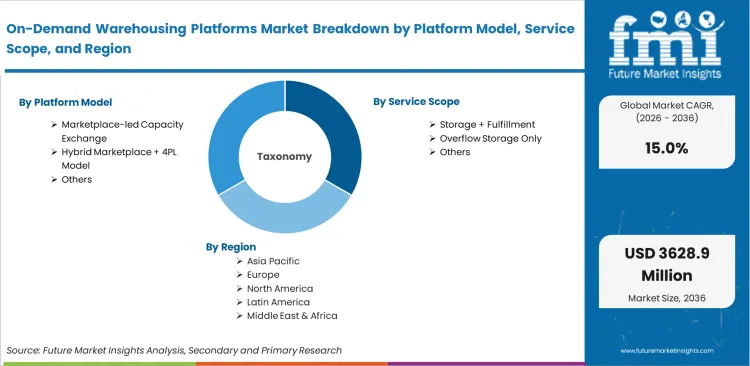
The on-demand warehousing platforms market crossed a valuation of USD 680.0 million in 2025. The industry is expected to reach USD 780.0 million in 2026 at a CAGR of 15.0% during the forecast period. Demand outlook carries the market valuation to USD 3,160.0 million by 2036 as supply chain strategies shift from fixed warehouse leases to flexible, on-demand capacity networks.
Securing temporary storage during sudden inventory spikes has become a practical challenge for operations managers. Long-term warehouse leases are often too restrictive, especially when regional stock levels can change quickly. Traditional real estate brokers may solve one problem, though they can also leave operators with fixed costs that no longer fit the volume pattern. To bring in more flexibility, logistics teams are turning to on-demand warehousing platforms. These models also allow facilities with available pallet space to generate additional revenue by serving shippers that need immediate overflow storage.
Summary of On-Demand Warehousing Platforms Market
- On-Demand Warehousing Platforms Market Definition
- This category captures digital matchmaking platforms and orchestration software that allow shippers to procure temporary physical storage space on a dynamic basis. It includes systems designed to match short-term capacity demand with available warehouse space, while supporting pricing, booking, and operational coordination. Value is created by improving storage flexibility, reducing unused capacity, and enabling faster responses to shifting inventory flows, seasonal peaks, and short-notice distribution requirements across logistics networks.
- Demand Drivers in the Market
- Unpredictable retail volume spikes force merchants to secure overflow storage without committing to long-term facility leases.
- Vacant commercial real estate spaces require digital platforms to monetize unused pallet positions efficiently.
- Rising final-mile delivery expectations compel brands to stage inventory in localized temporary nodes near urban populations.
- Key Segments Analyzed in the FMI Report
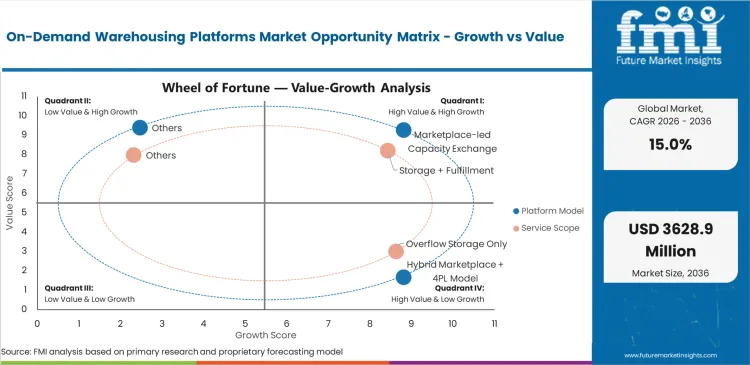
- Platform Model: Marketplace-led capacity exchange is expected to hold 36.0% share in 2026, dominating as shippers seek transparent pricing and immediate space availability.
- Service Scope: Storage + fulfillment is projected to capture 39.0% share in 2026, reflecting the absolute necessity for active pick-and-pack capabilities.
- Contract Type: Short-term / project-based is anticipated to lead with 44.0% share, providing critical flexibility during seasonal volume fluctuations.
- End User: E-commerce brands and retailers is set to command 41.0% share, driving extreme demand for localized rapid fulfillment staging.
- North America: represents the dominant geography of demand at 47.0% share, fueled by massive domestic consumption patterns and strained existing infrastructure.
- Analyst Opinion at FMI
- Rahul Pandita, Principal Analyst, Technology, at FMI, notes, "Reviewing the market forecast reveals that supply chain executives assume renting temporary space solves capacity crunches immediately. In reality, executing fulfillment across fragmented third-party buildings destroys inventory accuracy unless the underlying software architecture integrates perfectly. Companies purchase flexible space in hours but spend weeks trying to force diverse facility operators to use standardized shipping logic. Platforms controlling this digital translation layer dictate actual fulfillment success."
- Strategic Implications / Executive Takeaways
- Logistics design directors must prioritize software interoperability before authorizing physical inventory transfers to temporary facilities.
- Procurement heads evaluating shared capacity should mandate strict liability insurance tracking across all vendor contracts.
- Operations managers running seasonal businesses face unavoidable transportation costs unless utilizing managed marketplace orchestration.
- Methodology
- Primary Research: Consultations with logistics network IT directors determine genuine software implementation bottlenecks.
- Desk Research: Developer API documentation and interoperability standard whitepapers provide technical baseline data.
- Market-Sizing and Forecasting: Software-as-a-Service revenue disclosures establish accurate valuation models tracking the short-term warehouse marketplace market.
- Data Validation and Update Cycle: Commercial real estate occupancy data corroborates underlying software license activation requirements.
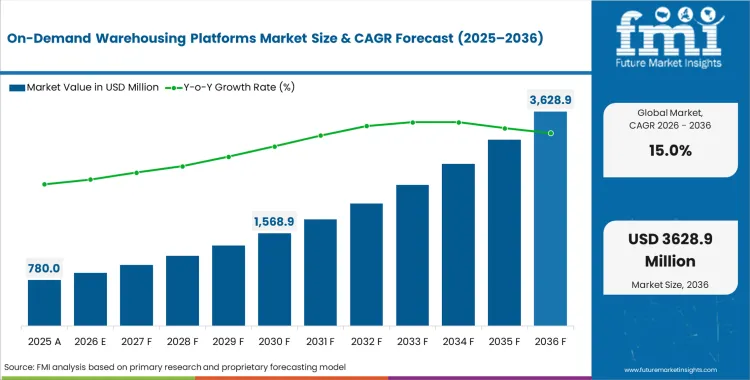
Once a retail network fully integrates its inventory software with an external exchange, securing temporary overflow space shifts from a multi-month negotiation into a transactional spot purchase. Master scheduling architects trigger growth across the broader on-demand warehousing platforms market by abandoning fixed regional distribution footprints. System orchestration subsequently depends entirely on accurate space availability algorithms tracking third-party logistics 3pl size operators with excess capacity.
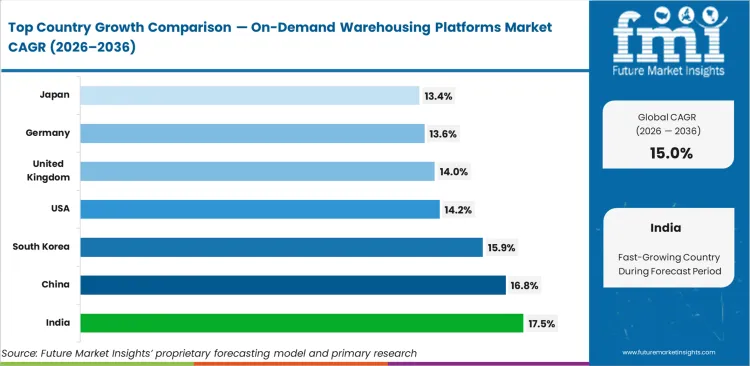
India records the highest growth at 17.5%, backed by infrastructure expansion and rapid utilization scaling. China comes next at 16.8% as manufacturing export nodes undergo stronger optimization. South Korea reaches 15.9% through investments in high-velocity consumer goods distribution coordination. The United States posts 14.2% as domestic storage shortages continue shaping demand. The United Kingdom stands at 14.0% by replacing aging static lease models. Germany records 13.6% with greater emphasis on industrial part buffering networks. Japan follows at 13.4% as shared storage architectures expand. Performance gaps across these countries are tied mainly to vacancy rates and retail velocity.
On-Demand Warehousing Platforms Market Definition
The on-demand warehousing platforms market centers on digital platforms and orchestration software connecting shippers requiring temporary storage with facility operators possessing excess physical capacity. Scope mandates active transactional matchmaking and inventory visibility across shared space. Purely static commercial real estate listings fall strictly outside this boundary. Continuous capacity trading distinguishes modern networks from historical long-term logistics contracts.
On-Demand Warehousing Platforms Market Inclusions
Scope covers cloud-based matchmaking algorithms, integrated billing systems, shared facility orchestration software, and short-term service level agreements negotiated digitally. Deployments encompassing warehouse design and layout intelligence representing spatial constraints for temporary tenants are fully covered. Professional managed services acting as digital fourth-party logistics providers mapping available space belong directly within this boundary.
On-Demand Warehousing Platforms Market Exclusions
This analysis excludes standalone commercial real estate brokerage fees. Traditional long-term facility leases lacking digital capacity trading functionality are not part of the category. Basic execution software sold solely for single-tenant operations is better classified under broader enterprise software markets. General freight forwarding services that operate without connection to specific temporary physical storage contracts are likewise excluded from the defined scope.
On-Demand Warehousing Platforms Market Research Methodology
- Primary Research: Fulfillment network directors, commercial real estate managers, and chief supply chain officers detail capacity procurement timelines.
- Desk Research: Software patent filings, platform transaction volume disclosures, and retail compliance standards provide essential structural context.
- Market-Sizing and Forecasting: Declared marketplace gross merchandise value and enterprise SaaS license agreements baseline current spending.
- Data Validation and Update Cycle: Industrial real estate vacancy metrics cross-validate flexible storage software demand curves quarterly.
Segmental Analysis
On-Demand Warehousing Platforms Market Analysis by Platform Model
Marketplace-led capacity exchange is projected to capture 36.0% share in 2026 as logistics directors rely less on traditional brokerage channels. According to FMI analysis, procurement teams are using software-based matching tools to identify open pallet positions and respond more quickly to overflow needs. Using a warehouse capacity exchange platform can help companies avoid time-consuming lease negotiations when volumes rise unexpectedly. Providers that control the matching layer are often in a position to retain stronger margins before any inventory movement begins. At the same time, liability remains an important consideration when multiple operators are involved. Shippers that move too quickly without checking insurance coverage and handling terms may face avoidable losses if goods are damaged. Facilities with stronger inventory systems and better visibility tend to secure better placement on these platforms. Internal capacity networks without centralized coordination can also create extra administrative work, especially when billing and reporting formats differ by site.
- Algorithmic matching: Software automatically pairs shippers with underutilized space. Supply chain planners avoid lengthy contract negotiations completely.
- Liability tracking: Integrated insurance modules protect high-value inventory. Financial controllers authorize short-term storage confident in damage coverage.
- Visibility integration: Application programming interfaces link disparate facility systems. Operations heads track remote inventory levels in real time.
On-Demand Warehousing Platforms Market Analysis by Service Scope
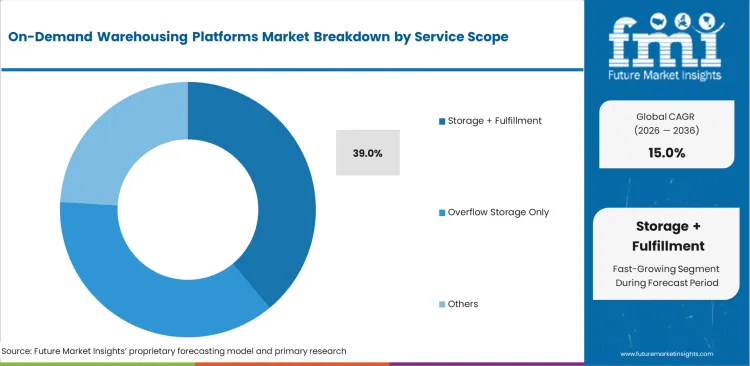
Fulfillment speed continues to shape consumer expectations across online retail. In 2026, storage and fulfillment is expected to account for 39.0% share as retailers look for temporary warehouse space that also includes pick-and-pack capability. FMI analysis suggests that many brand teams are redesigning distribution models around overflow warehousing to support delivery coverage across wider service areas. This is leading traditional operators to adopt warehouse management systems that can handle third-party order complexity more effectively. Distributed inventory placed closer to demand can support faster delivery performance and improve service consistency for active consumer brands. Many warehouse owners still assume pallet storage alone is enough to attract higher-value tenants, though e-commerce users usually need active piece-picking support. Providers that add fulfillment services without improving software systems often run into inventory accuracy issues during peak periods. By contrast, reliable outbound distribution coordination can generate stronger margins than static storage alone.
- Piece-picking execution: Temporary facilities process individual direct-to-consumer orders. E-commerce merchants bypass central distribution bottlenecks safely.
- Carrier integration: Shared warehouses print authorized shipping labels locally. Transport managers maintain negotiated parcel rates across remote nodes.
- Return processing: Distributed facilities handle incoming reverse logistics locally. Brand directors reduce total return transit times significantly.
On-Demand Warehousing Platforms Market Analysis by Contract Type
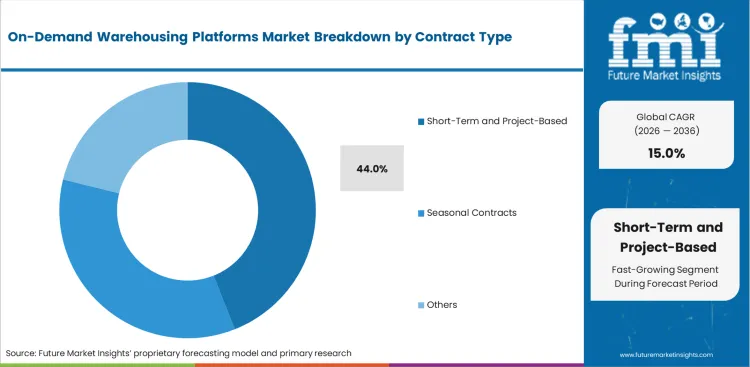
Finance teams are placing more value on storage capacity that can be reduced once seasonal demand passes. According to FMI, pay-as-you-go warehousing helps companies keep costs closer to real throughput levels instead of carrying fixed warehouse expense. Platform aggregators support this model by absorbing vacancy risk and setting daily market-based storage rates. When companies rely on separate local providers without centralized coordination, short-term deployment often becomes more difficult. Short-term and project-based agreements are expected to represent 44.0% share in 2026 because they offer flexibility during temporary spikes in inventory. However, these arrangements can also lead to more frequent product relocation if facilities later prioritize longer-term tenants. For that reason, they are usually better suited to overflow or campaign-driven inventory than to stable base volume. Traditional leases still play an important role where continuity matters more.
- Expense alignment: Storage costs scale exactly with inventory volume. Financial officers eliminate wasteful fixed real estate overhead.
- Rapid deployment: Standardized digital contracts bypass legal review delays. Supply chain directors secure emergency space in hours.
- Eviction risk: Host facilities retain the right to terminate short-term deals. Inventory managers must maintain secondary backup locations constantly.
On-Demand Warehousing Platforms Market Analysis by End User
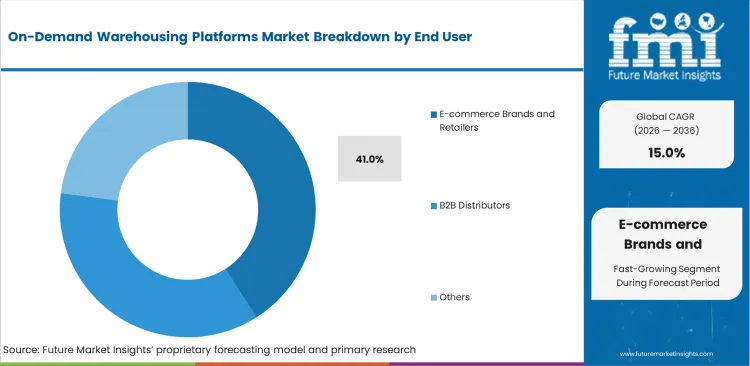
E-commerce brands and retailers represent 41.0% share in 2026 as digital merchants deploy decentralized storage to stage inventory closer to urban populations. FMI observes that integrating localized temporary warehouse space for promotions alongside traditional distribution centers requires extremely sophisticated supply chain management oversight. Platform providers mapping these temporary nodes earn significant ongoing transaction fees. Establishing a reliable backup warehouse network for disruption allows retailers to adapt quickly to shifting port congestion without leasing new buildings. Supply chain architects rarely discuss how heavily fragmented temporary storage struggles to process consolidated wholesale orders, often requiring costly physical transfers back to main facilities. Retailers clinging to massive centralized distribution hubs duplicate their final-mile shipping costs unnecessarily compared to competitors utilizing localized on-demand staging networks. Achieving true network agility requires embracing advanced supply chain analytics integration protocols across all temporary sites.
- Urban staging: Brands position high-velocity items near population centers. Last-mile delivery planners reduce final shipping transit times.
- Import buffering: Retailers store massive seasonal shipments temporarily. Procurement teams clear crowded port facilities without overloading primary warehouses.
- Inventory fragmentation: Distributing stock across temporary sites complicates total visibility. Planners require advanced tracking software preventing localized stockouts.
On-Demand Warehousing Platforms Market Drivers, Restraints, and Opportunities
Fast delivery expectations are forcing operations leaders to rethink staging strategy with greater urgency. Inefficient local inventory positioning can quickly result in missed shipping cut-offs and weaker fulfillment performance. Logistics architects increasingly require software platforms capable of connecting excess warehouse capacity with immediate tenant demand. That pressure is driving stronger adoption of shared-capacity models across major distribution hubs. Manual procurement of temporary space often causes disruption during promotional spikes, which is why supply chain leaders are using digital marketplaces to absorb overflow demand and limit local operational gridlock.
Legacy warehouse management software was not built to handle the continuous, multi-tenant transaction volumes that capacity sharing platforms generate, which slows adoption. Systems designed decades ago simply cannot process the real-time data flows required by modern capacity exchanges. IT directors patching older execution systems often encounter significant latency problems when continuous inventory data from multiple tenants exceeds what the database can process reliably. When the software cannot keep up with transaction volumes, warehouse throughput slows and facility capacity goes underutilized. Middleware bridges offer partial relief but introduce additional points of failure across critical operational pathways.
Opportunities in the On-Demand Warehousing Platforms Market
- Specialized cold storage: Temperature-controlled facilities face extreme capacity constraints. Software engineers deploying specialized cold-rated matchmaking logic secure premium revenue extending logistics 4.0 capabilities.
- Urban retail repurposing: Defunct shopping malls provide massive unused square footage. Platform providers transforming these empty retail spaces into active fulfillment nodes capture high-margin urban contracts.
- Automated overflow handling: Facilities demand seamless integration before accepting temporary goods. Developers linking capacity platforms directly with robotic sortation equipment build recurring revenue mapping physical storage execution.
Regional Analysis
Based on regional analysis, On-Demand Warehousing Platforms Market is segmented into North America, Europe, East Asia, South Asia & Pacific, Latin America, and Middle East & Africa across 40 plus countries.
.webp "Top Country Growth Comparison On Demand Warehousing Platforms Market Cagr (2026 2036)")
| Country | CAGR (2026 to 2036) |
|---|---|
| India | 17.5% |
| China | 16.8% |
| South Korea | 15.9% |
| United States | 14.2% |
| United Kingdom | 14.0% |
| Germany | 13.6% |
| Japan | 13.4% |
Source: Future Market Insights (FMI) analysis, based on proprietary forecasting model and primary research
South Asia & Pacific On-Demand Warehousing Platforms Market Analysis
Rapid formalization across domestic retail networks forces immediate digital capacity adoption. According to FMI's estimates, regional logistics conglomerates rapidly abandon disorganized manual overflow tracking favoring high-throughput algorithmic marketplaces. Developers bridging this severe technological leap secure massive foundational contracts. Local operations managers struggle navigating complex space integration pathways without external digital expertise.
- India: India’s intralogistics growth is accelerating investment in digitally managed overflow capacity. Supply chain directors facing sustained e-commerce volume spikes are securing advanced micro fulfillment space through platform-based models to protect throughput and delivery performance. At 17.5% CAGR, the market reflects strong demand for flexible warehousing access. Vendors with reliable local capacity networks are winning early contracts by helping operators reduce spoilage risk and respond faster to monsoon-related transport delays.
East Asia On-Demand Warehousing Platforms Market Analysis
Heavy export volumes are driving logistics networks toward physical capacity thresholds. According to FMI analysis, major regional export players are deploying dynamic storage grids to buffer outbound shipments before ocean freight movement begins. Coordinating these temporary fleets calls for exceptional spatial orchestration across already crowded sites. Facility architects remain focused on extracting marginal density gains, especially in port cities where congestion and land scarcity make storage efficiency central to logistics performance.
- China: High manufacturing volumes continue to drive the need for frequent staging improvements. Logistics architects focused on export movement are using overflow planning tools to support stronger daily throughput across shared warehouse space with autonomous mobile robots. China is growing at 16.8%, is seeing this model gain more traction as domestic operators refine dense logistics workflows. Platform developers are also promoting these systems more actively across neighboring regional shipping networks.
- South Korea: South Korea advances at 15.9% compound growth as strong technological fluency supports faster adoption of complex software systems. Operations managers are investing in more advanced middleware to support dense urban logistics networks and improve coordination across high-volume environments. Facilities that achieve smoother digital integration are often able to operate more efficiently during peak retail periods without adding permanent real estate. This gives operators more flexibility in handling seasonal demand while keeping infrastructure expansion under better control.
- Japan: Labor shortages are encouraging wider use of automation in shared facility operations. Operations directors are introducing algorithm-based workflows that match available space more accurately through smart logistics services. Integrators are also using capacity optimization tools to address workforce constraints linked to an aging labor base. This approach is helping facilities operate with better space utilization and lower dependence on manual coordination, supporting more efficient day-to-day performance across shared logistics environments. Japan registers 13.4% compound growth.
North America On-Demand Warehousing Platforms Market Analysis
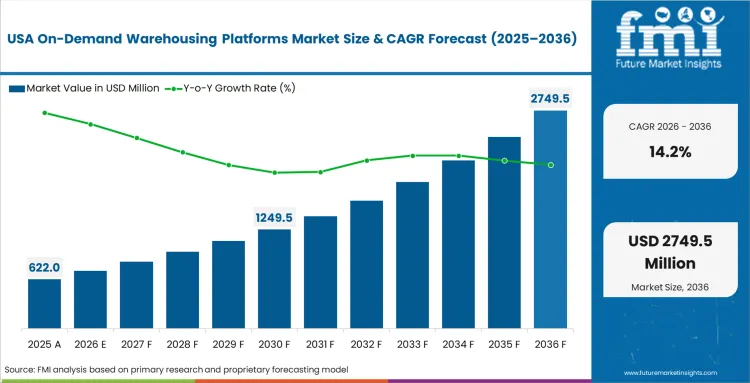
Aging commercial real estate infrastructure requires complete technological overhauls to support modern digital sharing. Based on FMI's assessment, massive retail networks urgently replace obsolete static leases with flexible dynamic spatial logic. Coordinating this transition without stopping daily operations requires extreme software precision. Planners rely heavily on detailed algorithmic modeling ensuring zero inventory misplacement.
- United States: Coordinating large third-party networks remains a major focus in capital expenditure planning. The United States registers 14.2% compound growth as engineering directors carry out complex software integrations using advanced supply chain visibility systems to maintain steady shipping volumes across fragmented facilities. Platform providers that can manage these transitions smoothly are often in a stronger position to secure long-term corporate partnerships.
Europe On-Demand Warehousing Platforms Market Analysis
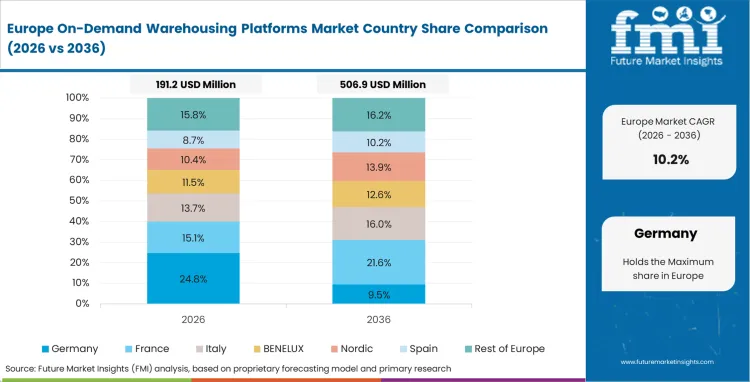
Strict municipal zoning regulations shape logistics deployment architecture heavily. FMI observes that European operations directors must balance maximum storage density against stringent environmental compliance requirements affecting truck routing. Vendors modifying their capacity platforms addressing these emissions hurdles capture significant enterprise contracts.
- United Kingdom: Resolving grocery distribution bottlenecks drives immediate software investments. Supply chain leaders implement advanced slotting orchestration managing highly perishable inventory flows across temporary cold storage nodes. The United Kingdom expands at 14.0% compound growth. Facilities upgrading local material handling equipment secure premium short-term contracts.
- Germany: Integrating heavy industrial workflows creates specific software requirements across shared industrial environments. Germany advances at 13.6% compound growth as automotive manufacturers deploy complex algorithms that support sophisticated part buffering near assembly lines. Precision engineering facilities use careful spatial routing across shared industrial parks to reduce the risk of production delays and maintain more stable line performance.
Competitive Aligners for Market Players
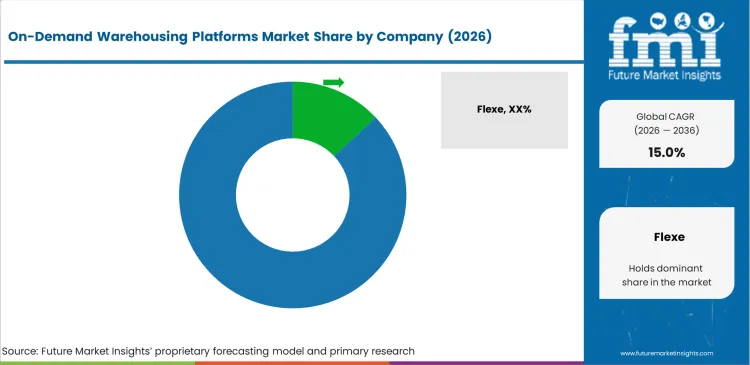
Mastering digital interoperability defines competitive success across this shared capacity landscape. Buyers researching who are the top on-demand warehousing companies discover that platform vendors like Flexe and Stord win massive enterprise contracts because their proprietary matching algorithms bridge fragmented physical execution systems seamlessly. Shippers care far less about specific building locations than guaranteed daily fulfillment metrics. Vendors selling isolated storage without digital connectivity continually lose bids against full-service platform providers promising comprehensive orchestration across the modern e-commerce platform. Building dense facility networks requires immense capital, pushing startups to focus entirely on software connectivity rather than real estate acquisition, transforming physical warehousing into fluid digital commerce nodes.
Established marketplace developers possess massive libraries containing validated integration code. Flowspace leverage years of documented API handshakes, allowing rapid deployment across complex legacy facilities running outdated software. New entrants evaluating the warehouse marketplace pricing model face intense margin pressure trying to recreate these established communication protocols. Operations directors trust proven integration libraries linking advanced inventory management software far more than theoretical capacity promises. Companies mastering scm bpo processes offer complete outsourced network management, absorbing all administrative friction generated by utilizing dozens of separate physical warehouse operators.
Major retail buyers are resisting software lock-in by keeping more than one platform in place. Procurement teams often divide digital spending across multiple providers, which creates pressure for open standards and easier integration. The balance between closed marketplace control and open best-of-breed architecture is becoming an important part of future deployment strategy. Platform providers that take a hardware-agnostic approach, much like load pooling and co-loading marketplaces in the LTL segment, are seeing stronger interest. More advanced networks are also exploring real-time transport capacity trading platforms that can link outbound freight execution with short-term warehousing to improve flexibility across the supply chain.
Key Players in On-Demand Warehousing Platforms Market
- Flexe
- Stord
- Flowspace
- WarehouseQuote
- Warehouse Exchange
- Warehowz
Scope of the Report
| Metric | Value |
|---|---|
| Quantitative Units | USD 780.0 million to USD 3,160.0 million, at a CAGR of 15.0% |
| Market Definition | On-Demand Warehousing Platforms encompasses digital marketplaces and orchestration software connecting shippers requiring temporary storage with facility operators possessing excess physical capacity. |
| Segmentation | Platform Model, Service Scope, Contract Type, End User, Geography of Demand |
| Regions Covered | North America, Europe, East Asia, South Asia & Pacific, Latin America, Middle East & Africa |
| Countries Covered | United States, China, India, South Korea, Japan, United Kingdom, Germany |
| Key Companies Profiled | Flexe, Stord, Flowspace, WarehouseQuote, Warehouse Exchange, Warehowz |
| Forecast Period | 2026 to 2036 |
| Approach | Declared marketplace gross merchandise value and enterprise SaaS license agreements baseline current spending. |
Source: Future Market Insights (FMI) analysis, based on proprietary forecasting model and primary research
On-Demand Warehousing Platforms Market Analysis by Segments
Platform Model:
- Marketplace-led capacity exchange
- Managed marketplace / orchestration
- Network-based overflow fulfillment
- Hybrid marketplace + 4PL model
Service Scope:
- Storage + fulfillment
- Overflow storage only
- Peak season surge support
- FBA / marketplace spillover support
- Returns and reverse logistics support
Contract Type:
- Short-term / project-based
- Seasonal contracts
- Rolling monthly agreements
- Transactional spot bookings
End User:
- E-commerce brands and retailers
- Consumer goods manufacturers
- B2B distributors
- 3PLs and freight intermediaries
- Marketplace sellers
Geography of Demand:
- North America
- Europe
- East Asia
- South Asia & Pacific
- Latin America
- Middle East & Africa
Bibliography
- Elia, V., Gnoni, M. G., & Tornese, F. (2024). On-demand warehousing platforms: Evolution and trend analysis of an industrial sharing economy model. Logistics, 8(4), 93.
- Ceschia, S., Sclafani, A., Gansterer, M., Mancini, S., & Meneghetti, A. (2024). Solving the online on-demand warehousing problem. Computers & Operations Research, 171, 106798.
- Sclafani, A., Mancini, S., Ceschia, S., Meneghetti, A., & Gansterer, M. (2025). Classification-based policies for the online on-demand warehousing problem. Annals of Operations Research.
- USA Census Bureau. (2026, March 10). Quarterly retail e-commerce sales: 4th quarter 2025. USA Department of Commerce.
This bibliography is provided for reader reference. The full FMI report contains the complete reference list with primary source documentation.
This Report Addresses
- Digital capacity exchange platforms accelerating unified remote facility utilization metrics.
- Marketplace deployment eliminating severe seasonal inventory storage bottlenecks immediately.
- Transactional billing models transforming traditional capital expenditure planning regarding facility leases.
- Legacy warehouse software latency causing physical hardware integration friction across multi-tenant spaces.
- Distributed staging nodes reducing massive outbound freight costs.
- India leading regional compound growth through rapid digital modernization across logistics hubs.
- Proprietary matching algorithms generating significant operational lock-in friction post-deployment.
- Grocers implementing specialized thermal capacity matching securing critical cold-chain advantages.
Frequently Asked Questions
What is an on-demand overflow warehouse capacity marketplace?
Digital systems serve as algorithmic matchmaking engines connecting shippers requiring temporary physical storage space with facility operators possessing underutilized pallet positions, ensuring fluid capacity trading without fixed long-term leases.
How is a warehouse marketplace different from a traditional 3PL?
When analyzing a warehouse marketplace vs traditional 3PL, legacy providers require lengthy contract negotiations and multi-year volume commitments. On-demand platforms center on live availability tracking, allowing shippers to procure space transactionally for brief seasonal peaks.
What is the market size in 2026 and 2036?
Capital requirements hit USD 780.0 million globally in 2026, scaling rapidly to USD 3,160.0 million by 2036. Logistics operators face immense pressure securing localized staging nodes without expanding permanent commercial real estate footprints.
Which companies are the leading providers?
When procurement teams ask who are the top on-demand warehousing companies, major global players include Flexe, Stord, Flowspace, WarehouseQuote, Warehouse Exchange, and Saltbox. Operations directors evaluate these firms based on their proprietary matchmaking logic and geographic facility density.
Why is demand rising for overflow warehouse marketplaces?
Unpredictable retail volume spikes force merchants to secure overflow storage dynamically. Rising final-mile delivery expectations compel brands to stage inventory in localized temporary nodes near urban populations reducing outbound transit times.
Which end users adopt these platforms most?
E-commerce brands and retailers command 41.0% share. Processing direct-to-consumer orders requires extremely fluid physical staging and highly sophisticated spatial routing logic managing sudden promotional bursts.
How are short-term warehouse contracts priced?
Short-term agreements hold 44.0% share. Chief financial officers refuse authorizing massive fixed leases preferring transactional agility adjusting storage costs matching actual inventory volume scaling exactly with throughput.
Which regions grow fastest?
India tracks at 17.5% compound growth. Rapid formalization across domestic logistics networks forces massive immediate software upgrades moving regional hubs from disorganized manual capacity tracking toward fully digital marketplaces.
What role does e-commerce play in category growth?
E-commerce environments prioritize maximum delivery velocity. Traditional long-haul operations lacking localized staging nodes face massive operational disadvantages attempting rapid individual piece-picking fulfillment required for online orders.
How do these marketplaces help during seasonal surges?
Connecting existing single-tenant facilities to multi-tenant digital networks allows shippers to absorb massive seasonal imports instantly. Planners clear crowded port facilities without overloading their primary permanent warehouses.
Can I book short-term warehouse space online?
Yes. Modern digital orchestration platforms provide transparent pricing, immediate space availability, and standardized short-term service level agreements eliminating traditional multi-month lease negotiations entirely.
Preview the report firsthand - request a free sample
Get SampleGet the brochure for pricing and purchase details.
Get PDFTable of Content
- Executive Summary
- Global Market Outlook
- Demand-side Trends
- Supply-side Trends
- Technology Roadmap Analysis
- Analysis and Recommendations
- Market Overview
- Market Coverage / Taxonomy
- Market Definition / Scope / Limitations
- Research Methodology
- Chapter Orientation
- Analytical Lens and Working Hypotheses
- Market Sizing, Forecasting, and Opportunity Mapping
- Research Design and Evidence Framework
- Desk Research Programme (Secondary Evidence)
- Company Annual and Sustainability Reports
- Peer-reviewed Journals and Academic Literature
- Corporate Websites, Product Literature, and Technical Notes
- Earnings Decks and Investor Briefings
- Statutory Filings and Regulatory Disclosures
- Technical White Papers and Standards Notes
- Trade Journals, Industry Magazines, and Analyst Briefs
- Conference Proceedings, Webinars, and Seminar Materials
- Government Statistics Portals and Public Data Releases
- Press Releases and Reputable Media Coverage
- Specialist Newsletters and Curated Briefings
- Sector Databases and Reference Repositories
- FMI Internal Proprietary Databases and Historical Market Datasets
- Subscription Datasets and Paid Sources
- Social Channels, Communities, and Digital Listening Inputs
- Additional Desk Sources
- Expert Input and Fieldwork (Primary Evidence)
- Primary Modes
- Qualitative Interviews and Expert Elicitation
- Quantitative Surveys and Structured Data Capture
- Blended Approach
- Why Primary Evidence is Used
- Focus Groups
- Observational and In-context Research
- Social and Community Interactions
- Primary Modes
- Stakeholder Universe Engaged
- C-suite Leaders
- Board Members
- Presidents and Vice Presidents
- R&D and Innovation Heads
- Technical Specialists
- Domain Subject-matter Experts
- Scientists
- Physicians and Other Healthcare Professionals
- Governance, Ethics, and Data Stewardship
- Research Ethics
- Data Integrity and Handling
- Desk Research Programme (Secondary Evidence)
- Tooling, Models, and Reference Databases
- Data Engineering and Model Build
- Data Acquisition and Ingestion
- Cleaning, Normalisation, and Verification
- Synthesis, Triangulation, and Analysis
- Quality Assurance and Audit Trail
- Market Background
- Market Dynamics
- Drivers
- Restraints
- Opportunity
- Trends
- Scenario Forecast
- Demand in Optimistic Scenario
- Demand in Likely Scenario
- Demand in Conservative Scenario
- Opportunity Map Analysis
- Product Life Cycle Analysis
- Supply Chain Analysis
- Investment Feasibility Matrix
- Value Chain Analysis
- PESTLE and Porter’s Analysis
- Regulatory Landscape
- Regional Parent Market Outlook
- Production and Consumption Statistics
- Import and Export Statistics
- Market Dynamics
- Global Market Analysis 2021 to 2025 and Forecast, 2026 to 2036
- Historical Market Size Value (USD Million) Analysis, 2021 to 2025
- Current and Future Market Size Value (USD Million) Projections, 2026 to 2036
- Y-o-Y Growth Trend Analysis
- Absolute $ Opportunity Analysis
- Global Market Pricing Analysis 2021 to 2025 and Forecast 2026 to 2036
- Global Market Analysis 2021 to 2025 and Forecast 2026 to 2036, By Platform Model
- Introduction / Key Findings
- Historical Market Size Value (USD Million) Analysis By Platform Model , 2021 to 2025
- Current and Future Market Size Value (USD Million) Analysis and Forecast By Platform Model , 2026 to 2036
- Marketplace-led Capacity Exchange
- Hybrid Marketplace + 4PL Model
- Others
- Marketplace-led Capacity Exchange
- Y-o-Y Growth Trend Analysis By Platform Model , 2021 to 2025
- Absolute $ Opportunity Analysis By Platform Model , 2026 to 2036
- Global Market Analysis 2021 to 2025 and Forecast 2026 to 2036, By Service Scope
- Introduction / Key Findings
- Historical Market Size Value (USD Million) Analysis By Service Scope, 2021 to 2025
- Current and Future Market Size Value (USD Million) Analysis and Forecast By Service Scope, 2026 to 2036
- Storage + Fulfillment
- Overflow Storage Only
- Others
- Storage + Fulfillment
- Y-o-Y Growth Trend Analysis By Service Scope, 2021 to 2025
- Absolute $ Opportunity Analysis By Service Scope, 2026 to 2036
- Global Market Analysis 2021 to 2025 and Forecast 2026 to 2036, By Contract Type
- Introduction / Key Findings
- Historical Market Size Value (USD Million) Analysis By Contract Type, 2021 to 2025
- Current and Future Market Size Value (USD Million) Analysis and Forecast By Contract Type, 2026 to 2036
- Short-Term and Project-Based
- Seasonal Contracts
- Others
- Short-Term and Project-Based
- Y-o-Y Growth Trend Analysis By Contract Type, 2021 to 2025
- Absolute $ Opportunity Analysis By Contract Type, 2026 to 2036
- Global Market Analysis 2021 to 2025 and Forecast 2026 to 2036, By End User
- Introduction / Key Findings
- Historical Market Size Value (USD Million) Analysis By End User, 2021 to 2025
- Current and Future Market Size Value (USD Million) Analysis and Forecast By End User, 2026 to 2036
- E-commerce Brands and Retailers
- B2B Distributors
- Others
- E-commerce Brands and Retailers
- Y-o-Y Growth Trend Analysis By End User, 2021 to 2025
- Absolute $ Opportunity Analysis By End User, 2026 to 2036
- Global Market Analysis 2021 to 2025 and Forecast 2026 to 2036, By Region
- Introduction
- Historical Market Size Value (USD Million) Analysis By Region, 2021 to 2025
- Current Market Size Value (USD Million) Analysis and Forecast By Region, 2026 to 2036
- North America
- Latin America
- Western Europe
- Eastern Europe
- East Asia
- South Asia and Pacific
- Middle East & Africa
- Market Attractiveness Analysis By Region
- North America Market Analysis 2021 to 2025 and Forecast 2026 to 2036, By Country
- Historical Market Size Value (USD Million) Trend Analysis By Market Taxonomy, 2021 to 2025
- Market Size Value (USD Million) Forecast By Market Taxonomy, 2026 to 2036
- By Country
- USA
- Canada
- Mexico
- By Platform Model
- By Service Scope
- By Contract Type
- By End User
- By Country
- Market Attractiveness Analysis
- By Country
- By Platform Model
- By Service Scope
- By Contract Type
- By End User
- Key Takeaways
- Latin America Market Analysis 2021 to 2025 and Forecast 2026 to 2036, By Country
- Historical Market Size Value (USD Million) Trend Analysis By Market Taxonomy, 2021 to 2025
- Market Size Value (USD Million) Forecast By Market Taxonomy, 2026 to 2036
- By Country
- Brazil
- Chile
- Rest of Latin America
- By Platform Model
- By Service Scope
- By Contract Type
- By End User
- By Country
- Market Attractiveness Analysis
- By Country
- By Platform Model
- By Service Scope
- By Contract Type
- By End User
- Key Takeaways
- Western Europe Market Analysis 2021 to 2025 and Forecast 2026 to 2036, By Country
- Historical Market Size Value (USD Million) Trend Analysis By Market Taxonomy, 2021 to 2025
- Market Size Value (USD Million) Forecast By Market Taxonomy, 2026 to 2036
- By Country
- Germany
- UK
- Italy
- Spain
- France
- Nordic
- BENELUX
- Rest of Western Europe
- By Platform Model
- By Service Scope
- By Contract Type
- By End User
- By Country
- Market Attractiveness Analysis
- By Country
- By Platform Model
- By Service Scope
- By Contract Type
- By End User
- Key Takeaways
- Eastern Europe Market Analysis 2021 to 2025 and Forecast 2026 to 2036, By Country
- Historical Market Size Value (USD Million) Trend Analysis By Market Taxonomy, 2021 to 2025
- Market Size Value (USD Million) Forecast By Market Taxonomy, 2026 to 2036
- By Country
- Russia
- Poland
- Hungary
- Balkan & Baltic
- Rest of Eastern Europe
- By Platform Model
- By Service Scope
- By Contract Type
- By End User
- By Country
- Market Attractiveness Analysis
- By Country
- By Platform Model
- By Service Scope
- By Contract Type
- By End User
- Key Takeaways
- East Asia Market Analysis 2021 to 2025 and Forecast 2026 to 2036, By Country
- Historical Market Size Value (USD Million) Trend Analysis By Market Taxonomy, 2021 to 2025
- Market Size Value (USD Million) Forecast By Market Taxonomy, 2026 to 2036
- By Country
- China
- Japan
- South Korea
- By Platform Model
- By Service Scope
- By Contract Type
- By End User
- By Country
- Market Attractiveness Analysis
- By Country
- By Platform Model
- By Service Scope
- By Contract Type
- By End User
- Key Takeaways
- South Asia and Pacific Market Analysis 2021 to 2025 and Forecast 2026 to 2036, By Country
- Historical Market Size Value (USD Million) Trend Analysis By Market Taxonomy, 2021 to 2025
- Market Size Value (USD Million) Forecast By Market Taxonomy, 2026 to 2036
- By Country
- India
- ASEAN
- Australia & New Zealand
- Rest of South Asia and Pacific
- By Platform Model
- By Service Scope
- By Contract Type
- By End User
- By Country
- Market Attractiveness Analysis
- By Country
- By Platform Model
- By Service Scope
- By Contract Type
- By End User
- Key Takeaways
- Middle East & Africa Market Analysis 2021 to 2025 and Forecast 2026 to 2036, By Country
- Historical Market Size Value (USD Million) Trend Analysis By Market Taxonomy, 2021 to 2025
- Market Size Value (USD Million) Forecast By Market Taxonomy, 2026 to 2036
- By Country
- Kingdom of Saudi Arabia
- Other GCC Countries
- Turkiye
- South Africa
- Other African Union
- Rest of Middle East & Africa
- By Platform Model
- By Service Scope
- By Contract Type
- By End User
- By Country
- Market Attractiveness Analysis
- By Country
- By Platform Model
- By Service Scope
- By Contract Type
- By End User
- Key Takeaways
- Key Countries Market Analysis
- USA
- Pricing Analysis
- Market Share Analysis, 2025
- By Platform Model
- By Service Scope
- By Contract Type
- By End User
- Canada
- Pricing Analysis
- Market Share Analysis, 2025
- By Platform Model
- By Service Scope
- By Contract Type
- By End User
- Mexico
- Pricing Analysis
- Market Share Analysis, 2025
- By Platform Model
- By Service Scope
- By Contract Type
- By End User
- Brazil
- Pricing Analysis
- Market Share Analysis, 2025
- By Platform Model
- By Service Scope
- By Contract Type
- By End User
- Chile
- Pricing Analysis
- Market Share Analysis, 2025
- By Platform Model
- By Service Scope
- By Contract Type
- By End User
- Germany
- Pricing Analysis
- Market Share Analysis, 2025
- By Platform Model
- By Service Scope
- By Contract Type
- By End User
- UK
- Pricing Analysis
- Market Share Analysis, 2025
- By Platform Model
- By Service Scope
- By Contract Type
- By End User
- Italy
- Pricing Analysis
- Market Share Analysis, 2025
- By Platform Model
- By Service Scope
- By Contract Type
- By End User
- Spain
- Pricing Analysis
- Market Share Analysis, 2025
- By Platform Model
- By Service Scope
- By Contract Type
- By End User
- France
- Pricing Analysis
- Market Share Analysis, 2025
- By Platform Model
- By Service Scope
- By Contract Type
- By End User
- India
- Pricing Analysis
- Market Share Analysis, 2025
- By Platform Model
- By Service Scope
- By Contract Type
- By End User
- ASEAN
- Pricing Analysis
- Market Share Analysis, 2025
- By Platform Model
- By Service Scope
- By Contract Type
- By End User
- Australia & New Zealand
- Pricing Analysis
- Market Share Analysis, 2025
- By Platform Model
- By Service Scope
- By Contract Type
- By End User
- China
- Pricing Analysis
- Market Share Analysis, 2025
- By Platform Model
- By Service Scope
- By Contract Type
- By End User
- Japan
- Pricing Analysis
- Market Share Analysis, 2025
- By Platform Model
- By Service Scope
- By Contract Type
- By End User
- South Korea
- Pricing Analysis
- Market Share Analysis, 2025
- By Platform Model
- By Service Scope
- By Contract Type
- By End User
- Russia
- Pricing Analysis
- Market Share Analysis, 2025
- By Platform Model
- By Service Scope
- By Contract Type
- By End User
- Poland
- Pricing Analysis
- Market Share Analysis, 2025
- By Platform Model
- By Service Scope
- By Contract Type
- By End User
- Hungary
- Pricing Analysis
- Market Share Analysis, 2025
- By Platform Model
- By Service Scope
- By Contract Type
- By End User
- Kingdom of Saudi Arabia
- Pricing Analysis
- Market Share Analysis, 2025
- By Platform Model
- By Service Scope
- By Contract Type
- By End User
- Turkiye
- Pricing Analysis
- Market Share Analysis, 2025
- By Platform Model
- By Service Scope
- By Contract Type
- By End User
- South Africa
- Pricing Analysis
- Market Share Analysis, 2025
- By Platform Model
- By Service Scope
- By Contract Type
- By End User
- USA
- Market Structure Analysis
- Competition Dashboard
- Competition Benchmarking
- Market Share Analysis of Top Players
- By Regional
- By Platform Model
- By Service Scope
- By Contract Type
- By End User
- Competition Analysis
- Competition Deep Dive
- Flexe
- Overview
- Product Portfolio
- Profitability by Market Segments (Product/Age /Sales Channel/Region)
- Sales Footprint
- Strategy Overview
- Marketing Strategy
- Product Strategy
- Channel Strategy
- Stord
- Flowspace
- WarehouseQuote
- Warehouse Exchange
- Warehowz
- Flexe
- Competition Deep Dive
- Assumptions & Acronyms Used


