

- Industry Size (2026)
- USD 1.4 Bn
- Forecast (2036)
- USD 5.0 Bn
- CAGR (2026 to 2036)
- 13.8%
Identity Verification Industry Forecast and Outlook in the UK 2026 to 2036
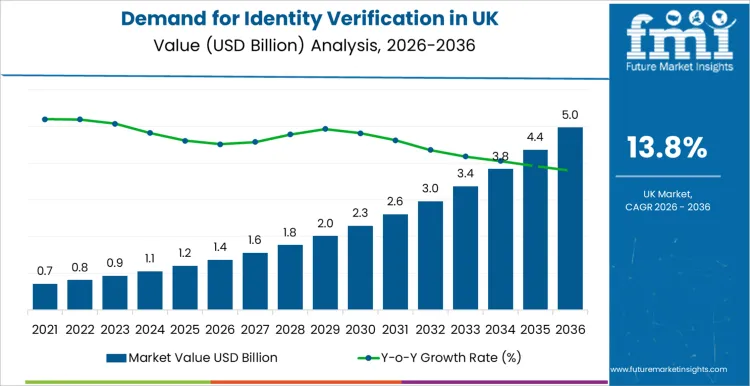
The demand for identity verification solutions and services in the United Kingdom is projected to reach a valuation of USD 1.4 billion in 2026. This sector is anticipated to experience transformative growth, achieving a size of USD 5.0 billion by 2036, advancing at a compound annual growth rate of 13.8%.
This exceptional expansion is anchored in the UK's rapid and wholesale digital transformation across its economy, a stringent and evolving regulatory landscape focused on anti-money laundering and KYC compliance, and the critical need to combat sophisticated digital fraud and cybercrime.
The imperative for robust, user-friendly verification is being driven by the proliferation of digital banking, the explosive growth of e-commerce, the digitization of government and healthcare services, and the remote onboarding of customers and employees.
This creates a concentrated demand for technologies that can seamlessly balance security, regulatory compliance, and customer experience, utilizing biometrics, document authentication, and database checks to establish trust in digital interactions.
Quick Stats for Identity Verification Demand in the UK
- Identity Verification Sales Valuation in the UK (2026): USD 1.4 billion
- Identity Verification Sales Forecast Valuation in the UK (2036): USD 5.0 billion
- Identity Verification Industry in the UK Forecast CAGR (2026 to 2036): 13.8%
- Leading Regional Growth: England (CAGR 15.2%)
- Leading Component: Solution (59.0%)
- Leading Industry: Banking, Financial Services & Insurance (BFSI) (32.7%)
- Leading Deployment: On-Premise (40.0%)
- Key Companies Profiled: Entrust, Onfido, IDEMIA, Transmit Security, Secret Double Octopus
Why is the UK a Regulatory and Technological Vanguard for Identity Verification Demand?
The UK's demand for identity verification is propelled by its position as a global financial technology leader and its proactive, often pioneering, regulatory environment. The Financial Conduct Authority (FCA) sets rigorous AML and fraud prevention standards that compel financial institutions to deploy advanced verification tools.
Ambitious government digital identity initiatives, such as the UK Digital Identity and Attributes Trust Framework, aim to create a secure, interoperable ecosystem for proving identity online, driving public and private sector investment.
The UK's highly developed digital economy, with one of the world's highest rates of online banking and retail adoption, presents a vast attack surface for fraudsters, making robust verification a commercial imperative for customer protection and brand trust. The concentration of fintech startups and challenger banks in London fosters intense innovation and early adoption of cutting-edge biometric and AI-powered verification methods, setting trends for the wider market.
How is the Identity Verification Landscape Segmented by Component, Industry, and Deployment?
The core offering, the vertical market it serves, and its technological infrastructure model categorize this sector. This segmentation reveals a market where software solutions are paramount, regulatory-driven industries lead investment, and deployment choices reflect a balance between control and agility.
Which Component Forms the Technological Core of the Market?
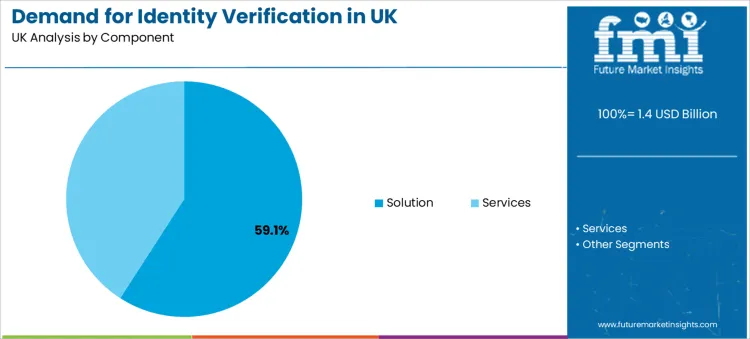
The solution component holds a dominant 59.0% share. This encompasses the core software platforms, APIs, and algorithms for document verification, biometric checks (facial, fingerprint), liveness detection, and data validation. Its prominence is driven by the essential need for this underlying technology to automate and secure digital onboarding and transaction processes. The Services segment, including implementation, integration, and managed verification services, is critical for deployment and operation but is built upon this foundational solution layer.
Which Industry is the Foremost Investor Due to Regulatory Pressure?
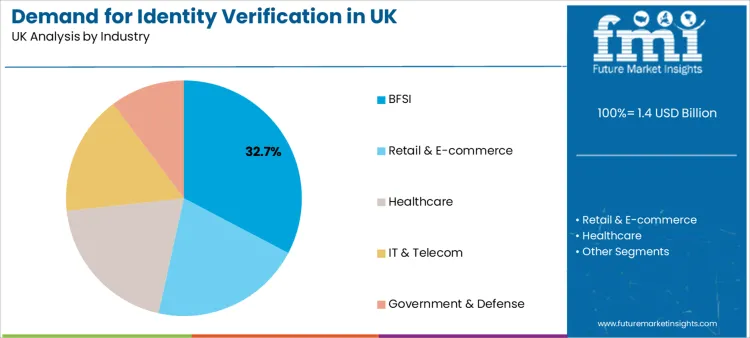
The BFSI sector stands as the largest end-user, with a 32.7% share. This is a direct result of the sector's acute regulatory obligations under AML and counter-terrorist financing (CTF) regulations, where customer due diligence is non-negotiable.
The retail & e-commerce sector is a critical growth segment, utilizing verification to combat payment fraud, prevent account takeovers, and ensure age-restricted sales compliance. Government and Healthcare are also major sectors, driven by digital service delivery and secure patient data access.
Which Deployment Model Balances Control with Current Trends?
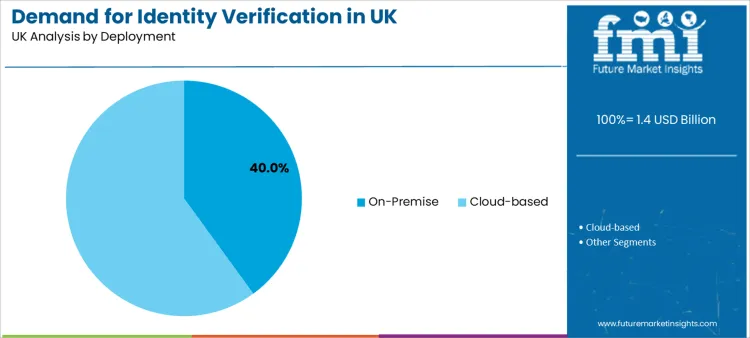
On-Premise deployment commands a leading 40.0% share. This reflects the preference, particularly among large regulated entities in BFSI and Government, to maintain direct physical control over sensitive identity data and verification systems within their own data centers for security and compliance reasons. However, Cloud-based deployment is experiencing faster growth, offering scalability, faster updates, and lower initial costs, making it attractive for retail, e-commerce, and agile fintech companies.
What are the Dynamics, Restraints, Opportunities, and Threats Shaping this Sector?
How are Regulation, Digitalization, and Fraud Escalation Driving Meteoric Demand?
The primary growth driver is the ever-tightening regulatory landscape, which mandates stronger customer authentication and ongoing monitoring. The irreversible shift of commerce and services online creates millions of new digital touchpoints requiring verification.
The increasing sophistication and volume of identity fraud and synthetic identity attacks make advanced verification tools a critical line of defense for organizational security and financial health.
Do Privacy Concerns and Integration Hurdles Restrain Seamless Adoption?
A significant restraint is the growing public and regulatory concern over data privacy and biometric data usage, embodied in laws like the UK GDPR, which can complicate solution design and erode user trust if not handled transparently.
The technical and operational complexity of integrating new verification solutions with legacy IT systems and workflows can be costly and slow. Furthermore, the risk of introducing friction into the customer journey can lead to abandonment, requiring a delicate balance between security and usability.
How are AI and Passwordless Authentication Creating New Potential?
Substantial opportunities are emerging from the integration of advanced artificial intelligence and machine learning for more accurate fraud pattern detection, risk-based authentication, and adaptive step-up verification.
The global shift towards passwordless authentication, using FIDO2 standards and biometrics, presents a major new frontier for seamless and secure verification. Furthermore, the development of decentralized identity models, where users control their own verifiable credentials, could revolutionize the market landscape in the long term.
What External Factors Could Challenge Sector Growth?
The sector faces threats from potential regulatory fragmentation or uncertainty that could slow investment decisions. A major publicized failure or data breach at a leading verification provider could temporarily undermine market confidence.
Intense competition and price pressure, especially in cloud-based API services, could squeeze margins. Rapid technological change also risks obsolescence, requiring continuous R&D investment from vendors.
How is Identity Verification Demand Evolving across Key Regions in the UK?
Growth is influenced by the concentration of regulated industries, technology hubs, government activity, and digital adoption rates. The projected compound annual growth rates from 2026 to 2036 illustrate these geographic distinctions.
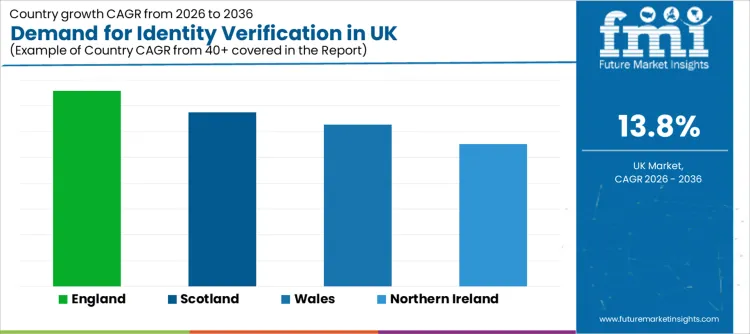
| Region | CAGR (2026-2036) |
|---|---|
| England | 15.2% |
| Scotland | 13.5% |
| Wales | 12.5% |
| Northern Ireland | 11.0% |
What is Fuelling Premier Growth in England?
England leads with a projected CAGR of 15.2%. This is overwhelmingly driven by London's status as a global financial and fintech capital, housing the headquarters of major banks, insurance firms, and regulators whose compliance needs drive massive demand.
The concentration of central government departments, a thriving e-commerce sector, and a dense ecosystem of technology vendors and startups in the South East creates an unparalleled center for both supply and demand, serving as the definitive nexus for the UK's identity verification sector.
Why is Scotland a Key Centre for Financial and Governmental Demand?
Scotland exhibits a very strong CAGR of 13.5%, powered by its significant financial services sector centered in Edinburgh, which has substantial regulatory compliance requirements. The devolved Scottish
Government's own digital service initiatives and the presence of major university research centers focusing on digital security and identity contribute to robust demand from both the public and private sectors, fostering a sophisticated regional market.
What Factors Underpin Strong Demand in Wales?
Wales shows robust growth with a CAGR of 12.5%. Welsh Government digital transformation programs aimed at improving citizen access to services, which incorporate secure identity verification, fuels this.
Growing sectors in fintech and cybersecurity within Cardiff, alongside the digital modernization of traditional industries, are driving increased adoption of verification technologies by businesses seeking to secure their online operations and comply with UK-wide regulations.
What Factors Underpin Growth in Northern Ireland?
Northern Ireland, with a projected CAGR of 11.0%, reflects solid growth supported by its own financial services activities, the digitization of public services, and a growing technology sector.
The region's unique position and cross-border considerations with the Republic of Ireland may also influence specific verification use cases and compliance needs, contributing to a steadily expanding market aligned with national digital infrastructure goals.
What Defines the Competitive Landscape of the Identity Verification Industry?
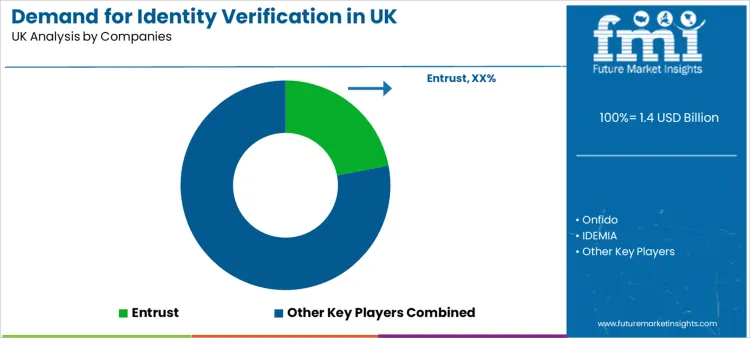
The competitive environment is dynamic and fragmented, characterized by intense rivalry on the basis of technological accuracy, speed, global document coverage, fraud detection rates, and developer experience. Established security giants compete with agile, AI-native specialists and niche biometric hardware providers.
Differentiation is achieved through superior liveness detection algorithms, expertise in specific verticals like banking or sharing economies, or pioneering new standards for passwordless and decentralized identity. Success depends not only on algorithmic performance but on providing a seamless API and SDK for easy integration, delivering detailed audit trails for compliance, and offering global support.
Forming strategic partnerships with major cloud platforms (AWS, Azure, Google Cloud), payment processors, and large system integrators is a critical channel strategy. The competitive landscape is shaped by rapid consolidation as larger players acquire innovative startups to augment their technology portfolios.
Key Industry Participants
- Entrust
- Onfido
- IDEMIA
- Transmit Security
- Secret Double Octopus
Scope of Report
| Items | Values |
|---|---|
| Quantitative Units | USD Billion |
| Component | Solution, Services |
| Industry | BFSI, Retail & E-commerce, Healthcare, IT & Telecom, Government & Defense |
| Deployment | On-Premise, Cloud-based |
| Regions Covered | England, Scotland, Wales, Northern Ireland |
| Key Companies Profiled | Entrust, Onfido, IDEMIA, Transmit Security, Secret Double Octopus |
Identity Verification Demand in the UK by Segment
By Component:
- Solution
- Services
By Industry:
- BFSI
- Retail & E-commerce
- Healthcare
- IT & Telecom
- Government & Defense
By Deployment:
- On-Premise
- Cloud-based
By Region:
- England
- Scotland
- Wales
- Northern Ireland
Bibliography
- Financial Conduct Authority (FCA). (2023). Financial Crime Guide and AML Regulations.
- UK Digital Identity & Attributes Trust Framework. (2024). Governance and Technical Specifications.
- UK Finance. (2023). Fraud and Cyber Crime Report.
- TechUK. (2024). Digital Identity Policy and Innovation.
- Office for National Statistics (ONS). (2023). Digital Adoption in UK Businesses and Society.
Frequently Asked Questions
How big is the demand for identity verification in uk in 2026?
The demand for identity verification in uk is estimated to be valued at USD 1.4 billion in 2026.
What will be the size of identity verification in uk in 2036?
The market size for the identity verification in uk is projected to reach USD 5.0 billion by 2036.
How much will be the demand for identity verification in uk growth between 2026 and 2036?
The demand for identity verification in uk is expected to grow at a 13.8% CAGR between 2026 and 2036.
What are the key product types in the identity verification in uk?
The key product types in identity verification in uk are solution and services.
Which industry segment is expected to contribute significant share in the identity verification in uk in 2026?
In terms of industry, bfsi segment is expected to command 32.7% share in the identity verification in uk in 2026.
Preview the report firsthand - request a free sample
Get SampleGet the brochure for pricing and purchase details.
Get PDFTable of Content
- Executive Summary
- UK Market Outlook
- Demand-side Trends
- Supply-side Trends
- Technology Roadmap Analysis
- Analysis and Recommendations
- Market Overview
- Market Coverage / Taxonomy
- Market Definition / Scope / Limitations
- Market Background
- Market Dynamics
- Drivers
- Restraints
- Opportunity
- Trends
- Scenario Forecast
- Demand in Optimistic Scenario
- Demand in Likely Scenario
- Demand in Conservative Scenario
- Opportunity Map Analysis
- Product Life Cycle Analysis
- Supply Chain Analysis
- Investment Feasibility Matrix
- Value Chain Analysis
- PESTLE and Porter’s Analysis
- Regulatory Landscape
- Regional Parent Market Outlook
- Production and Consumption Statistics
- Import and Export Statistics
- Market Dynamics
- UK Market Analysis 2021 to 2025 and Forecast, 2026 to 2036
- Historical Market Size Value (USD Million) Analysis, 2021 to 2025
- Current and Future Market Size Value (USD Million) Projections, 2026 to 2036
- Y-o-Y Growth Trend Analysis
- Absolute $ Opportunity Analysis
- UK Market Pricing Analysis 2021 to 2025 and Forecast 2026 to 2036
- UK Market Analysis 2021 to 2025 and Forecast 2026 to 2036, By Component
- Introduction / Key Findings
- Historical Market Size Value (USD Million) Analysis By Component , 2021 to 2025
- Current and Future Market Size Value (USD Million) Analysis and Forecast By Component , 2026 to 2036
- Solution
- Services
- Solution
- Y-o-Y Growth Trend Analysis By Component , 2021 to 2025
- Absolute $ Opportunity Analysis By Component , 2026 to 2036
- UK Market Analysis 2021 to 2025 and Forecast 2026 to 2036, By Industry
- Introduction / Key Findings
- Historical Market Size Value (USD Million) Analysis By Industry, 2021 to 2025
- Current and Future Market Size Value (USD Million) Analysis and Forecast By Industry, 2026 to 2036
- BFSI
- Retail & E-commerce
- Healthcare
- IT & Telecom
- Government & Defense
- BFSI
- Y-o-Y Growth Trend Analysis By Industry, 2021 to 2025
- Absolute $ Opportunity Analysis By Industry, 2026 to 2036
- UK Market Analysis 2021 to 2025 and Forecast 2026 to 2036, By Deployment
- Introduction / Key Findings
- Historical Market Size Value (USD Million) Analysis By Deployment, 2021 to 2025
- Current and Future Market Size Value (USD Million) Analysis and Forecast By Deployment, 2026 to 2036
- On-Premise
- Cloud-based
- On-Premise
- Y-o-Y Growth Trend Analysis By Deployment, 2021 to 2025
- Absolute $ Opportunity Analysis By Deployment, 2026 to 2036
- Market Structure Analysis
- Competition Dashboard
- Competition Benchmarking
- Market Share Analysis of Top Players
- By Regional
- By Component
- By Industry
- By Deployment
- Competition Analysis
- Competition Deep Dive
- Entrust
- Overview
- Product Portfolio
- Profitability by Market Segments (Product/Age /Sales Channel/Region)
- Sales Footprint
- Strategy Overview
- Marketing Strategy
- Product Strategy
- Channel Strategy
- Onfido
- IDEMIA
- Transmit Security
- Secret Double Octopus
- Entrust
- Competition Deep Dive
- Assumptions & Acronyms Used
- Research Methodology


