

- Industry Size (2026)
- USD 56.6 Mn
- Forecast (2036)
- USD 64.8 Mn
- CAGR (2026 to 2036)
- 1.4%
Demand for Consent Management in the UK 2026 to 2036
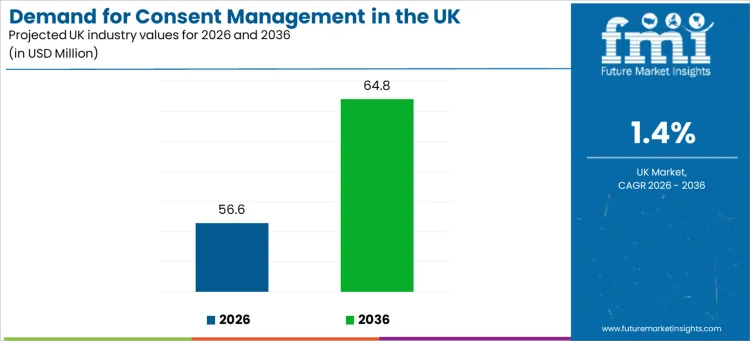
Demand for consent management in the UK is expected to be valued at USD 56.6 million in 2026 and is projected to reach USD 64.8 million by 2036, at a CAGR of 1.4%. This trajectory mirrors how privacy compliance has become a permanent operational requirement rather than a one-time regulatory response. Organizations handling personal data must maintain structured consent records that withstand audits, internal reviews, and evolving regulatory interpretation.
Consent management functions as an operational control layer embedded within digital activity rather than a standalone compliance tool. UK organizations rely on these systems to document permission status, manage withdrawals, and align data usage with declared purposes across websites, applications, and internal data environments. Reliability, traceability, and alignment with governance frameworks shape purchasing decisions more than feature expansion.
Enterprise buyers assess consent solutions through integration discipline and process fit. Systems must align with existing data infrastructure, internal access controls, and audit workflows without introducing operational friction. Legal, compliance, and digital teams expect shared visibility into consent status and change history, supporting consistent handling of personal data across departments. Demand remains steady as consent oversight becomes part of routine data governance, driven by accountability expectations and operational risk management rather than short-term regulatory reaction.
Quick Stats for Consent Management Industry in the UK
- Consent Management Industry Value (2026): USD 56.6 million
- Consent Management Industry Forecast Value (2036): USD 64.8 million
- Consent Management Industry Forecast CAGR (2026-2036): 1.4%
- Leading Deployment Model by Demand Share: On-premises
- Fastest-Growing Regions: England, Scotland, Wales, Northern Ireland
- Top Industry Participants: OneTrust, TrustArc, Cookiebot by Cybot A/S, Quantcast Choice, Crownpeak
Consent Management Industry in the UK Key Takeaways
| Metric | Value |
|---|---|
| Industry Value (2026) | USD 56.6 million |
| Industry Forecast Value (2036) | USD 64.8 million |
| Forecast CAGR (2026 to 2036) | 1.4% |
Why is the UK Building Steady Demand for Consent Management?
Organizations in the UK face increasingly strict privacy and data protection expectations, driven by regulatory frameworks and heightened consumer awareness. Businesses find that effective consent management is essential to demonstrate lawful processing of personal data, respond to individual rights requests, and maintain clear records of preferences. This push creates ongoing need for systematic consent capture and audit trails rather than ad-hoc patchwork solutions.
Technology adoption by UK firms reflects practical shifts in digital engagement. Web platforms and mobile apps must coordinate cookie banners, preference centres, and opt-in mechanisms to align with data protection requirements and avoid enforcement actions. Enterprises migrating to unified data platforms opt for consent orchestration tools that centralise controls, simplify integration with CRMs, and ensure consistent treatment of user permissions across touchpoints. This integrates compliance into everyday operations.
Trust and customer experience considerations reinforce demand. UK consumers now expect transparent choices about how their information is used and shared. Companies that clearly communicate consent options and respect preferences tend to retain engagement and reduce churn. Teams responsible for digital transformation and compliance prioritize tools that streamline consent updates and reporting, embedding privacy respect into brand reputation strategy.
How is Consent Management Demand Segmented by Deployment, Solution, and Services in the UK?
Demand for consent management in the UK reflects how organizations structure data governance, manage regulatory exposure, and maintain operational control across digital touchpoints. Segmentation follows practical decisions around infrastructure ownership, compliance execution, and internal capability maturity rather than technology novelty.
Why does on-premises deployment remain the leading choice for consent control?
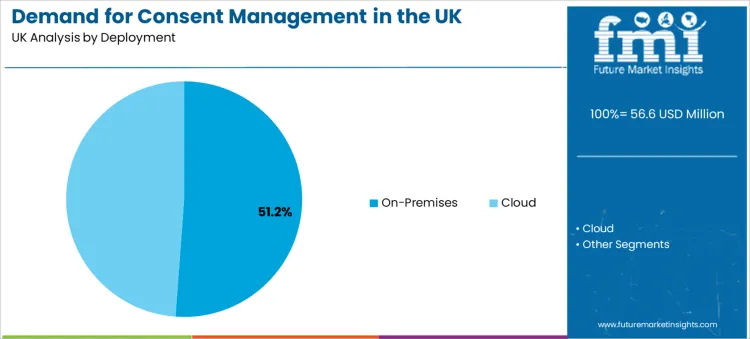
On-premises deployment holds a 51.2% share, indicating strong preference for direct system control and data residency assurance. Many UK organizations manage consent records alongside sensitive customer and employee data that sits within tightly governed IT environments. On-premises setups allow teams to align consent workflows with internal security policies, audit frameworks, and access controls already embedded across enterprise systems.
This deployment choice also supports organizations operating under complex legacy architectures where integration flexibility matters more than rapid deployment. Internal IT teams retain visibility over data flows, change management, and update timing, which reduces uncertainty during regulatory reviews and internal audits.
What keeps consent management platforms at the centre of solution demand?
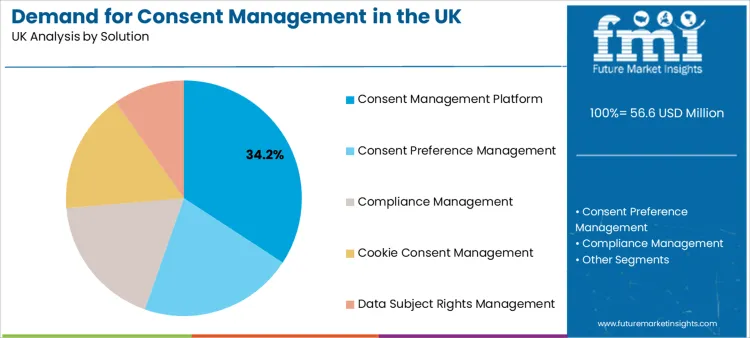
Consent management platforms account for a 34.2% share, positioning them as the primary solution focus. These platforms centralize consent capture, storage, and status tracking across websites, applications, and internal systems. Teams value having a single operational layer that standardizes consent logic while supporting configurable rules for different data categories and jurisdictions.
Platform adoption simplifies coordination between legal, compliance, and digital teams by providing shared visibility and structured reporting. This reduces manual intervention and limits reliance on fragmented tools that create reconciliation gaps during compliance checks.
Why do consulting services lead service-based demand?
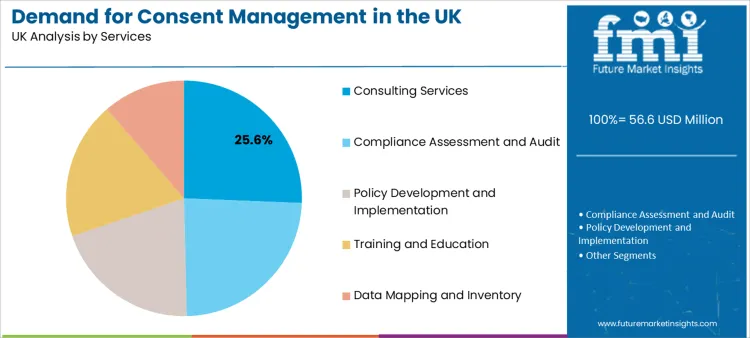
Consulting services represent a 25.6% share, reflecting the ongoing need for interpretation, scoping, and implementation guidance. Many organizations require support translating regulatory obligations into operational consent processes that fit their data architecture and customer journeys. Consultants help map consent touchpoints, define responsibility boundaries, and align system configuration with documented policies.
This service demand is strongest where internal compliance expertise is limited or where consent programmes are undergoing redesign due to regulatory scrutiny or platform consolidation initiatives.
What are the Key Dynamics in demand for consent management in the UK?
Demand for consent management in the UK reflects stringent data protection expectations driven by the UK GDPR and the Data Protection Act 2018. Organizations operating in digital advertising, ecommerce, and online services must capture, record, and demonstrate lawful bases for processing personal data. Growth in cookie-dependent businesses and rising enforcement actions have elevated the need for structured consent frameworks that help firms avoid fines and reputational harm. Procurement decisions focus on systems that support consent capture, preference management, withdrawal handling, and audit trails in line with Information Commissioner’s Office (ICO) guidance.
How do regulatory clarity and enforcement influence uptake?
Uptake of consent management solutions in the UK is shaped by regulatory clarity around digital privacy requirements and active enforcement by the ICO. UK businesses handling personal data are required to obtain valid consent for targeted marketing, profiling, and third-party sharing where no other legal basis applies. Heightened regulatory scrutiny of cookie banners, tracking technologies, and behavioural advertising has increased pressure on website operators and app owners to deploy mechanisms that record consent granularly and securely. Telecom, retail, and financial services sectors prioritise consent management platforms that integrate with customer data infrastructure and support frequent updates to consent records following changes in preferences or legal standards.
How do consumer expectation and technology complexity affect demand?
Consumer expectation for transparent data use and easy control over preferences contributes to demand for consent management in the UK. Users increasingly disengage from services that do not offer clear choices or straightforward withdrawal mechanisms, influencing how organizations design user journeys and manage consent flows. Technical complexity arising from multi-channel interactions and cross-device tracking requires solutions that unify consent signals and respect preferences across web, mobile, email, and third-party integrations. Organizations must balance speed of rollout with robustness of consent handling, particularly where legacy systems lack native support for modern privacy standards.
How is Consent Management Demand Evolving across Key Regions in the UK?
Demand for consent management across the UK advances through regulatory compliance needs, digital service expansion, and tighter data governance expectations. Regional variation reflects organisational scale, digital maturity, public sector digitisation pace, and how enterprises formalise consent workflows within existing customer data and privacy operations.
| Region | CAGR (2026-2036) |
|---|---|
| England | 1.5% |
| Scotland | 1.3% |
| Wales | 1.2% |
| Northern Ireland | 1.1% |
Why is England leading expansion through enterprise scale and compliance formalisation?
England grows at 1.5%, supported by a higher concentration of large enterprises, regulated service providers, and complex digital ecosystems. Organizations invest in consent management to standardize data permissions across multiple platforms and customer touchpoints. Demand strengthens where firms operate high-volume data flows and require auditable consent records that integrate smoothly with CRM, marketing automation, and analytics systems.
How is Scotland progressing through steady adoption within public services and SMEs?
Scotland expands at 1.3%, shaped by gradual uptake among public sector bodies and small to mid-sized enterprises improving digital governance. Adoption focuses on simplifying consent capture, storage, and retrieval without adding operational burden. Demand rises where organisations modernise legacy systems and seek structured compliance controls aligned with privacy policies and citizen-facing digital services.
What is shaping Wales as organisations prioritise cost control and governance clarity?
Wales advances at 1.2%, driven by cautious implementation among organisations balancing compliance needs with budget discipline. Buyers favour consent management tools that offer clear visibility into permissions while remaining easy to configure and maintain. Demand builds when solutions reduce manual oversight, support internal audits, and align with limited IT resources across smaller operational teams.
Why is Northern Ireland showing measured growth tied to selective deployment?
Northern Ireland records 1.1% growth, reflecting selective deployment within sectors handling sensitive personal data. Organisations focus on targeted use cases where consent clarity directly supports risk reduction and operational assurance. Demand improves when systems demonstrate reliability, straightforward reporting, and compatibility with existing data handling practices without extensive process redesign.
What Defines the Competitive Landscape for Consent Management in the UK?
Demand for consent management in the UK is driven by GDPR enforcement, rising regulatory audits, and expanding digital data collection. Organizations assess consent platforms based on compliance automation, user experience flexibility, integration with marketing systems, and audit readiness. Buyer evaluation includes localization for UK regulations, support for multi-domain environments, data residency controls, and reporting accuracy. Procurement behavior favors vendors offering rapid deployment, strong legal templates, scalable pricing models, and ongoing regulatory update support. Trend in the UK industry reflects transition from basic cookie banners toward enterprise-wide privacy governance infrastructure.
OneTrust leads the UK market through comprehensive consent and privacy management platforms adopted by large enterprises and regulated sectors. TrustArc competes by providing flexible consent frameworks combined with advisory services aligned to UK and European compliance expectations. Cookiebot by Cybot A/S maintains strong presence among publishers and mid-sized businesses requiring fast, compliant cookie management. Quantcast Choice supports demand with consent solutions optimized for advertising transparency and consent signaling across digital ecosystems. Crownpeak differentiates through integrated consent and content governance capabilities suited for complex, brand-driven digital experiences.
Key Industry Participants
- OneTrust
- TrustArc
- Cookiebot by Cybot A/S
- Quantcast Choice
- Crownpeak
Scope of Report
| Items | Values |
|---|---|
| Quantitative Units | USD million |
| Deployment | On-Premises; Cloud |
| Solution | Consent Management Platform; Consent Preference Management; Compliance Management; Cookie Consent Management; Data Subject Rights Management |
| Services | Consulting Services; Compliance Assessment and Audit; Policy Development and Implementation; Training and Education; Data Mapping and Inventory |
| Regions Covered | England; Scotland; Wales; Northern Ireland |
| Key Companies Profiled | OneTrust; TrustArc; Cookiebot by Cybot A/S; Quantcast Choice; Crownpeak |
Consent Management Demand in the UK by Segments
By Deployment:
- On-Premises
- Cloud
By Solution:
- Consent Management Platform
- Consent Preference Management
- Compliance Management
- Cookie Consent Management
- Data Subject Rights Management
By Services:
- Consulting Services
- Compliance Assessment and Audit
- Policy Development and Implementation
- Training and Education
- Data Mapping and Inventory
By Region:
- England
- Scotland
- Wales
- Northern Ireland
Bibliography
- Information Commissioner’s Office. (2023). Guidance on the use of cookies and similar technologies. ICO.
- Information Commissioner’s Office. (2024). Consent, lawful basis, and accountability under the UK GDPR. ICO.
- UK Parliament. (2023). Data Protection Act 2018: Updated guidance and statutory interpretation materials. The Stationery Office.
- Department for Science, Innovation and Technology. (2023). UK data protection reform: Maintaining high standards of data protection. UK Government.
- European Data Protection Board. (2023). Guidelines 05/2020 on consent under Regulation (EU) 2016/679 (updated version). EDPB.
- National Cyber Security Centre. (2024). Data governance, privacy controls, and secure handling of personal data in digital services. NCSC.
Frequently Asked Questions
How big is the consent management industry in the UK in 2026?
The consent management industry in the UK is projected to be valued at USD 56.6 million in 2026.
What will be the size of the consent management industry in the UK in 2036?
The industry size for consent management in the UK is projected to reach USD 64.8 million by 2036.
How much will the demand for consent management in the UK grow between 2026 and 2036?
Demand for consent management in the UK is projected to grow at a 1.4% CAGR between 2026 and 2036.
Which deployment model holds a significant share in the consent management industry in the UK in 2026?
In terms of deployment, on-premises solutions are expected to account for a 51.2% share in 2026.
Which regions are contributing to demand growth for consent management in the UK?
England, Scotland, Wales, and Northern Ireland are contributing to demand growth for consent management in the UK.
Preview the report firsthand - request a free sample
Get SampleGet the brochure for pricing and purchase details.
Get PDFTable of Content
- Executive Summary
- UK Market Outlook
- Demand-side Trends
- Supply-side Trends
- Technology Roadmap Analysis
- Analysis and Recommendations
- Market Overview
- Market Coverage / Taxonomy
- Market Definition / Scope / Limitations
- Market Background
- Market Dynamics
- Drivers
- Restraints
- Opportunity
- Trends
- Scenario Forecast
- Demand in Optimistic Scenario
- Demand in Likely Scenario
- Demand in Conservative Scenario
- Opportunity Map Analysis
- Product Life Cycle Analysis
- Supply Chain Analysis
- Investment Feasibility Matrix
- Value Chain Analysis
- PESTLE and Porter’s Analysis
- Regulatory Landscape
- Regional Parent Market Outlook
- Production and Consumption Statistics
- Import and Export Statistics
- Market Dynamics
- UK Market Analysis 2021 to 2025 and Forecast, 2026 to 2036
- Historical Market Size Value (USD Million) Analysis, 2021 to 2025
- Current and Future Market Size Value (USD Million) Projections, 2026 to 2036
- Y-o-Y Growth Trend Analysis
- Absolute $ Opportunity Analysis
- UK Market Pricing Analysis 2021 to 2025 and Forecast 2026 to 2036
- UK Market Analysis 2021 to 2025 and Forecast 2026 to 2036, By Deployment
- Introduction / Key Findings
- Historical Market Size Value (USD Million) Analysis By Deployment , 2021 to 2025
- Current and Future Market Size Value (USD Million) Analysis and Forecast By Deployment , 2026 to 2036
- On-Premises
- Cloud
- On-Premises
- Y-o-Y Growth Trend Analysis By Deployment , 2021 to 2025
- Absolute $ Opportunity Analysis By Deployment , 2026 to 2036
- UK Market Analysis 2021 to 2025 and Forecast 2026 to 2036, By Solution
- Introduction / Key Findings
- Historical Market Size Value (USD Million) Analysis By Solution, 2021 to 2025
- Current and Future Market Size Value (USD Million) Analysis and Forecast By Solution, 2026 to 2036
- Consent Management Platform
- Consent Preference Management
- Compliance Management
- Cookie Consent Management
- Data Subject Rights Management
- Consent Management Platform
- Y-o-Y Growth Trend Analysis By Solution, 2021 to 2025
- Absolute $ Opportunity Analysis By Solution, 2026 to 2036
- UK Market Analysis 2021 to 2025 and Forecast 2026 to 2036, By Services
- Introduction / Key Findings
- Historical Market Size Value (USD Million) Analysis By Services, 2021 to 2025
- Current and Future Market Size Value (USD Million) Analysis and Forecast By Services, 2026 to 2036
- Consulting Services
- Compliance Assessment and Audit
- Policy Development and Implementation
- Training and Education
- Data Mapping and Inventory
- Consulting Services
- Y-o-Y Growth Trend Analysis By Services, 2021 to 2025
- Absolute $ Opportunity Analysis By Services, 2026 to 2036
- Market Structure Analysis
- Competition Dashboard
- Competition Benchmarking
- Market Share Analysis of Top Players
- By Regional
- By Deployment
- By Solution
- By Services
- Competition Analysis
- Competition Deep Dive
- OneTrust
- Overview
- Product Portfolio
- Profitability by Market Segments (Product/Age /Sales Channel/Region)
- Sales Footprint
- Strategy Overview
- Marketing Strategy
- Product Strategy
- Channel Strategy
- TrustArc
- Cookiebot by Cybot A/S
- Quantcast Choice
- Crownpeak
- OneTrust
- Competition Deep Dive
- Assumptions & Acronyms Used
- Research Methodology


