

- Industry Size (2026)
- USD 30.1 Mn
- Forecast (2036)
- USD 56.7 Mn
- CAGR (2026 to 2036)
- 6.6%
Demand for Citrus Molasses in South Korea Forecast and Outlook 2026 to 2036
Demand for citrus molasses in South Korea is set for significant growth as it progresses towards 2036. Starting from a value of USD 30.1 million in 2026, projections indicate a steady increase, reaching USD 56.7 million over the next decade. This growth trajectory underscores a compound annual growth rate (CAGR) of 6.6%, driven largely by rising consumer preferences for natural and functional ingredients. By closely monitoring demand trends, the market is expected to see incremental increases each year, bolstered by the growing utilization of citrus molasses in various food and beverage applications. As health-conscious consumers seek out more wholesome options, this sector stands to benefit markedly.
Key to fostering this growth is investment selectivity, as businesses aim to enhance production efficiency and expand processing capabilities. It is essential for companies within the market to allocate capital wisely—focusing on upgrading technologies and securing stable supply chains for raw materials. While the market's capital intensity remains moderate, the potential for returns hinges on the ability to navigate the landscape of fluctuating raw material costs and evolving regulatory frameworks. Those players who can adeptly balance the expansion of their production capacities with strategic investment management are well-poised for sustainable growth in this dynamic segment of the South Korean market.
Quick Stats for the Demand for Citrus Molasses in South Korea
- Citrus Molasses in South Korea Value (2026): USD 30.1 million
- Citrus Molasses in South Korea Forecast Value (2036): USD 56.7 million
- Citrus Molasses in South Korea Forecast CAGR (2026 to 2036): 6.6%
- Citrus Molasses in South Korea Leading Segment: B2B (80%)
- Key Growth Regions of Citrus Molasses in South Korea: Jeju (leading CAGR ~7.9%)
- Top Players of Citrus Molasses in South Korea: Lemon Concentrate S.L., Louis Dreyfus Company B.V., Citrusuco S.A., Citromax Group, Sucocitrico Cutrale Ltd.
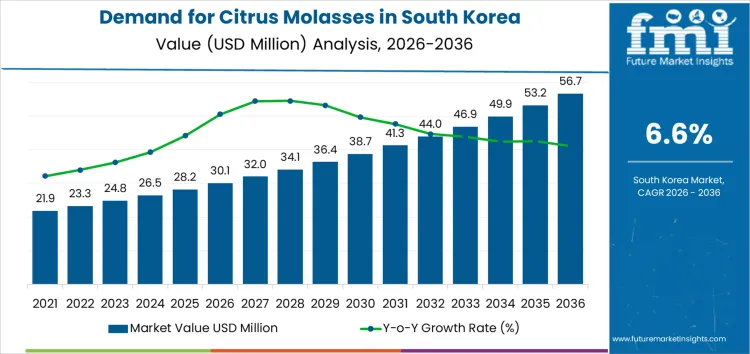
What is the Growth Forecast for the Citrus Molasses Market in South Korea through 2036?
The citrus molasses market in South Korea is projected to experience consistent growth from 2026 to 2036. Starting at USD 30.1 million in 2026, the market is expected to rise to USD 32.0 million in 2027. By 2028, the market value will reach USD 34.1 million, followed by USD 36.4 million in 2029. The market will continue to grow, reaching USD 38.7 million in 2030 and USD 41.3 million in 2031.
As the demand for natural and functional ingredients rises, the market will expand further, with the value reaching USD 44.0 million in 2032 and USD 46.9 million in 2033. By 2034, the market is projected to reach USD 49.9 million, growing to USD 53.2 million in 2035. By 2036, the market value is expected to reach USD 56.7 million, reflecting steady compound growth driven by the increasing use of citrus molasses in food and beverage products and the growing preference for natural ingredients in South Korea.
Key Takeaways for Demand for Citrus Molasses in South Korea
| Metric | Value |
|---|---|
| Industry Sales Value (2026) | USD 30.1 million |
| Industry Forecast Value (2036) | USD 56.7 million |
| Industry Forecast CAGR (2026 to 2036) | 6.6% |
Why is the Demand for Citrus Molasses Growing in South Korea?
Demand for citrus molasses in South Korea has grown modestly as food and industrial sectors increasingly seek versatile syrups and fermentation substrates. Historically, molasses overall in South Korea has been used across food processing, animal feed, biofuel production, and industrial fermentation, with imports supplying much of domestic demand because sugarcane cultivation is limited locally. Molasses from sugarcane and sugar beets has been integrated into bakery syrups, sauces, confectionery, and fermentation processes where consistent sugar content supports predictable yields. As part of the broader molasses category, citrus molasses draws on byproducts of citrus processing, which in South Korea are supplied by domestic citrus harvests that vary with seasonal yield and import levels of citrus fruits. Citrus production experienced fluctuations in recent years, affected by weather and acreage changes, although citrus consumption and imports have remained significant for both fresh fruit and processed citrus products. These dynamics have shaped how citrus byproducts like concentrated juices and peels are managed, supporting occasional use of citrus derivatives in food and industrial streams.
Looking ahead, the demand for citrus molasses in South Korea is expected to increase in line with expanding end-use applications that value sugar-rich byproducts and bioactive compounds. Global market projections indicate overall citrus molasses volumes will rise due to demand from animal feed, pulp production, and biofuel sectors, which could influence South Korean import patterns given limited domestic production of molasses precursors. Growth in functional food and beverage manufacturing that incorporates natural sweeteners and flavoring agents may also support uptake of citrus molasses or similar citrus-derived concentrates in specific product categories. Technological developments in byproduct valorization, whereby citrus processing waste is converted into value-added ingredients, could reinforce demand for citrus molasses in industrial fermentation and specialized food applications. Broader trends in sustainability and circular processing, along with continued expansion of fermented food sectors, are likely to influence how citrus molasses fits into South Korea’s ingredient supply chains over the coming years.
What Are the Key Segments in Demand for Citrus Molasses in South Korea?
Demand for citrus molasses in South Korea is influenced by nature and sales channels. Conventional citrus molasses leads the nature segment, holding a 79% share, while organic citrus molasses follows. In terms of sales channels, B2B (business-to-business) transactions dominate the market, comprising 80%, with B2C (business-to-consumer) sales representing a smaller share. The growing food and beverage industry, along with increasing consumer demand for natural sweeteners, is driving the demand for citrus molasses.
What Is the Demand Pattern for Citrus Molasses in South Korea by Nature?
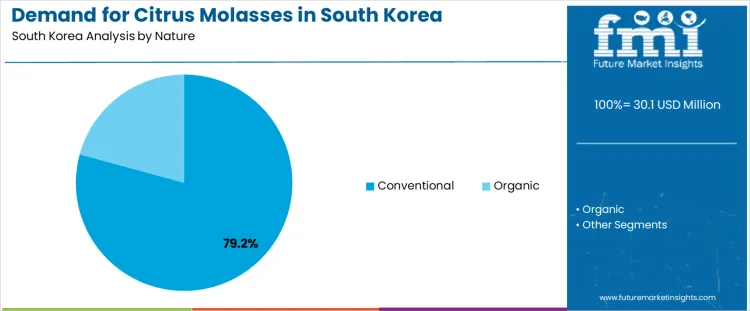
The demand for citrus molasses in South Korea is predominantly for conventional products, which account for 79% of the market. Conventional citrus molasses is typically more affordable than its organic counterpart, making it a preferred choice for large-scale applications in the food and beverage industry. It is used as a sweetener in various products, including jams, sauces, and baked goods, due to its rich flavor and functional properties. The higher availability and lower cost of conventional citrus molasses contribute to its dominant position in the market. Organic citrus molasses, while a smaller segment, is gaining traction among consumers and businesses that prioritize organic products. Organic citrus molasses is typically produced without synthetic pesticides or fertilizers, appealing to health-conscious consumers and businesses focused on sustainability. Despite its smaller market share, demand for organic citrus molasses is increasing, driven by the rising preference for natural and clean-label ingredients in the food and beverage industry. As consumer awareness of health and environmental issues grows, organic citrus molasses is expected to see continued growth, albeit at a slower pace compared to conventional products.
What Is the Demand Pattern for Citrus Molasses in South Korea by Sales Channel?
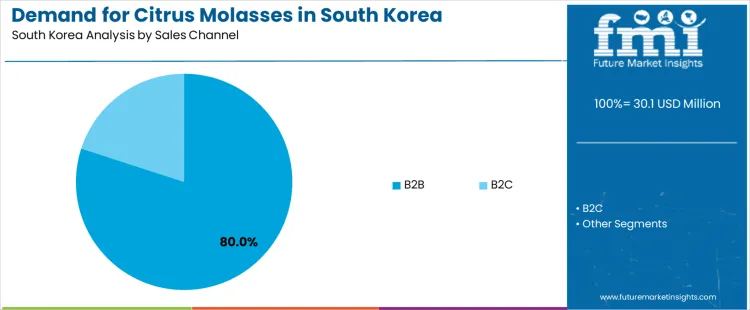
In South Korea, the demand for citrus molasses is heavily driven by the B2B (business-to-business) sales channel, which accounts for 80% of the market. B2B transactions are primarily driven by the food and beverage industry, where citrus molasses is used as a raw ingredient in manufacturing a wide range of products such as beverages, sauces, and processed foods. Manufacturers prefer to purchase citrus molasses in bulk, benefiting from lower prices and larger quantities to meet production needs. The B2B sector also includes suppliers to the cosmetics and pharmaceutical industries, where citrus molasses is used for its antioxidant and antimicrobial properties. While B2B remains the dominant sales channel, B2C (business-to-consumer) sales are growing, particularly in the retail sector. The increasing availability of citrus molasses in health food stores and supermarkets, where it is marketed as a natural sweetener alternative, has contributed to its rising popularity among consumers. B2C sales are typically driven by consumer trends toward healthier, more sustainable food options. As the market for natural and organic products expands in South Korea, B2C demand for citrus molasses is expected to increase, although B2B transactions will likely continue to dominate due to the scale of commercial usage in food production.
What are the Key Dynamics in the Demand for Citrus Molasses in South Korea?
Demand for citrus molasses in South Korea is shaped by its use as an industrial sweetener, ingredient in animal feed, and additive in food processing. The country imports citrus molasses as domestic citrus production does not fully satisfy industrial requirements. Food manufacturers and beverage producers utilise this ingredient for formulation of confectionery, soft drinks, and bakery items. Livestock and aquaculture sectors use citrus molasses in feed mixes due to its energy content and palatability. Price movements in global markets and shifts in dietary preferences influence the scale of usage of this commodity.
What are the Drivers of Demand for Citrus Molasses in South Korea?
Drivers of demand include growth in processed food and beverage manufacturing where citrus molasses functions as a sweetening agent and flavour enhancer. Expansion of the livestock and aquaculture sectors supports interest in citrus molasses for feed formulations that provide carbohydrates and improve feed intake. South Korea’s active import market for agricultural by-products helps secure supply where local citrus derivatives are limited. Industrial users value citrus molasses for consistency in formulation and blending across production lines. Rising output in confectionery and bakery categories also contributes to steady requirements for this ingredient.
What are the Restraints on Demand for Citrus Molasses in South Korea?
Restraints on demand arise from competition with alternative sweeteners such as refined sugar, high-fructose corn syrup, and other molasses types that may offer cost or functional advantages. Price volatility in global citrus and commodity markets can constrain procurement budgets for manufacturers. Regulatory standards on food additives and feed components require compliance and can increase testing and certification costs for importers and processors. Consumer sensitivity to sugar content in food and beverage products may lead formulators to limit usage of high-sugar inputs including citrus molasses, affecting overall volumes demanded.
What Key Trends Affect Demand for Citrus Molasses in South Korea?
A key trend involves reformulation efforts in the food and beverage sector to balance taste with nutritional profiles, which can alter levels of citrus molasses used. Growth in specialised feed blends for poultry and aquaculture supports tailored inclusion of citrus molasses as an energy source. Import patterns show diversification of supply origins to manage price exposure and ensure continuity of supply. Industry adoption of sustainable sourcing practices influences selection of agricultural by-products. Retail demand for healthier snack options prompts producers to evaluate alternative sweetening strategies, affecting long-term demand patterns for citrus molasses.
What is the Regional Analysis of Demand for Citrus Molasses in South Korea?
The demand for citrus molasses in South Korea varies across regions, with growth influenced by local agricultural production, processing capabilities, and consumption patterns. South Gyeongsang, with a CAGR of 6.9%, shows strong demand, driven by its significant citrus production and food processing industries. North Jeolla, with a growth rate of 5.2%, has a moderate demand, influenced by its agricultural base and evolving food manufacturing sector. South Jeolla, with a projected CAGR of 6.2%, experiences steady growth, supported by its growing food processing and agricultural industries. Jeju, with the highest growth rate of 7.9%, is seeing increased demand, likely driven by its reputation for citrus cultivation and the local demand for natural sweeteners. The regional differences reflect the varying strengths of agricultural and food processing industries, which are key drivers of citrus molasses demand.
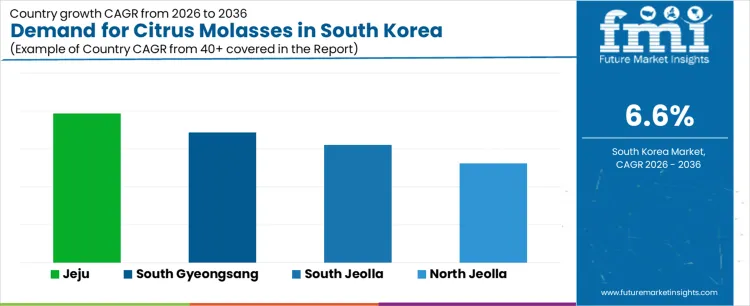
| Region | CAGR (2026 to 2036) |
|---|---|
| South Gyeongsang | 6.9% |
| North Jeolla | 5.2% |
| South Jeolla | 6.2% |
| Jeju | 7.9% |
What is the Demand for Citrus Molasses in South Gyeongsang?
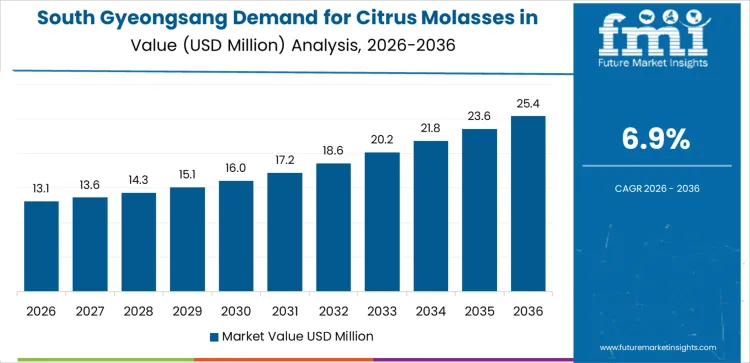
South Gyeongsang is projected to experience strong demand growth for citrus molasses, with a CAGR of 6.9% from 2026 to 2036. The region’s significant citrus production, coupled with its food processing and manufacturing sectors, drives this growth. As the demand for natural sweeteners and flavoring agents in food and beverages rises, citrus molasses, a byproduct of citrus juice production, is gaining popularity. South Gyeongsang’s established agricultural and food industries make it a key player in the growth of citrus molasses demand, especially as food manufacturers seek sustainable, natural ingredients for various products.
What Drives Demand for Citrus Molasses in North Jeolla?
North Jeolla’s demand for citrus molasses is expected to grow at a moderate pace, with a CAGR of 5.2%. The region’s agricultural focus and food processing activities contribute to the demand for citrus molasses, which is used in beverages, snacks, and confectionery. While North Jeolla is not as heavily involved in citrus production as other regions like South Gyeongsang or Jeju, it is experiencing growth in food manufacturing and innovation. The region’s demand for citrus molasses is expected to rise gradually, driven by the increasing use of natural sweeteners in processed food products and beverages.
How is Demand for Citrus Molasses Expected to Evolve in South Jeolla?
South Jeolla, with a projected CAGR of 6.2%, is experiencing steady growth in the demand for citrus molasses. The region’s agricultural and food processing industries play a significant role in driving this demand. As South Jeolla continues to expand its food manufacturing capabilities, including the production of beverages and snacks, the need for natural sweeteners like citrus molasses is expected to increase. Citrus molasses is gaining popularity due to its natural origins and suitability for a variety of food products. As consumer preferences shift toward healthier and more natural alternatives, South Jeolla’s demand for citrus molasses is expected to rise consistently.
What Drives the Growth in Demand for Citrus Molasses in Jeju?
Jeju, with the highest projected CAGR of 7.9%, is seeing strong growth in demand for citrus molasses. The region’s well-established citrus cultivation, particularly for Jeju oranges, positions it as a key source of raw material for citrus molasses. The growing consumer preference for natural sweeteners in food and beverages, combined with Jeju’s focus on local agricultural products, has led to increased demand for citrus molasses. As Jeju continues to capitalize on its agricultural strengths, demand for citrus molasses is expected to expand rapidly, particularly in the food, beverage, and health product sectors.
What is the Competitive Landscape for Citrus Molasses Demand in South Korea?
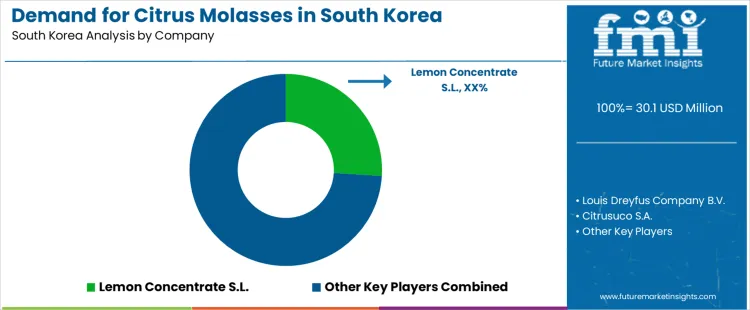
Demand for citrus molasses in South Korea is influenced by growing use in animal feed, food and beverage formulations, and specialty ingredient applications. Imported citrus byproducts serve as cost-effective energy sources in feed rations and flavoring components in processed foods, aligning with broader preferences for natural and functional ingredients. The molasses segment in South Korea is part of a larger molasses market that is expected to grow owing to food and feed demand and expanding applications in fermentation-based manufacturing. Citrus molasses specifically attracts interest due to its sugar content and nutritional contribution in feed applications, though its uptake remains part of broader molasses imports rather than extensive local production owing to limited domestic citrus processing. Market participation by international suppliers has increased through feed ingredient distribution partnerships and quality certification services designed to meet Korean regulatory requirements. This trend reflects integration of global supply chains with local feed manufacturers and food processors that require traceable, consistent ingredient sources.
Competition among key suppliers in South Korea revolves around product quality, supply reliability, and documented compliance with industry standards. Lemon Concentrate S.L. is recognised as a leading supplier of citrus molasses, supported by technical brochures that outline sugar profiles, viscosity characteristics, and application guidelines for feed and food industries. Louis Dreyfus Company B.V. positions its citrus byproduct offerings with detailed literature on sourcing, processing methods, and traceability credentials. Citrosuco S.A. materials focus on consistent supply from large citrus processing operations and include specification data such as °Brix values and acid content relevant to end-use formulations. Citromax Group brochures present product grades and handling recommendations tailored to livestock nutrition requirements. Sucocitrico Cutrale Ltd. documentation emphasises scalability of supply and analytical data on nutritional components. Brochures from these companies typically include technical specifications, processing standards, and certification information that inform procurement decisions by South Korean feed producers and food ingredient buyers.
Key Players of the Demand for Citrus Molasses in South Korea
- Lemon Concentrate S.L.
- Louis Dreyfus Company B.V.
- Citrusuco S.A.
- Citromax Group
- Sucocitrico Cutrale Ltd.
Scope of the Report
| Items | Values |
|---|---|
| Quantitative Units (2026) | USD Million |
| Nature | Conventional, Organic |
| Sales Channel | B2B, B2C |
| Application | Animal Feed, Pulp Production, Biofuel |
| Companies | Lemon Concentrate S.L., Louis Dreyfus Company B.V., Citrusuco S.A., Citromax Group, Sucocitrico Cutrale Ltd. |
| Region Covered | South Korea |
| Provinces Covered | South Gyeongsang, North Jeolla, South Jeolla, Jeju |
| Additional Attributes | Dollar sales by nature, sales channel, and application. Demand is supported by expansion in livestock feed formulations, increasing interest in bio-based fuels, and rising utilization of citrus by-products in pulp and food processing industries. |
Key Segments of Demand for Citrus Molasses in South Korea
Nature
- Conventional
- Organic
Sales Channel
- B2B
- B2C
Application
- Animal Feed
- Pulp Production
- Biofuel
- Other
Provinces
- South Gyeongsang
- North Jeolla
- South Jeolla
- Jeju
Bibliography
- Korea Rural Economic Institute. (2024). Agricultural outlook: Citrus (November 2024). Seoul, Republic of Korea: KREI.
- U.S. Department of Agriculture, Foreign Agricultural Service. (2025). Citrus annual: Korea, Republic of (KS2025-0052). Washington, DC: USDA.
- Food and Agriculture Organization of the United Nations. (2024). World food and agriculture: Statistical yearbook 2024. Rome, Italy: FAO.
- Statistics Korea. (2025). Fruit production (KOSIS Table DT_1ET0292). Daejeon, Republic of Korea: Statistics Korea.
- Saeed, M., Kamboh, A. A., & Huayou, C. (2024). Promising future of citrus waste into fermented high-quality bio-feed in poultry nutrition and safe environment. Poultry Science, 103(5).
Frequently Asked Questions
How big is the demand for citrus molasses in south korea in 2026?
The demand for citrus molasses in south korea is estimated to be valued at USD 30.1 million in 2026.
What will be the size of citrus molasses in south korea in 2036?
The market size for the citrus molasses in south korea is projected to reach USD 56.7 million by 2036.
How much will be the demand for citrus molasses in south korea growth between 2026 and 2036?
The demand for citrus molasses in south korea is expected to grow at a 6.6% CAGR between 2026 and 2036.
What are the key product types in the citrus molasses in south korea?
The key product types in citrus molasses in south korea are conventional and organic.
Which sales channel segment is expected to contribute significant share in the citrus molasses in south korea in 2026?
In terms of sales channel, b2b segment is expected to command 80.0% share in the citrus molasses in south korea in 2026.
Preview the report firsthand - request a free sample
Get SampleGet the brochure for pricing and purchase details.
Get PDFTable of Content
- Executive Summary
- South Korea Market Outlook
- Demand-side Trends
- Supply-side Trends
- Technology Roadmap Analysis
- Analysis and Recommendations
- Market Overview
- Market Coverage / Taxonomy
- Market Definition / Scope / Limitations
- Market Background
- Market Dynamics
- Drivers
- Restraints
- Opportunity
- Trends
- Scenario Forecast
- Demand in Optimistic Scenario
- Demand in Likely Scenario
- Demand in Conservative Scenario
- Opportunity Map Analysis
- Product Life Cycle Analysis
- Supply Chain Analysis
- Investment Feasibility Matrix
- Value Chain Analysis
- PESTLE and Porter’s Analysis
- Regulatory Landscape
- Regional Parent Market Outlook
- Production and Consumption Statistics
- Import and Export Statistics
- Market Dynamics
- South Korea Market Analysis 2021 to 2025 and Forecast, 2026 to 2036
- Historical Market Size Value (USD Million) Analysis, 2021 to 2025
- Current and Future Market Size Value (USD Million) Projections, 2026 to 2036
- Y-o-Y Growth Trend Analysis
- Absolute $ Opportunity Analysis
- South Korea Market Pricing Analysis 2021 to 2025 and Forecast 2026 to 2036
- South Korea Market Analysis 2021 to 2025 and Forecast 2026 to 2036, By Nature
- Introduction / Key Findings
- Historical Market Size Value (USD Million) Analysis By Nature, 2021 to 2025
- Current and Future Market Size Value (USD Million) Analysis and Forecast By Nature, 2026 to 2036
- Conventional
- Organic
- Conventional
- Y-o-Y Growth Trend Analysis By Nature, 2021 to 2025
- Absolute $ Opportunity Analysis By Nature, 2026 to 2036
- South Korea Market Analysis 2021 to 2025 and Forecast 2026 to 2036, By Sales Channel
- Introduction / Key Findings
- Historical Market Size Value (USD Million) Analysis By Sales Channel, 2021 to 2025
- Current and Future Market Size Value (USD Million) Analysis and Forecast By Sales Channel, 2026 to 2036
- B2B
- B2C
- B2B
- Y-o-Y Growth Trend Analysis By Sales Channel, 2021 to 2025
- Absolute $ Opportunity Analysis By Sales Channel, 2026 to 2036
- South Korea Market Analysis 2021 to 2025 and Forecast 2026 to 2036, By Application
- Introduction / Key Findings
- Historical Market Size Value (USD Million) Analysis By Application, 2021 to 2025
- Current and Future Market Size Value (USD Million) Analysis and Forecast By Application, 2026 to 2036
- Animal Feed
- Pulp Production
- Biofuel
- Animal Feed
- Y-o-Y Growth Trend Analysis By Application, 2021 to 2025
- Absolute $ Opportunity Analysis By Application, 2026 to 2036
- Market Structure Analysis
- Competition Dashboard
- Competition Benchmarking
- Market Share Analysis of Top Players
- By Regional
- By Nature
- By Sales Channel
- By Application
- Competition Analysis
- Competition Deep Dive
- Lemon Concentrate S.L.
- Overview
- Product Portfolio
- Profitability by Market Segments (Product/Age /Sales Channel/Region)
- Sales Footprint
- Strategy Overview
- Marketing Strategy
- Product Strategy
- Channel Strategy
- Louis Dreyfus Company B.V.
- Citrusuco S.A.
- Citromax Group
- Sucocitrico Cutrale Ltd.
- Lemon Concentrate S.L.
- Competition Deep Dive
- Assumptions & Acronyms Used
- Research Methodology


