

- Industry Size (2026)
- USD 591.9 Mn
- Forecast (2036)
- USD 899.6 Mn
- CAGR (2026 to 2036)
- 4.3%
Demand for Fiber Cement in South Korea Forecast and Outlook 2026 to 2036
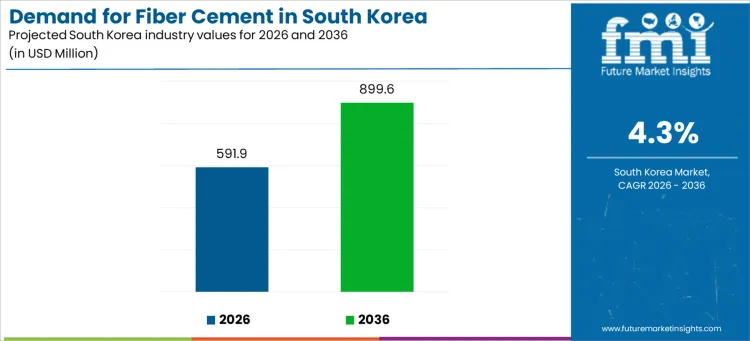
Demand for fiber cement in South Korea is anticipated to push valuation to USD 591.9 million in 2026. Revenue associated with this composite material sector is likely to ascend to USD 899.6 million by 2036, advancing at a compound annual growth rate of 4.3%. South Korea faces a distinct architectural shift as urbanization intensifies, driving architects to seek durable, versatile alternatives to traditional masonry. Urban regeneration projects in major metropolitan hubs like Seoul and Busan require cladding solutions that withstand humidity and temperature fluctuations while offering modern aesthetics.
Fiber cement offers superior resistance to moisture and fire, making it an ideal choice for high-density housing complexes where safety standards are paramount. Consequently, construction firms are increasingly specifying these composites for both exterior facades and interior partitioning. Government mandates focusing on building safety and energy efficiency are acting as powerful catalysts for material adoption. Recent regulatory updates following fire safety incidents have led to stricter non-combustibility requirements for exterior building materials.
Policymakers are enforcing codes that favor fiber cement over vinyl or combustible wood siding options. Sustainable construction initiatives are also promoting the use of eco-friendly materials that incorporate recycled content. Public awareness regarding environmental impact is encouraging developers to select building envelopes that offer longevity and minimal maintenance. This regulatory and social pressure ensures a consistent uptake of high-performance cementitious composites across the national construction landscape.
Quick Stats for Demand for Fiber Cement in South Korea
- Demand for Fiber Cement in South Korea Value (2026): USD 591.9 million
- Demand for Fiber Cement in South Korea Forecast Value (2036): USD 899.6 million
- Demand for Fiber Cement in South Korea Forecast CAGR: 4.3%
- Leading Raw Material Segment for Fiber Cement Industry in South Korea: Portland Cement (40.0%)
- Leading Application Segment for Fiber Cement Industry in South Korea: Cladding (32.8%)
- Leading End User Segment for Fiber Cement Industry in South Korea: Residential (67.9%)
- Key Growth Regions for Fiber Cement Industry in South Korea: Jeju, South Gyeongsang, South Jeolla, North Jeolla
- Fiber Cement Industry in South Korea Key Players: James Hardie Industries PLC, Etex Group, Cembrit Holding A/S, Nichiha Corporation, Swisspearl Group
Technological integration in manufacturing processes is enhancing product performance and appeal. Producers are utilizing advanced manufacturing equipment to create high-density panels with intricate textures that mimic natural wood or stone. Integration of building insulation materials with fiber cement systems is improving the thermal efficiency of residential structures, aligning with zero-energy building goals. Innovations in coil coatings allow for pre-finished boards that retain color vibrance for decades, reducing lifecycle costs for building owners. These technical advancements are broadening the application scope of fiber cement beyond simple siding to decorative interior elements and robust roofing solutions.
Demand for Fiber Cement in South Korea Key Takeaways
South Korea's construction material domain is witnessing a steady transition towards high-performance composites that offer a balance of safety, aesthetics, and sustainability. Portland cement remains the foundational raw material, ensuring structural integrity, while silica and cellulosic fibers provide necessary flexibility. Residential construction drives the bulk of consumption, particularly for siding and cladding applications. Regional growth is robust in tourism-heavy areas requiring durable infrastructure. Competitive dynamics are led by global entities that have established strong distribution networks and localized product lines. Ultimately, the sector is evolving from a niche alternative to a mainstream standard for modern Korean architecture.
| Metric | Value |
|---|---|
| Industry Size (2026) | USD 591.9 million |
| Industry Value (2036) | USD 899.6 million |
| CAGR (2026 to 2036) | 4.3% |
What Specific Environmental Factors Are Fueling Fiber Cement Adoption?
Increasing frequency of typhoons and heavy rainfall in the Korean peninsula necessitates building materials with superior moisture resistance. Fiber cement does not rot, warp, or succumb to mold, unlike traditional timber, making it highly suitable for the local climate. Usage of bio-based building materials is gaining traction, but fiber cement holds an advantage in longevity and fire resistance.
Concerns regarding urban heat islands are also driving architects to choose lighter colored, reflective cladding options available in fiber cement ranges. Demand is further supported by the material's ability to withstand freeze-thaw cycles without cracking, a critical factor for durability during cold Korean winters.
How is the Sector Structured Across Key Segments?
Structure of this domain is categorized by raw material composition, application area, and end-user facility type. Raw material segmentation highlights the blend of cement, silica, and fibers that define the product's physical properties. Application classification distinguishes between external uses like cladding and roofing, and internal uses like backer boards. End-user data underscores the heavy reliance on the housing sector compared to commercial developments. Understanding this segmentation helps manufacturers optimize their supply chains, sourcing specific grades of silica or cellulose to meet the varying performance standards required for different applications.
Why Does Portland Cement Maintain Compositional Dominance?
Portland Cement commands a 40.0% share of the industry. This binder is the primary component responsible for the compressive strength and durability of the final board. Manufacturers utilize high-grade Portland cement to ensure that panels meet stringent impact resistance standards. Availability of domestic cement production in South Korea ensures a steady supply chain for local factories. While blended cement and masonry cement exist, Portland cement offers the consistent chemical properties needed for precise fiber cement formulation. Its dominance is secured by its role in providing the non-combustible matrix that makes these boards a preferred choice for fire-safe construction.
How is the Cladding Application Contributing to Sector Growth?
Cladding accounts for 32.8% of the usage share. Visual appeal of building exteriors is a major priority for Korean property developers seeking to differentiate their projects. Fiber cement board cladding offers versatility in design, capable of mimicking wood, stone, or smooth concrete finishes. Architects value the ease of installation and the reduced structural load compared to heavy stone masonry. Renovations of older apartment complexes often involve over-cladding with fiber cement to improve insulation and aesthetics simultaneously. This application segment is vital for modernizing the urban landscape, driving consistent sales volume for large format panels.
Why Do Residential Projects Lead Consumption?
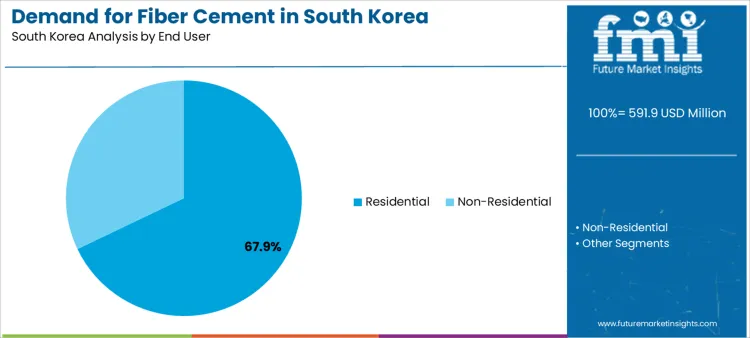
Residential projects capture a 67.9% share of the sector. Housing remains a critical focus of national development, with continuous construction of new apartment towns and suburban single-family homes. Homeowners increasingly prioritize low-maintenance exteriors that do not require frequent painting or sealing. Cement boards market analysis indicates a strong preference for fiber cement siding in the growing modular and country-house segments. Safety regulations requiring fire-resistant materials in densely populated residential areas further mandate the use of non-combustible options. Consequently, the residential sector remains the bedrock of demand, fueled by both new starts and remodeling activities.
Will the Shift Towards Green Construction Redefine Future Sales?
Usage of eco-friendly materials is becoming a decisive factor in project tendering. Manufacturers are exploring carbon negative cement and geopolymer cement as potential raw materials to lower the embodied carbon of their boards. Adoption of co2 reduced concrete technologies in the production process appeals to environmentally conscious developers. South Korea's "Green Deal" policy incentivizes the use of sustainable building products, potentially offering tax benefits for projects utilizing low-carbon materials. Innovations in this space are crucial for maintaining relevance as carbon footprint calculations become a standard part of architectural planning.
How Do Raw Material Innovations Impact Design?
Integration of alternative fibers is enhancing the performance-to-weight ratio of boards. Research into reinforced concrete additives using pcr fibers suggests potential for using post-consumer recycled plastics in fiber cement matrices. Advances in ultra high performance concrete technology are influencing the development of thinner, yet stronger, fiber cement sheets. These innovations allow for larger panel sizes with fewer joints, enabling sleek, modern facade designs. Improvements in construction chemicals used for coating and sealing further extend the lifespan of these products, making them competitive against premium metal or stone cladding.
Is the Trend Towards Prefabrication Affecting Demand?
Modular and prefabricated construction methods are gaining traction to address labor shortages in the Korean construction industry. Fiber cement is ideally suited for off-site manufacturing due to its durability during transport and installation. Pre-cut and pre-finished boards accelerate the assembly process, reducing on-site waste and labor costs. This shift necessitates precise manufacturing tolerances and consistent quality, pushing suppliers to invest in automated cutting and finishing lines. As prefabrication becomes more mainstream for residential and commercial builds, demand for dimensionally stable and robust cladding materials like fiber cement is set to rise.
How is the Landscape Evolving Across South Korea's Regions?
Regional consumption is influenced by local climate conditions, tourism development, and industrial revitalization projects. Coastal areas prioritize salt-resistant materials, while urban centers focus on aesthetic versatility and fire safety. Regions like Jeju and the southeastern coast face unique challenges due to their proximity to the sea. The salty air and high humidity levels necessitate the use of salt-resistant materials in construction. This necessity extends to both commercial and residential buildings, where components such as windows, facades, and roofing must be durable and resistant to corrosion. These areas often contend with typhoons and heavy rainfall, making it crucial for structures to incorporate features that enhance water resistance and structural integrity, such as elevated foundations and storm shutters.
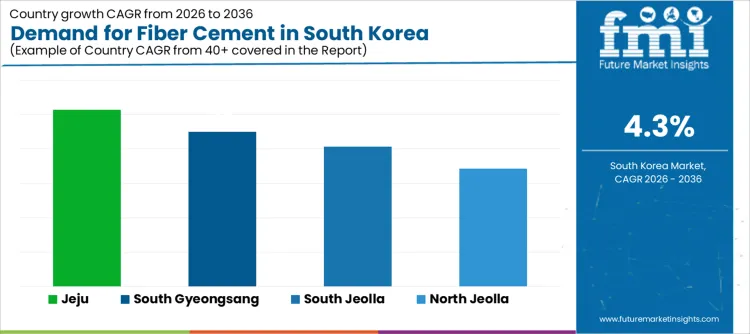
| Region | CAGR (2026 to 2036) |
|---|---|
| Jeju | 5.1% |
| South Gyeongsang | 4.5% |
| South Jeolla | 4.1% |
| North Jeolla | 3.4% |
Why is the Tourism Infrastructure in Jeju Driving Rapid Growth?
Adoption of fiber cement in Jeju is projected to expand at a CAGR of 5.1%. Jeju Island's booming hospitality sector requires building materials that can withstand high humidity and saline winds. Hotels, resorts, and vacation homes extensively use fiber cement siding for its durability and wood-like appearance without the rot issues associated with natural timber. Local regulations emphasizing eco-friendly development align with the sustainable profile of fiber cement. Construction of theme parks and museums on the island also drives demand for decorative cladding and durable roofing solutions.
How is Industrial Revitalization in South Gyeongsang Influencing Sales?
Sales of construction composites in South Gyeongsang are likely to reach a CAGR of 4.5%. This region involves significant industrial facility upgrades and workforce housing developments. Refurbishment of older industrial zones requires cost-effective and fire-resistant cladding materials. Fiber cement offers a practical solution for modernizing factory exteriors and warehouses. Residential developments catering to the workforce of major shipyards and automotive plants are also adopting fiber cement for its longevity. Availability of local ports facilitates easy import of raw materials, supporting a competitive regional supply chain.
What Specific Factors Drive Demand in South Jeolla?
Expansion in South Jeolla is anticipated to rise at a CAGR of 4.1%. Agricultural modernization and the development of "smart villages" in this province are contributing to growth. Farmers and rural residents are upgrading traditional homes with modern, energy-efficient materials. Fiber cement's resistance to pests and moisture makes it a popular choice for rural housing. Investments in coastal tourism infrastructure, including pensions and cafes, utilize fiber cement for its aesthetic appeal and weather resilience. Local government subsidies for housing improvement further stimulate the purchase of durable siding materials.
Why is North Jeolla Modernizing its Residential Zones?
Deployment of building materials in North Jeolla is expected to increase at a CAGR of 3.4%. Urban renewal projects in cities like Jeonju are driving the replacement of aging facades with modern composites. The region's focus on maintaining cultural aesthetics while using modern materials leads to the use of fiber cement products that mimic traditional textures. Construction of new apartment complexes in developing districts like the Saemangeum area creates a steady baseline of demand. While growth is moderate, the shift towards higher quality construction standards ensures sustained interest in fiber cement solutions.
What Strategic Initiatives Define Market Leadership?
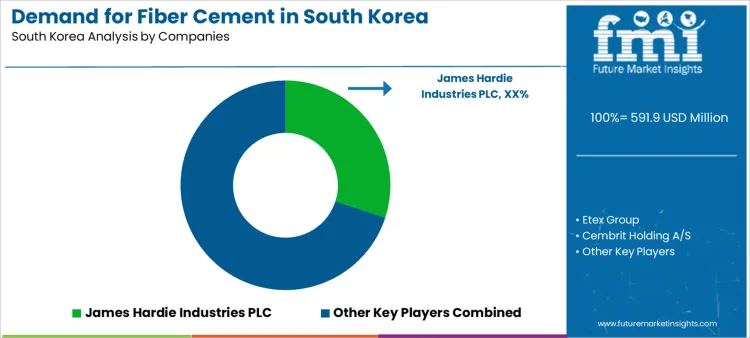
James Hardie Industries PLC commands a dominant position with a 30.0% share, leveraging its global brand reputation and premium product technologies like ColorPlus. Its strategy focuses on educating architects and contractors about the superior lifecycle costs of fiber cement compared to vinyl or wood. James Hardie invests heavily in marketing campaigns targeting high-end residential developments. Competitors like Etex Group and Nichiha emphasize design versatility, offering extensive catalogs of textures and finishes. Strategic partnerships with major Korean construction firms allow these global leaders to secure specifications in large-scale housing projects.
How Are Niche Competitors Challenging Global Giants?
Players such as Cembrit and Swisspearl target the high-end architectural facade segment. They differentiate themselves through unique color palettes and through-colored boards that hide chips and scratches. These companies focus on commercial and institutional projects where aesthetics are a primary driver. Local distributors play a crucial role in providing technical support and ensuring just-in-time delivery to construction sites. By offering specialized cutting and fabrication services, smaller competitors can capture value in the bespoke design sector, challenging the volume-driven strategies of the larger incumbents.
Key Companies
- James Hardie Industries PLC
- Etex Group
- Cembrit Holding A/S
- Nichiha Corporation
- Swisspearl Group
Scope of Report
| Items | Values |
|---|---|
| Quantitative Units | USD Million |
| Raw Materials | Portland Cement, Silica, Cellulosic Fiber, Others |
| Application | Cladding, Siding, Backer Boards, Molding and Trimming, Roofing |
| End User | Residential, Non-Residential |
| Regions Covered | Jeju, South Gyeongsang, South Jeolla, North Jeolla |
| Key Companies Profiled | James Hardie, Etex Group, Cembrit, Nichiha, Swisspearl |
Demand for Fiber Cement in South Korea by Segments
By Raw Materials:
- Portland Cement
- Silica
- Cellulosic Fiber
- Others
By Application:
- Cladding
- Siding
- Backer Boards
- Molding and Trimming
- Roofing
By End User:
- Residential
- Non-Residential
Bibliography
- Statistics Korea. (2024, January 3). Approval notice for changes to statistics on building permission, commencement, and completion works (KOSTAT Notice No. 2024-5). Statistics Korea, Republic of Korea.
- Korea Cement Association. (2025). Cement in Korea 2025: Industry statistics and demand–supply overview. Korea Cement Association, Republic of Korea.
- Korea Institute of Civil Engineering and Building Technology. (2024, February 21). Fire safety research direction and strengthened fire resistance requirements for building materials. Korea Institute of Civil Engineering and Building Technology, Republic of Korea.
- Korea Institute of Civil Engineering and Building Technology. (2024). Advances in fire resistance evaluation and performance-based fire safety standards for building materials. Korea Institute of Civil Engineering and Building Technology, Republic of Korea.
Frequently Asked Questions
How big is the demand for Fiber Cement in South Korea in 2026?
The demand for Fiber Cement in South Korea is estimated to be valued at USD 591.9 million in 2026.
What will be the size of Fiber Cement in South Korea in 2036?
The industry size for the Fiber Cement in South Korea is projected to reach USD 899.6 million by 2036.
How much will be the demand for Fiber Cement in South Korea growth between 2026 and 2036?
The demand for Fiber Cement in South Korea is expected to grow at a 4.3% CAGR between 2026 and 2036.
What are the key product types in the Fiber Cement in South Korea?
The key product types in Fiber Cement in South Korea are Portland Cement, Silica, and Cellulosic Fiber.
Which end user segment is expected to contribute significant share in the Fiber Cement in South Korea in 2026?
By end user, Residential segment is expected to command 67.9% share in the Fiber Cement in South Korea in 2026.
Preview the report firsthand - request a free sample
Get SampleGet the brochure for pricing and purchase details.
Get PDFTable of Content
- Executive Summary
- South Korea Market Outlook
- Demand-side Trends
- Supply-side Trends
- Technology Roadmap Analysis
- Analysis and Recommendations
- Market Overview
- Market Coverage / Taxonomy
- Market Definition / Scope / Limitations
- Market Background
- Market Dynamics
- Drivers
- Restraints
- Opportunity
- Trends
- Scenario Forecast
- Demand in Optimistic Scenario
- Demand in Likely Scenario
- Demand in Conservative Scenario
- Opportunity Map Analysis
- Product Life Cycle Analysis
- Supply Chain Analysis
- Investment Feasibility Matrix
- Value Chain Analysis
- PESTLE and Porter’s Analysis
- Regulatory Landscape
- Regional Parent Market Outlook
- Production and Consumption Statistics
- Import and Export Statistics
- Market Dynamics
- South Korea Market Analysis 2021 to 2025 and Forecast, 2026 to 2036
- Historical Market Size Value (USD Million) Analysis, 2021 to 2025
- Current and Future Market Size Value (USD Million) Projections, 2026 to 2036
- Y-o-Y Growth Trend Analysis
- Absolute $ Opportunity Analysis
- South Korea Market Pricing Analysis 2021 to 2025 and Forecast 2026 to 2036
- South Korea Market Analysis 2021 to 2025 and Forecast 2026 to 2036, By Raw Materials
- Introduction / Key Findings
- Historical Market Size Value (USD Million) Analysis By Raw Materials , 2021 to 2025
- Current and Future Market Size Value (USD Million) Analysis and Forecast By Raw Materials , 2026 to 2036
- Portland Cement
- Silica
- Cellulosic Fiber
- Others
- Portland Cement
- Y-o-Y Growth Trend Analysis By Raw Materials , 2021 to 2025
- Absolute $ Opportunity Analysis By Raw Materials , 2026 to 2036
- South Korea Market Analysis 2021 to 2025 and Forecast 2026 to 2036, By End User
- Introduction / Key Findings
- Historical Market Size Value (USD Million) Analysis By End User, 2021 to 2025
- Current and Future Market Size Value (USD Million) Analysis and Forecast By End User, 2026 to 2036
- Residential
- Non-Residential
- Residential
- Y-o-Y Growth Trend Analysis By End User, 2021 to 2025
- Absolute $ Opportunity Analysis By End User, 2026 to 2036
- South Korea Market Analysis 2021 to 2025 and Forecast 2026 to 2036, By Application
- Introduction / Key Findings
- Historical Market Size Value (USD Million) Analysis By Application, 2021 to 2025
- Current and Future Market Size Value (USD Million) Analysis and Forecast By Application, 2026 to 2036
- Cladding
- Siding
- Backer Boards
- Molding and Trimming
- Roofing
- Cladding
- Y-o-Y Growth Trend Analysis By Application, 2021 to 2025
- Absolute $ Opportunity Analysis By Application, 2026 to 2036
- Market Structure Analysis
- Competition Dashboard
- Competition Benchmarking
- Market Share Analysis of Top Players
- By Regional
- By Raw Materials
- By End User
- By Application
- Competition Analysis
- Competition Deep Dive
- James Hardie Industries PLC
- Overview
- Product Portfolio
- Profitability by Market Segments (Product/Age /Sales Channel/Region)
- Sales Footprint
- Strategy Overview
- Marketing Strategy
- Product Strategy
- Channel Strategy
- Etex Group
- Cembrit Holding A/S
- Nichiha Corporation
- Swisspearl Group
- James Hardie Industries PLC
- Competition Deep Dive
- Assumptions & Acronyms Used
- Research Methodology


