

- Industry Size (2026)
- USD 2114.9 Mn
- Forecast (2036)
- USD 3359.6 Mn
- CAGR (2026 to 2036)
- 4.7%
Fiber Cement Outlook in the UK 2026 to 2036
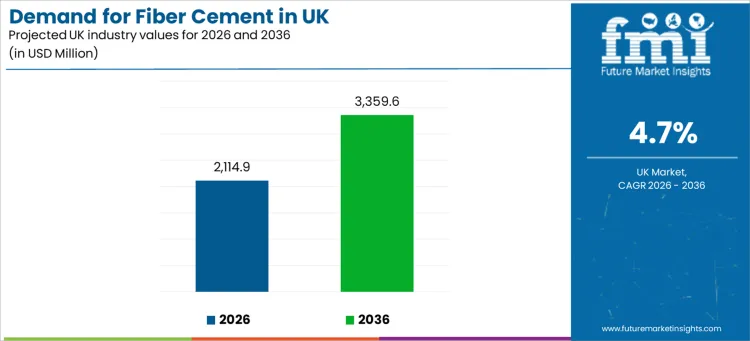
Demand for fiber cement in the UK is projected at USD 2,114.9 million in 2026 and is expected to reach USD 3,359.6 million by 2036, expanding at a 4.7% CAGR. This demand base is supported by long-term building envelope needs where durability, moisture resistance, and low-maintenance performance remain decisive across housing stock upgrades and new build pipelines. Fiber cement is commonly positioned as a practical solution for exterior façade protection and selected interior construction layers where dimensional stability matters.
Fiber cement is manufactured by combining cementitious binders with reinforcing fibers and mineral fillers to form boards, panels, siding products, and related building components. Buyers evaluate it through performance under changing weather exposure, resistance to rot and insect damage, stability against swelling, ease of installation, and visual finish retention over time. These factors make it relevant for developers seeking predictable project delivery and reduced call-backs after handover.
Quick Stats for Fiber Cement Demand in the UK
- Fiber Cement Valuation in the UK (2026): USD 2,114.9 million
- Fiber Cement Forecast Valuation in the UK (2036): USD 3,359.6 million
- Forecast CAGR 2026 to 2036: 4.7%
- Leading Regional Growth: England (5.2%)
- Leading Raw Material: Portland Cement (38.4% share)
- Leading End User: Residential (64.5% share)
- Leading Application: Cladding (31.1% share)
- Key Companies Profiled: James Hardie Industries PLC; Etex Group; Cembrit Holding A/S; Nichiha Corporation; Swisspearl Group
For CEOs and commercial heads, adoption is often tied to lifecycle cost control and risk reduction. A material that reduces repainting cycles, supports repeatable installation routines, and maintains façade integrity supports stronger customer satisfaction and lower warranty exposure. For construction solution providers, value sits in system compatibility, repeatable detailing, and availability of standardised profiles that simplify procurement across multiple sites.
Fiber Cement in the UK Key Takeaways
| Metric | Value |
|---|---|
| Industry Value (2026) | USD 2,114.9 million |
| Industry Forecast Value (2036) | USD 3,359.6 million |
| Forecast CAGR (2026 to 2036) | 4.7% |
Why is the UK Building Consistent Demand for Fiber Cement?
Demand in the UK is supported by practical construction requirements tied to building envelope performance, renovation cycles, and long-term housing quality expectations. Contractors and developers look for exterior solutions that can perform through wet weather exposure, maintain dimensional stability, and reduce recurring maintenance spend. Fiber cement fits well in these priorities because it offers a balance of durability and installed appearance consistency that supports both volume housing and design-led residential projects.
A central driver is the steady pace of residential replacement and upgrade activity. Building owners and developers are focused on façade durability, insulation pairing compatibility, and protection against moisture ingress. External envelope choices now carry more scrutiny because defects can drive significant rework costs, project delays, and customer dissatisfaction. This increases interest in materials that keep performance stable across temperature swings and seasonal conditions.
Fire safety attention also plays a role in shaping how façade systems are selected and validated. Approved Document B guidance is used as a reference point for fire safety expectations in England, including considerations relevant to external wall systems. This environment increases the weight of compliance documentation and system-level verification during specification decisions. Developers and main contractors value solutions that support clear certification pathways and predictable approval timelines.
Sustainability planning influences selection as well. Whole-life carbon thinking has become more prominent in the UK built environment, pushing teams to consider material durability, replacement frequency, and end-of-life planning. UKGBC’s whole life carbon roadmap highlights the need to reduce carbon impacts across the full building lifecycle. Materials that avoid early replacement cycles can support these goals by lowering refurbishment intensity over time.
Category planning teams often keep a close watch on adjacent building material themes such as fiber cement materials and installation formats such as fiber cement boards used in construction when aligning product roadmaps with durability and build-speed priorities.
How is Fiber Cement Demand Segmented by Raw Material, End User, and Application?
This segmentation reflects differences in formulation design, installation context, and where performance outcomes matter most during the building lifecycle. It also reflects procurement realities, since large-scale construction programs need stable supply, repeatable installation workflows, and predictable on-site handling characteristics.
Why does Portland Cement lead fiber cement formulations in UK production mixes?
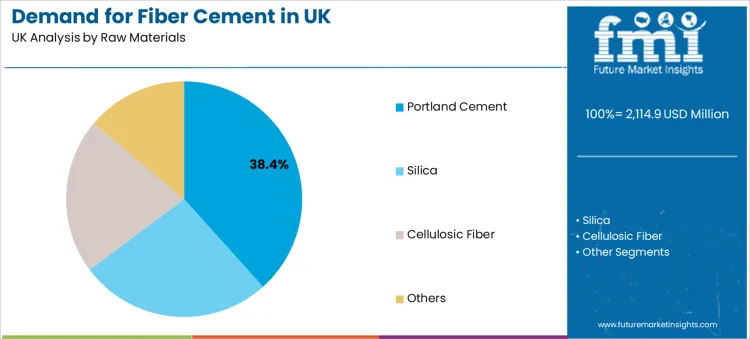
Portland cement holds a 38.4% share, making it the leading raw material base in this demand structure. This aligns with how cementitious binders provide structural integrity, compressive strength, and long-term stability across exterior exposure conditions.
Buyers value consistency because exterior applications must remain stable under repeated wet-dry cycles and temperature variation. Portland cement-based formulations support predictable board performance, stable fastening response, and dependable finishing behaviour during paint or coating application.
Manufacturers and contractors also benefit from familiarity. Portland cement has well-established supply chains and known behaviour within construction manufacturing processes. This improves cost planning, reduces formulation uncertainty, and supports repeatable output quality at scale.
Why is Residential Construction the anchor end user for fiber cement installations?
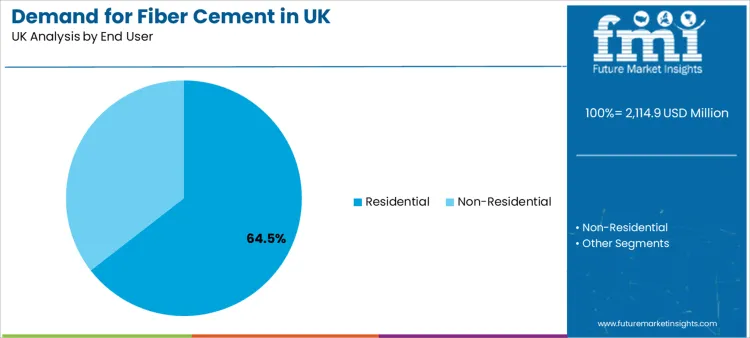
Residential holds a 64.5% share, making it the dominant end user segment. Residential adoption is driven by exterior durability needs, repeatable visual performance, and practical repairability. Housing developers focus on façade materials that reduce call-backs, maintain aesthetics through weather exposure, and allow fast installation across large housing volumes. Fiber cement supports these goals through predictable panel behaviour and stable edge performance.
Residential demand is also shaped by renovation cycles. Homeowners and landlords often upgrade façades to improve curb appeal, reduce maintenance, and improve weather protection. For suppliers, residential leadership rewards consistent product availability, stocked profiles, and installer-friendly formats that simplify on-site handling.
Why is Cladding taking the lead as the Most Common Application Route?
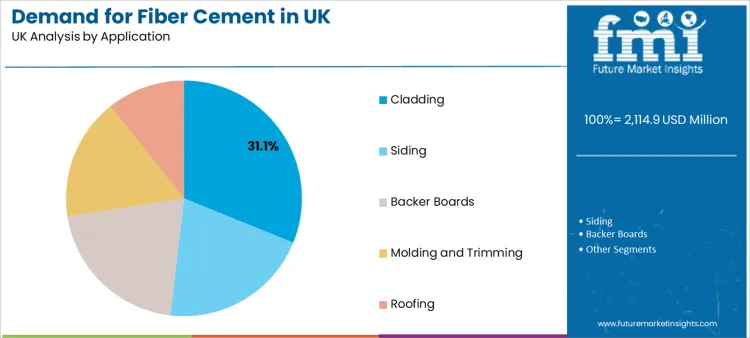
Cladding represents a 31.1% share, positioning it as the leading application. Cladding use reflects the need to protect the exterior envelope while delivering a clean architectural finish. It also supports performance goals linked to moisture management and façade longevity. Specifiers evaluate cladding through impact resistance, resistance to warping, finish retention, and compatibility with sub-frames and fastening systems.
Siding remains a strong usage pathway where fast installation and repeatable detailing matter. Backer boards support interior build systems that need moisture tolerance and stable substrate performance for tile and wet-area applications. Molding and trimming support aesthetic detailing, edge coverage, and transitions around openings. Roofing applications appear where fibre cement profiles are chosen for durability and weather resistance.
Teams planning high-performance façades often align design choices with broader external envelope themes such as rainscreen cladding systems and roof layer planning needs tied to roofing materials used in modern builds.
What are the Dynamics, Restraints, Opportunities, and Threats Shaping this Space?
What dynamics are strengthening UK demand fundamentals?
Durability and lifecycle cost control are central demand drivers. Developers want fewer maintenance cycles and a more predictable finish life. Contractors want materials that install reliably with fewer on-site defects. Housing upgrades and external envelope refurbishment cycles support steady repeat demand.
Specification discipline also strengthens demand. Fire safety guidance frameworks influence how external wall systems are assessed, increasing the value of documented performance and predictable compliance pathways.
Another driver is standardisation in product quality expectations. Fibre cement flat sheets are governed by established technical specifications and test methods in BS EN 12467, which supports consistent evaluation criteria for buyers and specifiers.
What restraints can limit adoption or slow purchasing cycles?
Installation quality can act as a restraint when crews lack familiarity with correct detailing and fastening practices. Edge finishing, joint treatment, and moisture management need disciplined execution. Procurement cycles can also slow when projects face budget pressure or planning delays.
On-site health and safety requirements influence handling and cutting practices. Silica dust control remains a serious focus area in construction environments, and HSE guidance emphasises preventing lung disease risks from respirable crystalline silica exposure. This can increase the importance of dust control methods, tooling choices, and worker protection processes, influencing installer preferences and site readiness.
Where do practical opportunities sit for suppliers and service partners?
Opportunity rises where customers want faster build cycles and consistent façade outcomes across multi-site programs. Pre-finished panels, improved coating systems, and installation-friendly profiles can reduce site time and improve workmanship consistency.
There is also room for stronger system packaging. Buyers value solutions that arrive with compatible trims, fixings, guidance documents, and training. Firms that help builders standardise detailing across projects can strengthen repeat orders and reduce installation risk.
Stakeholders designing high-capacity residential pipelines often keep an eye on category direction tied to fiber cement materials while façade specialists align choices with rainscreen cladding systems when moisture management and aesthetics sit at the center of the project brief.
What Threats can disrupt demand expectations?
Supply disruption remains a key threat in large build programs. Any shortage in boards, trims, or accessories can delay sequencing and increase labour cost. Non-compliant installation can also create costly rework and reputational damage for builders.
Regulatory change risk influences procurement and material selection. Updates in fire safety guidance and compliance expectations can shift specification pathways, requiring new documentation or revised system testing.
How is Fiber Cement Demand Evolving across Key Regions in the UK?
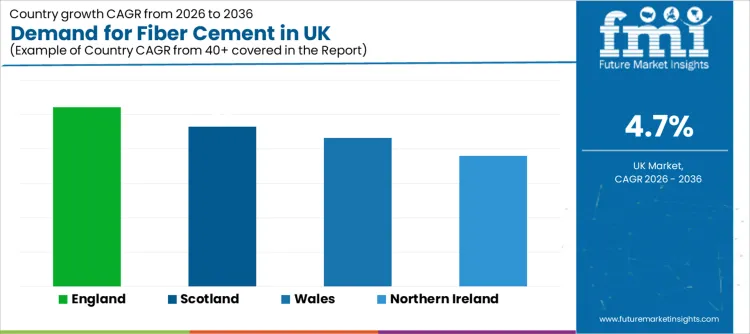
| Region | CAGR 2026 to 2036 |
|---|---|
| England | 5.2% |
| Scotland | 4.6% |
| Wales | 4.3% |
| Northern Ireland | 3.8% |
Why is England leading growth through higher housing activity and external envelope upgrades?
England grows at 5.2%, supported by higher volumes of residential construction activity and sustained refurbishment needs across housing stock. Contractors and developers focus on repeatable cladding and siding installation routines that control labour time and reduce defect risk. Large project footprints create demand for consistent supply, stable product performance, and a reliable distribution network that can serve multi-site schedules.
How is Scotland building steady demand through weather resilience needs and renovation cycles?
Scotland advances at 4.6%, reflecting the value placed on weather-resistant building envelope solutions and steady renovation demand. Harsh exposure conditions increase the importance of moisture tolerance and stable façade performance. Buyers place weight on product consistency and installation detailing that reduces water ingress risk and maintains finish integrity over time.
What is supporting Wales as fiber cement adoption rises through mixed residential development patterns?
Wales increases at 4.3%, supported by residential build activity and refurbishment requirements that favour durable façade solutions. Contractors value materials that install efficiently and maintain consistent aesthetic quality across varied building types. Procurement teams also prioritise predictable delivery schedules that support staged construction programs.
Why is Northern Ireland expanding at a measured pace through Targeted Project Pipelines?
Northern Ireland grows at 3.8%, shaped by a smaller project base and more targeted adoption patterns. Demand rises where builders seek durable exterior protection and stable performance across seasonal exposure. Suppliers that provide dependable availability and installer support can strengthen adoption in this environment.
What Defines the Competitive Landscape for Fiber Cement in the UK?
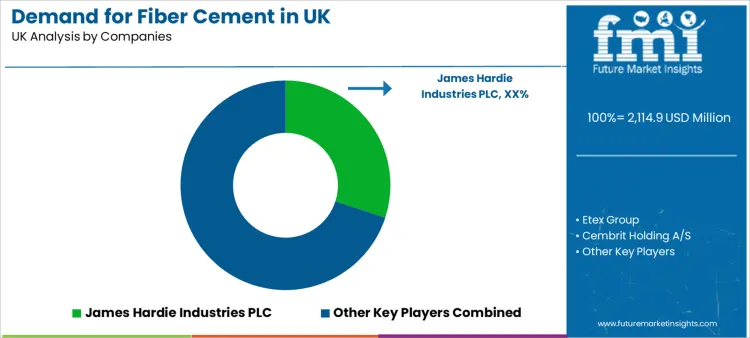
Competition is shaped by product durability, finish range, installation support, and supply reliability. Buyers evaluate suppliers based on how well materials perform across cladding and siding use, how consistently boards handle cutting and fastening, and how quickly the supplier can support site requirements. Product documentation, certification readiness, and clear installation guidance influence contractor confidence and reduce workmanship variation.
James Hardie Industries PLC competes through established product formats and broad contractor familiarity across façade applications. Etex Group competes through its building materials portfolio and channel reach. Cembrit Holding A/S competes through fibre cement expertise and system-oriented product offerings. Nichiha Corporation competes through façade-focused product positioning and architectural finish capabilities. Swisspearl Group competes through design variety and exterior panel systems that support modern building envelope requirements.
Teams balancing façade choices across multiple material families often align selection frameworks with adjacent external envelope themes tied to roofing materials used in modern builds and fiber cement boards used in construction when standardising project specifications.
Key Industry Participants
- James Hardie Industries PLC
- Etex Group
- Cembrit Holding A/S
- Nichiha Corporation
- Swisspearl Group
Scope of Report
| Items | Values |
|---|---|
| Quantitative Units | USD Million |
| Raw Materials | Portland Cement; Silica; Cellulosic Fiber; Others |
| End User | Residential; Non-Residential |
| Application | Cladding; Siding; Backer Boards; Molding and Trimming; Roofing |
| Regions Covered | England; Scotland; Wales; Northern Ireland |
| Key Companies Profiled | James Hardie Industries PLC; Etex Group; Cembrit Holding A/S; Nichiha Corporation; Swisspearl Group |
Fiber Cement Demand in the UK by Segments
By Raw Materials:
- Portland Cement
- Silica
- Cellulosic Fiber
- Others
By End User:
- Residential
- Non-Residential
By Application:
- Cladding
- Siding
- Backer Boards
- Molding and Trimming
- Roofing
By Region:
- England
- Scotland
- Wales
- Northern Ireland
Bibliography
- British Standards Institution. (2018). BS EN 12467:2012+A2:2018 Fibre-cement flat sheets: Product specification and test methods.
- Department for Levelling Up, Housing and Communities. (2024). Approved Document B (Fire Safety): 2019 edition incorporating 2020 and 2022 amendments.
- Health and Safety Executive. (2025). Control of exposure to silica dust: A guide for employees (INDG463).
- UK Green Building Council. (2024). Whole life carbon roadmap: A pathway to net zero.
Frequently Asked Questions
How big is the demand for fiber cement in uk in 2026?
The demand for fiber cement in uk is estimated to be valued at USD 2,114.9 million in 2026.
What will be the size of fiber cement in uk in 2036?
The market size for the fiber cement in uk is projected to reach USD 3,359.6 million by 2036.
How much will be the demand for fiber cement in uk growth between 2026 and 2036?
The demand for fiber cement in uk is expected to grow at a 4.7% CAGR between 2026 and 2036.
What are the key product types in the fiber cement in uk?
The key product types in fiber cement in uk are portland cement, silica, cellulosic fiber and others.
Which end user segment is expected to contribute significant share in the fiber cement in uk in 2026?
In terms of end user, residential segment is expected to command 64.5% share in the fiber cement in uk in 2026.
Preview the report firsthand - request a free sample
Get SampleGet the brochure for pricing and purchase details.
Get PDFTable of Content
- Executive Summary
- UK Market Outlook
- Demand-side Trends
- Supply-side Trends
- Technology Roadmap Analysis
- Analysis and Recommendations
- Market Overview
- Market Coverage / Taxonomy
- Market Definition / Scope / Limitations
- Market Background
- Market Dynamics
- Drivers
- Restraints
- Opportunity
- Trends
- Scenario Forecast
- Demand in Optimistic Scenario
- Demand in Likely Scenario
- Demand in Conservative Scenario
- Opportunity Map Analysis
- Product Life Cycle Analysis
- Supply Chain Analysis
- Investment Feasibility Matrix
- Value Chain Analysis
- PESTLE and Porter’s Analysis
- Regulatory Landscape
- Regional Parent Market Outlook
- Production and Consumption Statistics
- Import and Export Statistics
- Market Dynamics
- UK Market Analysis 2021 to 2025 and Forecast, 2026 to 2036
- Historical Market Size Value (USD Million) Analysis, 2021 to 2025
- Current and Future Market Size Value (USD Million) Projections, 2026 to 2036
- Y-o-Y Growth Trend Analysis
- Absolute $ Opportunity Analysis
- UK Market Pricing Analysis 2021 to 2025 and Forecast 2026 to 2036
- UK Market Analysis 2021 to 2025 and Forecast 2026 to 2036, By Raw Materials
- Introduction / Key Findings
- Historical Market Size Value (USD Million) Analysis By Raw Materials , 2021 to 2025
- Current and Future Market Size Value (USD Million) Analysis and Forecast By Raw Materials , 2026 to 2036
- Portland Cement
- Silica
- Cellulosic Fiber
- Others
- Portland Cement
- Y-o-Y Growth Trend Analysis By Raw Materials , 2021 to 2025
- Absolute $ Opportunity Analysis By Raw Materials , 2026 to 2036
- UK Market Analysis 2021 to 2025 and Forecast 2026 to 2036, By End User
- Introduction / Key Findings
- Historical Market Size Value (USD Million) Analysis By End User, 2021 to 2025
- Current and Future Market Size Value (USD Million) Analysis and Forecast By End User, 2026 to 2036
- Residential
- Non-Residential
- Residential
- Y-o-Y Growth Trend Analysis By End User, 2021 to 2025
- Absolute $ Opportunity Analysis By End User, 2026 to 2036
- UK Market Analysis 2021 to 2025 and Forecast 2026 to 2036, By Application
- Introduction / Key Findings
- Historical Market Size Value (USD Million) Analysis By Application, 2021 to 2025
- Current and Future Market Size Value (USD Million) Analysis and Forecast By Application, 2026 to 2036
- Cladding
- Siding
- Backer Boards
- Molding and Trimming
- Roofing
- Cladding
- Y-o-Y Growth Trend Analysis By Application, 2021 to 2025
- Absolute $ Opportunity Analysis By Application, 2026 to 2036
- Market Structure Analysis
- Competition Dashboard
- Competition Benchmarking
- Market Share Analysis of Top Players
- By Regional
- By Raw Materials
- By End User
- By Application
- Competition Analysis
- Competition Deep Dive
- James Hardie Industries PLC
- Overview
- Product Portfolio
- Profitability by Market Segments (Product/Age /Sales Channel/Region)
- Sales Footprint
- Strategy Overview
- Marketing Strategy
- Product Strategy
- Channel Strategy
- Etex Group
- Cembrit Holding A/S
- Nichiha Corporation
- Swisspearl Group
- James Hardie Industries PLC
- Competition Deep Dive
- Assumptions & Acronyms Used
- Research Methodology


