

- Industry Size (2026)
- USD 33.3 Mn
- Forecast (2036)
- USD 51.3 Mn
- CAGR (2026 to 2036)
- 4.4%
Demand for Carbon Fiber Composites for Prosthetics in the UK 2026 to 2036
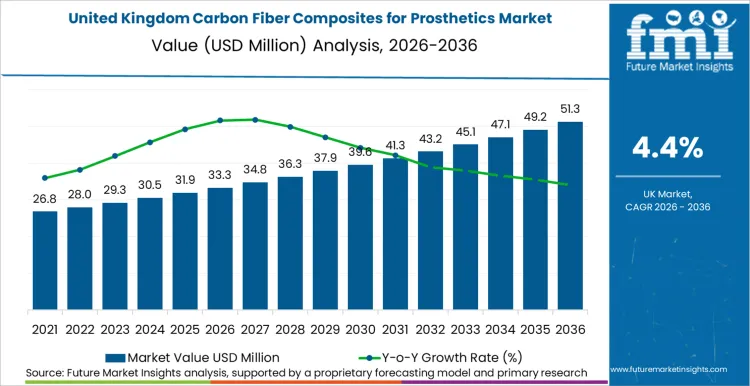
The demand for carbon fiber composites for prosthetics in the UK is anticipated to grow from USD 33.3 million in 2026 to USD 51.3 million by 2036, at a CAGR of 4.4%. This growth is driven by the increasing need for lightweight, durable materials that enhance prosthetic performance, particularly in lower limb prosthetics. Carbon fiber composites offer a high strength-to-weight ratio, providing comfort, mobility, and better long-term functionality for prosthetic users. The trend toward customized, high-performance prosthetics is also contributing to the rise in demand.
Healthcare funding and service expectations are key factors in the adoption of these materials, particularly in NHS and private sectors where durability and cost-efficiency are prioritized. Carbon fiber composites help ensure extended service life, reducing the frequency of replacements. The integration of digital design and additive manufacturing further accelerates demand, allowing for tailored solutions that improve prosthetic fit and functionality.
Quick Stats for Carbon Fiber Composites for Prosthetics Industry in the UK
- Carbon Fiber Composites for Prosthetics Industry Value (2026): USD 33.3 million
- Carbon Fiber Composites for Prosthetics Industry Forecast Value (2036): USD 51.3 million
- Carbon Fiber Composites for Prosthetics Industry Forecast CAGR (2026-2036): 4.4%
- Leading Product Type by Demand Share: Lower Limb Prosthetics
- Fastest-Growing Regions: England, Scotland, Wales, Northern Ireland
- Key Industry Participants: BASF SE, Syensqo, Teijin Carbon, Toray Industries Inc, Hexcel Corporation, Nitpro Composites
Carbon Fiber Composites for Prosthetics Industry in the UK Key Takeaways
| Metric | Value |
|---|---|
| Industry Value (2026) | USD 33.3 million |
| Industry Forecast Value (2036) | USD 51.3 million |
| Forecast CAGR (2026 to 2036) | 4.4% |
Why is the UK Building Steady Demand for Carbon Fiber Composites for Prosthetics?
Demand in the UK rises as prosthetic manufacturers pursue lighter, stronger materials that improve wearer comfort and performance. Carbon fiber composites deliver high strength‑to‑weight advantages over traditional metals, helping users move with less effort and reduced fatigue. Clinicians and prosthetics increasingly specify these materials because they support more natural gait and daily activity levels for amputees.
Healthcare funding and service expectations shape adoption patterns. NHS prosthetics services and private clinics prioritize durable solutions that align with long‑term rehabilitation goals. Carbon fiber composites resist fatigue and environmental wear, which helps providers justify investment based on extended service life and fewer replacements. This reliability matters in fitting decisions and supports ongoing procurement of advanced composite components.
Innovation and customization trends also drive uptake. UK prosthetic labs use digital design and additive manufacturing paired with carbon fiber layups to produce bespoke socket interfaces and structural elements. This approach tightens fit precision, enhancing functional outcomes and wearer satisfaction. As prosthetics gain confidence in designing around composite properties, these materials become integral to advanced prosthetic solutions rather than occasional technical experiments.
How is Carbon Fiber Composites for Prosthetics Demand Segmented by Product Type and End-User in the UK?
Demand for carbon fiber composites in prosthetics in the UK reflects how the medical and rehabilitation sectors increasingly rely on lightweight, durable materials to enhance comfort, mobility, and functionality for prosthetic users. Segmentation follows the need for customizability, strength, and the ability to support advanced rehabilitation technologies.
Why do lower limb prosthetics lead product-level adoption?
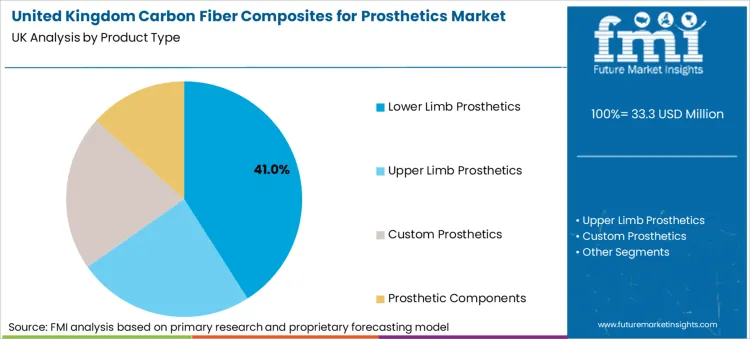
Lower limb prosthetics account for 41.0% of the demand, making them the most significant product segment. The high demand for carbon fiber composites in lower limb prosthetics is driven by the need for strong, lightweight materials that can support the complex mechanical stresses associated with walking, running, and other dynamic movements. Carbon fiber composites offer superior strength-to-weight ratios, providing patients with prosthetics that are both durable and comfortable, which enhances mobility and quality of life.
Advancements in carbon fiber technology allow for more precise customization of lower limb prosthetics, improving fit and function. This makes carbon fiber an essential material for the growing industry of lower limb prosthetic devices, particularly for individuals who require high-performance, long-lasting solutions.
What makes hospitals the primary end-user for prosthetics?
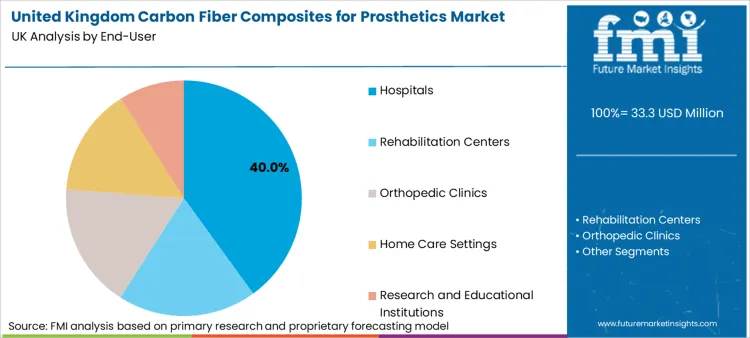
Hospitals represent 40.0% of the demand, reflecting their central role in both initial amputee care and long-term prosthetic management. Hospitals offer a wide range of services, from surgical procedures to post-operative rehabilitation, making them key locations for the fitting and adjustment of carbon fiber prosthetics. Medical professionals in hospitals are often involved in complex cases where the integration of high-performance prosthetic materials like carbon fiber is crucial for recovery and functional outcomes.
Hospitals support a comprehensive approach to patient care, including rehabilitation programs that rely on the use of advanced materials to ensure optimal patient mobility and comfort post-surgery.
What are the Key Dynamics in Demand for Carbon Fiber Composites for Prosthetics in the UK?
Demand for carbon fiber composites in prosthetics in the UK reflects a focus on lightweight performance, durability, and biomechanical responsiveness required in medical devices. Clinical practitioners and prosthetics prioritize materials that reduce device weight without sacrificing strength or fatigue resistance because users benefit from energy‑efficient gait and reduced residual limb stress. Demand is concentrated among amputees engaged in active mobility, sports rehabilitation, and occupational return‑to‑work programmes, where comfort and performance are paramount. Healthcare providers, including the NHS and private clinics, evaluate carbon fiber composite solutions for their long service life and capacity to integrate with modular prosthetic systems.
How do clinical performance need and user experience expectations shape uptake?
Clinical performance requirements significantly influence uptake because carbon fiber composites offer high specific strength and stiffness, supporting dynamic load transfer with low inertial mass. In lower‑limb prosthetics, such as transtibial and transfemoral sockets, pylons, and energy‑return feet, carbon fiber improves energy storage and release during walking and running, which enhances functional outcomes for users seeking stability and fluid motion. Upper‑limb prosthetic components leverage carbon composites to reduce systemic weight and improve fine motor control for activities of daily living. Rehabilitation professionals in the UK calibrate component choice to individual biomechanics, lifestyle demands, and anticipated activity levels, creating bespoke solutions rather than one‑size‑fits‑all offerings.
What do cost, supply chain and healthcare funding factors mean for sustained demand?
Carbon fiber composite prosthetic components command premium pricing relative to aluminium or thermoplastic alternatives, and cost considerations impact adoption when funding is subject to budgetary constraints in public and private healthcare sectors. NHS funding decisions focus on clinical necessity and long‑term cost effectiveness, evaluating whether reduced replacement frequency and improved mobility outcomes justify higher initial expense. Private rehabilitation and insurance coverage can enable wider access, particularly among active individuals seeking advanced performance features. Supply chain reliability for aerospace‑grade carbon fiber precursors and specialized fabrication processes such as lay‑up and autoclave curing influence lead times for bespoke prosthetic builds, which can affect clinical scheduling and user timelines.
How is Carbon Fiber Composites for Prosthetics Demand Evolving across Key Regions in the UK?
Demand for carbon fiber composites in prosthetics across the UK grows as advancements in material performance, comfort, and durability improve patient outcomes. Regional variation reflects the development of healthcare infrastructure, regional manufacturing capabilities, and how quickly prosthetic producers adopt lightweight, high-strength composite materials for customized solutions.
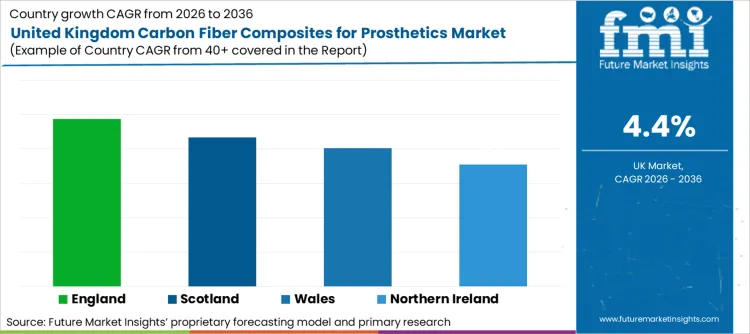
| Region | CAGR (2026-2036) |
|---|---|
| England | 4.9% |
| Scotland | 4.3% |
| Wales | 4.0% |
| Northern Ireland | 3.5% |
Why is England leading expansion through healthcare infrastructure and advanced manufacturing adoption?
England grows at 4.9%, supported by advanced healthcare infrastructure and a larger base of prosthetic manufacturers adopting carbon fiber composites. Demand rises where manufacturers seek materials that deliver superior strength, flexibility, and lightweight properties for high-performance prosthetics. Healthcare providers prioritise cost-effective, durable solutions that enhance patient mobility and reduce wear over time.
How is Scotland progressing through adoption in specialized prosthetic applications and clinical partnerships?
Scotland expands at 4.3%, shaped by adoption in specialized prosthetics for patients requiring advanced, custom solutions. Demand builds where healthcare providers and manufacturers collaborate to deliver lightweight, durable prosthetics that improve comfort and functionality. Scottish companies focus on carbon fiber’s performance in reducing prosthetic weight while maintaining strength and resilience for daily use.
What is shaping Wales as manufacturers balance production scalability with personalized patient care?
Wales advances at 4.0%, driven by selective integration of carbon fiber composites in prosthetic applications where personalization and patient comfort are key. Demand strengthens when producers optimize production methods to deliver custom prosthetics while maintaining cost efficiency. Manufacturers focus on incorporating carbon fiber’s high-performance qualities into tailored solutions that meet the specific needs of individual patients.
Why is Northern Ireland showing measured growth tied to niche adoption and specialized care?
Northern Ireland records 3.5% growth, reflecting selective adoption for specialized prosthetics with high demand for comfort and function. Adoption progresses in regions where healthcare facilities prioritize niche applications, such as upper-limb prosthetics, that benefit from the lightweight yet strong properties of carbon fiber composites. Demand improves as local providers offer custom solutions tailored to specific patient needs.
What Defines the Competitive Landscape for Carbon Fiber Composites for Prosthetics in the UK?
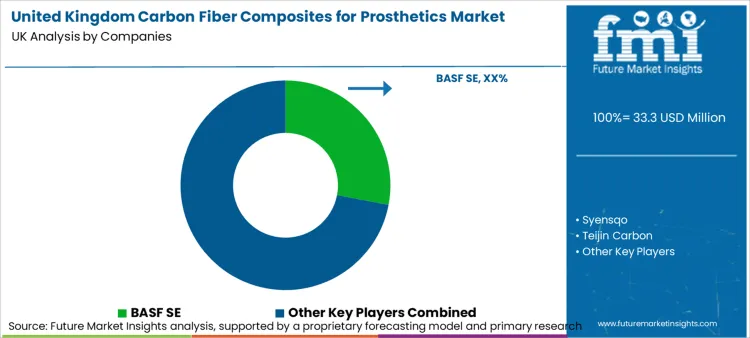
Demand for carbon fiber composites in the UK’s prosthetics industry is driven by the need for lightweight, durable, and high-strength materials that enhance mobility and comfort for prosthetic users. Buyers assess composite materials based on their structural integrity, resistance to wear and tear, fatigue resistance, and ability to be easily molded for custom prosthetic designs. The weight-to-strength ratio and long-term performance in high-stress conditions are critical factors. Procurement behavior tends to favor suppliers who can offer rapid prototyping, customization, and high-quality standards required by the medical device industry. The industry trend shows increasing demand for advanced carbon fiber solutions to improve the performance and comfort of prosthetics, particularly in the growing field of sports prosthetics and advanced prosthetic limbs.
BASF SE holds a significant position in the UK industry through its extensive portfolio of lightweight, durable carbon fiber composites that are ideal for prosthetic applications. Syensqo competes by offering high-performance carbon fiber materials designed for medical-grade applications, with a focus on flexibility and strength for personalized prosthetics. Teijin Carbon stands out with its advanced carbon fiber technologies tailored for medical uses, offering a balance of weight, strength, and ease of molding. Toray Industries Inc. provides high-quality carbon fiber solutions with applications across various industries, including prosthetics, where durability and comfort are key. Hexcel Corporation supports demand through its composite solutions, providing customized materials for prosthetic components that need to withstand daily wear and provide flexibility. Nitpro Composites, while smaller, offers specialized solutions focusing on high-strength carbon fiber composites for the medical sector. Competitive differentiation in the industry centers on material performance, customization capabilities, regulatory compliance, and long-term durability
Key Industry Participants
- BASF SE
- Syensqo
- Teijin Carbon
- Toray Industries Inc
- Hexcel Corporation
- Nitpro Composites
Scope of Report
| Items | Values |
|---|---|
| Quantitative Units | USD million |
| Product Type | Lower Limb Prosthetics; Upper Limb Prosthetics; Custom Prosthetics; Prosthetic Components |
| End-User | Hospitals; Rehabilitation Centers; Orthopedic Clinics; Home Care Settings; Research and Educational Institutions |
| Regions Covered | England; Scotland; Wales; Northern Ireland |
| Key Companies Profiled | BASF SE; Syensqo; Teijin Carbon; Toray Industries Inc; Hexcel Corporation; Nitpro Composites |
Carbon Fiber Composites for Prosthetics Demand in the UK by Segments
Product Type:
- Lower Limb Prosthetics
- Upper Limb Prosthetics
- Custom Prosthetics
- Prosthetic Components
End-User:
- Hospitals
- Rehabilitation Centers
- Orthopedic Clinics
- Home Care Settings
- Research and Educational Institutions
By Region:
- England
- Scotland
- Wales
- Northern Ireland
Bibliography
- Medicines and Healthcare products Regulatory Agency. (2023). Medical Devices Regulations: Performance, safety, and post-market surveillance requirements. UK Government.
- International Organization for Standardization. (2023). ISO 10328: Prosthetics - Structural testing of lower-limb prostheses. ISO.
- International Organization for Standardization. (2024). ISO 13485: Medical devices - Quality management systems (latest confirmed edition). ISO.
- European Commission. (2023). Regulation (EU) 2017/745 on medical devices: Application to composite materials in prosthetics. European Union.
Frequently Asked Questions
How big is the carbon fiber composites for prosthetics industry in the UK in 2026?
The carbon fiber composites for prosthetics industry in the UK is projected to be valued at USD 33.3 million in 2026.
What will be the size of the carbon fiber composites for prosthetics industry in the UK in 2036?
The industry size for carbon fiber composites for prosthetics in the UK is projected to reach USD 51.3 million by 2036.
How much will the demand for carbon fiber composites for prosthetics in the UK grow between 2026 and 2036?
Demand for carbon fiber composites for prosthetics in the UK is projected to grow at a 4.4% CAGR between 2026 and 2036.
Which product type holds a significant share in the carbon fiber composites for prosthetics industry in the UK in 2026?
In terms of product type, lower limb prosthetics are expected to account for a 41.0% share in 2026.
Which end-user segment contributes a major share in the carbon fiber composites for prosthetics industry in the UK in 2026?
Hospitals are expected to account for 40.0% of the carbon fiber composites for prosthetics industry in the UK in 2026.
Preview the report firsthand - request a free sample
Get SampleGet the brochure for pricing and purchase details.
Get PDFTable of Content
- Executive Summary
- UK Market Outlook
- Demand-side Trends
- Supply-side Trends
- Technology Roadmap Analysis
- Analysis and Recommendations
- Market Overview
- Market Structure, Signals, and Trend Drivers
- Benchmarking and Cross-market Comparability
- Market Sizing, Forecasting, and Opportunity Mapping
- Research Design and Evidence Framework
- Desk Research Programme (Secondary Evidence)
- Company Annual and Sustainability Reports
- Peer-reviewed Journals and Academic Literature
- Corporate Websites, Product Literature, and Technical Notes
- Earnings Decks and Investor Briefings
- Statutory Filings and Regulatory Disclosures
- Technical White Papers and Standards Notes
- Trade Journals, Industry Magazines, and Analyst Briefs
- Conference Proceedings, Webinars, and Seminar Materials
- Government Statistics Portals and Public Data Releases
- Press Releases and Reputable Media Coverage
- Specialist Newsletters and Curated Briefings
- Sector Databases and Reference Repositories
- Roots Internal Knowledge Base and Historical Datasets
- Subscription Datasets and Paid Sources
- Social Channels, Communities, and Digital Listening Inputs
- Additional Desk Sources
- Expert Input and Fieldwork (Primary Evidence)
- Primary Modes
- Qualitative Interviews and Expert Elicitation
- Quantitative Surveys and Structured Data Capture
- Blended A7oach
- Why Primary Evidence is Used
- Field Techniques
- Interviews
- Surveys
- Focus Groups
- Observational and In-context Research
- Social and Community Interactions
- Stakeholder Universe Engaged
- C-suite Leaders
- Board Members
- Presidents and Vice Presidents
- R&D and Innovation Heads
- Technical Specialists
- Domain Subject-matter Experts
- Scientists
- Physicians and Other Healthcare Professionals
- Governance, Ethics, and Data Stewardship
- Research Ethics
- Data Integrity and Handling
- Primary Modes
- Tooling, Models, and Reference Databases
- Desk Research Programme (Secondary Evidence)
- Data Engineering and Model Build
- Data Acquisition and Ingestion
- Cleaning, Normalisation, and Verification
- Synthesis, Triangulation, and Analysis
- Quality Assurance and Audit Trail
- Market Background
- Market Dynamics
- Drivers
- Restraints
- Opportunity
- Trends
- Scenario Forecast
- Demand in Optimistic Scenario
- Demand in Likely Scenario
- Demand in Conservative Scenario
- Opportunity Map Analysis
- Product Life Cycle Analysis
- Supply Chain Analysis
- Investment Feasibility Matrix
- Value Chain Analysis
- PESTLE and Porter’s Analysis
- Regulatory Landscape
- Regional Parent Market Outlook
- Production and Consumption Statistics
- Import and Export Statistics
- Market Dynamics
- UK Market Analysis 2021 to 2025 and Forecast, 2026 to 2036
- Historical Market Size Value (USD Million) Analysis, 2021 to 2025
- Current and Future Market Size Value (USD Million) Projections, 2026 to 2036
- Y-o-Y Growth Trend Analysis
- Absolute $ Opportunity Analysis
- UK Market Pricing Analysis 2021 to 2025 and Forecast 2026 to 2036
- UK Market Analysis 2021 to 2025 and Forecast 2026 to 2036, By Product Type
- Introduction / Key Findings
- Historical Market Size Value (USD Million) Analysis By Product Type , 2021 to 2025
- Current and Future Market Size Value (USD Million) Analysis and Forecast By Product Type , 2026 to 2036
- Lower Limb Prosthetics
- Upper Limb Prosthetics
- Custom Prosthetics
- Prosthetic Components
- Lower Limb Prosthetics
- Y-o-Y Growth Trend Analysis By Product Type , 2021 to 2025
- Absolute $ Opportunity Analysis By Product Type , 2026 to 2036
- UK Market Analysis 2021 to 2025 and Forecast 2026 to 2036, By End-User
- Introduction / Key Findings
- Historical Market Size Value (USD Million) Analysis By End-User, 2021 to 2025
- Current and Future Market Size Value (USD Million) Analysis and Forecast By End-User, 2026 to 2036
- Hospitals
- Rehabilitation Centers
- Orthopedic Clinics
- Home Care Settings
- Research and Educational Institutions
- Hospitals
- Y-o-Y Growth Trend Analysis By End-User, 2021 to 2025
- Absolute $ Opportunity Analysis By End-User, 2026 to 2036
- Market Structure Analysis
- Competition Dashboard
- Competition Benchmarking
- Market Share Analysis of Top Players
- By Regional
- By Product Type
- By End-User
- Competition Analysis
- Competition Deep Dive
- BASF SE
- Overview
- Product Portfolio
- Profitability by Market Segments (Product/Age /Sales Channel/Region)
- Sales Footprint
- Strategy Overview
- Marketing Strategy
- Product Strategy
- Channel Strategy
- Syensqo
- Teijin Carbon
- Toray Industries Inc
- Hexcel Corporation
- Nitpro Composites
- BASF SE
- Competition Deep Dive
- Assumptions & Acronyms Used


