

- Industry Size (2026)
- USD 3.1 Bn
- Forecast (2036)
- USD 17.3 Bn
- CAGR (2026 to 2036)
- 18.6%
Dynamic Curbside Management and Loading Zone Optimization Market Forecast and Outlook 2026 to 2036
The dynamic curbside management and loading zone optimization market is valued at USD 3.1 billion in 2026 and is projected to reach USD 17.3 billion by 2036, reflecting a CAGR of 18.6%. Demand increases as cities address congestion, commercial loading conflicts, and rising delivery vehicle volumes linked to e-commerce growth. Municipal authorities and private operators adopt digital curb tools to improve turnover, reduce dwell times, and support safer, more efficient street operations.
Curbside reservation and booking systems lead solution adoption because scheduled access windows and automated permitting provide predictable loading availability for delivery fleets. Platforms integrate occupancy sensors, ANPR enforcement, and traffic data to allocate curb space dynamically based on real-time demand. Analytics dashboards assist cities in optimizing curb pricing, identifying misuse patterns, and improving compliance across high-activity corridors. CurbFlow, Coord (Lyft), Populus, Sidewalk Labs, and Passport shape competitive development through digital permitting ecosystems, API-based integrations for fleet operators, and scalable curb management suites that enhance allocation efficiency across mixed-use urban districts.
Quick Stats for Dynamic Curbside Management and Loading Zone Optimization Market
- Market Value (2026): USD 3.1 billion
- Market Forecast Value (2036): USD 17.3 billion
- Forecast CAGR (2026 to 2036): 18.6%
- Leading Solution Type in Global Demand: Curbside Reservation & Booking Systems
- Key Growth Regions in Global Demand: China, India, USA, Japan
- Top Players in Global Demand: CurbFlow, Coord (Lyft), Populus, Sidewalk Labs, Passport

Dynamic Curbside Management and Loading Zone Optimization Market Key Takeaways
| Metric | Value |
|---|---|
| Market Value (2026) | USD 3.1 billion |
| Market Forecast Value (2036) | USD 17.3 billion |
| Forecast CAGR (2026 to 2036) | 18.6% |
How Are the Segments Classified in the Dynamic Curbside Management and Loading Zone Optimization Market?
Demand for dynamic curbside management solutions is shaped by congestion pressures, regulatory enforcement needs, and the growth of commercial delivery fleets in dense urban zones. Buyers evaluate reservation capability, sensor-driven occupancy insights, and integration with routing tools that improve asset utilization. Adoption patterns reflect increased reliance on digital curb allocation, real-time pricing models, and coordinated loading-zone operations across commercial, passenger, and municipal environments.
Which Solution Type Accounts for the Largest Share of Global Demand?

Curbside reservation and booking systems hold 39.7%, making them the leading solution-type segment globally. These systems manage access windows, reduce conflicts between delivery vehicles, and support structured curb allocation in high-demand areas. Dynamic pricing and enforcement platforms regulate curb use through variable pricing, automated compliance checks, and digital permits. Real-time occupancy and sensor analytics support data-driven curb utilization, enabling adaptive planning. Integrated curbside navigation and routing tools assist drivers in locating available curb spaces and reducing circulation time. Solution-type distribution reflects rising demand for structured access and analytics-driven curbside operations.
Key Points:
- Reservation systems support scheduled access and congestion reduction.
- Dynamic pricing platforms regulate curb use through digital enforcement.
- Sensor analytics enable data-driven curbside planning.
- Routing tools support efficient curbspace location and reduced dwell time.
Which Deployment Mode Represents the Largest Share of Global Demand?

Cloud-based systems hold 46.4%, making them the largest deployment-mode segment globally. Cloud deployment supports real-time updates, centralized data access, scalable analytics, and integration with city platforms and fleet systems. On-premises systems serve municipalities or private operators requiring controlled data environments and localized security structures. Hybrid deployments blend cloud analytics with on-premises data retention or legacy system integration. Deployment distribution reflects scalability needs, interoperability requirements, and security preferences across municipal and commercial users.
Key Points:
- Cloud systems support scalability and real-time analytics.
- On-premises deployment suits secure or regulated environments.
- Hybrid models integrate modern analytics with legacy infrastructure.
- Deployment choice aligns with data governance and integration needs.
Which Application Accounts for the Largest Share of Global Demand?

Commercial loading and delivery zones hold 42.8%, making them the largest application segment globally. These zones face high delivery density from parcel carriers, retail replenishment fleets, and service vehicles requiring scheduled access and real-time allocation. Passenger pick-up and drop-off zones support ride-hailing, taxis, and shuttle operations that rely on dynamic curb access. Ride-hailing and fleet staging zones support demand balancing and staging coordination. Municipal parking and urban traffic interfaces integrate curbside tools into wider traffic-management systems. Application distribution reflects delivery intensity, curb turnover needs, and urban-mobility governance.
Key Points:
- Commercial loading zones require structured, high-turnover curb access.
- Passenger zones rely on dynamic allocation for safe pickup flows.
- Fleet staging supports coordinated ride-hail operations.
- Municipal interfaces integrate curb management with broader traffic systems.
What are the Key Dynamics in the Dynamic Curbside Management and Loading Zone Optimization Market?
Global demand rises as cities address rising congestion, increasing delivery volumes, and parking conflicts created by e-commerce, ride hailing, and commercial vehicle activity. Dynamic curbside platforms manage allocation of loading spaces, regulate dwell times, and provide real time visibility to drivers and enforcement teams. Municipalities adopt digital tools to balance freight needs, transit reliability, and pedestrian flow. Data driven controls help optimize curb utilization across mixed use corridors with variable hourly demand patterns.
How are urban activity patterns and freight delivery pressures shaping adoption of dynamic curbside systems?
Cities experience growing conflicts among delivery vans, ride hailing fleets, and personal vehicles competing for limited curb space. Municipal agencies deploy scheduling, digital permits, and sensor based tools to regulate loading zones. Carriers rely on real time curb availability data to reduce search times and parking violations. High density commercial districts use dynamic pricing to encourage turnover in peak periods. Transit agencies adopt curb management tools to protect bus lane reliability. Retail corridors rely on structured loading windows that align with store operations. Analytics platforms evaluate usage trends, supporting adjustments to curb allocation across weekdays, weekends, and seasonal demand shifts.
How do regulatory diversity, infrastructure needs, and system integration challenges influence scalability?
Municipal regulations differ across cities, creating complexity for operators attempting to standardize curbside technologies. Deployment requires investment in sensors, signage, communication systems, and enforcement tools. Integration with carrier routing platforms and payment systems introduces technical alignment challenges. Smaller cities manage budget constraints when evaluating digital platforms. Enforcement capacity affects compliance reliability, influencing perceived system effectiveness. Physical constraints in older districts limit installation of sensors and designated loading areas. Data privacy concerns require structured governance for real time vehicle and curb usage information. Variability in stakeholder priorities adds complexity to long term optimization strategies.
How is Demand for Dynamic Curbside Management and Loading Zone Optimization Market Evolving Across Key Countries?
Demand for the dynamic curbside management and loading zone optimization market is rising due to increased urban congestion, higher commercial delivery intensity, and stronger adoption of digital curbside orchestration tools. China records a CAGR of 19.9% supported by rapid smart-city deployment and dense traffic networks. India shows a 19.1% CAGR driven by high metropolitan congestion and expanding digital-mobility platforms. USA posts an 18.0% CAGR supported by strong urban freight activity and regulatory focus on curb efficiency. Japan holds a 16.7% CAGR linked with structured mobility planning. UK records a 15.9% CAGR supported by clean-transport priorities and urban-access constraints.
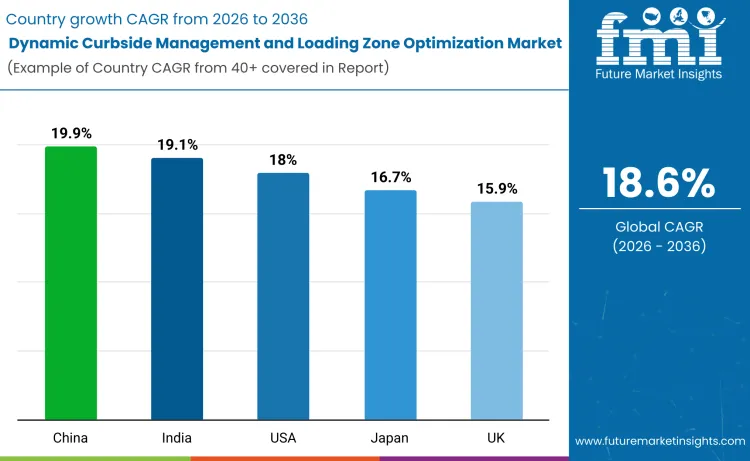
| Country | CAGR (%) |
|---|---|
| China | 19.9% |
| India | 19.1% |
| USA | 18.0% |
| Japan | 16.7% |
| UK | 15.9% |
How is China driving demand for Dynamic Curbside Management and Loading Zone Optimization?
China drives demand due to rapid growth in urban transportation networks, strong investment in smart-city programs, and rising delivery volumes. The country’s CAGR of 19.9% reflects continuous adoption of curbside-management platforms integrating occupancy detection, digital permitting, and dynamic pricing. Municipal authorities deploy curbside systems to improve traffic flow and reduce illegal stopping in dense commercial districts. Logistics operators rely on real-time loading zone allocation to support high-frequency delivery operations. Digital platforms integrate routing and demand forecasting to optimize curbside turnover. Large urban populations reinforce continuous demand for structured curbside-control systems.
- Smart-city expansion supporting digital curb regulation
- High delivery volumes requiring structured loading access
- Real-time curbside allocation tools enhancing operations
- Municipal focus on reducing congestion and illegal parking
How is India driving demand for Dynamic Curbside Management and Loading Zone Optimization?
India supports rising demand due to severe metropolitan congestion, strong growth in e-commerce deliveries, and broader adoption of digital mobility infrastructure. The country’s CAGR of 19.1% reflects increased use of curbside platforms that coordinate loading activities and reduce street-level conflicts between vehicles and pedestrians. Municipalities deploy sensor-enabled systems to manage delivery peaks in busy commercial zones. Logistics platforms integrate curbside data to shorten dwell times and support predictable last-mile operations. Large urban populations rely on dynamic curb assignment to reduce delivery delays and improve street circulation. Public–private mobility partnerships strengthen platform adoption.
- High congestion driving structured curb allocation
- Digital mobility platforms coordinating loading activities
- Logistics integration reducing delivery dwell time
- Municipal partnerships supporting curbside modernization
How is the USA driving demand for Dynamic Curbside Management and Loading Zone Optimization?
The USA drives demand through strong urban freight activity, high delivery volumes, and regulatory focus on efficient curb usage. The country’s CAGR of 18.0% reflects steady integration of curbside-management systems across metropolitan areas seeking to reduce double-parking and optimize loading turnover. Cities deploy digital permitting, occupancy sensors, and time-window controls to manage commercial vehicle flow. Logistics providers use curbside data to coordinate arrival schedules and reduce failed access attempts. Retail districts rely on structured curb allocation to balance passenger pickup, delivery vehicles, and micro-mobility needs. Increased focus on safety and traffic efficiency reinforces adoption.
- High freight and delivery activity in urban cores
- Digital permitting and occupancy-sensing adoption
- Logistics use of curb data to improve access reliability
- Regulatory emphasis on reducing double-parking incidents
How is Japan driving demand for Dynamic Curbside Management and Loading Zone Optimization?
Japan drives demand due to compact urban layouts, structured mobility frameworks, and focus on punctual delivery operations. The country’s CAGR of 16.7% reflects adoption of curbside-management platforms enabling time-window optimization, real-time loading zone visibility, and improved routing in narrow urban corridors. Logistics operators rely on curbside data to maintain delivery precision. Municipal agencies implement digital zoning policies to manage freight access without disrupting pedestrian flow. High-density commercial districts benefit from controlled curb turnover supporting predictable operations. Rising delivery volumes reinforce the need for dynamic curb allocation systems.
- Compact cities requiring precise curb control
- Digital zoning and time-window optimization tools
- Logistics reliance on real-time curb availability
- Controlled curb turnover supporting commercial district operations
How is the UK driving demand for Dynamic Curbside Management and Loading Zone Optimization?
The UK supports demand through clean-transport regulations, low-emission zones, and strong interest in efficient curbside use across dense city centers. The country’s CAGR of 15.9% reflects adoption of digital curbside-management tools coordinating delivery access, loading schedules, and vehicle restrictions. Cities use sensor-based systems to manage loading windows and reduce congestion. Logistics operators integrate curbside intelligence to navigate access limitations and maintain delivery reliability. Retail districts rely on dynamic curb allocation to balance passenger pickup, delivery fleets, and micro-mobility operations. Urban freight strategies reinforce the need for technology-driven curb solutions.
- Clean-transport and access-regulation frameworks
- Sensor-enabled curbside scheduling and management
- Logistics integration supporting reliable delivery timing
- Urban freight strategies promoting efficient curb utilization
Key Players in the Dynamic Curbside Management and Loading Zone Optimization Market
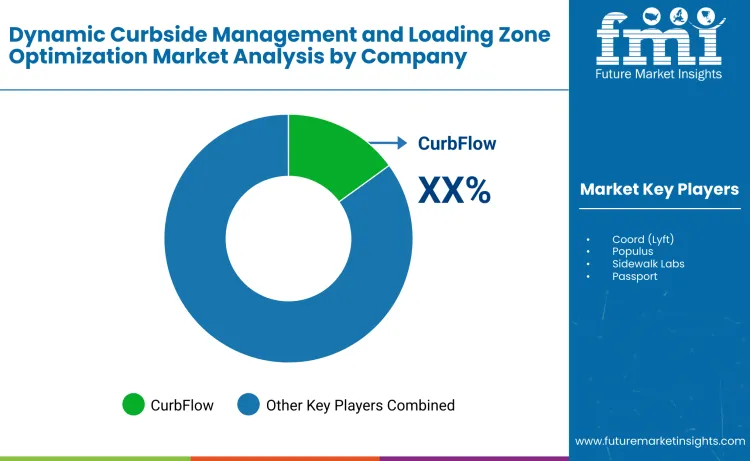
- CurbFlow
- Coord (Lyft)
- Populus
- Sidewalk Labs
- Passport
Scope of the Report
| Items | Values |
|---|---|
| Quantitative Units | USD billion |
| Solution Type | Curbside Reservation & Booking Systems, Dynamic Pricing & Enforcement Platforms, Real-Time Occupancy & Sensor Analytics, Integrated Curbside Navigation & Routing Tools |
| Deployment Mode | Cloud-Based Systems, On-Premises Systems, Hybrid Deployments |
| Application | Commercial Loading & Delivery Zones, Passenger Pick-Up/Drop-Off Zones, Ride-Hailing & Fleet Staging Zones, Municipal Parking & Urban Traffic Interfaces |
| End-User | Municipal Governments, Logistics & Parcel Delivery Operators, Ride-Hailing & Mobility Service Providers, Commercial Property Owners |
| Regions Covered | Asia Pacific, Europe, North America, Latin America, Middle East & Africa |
| Countries Covered | India, China, USA, Germany, South Korea, Japan, Italy, and 40+ countries |
| Key Companies Profiled | CurbFlow, Coord (Lyft), Populus, Sidewalk Labs, Passport |
| Additional Attributes | Dollar sales by solution type, deployment model, application category, and end-user groups; adoption trends influenced by curb digitization policies, urban traffic demand management, and commercial loading compliance; integration of cameras, LiDAR, and embedded curbside sensors for real-time analytics; development of API-based curbside orchestration for fleets, parcel delivery, and ride-hailing systems; competitive landscape of mobility data platforms and municipal enforcement technology providers; regulatory drivers from smart city initiatives, congestion pricing pilots, and curb-use monetization frameworks. |
Dynamic Curbside Management and Loading Zone Optimization Market by Segment
By Solution Type:
- Curbside Reservation & Booking Systems
- Dynamic Pricing & Enforcement Platforms
- Real-Time Occupancy & Sensor Analytics
- Integrated Curbside Navigation & Routing Tools
By Deployment Mode:
- Cloud-Based Systems
- On-Premises Systems
- Hybrid Deployments
By Application:
- Commercial Loading & Delivery Zones
- Passenger Pick-Up/Drop-Off Zones
- Ride-Hailing & Fleet Staging Zones
- Municipal Parking & Urban Traffic Interfaces
By End-User:
- Municipal Governments
- Logistics & Parcel Delivery Operators
- Ride-Hailing & Mobility Service Providers
- Commercial Property Owners
Region:
- Asia Pacific
- China
- Japan
- South Korea
- India
- Australia & New Zealand
- ASEAN
- Rest of Asia Pacific
- Europe
- Germany
- United Kingdom
- France
- Italy
- Spain
- Nordic
- BENELUX
- Rest of Europe
- North America
- United States
- Canada
- Mexico
- Latin America
- Brazil
- Chile
- Rest of Latin America
- Middle East & Africa
- Kingdom of Saudi Arabia
- Other GCC Countries
- Turkey
- South Africa
- Other African Union
- Rest of Middle East & Africa
Frequently Asked Questions
What is the size of the dynamic curbside management and loading zone optimization market in 2026?
The market is valued at USD 3.1 billion in 2026, driven by demand for structured curb access and regulated loading activity.
What will be the industry size by 2036?
Industry value will reach USD 17.3 billion by 2036 as cities adopt digital curb platforms to manage delivery peaks and improve traffic flow.
What is the CAGR for 2026n to 2036?
The dynamic curbside management and loading zone optimization market expands at an 18.6% CAGR during the forecast period.
Which solution-type segment leads in 2026?
Curbside reservation and booking systems hold 39.7% share due to their role in scheduling curb access and reducing delivery conflicts.
Which deployment-mode segment holds the highest share?
Cloud-based systems lead with 46.4% share, supported by scalable integration, real-time data access, and reduced infrastructure requirements.
Preview the report firsthand - request a free sample
Get SampleGet the brochure for pricing and purchase details.
Get PDFTable of Content
- Executive Summary
- Market Overview
- Global Market Value, 2020 to 2026
- Global Market Forecast, 2026 to 2036
- Market Dynamics
- Drivers
- Restraints
- Opportunities
- Regulatory & Standards Landscape
- Technology & Material Innovation Outlook
- Market Segmentation Analysis
- By Solution Type
- Curbside Reservation & Booking Systems
- Dynamic Pricing & Enforcement Platforms
- Real-Time Occupancy & Sensor Analytics
- Integrated Curbside Navigation & Routing Tools
- By Deployment Mode
- Cloud-Based Systems
- On-Premises Systems
- Hybrid Deployments
- By Application
- Commercial Loading & Delivery Zones
- Passenger Pick-Up/Drop-Off Zones
- Ride-Hailing & Fleet Staging Zones
- Municipal Parking & Urban Traffic Interfaces
- By End-User
- Municipal Governments
- Logistics & Parcel Delivery Operators
- Ride-Hailing & Mobility Service Providers
- Commercial Property Owners
- By Solution Type
- Regional Outlook
- Asia Pacific
- Europe
- North America
- Latin America
- Middle East & Africa
- Country-Level Outlook
- China
- India
- USA
- Japan
- United Kingdom
- Germany
- South Korea
- Italy
- Australia & New Zealand
- ASEAN
- Brazil
- Chile
- Turkey
- South Africa
- Other GCC Countries
- Rest of Europe
- Rest of Latin America
- Rest of Middle East & Africa
- Competitive Landscape
- Market Structure Overview
- Company Positioning
- Strategic Initiatives
- Key Player Profiles
- Scope of the Report
- Research Methodology
- Assumptions & Acronyms


