

- Industry Size (2026)
- USD 780 Mn
- Forecast (2036)
- USD 2488.2 Mn
- CAGR (2026 to 2036)
- 12.30%
Household Flexible Plastic Front-of-Store Collection and Sorting Market Forecast and Outlook 2026 to 2036
The household flexible plastic front-of-store collection and sorting market is expected to grow from USD 780 million in 2026 to USD 2,488.2 million by 2036, reflecting a compound annual growth rate (CAGR) of 12.3%. This growth is driven by the increasing need for efficient recycling systems, particularly for household plastics that are collected and sorted at retail locations. Flexible plastics, such as plastic bags, wraps, and films, have long been challenging to recycle, and dedicated collection systems are becoming essential as governments and businesses alike push for more sustainable packaging practices. Retailers and waste management companies are developing and implementing systems to collect these materials directly from consumers, improving overall recycling rates and reducing plastic waste.
As awareness about the environmental impact of plastic waste increases, particularly in light of global sustainability goals, the adoption of front-of-store collection and sorting systems is expanding. Furthermore, the growing regulatory pressure and public demand for recycling solutions that focus on post-consumer plastic waste will continue to fuel market growth. By streamlining the collection and sorting process, businesses are able to contribute to circular economy initiatives, providing consumers with more convenient recycling options.
Quick Stats for Household Flexible Plastic Front-of-Store Collection and Sorting Market
- Household Flexible Plastic Front-of-Store Collection and Sorting Market Value (2026): USD 780 million
- Household Flexible Plastic Front-of-Store Collection and Sorting Market Forecast Value (2036): USD 2,488.2 million
- Household Flexible Plastic Front-of-Store Collection and Sorting Market Global Forecast CAGR (2026-2036): 12.30%
- Top Flexible Plastic Type Collected in Household Flexible Plastic Front-of-Store Collection and Sorting Market: Plastic Bags & Film (46%)
- Key Growth Regions in Household Flexible Plastic Front-of-Store Collection and Sorting Market: India, China, USA, Brazil, Germany
- Top Players in Household Flexible Plastic Front-of-Store Collection and Sorting Market: Tomra Systems ASA, ZenRobotics, Evreka, Rehrig Pacific Company, ALPLA Group
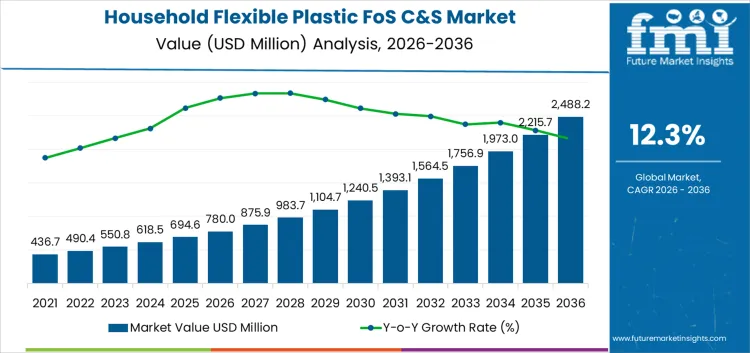
What is the Growth Forecast for the Household Flexible Plastic Front-of-Store Collection and Sorting Market through 2036?
The 5-year growth block analysis for the household flexible plastic front-of-store collection and sorting market shows steady and consistent growth, with a notable acceleration in the later stages. Starting at USD 780 million in 2026, the market grows to USD 876.8 million in 2027 and USD 986.96 million in 2028, reflecting the early-stage adoption of these collection and sorting systems across retail stores. As awareness of sustainable packaging and waste reduction increases, the demand for such solutions continues to rise.
From 2028 to 2030, the market shows a stronger upward trend, reaching USD 1,112.23 million in 2029 and USD 1,255.38 million in 2030. This period marks a phase of accelerated growth, driven by expanding regulatory initiatives, increased consumer demand for convenient recycling solutions, and more widespread adoption by retailers. From 2030 to 2035, the market continues its growth trajectory, reaching USD 1,418.35 million in 2031, USD 1,603.21 million in 2032, and USD 1,812.24 million in 2033.
By 2035, the market is expected to reach USD 2,313.80 million, with a projected final value of USD 2,488.2 million by 2036. The growth block analysis highlights how the market will benefit from sustained investment in recycling infrastructure, increased participation from consumers, and the ongoing development of more efficient, cost-effective sorting systems. The pace of growth accelerates as retail collection points for flexible plastics become a standard feature across the industry, fostering long-term market expansion.
Household Flexible Plastic Front-of-Store Collection and Sorting Market Key Takeaways
| Metric | Value |
|---|---|
| Industry Sales Value (2026) | USD 780 million |
| Industry Forecast Value (2036) | USD 2,488.2 million |
| Industry Forecast CAGR (2026-2036) | 12.3% |
What Is Driving the Demand for Household Flexible Plastic Front of Store Collection and Sorting Globally?
The demand for household flexible plastic front of store (FOS) collection and sorting systems is driven by growing regulatory pressure, expanding recycling targets, and rising consumer awareness of plastic waste. Governments and municipalities in Europe, North America, and parts of Asia are implementing policies that require or incentivise the collection and recycling of flexible plastics used in shopping bags, pouches, films, and packaging. These materials are difficult to manage through traditional curbside recycling due to their light weight and propensity to clog sorting machinery. Front of store collection points at supermarkets and retail outlets offer a convenient way for consumers to return flexible plastics, which can then be sorted and redirected to recycling streams or mechanical/chemical recycling facilities. Retailers and brand owners are adopting these systems to meet extended producer responsibility (EPR) requirements, reduce landfill use, and support corporate commitments to circularity. Consumer preference for visible and convenient recycling options also reinforces demand for FOS solutions, as visible collection infrastructure at stores enhances participation and contributes to waste reduction goals.
Future demand for household flexible plastic front of store collection and sorting is expected to grow as recycling policies and industry commitments strengthen globally. Expansion of EPR frameworks and mandatory recycling targets will encourage more retailers to install and operate FOS collection systems. Advances in sorting technology, including improved identification and separation of mixed flexible plastics, will enhance the quality of recovered materials and reduce contamination. Integration of digital tracking, incentives, and user engagement tools may further increase consumer participation, making collection more efficient. Collaboration among retailers, waste management firms, and recyclers will shape how effectively these systems scale, especially in regions with limited existing infrastructure. Costs, operational complexity, and the development of end markets for recycled flexible plastics will influence the pace of adoption. As demand for circular packaging solutions rises and regulatory frameworks tighten, the global household flexible plastic FOS collection and sorting market is expected to expand steadily.
What Are the Key Segments in Household Flexible Plastic Front-of-Store Collection and Sorting Market?
The household flexible plastic front-of-store collection and sorting market is segmented by collection system type and flexible plastic type collected. In-store drop-off bins/containers lead the collection system type segment with 42% of the market share, providing a simple and accessible way for consumers to recycle. Plastic bags & film dominate the flexible plastic type collected segment, accounting for 46%, driven by their widespread use in households. The market is growing as retailers and communities increasingly focus on sustainability and reducing plastic waste through efficient collection and sorting solutions.
Which Collection System Type Drives Household Flexible Plastic Front-of-Store Collection and Sorting Market Demand Globally?
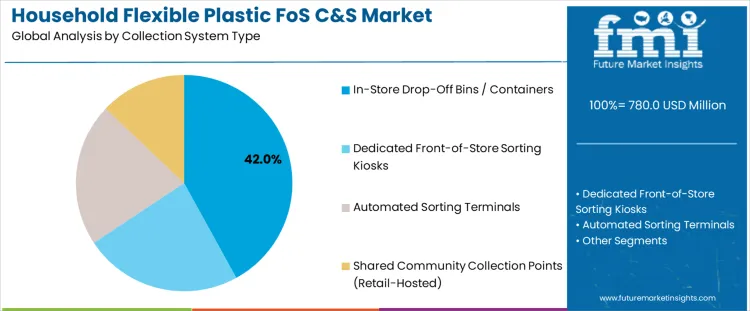
In-store drop-off bins/containers hold 42% of the market share. These systems are commonly used in retail environments, providing a convenient and accessible way for consumers to recycle flexible plastics, such as plastic bags and film, at the point of purchase. The popularity of in-store drop-off bins is driven by their simplicity, low cost, and effectiveness in encouraging recycling. Retailers use these systems to engage customers in sustainability efforts and support waste reduction initiatives. The increasing focus on reducing plastic waste and the growing consumer demand for recycling options contribute to the rising adoption of in-store drop-off bins. As retailers strive to meet environmental goals and improve their sustainability practices, the demand for these accessible collection systems is expected to continue growing. Other systems like dedicated front-of-store sorting kiosks and automated sorting terminals are also contributing to the market, but in-store drop-off bins remain the dominant system due to their ease of use and wide availability.
Which Flexible Plastic Type Collected Drives Household Flexible Plastic Front-of-Store Collection and Sorting Market Demand Globally?
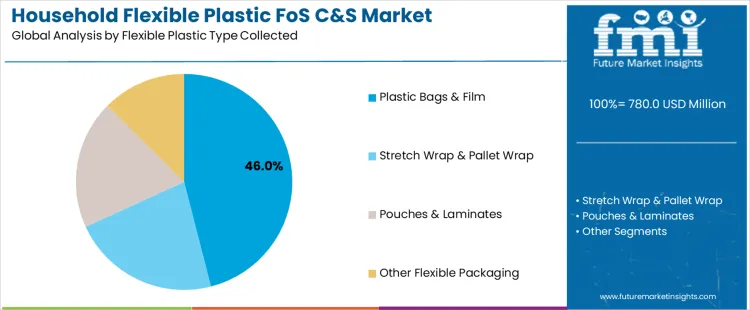
Plastic bags & film dominate the flexible plastic type collected segment, accounting for 46% of the market share. These materials are commonly used for packaging and are widely found in households, making them a key focus for recycling efforts. Plastic bags and films are often single-use items, which contribute to a significant amount of plastic waste, particularly in the retail and grocery sectors. Collecting these items through front-of-store collection systems allows retailers to provide a convenient recycling option for consumers and helps reduce the environmental impact of plastic waste. The rising demand for sustainable packaging solutions and the increasing pressure on retailers to manage plastic waste effectively are driving the collection of plastic bags and films. Other flexible packaging types, such as stretch wrap & pallet wrap and pouches & laminates, also contribute to the market but are collected in smaller quantities compared to plastic bags and films. The large volume of plastic bags and films used in daily consumer activities ensures that this category remains the dominant flexible plastic type in front-of-store collection and sorting systems.
What are the Key Dynamics of the Global Household Flexible Plastic Front of Store Collection and Sorting Market?
The global household flexible plastic front of store collection and sorting market is expanding as retailers, brands and waste managers enhance systems to divert flexible plastics from landfill. Front of store collection points capture materials at shop entrances where consumers return bags, wraps and film packaging. Sorting infrastructure is used to separate and prepare materials for recycling streams. Growth reflects rising consumer awareness of plastic waste and retailer commitments to circular packaging. Expansion of programs in urban and suburban areas supports higher participation and recovery rates, creating momentum in sustainable material management.
What are the Key Drivers for the Global Household Flexible Plastic Front of Store Collection and Sorting Market?
Key drivers include growing regulatory pressure on single use plastics and targets for recycled content that encourage capture and recycling of flexible films. Retailers adopt front of store collection to meet extended producer responsibility requirements and reduce waste handling costs. Consumer demand for visible recycling options at the point of purchase motivates store based collection initiatives. Advances in sorting technology improve quality of separated materials and lower contamination rates, making recycling more economically viable. Collaboration between brands, retailers and recovery partners helps scale infrastructure and create consistent systems across regions.
What are the Restraints for the Global Household Flexible Plastic Front of Store Collection and Sorting Market?
A restraint is the challenge of collecting and sorting highly variable flexible plastics that differ in resin type, additives and contamination levels. Materials that are soiled with food residue or mixed with other waste can complicate processing and reduce recycling value. Establishing and maintaining front of store collection points requires operational planning, staff training and space allocation, which some retailers may find difficult. Inconsistent consumer participation and drop off behavior can limit the volume of recoverable material. Regions with limited recycling infrastructure struggle to transport and process collected flexible plastics, reducing system effectiveness.
What is the Key Trends in the Global Household Flexible Plastic Front of Store Collection and Sorting Market?
A key trend is integration of smart sorting systems that use optical and sensor technologies to improve material identification and reduce contamination rates. Retailers are partnering with recycling organisations and packaging brands to develop standardized collection schemes and shared recovery networks. Incentive programs that reward consumers for returning flexible films at store entrances are rising, increasing participation and awareness. Use of harmonized labeling and communication helps consumers understand what can be returned. Growth of collaborative programs that link front of store collection with downstream recycling facilities supports development of stable supply chains for circular flexible plastic streams.
What is the Country-Wise Outlook for Household Flexible Plastic Front-of-Store Collection and Sorting?
The Household Flexible Plastic Front-of-Store Collection and Sorting market is growing rapidly, driven by increased awareness of plastic waste and the push for more sustainable waste management practices. Countries like India, China, and the USA are at the forefront of adopting systems that enable the efficient collection and sorting of flexible plastics at retail locations. As regulatory pressure increases and consumers become more environmentally conscious, the demand for solutions that facilitate better plastic waste management is rising. This market is expected to see continued expansion as industries move toward circular economy models and as flexible plastic recycling becomes a key component of sustainable waste practices in the retail sector.
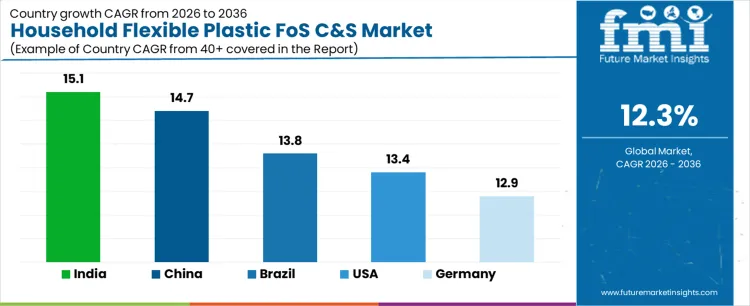
| Country | CAGR (2026-2036) |
|---|---|
| India | 15.1% |
| China | 14.7% |
| USA | 13.4% |
| Brazil | 13.8% |
| Germany | 12.9% |
What is Driving the Growth of Household Flexible Plastic Front-of-Store Collection and Sorting in India?
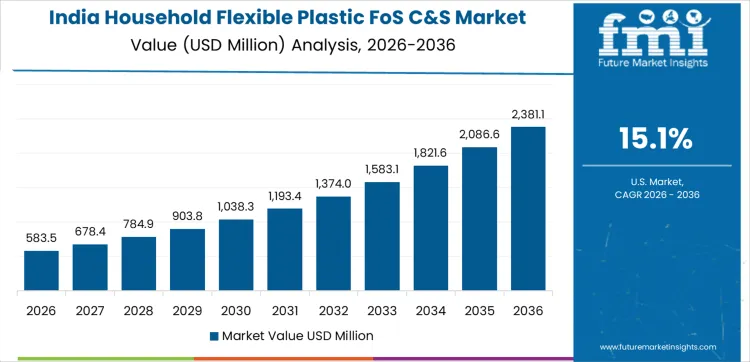
India’s Household Flexible Plastic Front-of-Store Collection and Sorting market is projected to grow at a CAGR of 15.1%. The rapid urbanization and growth of the retail sector in India are driving the need for more sustainable waste management solutions. As the government enforces stricter plastic waste management regulations and the demand for efficient recycling increases, there is a strong push for front-of-store collection and sorting systems. These systems help retailers collect and sort flexible plastics for recycling, contributing to reduced landfill waste and promoting a circular economy. India’s increasing focus on environmental sustainability and waste reduction further accelerates the adoption of such solutions.
What is Contributing to the Growth of Household Flexible Plastic Front-of-Store Collection and Sorting in China?
China’s Household Flexible Plastic Front-of-Store Collection and Sorting market is expected to grow at a CAGR of 14.7%. As one of the largest producers of plastic waste globally, China has increasingly prioritized improving its waste management systems. The growing retail and consumer goods sectors, coupled with stricter environmental regulations, are pushing for more efficient solutions to handle flexible plastic waste. Front-of-store collection and sorting systems allow retailers to manage plastic waste more effectively, ensuring that it is properly sorted and recycled. China’s commitment to reducing plastic waste, along with its ongoing development of recycling infrastructure, drives the growth of this market.
What is Driving the Household Flexible Plastic Front-of-Store Collection and Sorting Market Growth in the USA?
The USA’s Household Flexible Plastic Front-of-Store Collection and Sorting market is projected to grow at a CAGR of 13.4%. The increasing regulatory pressure to reduce plastic waste, along with consumer demand for more sustainable practices, is driving the adoption of collection and sorting systems in retail environments. Front-of-store collection systems allow retailers to easily manage flexible plastics, facilitating the recycling process and helping reduce the amount of plastic waste sent to landfills. As the USA moves toward a circular economy and more states implement plastic recycling mandates, the demand for such systems is expected to continue rising.
What is Influencing the Growth of Household Flexible Plastic Front-of-Store Collection and Sorting in Brazil?
Brazil’s Household Flexible Plastic Front-of-Store Collection and Sorting market is projected to grow at a CAGR of 13.8%. With increasing environmental awareness and a growing focus on waste management, Brazil is adopting more sustainable practices in the retail sector. The need for efficient systems to collect and sort flexible plastics at the point of sale is rising, driven by both consumer demand and government regulations aimed at reducing plastic waste. As Brazil seeks to improve its recycling infrastructure and comply with global environmental standards, the market for front-of-store collection and sorting systems is expected to see steady growth.
What is Contributing to the Growth of Household Flexible Plastic Front-of-Store Collection and Sorting in Germany?
Germany’s Household Flexible Plastic Front-of-Store Collection and Sorting market is expected to grow at a CAGR of 12.9%. As one of the leading countries in Europe for sustainable waste management, Germany is at the forefront of adopting systems that facilitate the efficient collection and recycling of flexible plastics. The country’s strict recycling regulations and its focus on reducing plastic waste are key drivers of this market. Retailers in Germany are increasingly adopting front-of-store collection and sorting systems to comply with environmental laws and cater to growing consumer demand for more sustainable practices. This trend, combined with Germany’s strong recycling infrastructure, is expected to continue driving the growth of the market.
What is the Competitive Landscape for the Household Flexible Plastic Front of Store Collection and Sorting Market?
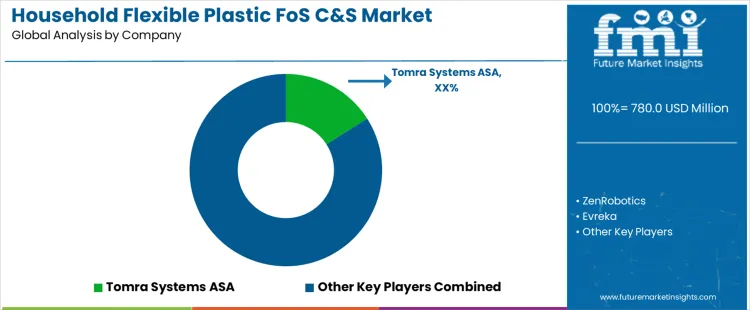
Global demand for household flexible plastic front of store collection and sorting solutions is rising as retailers, municipalities and waste managers seek effective systems to capture and divert soft plastics from landfills. Flexible plastics used in packaging for snacks, produce, personal care and household goods are lightweight and convenient but difficult to recycle through conventional curbside streams. Front of store collection points at supermarkets and retail locations provide convenient drop off access for consumers, helping increase capture rates and feed recycling infrastructure. Growing regulatory pressure on plastic waste, extended producer responsibility policies and heightened consumer awareness of plastic pollution support uptake of these collection systems. Retailers also use sorting technologies to streamline material recovery, reduce contamination and improve the quality of recycled feedstock for reprocessing into new products. This trend is evident across North America, Europe and Asia Pacific as commitments to circular economy practices strengthen and recycling targets become more ambitious.
On the supply side a focused group of technology and recycling infrastructure companies competes to deliver front of store collection and sorting solutions. Tomra Systems ASA is recognised as a leading player with extensive experience in reverse vending and automated sorting technologies tailored for flexible plastics. Other competitors include ZenRobotics, which offers robotic and AI driven material recognition and sorting systems; Evreka, which provides software and hardware solutions for waste collection optimisation; Rehrig Pacific Company, a major provider of recycling containers and logistics support; and ALPLA Group, a global packaging and recycling specialist with capabilities in recycled plastic recovery and reuse. Competition among these firms focuses on collection convenience, accuracy of sorting technology, integration with retailer operations, cost efficiency and traceability of recovered materials. Companies that combine robust hardware, advanced material recognition, seamless integration with front of store workflows and strong service support are best positioned to capture growth as flexible plastic recycling systems expand worldwide.
Key Players of the Household Flexible Plastic Front-of-Store Collection and Sorting Market
- Tomra Systems ASA
- ZenRobotics
- Evreka
- Rehrig Pacific Company
- ALPLA Group
Scope of the Report
| Items | Values |
|---|---|
| Quantitative Units (2026) | USD Million |
| Collection System Type | In-Store Drop-Off Bins / Containers, Dedicated Front-of-Store Sorting Kiosks, Automated Sorting Terminals, Shared Community Collection Points (Retail-Hosted) |
| Flexible Plastic Type Collected | Plastic Bags & Film, Stretch Wrap & Pallet Wrap, Pouches & Laminates, Other Flexible Packaging |
| Companies | Tomra Systems ASA, ZenRobotics, Evreka, Rehrig Pacific Company, ALPLA Group |
| Regions Covered | North America, Latin America, Western Europe, Eastern Europe, South Asia and Pacific, East Asia, Middle East & Africa |
| Countries Covered | United States, Canada, Mexico, Brazil, Argentina, Germany, France, United Kingdom, Italy, Spain, Netherlands, China, India, Japan, South Korea, ANZ, GCC Countries, South Africa |
| Additional Attributes | Dollar by sales by collection system type, flexible plastic type collected, and region. Includes market trends in household flexible plastic collection and sorting systems, performance in various retail and community collection points, cost-effectiveness, sustainability practices, regulatory compliance, market share and competitive positioning of key companies, and the role of front-of-store collection and sorting in enhancing recycling, reducing waste, and supporting circular economy efforts in retail environments. |
Key Segments in the Household Flexible Plastic Front-of-Store Collection and Sorting Market
Collection System Type:
- In Store Drop Off Bins / Containers
- Dedicated Front of Store Sorting Kiosks
- Automated Sorting Terminals
- Shared Community Collection Points (Retail Hosted)
Flexible Plastic Type Collected:
- Plastic Bags & Film
- Stretch Wrap & Pallet Wrap
- Pouches & Laminates
- Other Flexible Packaging
Region:
- Asia Pacific
- China
- India
- Japan
- South Korea
- ASEAN
- Rest of Asia Pacific
- Europe
- Germany
- United Kingdom
- France
- Italy
- Spain
- Nordic
- BENELUX
- Rest of Europe
- North America
- United States
- Canada
- Mexico
- Latin America
- Brazil
- Chile
- Rest of Latin America
- Middle East & Africa
- Kingdom of Saudi Arabia
- Other GCC Countries
- Turkey
- South Africa
- Other African Union
- Rest of Middle East & Africa
Frequently Asked Questions
How big is the household flexible plastic front-of-store collection and sorting market in 2026?
The global household flexible plastic front-of-store collection and sorting market is estimated to be valued at USD 780.0 million in 2026.
What will be the size of household flexible plastic front-of-store collection and sorting market in 2036?
The market size for the household flexible plastic front-of-store collection and sorting market is projected to reach USD 2,488.2 million by 2036.
How much will be the household flexible plastic front-of-store collection and sorting market growth between 2026 and 2036?
The household flexible plastic front-of-store collection and sorting market is expected to grow at a 12.3% CAGR between 2026 and 2036.
What are the key product types in the household flexible plastic front-of-store collection and sorting market?
The key product types in household flexible plastic front-of-store collection and sorting market are in‑store drop‑off bins / containers, dedicated front‑of‑store sorting kiosks, automated sorting terminals and shared community collection points (retail‑hosted).
Which flexible plastic type collected segment to contribute significant share in the household flexible plastic front-of-store collection and sorting market in 2026?
In terms of flexible plastic type collected, plastic bags & film segment to command 46.0% share in the household flexible plastic front-of-store collection and sorting market in 2026.
Preview the report firsthand - request a free sample
Get SampleGet the brochure for pricing and purchase details.
Get PDFTable of Content
- Executive Summary
- Global Market Outlook
- Demand-side Trends
- Supply-side Trends
- Technology Roadmap Analysis
- Analysis and Recommendations
- Market Overview
- Market Coverage / Taxonomy
- Market Definition / Scope / Limitations
- Market Background
- Market Dynamics
- Drivers
- Restraints
- Opportunity
- Trends
- Scenario Forecast
- Demand in Optimistic Scenario
- Demand in Likely Scenario
- Demand in Conservative Scenario
- Opportunity Map Analysis
- Product Life Cycle Analysis
- Supply Chain Analysis
- Investment Feasibility Matrix
- Value Chain Analysis
- PESTLE and Porter’s Analysis
- Regulatory Landscape
- Regional Parent Market Outlook
- Production and Consumption Statistics
- Import and Export Statistics
- Market Dynamics
- Global Market Analysis 2021 to 2025 and Forecast, 2026 to 2036
- Historical Market Size Value (USD Million) Analysis, 2021 to 2025
- Current and Future Market Size Value (USD Million) Projections, 2026 to 2036
- Y-o-Y Growth Trend Analysis
- Absolute $ Opportunity Analysis
- Global Market Pricing Analysis 2021 to 2025 and Forecast 2026 to 2036
- Global Market Analysis 2021 to 2025 and Forecast 2026 to 2036, By Collection System Type
- Introduction / Key Findings
- Historical Market Size Value (USD Million) Analysis By Collection System Type , 2021 to 2025
- Current and Future Market Size Value (USD Million) Analysis and Forecast By Collection System Type , 2026 to 2036
- In‑Store Drop‑Off Bins / Containers
- Dedicated Front‑of‑Store Sorting Kiosks
- Automated Sorting Terminals
- Shared Community Collection Points (Retail‑Hosted)
- Y-o-Y Growth Trend Analysis By Collection System Type , 2021 to 2025
- Absolute $ Opportunity Analysis By Collection System Type , 2026 to 2036
- Global Market Analysis 2021 to 2025 and Forecast 2026 to 2036, By Flexible Plastic Type Collected
- Introduction / Key Findings
- Historical Market Size Value (USD Million) Analysis By Flexible Plastic Type Collected, 2021 to 2025
- Current and Future Market Size Value (USD Million) Analysis and Forecast By Flexible Plastic Type Collected, 2026 to 2036
- Plastic Bags & Film
- Stretch Wrap & Pallet Wrap
- Pouches & Laminates
- Other Flexible Packaging
- Y-o-Y Growth Trend Analysis By Flexible Plastic Type Collected, 2021 to 2025
- Absolute $ Opportunity Analysis By Flexible Plastic Type Collected, 2026 to 2036
- Global Market Analysis 2021 to 2025 and Forecast 2026 to 2036, By Region
- Introduction
- Historical Market Size Value (USD Million) Analysis By Region, 2021 to 2025
- Current Market Size Value (USD Million) Analysis and Forecast By Region, 2026 to 2036
- North America
- Latin America
- Western Europe
- Eastern Europe
- East Asia
- South Asia and Pacific
- Middle East & Africa
- Market Attractiveness Analysis By Region
- North America Market Analysis 2021 to 2025 and Forecast 2026 to 2036, By Country
- Historical Market Size Value (USD Million) Trend Analysis By Market Taxonomy, 2021 to 2025
- Market Size Value (USD Million) Forecast By Market Taxonomy, 2026 to 2036
- By Country
- USA
- Canada
- Mexico
- By Collection System Type
- By Flexible Plastic Type Collected
- By Country
- Market Attractiveness Analysis
- By Country
- By Collection System Type
- By Flexible Plastic Type Collected
- Key Takeaways
- Latin America Market Analysis 2021 to 2025 and Forecast 2026 to 2036, By Country
- Historical Market Size Value (USD Million) Trend Analysis By Market Taxonomy, 2021 to 2025
- Market Size Value (USD Million) Forecast By Market Taxonomy, 2026 to 2036
- By Country
- Brazil
- Chile
- Rest of Latin America
- By Collection System Type
- By Flexible Plastic Type Collected
- By Country
- Market Attractiveness Analysis
- By Country
- By Collection System Type
- By Flexible Plastic Type Collected
- Key Takeaways
- Western Europe Market Analysis 2021 to 2025 and Forecast 2026 to 2036, By Country
- Historical Market Size Value (USD Million) Trend Analysis By Market Taxonomy, 2021 to 2025
- Market Size Value (USD Million) Forecast By Market Taxonomy, 2026 to 2036
- By Country
- Germany
- UK
- Italy
- Spain
- France
- Nordic
- BENELUX
- Rest of Western Europe
- By Collection System Type
- By Flexible Plastic Type Collected
- By Country
- Market Attractiveness Analysis
- By Country
- By Collection System Type
- By Flexible Plastic Type Collected
- Key Takeaways
- Eastern Europe Market Analysis 2021 to 2025 and Forecast 2026 to 2036, By Country
- Historical Market Size Value (USD Million) Trend Analysis By Market Taxonomy, 2021 to 2025
- Market Size Value (USD Million) Forecast By Market Taxonomy, 2026 to 2036
- By Country
- Russia
- Poland
- Hungary
- Balkan & Baltic
- Rest of Eastern Europe
- By Collection System Type
- By Flexible Plastic Type Collected
- By Country
- Market Attractiveness Analysis
- By Country
- By Collection System Type
- By Flexible Plastic Type Collected
- Key Takeaways
- East Asia Market Analysis 2021 to 2025 and Forecast 2026 to 2036, By Country
- Historical Market Size Value (USD Million) Trend Analysis By Market Taxonomy, 2021 to 2025
- Market Size Value (USD Million) Forecast By Market Taxonomy, 2026 to 2036
- By Country
- China
- Japan
- South Korea
- By Collection System Type
- By Flexible Plastic Type Collected
- By Country
- Market Attractiveness Analysis
- By Country
- By Collection System Type
- By Flexible Plastic Type Collected
- Key Takeaways
- South Asia and Pacific Market Analysis 2021 to 2025 and Forecast 2026 to 2036, By Country
- Historical Market Size Value (USD Million) Trend Analysis By Market Taxonomy, 2021 to 2025
- Market Size Value (USD Million) Forecast By Market Taxonomy, 2026 to 2036
- By Country
- India
- ASEAN
- Australia & New Zealand
- Rest of South Asia and Pacific
- By Collection System Type
- By Flexible Plastic Type Collected
- By Country
- Market Attractiveness Analysis
- By Country
- By Collection System Type
- By Flexible Plastic Type Collected
- Key Takeaways
- Middle East & Africa Market Analysis 2021 to 2025 and Forecast 2026 to 2036, By Country
- Historical Market Size Value (USD Million) Trend Analysis By Market Taxonomy, 2021 to 2025
- Market Size Value (USD Million) Forecast By Market Taxonomy, 2026 to 2036
- By Country
- Kingdom of Saudi Arabia
- Other GCC Countries
- Turkiye
- South Africa
- Other African Union
- Rest of Middle East & Africa
- By Collection System Type
- By Flexible Plastic Type Collected
- By Country
- Market Attractiveness Analysis
- By Country
- By Collection System Type
- By Flexible Plastic Type Collected
- Key Takeaways
- Key Countries Market Analysis
- USA
- Pricing Analysis
- Market Share Analysis, 2025
- By Collection System Type
- By Flexible Plastic Type Collected
- Canada
- Pricing Analysis
- Market Share Analysis, 2025
- By Collection System Type
- By Flexible Plastic Type Collected
- Mexico
- Pricing Analysis
- Market Share Analysis, 2025
- By Collection System Type
- By Flexible Plastic Type Collected
- Brazil
- Pricing Analysis
- Market Share Analysis, 2025
- By Collection System Type
- By Flexible Plastic Type Collected
- Chile
- Pricing Analysis
- Market Share Analysis, 2025
- By Collection System Type
- By Flexible Plastic Type Collected
- Germany
- Pricing Analysis
- Market Share Analysis, 2025
- By Collection System Type
- By Flexible Plastic Type Collected
- UK
- Pricing Analysis
- Market Share Analysis, 2025
- By Collection System Type
- By Flexible Plastic Type Collected
- Italy
- Pricing Analysis
- Market Share Analysis, 2025
- By Collection System Type
- By Flexible Plastic Type Collected
- Spain
- Pricing Analysis
- Market Share Analysis, 2025
- By Collection System Type
- By Flexible Plastic Type Collected
- France
- Pricing Analysis
- Market Share Analysis, 2025
- By Collection System Type
- By Flexible Plastic Type Collected
- India
- Pricing Analysis
- Market Share Analysis, 2025
- By Collection System Type
- By Flexible Plastic Type Collected
- ASEAN
- Pricing Analysis
- Market Share Analysis, 2025
- By Collection System Type
- By Flexible Plastic Type Collected
- Australia & New Zealand
- Pricing Analysis
- Market Share Analysis, 2025
- By Collection System Type
- By Flexible Plastic Type Collected
- China
- Pricing Analysis
- Market Share Analysis, 2025
- By Collection System Type
- By Flexible Plastic Type Collected
- Japan
- Pricing Analysis
- Market Share Analysis, 2025
- By Collection System Type
- By Flexible Plastic Type Collected
- South Korea
- Pricing Analysis
- Market Share Analysis, 2025
- By Collection System Type
- By Flexible Plastic Type Collected
- Russia
- Pricing Analysis
- Market Share Analysis, 2025
- By Collection System Type
- By Flexible Plastic Type Collected
- Poland
- Pricing Analysis
- Market Share Analysis, 2025
- By Collection System Type
- By Flexible Plastic Type Collected
- Hungary
- Pricing Analysis
- Market Share Analysis, 2025
- By Collection System Type
- By Flexible Plastic Type Collected
- Kingdom of Saudi Arabia
- Pricing Analysis
- Market Share Analysis, 2025
- By Collection System Type
- By Flexible Plastic Type Collected
- Turkiye
- Pricing Analysis
- Market Share Analysis, 2025
- By Collection System Type
- By Flexible Plastic Type Collected
- South Africa
- Pricing Analysis
- Market Share Analysis, 2025
- By Collection System Type
- By Flexible Plastic Type Collected
- USA
- Market Structure Analysis
- Competition Dashboard
- Competition Benchmarking
- Market Share Analysis of Top Players
- By Regional
- By Collection System Type
- By Flexible Plastic Type Collected
- Competition Analysis
- Competition Deep Dive
- Tomra Systems ASA
- Overview
- Product Portfolio
- Profitability by Market Segments (Product/Age /Sales Channel/Region)
- Sales Footprint
- Strategy Overview
- Marketing Strategy
- Product Strategy
- Channel Strategy
- ZenRobotics
- Evreka
- Rehrig Pacific Company
- ALPLA Group
- Tomra Systems ASA
- Competition Deep Dive
- Assumptions & Acronyms Used
- Research Methodology


