

- Industry Size (2026)
- USD 110.2 Mn
- Forecast (2036)
- USD 163.2 Mn
- CAGR (2026 to 2036)
- 4.0%
4-Allylanisole Market Size, Market Forecast and Outlook By FMI
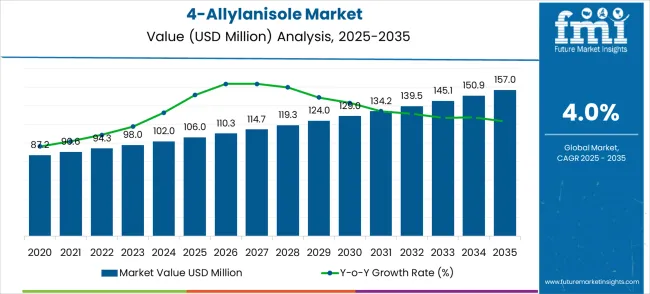
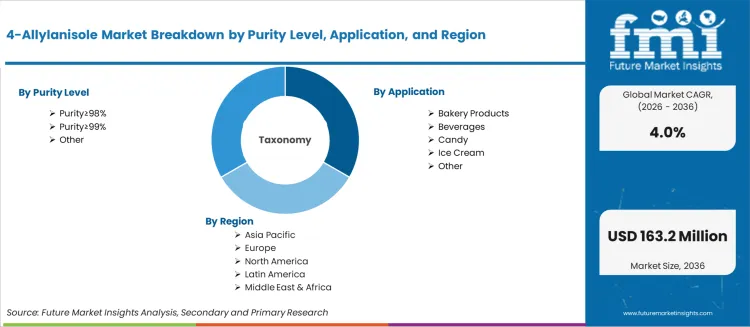
The 4-allylanisole market was valued at USD 106.0 million in 2025, projected to reach USD 110.2 million in 2026, and is forecast to expand to USD 163.2 million by 2036 at a 4.0% CAGR. Based on Future Market Insights' analysis, 4-allylanisole, also known as estragole or methyl chavicol, is a naturally occurring phenylpropene compound extracted from essential oils of basil, tarragon, and anise. It serves as a flavouring ingredient in bakery products, beverages, confectionery, and ice cream, delivering a characteristic anise-like taste and aroma at trace concentrations. The compound also finds application in fragrance formulations and as a starting material in the synthesis of anethole, another widely used flavouring agent.
Summary of 4-Allylanisole Market
- Market Snapshot
- The 4-allylanisole market is valued at USD 106.0 million in 2025 and is projected to reach USD 163.2 million by 2036.
- The industry is expected to grow at a 4.0% CAGR from 2026 to 2036, creating an incremental opportunity of USD 53.0 million.
- The market is a specialty food flavouring ingredient category where food safety regulations, purity specifications, and processed food consumption volumes define procurement patterns.
- Demand and Growth Drivers
- Demand is sustained by the global food flavourings industry, tracking processed food and beverage consumption growth across bakery, confectionery, and ice cream sectors.
- Natural flavouring ingredient preferences among consumers and food manufacturers are supporting demand for plant-derived 4-allylanisole over synthetic alternatives.
- Growing processed food consumption in Asia-Pacific and Latin America is creating incremental demand for anise-flavoured food products.
- Among key countries, China leads at 5.4% CAGR, followed by India at 5.0%, Germany at 4.6%, Brazil at 4.2%, USA at 3.8%, UK at 3.4%, and Japan at 3.0%.
- Product and Segment View
- 4-Allylanisole (estragole) is a naturally occurring phenylpropene compound extracted from basil, tarragon, and anise essential oils for flavouring and fragrance applications.
- Purity ≥98% leads with 52.0% share in 2026, serving the majority of food-grade flavouring applications. Bakery Products leads Application with 38.0% share in 2026.
- Scope includes food-grade and fragrance-grade 4-allylanisole. Excludes crude essential oils, finished food products, and structurally unrelated flavouring compounds.
- Geography and Competitive Outlook
- China and India are the fastest-growing markets driven by food processing expansion and essential oil production capabilities.
- Europe represents a mature, regulation-intensive market where EFSA safety assessments directly influence permissible usage levels and procurement volumes.
- Competition is shaped by essential oil sourcing, food-grade certification, and purity consistency, with key players including Arora Aromatics, De Monchy Aromatics, Penta Manufacturing, Mane Kancor, Hindustan Mint & Agro, and Jiangxi Spice Chemical Industrial.
- Analyst Opinion at FMI
- Nikhil Kaitwade, Principal Consultant for Food Ingredients, opines: 'In my analysis, I have observed that the 4-allylanisole market operates under a regulatory tightening cycle where European genotoxicity assessments on estragole are influencing permissible usage levels globally. Food manufacturers who source 4-allylanisole must maintain documentation tracing material back to identified botanical origins and demonstrating compliance with evolving maximum usage thresholds. Suppliers who invest in full supply chain traceability from essential oil distillation through purification and food-grade certification will retain market access as regulatory requirements tighten, while those who cannot provide origin documentation will face progressive exclusion from major food manufacturing supply chains.'
- Strategic Implications / Executive Takeaways
- Suppliers must invest in full supply chain traceability from botanical sourcing through food-grade certification to meet tightening regulatory documentation requirements.
- Food manufacturers should monitor EFSA and equivalent regulatory body assessments on estragole usage thresholds to anticipate specification changes in flavour formulations.
- Essential oil producers in India and China should pursue multi-jurisdiction food-grade certifications to capture growing export demand for naturally sourced 4-allylanisole.
4-Allylanisole Market Key Takeaways
| Metric | Details |
|---|---|
| Industry Size (2026) | USD 110.2 million |
| Industry Value (2036) | USD 163.2 million |
| CAGR (2026 to 2036) | 4.0% |
Source: Future Market Insights, 2026
FMI analysts observe that market demand is structurally linked to the global food flavourings industry, which tracks processed food and beverage consumption volumes. The bakery products sector is the largest application, where 4-allylanisole contributes to the flavour profiles of anise-flavoured breads, biscuits, and pastries consumed primarily in European, Middle Eastern, and Asian markets. Regulatory frameworks governing the use of estragole in food products, particularly the European Food Safety Authority's assessments on genotoxicity thresholds, directly influence permissible usage levels and consequently procurement volumes. Manufacturers must source food-grade material that meets purity specifications and maximum contaminant limits set by national food safety authorities.
China leads country-level growth at 5.4% CAGR through 2036, driven by expanding food processing output and domestic flavouring ingredient manufacturing. India follows at 5.0%, supported by growing processed food consumption and essential oil production capabilities. Germany registers 4.6% growth, propelled by its food processing and flavouring industry. Brazil expands at 4.2%, the United States at 3.8%, the United Kingdom at 3.4%, and Japan at 3.0%.
4-Allylanisole Market Definition
The 4-allylanisole market covers the naturally occurring phenylpropene compound estragole (methyl chavicol) used as a flavouring ingredient in food products, a fragrance component, and a chemical intermediate. The compound is extracted from essential oils of basil, tarragon, and anise, or produced synthetically, and delivers a characteristic anise-like taste and aroma. The market serves food and beverage manufacturers, fragrance houses, and specialty chemical companies across bakery, confectionery, ice cream, beverage, and personal care applications.
4-Allylanisole Market Inclusions
Market scope includes food-grade, fragrance-grade, and technical-grade 4-allylanisole across all purity levels. Bakery, beverage, confectionery, ice cream, and other food applications are covered. Regional and country-level market sizes and forecast projections from 2026 to 2036 are included.
4-Allylanisole Market Exclusions
The scope excludes crude essential oils not processed into isolated 4-allylanisole, finished food and beverage products, structurally unrelated flavouring compounds, and anethole produced through separate manufacturing processes. Essential oil distillation equipment is excluded.
4-Allylanisole Market Research Methodology
- Primary Research: Analysts engaged with flavour compounding directors, food-grade chemical procurement managers, essential oil processors, and food safety regulatory specialists to map specification requirements and procurement volumes.
- Desk Research: Data collection aggregated food additive regulatory databases, essential oil trade statistics, food flavouring industry association reports, and published safety assessments from EFSA and JECFA.
- Market-Sizing and Forecasting: Baseline values derive from a bottom-up aggregation of 4-allylanisole shipment volumes by purity grade and application, applying food processing growth rates and regulatory usage threshold trends to project demand through 2036.
- Data Validation and Update Cycle: Projections are cross-verified against essential oil trade data, food flavouring industry revenue reports, and published food additive consumption statistics.
Why is the 4-Allylanisole Market Growing?
Market expansion is being supported by the increasing consumer preference for natural flavoring ingredients across food and beverage sectors, creating demand for authentic taste compounds that enhance product appeal. Modern food applications require distinctive and natural flavor profiles to differentiate products in competitive consumer markets, driving demand for unique natural flavoring agents like 4-allylanisole. The superior anise-like flavor characteristics and natural origin of 4-allylanisole make it an essential component in sophisticated food formulations where taste authenticity and consumer preference for natural ingredients are valued.
The growing emphasis on clean label products and natural ingredient sourcing is driving demand for high-purity 4-allylanisole from certified suppliers with proven track records of quality and natural authenticity. Food and beverage manufacturers are increasingly investing in premium natural flavoring ingredients that offer superior taste enhancement and meet consumer expectations for natural product formulations while ensuring regulatory compliance. Industry standards and certification requirements are establishing quality benchmarks that favor sustainably sourced 4-allylanisole with consistent purity levels and verified natural origin.
The food industry's focus on premium and artisanal products is creating substantial demand for distinctive natural flavoring ingredients capable of creating unique taste signatures in high-value food segments. Consumer awareness of ingredient quality and natural sourcing practices continues to drive innovation in 4-allylanisole applications while maintaining cost-effectiveness, leading to development of specialized extraction and purification technologies that enhance 4-allylanisole's flavor properties and market versatility.
Segmental Analysis
The market is segmented by purity level, application, and region. By purity level, the market is divided into Purity≥98%, Purity≥99%, and other configurations. Based on application, the market is categorized into bakery products, beverages, candy, ice cream, and other food applications. Regionally, the market is divided into North America, Europe, East Asia, South Asia & Pacific, Latin America, and Middle East & Africa.
By Purity Level, Purity≥98% Segment Accounts for 52% Market Share
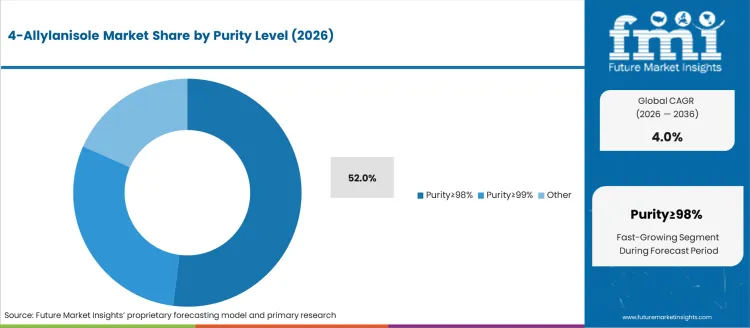
Purity≥98% configurations are projected to account for 52% of the 4-allylanisole market in 2026. This leading share is supported by the widespread adoption in commercial food applications and growing demand for high-quality flavoring compounds in large-scale food production. High-purity 4-allylanisole provides superior flavor consistency and enhanced taste stability, making it the preferred choice for commercial bakery products, beverage formulations, and processed food applications. The segment benefits from advanced purification technologies that have improved 4-allylanisole quality while maintaining cost-effectiveness for volume food production applications.
Modern Purity≥98% 4-allylanisole incorporates sophisticated distillation processes and enhanced purification techniques that maximize flavor clarity while ensuring consistent quality across production batches. These innovations have significantly improved food application performance while reducing off-flavor variations that can affect final product taste and consumer acceptance. The commercial food industry particularly drives demand for high-purity solutions, as these applications require reliable flavor characteristics and superior quality consistency to maintain brand reputation and consumer satisfaction.
Additionally, the processed food market increasingly adopts Purity≥98% 4-allylanisole to ensure consistent flavor profiles and enhance product standardization in cost-sensitive manufacturing environments. The growing emphasis on commercial food quality creates opportunities for specialized high-purity 4-allylanisole formulations designed for large-scale food production and quality-critical manufacturing applications.
By Application, Bakery Products Segment Accounts for 38% Market Share
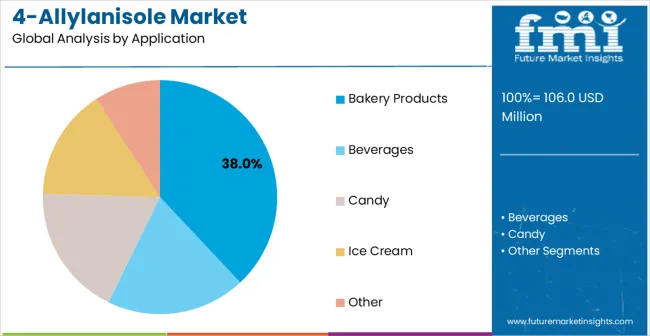
Bakery products applications are expected to represent 38% of 4-allylanisole demand in 2026. This dominant share reflects the critical role of 4-allylanisole in creating distinctive anise flavors and enhancing taste complexity in baked goods formulations. Bakery manufacturers require high-quality 4-allylanisole capable of providing authentic anise-like characteristics while maintaining excellent stability during baking processes and storage periods. The segment benefits from continuous innovation in bakery formulation techniques that maximize 4-allylanisole's flavor contribution to complex taste profiles.
The commercial bakery industry drives significant demand for food-grade 4-allylanisole that provides exceptional flavor longevity and enhanced taste depth in bread, pastries, and specialty baked products. These applications require 4-allylanisole with superior purity levels and consistent flavor characteristics to ensure reproducible product quality and brand consistency. The segment benefits from growing consumer appreciation for authentic anise flavors and increasing demand for specialty bakery products that showcase distinctive flavor profiles.
Artisanal and specialty bakery segments contribute substantially to market growth as independent bakers implement 4-allylanisole in unique product formulations and premium baked goods. The growing adoption of natural flavoring ingredients creates opportunities for specialized 4-allylanisole applications designed for organic and natural bakery products. Additionally, the trend toward ethnic and international flavors drives demand for distinctive ingredients like 4-allylanisole that enable authentic taste development in specialty bakery applications.
What are the Market Drivers, Restraints, and Key Trends of the 4-Allylanisole Market
The 4-allylanisole market is advancing steadily due to increasing natural flavoring demand and growing recognition of 4-allylanisole's unique taste properties across food applications. However, the market faces challenges including seasonal supply variations, need for specialized extraction expertise, and varying quality requirements across different food applications. Natural certification standards and food safety regulations continue to influence sourcing practices and market development patterns.
Integration of Advanced Extraction and Flavor Enhancement Technologies
The growing adoption of sophisticated extraction processes and enhanced flavor enhancement techniques is enabling significant purity improvements while maintaining natural origin authenticity in 4-allylanisole production. Advanced extraction methods provide better yield efficiency and superior flavor quality, enabling consistent product characteristics and enhanced food application performance. These technologies are particularly valuable for premium food applications that require maximum flavor clarity and natural ingredient authenticity.
Development of Sustainable Sourcing and Food Safety Systems
Modern 4-allylanisole suppliers are implementing comprehensive sustainability programs and traceability systems that ensure responsible sourcing while maintaining superior product quality and food safety compliance. Advanced quality control processes enable precise monitoring of purity levels and flavor characteristics while supporting certification requirements for organic and natural food standards. These systems are essential for meeting food industry expectations for ingredient transparency and environmental responsibility.
Analysis of 4-Allylanisole Market by Key Country
.webp "Top Country Growth Comparison 4 Allylanisole Market Cagr (2026 2036)")
| Country | CAGR (2026-2036) |
|---|---|
| China | 5.4% |
| India | 5.0% |
| Germany | 4.6% |
| Brazil | 4.2% |
| United States | 3.8% |
| United Kingdom | 3.4% |
| Japan | 3.0% |
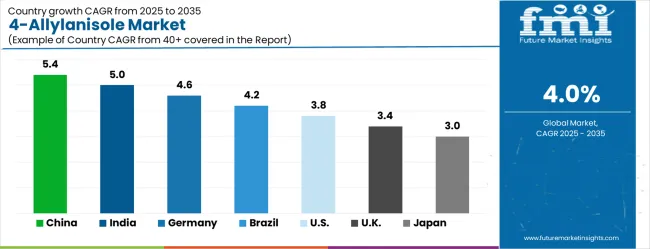
The 4-allylanisole market is growing steadily, with China leading at a 5.4% CAGR through 2036, driven by expanding food processing industry capabilities and growing domestic consumer food market development. India follows at 5.0%, supported by traditional flavor expertise and increasing food manufacturing infrastructure. Germany records strong growth at 4.6%, emphasizing premium food industry development and advanced flavor technologies. Brazil grows moderately at 4.2%, leveraging natural resource advantages and expanding food processing capabilities. The United States shows solid growth at 3.8%, focusing on premium food market expansion and natural ingredient demand. The United Kingdom maintains steady expansion at 3.4%, supported by specialty food development. Japan demonstrates stable growth at 3.0%, emphasizing quality excellence and sophisticated food applications.
The report covers an in-depth analysis of 40+ countries, the top-performing countries are highlighted below.
Market Analysis for 4-Allylanisole Market in China
The 4-allylanisole market in China is projected to exhibit the highest growth rate with a CAGR of 5.4% through 2036, driven by the country's expanding food processing industry capabilities and rapidly growing domestic consumer food market. The extensive food manufacturing infrastructure and increasing investment in advanced flavor technologies are creating substantial opportunities for high-quality 4-allylanisole production and application. Major food manufacturers are establishing comprehensive ingredient supply chains to support both domestic food industry demand and international export markets while meeting global food safety standards.
Food processing industry expansion and consumer food market development are supporting widespread adoption of advanced 4-allylanisole production technologies across commercial food manufacturing operations, driving demand for sophisticated extraction equipment and food safety quality control systems. Export market development and food-grade quality certification programs are creating significant opportunities for Chinese 4-allylanisole producers in global food ingredient supply chains requiring consistent quality and competitive pricing.
Opportunity Analysis for 4-Allylanisole Market in India
The 4-allylanisole market in India is expanding at a CAGR of 5.0%, supported by the country's traditional expertise in flavor compounds and increasing focus on food manufacturing infrastructure development. The established spice and flavor industry infrastructure and growing investment in modern food processing technologies are driving substantial 4-allylanisole production capabilities. Manufacturing facilities are leveraging traditional knowledge while adopting contemporary food safety methods to meet international quality requirements and market demands.
Traditional flavor expertise and food manufacturing expansion are creating opportunities for high-quality 4-allylanisole production across diverse food ingredient categories requiring authentic natural sourcing and superior flavor characteristics. International food market expansion and quality certification achievements are driving investments in advanced extraction technologies for 4-allylanisole applications throughout major food processing regions and manufacturing facilities.
Sales Forecast for 4-Allylanisole Market in Germany
The 4-allylanisole market in Germany is projected to grow at a CAGR of 4.6%, supported by the country's leadership in premium food industry development and advanced flavor technology applications. German food companies are implementing sophisticated 4-allylanisole processing systems that meet stringent food safety standards and premium market requirements. The market is characterized by focus on innovation, advanced extraction technologies, and compliance with comprehensive food safety and quality regulations.
Premium food industry investments are prioritizing advanced 4-allylanisole processing technologies that demonstrate superior purity levels and flavor excellence while meeting German food safety and quality standards for premium food applications. Innovation programs and technology development initiatives are driving adoption of precision-engineered extraction systems that support optimal 4-allylanisole quality and enhanced food application performance.
Growth Outlook for 4-Allylanisole Market in Brazil
The 4-allylanisole market in Brazil is growing at a CAGR of 4.2%, driven by the country's natural resource advantages and expanding food processing capabilities across agricultural and food manufacturing sectors. The abundant natural aromatic resources and growing investment in modern food processing infrastructure are creating opportunities for sustainable 4-allylanisole production. Processing facilities are adopting advanced technologies to support growing domestic and export food market requirements while maintaining environmental sustainability standards.
Natural resource utilization and food processing expansion are facilitating development of cost-effective 4-allylanisole production systems capable of meeting diverse quality requirements and food safety specifications across international food applications. Regional processing capability enhancement and food export market development are creating demand for standardized 4-allylanisole products that meet international food industry specifications and safety requirements.
Demand Assessment for 4-Allylanisole Market in the United States
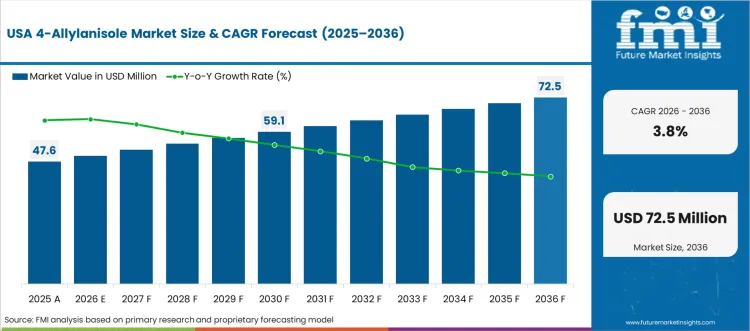
The 4-allylanisole market in the United States is expanding at a CAGR of 3.8%, driven by the country's premium food market expansion and increasing consumer demand for natural food ingredients. The sophisticated food industry ecosystem and focus on premium product development create consistent demand for high-quality 4-allylanisole solutions. The market benefits from artisanal food growth and specialty food brand development across multiple premium food segments.
Premium food market expansion and natural ingredient demand growth are driving adoption of premium 4-allylanisole solutions that offer superior flavor characteristics and authenticity verification for high-end food applications. Artisanal food development and specialty market growth are supporting demand for specialized 4-allylanisole formulations that meet stringent quality requirements and natural sourcing expectations.
Revenue Prospects for 4-Allylanisole Market in the United Kingdom
The 4-allylanisole market in the United Kingdom is projected to grow at a CAGR of 3.4%, supported by ongoing specialty food development and increasing emphasis on natural ingredient authenticity in premium food formulations. Food companies are investing in high-quality 4-allylanisole solutions that provide distinctive flavor characteristics and meet consumer expectations for natural product formulations. The market is characterized by focus on brand differentiation, ingredient quality, and regulatory compliance across specialty food applications.
Specialty food development and natural ingredient authentication programs are supporting adoption of verified 4-allylanisole solutions that meet contemporary quality and sustainability standards for premium food applications. Brand differentiation initiatives and quality enhancement programs are creating demand for specialized 4-allylanisole applications that provide distinctive flavor characteristics and natural sourcing verification.
In-depth Review of 4-Allylanisole Market in Japan
The 4-allylanisole market in Japan is expanding at a CAGR of 3.0%, driven by the country's emphasis on quality excellence and sophisticated food application development. Japanese food companies are developing advanced 4-allylanisole formulations that incorporate precision blending and quality optimization principles. The market benefits from focus on flavor sophistication, ingredient purity, and continuous improvement in food composition techniques.
Quality excellence programs and sophisticated food development initiatives are driving advancement of premium 4-allylanisole applications that demonstrate superior flavor characteristics and composition reliability. Food sophistication programs and ingredient quality advancement are supporting adoption of precision-formulated 4-allylanisole solutions that optimize flavor performance and ensure consistent food quality in demanding applications.
Europe Market Split by Country
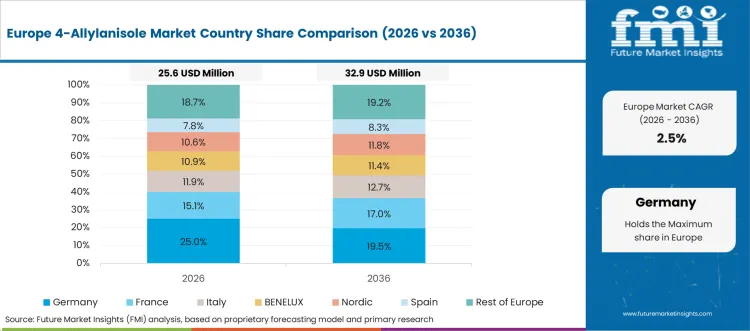
The 4-allylanisole market in Europe is projected to grow from USD 32.4 million in 2026 to USD 46.8 million by 2036, registering a CAGR of 3.7% over the forecast period. Germany is expected to maintain its leadership with a 30.8% share in 2026, supported by its advanced food industry and premium food market development. The United Kingdom follows with 21.2% market share, driven by specialty food development and natural ingredient demand growth. France holds 18.5% of the European market, benefiting from traditional culinary expertise and premium food industry expansion. Italy and Spain collectively represent 17.3% of regional demand, with growing focus on artisanal food development and natural flavor applications. The Rest of Europe region accounts for 12.2% of the market, supported by emerging specialty food markets in Eastern European countries and Nordic premium food development.
Competitive Landscape
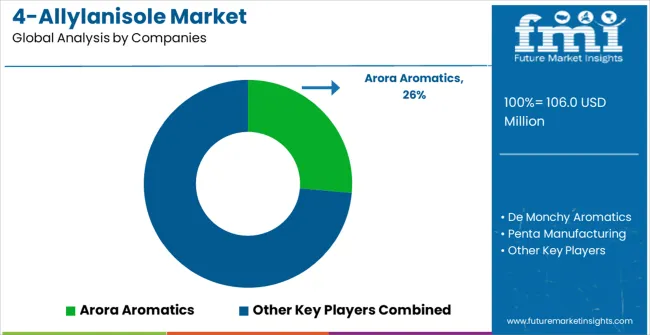
The 4-allylanisole market is defined by competition among established flavor ingredient suppliers, specialized natural extract manufacturers, and aromatic processing companies. Companies are investing in advanced extraction technologies, product innovation, quality assurance systems, and sustainable sourcing capabilities to deliver reliable, pure, and cost-effective 4-allylanisole solutions. Strategic partnerships, technological advancement, and geographic expansion are central to strengthening product portfolios and market presence.
Arora Aromatics, operating regionally, offers comprehensive 4-allylanisole solutions with focus on natural authenticity, quality consistency, and technical support services for food applications. De Monchy Aromatics, specialized supplier, provides advanced natural flavor ingredients with emphasis on purity consistency and application-specific formulations for food industries. Penta Manufacturing delivers specialized chemical products with focus on food-grade applications and quality optimization. Norex Flavours offers comprehensive flavor solutions with standardized procedures and food industry manufacturing support.
Mane Kancor provides advanced flavor extraction capabilities with emphasis on sustainable sourcing and technical expertise for food applications. Hindustan Mint & Agro delivers specialized aromatic extraction services with focus on quality excellence and natural ingredient applications. Jiangxi Spice Chemical Industrial offers comprehensive natural ingredient processing with regional manufacturing and food safety capabilities. Yibin Chuanhui Perfumery provides advanced aromatic solutions with specialized extraction technologies and market expertise. Ji'an Wanyi Spice Oil offers specialized extraction expertise and regional production capabilities for natural ingredient markets. These companies offer specialized 4-allylanisole expertise, regional production capabilities, and technical support across global and regional food industry networks.
Global 4-Allylanisole Market -- Stakeholder Contribution Framework
The 4-allylanisole market underpins natural food flavor development, premium culinary applications, sustainable ingredient sourcing, and authentic taste innovation excellence. With growing natural ingredient demand, premium food market expansion, and sustainable sourcing requirements, the sector faces pressure to balance flavor authenticity, supply chain reliability, and food safety compliance. Coordinated contributions from governments, industry bodies, OEMs/technology integrators, suppliers, and investors will accelerate the transition toward sustainable, high-quality, and application-optimized 4-allylanisole solutions.
How Governments Could Spur Market Growth and Adoption
- Natural Food Incentives: Provide tax credits for natural flavoring ingredient producers adopting sustainable extraction methods and incentivize research into advanced purification technologies for food applications.
- R&D Support: Fund research programs on sustainable 4-allylanisole extraction, enhanced purification processes, and application-specific formulation innovations for food industry uses.
- Food Safety Standards: Establish stringent quality and authenticity standards to ensure natural ingredient integrity and prevent synthetic substitution in food applications.
- Trade Facilitation: Reduce tariffs for importing natural aromatic raw materials while supporting local exports of high-quality 4-allylanisole and flavor ingredients.
- Sustainability Mandates: Integrate natural ingredient sourcing requirements into food safety regulations and environmental compliance frameworks.
How Industry Bodies Could Support Market Development
- Standardization & Certification: Develop harmonized guidelines for 4-allylanisole purity specifications, natural origin verification, and food safety testing protocols.
- Global Branding: Position regional 4-allylanisole producers as leaders in sustainable and high-quality natural food flavoring ingredient solutions.
- Training & Workforce Development: Create curricula for natural extraction techniques, food safety analysis methods, and sustainable sourcing practices to address skill shortages.
- Policy Advocacy: Engage with regulators to shape favorable natural ingredient policies and food industry requirements that drive 4-allylanisole adoption.
How OEMs and Technology Integrators Could Strengthen the Ecosystem
- Extraction Innovation: Advance steam distillation technologies, enhanced separation processes, and automated food safety control systems for improved efficiency and purity consistency.
- Partnerships: Collaborate with food manufacturers to develop application-specific 4-allylanisole formulations optimized for bakery products, beverages, confectionery, and specialty food applications.
- Product Innovation: Develop specialized extraction equipment, purification systems, and flavor enhancement technologies for enhanced 4-allylanisole production and food application optimization.
- Turnkey Solutions: Bundle 4-allylanisole production with complete flavor enhancement systems, offering end-to-end quality assurance and sustainable sourcing verification.
How Suppliers Could Navigate the Shift
- Sustainable Sourcing: Provide certified natural raw materials, sustainable extraction equipment, and food safety compliance technologies to enhance product authenticity and quality.
- Localized Processing: Establish regional extraction facilities to reduce transportation costs and provide faster response times to food industry requirements.
- Portfolio Diversification: Expand from standard 4-allylanisole into specialty segments (ultra-high purity, organic certified, application-specific formulations for food uses).
- Customer Engagement: Deploy technical support teams to demonstrate flavor benefits and quality advantages of premium 4-allylanisole solutions for food applications.
How Investors and Financial Enablers Could Unlock Value
- Infrastructure Financing: Fund natural extraction facilities, advanced purification equipment, and food safety testing centers in key production regions like China, India, and Germany.
- Innovation Finance: Support companies developing breakthrough extraction technologies, sustainable sourcing systems, and application-specific 4-allylanisole formulations for food industries.
- M&A and Consolidation: Back strategic acquisitions to integrate natural ingredient expertise and expand geographic production capabilities for food market access.
- Risk Management Tools: Provide insurance and hedging products against raw material supply variations and natural ingredient price volatility affecting food manufacturers.
Sustainability Investment: Channel capital toward certified organic production, environmental compliance systems, and sustainable sourcing verification programs for enhanced food market positioning.
Key Players in the 4-Allylanisole Market
- Arora Aromatics
- De Monchy Aromatics
- Penta Manufacturing
- Norex Flavours
- Mane Kancor
- Hindustan Mint & Agro
- Jiangxi Spice Chemical Industrial
- Yibin Chuanhui Perfumery
- Ji'an Wanyi Spice Oil
Scope of the Report
| Metric | Value |
|---|---|
| Quantitative Units | USD 110.2 million to USD 163.2 million, at a CAGR of 4.0% |
| Market Definition | 4-Allylanisole (estragole) is a naturally occurring phenylpropene flavouring compound extracted from basil, tarragon, and anise essential oils, used in food, beverage, confectionery, and fragrance applications. |
| Purity Level Segmentation | Purity ≥98%, Purity ≥99%, Other |
| Application Segmentation | Bakery Products, Beverages, Candy, Ice Cream, Other |
| Regions Covered | North America, Latin America, Europe, East Asia, South Asia, Oceania, Middle East & Africa |
| Countries Covered | China, India, Germany, Brazil, USA, UK, Japan, and 40 plus countries |
| Key Companies Profiled | Arora Aromatics, De Monchy Aromatics, Penta Manufacturing, Mane Kancor, Hindustan Mint & Agro, Jiangxi Spice Chemical Industrial, Norex Flavours |
| Forecast Period | 2026 to 2036 |
| Approach | Bottom-up methodology starting with 4-allylanisole shipment volumes by purity and application, projecting demand based on food processing growth and regulatory usage threshold trends. |
4-Allylanisole Market by Segments
Purity Level:
- Purity≥98%
- Purity≥99%
- Other
Application:
- Bakery Products
- Beverages
- Candy
- Ice Cream
- Other
Region:
- North America
- United States
- Canada
- Mexico
- Europe
- Germany
- United Kingdom
- France
- Italy
- Spain
- Nordic
- BENELUX
- Rest of Europe
- East Asia
- China
- Japan
- South Korea
- South Asia & Pacific
- India
- ASEAN
- Australia & New Zealand
- Rest of South Asia & Pacific
- Latin America
- Brazil
- Chile
- Rest of Latin America
- Middle East & Africa
- Kingdom of Saudi Arabia
- Other GCC Countries
- Turkey
- South Africa
- Other African Union
- Rest of Middle East & Africa
Bibliography
- European Food Safety Authority. (2024). Scientific opinion on estragole: Updated risk assessment. EFSA Journal.
- Joint FAO/WHO Expert Committee on Food Additives. (2024). Safety evaluation of certain food additives: Estragole. WHO Technical Report Series.
- USA Food and Drug Administration. (2024). GRAS substances database: Flavoring agents including estragole. FDA.
- International Organization of the Flavor Industry. (2024). IOFI guidelines on naturally occurring substances in flavourings. IOFI.
- Food and Agriculture Organization of the United Nations. (2024). Spices and essential oils: Global trade statistics. FAO.
This bibliography is provided for reader reference. The full Future Market Insights report contains the complete reference list with primary research documentation.
Frequently Asked Questions
How large is the global 4-allylanisole market in 2026?
The global market is estimated to be valued at USD 110.2 million in 2026.
What will be the market size by 2036?
The market is projected to reach USD 163.2 million by 2036.
What is the expected CAGR between 2026 and 2036?
The market is expected to grow at a CAGR of 4.0% between 2026 and 2036.
Which Purity Level leads in 2026?
Purity ≥98% accounts for 52.0% share in 2026, serving the majority of food-grade flavouring applications across bakery, confectionery, and beverage sectors.
Which Application leads in 2026?
Bakery Products account for 38.0% share in 2026, driven by the use of 4-allylanisole in anise-flavoured breads, biscuits, and pastries.
What is driving demand in China?
Expanding food processing output and domestic flavouring ingredient manufacturing are propelling China to a 5.4% CAGR through 2036.
Does the report cover India?
Yes, India is included within South Asia, tracking at a 5.0% CAGR driven by growing processed food consumption and essential oil production capabilities.
Preview the report firsthand - request a free sample
Get SampleGet the brochure for pricing and purchase details.
Get PDFTable of Content
- Executive Summary
- Global Market Outlook
- Demand-side Trends
- Supply-side Trends
- Technology Roadmap Analysis
- Analysis and Recommendations
- Market Overview
- Market Coverage / Taxonomy
- Market Definition / Scope / Limitations
- Research Methodology
- Chapter Orientation
- Analytical Lens and Working Hypotheses
- Market Structure, Signals, and Trend Drivers
- Benchmarking and Cross-market Comparability
- Market Sizing, Forecasting, and Opportunity Mapping
- Research Design and Evidence Framework
- Desk Research Programme (Secondary Evidence)
- Company Annual and Sustainability Reports
- Peer-reviewed Journals and Academic Literature
- Corporate Websites, Product Literature, and Technical Notes
- Earnings Decks and Investor Briefings
- Statutory Filings and Regulatory Disclosures
- Technical White Papers and Standards Notes
- Trade Journals, Industry Magazines, and Analyst Briefs
- Conference Proceedings, Webinars, and Seminar Materials
- Government Statistics Portals and Public Data Releases
- Press Releases and Reputable Media Coverage
- Specialist Newsletters and Curated Briefings
- Sector Databases and Reference Repositories
- FMI Internal Proprietary Databases and Historical Market Datasets
- Subscription Datasets and Paid Sources
- Social Channels, Communities, and Digital Listening Inputs
- Additional Desk Sources
- Expert Input and Fieldwork (Primary Evidence)
- Primary Modes
- Qualitative Interviews and Expert Elicitation
- Quantitative Surveys and Structured Data Capture
- Blended Approach
- Why Primary Evidence is Used
- Field Techniques
- Interviews
- Surveys
- Focus Groups
- Observational and In-context Research
- Social and Community Interactions
- Stakeholder Universe Engaged
- C-suite Leaders
- Board Members
- Presidents and Vice Presidents
- R&D and Innovation Heads
- Technical Specialists
- Domain Subject-matter Experts
- Scientists
- Physicians and Other Healthcare Professionals
- Governance, Ethics, and Data Stewardship
- Research Ethics
- Data Integrity and Handling
- Primary Modes
- Tooling, Models, and Reference Databases
- Desk Research Programme (Secondary Evidence)
- Data Engineering and Model Build
- Data Acquisition and Ingestion
- Cleaning, Normalisation, and Verification
- Synthesis, Triangulation, and Analysis
- Quality Assurance and Audit Trail
- Market Background
- Market Dynamics
- Drivers
- Restraints
- Opportunity
- Trends
- Scenario Forecast
- Demand in Optimistic Scenario
- Demand in Likely Scenario
- Demand in Conservative Scenario
- Opportunity Map Analysis
- Product Life Cycle Analysis
- Supply Chain Analysis
- Investment Feasibility Matrix
- Value Chain Analysis
- PESTLE and Porter’s Analysis
- Regulatory Landscape
- Regional Parent Market Outlook
- Production and Consumption Statistics
- Import and Export Statistics
- Market Dynamics
- Global Market Analysis 2021 to 2025 and Forecast, 2026 to 2036
- Historical Market Size Value (USD Million) Analysis, 2021 to 2025
- Current and Future Market Size Value (USD Million) Projections, 2026 to 2036
- Y-o-Y Growth Trend Analysis
- Absolute $ Opportunity Analysis
- Global Market Pricing Analysis 2021 to 2025 and Forecast 2026 to 2036
- Global Market Analysis 2021 to 2025 and Forecast 2026 to 2036, By Purity Level
- Introduction / Key Findings
- Historical Market Size Value (USD Million) Analysis By Purity Level , 2021 to 2025
- Current and Future Market Size Value (USD Million) Analysis and Forecast By Purity Level , 2026 to 2036
- Purity≥98%
- Purity≥99%
- Other
- Purity≥98%
- Y-o-Y Growth Trend Analysis By Purity Level , 2021 to 2025
- Absolute $ Opportunity Analysis By Purity Level , 2026 to 2036
- Global Market Analysis 2021 to 2025 and Forecast 2026 to 2036, By Application
- Introduction / Key Findings
- Historical Market Size Value (USD Million) Analysis By Application, 2021 to 2025
- Current and Future Market Size Value (USD Million) Analysis and Forecast By Application, 2026 to 2036
- Bakery Products
- Beverages
- Candy
- Ice Cream
- Other
- Bakery Products
- Y-o-Y Growth Trend Analysis By Application, 2021 to 2025
- Absolute $ Opportunity Analysis By Application, 2026 to 2036
- Global Market Analysis 2021 to 2025 and Forecast 2026 to 2036, By Region
- Introduction
- Historical Market Size Value (USD Million) Analysis By Region, 2021 to 2025
- Current Market Size Value (USD Million) Analysis and Forecast By Region, 2026 to 2036
- North America
- Latin America
- Western Europe
- Eastern Europe
- East Asia
- South Asia and Pacific
- Middle East & Africa
- Market Attractiveness Analysis By Region
- North America Market Analysis 2021 to 2025 and Forecast 2026 to 2036, By Country
- Historical Market Size Value (USD Million) Trend Analysis By Market Taxonomy, 2021 to 2025
- Market Size Value (USD Million) Forecast By Market Taxonomy, 2026 to 2036
- By Country
- USA
- Canada
- Mexico
- By Purity Level
- By Application
- By Country
- Market Attractiveness Analysis
- By Country
- By Purity Level
- By Application
- Key Takeaways
- Latin America Market Analysis 2021 to 2025 and Forecast 2026 to 2036, By Country
- Historical Market Size Value (USD Million) Trend Analysis By Market Taxonomy, 2021 to 2025
- Market Size Value (USD Million) Forecast By Market Taxonomy, 2026 to 2036
- By Country
- Brazil
- Chile
- Rest of Latin America
- By Purity Level
- By Application
- By Country
- Market Attractiveness Analysis
- By Country
- By Purity Level
- By Application
- Key Takeaways
- Western Europe Market Analysis 2021 to 2025 and Forecast 2026 to 2036, By Country
- Historical Market Size Value (USD Million) Trend Analysis By Market Taxonomy, 2021 to 2025
- Market Size Value (USD Million) Forecast By Market Taxonomy, 2026 to 2036
- By Country
- Germany
- UK
- Italy
- Spain
- France
- Nordic
- BENELUX
- Rest of Western Europe
- By Purity Level
- By Application
- By Country
- Market Attractiveness Analysis
- By Country
- By Purity Level
- By Application
- Key Takeaways
- Eastern Europe Market Analysis 2021 to 2025 and Forecast 2026 to 2036, By Country
- Historical Market Size Value (USD Million) Trend Analysis By Market Taxonomy, 2021 to 2025
- Market Size Value (USD Million) Forecast By Market Taxonomy, 2026 to 2036
- By Country
- Russia
- Poland
- Hungary
- Balkan & Baltic
- Rest of Eastern Europe
- By Purity Level
- By Application
- By Country
- Market Attractiveness Analysis
- By Country
- By Purity Level
- By Application
- Key Takeaways
- East Asia Market Analysis 2021 to 2025 and Forecast 2026 to 2036, By Country
- Historical Market Size Value (USD Million) Trend Analysis By Market Taxonomy, 2021 to 2025
- Market Size Value (USD Million) Forecast By Market Taxonomy, 2026 to 2036
- By Country
- China
- Japan
- South Korea
- By Purity Level
- By Application
- By Country
- Market Attractiveness Analysis
- By Country
- By Purity Level
- By Application
- Key Takeaways
- South Asia and Pacific Market Analysis 2021 to 2025 and Forecast 2026 to 2036, By Country
- Historical Market Size Value (USD Million) Trend Analysis By Market Taxonomy, 2021 to 2025
- Market Size Value (USD Million) Forecast By Market Taxonomy, 2026 to 2036
- By Country
- India
- ASEAN
- Australia & New Zealand
- Rest of South Asia and Pacific
- By Purity Level
- By Application
- By Country
- Market Attractiveness Analysis
- By Country
- By Purity Level
- By Application
- Key Takeaways
- Middle East & Africa Market Analysis 2021 to 2025 and Forecast 2026 to 2036, By Country
- Historical Market Size Value (USD Million) Trend Analysis By Market Taxonomy, 2021 to 2025
- Market Size Value (USD Million) Forecast By Market Taxonomy, 2026 to 2036
- By Country
- Kingdom of Saudi Arabia
- Other GCC Countries
- Turkiye
- South Africa
- Other African Union
- Rest of Middle East & Africa
- By Purity Level
- By Application
- By Country
- Market Attractiveness Analysis
- By Country
- By Purity Level
- By Application
- Key Takeaways
- Key Countries Market Analysis
- USA
- Pricing Analysis
- Market Share Analysis, 2025
- By Purity Level
- By Application
- Canada
- Pricing Analysis
- Market Share Analysis, 2025
- By Purity Level
- By Application
- Mexico
- Pricing Analysis
- Market Share Analysis, 2025
- By Purity Level
- By Application
- Brazil
- Pricing Analysis
- Market Share Analysis, 2025
- By Purity Level
- By Application
- Chile
- Pricing Analysis
- Market Share Analysis, 2025
- By Purity Level
- By Application
- Germany
- Pricing Analysis
- Market Share Analysis, 2025
- By Purity Level
- By Application
- UK
- Pricing Analysis
- Market Share Analysis, 2025
- By Purity Level
- By Application
- Italy
- Pricing Analysis
- Market Share Analysis, 2025
- By Purity Level
- By Application
- Spain
- Pricing Analysis
- Market Share Analysis, 2025
- By Purity Level
- By Application
- France
- Pricing Analysis
- Market Share Analysis, 2025
- By Purity Level
- By Application
- India
- Pricing Analysis
- Market Share Analysis, 2025
- By Purity Level
- By Application
- ASEAN
- Pricing Analysis
- Market Share Analysis, 2025
- By Purity Level
- By Application
- Australia & New Zealand
- Pricing Analysis
- Market Share Analysis, 2025
- By Purity Level
- By Application
- China
- Pricing Analysis
- Market Share Analysis, 2025
- By Purity Level
- By Application
- Japan
- Pricing Analysis
- Market Share Analysis, 2025
- By Purity Level
- By Application
- South Korea
- Pricing Analysis
- Market Share Analysis, 2025
- By Purity Level
- By Application
- Russia
- Pricing Analysis
- Market Share Analysis, 2025
- By Purity Level
- By Application
- Poland
- Pricing Analysis
- Market Share Analysis, 2025
- By Purity Level
- By Application
- Hungary
- Pricing Analysis
- Market Share Analysis, 2025
- By Purity Level
- By Application
- Kingdom of Saudi Arabia
- Pricing Analysis
- Market Share Analysis, 2025
- By Purity Level
- By Application
- Turkiye
- Pricing Analysis
- Market Share Analysis, 2025
- By Purity Level
- By Application
- South Africa
- Pricing Analysis
- Market Share Analysis, 2025
- By Purity Level
- By Application
- USA
- Market Structure Analysis
- Competition Dashboard
- Competition Benchmarking
- Market Share Analysis of Top Players
- By Regional
- By Purity Level
- By Application
- Competition Analysis
- Competition Deep Dive
- Arora Aromatics
- Overview
- Product Portfolio
- Profitability by Market Segments (Product/Age /Sales Channel/Region)
- Sales Footprint
- Strategy Overview
- Marketing Strategy
- Product Strategy
- Channel Strategy
- De Monchy Aromatics
- Penta Manufacturing
- Norex Flavours
- Mane Kancor
- Hindustan Mint & Agro
- Jiangxi Spice Chemical Industrial
- Yibin Chuanhui Perfumery
- Ji'an Wanyi Spice Oil
- Arora Aromatics
- Competition Deep Dive
- Assumptions & Acronyms Used


