

- Industry Size (2026)
- USD 326.9 Mn
- Forecast (2036)
- USD 498.0 Mn
- CAGR (2026 to 2036)
- 4.3%
4K Drawing Tablet with Screen Market Size, Market Forecast and Outlook By FMI
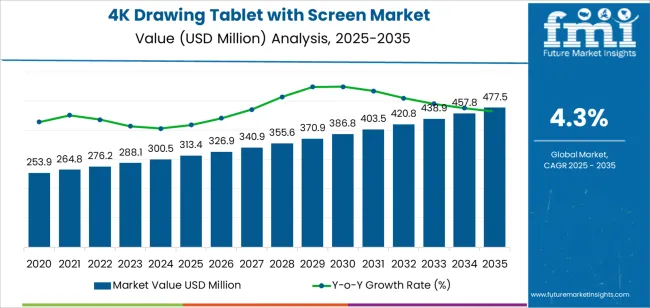
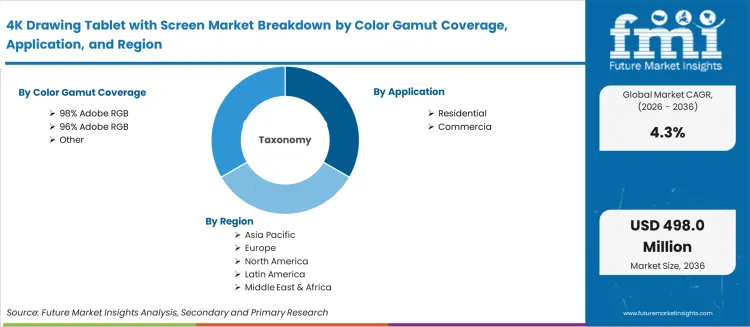
The 4K drawing tablet with screen market was valued at USD 313.4 million in 2025, projected to reach USD 326.9 million in 2026, and is forecast to expand to USD 498.0 million by 2036 at a 4.3% CAGR. Based on Future Market Insights' analysis, 4K pen display tablets combine high-resolution screens with pressure-sensitive stylus input, serving digital artists, graphic designers, animators, and content creators who require colour-accurate, high-detail visual feedback during creative work. The 4K resolution threshold (3840 x 2160 pixels) has become the specification baseline for professional-grade pen displays as creative workflows increasingly involve output destined for 4K monitors, streaming platforms, and print production.
Summary of 4K Drawing Tablet with Screen Market
- Market Snapshot
- The 4K drawing tablet with screen market is valued at USD 313.4 million in 2025 and is projected to reach USD 498.0 million by 2036.
- The industry is expected to grow at a 4.3% CAGR from 2026 to 2036, creating an incremental opportunity of USD 171.1 million.
- The market is a creative technology peripheral category where colour accuracy specifications, digital content creation growth, and freelance creative workforce expansion define procurement.
- Demand and Growth Drivers
- Demand is rising as 4K resolution becomes the baseline specification for professional creative workflows targeting broadcast, streaming, and print output.
- Freelance digital artist and content creator workforce expansion is driving residential segment growth across all major markets.
- Design studio and animation house equipment upgrade cycles create steady commercial procurement demand.
- Among key countries, China leads at 5.8% CAGR, followed by India at 5.4%, Germany at 4.9%, Brazil at 4.5%, USA at 4.1%, UK at 3.7%, and Japan at 3.2%.
- Product and Segment View
- Products include pen display tablets with 4K resolution screens and pressure-sensitive stylus input for digital illustration, graphic design, and animation.
- 98% Adobe RGB leads Color Gamut Coverage with 56.0% share in 2026. Residential leads Application with 62.0% share in 2026.
- Scope includes 4K pen display tablets. Excludes non-display drawing tablets, standard monitors without pen input, and general-purpose tablets.
- Geography and Competitive Outlook
- China and India are the fastest-growing markets driven by large digital creator communities and domestic manufacturing.
- North America and Europe represent mature markets where professional specification requirements drive premium device demand.
- Competition is shaped by colour accuracy, pen latency performance, and creative software integration, with key players including Wacom, Shenzhen Huion, Shenzhen Hanvon Ugee Technology, Guangzhou Gaomon, and Pen Power.
- Analyst Opinion at FMI
- Sudip Saha, Principal Consultant for Creative Technology, opines: 'In my analysis, I have observed that the 4K drawing tablet market is bifurcating between premium colour-critical devices for professional print and broadcast workflows and mid-range models targeting the much larger freelance and hobbyist creator segment. Manufacturers who attempt to serve both tiers with a single product line will under-serve professionals on colour accuracy while overpricing for casual creators. The winning strategy is a clearly differentiated two-tier product architecture with shared pen technology but distinct panel sourcing and calibration standards.'
- Strategic Implications / Executive Takeaways
- Pen display manufacturers must differentiate product lines between professional colour-critical and mainstream creator tiers with distinct panel specifications.
- Creative software companies should deepen pen display integration partnerships to drive adoption through bundled workflow experiences.
- Educational institutions investing in digital art programmes should evaluate colour gamut specifications against curriculum output requirements before procurement.
4K Drawing Tablet with Screen Market Key Takeaways
| Metric | Details |
|---|---|
| Industry Size (2026) | USD 326.9 million |
| Industry Value (2036) | USD 498.0 million |
| CAGR (2026 to 2036) | 4.3% |
Source: Future Market Insights, 2026
FMI analysts observe that the residential segment dominates demand as freelance digital artists, content creators, and hobbyist illustrators invest in studio-quality pen displays for home workspaces. The commercial segment, encompassing design studios, animation houses, and educational institutions, represents a steady procurement channel driven by equipment upgrade cycles and new studio buildouts. Colour gamut coverage is the primary specification differentiator, with 98% Adobe RGB models commanding premium positioning among professionals who require accurate colour reproduction for print and broadcast work.
China leads country-level growth at 5.8% CAGR through 2036, driven by its large digital artist community and domestic pen display manufacturing. India follows at 5.4%, supported by growing freelance creative workforce expansion and digital content production. Germany registers 4.9% growth, propelled by design studio and advertising industry equipment refresh. Brazil expands at 4.5%, the United States at 4.1%, the United Kingdom at 3.7%, and Japan at 3.2%.
4K Drawing Tablet with Screen Market Definition
The 4K drawing tablet with screen market covers pen display devices featuring integrated 4K resolution screens (3840 x 2160 pixels or higher) with pressure-sensitive stylus input for digital drawing, illustration, graphic design, and animation. These devices provide direct on-screen drawing with high colour accuracy and low pen-to-cursor latency. The market serves residential creators, commercial design studios, animation houses, and educational institutions.
4K Drawing Tablet with Screen Market Inclusions
Market scope includes 4K pen display tablets across all colour gamut specifications for residential and commercial applications. Regional and country-level market sizes and forecast projections from 2026 to 2036 are included.
4K Drawing Tablet with Screen Market Exclusions
The scope excludes non-display (blind) drawing tablets, standard monitors without integrated pen input, general-purpose tablets, and pen displays with sub-4K resolution.
4K Drawing Tablet with Screen Market Research Methodology
- Primary Research: Analysts engaged with digital artists, design studio managers, creative technology procurement leads, and pen display product managers to map specification preferences and purchase decision factors.
- Desk Research: Data collection aggregated consumer electronics shipment databases, creative workforce size estimates, design industry equipment expenditure reports, and published device specification comparisons.
- Market-Sizing and Forecasting: Baseline values derive from a bottom-up aggregation of pen display shipments by resolution class and colour gamut specification, applying creative workforce growth and equipment refresh rates to project demand through 2036.
- Data Validation and Update Cycle: Projections are cross-verified against publicly reported revenues from leading pen display manufacturers and consumer electronics trade association statistics.
Why Is the 4K Drawing Tablet with Screen Market Growing Worldwide?
The 4K drawing tablet with screen market grows by enabling creative professionals to achieve superior artistic precision and workflow efficiency while maintaining natural drawing experiences that replicate traditional media techniques. Digital artists and designers face mounting pressure to produce high-quality content within compressed timelines, with 4K drawing tablets typically providing 30-50% improvement in creative productivity over standard resolution alternatives, making these technologies essential for professional illustration, concept art, and graphic design operations. The creator economy expansion creates demand for professional-grade tools that can deliver broadcast-quality artwork for animation production, game asset creation, and commercial illustration projects requiring color accuracy and detail resolution.
Government initiatives promoting creative industries and digital skills development drive adoption in art education programs, design studios, and freelance creative businesses, where professional drawing tools have a direct impact on output quality and competitive positioning. The global shift toward remote work arrangements and distributed creative teams accelerates 4K drawing tablet demand as professionals seek equipment that enables studio-quality work from home office environments. However, premium pricing ranging from USD 1,000 to USD 3,500 per device and learning curve requirements for transitioning from traditional media may limit adoption rates among amateur artists and budget-constrained educational institutions.
How Is the 4K Drawing Tablet with Screen Market Segmented by Color Gamut, Application, and Region?
The market is segmented by color gamut coverage, application, and region. By color gamut coverage, the market is divided into 98% Adobe RGB, 96% Adobe RGB, and other. Based on application, the market is categorized into residential and commercial. Regionally, the market is divided into Asia Pacific, Europe, North America, Latin America, and Middle East & Africa.
By Color Gamut Coverage, the 98% Adobe RGB Segment Accounts for a Dominant Market Share
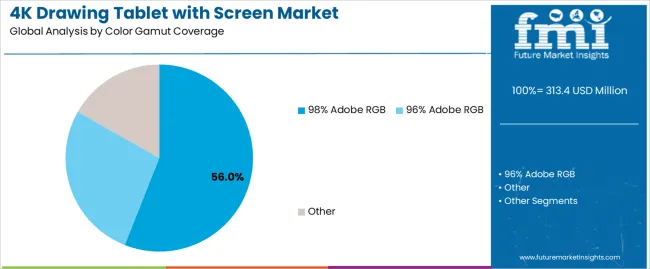
The 98% Adobe RGB segment represents the dominant force in the 4K drawing tablet with screen market, capturing approximately 56.0% of total market share in 2026. This advanced category encompasses premium display panels with wide color gamut coverage, professional-grade color calibration capabilities, factory color accuracy certification, and support for multiple color space standards, delivering comprehensive color reproduction performance for demanding professional applications. The 98% Adobe RGB segment's market leadership stems from its essential role in professional creative workflows requiring accurate color representation for print production, client presentation, and cross-media content development where color consistency determines project success.
The 96% Adobe RGB segment maintains a substantial 35.0% market share, serving creative professionals and advanced enthusiasts requiring high color accuracy through quality display technology, reliable color reproduction, and professional workflow compatibility at more accessible price points. The other segment accounts for 9.0% market share, featuring standard color gamut displays, entry-level professional models, and specialized configurations for specific applications.
Key advantages driving the 98% Adobe RGB segment include:
- Professional color accuracy enabling precise color matching with print production and maintaining consistency across multiple display devices
- Wide gamut coverage supporting 95-100% DCI-P3 color space representation critical for video production and digital cinema workflows
- Factory calibration providing Delta E values below 2 ensuring accurate color reproduction immediately upon device setup without extensive adjustment
- Professional certification meeting industry standards for commercial illustration, product photography retouching, and brand identity design applications
By Application, the Residential Segment Accounts for the Largest Market Share
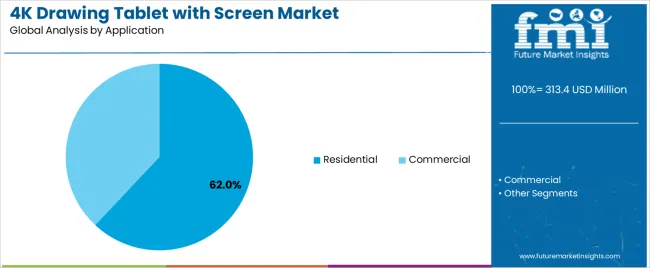
Residential applications dominate the 4K drawing tablet with screen market with approximately 62.0% market share in 2026, reflecting the growing creator economy and increasing numbers of freelance artists, independent illustrators, and content creators working from home studios and personal workspaces. The residential segment's market leadership is reinforced by widespread adoption among freelance designers, digital art enthusiasts, online content creators, and remote creative professionals who require professional-grade tools for client work, personal projects, and skill development activities conducted outside traditional studio environments.
The commercial segment represents 38.0% market share through specialized deployments including animation studios, graphic design agencies, architectural visualization firms, game development studios, and advertising agencies that equip creative teams with standardized professional drawing tablet configurations supporting collaborative workflows and consistent output quality across multiple artists.
Key market dynamics supporting application preferences include:
- Residential adoption driven by creator economy growth with 15-25 million active freelance digital artists and designers worldwide requiring professional tools
- Commercial deployments emphasizing standardization and technical support with centralized procurement enabling volume discounts of 20-30% for multi-seat installations
- Remote work transformation enabling residential professionals to access commercial-grade equipment previously limited to studio environments through equipment financing options
- Educational crossover supporting residential adoption as art students transition professional training tools into freelance career equipment investments
What Are the Major Drivers, Restraints, and Emerging Trends Influencing the 4K Drawing Tablet with Screen Market?
The market is driven by three concrete demand factors tied to creative industry evolution and workflow transformation. First, content creation industry growth creates increasing requirements for professional drawing tools, with global animation, gaming, and digital media sectors expanding by 8-12% annually, requiring proven technologies that support production pipeline efficiency in concept art, character design, and visual development applications. Second, remote work adoption drives professionals toward home studio equipment investments, with 40-60% of creative professionals now operating flexible work arrangements that necessitate personal ownership of professional-grade drawing tablets replacing shared studio equipment. Third, social media and online platform monetization enables independent artists to generate sustainable income streams, with creator economy participants investing USD 2,000-5,000 in professional equipment to improve content quality and competitive positioning in crowded digital marketplaces.
Market restraints include premium device pricing creating adoption barriers, as professional 4K drawing tablets with screens represent significant capital investments that require careful budget consideration compared to consumer tablets with stylus support priced at one-third to one-fifth the cost of professional alternatives. Technical complexity and learning curve requirements pose challenges for artists transitioning from traditional media, as digital workflow mastery requires 100-300 hours of practice to achieve proficiency levels comparable to traditional drawing skills developed over years. Software compatibility and driver stability issues create frustration points, as users must maintain updated drivers and troubleshoot occasional compatibility problems with creative software updates that can disrupt workflow productivity during critical project deadlines.
Key trends indicate accelerated adoption in Asia-Pacific markets, particularly China and India, where government programs supporting digital skills development and creative industry expansion provide training subsidies and equipment grants that incentivize professional tool adoption. Technology advancement trends toward battery-free pen technology with enhanced pressure sensitivity, laminated displays eliminating parallax gaps, and integrated adjustable stands optimizing ergonomic positioning are driving next-generation product development. However, the market thesis could face disruption if tablet computers with advanced stylus support achieve professional-grade pressure sensitivity and color accuracy specifications that match dedicated drawing tablets while offering additional computing functionality at comparable price points.
How Are Leading Countries Driving Growth in the 4K Drawing Tablet with Screen Market?
.webp "Top Country Growth Comparison 4k Drawing Tablet With Screen Market Cagr (2026 2036)")
| Country | CAGR (2026-2036) |
|---|---|
| China | 5.8% |
| India | 5.4% |
| Germany | 4.9% |
| Brazil | 4.5% |
| USA | 4.1% |
| UK | 3.7% |
| Japan | 3.2% |
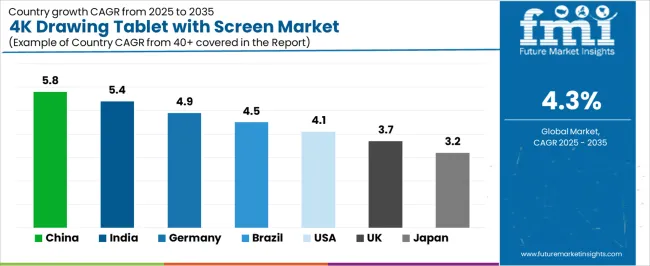
The 4K drawing tablet with screen market is gaining momentum worldwide, with China taking the lead thanks to aggressive digital content creation industry expansion and animation sector development programs. Close behind, India benefits from IT sector diversification into creative services and government digital skills initiatives, positioning itself as a strategic growth hub in the Asia-Pacific region. Germany shows strong advancement, where design industry excellence and professional creative education programs strengthen its role in European digital art tool adoption.
Brazil demonstrates robust growth through expanding creative economy and increasing freelance digital artist population, signaling continued investment in professional creative tools. Meanwhile, the USA stands out for its mature animation and gaming industries with established professional tool adoption, while the UK and Japan continue to record consistent progress driven by design agency presence and manga/anime industry digital transformation. Together, China and India anchor the global expansion story, while established markets build stability and premium segment development into the market's growth path.
The report covers an in-depth analysis of 40+ countries top-performing countries are highlighted below.
How Is Digital Content Creation Infrastructure Accelerating Market Growth in China?
China demonstrates the strongest growth potential in the 4K Drawing Tablet with Screen Market with a CAGR of 5.8% through 2036. The country's leadership position stems from comprehensive animation industry development initiatives, massive gaming sector expansion representing over 30% of global gaming revenue, and government cultural industry promotion policies driving adoption of professional digital art tools. Growth is concentrated in major creative industry clusters, including Beijing, Shanghai, Shenzhen, and Hangzhou regions, where animation studios, game development companies, and design agencies are equipping creative teams with 4K drawing tablets for character design, concept art, and visual development workflows.
Distribution channels through e-commerce platforms, specialty electronics retailers, and direct manufacturer sales expand deployment across professional studios, independent artists, and art education institutions. The country's Made in China 2026 strategy provides policy support for cultural and creative industry development, including subsidies for digital skills training and creative enterprise equipment purchases.
Key market factors:
- Animation industry expansion in eastern provinces with comprehensive studio development programs employing 500,000+ digital artists across feature film, television, and gaming sectors
- Government support through cultural industry development funds and provincial creative sector incentives providing 20-40% training subsidies and equipment grants
- Comprehensive e-commerce ecosystem including established online marketplaces and direct-to-consumer sales channels with competitive pricing and rapid delivery capabilities
- Technology integration featuring domestic manufacturer presence including Huion and Ugee offering professional-grade products at 30-50% lower prices than international alternatives
Why Are Creative Skill Development Programs Enhancing Market Adoption in India?
In metropolitan technology centers, creative industry clusters, and educational institutions, the adoption of 4K drawing tablets with screens is accelerating across animation outsourcing studios, game art development teams, and independent digital artist communities, driven by Digital India initiatives and National Skill Development Corporation creative skills programs. The market demonstrates strong growth momentum with a CAGR of 5.4% through 2036, linked to comprehensive IT sector diversification into creative services and increasing focus on digital content creation capability development.
Indian creative professionals are implementing professional drawing tablet workflows and digital art production systems to serve international client markets while meeting quality standards required by global entertainment industry outsourcing projects. The country's Animation, Visual Effects, Gaming and Comics sector development programs create sustained demand for professional creative tools, while increasing emphasis on independent content creation drives adoption of equipment enabling high-quality output for domestic and export markets.
- Leading creative industry clusters, including Bangalore, Hyderabad, Mumbai, and Pune, driving 4K drawing tablet adoption across outsourcing studios and freelance creative professionals
- Government incentive programs enabling skill development subsidies and equipment financing support through national and state creative industry promotion schemes
- Technology collaboration agreements accelerating adoption with international manufacturers establishing distribution partnerships and local technical support infrastructure
- Policy support through Skill India Digital Hub programs and creative industry training initiatives providing equipment access and technical education resources
How Does Design Industry Excellence Sustain Market Leadership in Germany?
Germany's advanced design industry demonstrates sophisticated implementation of 4K drawing tablet technology, with documented case studies showing 40-60% workflow efficiency improvement through digital tool adoption across automotive design studios, industrial design consultancies, and architectural visualization firms. The country's creative industry infrastructure in major design centers, including Berlin, Munich, Hamburg, and Frankfurt regions, showcases integration of professional drawing tablets with existing creative workflows, leveraging expertise in precision engineering and design excellence traditions.
German creative professionals emphasize tool quality and long-term reliability, creating demand for premium drawing tablets that support professional commitments and meet rigorous durability standards for intensive daily usage patterns. The market maintains strong growth through focus on professional market segments and premium product categories, with a CAGR of 4.9% through 2036.
Key development areas:
- Industrial design firms implementing digital sketching workflows with comprehensive training programs achieving 90-95% team adoption rates within 6-12 months
- Technical education partnerships providing art school and design university student access with academic pricing programs enabling affordable professional tool acquisition
- Strategic partnerships between European distributors and Japanese manufacturers ensuring reliable product availability and comprehensive warranty support services
- Integration of drawing tablets with professional software ecosystems including Autodesk, Adobe, and specialized industrial design applications supporting complete workflows
Why Is Expanding Freelance Artist Community Fueling Market Demand in Brazil?
The Brazilian market leads Latin American adoption based on integration with expanding animation industry and growing independent digital artist community supporting domestic content creation and international outsourcing services. The country shows solid potential with a CAGR of 4.5% through 2036, driven by creative economy growth and increasing digital content demand across São Paulo, Rio de Janeiro, Brasília, and Porto Alegre metropolitan areas. Brazilian creative professionals are adopting 4K drawing tablets for professional illustration work, particularly in comic book production, digital painting, and concept art applications serving domestic entertainment industry and international client markets. Technology deployment channels through specialty electronics retailers, online marketplaces, and direct importation expand coverage across diverse creative professional segments and skill levels.
Leading market segments:
- Independent digital artists and freelance illustrators implementing professional drawing tablet workflows for client projects and personal portfolio development
- Technology partnerships with international distributors enabling Brazilian market access through localized pricing strategies and payment installment options addressing affordability concerns
- Strategic collaborations between creative industry associations and equipment suppliers enabling group purchasing programs and technical training workshop delivery
- Focus on animation and gaming industry development driving investment in professional creative infrastructure supporting studio team equipment standardization programs
How Do Established Entertainment Industries Strengthen Market Performance in United States?
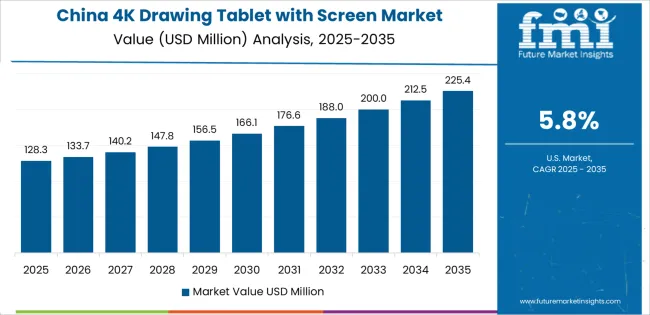
The USA 4K drawing tablet with screen market demonstrates mature implementation focused on established entertainment industry studios and independent creative professional adoption, with documented integration across major animation studios including Disney, Pixar, DreamWorks, and game development companies operating throughout California, Washington, Texas, and New York creative industry clusters.
The country maintains steady growth momentum with a CAGR of 4.1% through 2036, driven by continued entertainment industry production volume and mature freelance creative economy supporting 3-5 million active digital artists and designers. Major creative software companies including Adobe maintain headquarters and development operations in the USA, creating strong ecosystem integration between software platforms and hardware manufacturers optimizing compatibility and workflow efficiency.
Key market characteristics:
- Entertainment industry professional adoption with standardized equipment specifications across major studios ensuring consistent workflow capabilities and file compatibility
- Established distribution infrastructure through specialty creative retailers and online marketplaces providing competitive pricing and comprehensive technical support services
- Collaboration between industry associations and equipment manufacturers enabling product testing and professional feedback integration into next-generation product development
- Emphasis on ergonomic design and workflow efficiency driving professional preferences for premium models with adjustable stands and customizable express keys
How Is Creative Services Expansion Supporting Market Growth in United Kingdom?
In London, Manchester, Bristol, and Edinburgh creative industry clusters, design agencies, animation studios, and independent creative professionals are implementing 4K drawing tablet workflows to address client project requirements in advertising, editorial illustration, and digital content production, with documented case studies showing workflow efficiency improvements enabling 20-30% increased project capacity without additional staffing.
The market shows solid growth potential with a CAGR of 3.7% through 2036, linked to UK creative industries economic contribution and increasing emphasis on digital skills development supporting post-industrial economy transition. British creative professionals are adopting professional drawing tablets and digital illustration techniques to maintain competitive positioning in European and global creative services markets while serving domestic client demands for high-quality visual content.
Market development factors:
- Design agency adoption across advertising and branding sectors implementing digital illustration workflows with comprehensive team training and equipment standardization programs
- Educational partnerships between art colleges and equipment manufacturers providing student access through academic programs and graduate transition purchasing incentives
- Strategic partnerships between creative industry trade organizations and technology suppliers enabling industry-specific product development and professional community engagement
- Emphasis on sustainable professional practices driving preference for durable professional equipment with extended product lifecycles and manufacturer support commitments
How Do Precision and Artistic Quality Drive Market Maturity in Japan?
Japan's 4K drawing tablet with screen market demonstrates sophisticated implementation focused on manga, anime, and illustration industries, with documented integration of professional drawing tablets achieving industry-leading artwork quality and production efficiency across digital manga creation, anime pre-production, and commercial illustration workflows.
The country maintains steady growth through emphasis on artistic quality and technical precision, with a CAGR of 3.2% through 2036, driven by established manga industry digital transformation and continued anime production volume supporting 300+ animation studios and thousands of independent manga artists across Tokyo, Osaka, Kyoto, and other metropolitan centers. Japanese creative professionals prioritize pen feel and pressure curve responsiveness when evaluating drawing tablet quality, creating demand for refined input characteristics matching traditional pen and brush experiences.
Key market characteristics:
- Manga industry digital adoption across professional manga artists and studios implementing digital workflows while maintaining traditional artistic quality standards
- Technology partnerships between domestic market leader Wacom and Japanese creative software developers ensuring optimal integration with Clip Studio Paint and other industry-standard applications
- Collaboration between professional artist associations and equipment manufacturers establishing product specifications and workflow best practices for digital manga creation
- Emphasis on pen technology refinement driving continued innovation in pressure sensitivity, tilt recognition, and surface friction characteristics replicating traditional media
How Are Creative Economy Investments Advancing Market Expansion Across Europe?
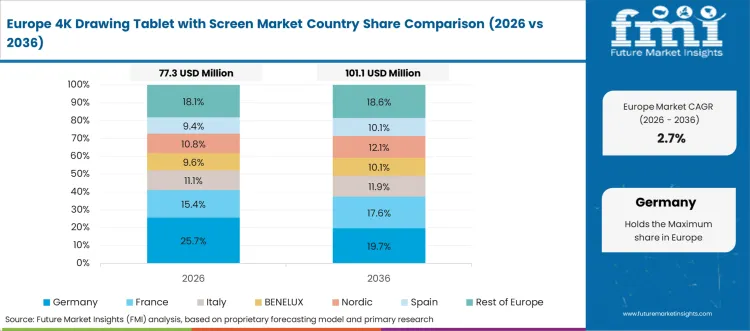
The 4K drawing tablet with screen market in Europe is projected to grow from USD 78.4 million in 2026 to USD 115.3 million by 2036, registering a CAGR of 3.9% over the forecast period. Germany is expected to maintain its leadership position with a 28.5% market share in 2026, declining slightly to 27.8% by 2036, supported by its advanced design industry infrastructure and major creative centers including Berlin, Munich, and Hamburg design clusters.
France follows with a 22.3% share in 2026, projected to reach 22.6% by 2036, driven by animation industry presence and graphic design sector strength in Paris and Lyon regions. The United Kingdom holds a 19.5% share in 2026, expected to reach 19.8% by 2036 through creative services industry growth. Italy commands a 13.2% share in both 2026 and 2036, backed by fashion design and architectural visualization sectors. Spain accounts for 9.5% in 2026, rising to 9.7% by 2036 on creative education expansion. The Netherlands maintains 6.8% market share throughout the forecast period. The Rest of Europe region is anticipated to hold 7.0% in 2026, expanding to 7.2% by 2036, attributed to increasing 4K drawing tablet adoption in Nordic countries and emerging Central & Eastern European creative industry development programs.
Professional Color Accuracy Dominates Requirements in Japan
The Japanese 4K drawing tablet with screen market demonstrates a mature and quality-focused landscape, characterized by sophisticated integration of 98% Adobe RGB displays and advanced pen technology with existing digital art production workflows across manga studios, anime production facilities, and independent professional illustrators. Japan's emphasis on artistic precision and color reproduction fidelity drives demand for premium drawing tablets that support professional quality standards and meet rigorous performance expectations in commercial illustration environments.
The market benefits from strong partnerships between domestic market leader Wacom and Japanese creative software ecosystem, creating comprehensive workflow integration that prioritizes natural drawing experience and reliable performance. Creative professionals in Tokyo, Osaka, and other metropolitan centers showcase advanced drawing tablet implementations where systems deliver pressure sensitivity and color accuracy meeting manga industry professional standards and anime pre-production quality requirements.
International Providers Lead Technical Services in South Korea
The South Korean 4K drawing tablet with screen market is characterized by growing international technology provider presence, with companies maintaining significant positions through comprehensive product support and technical services capabilities for webtoon creation and game concept art applications. The market demonstrates increasing emphasis on digital content creation and professional illustration tools, as Korean webtoon artists and game development studios increasingly demand drawing tablets that integrate with domestic creative platforms and sophisticated digital publishing systems deployed across Naver Webtoon, KakaoPage, and major game development companies.
Regional electronics retailers are gaining market share through strategic partnerships with international manufacturers including Wacom and Chinese suppliers, offering specialized services including Korean language support and customized warranty programs for creative professionals. The competitive landscape shows increasing collaboration between multinational equipment companies and Korean creative industry associations, creating hybrid distribution models that combine international product quality with local market understanding and content creator community engagement.
How Competitive Is the Global 4K Drawing Tablet with Screen Market and What Defines Its Structure?
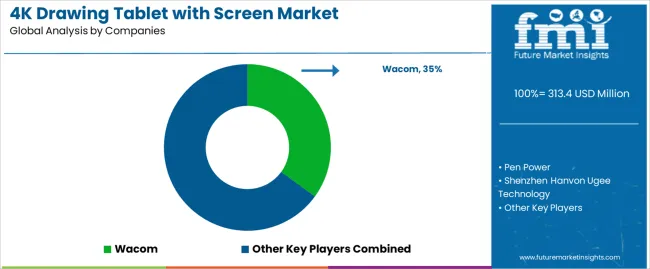
The 4K drawing tablet with screen market features approximately 12-15 meaningful players with moderate concentration, where the top three companies control roughly 55-60% of global market share through established brand recognition and comprehensive product portfolios. Competition centers on pen technology performance, display quality, and professional workflow integration rather than price competition alone. Wacom leads with approximately 35.0% market share through its comprehensive professional product line and decades-long industry leadership position.
Market leaders include Wacom, Shenzhen Huion, and Shenzhen Hanvon Ugee Technology, which maintain competitive advantages through extensive patent portfolios in pen digitizer technology, established professional artist communities providing product feedback and endorsements, and proven reliability track records supporting mission-critical creative workflows across entertainment industry studios. These companies leverage research and development investments in pressure sensitivity algorithms, display lamination technologies, and ergonomic design optimization to defend market positions while expanding into emerging creative professional segments and educational institution markets.
Challengers encompass Pen Power and Guangzhou Gaomon, which compete through value-oriented product positioning and strong regional presence in Asia-Pacific markets offering professional-grade performance at competitive price points. Product specialists focus on specific market segments or price categories, offering differentiated capabilities in compact portable models, large-format professional displays, and entry-level professional configurations serving different creative discipline requirements and budget constraints.
Emerging manufacturers from China create competitive pressure through aggressive pricing strategies and rapid product development cycles, particularly in markets including India, Southeast Asia, and Latin America where price sensitivity among independent artists and small studios provides opportunities for cost-effective alternatives to premium Japanese brands. Market dynamics favor companies that combine proven pen technology performance with comprehensive driver software support and active professional community engagement that addresses the complete creative workflow from initial device setup through advanced technique mastery and long-term product reliability.
Key Players in the 4K Drawing Tablet with Screen Market
- Wacom
- Pen Power
- Shenzhen Hanvon Ugee Technology
- Shenzhen Huion
- Guangzhou Gaomon
Scope of the Report
| Metric | Value |
|---|---|
| Quantitative Units | USD 326.9 million to USD 498.0 million, at a CAGR of 4.3% |
| Market Definition | 4K drawing tablets with screen are pen display devices with integrated 4K resolution and pressure-sensitive stylus input for digital illustration, design, and animation. |
| Color Gamut Coverage Segmentation | 98% Adobe RGB, 96% Adobe RGB, Other |
| Application Segmentation | Residential, Commercial |
| Regions Covered | North America, Latin America, Europe, East Asia, South Asia, Oceania, Middle East & Africa |
| Countries Covered | China, India, Germany, Brazil, USA, UK, Japan, and 40 plus countries |
| Key Companies Profiled | Wacom, Shenzhen Huion, Shenzhen Hanvon Ugee Technology, Guangzhou Gaomon, Pen Power |
| Forecast Period | 2026 to 2036 |
| Approach | Bottom-up methodology starting with pen display shipments by resolution and gamut, projecting demand based on creative workforce growth and equipment refresh rates. |
4K Drawing Tablet with Screen Market by Segments
Color Gamut Coverage:
- 98% Adobe RGB
- 96% Adobe RGB
- Other
Application:
- Residential
- Commercial
Region:
- Asia Pacific
- China
- India
- Japan
- South Korea
- Vietnam
- Australia & New Zealand
- ASEAN
- Rest of Asia Pacific
- Europe
- Germany
- United Kingdom
- France
- Italy
- Spain
- Netherlands
- Nordic
- BENELUX
- Rest of Europe
- North America
- United States
- Canada
- Mexico
- Latin America
- Brazil
- Argentina
- Rest of Latin America
- Middle East & Africa
- Kingdom of Saudi Arabia
- Other GCC Countries
- Turkey
- South Africa
- Other African Union
- Rest of Middle East & Africa
Bibliography
- International Color Consortium. (2024). ICC profile specification and colour management guidelines. ICC.
- Consumer Technology Association. (2024). U.S. consumer technology sales and forecasts 2024. CTA.
- World Economic Forum. (2024). Future of the creative economy: Digital tools and workforce trends. WEF.
- Wacom Co., Ltd. (2024). Annual Report 2024. Wacom.
- International Electrotechnical Commission. (2024). IEC 62977: Electronic displays - measurement methods. IEC.
This bibliography is provided for reader reference. The full Future Market Insights report contains the complete reference list with primary research documentation.
Frequently Asked Questions
How large is the global 4K drawing tablet with screen market in 2026?
The global market is estimated to be valued at USD 326.9 million in 2026.
What will be the market size by 2036?
The market is projected to reach USD 498.0 million by 2036.
What is the expected CAGR between 2026 and 2036?
The market is expected to grow at a CAGR of 4.3% between 2026 and 2036.
Which Color Gamut leads in 2026?
98% Adobe RGB accounts for 56.0% share in 2026, serving professionals requiring accurate colour reproduction for print and broadcast workflows.
Which Application leads in 2026?
Residential accounts for 62.0% share in 2026, driven by freelance digital artist and content creator demand for studio-quality home workspace equipment.
What is driving demand in China?
A large digital artist community and domestic pen display manufacturing capacity are propelling China to a 5.8% CAGR through 2036.
Does the report cover the United States?
Yes, the United States is included within North America, tracking at a 4.1% CAGR driven by professional design studio and content creator equipment demand.
Preview the report firsthand - request a free sample
Get SampleGet the brochure for pricing and purchase details.
Get PDFTable of Content
- Executive Summary
- Global Market Outlook
- Demand-side Trends
- Supply-side Trends
- Technology Roadmap Analysis
- Analysis and Recommendations
- Market Overview
- Market Coverage / Taxonomy
- Market Definition / Scope / Limitations
- Research Methodology
- Chapter Orientation
- Analytical Lens and Working Hypotheses
- Market Structure, Signals, and Trend Drivers
- Benchmarking and Cross-market Comparability
- Market Sizing, Forecasting, and Opportunity Mapping
- Research Design and Evidence Framework
- Desk Research Programme (Secondary Evidence)
- Company Annual and Sustainability Reports
- Peer-reviewed Journals and Academic Literature
- Corporate Websites, Product Literature, and Technical Notes
- Earnings Decks and Investor Briefings
- Statutory Filings and Regulatory Disclosures
- Technical White Papers and Standards Notes
- FMI Internal Proprietary Databases and Historical Market Datasets
- Subscription Datasets and Paid Sources
- Social Channels, Communities, and Digital Listening Inputs
- Additional Desk Sources
- Expert Input and Fieldwork (Primary Evidence)
- Primary Modes
- Qualitative Interviews and Expert Elicitation
- Quantitative Surveys and Structured Data Capture
- Blended Approach
- Why Primary Evidence is Used
- Field Techniques
- Interviews
- Surveys
- Focus Groups
- Observational and In-context Research
- Social and Community Interactions
- Stakeholder Universe Engaged
- C-suite Leaders
- Board Members
- Presidents and Vice Presidents
- R&D and Innovation Heads
- Technical Specialists
- Domain Subject-matter Experts
- Scientists
- Physicians and Other Healthcare Professionals
- Governance, Ethics, and Data Stewardship
- Research Ethics
- Data Integrity and Handling
- Primary Modes
- Tooling, Models, and Reference Databases
- Desk Research Programme (Secondary Evidence)
- Data Engineering and Model Build
- Data Acquisition and Ingestion
- Cleaning, Normalisation, and Verification
- Synthesis, Triangulation, and Analysis
- Quality Assurance and Audit Trail
- Market Background
- Market Dynamics
- Drivers
- Restraints
- Opportunity
- Trends
- Scenario Forecast
- Demand in Optimistic Scenario
- Demand in Likely Scenario
- Demand in Conservative Scenario
- Opportunity Map Analysis
- Product Life Cycle Analysis
- Supply Chain Analysis
- Investment Feasibility Matrix
- Value Chain Analysis
- PESTLE and Porter’s Analysis
- Regulatory Landscape
- Regional Parent Market Outlook
- Production and Consumption Statistics
- Import and Export Statistics
- Market Dynamics
- Global Market Analysis 2021 to 2025 and Forecast, 2026 to 2036
- Historical Market Size Value (USD Million) Analysis, 2021 to 2025
- Current and Future Market Size Value (USD Million) Projections, 2026 to 2036
- Y-o-Y Growth Trend Analysis
- Absolute $ Opportunity Analysis
- Global Market Pricing Analysis 2021 to 2025 and Forecast 2026 to 2036
- Global Market Analysis 2021 to 2025 and Forecast 2026 to 2036, By Color Gamut Coverage
- Introduction / Key Findings
- Historical Market Size Value (USD Million) Analysis By Color Gamut Coverage , 2021 to 2025
- Current and Future Market Size Value (USD Million) Analysis and Forecast By Color Gamut Coverage , 2026 to 2036
- 98% Adobe RGB
- 96% Adobe RGB
- Other
- 98% Adobe RGB
- Y-o-Y Growth Trend Analysis By Color Gamut Coverage , 2021 to 2025
- Absolute $ Opportunity Analysis By Color Gamut Coverage , 2026 to 2036
- Global Market Analysis 2021 to 2025 and Forecast 2026 to 2036, By Application
- Introduction / Key Findings
- Historical Market Size Value (USD Million) Analysis By Application, 2021 to 2025
- Current and Future Market Size Value (USD Million) Analysis and Forecast By Application, 2026 to 2036
- Residential
- Commercia
- Residential
- Y-o-Y Growth Trend Analysis By Application, 2021 to 2025
- Absolute $ Opportunity Analysis By Application, 2026 to 2036
- Global Market Analysis 2021 to 2025 and Forecast 2026 to 2036, By Region
- Introduction
- Historical Market Size Value (USD Million) Analysis By Region, 2021 to 2025
- Current Market Size Value (USD Million) Analysis and Forecast By Region, 2026 to 2036
- North America
- Latin America
- Western Europe
- Eastern Europe
- East Asia
- South Asia and Pacific
- Middle East & Africa
- Market Attractiveness Analysis By Region
- North America Market Analysis 2021 to 2025 and Forecast 2026 to 2036, By Country
- Historical Market Size Value (USD Million) Trend Analysis By Market Taxonomy, 2021 to 2025
- Market Size Value (USD Million) Forecast By Market Taxonomy, 2026 to 2036
- By Country
- USA
- Canada
- Mexico
- By Color Gamut Coverage
- By Application
- By Country
- Market Attractiveness Analysis
- By Country
- By Color Gamut Coverage
- By Application
- Key Takeaways
- Latin America Market Analysis 2021 to 2025 and Forecast 2026 to 2036, By Country
- Historical Market Size Value (USD Million) Trend Analysis By Market Taxonomy, 2021 to 2025
- Market Size Value (USD Million) Forecast By Market Taxonomy, 2026 to 2036
- By Country
- Brazil
- Chile
- Rest of Latin America
- By Color Gamut Coverage
- By Application
- By Country
- Market Attractiveness Analysis
- By Country
- By Color Gamut Coverage
- By Application
- Key Takeaways
- Western Europe Market Analysis 2021 to 2025 and Forecast 2026 to 2036, By Country
- Historical Market Size Value (USD Million) Trend Analysis By Market Taxonomy, 2021 to 2025
- Market Size Value (USD Million) Forecast By Market Taxonomy, 2026 to 2036
- By Country
- Germany
- UK
- Italy
- Spain
- France
- Nordic
- BENELUX
- Rest of Western Europe
- By Color Gamut Coverage
- By Application
- By Country
- Market Attractiveness Analysis
- By Country
- By Color Gamut Coverage
- By Application
- Key Takeaways
- Eastern Europe Market Analysis 2021 to 2025 and Forecast 2026 to 2036, By Country
- Historical Market Size Value (USD Million) Trend Analysis By Market Taxonomy, 2021 to 2025
- Market Size Value (USD Million) Forecast By Market Taxonomy, 2026 to 2036
- By Country
- Russia
- Poland
- Hungary
- Balkan & Baltic
- Rest of Eastern Europe
- By Color Gamut Coverage
- By Application
- By Country
- Market Attractiveness Analysis
- By Country
- By Color Gamut Coverage
- By Application
- Key Takeaways
- East Asia Market Analysis 2021 to 2025 and Forecast 2026 to 2036, By Country
- Historical Market Size Value (USD Million) Trend Analysis By Market Taxonomy, 2021 to 2025
- Market Size Value (USD Million) Forecast By Market Taxonomy, 2026 to 2036
- By Country
- China
- Japan
- South Korea
- By Color Gamut Coverage
- By Application
- By Country
- Market Attractiveness Analysis
- By Country
- By Color Gamut Coverage
- By Application
- Key Takeaways
- South Asia and Pacific Market Analysis 2021 to 2025 and Forecast 2026 to 2036, By Country
- Historical Market Size Value (USD Million) Trend Analysis By Market Taxonomy, 2021 to 2025
- Market Size Value (USD Million) Forecast By Market Taxonomy, 2026 to 2036
- By Country
- India
- ASEAN
- Australia & New Zealand
- Rest of South Asia and Pacific
- By Color Gamut Coverage
- By Application
- By Country
- Market Attractiveness Analysis
- By Country
- By Color Gamut Coverage
- By Application
- Key Takeaways
- Middle East & Africa Market Analysis 2021 to 2025 and Forecast 2026 to 2036, By Country
- Historical Market Size Value (USD Million) Trend Analysis By Market Taxonomy, 2021 to 2025
- Market Size Value (USD Million) Forecast By Market Taxonomy, 2026 to 2036
- By Country
- Kingdom of Saudi Arabia
- Other GCC Countries
- Turkiye
- South Africa
- Other African Union
- Rest of Middle East & Africa
- By Color Gamut Coverage
- By Application
- By Country
- Market Attractiveness Analysis
- By Country
- By Color Gamut Coverage
- By Application
- Key Takeaways
- Key Countries Market Analysis
- USA
- Pricing Analysis
- Market Share Analysis, 2025
- By Color Gamut Coverage
- By Application
- Canada
- Pricing Analysis
- Market Share Analysis, 2025
- By Color Gamut Coverage
- By Application
- Mexico
- Pricing Analysis
- Market Share Analysis, 2025
- By Color Gamut Coverage
- By Application
- Brazil
- Pricing Analysis
- Market Share Analysis, 2025
- By Color Gamut Coverage
- By Application
- Chile
- Pricing Analysis
- Market Share Analysis, 2025
- By Color Gamut Coverage
- By Application
- Germany
- Pricing Analysis
- Market Share Analysis, 2025
- By Color Gamut Coverage
- By Application
- UK
- Pricing Analysis
- Market Share Analysis, 2025
- By Color Gamut Coverage
- By Application
- Italy
- Pricing Analysis
- Market Share Analysis, 2025
- By Color Gamut Coverage
- By Application
- Spain
- Pricing Analysis
- Market Share Analysis, 2025
- By Color Gamut Coverage
- By Application
- France
- Pricing Analysis
- Market Share Analysis, 2025
- By Color Gamut Coverage
- By Application
- India
- Pricing Analysis
- Market Share Analysis, 2025
- By Color Gamut Coverage
- By Application
- ASEAN
- Pricing Analysis
- Market Share Analysis, 2025
- By Color Gamut Coverage
- By Application
- Australia & New Zealand
- Pricing Analysis
- Market Share Analysis, 2025
- By Color Gamut Coverage
- By Application
- China
- Pricing Analysis
- Market Share Analysis, 2025
- By Color Gamut Coverage
- By Application
- Japan
- Pricing Analysis
- Market Share Analysis, 2025
- By Color Gamut Coverage
- By Application
- South Korea
- Pricing Analysis
- Market Share Analysis, 2025
- By Color Gamut Coverage
- By Application
- Russia
- Pricing Analysis
- Market Share Analysis, 2025
- By Color Gamut Coverage
- By Application
- Poland
- Pricing Analysis
- Market Share Analysis, 2025
- By Color Gamut Coverage
- By Application
- Hungary
- Pricing Analysis
- Market Share Analysis, 2025
- By Color Gamut Coverage
- By Application
- Kingdom of Saudi Arabia
- Pricing Analysis
- Market Share Analysis, 2025
- By Color Gamut Coverage
- By Application
- Turkiye
- Pricing Analysis
- Market Share Analysis, 2025
- By Color Gamut Coverage
- By Application
- South Africa
- Pricing Analysis
- Market Share Analysis, 2025
- By Color Gamut Coverage
- By Application
- USA
- Market Structure Analysis
- Competition Dashboard
- Competition Benchmarking
- Market Share Analysis of Top Players
- By Regional
- By Color Gamut Coverage
- By Application
- Competition Analysis
- Competition Deep Dive
- Wacom
- Overview
- Product Portfolio
- Profitability by Market Segments (Product/Age /Sales Channel/Region)
- Sales Footprint
- Strategy Overview
- Marketing Strategy
- Product Strategy
- Channel Strategy
- Pen Power
- Shenzhen Hanvon Ugee Technology
- Shenzhen Huion
- Guangzhou Gaomon
- Wacom
- Competition Deep Dive
- Assumptions & Acronyms Used


