

- Market Size (2026)
- USD 1.4 Bn
- Forecast (2036)
- USD 2.5 Bn
- CAGR (2026 to 2036)
- 5.9%
Electronic Brake Control Valve Components Market Size, Market Forecast and Outlook By FMI
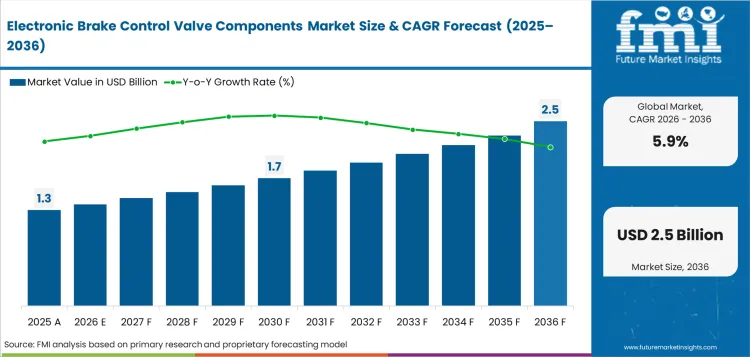
The electronic brake control valve components market stood at USD 1.3 billion in 2025 and is projected to reach USD 1.4 billion by the end of 2026. Demand is forecast to expand at a CAGR of 5.9% from 2026 to 2036, taking the market value to USD 2.5 billion by 2036. OEM supply is expected to lead with a 71.5% sales channel share, and electro-pneumatic actuation is expected to lead the technology segment with a 58.4% share.
Summary of the Electronic Brake Control Valve Components Market
- Demand and Growth Drivers
- Electronic braking migration increases demand for valve modules as trucks and buses move from air-signal timing toward electronic pressure control.
- ADAS braking functions lift component value as automatic brake requests need faster valve response and verified pressure regulation.
- Electric commercial platforms create new brake blending needs across friction braking and energy recovery systems.
- Product and Segment View
- OEM supply is expected to lead the sales channel segment with 71.5% share in 2026, reflecting vehicle-level validation needs.
- Electro-pneumatic actuation is projected to dominate technology demand with 58.4% share in 2026, due to its match with air-brake architecture.
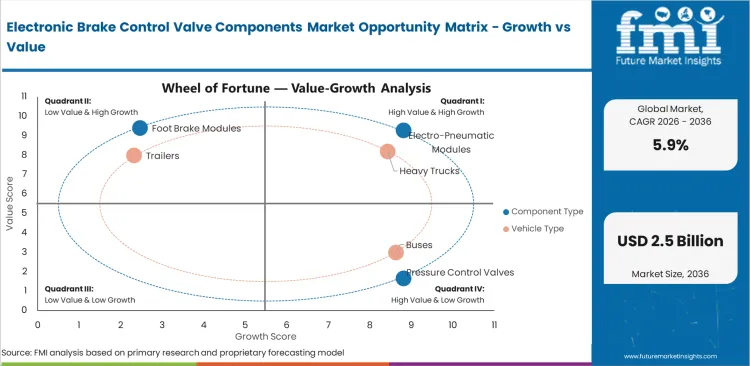
- Electro-pneumatic modules are expected to hold high-value component demand as axle pressure control needs compact valve and electronics packaging.
- Geography and Competitive Outlook
- India is expected to record a CAGR of 7.2% through 2036, as commercial vehicle output and safety upgrades expand.
- China is projected to expand at 6.8% CAGR by 2036, as electric commercial vehicles and local EBS platforms grow.
- Companies combining valve design depth with brake software capability are strengthening their market position during the forecast period.
- Analyst Opinion
- Nikhil Kaitwade, Principal Consultant for Automotive at FMI, says, “Electronic brake control valve components are shifting from loose pneumatic parts toward compact mechatronic modules. Truck platforms need pressure control with diagnostic fallback. Platform testing raises calibration cost while valve expertise and service support reduce repeat engineering work.”
- Electronic Brake Control Valve Components Market Value Analysis
- The electronic brake control valve components market is moving from separate pneumatic valve supply into electronic brake-control module demand.
- Adoption is being driven by safety evidence needs across commercial vehicle braking platforms and automated brake functions.
- The market benefits from deeper use of digital brake control and antiskid systems across trucks and buses.
- Demand is backed by OEM validation needs for pressure response and diagnostic records across electronic braking programs.
Key Takeaways, Market Size and Forecast
- The electronic brake control valve components market was valued at USD 1.3 billion in 2025 through component-level sizing and platform fitment checks.
- By 2036, the electronic brake control valve components market is expected to be worth USD 2.5 billion.
- From 2026 to 2036, the market is projected to expand at a CAGR of 5.9% during the forecast period.
- The market is projected to create an incremental opportunity of USD 1.1 billion between 2026 and 2036.
- In 2026, OEM supply is expected to account for 71.5% of sales channel demand.
- India at 7.2% and China at 6.8% are two faster country markets for electronic brake control valve components.
Brake-control sourcing is becoming more focused on fewer parts and easier vehicle integration. Knorr-Bremse said in September 2024 that GSBC reduces many conventional brake-control components into one technical brake-control platform, which helps OEMs simplify layouts and reduce parts. Haldex said in September 2024 that EB+ 4.0 uses three main modules: ECU, solenoid valves, and pressure modulators. This makes trailer EBS upgrades easier because the same piping, cabling, and mounting positions can be retained. Bendix said in May 2024 that GSBC keeps air-brake actuation in place and adds a secondary control layer for autonomous vehicles. This is important as fleets and OEMs need braking systems which can operate safely during certain primary-system faults. ZF’s January 2025 contract covering nearly 5 million vehicles shows how brake-by-wire systems are moving into large supply programs, although this source is mainly a light-vehicle by-wire signal.
Electronic Brake Control Valve Components Market Definition
The electronic brake control valve components market includes valve assemblies used to regulate brake pressure through electronic commands. These components serve trucks, buses, trailers, and selected light commercial vehicle braking systems. Brake pads, brake discs, brake fluids, basic air tanks, and non-electronic pneumatic valves are outside the scope.
Electronic Brake Control Valve Components Market Inclusions
Market scope covers all commercially traded electronic brake control valve components categorized by component type, including electro-pneumatic modules, pressure control valves, foot brake modules, trailer control modules, wheel speed sensors, and control units; vehicle type, including heavy trucks, buses, trailers, specialty vehicles, and light commercial vehicles; actuation technology, including electro-pneumatic, electro-hydraulic, fully electronic, and hybrid control systems; sales channel, including OEM, aftermarket, remanufactured, and service kits; and applications, including service braking, stability control, trailer braking, brake blending, and hill hold. Revenue scope covers 2026 to 2036. The key stakeholders include brake control valve manufacturers, electronic braking system suppliers, commercial vehicle OEMs, trailer manufacturers, fleet operators, remanufacturing firms, component distributors, service workshops, testing laboratories, safety regulators, and certification bodies.
Electronic Brake Control Valve Components Market Exclusions
Scope does not include friction brake parts, basic pneumatic air tanks, passenger car hydraulic master cylinders, mechanical parking cables, or complete vehicle brake systems.
Electronic Brake Control Valve Components Market Research Methodology
- Primary Research: FMI analysts spoke to commercial vehicle manufacturers, brake module suppliers, fleet service teams, and component distributors in major markets.
- Desk Research: Combined data from safety rules, brake technology references, company product portfolios, and commercial vehicle registration sources.
- Market sizing and forecasting: Added component fitment rates across vehicle types and actuation formats from the bottom up.
- Data validation: Cross-checked every three months against Automotive Brake System & Components demand and supplier portfolio coverage.
Why is the Electronic Brake Control Valve Components Market Growing?
- Vehicle makers are using electronic brake control valves earlier in platform design to reduce late-stage calibration rework.
- Brake suppliers are adding electronic control depth as ADAS functions need fast and reliable pressure modulation.
- Trailer builders are moving toward modular EBS hardware as load sensing and rollover protection become standard tender expectations.
Electronic brake control valves gain importance as automatic braking becomes a regulated safety direction. NHTSA finalized FMVSS No. 127 in April 2024, with automatic emergency braking required on new light vehicles from 2029. This rule affects light trucks directly and raises braking performance expectations across nearby commercial platforms. Valve suppliers gain from this pattern as brake commands need precise pressure control and reliable diagnostic records.
EU road safety reporting notes HGVs and buses from July 2024 need ISA and blind spot detection. The same source cites improved AEBS for new heavy vehicles from 2028. This regulatory frame lifts the value of automotive active safety system integration inside braking platforms. Brake valve makers with proven software interfaces gain stronger access to OEM programs.
Market Segmentation Analysis
- Electro-pneumatic modules carry an forecast 34.2% share of component type demand in 2026, helped by compact valve and electronics packaging for axle-level pressure control.
- Heavy trucks represent the largest vehicle base at a projected 46.8% share, as high-load operations rely on air-brake platforms.
- Electro-pneumatic actuation is expected to hold 58.4% of technology demand, reflecting its fit with fail-safe braking requirements.
- OEM supply is forecast to capture 71.5% of sales channel revenue, since vehicle validation requires early alignment of valve hardware and brake software.
- Service braking accounts for an projected 39.6% application share, reflecting the central role of primary pressure control circuits.
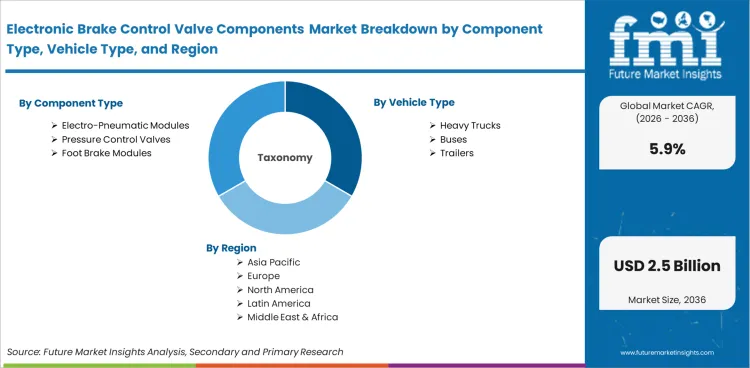
The market for electronic brake control valve components is divided into groups based on component type, vehicle type, actuation technology, sales channel, application, and region. Under component type, the market includes electro-pneumatic modules, pressure control valves, foot brake modules, trailer control modules, wheel speed sensors, and control units. By vehicle type, the market covers heavy trucks, buses, trailers, specialty vehicles, and light commercial vehicles. Based on actuation technology, it includes electro-pneumatic, electro-hydraulic, fully electronic, and hybrid control systems. By sales channel, the market is segmented into OEM, aftermarket, remanufactured, and service kits. By application, the market includes service braking, stability control, trailer braking, brake blending, and hill hold.
Insights into Electronic Brake Control Valve Components Market by Component Type
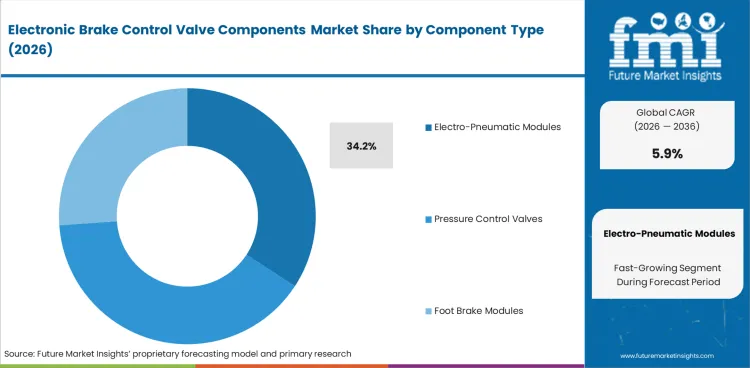
- In 2026, electro-pneumatic modules are expected to contribute 34.2% of the component type segment. Integrated valve and electronic control packaging supports axle-level pressure control across commercial vehicle braking systems.
- Pressure control valves and trailer control modules address selected braking architectures. Their value improves in trailer EBS upgrades and replacement programs requiring reliable diagnostics.
Insights into Electronic Brake Control Valve Components Market by Vehicle Type
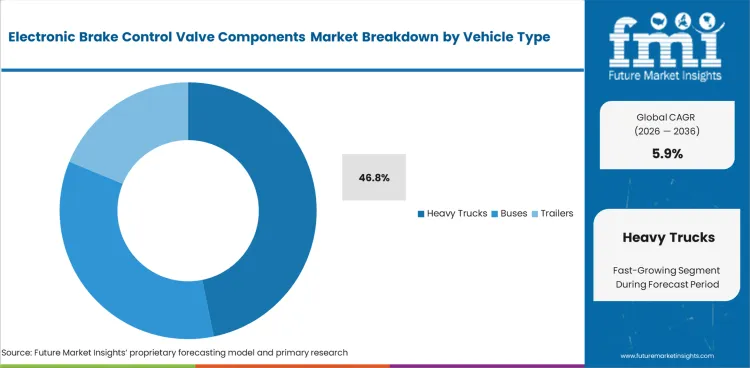
- Heavy trucks are projected to account for 46.8% of the vehicle type segment in 2026. Long-haul and high-load operations require stable braking control across air-brake platforms.
- Buses and trailers raise demand across urban mobility and freight applications. Their use is shaped by safety compliance and service access across fleet networks.
Insights into Electronic Brake Control Valve Components Market by Actuation Technology
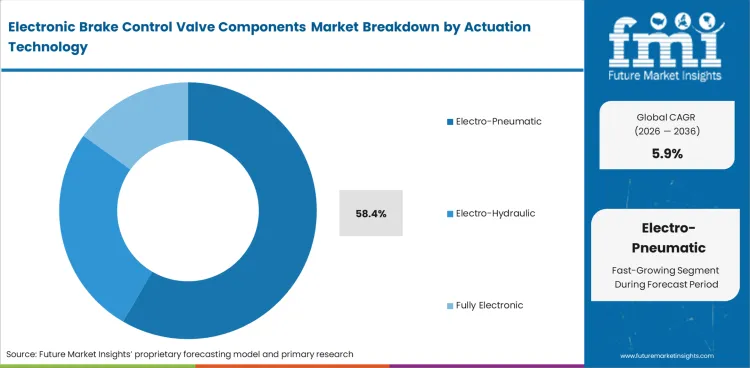
- Electro-pneumatic actuation is expected to represent 58.4% share in 2026. Commercial vehicle manufacturers prefer this technology as it combines electronic command speed with air-brake reliability.
- Fully electronic and hybrid formats address selected brake-by-wire vehicle programs. Their value improves in brake-by-wire platforms and electric commercial vehicle development.
Insights into Electronic Brake Control Valve Components Market by Sales Channel
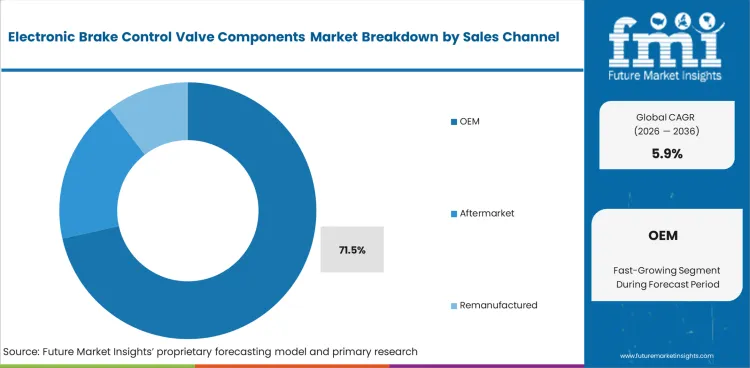
- OEM supply is projected to hold 71.5% share in 2026. Vehicle manufacturers prefer direct sourcing to align valve hardware with software calibration and brake-system validation.
- Aftermarket and remanufactured channels increase replacement demand across older fleets. Their role improves if service networks need diagnostic-ready parts and faster module availability.
Insights into Electronic Brake Control Valve Components Market by Application
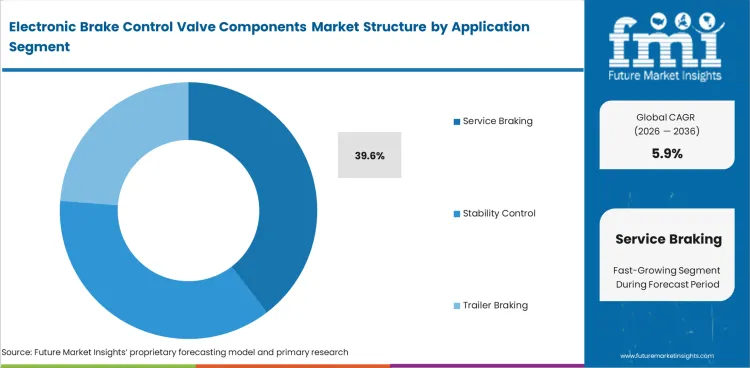
- Service braking is expected to account for 39.6% of the application segment in 2026. Primary brake-control circuits require dependable valve modules for routine stopping and pressure regulation.
- Stability control and trailer braking applications boost additional component demand. Their value improves as fleets add electronic safety functions and trailer EBS capability.
Electronic Brake Control Valve Components Market Drivers, Restraints, and Opportunities
- ADAS brake requests are creating demand for electronic pressure control across higher-value vehicle platforms.
- The need for test benches and safety documentation increases pricing pressure for smaller brake valve suppliers.
- Electric trucks improve service opportunity through brake blending and software-controlled pressure management.
Electronic brake control valve components keep gaining use as trucks and buses need faster pressure control and safer braking response across electronic brake systems. Cost pressure and complex calibration needs can slow broader use in smaller fleets. Demand continues through OEM brake integration and trailer EBS applications.
AEB Cost Bands Are Repricing Brake Valve Content
Electronic brake control valve component pricing is moving beyond basic valve-body economics as automatic braking becomes a higher-value system sale. In February 2025, the USA DOT’s ITS Deployment Evaluation posted AEB truck cost scenarios of $500, $2,500, and $3,000 per truck, with efficacy assumptions of 16% to 28%. For valve suppliers, this reframes quotes around integrated actuation with diagnostics included in offerings. Calibration and fail-safe response features are highlighted in updated supplier quotes. This shift places greater emphasis on system capabilities beyond basic metal components. OEMs are likely to push for bundled pricing across valve system procurement practices. Suppliers protect margins through engineering recovery included within contract pricing structures. Software validation charges are applied as part of the overall system cost recovery. Tighter change order terms are introduced to manage evolving customer requirements effectively. The market implies premium pricing for qualified electronic pneumatic valve assemblies. Broad commodity-style discounting is becoming less common across this supplier segment.
Truck-Part Tariffs Are Lifting Quote Risk
Electronic brake control valve component prices are absorbing policy-driven landed-cost risk in medium- and heavy-duty supply chains. In October 2025, the White House said a Section 232 proclamation would impose a 25% tariff on imports of medium- and heavy-duty trucks and truck parts, with Class 3 to Class 8 vehicles covered; it noted imports represent about 43% of trucks sold in America. For electronic brake valve suppliers, the effect is not uniform sticker-price inflation. This trend is more visible in surcharge clauses across current supplier agreements. Shorter quote validity periods are becoming more common in pricing practices. Dual price sheets are used for USMCA-compliant sourcing across supplier contracts. Non-compliant sourcing uses separate pricing sheets within the same agreements. Buyers should expect higher scrutiny on castings during supplier evaluation processes. Forgings will face closer review before annual price lock agreements are finalized. Solenoids receive increased attention during component validation and sourcing assessments. Electronic subassemblies require deeper verification before finalizing annual pricing commitments.
Analysis of Electronic Brake Control Valve Components Market By Key Countries
.webp "Top Country Growth Comparison Electronic Brake Control Valve Components Market Cagr (2026 2036)")
| Country | CAGR |
|---|---|
| India | 7.2% |
| China | 6.8% |
| USA | 5.9% |
| Germany | 4.8% |
| UK | 3.9% |
Source: Future Market Insights, 2026.
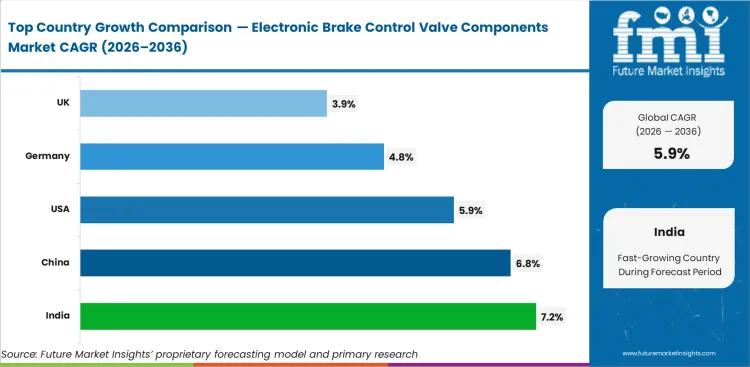
Electronic Brake Control Valve Components Market CAGR Analysis By Country
- India is projected to record the fastest CAGR at 7.2% through 2036, backed by commercial vehicle production and stronger brake safety upgrades.
- China’s 6.8% CAGR by 2036 is driven by electric bus output and local EBS platform development.
- At a forecast 5.9% CAGR, the USA forecast is shaped by ADAS braking needs and heavy vehicle safety rulemaking.
- Germany at 4.8% CAGR and the UK at 3.9% CAGR indicate steadier demand from mature brake supplier networks and replacement activity.
Demand for electronic brake control valve components is forecast to rise at 5.9% CAGR from 2026 to 2036. Country-level analysis covers the major markets contributing to this forecast, with the key markets listed below.
Demand Outlook for Electronic Brake Control Valve Components Market in India
India’s electronic brake control valve components industry is projected to record a CAGR of 7.2% through 2036. SIAM reported commercial vehicle domestic sales of 9.57 lakh units in FY 2024-25 through its August 2025 annual report. This manufacturing and sales base backs demand for India electronic brake control valve components. Local suppliers can gain from truck makers seeking validated modules for automotive brake actuation systems programs.
- Local truck production backs demand for pressure control valves and electronic braking modules.
- Bharat NCAP and road safety programs increase attention toward active safety hardware across vehicle platforms.
Sales Analysis of Electronic Brake Control Valve Components Market in China
The electronic brake control valve components sector in China is expected to expand at a CAGR of 6.8% during the assessment period. CAAM-based reporting placed China commercial vehicle production at 4.261 million units in 2025. This production base backs demand for China electronic brake control valve components. Local EBS platform makers benefit from electric bus and truck programs needing reliable valve response.
- Strong commercial vehicle production backs demand for electronic braking and valve-control modules.
- Electric city bus programs raise the need for brake blending across urban duty cycles.
Demand Outlook for Electronic Brake Control Valve Components Market in the United States
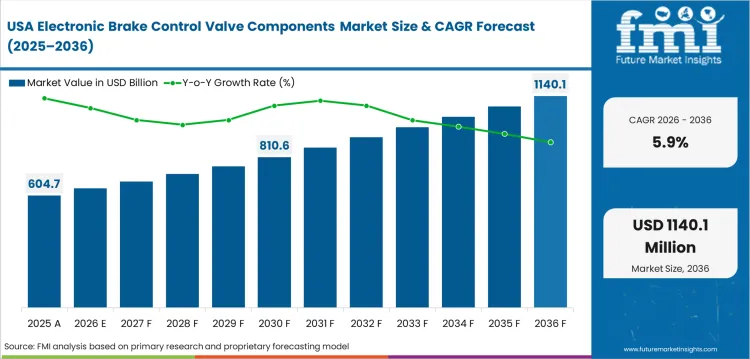
The USA electronic brake control valve components industry is forecast to grow at a CAGR of 5.9% by 2036. ICCT reported 116,908 new medium- and heavy-duty truck and bus registrations in Q2 2025. This fleet base favors demand for USA electronic brake control valve components. Manufacturers value brake suppliers with safety-rule knowledge and proven system diagnostics.
- Federal heavy vehicle AEB rulemaking reinforces demand for precise pressure modulation systems.
- Class 8 tractor fleets need durable valve modules for long-haul braking and trailer compatibility.
Opportunity Analysis of Electronic Brake Control Valve Components Market in Germany
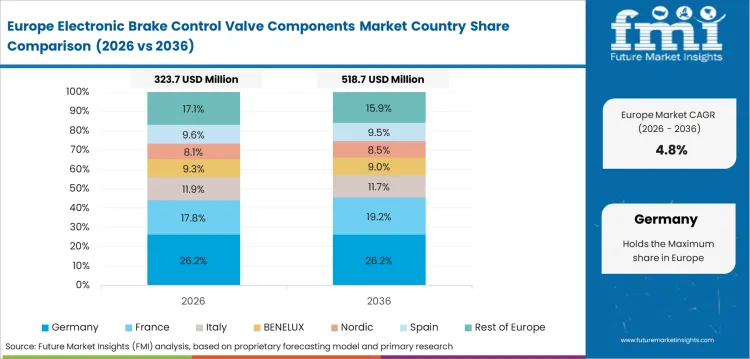
The electronic brake control valve components segment in Germany is forecast to expand at 4.8% CAGR over the forecast years. VDA listed 477,220 commercial vehicle registrations in Germany for 2025. Established supplier capacity backs demand for Germany electronic brake control valve components. Testing demand is strongest for precision valve control and diagnostic-ready brake modules.
- German truck and trailer fleets raise replacement demand for control valves and remanufactured modules.
- EU General Safety Regulation raises the need for integrated brake-control electronics.
Future Outlook for Electronic Brake Control Valve Components Market in the United Kingdom
The UK electronic brake control valve components industry is expected to post 3.9% CAGR through 2036. SMMT reported UK commercial vehicle production of 125,649 units in 2024 through its January 2025 manufacturing release. This backs demand for UK electronic brake control valve components as fleet renewal continues. Service networks with strong diagnostics can help operators replacing complex valve modules.
- UK trailer fleets create demand for electronic brake valve service and diagnostic replacement.
- Zero-emission bus buying increases need for brake blending across urban fleets.
Competitive Landscape and Strategic Positioning
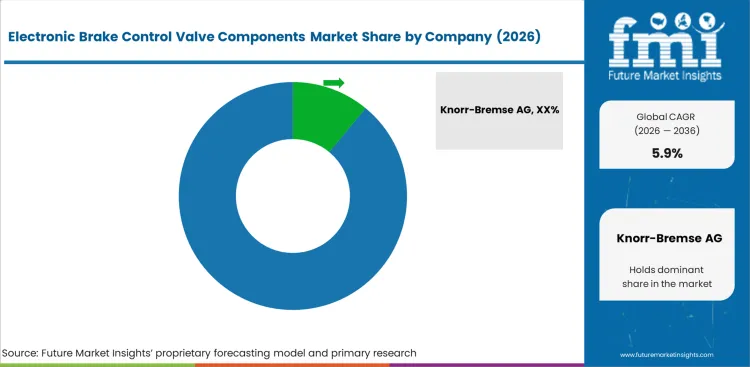
- Knorr-Bremse competes from a broad electronic braking base and long-standing access to commercial vehicle platform programs.
- ZF and Bendix bring brake-by-wire capability into control platforms supporting truck active safety functions.
- Haldex and other specialist suppliers concentrate on trailer EBS modules and service-ready valve assemblies for fleet replacement needs.
Competitive advantage in electronic brake control valve components is built around validated brake response and platform access. Knorr-Bremse and ZF have stronger positions through system-level brake control experience and by-wire program exposure. Bendix adds brake-control work supporting North American fleet validation needs. Haldex brings trailer EBS depth across modular valve platforms and replacement-focused service channels.
Entry barriers are high as safety-critical valve modules need long testing cycles and complete documentation records. Brake pressure accuracy and diagnostic speed now influence supplier selection across truck and trailer programs. Manufacturers prefer partners combining valve hardware with software-ready control units in compact assemblies. Suppliers with proven validation depth and dependable service coverage are better placed for repeat platform awards.
Key Companies in the Electronic Brake Control Valve Components Market
Key global companies leading the electronic brake control valve components market include:
- Knorr-Bremse AG, ZF Friedrichshafen AG, and Bendix Commercial Vehicle Systems LLC have strong brake-control infrastructure for EBS design and global supply.
- Haldex AB, Robert Bosch GmbH, and Continental AG serve manufacturers through valve modules, electronic controls, and safety-system integration.
- Continental AG holds specialist positions across electronic brake controls, vehicle safety electronics, and sensor-based braking support for commercial vehicle platforms.
Competitive Benchmarking: Electronic Brake Control Valve Components Market
| Company | Valve Control Depth | Software Calibration Strength | Commercial Vehicle Reach | Geographic Footprint |
|---|---|---|---|---|
| Knorr-Bremse AG | High | High | Strong | Global footprint across Europe, North America, China, India, and wider Asia; over 100 locations in over 30 countries. |
| ZF Friedrichshafen AG | High | High | Strong | Global commercial vehicle operations across Europe, North America, India, China, and wider Asia-Pacific. |
| Bendix Commercial Vehicle Systems LLC | High | High | Strong | North America-focused footprint with headquarters in Ohio and manufacturing presence in the USA and Mexico. |
| Haldex AB | High | Medium | Strong | Strong presence across North America, Europe, and Asia through truck, bus, trailer, aftermarket, and workshop networks. |
| Robert Bosch GmbH | Medium | High | Moderate | Global mobility footprint across over 300 locations in around 66 countries, including production and R&D sites. |
| Continental AG | Medium | High | Moderate | Global footprint across Germany and 56 other countries and markets through production, R&D, and administration sites. |
Source: Future Market Insights, 2026.
Key Developments in Electronic Brake Control Valve Components Market
- 1. In September 2024, Knorr-Bremse TruckServices presented the diagnostic-ready service concept for iTEBS X, its latest-generation electronic trailer braking system, at Automechanika 2024. The development is relevant to the electronic brake control valve components market because iTEBS X integrates an electronic control unit, sensor technology, pneumatic brake controller, ABS, and load-dependent braking in one compact assembly. Knorr-Bremse stated that the platform networks braking components such as the parking and maneuvering valve and air suspension more tightly with the trailer braking system.
- 2. April 2025, ZF Aftermarket announced that it would present the WABCO Central Brake Unit as a remanufactured product for the first time at Rematec 2025, with initial part numbers available during 2025. The development is directly relevant because ZF identifies the Central Brake Unit as a key component of commercial vehicle Electronic Braking Systems. It sends electronic inputs to braking components, supports shorter response times, and improves brake stability.
Key Players in the Electronic Brake Control Valve Components Market
Major Global Players:
- Knorr-Bremse AG
- ZF Friedrichshafen AG
- Bendix Commercial Vehicle Systems LLC
- Robert Bosch GmbH
- Continental AG
Specialist Players:
- Haldex AB
Report Scope and Coverage
| Parameter | Details |
|---|---|
| Quantitative Units | USD 1.4 billion to USD 2.5 billion, at a CAGR of 5.9% |
| Market Definition | Electronic brake control valve components regulate brake pressure through electronic command signals in commercial vehicles. |
| Countries Covered | USA, UK, Germany, China, India, Japan, South Korea, and 30 plus countries |
| Key Companies Profiled | Knorr-Bremse AG, ZF Friedrichshafen AG, Bendix Commercial Vehicle Systems LLC, Haldex AB, Robert Bosch GmbH, Continental AG |
| Forecast Period | 2026 to 2036 |
| Approach | Hybrid bottom-up and top-down methodology starting with component demand and validated brake-control use patterns. |
Electronic Brake Control Valve Components Market by Segments
Electronic Brake Control Valve Components Market Segmented by Component Type:
- Electro-Pneumatic Modules
- Pressure Control Valves
- Foot Brake Modules
- Trailer Control Modules
- Wheel Speed Sensors
- Control Units
Electronic Brake Control Valve Components Market Segmented by Vehicle Type:
- Heavy Trucks
- Buses
- Trailers
- Specialty Vehicles
- Light Commercial Vehicles
Electronic Brake Control Valve Components Market Segmented by Actuation Technology:
- Electro-Pneumatic
- Electro-Hydraulic
- Fully Electronic
- Hybrid Control
Electronic Brake Control Valve Components Market Segmented by Sales Channel:
- OEM
- Aftermarket
- Remanufactured
- Service Kits
Electronic Brake Control Valve Components Market Segmented by Application:
- Service Braking
- Stability Control
- Trailer Braking
- Brake Blending
- Hill Hold
Research Sources and Bibliography
- National Highway Traffic Safety Administration. (2024, April 29). NHTSA finalizes rule on automatic emergency braking. USA Department of Transportation.
- Department for Transport. (2026, February 16). Mandating vehicle safety technologies in GB type approval. GOV.UK.
- Bendix Commercial Vehicle Systems LLC. (2024, May 20). Bendix highlights Global Scalable Brake Control during ACT Expo.
- Haldex AB. (2024, September 12). From brake pads to new UN regulations.
- Knorr-Bremse AG. (2024, September 16). Knorr-Bremse to present safety-critical solutions at IAA Transportation.
- ZF Friedrichshafen AG. (2025, January 6). ZF secures substantial brake-by-wire technology business for light vehicles.
- Society of Indian Automobile Manufacturers. (2025, August 28). SIAM annual report 2024 25.
- Verband der Automobilindustrie. (2026). New registrations.
- Society of Motor Manufacturers and Traders. (2025, January 30). Exports push CV production to best performance in 16 years.
- Bendix Commercial Vehicle Systems LLC. (2024, May 20). Bendix highlights Global Scalable Brake Control during ACT Expo.
- Haldex. (2024, September 12). From brake pads to new UN regulations.
- Knorr-Bremse AG. (2024, September 16). Knorr-Bremse to present safety-critical solutions at IAA Transportation.
- ZF Friedrichshafen AG. (2025, January 6). ZF secures substantial brake-by-wire technology business for light vehicles.
- ZF Group. (2025, April 8). ZF Aftermarket presents broad ZF REMAN portfolio including new solutions at Rematec in Amsterdam. ZF Aftermarket presents broad ZF REMAN portfolio including new solutions at Rematec in Amsterdam - ZF
- Knorr-Bremse AG. (2024, September 4). Knorr-Bremse TruckServices at Automechanika 2024: “TruckServices Future Ready Aftermarket. Products & Services for Today. Solutions for Tomorrow.” Knorr-Bremse TruckServices at Automechanika 2024: “TruckServices Future Ready Aftermarket. Products & Services for Today. Solutions for Tomorrow.”
- The White House. (2025, October 17). Fact Sheet: President Donald J. Trump Addresses the Threat to National Security from Imports of Medium and Heavy-Duty Vehicles, Parts, and Buses.Fact Sheet: President Donald J. Trump Addresses the Threat to National Security from Imports of Medium and Heavy-Duty Vehicles, Parts, and Buses The White House
- Intelligent Transportation Systems Joint Program Office. (2025, February 26). Studies Estimate Automatic Emergency Braking (AEB) System Adoption for Truck Fleets in USA Could Lead to a Benefit-Cost Ratio of up to 3.75 Depending on Cost Scenarios and Discount Rates. ITS Deployment Evaluation. USA Department of Transportation. Studies Estimate Automatic Emergency Braking (AEB) System Adoption for Truck Fleets in USA Could Lead to a Benefit-Cost Ratio of up to 3.75 Depending on Cost Scenarios and Discount Rates. | ITS Deployment Evaluation
This Report Answers
- What is the current and future size of the electronic brake control valve components market?
- How fast is demand expected to expand between 2026 and 2036?
- Which component type is expected to lead the market by 2026?
- Which sales channel is expected to account for the leading demand by 2026?
- Which countries are projected to record faster expansion through 2036?
- Who are the key companies active in the electronic brake control valve components market?
Frequently Asked Questions
What is the global market demand for Electronic Brake Control Valve Components in 2026?
In 2026, the global market for electronic brake control valve components is expected to be worth USD 1.4 billion.
How big will the market for Electronic Brake Control Valve Components be in 2036?
By 2036, the market for electronic brake control valve components is expected to be worth USD 2.5 billion.
How much is demand for Electronic Brake Control Valve Components expected to expand between 2026 and 2036?
Between 2026 and 2036, demand for electronic brake control valve components is expected to expand at a CAGR of 5.9%.
Which component type segment is likely to be the leading segment globally by 2026?
Electro-pneumatic modules are expected to account for 34.2% of the component type segment in 2026.
What is causing demand to rise in India?
The India electronic brake control valve components market is projected to record 7.2% CAGR through 2036, backed by commercial vehicle production and brake safety upgrades.
What is causing demand to rise in China?
The China electronic brake control valve components market is projected to expand at 6.8% CAGR through 2036, backed by electric commercial vehicles and local EBS platform development.
Preview the report firsthand - request a free sample
Get SampleGet the brochure for pricing and purchase details.
Get PDFTable of Content
- Key Takeaways
- Market Size and CAGR
- Top Growth Driver
- Fastest Growing Segment
- Leading Region
- Key Companies
- Emerging Opportunities
- Executive Summary
- Global Market Outlook
- Demand-side Trends
- Supply-side Trends
- Technology Roadmap Analysis
- Analysis and Recommendations
- Analyst Perspective (What is happening? Why now? What should investors know?)
- Key Questions Answered
- How large is the market?
- What is the CAGR?
- What are key trends?
- Which region dominates?
- Who are the leaders?
- Market Overview
- Market Coverage / Taxonomy
- Market Definition / Scope / Limitations
- Research Methodology
- Chapter Orientation
- Analytical Lens and Working Hypotheses
- Market Structure, Signals, and Trend Drivers
- Benchmarking and Cross-market Comparability
- Market Sizing, Forecasting, and Opportunity Mapping
- Research Design and Evidence Framework
- Desk Research Programme (Secondary Evidence)
- Expert Input and Fieldwork (Primary Evidence)
- Tooling, Models, and Reference Databases
- Data Engineering and Model Build
- Quality Assurance and Audit Trail
- Market Background
- Market Dynamics (Drivers, Restraints, Opportunity, Trends)
- Scenario Forecast (Optimistic, Likely, Conservative)
- Impact Analysis
- AI Impact
- Sustainability Impact
- Regulatory Impact
- Technology Impact
- Consumer / Buyer Analysis
- Purchase Drivers
- Adoption Barriers
- Buyer Journey
- Opportunity Map Analysis
- Product Life Cycle Analysis
- Supply Chain Analysis
- Investment Feasibility Matrix
- Value Chain Analysis
- PESTLE and Porter's Analysis
- Regulatory Landscape
- Regional Parent Market Outlook
- Production and Consumption Statistics
- Import and Export Statistics
- Global Market Analysis and Forecast, 2021 to 2036
- Historical Market Size Value (USD Billion) & Volume (Unit) Analysis, 2021 to 2025
- Current and Future Market Size Value (USD Billion) & Volume (Unit) Projections, 2026 to 2036
- Y-o-Y Growth Trend Analysis
- Absolute $ Opportunity Analysis
- Global Market Pricing Analysis, 2021 to 2036
- Global Market Analysis and Forecast, By Component Type, 2021 to 2036
- Introduction / Key Findings
- Historical Market Size Value (USD Billion) & Volume (Unit) Analysis By Component Type, 2021 to 2025
- Current and Future Market Size Value (USD Billion) & Volume (Unit) Analysis and Forecast By Component Type, 2026 to 2036
- Electro-Pneumatic Modules
- Pressure Control Valves
- Foot Brake Modules
- Trailer Control Modules
- Wheel Speed Sensors
- Control Value (USD Billion) & Volume (Unit)s
- Electro-Pneumatic Modules
- Y-o-Y Growth Trend Analysis By Component Type, 2021 to 2025
- Absolute $ Opportunity Analysis By Component Type, 2026 to 2036
- Global Market Analysis and Forecast, By Vehicle Type, 2021 to 2036
- Introduction / Key Findings
- Historical Market Size Value (USD Billion) & Volume (Unit) Analysis By Vehicle Type, 2021 to 2025
- Current and Future Market Size Value (USD Billion) & Volume (Unit) Analysis and Forecast By Vehicle Type, 2026 to 2036
- Heavy Trucks
- Buses
- Trailers
- Specialty Vehicles
- Light Commercial Vehicles
- Heavy Trucks
- Y-o-Y Growth Trend Analysis By Vehicle Type, 2021 to 2025
- Absolute $ Opportunity Analysis By Vehicle Type, 2026 to 2036
- Global Market Analysis and Forecast, By Actuation Technology, 2021 to 2036
- Introduction / Key Findings
- Historical Market Size Value (USD Billion) & Volume (Unit) Analysis By Actuation Technology, 2021 to 2025
- Current and Future Market Size Value (USD Billion) & Volume (Unit) Analysis and Forecast By Actuation Technology, 2026 to 2036
- Electro-Pneumatic
- Electro-Hydraulic
- Fully Electronic
- Hybrid Control
- Electro-Pneumatic
- Y-o-Y Growth Trend Analysis By Actuation Technology, 2021 to 2025
- Absolute $ Opportunity Analysis By Actuation Technology, 2026 to 2036
- Global Market Analysis and Forecast, By Sales Channel, 2021 to 2036
- Introduction / Key Findings
- Historical Market Size Value (USD Billion) & Volume (Unit) Analysis By Sales Channel, 2021 to 2025
- Current and Future Market Size Value (USD Billion) & Volume (Unit) Analysis and Forecast By Sales Channel, 2026 to 2036
- OEM
- Aftermarket
- Remanufactured
- Service Kits
- OEM
- Y-o-Y Growth Trend Analysis By Sales Channel, 2021 to 2025
- Absolute $ Opportunity Analysis By Sales Channel, 2026 to 2036
- Global Market Analysis and Forecast, By Application, 2021 to 2036
- Introduction / Key Findings
- Historical Market Size Value (USD Billion) & Volume (Unit) Analysis By Application, 2021 to 2025
- Current and Future Market Size Value (USD Billion) & Volume (Unit) Analysis and Forecast By Application, 2026 to 2036
- Service Braking
- Stability Control
- Trailer Braking
- Brake Blending
- Hill Hold
- Service Braking
- Y-o-Y Growth Trend Analysis By Application, 2021 to 2025
- Absolute $ Opportunity Analysis By Application, 2026 to 2036
- Global Market Analysis and Forecast, By Region, 2021 to 2036
- Introduction
- Historical Market Size Value (USD Billion) & Volume (Unit) Analysis By Region, 2021 to 2025
- Current Market Size Value (USD Billion) & Volume (Unit) Analysis and Forecast By Region, 2026 to 2036
- North America
- Latin America
- Western Europe
- Eastern Europe
- East Asia
- South Asia and Pacific
- Middle East & Africa
- Market Attractiveness Analysis By Region
- North America Market Analysis and Forecast, By Country, 2021 to 2036
- Historical Market Size Value (USD Billion) & Volume (Unit) Trend Analysis By Market Taxonomy, 2021 to 2025
- Market Size Value (USD Billion) & Volume (Unit) Forecast By Market Taxonomy, 2026 to 2036
- By Country
- USA
- Canada
- Mexico
- By Component Type
- By Vehicle Type
- By Actuation Technology
- By Sales Channel
- By Application
- By Country
- Market Attractiveness Analysis
- By Country
- By Component Type
- By Vehicle Type
- By Actuation Technology
- By Sales Channel
- By Application
- Key Takeaways
- Latin America Market Analysis and Forecast, By Country
- Historical Market Size Value (USD Billion) & Volume (Unit) Trend Analysis By Market Taxonomy, 2021 to 2025
- Market Size Value (USD Billion) & Volume (Unit) Forecast By Market Taxonomy, 2026 to 2036
- By Country
- Brazil
- Chile
- Rest of Latin America
- By Component Type
- By Vehicle Type
- By Actuation Technology
- By Sales Channel
- By Application
- By Country
- Market Attractiveness Analysis
- By Country
- By Component Type
- By Vehicle Type
- By Actuation Technology
- By Sales Channel
- By Application
- Key Takeaways
- Western Europe Market Analysis and Forecast, By Country
- Historical Market Size Value (USD Billion) & Volume (Unit) Trend Analysis By Market Taxonomy, 2021 to 2025
- Market Size Value (USD Billion) & Volume (Unit) Forecast By Market Taxonomy, 2026 to 2036
- By Country
- Germany
- UK
- Italy
- Spain
- France
- Nordic
- BENELUX
- Rest of Western Europe
- By Component Type
- By Vehicle Type
- By Actuation Technology
- By Sales Channel
- By Application
- By Country
- Market Attractiveness Analysis
- By Country
- By Component Type
- By Vehicle Type
- By Actuation Technology
- By Sales Channel
- By Application
- Key Takeaways
- Eastern Europe Market Analysis and Forecast, By Country
- Historical Market Size Value (USD Billion) & Volume (Unit) Trend Analysis By Market Taxonomy, 2021 to 2025
- Market Size Value (USD Billion) & Volume (Unit) Forecast By Market Taxonomy, 2026 to 2036
- By Country
- Russia
- Poland
- Hungary
- Balkan & Baltic
- Rest of Eastern Europe
- By Component Type
- By Vehicle Type
- By Actuation Technology
- By Sales Channel
- By Application
- By Country
- Market Attractiveness Analysis
- By Country
- By Component Type
- By Vehicle Type
- By Actuation Technology
- By Sales Channel
- By Application
- Key Takeaways
- East Asia Market Analysis and Forecast, By Country
- Historical Market Size Value (USD Billion) & Volume (Unit) Trend Analysis By Market Taxonomy, 2021 to 2025
- Market Size Value (USD Billion) & Volume (Unit) Forecast By Market Taxonomy, 2026 to 2036
- By Country
- China
- Japan
- South Korea
- By Component Type
- By Vehicle Type
- By Actuation Technology
- By Sales Channel
- By Application
- By Country
- Market Attractiveness Analysis
- By Country
- By Component Type
- By Vehicle Type
- By Actuation Technology
- By Sales Channel
- By Application
- Key Takeaways
- South Asia and Pacific Market Analysis and Forecast, By Country
- Historical Market Size Value (USD Billion) & Volume (Unit) Trend Analysis By Market Taxonomy, 2021 to 2025
- Market Size Value (USD Billion) & Volume (Unit) Forecast By Market Taxonomy, 2026 to 2036
- By Country
- India
- ASEAN
- Australia & New Zealand
- Rest of South Asia and Pacific
- By Component Type
- By Vehicle Type
- By Actuation Technology
- By Sales Channel
- By Application
- By Country
- Market Attractiveness Analysis
- By Country
- By Component Type
- By Vehicle Type
- By Actuation Technology
- By Sales Channel
- By Application
- Key Takeaways
- Middle East & Africa Market Analysis and Forecast, By Country
- Historical Market Size Value (USD Billion) & Volume (Unit) Trend Analysis By Market Taxonomy, 2021 to 2025
- Market Size Value (USD Billion) & Volume (Unit) Forecast By Market Taxonomy, 2026 to 2036
- By Country
- Kingdom of Saudi Arabia
- Other GCC Countries
- Türkiye
- South Africa
- Other African Union
- Rest of Middle East & Africa
- By Component Type
- By Vehicle Type
- By Actuation Technology
- By Sales Channel
- By Application
- By Country
- Market Attractiveness Analysis
- By Country
- By Component Type
- By Vehicle Type
- By Actuation Technology
- By Sales Channel
- By Application
- Key Takeaways
- Key Countries Market Analysis
- USA
- Pricing Analysis
- Market Share Analysis, 2025
- By Component Type
- By Vehicle Type
- By Actuation Technology
- By Sales Channel
- By Application
- Canada
- Pricing Analysis
- Market Share Analysis, 2025
- By Component Type
- By Vehicle Type
- By Actuation Technology
- By Sales Channel
- By Application
- Mexico
- Pricing Analysis
- Market Share Analysis, 2025
- By Component Type
- By Vehicle Type
- By Actuation Technology
- By Sales Channel
- By Application
- Brazil
- Pricing Analysis
- Market Share Analysis, 2025
- By Component Type
- By Vehicle Type
- By Actuation Technology
- By Sales Channel
- By Application
- Chile
- Pricing Analysis
- Market Share Analysis, 2025
- By Component Type
- By Vehicle Type
- By Actuation Technology
- By Sales Channel
- By Application
- Germany
- Pricing Analysis
- Market Share Analysis, 2025
- By Component Type
- By Vehicle Type
- By Actuation Technology
- By Sales Channel
- By Application
- UK
- Pricing Analysis
- Market Share Analysis, 2025
- By Component Type
- By Vehicle Type
- By Actuation Technology
- By Sales Channel
- By Application
- Italy
- Pricing Analysis
- Market Share Analysis, 2025
- By Component Type
- By Vehicle Type
- By Actuation Technology
- By Sales Channel
- By Application
- Spain
- Pricing Analysis
- Market Share Analysis, 2025
- By Component Type
- By Vehicle Type
- By Actuation Technology
- By Sales Channel
- By Application
- France
- Pricing Analysis
- Market Share Analysis, 2025
- By Component Type
- By Vehicle Type
- By Actuation Technology
- By Sales Channel
- By Application
- India
- Pricing Analysis
- Market Share Analysis, 2025
- By Component Type
- By Vehicle Type
- By Actuation Technology
- By Sales Channel
- By Application
- ASEAN
- Pricing Analysis
- Market Share Analysis, 2025
- By Component Type
- By Vehicle Type
- By Actuation Technology
- By Sales Channel
- By Application
- Australia & New Zealand
- Pricing Analysis
- Market Share Analysis, 2025
- By Component Type
- By Vehicle Type
- By Actuation Technology
- By Sales Channel
- By Application
- China
- Pricing Analysis
- Market Share Analysis, 2025
- By Component Type
- By Vehicle Type
- By Actuation Technology
- By Sales Channel
- By Application
- Japan
- Pricing Analysis
- Market Share Analysis, 2025
- By Component Type
- By Vehicle Type
- By Actuation Technology
- By Sales Channel
- By Application
- South Korea
- Pricing Analysis
- Market Share Analysis, 2025
- By Component Type
- By Vehicle Type
- By Actuation Technology
- By Sales Channel
- By Application
- Russia
- Pricing Analysis
- Market Share Analysis, 2025
- By Component Type
- By Vehicle Type
- By Actuation Technology
- By Sales Channel
- By Application
- Poland
- Pricing Analysis
- Market Share Analysis, 2025
- By Component Type
- By Vehicle Type
- By Actuation Technology
- By Sales Channel
- By Application
- Hungary
- Pricing Analysis
- Market Share Analysis, 2025
- By Component Type
- By Vehicle Type
- By Actuation Technology
- By Sales Channel
- By Application
- Kingdom of Saudi Arabia
- Pricing Analysis
- Market Share Analysis, 2025
- By Component Type
- By Vehicle Type
- By Actuation Technology
- By Sales Channel
- By Application
- Türkiye
- Pricing Analysis
- Market Share Analysis, 2025
- By Component Type
- By Vehicle Type
- By Actuation Technology
- By Sales Channel
- By Application
- South Africa
- Pricing Analysis
- Market Share Analysis, 2025
- By Component Type
- By Vehicle Type
- By Actuation Technology
- By Sales Channel
- By Application
- USA
- Market Structure Analysis
- Competition Dashboard
- Competition Benchmarking
- Market Share Analysis of Top Players
- By Regional
- By Component Type
- By Vehicle Type
- By Actuation Technology
- By Sales Channel
- By Application
- Emerging Startups
- Innovation Benchmarking
- Competition Analysis
- Competition Deep Dive
- Knorr-Bremse AG
- Overview
- Product Portfolio
- Profitability by Market Segments (Product/Region/Sales Channel)
- Sales Footprint
- Strategy Overview
- Marketing Strategy
- Product Strategy
- Channel Strategy
- ZF Friedrichshafen AG
- Bendix Commercial Vehicle Systems LLC
- Robert Bosch GmbH
- Continental AG
- Haldex AB
- Knorr-Bremse AG
- Case Studies
- Success Stories
- Recent Developments
- Competition Deep Dive
- Assumptions & Acronyms Used


