

- Industry Size (2026)
- USD 1.2 Bn
- Forecast (2036)
- USD 3.7 Bn
- CAGR (2026 to 2036)
- 11.6%
What Is the FSMA 204 Traceability Data Integration Software Market Forecast and Outlook for 2026 to 2036?
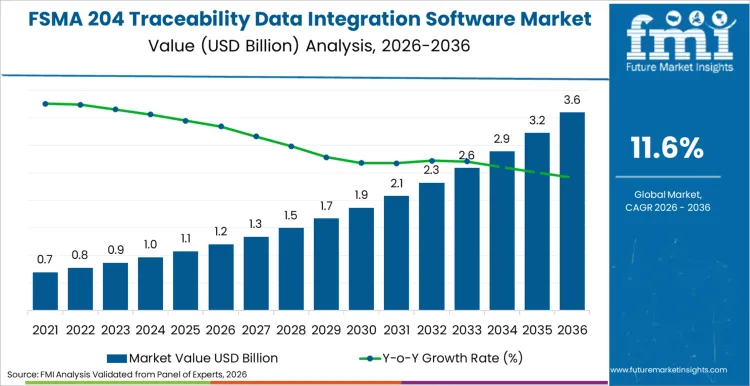
The global FSMA 204 traceability data integration software market sector is on track to achieve a valuation of USD 3.7 billion by 2036, accelerating from USD 1.2 billion in 2026 at a CAGR of 11.6%. As per Future Market Insights, this growth trajectory reflects the intersection of regulatory compliance mandates and technological advancement across food supply chains.
The market transformation gained momentum in January 2026 when the FDA's original FSMA 204 compliance deadline triggered widespread software procurement activities. Despite the July 2028 deadline extension announced in December 2025, major retailers including Walmart and Kroger maintained their original timelines, forcing suppliers to accelerate adoption schedules.
Finn, a representative at Datacor, stated: 'Food processors should be electronically gathering their data, so they can process it correctly and communicate it accurately to their customers.' This perspective captures the operational reality driving market expansion beyond mere regulatory compliance.
The regulatory landscape shifted significantly in 2025 when the FDA published final guidance documents clarifying Key Data Elements requirements for Critical Tracking Events. This clarity eliminated previous uncertainty that had delayed software procurement decisions throughout 2024.
Market dynamics in 2026 reveal acceleration patterns not seen in previous years. Food manufacturers are moving beyond basic compliance to embrace comprehensive supply chain visibility platforms. This evolution reflects lessons learned from recent contamination events where traditional paper-based systems proved inadequate for rapid source identification.
What Does the Summary of FSMA 204 Traceability Data Integration Software Market Reveal?
What Is Growth Outlook for FSMA 204 Traceability Data Integration Software Market as per Future Market Insights Projection?
The market will expand at 11.6% CAGR through 2036, driven by regulatory enforcement and retailer mandates affecting food manufacturers, distributors, and restaurants handling traceability-listed products.
FMI Research Approach: Analysis combines regulatory impact assessment with technology adoption modeling across 15,000+ food companies subject to FSMA 204 requirements.
How Do FMI Analysts Perceive FSMA 204 Traceability Data Integration Software Market to Evolve?
FMI analysts expect the market to evolve from basic compliance tools toward comprehensive supply chain intelligence platforms integrating blockchain, IoT sensors, and artificial intelligence for predictive contamination prevention.
FMI Research Approach: Technology roadmap analysis based on patent filings, venture capital investments, and pilot program outcomes from leading food technology companies.
Which Country Holds Largest Share in Global FSMA 204 Traceability Data Integration Software Market?
The United States maintains the largest market share at 42% due to direct FSMA 204 jurisdiction and high concentration of covered food manufacturers and retailers.
FMI Research Approach: Country-level analysis based on FDA registration data, export volumes, and software procurement patterns across jurisdictions.
How Large Will FSMA 204 Traceability Data Integration Software Market Be by 2036?
The market will reach USD 3.7 billion by 2036, representing a threefold increase from 2026 baseline values as compliance costs distribute across global food supply networks.
FMI Research Approach: Bottom-up modeling using per-facility software costs, compliance timelines, and international trade flow dependencies.
What Is Definition of FSMA 204 Traceability Data Integration Software Market?
Software solutions enabling food companies to capture, store, and report Key Data Elements for Critical Tracking Events as mandated by FDA's Food Safety Modernization Act Section 204.
FMI Research Approach: Definition derived from FDA regulatory text analysis and software functionality mapping across vendor offerings.
What Are Globally Unique Trends Shaping FSMA 204 Traceability Data Integration Software Market?
Retailer-driven compliance expansion beyond FDA requirements, integration with existing ERP systems, and development of supplier portal functionalities for multi-tier traceability management.
FMI Research Approach: Trend identification through retailer requirement analysis, software feature evolution tracking, and supply chain integration pattern assessment.
FSMA 204 Traceability Data Integration Software Market Key Takeaways / Source: Future Market Insights (FMI) analysis, based on proprietary forecasting model and primary research
FSMA 204 Traceability Data Integration Software Market Key Takeaways
| Metric | Details |
|---|---|
| Industry Size (2026) | USD 1.2 Billion |
| Industry Value (2036) | USD 3.7 Billion |
| CAGR (2026-2036) | 11.6% |
Source: Future Market Insights (FMI) analysis, based on proprietary forecasting model and primary research
What Factors Are Propelling Adoption of FSMA 204 Traceability Data Integration Software Market?
Regulatory compliance requirements drive primary adoption as food companies face potential FDA enforcement actions including facility inspections, warning letters, and product seizures for non-compliance with FSMA 204 recordkeeping mandates. The regulation requires maintenance of specific Key Data Elements including lot codes, supplier information, and location data for Critical Tracking Events such as harvesting, receiving, transforming, and shipping operations.
Retailer mandate expansion accelerates market growth beyond FDA requirements. In December 2023, Kroger announced universal traceability requirements for all food products, extending beyond the FDA's Food Traceability List. Walmart implemented similar requirements in early 2024, creating compliance pressure affecting thousands of suppliers across multiple product categories. These retailer initiatives establish de facto industry standards exceeding regulatory minimums.
Technology integration benefits justify software investments beyond compliance costs. Modern traceability platforms connect with existing enterprise resource planning systems, warehouse management software, and transportation management systems. This integration enables real-time inventory tracking, automated recall management, and supply chain optimization capabilities that generate operational value independent of regulatory requirements.
Consumer demand for transparency influences corporate traceability strategies. Food safety incidents generate significant media attention and consumer response, motivating companies to invest in comprehensive traceability capabilities. The 2024 listeria outbreak affecting multiple produce categories demonstrated the reputation and financial risks associated with inadequate traceability systems, reinforcing the business case for software investment.
Supply chain complexity necessitates digital solutions for multi-tier visibility. Modern food supply chains often include multiple processing stages, co-manufacturing relationships, and international ingredient sourcing. Manual recordkeeping systems cannot efficiently manage the data volume and accuracy requirements for FSMA 204 compliance across these complex networks.
How is the FSMA 204 Traceability Data Integration Software Market Segmented?
The FSMA 204 traceability data integration software market is segmented by end user, deployment model, solution type, and region to reflect how regulatory obligations translate into operational buying behaviour across food supply chains.
By end user, demand is led by food manufacturers, followed by retail and food service operators, and technology providers, mirroring where Critical Tracking Events are most complex and compliance exposure is highest. By deployment, adoption spans cloud-based, on-premise, and hybrid platforms, reflecting differences in data residency requirements, integration depth with legacy ERP systems, and enterprise security policies. By solution type, the market includes data integration platforms, traceability management systems, compliance monitoring software, and supply chain visibility tools that collectively support Key Data Element capture and reporting.
FMI analysis suggests that while point compliance tools remain relevant, the market structure is increasingly consolidating around integrated platforms capable of serving multi-tier traceability, positioning standalone applications as transitional rather than long-term solutions.
Why Does Food Manufacturing Hold a Dominant Share?
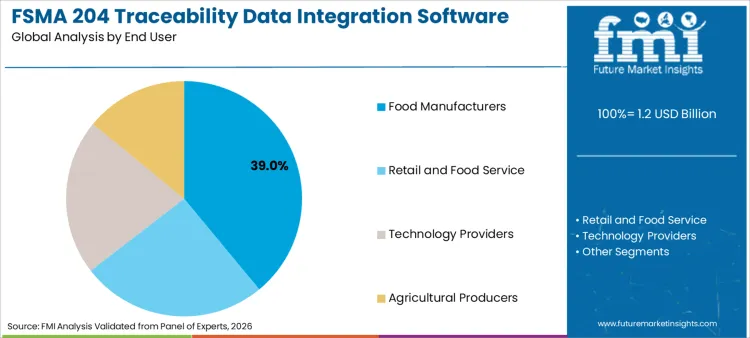
Food manufacturing commands a dominant 39% share because it sits at the center of FSMA 204 compliance obligations, where complex transformation activities require granular documentation of Critical Tracking Events across multiple stages. Datacor ERP reported strong 2024 demand for comprehensive end-to-end solutions among food processors managing multiple ingredient streams and finished product lines. Companies such as General Mills and Campbell Soup significantly increased traceability investments during 2025, implementing systems that track ingredients from receiving through processing, packaging, and shipping. This segment depends on sophisticated software capable of managing recipe formulations, batch genealogy, and finished product lot assignments across multiple production lines and facilities, positioning manufacturers as the primary drivers of traceability software demand.
Why Does Retail and Food Service Capture a Large Share?
Retail and food service account for 35% of market share because their operational exposure begins at receiving and extends through inventory management, delivery, and customer-facing recall execution. Major retailers have expanded supplier portal requirements to enforce upstream data capture and validation. Amazon Fresh and Whole Foods mandated electronic data submission for all produce suppliers in March 2024, while restaurant chains such as Chipotle and Panera Bread invested in ingredient tracking systems during 2025 to enable rapid menu-level impact assessment during contamination events. This segment prioritizes solutions that combine supplier data ingestion with rapid recall response and consumer-facing transparency capabilities.
What Trends Are Shaping Industry Evolution?
Consumer psychology shifts toward transparency expectations drive traceability investments beyond regulatory minimums. Recent food safety incidents including the 2024 produce contamination events generated sustained consumer awareness about food sourcing and safety practices. Companies respond with consumer-facing traceability features including QR code scanning and origin information displays.
Material innovation in identification technologies reduces implementation costs and improves accuracy for traceability data collection. Advanced label printing systems, RFID tags, and blockchain-based record systems became commercially viable for mid-size food companies during 2025. These technologies enable automated data capture reducing manual data entry errors and labor costs associated with compliance.
Digital transformation initiatives integrate traceability with broader supply chain optimization programs. Companies like Tyson Foods and Cargill implemented comprehensive digital supply chain platforms during 2024 and 2025, combining traceability with demand planning, inventory optimization, and supplier performance management capabilities.
Supply chain evolution toward regionalization and sustainability increases traceability complexity and software requirements. The trend toward local sourcing and sustainable ingredient procurement creates more diverse supplier networks requiring enhanced data collection and validation capabilities. Organic food companies particularly emphasize comprehensive farm-to-consumer traceability supporting both regulatory compliance and marketing differentiation strategies.
Country-wise Analysis
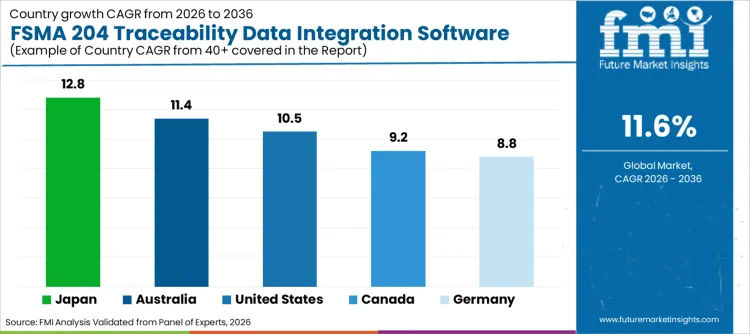
Growth in the FSMA 204 traceability data integration software market is being shaped by regulatory exposure to USA food safety enforcement and export dependency rather than uniform digital adoption. While the global market expands at an 11.6% CAGR, countries with direct or indirect exposure to FSMA 204 timelines are accelerating faster as compliance readiness becomes a prerequisite for market access.
The United States anchors demand with a 10.5% CAGR, driven by direct regulatory authority and retailer-led enforcement that sustains 2026 readiness expectations despite the federal extension to 2028. Export-oriented economies are scaling rapidly, led by Japan at 12.8% CAGR and Australia at 11.4%, where traceability adoption is tied to seafood, meat, and produce exports to the USA Canada follows at 9.2% as cross-border supply chains align with FSMA 204 standards, while Germany grows at 8.8% as exporters balance USA compliance with emerging EU traceability frameworks. FMI analysis indicates that regional growth will increasingly track USA market access pressure and private retailer mandates rather than domestic regulatory cycles alone.
| Country | CAGR (2026 to 2036) |
|---|---|
| United States | 10.5% |
| Japan | 12.8% |
| Australia | 11.4% |
| Canada | 9.2% |
| Germany | 8.8% |
Source: FMI historical analysis and forecast data.
Why is the United States anchoring global FSMA 204 adoption?
The United States is growing at a 10.5% CAGR because it combines direct FSMA 204 regulatory authority with retailer-driven enforcement that effectively accelerates compliance timelines. Even with the federal enforcement extension to July 2028, major retailers such as Walmart and Kroger continue to require 2026 readiness, sustaining immediate software demand across food manufacturers and suppliers. FDA enforcement has focused on high-risk facilities, with pilot inspections conducted in September 2025 validating software-based recordkeeping systems and establishing compliance benchmarks. Companies such as Fresh Del Monte and Dole implemented comprehensive traceability platforms during 2024, integrating field harvesting data with processing and distribution records. This environment drives both mandatory adoption among regulated entities and voluntary uptake by firms seeking competitive advantages through enhanced traceability capabilities.
How is Japan accelerating adoption through export exposure?
Japan leads growth at a 12.8% CAGR due to its high concentration of seafood exports to the United States and advanced technology adoption capabilities supporting comprehensive traceability implementation. Japanese seafood processors including Nippon Suisan and Maruha Nichiro implemented advanced traceability systems during 2025 to address FSMA 204 requirements for USA seafood imports. These companies integrated catch documentation, processing records, and cold chain monitoring data into comprehensive platforms supporting both regulatory compliance and quality assurance objectives. The Japanese Ministry of Agriculture announced enhanced domestic traceability requirements in August 2025, creating parallel regulatory drivers for software adoption and reinforcing enterprise-grade platform deployment.
Why is Australia scaling rapidly ahead of enforcement deadlines?
Australia’s 11.4% CAGR reflects strong agricultural export exposure to the United States combined with advanced digital agriculture adoption supporting comprehensive traceability implementation. Australian beef and produce exporters including JBS Australia and Costa Group implemented comprehensive traceability systems during 2024 and 2025 to support FSMA 204 compliance for USA market access. These systems integrated on-farm production records with processing facility data and shipping documentation. The Australian Department of Agriculture launched the National Traceability Framework in July 2025, establishing standards compatible with FSMA 204 requirements and supporting export competitiveness, reinforcing software adoption across exporters and domestic producers.
What is driving Canada’s compliance-led growth?
Canada is expanding at a 9.2% CAGR as food manufacturers align traceability systems with FSMA 204 requirements to preserve access to USA markets. The Canadian Food Inspection Agency issued formal guidance in 2025 clarifying that exporters must adopt FSMA 204-standard recordkeeping to maintain USA market access. Companies such as Maple Leaf Foods and McCain Foods implemented comprehensive traceability systems during 2025, supporting both USA export compliance and anticipated domestic regulatory requirements. Cross-border supply chain integration requirements further drive adoption of enterprise-grade platforms capable of real-time data sharing with USA retailers.
Why is Germany growing at a measured pace?
Germany’s 8.8% CAGR reflects export-driven adoption rather than direct FSMA jurisdiction. German food manufacturers including Dr. Oetker and Ferrero expanded USA market presence during 2024 and 2025 and maintained 2026 readiness timelines to meet the strict requirements of USA retail partners such as Whole Foods and Kroger. These companies implemented comprehensive traceability platforms supporting ingredient sourcing documentation, manufacturing process tracking, and shipping record management for USA-bound products. At the same time, Germany is preparing for expanded EU traceability initiatives, including 2025 pilot programs linked to the Digital Product Passport, prompting investment in scalable platforms capable of supporting both USA and EU compliance pathways.
What Strategic Moves Are Defining the Competitive Landscape?
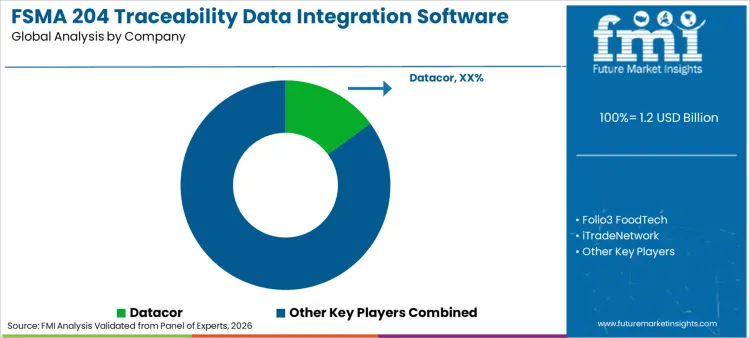
The competitive landscape reveals intense consolidation activity as established software vendors acquire specialized traceability capabilities while new entrants focus on industry-specific solutions. Major enterprise software providers expand food industry offerings through acquisition and partnership strategies, while niche players emphasize deep functionality for specific product categories or supply chain segments.
Manufacturing strategy evolution emphasizes modular platforms supporting multiple regulatory frameworks rather than FSMA 204-specific point solutions. Vendors recognize that food companies require systems addressing various international regulations, retailer requirements, and certification standards. This understanding drives development of configurable platforms accommodating diverse compliance needs while maintaining core traceability functionality.
Platform integration capabilities become key differentiators as food companies seek solutions connecting with existing ERP, warehouse management, and transportation systems. Vendors emphasizing seamless integration and data exchange capabilities gain competitive advantages over standalone applications requiring manual data transfer and duplicate entry processes.
An executive at a leading traceability software company noted: 'The market is moving beyond basic compliance to comprehensive supply chain intelligence, requiring solutions that integrate multiple data sources and provide actionable insights for operational improvement.'
Recent Developments:
In August 2025, Aptean launched enhanced food-specific ERP modules providing real-time visibility from raw materials to finished goods, targeting mid-market food manufacturers seeking comprehensive traceability capabilities.
In September 2025, iTradeNetwork expanded its platform to capture Key Data Elements natively across critical tracking events, positioning itself as the only solution providing end-to-end data collection within existing supply chain workflows.
In October 2025, SGS launched TRAKKEY digital traceability platform specifically designed for FSMA 204 compliance, offering pre-configured modules for produce, seafood, and processed foods sectors.
Who Are the Key Players in FSMA 204 Traceability Data Integration Software Market?
- Datacor
- Folio3 FoodTech
- iTradeNetwork
- BFC Software
- Share-ify
- SGS (TRAKKEY)
- Cleo
- Famous Software
- Aptean
- SAP
- TraceGains
- HarvestMark
Market Definition
The FSMA 204 Traceability Data Integration Software Market includes software solutions that enable food companies to capture, store, manage, and report Key Data Elements (KDEs) associated with Critical Tracking Events (CTEs) as mandated by the USA Food and Drug Administration’s Food Safety Modernization Act Section 204. These solutions support compliance with FDA recordkeeping requirements by documenting lot codes, supplier details, location data, and event timestamps across harvesting, receiving, transformation, and shipping operations.
The market comprises integrated traceability platforms, specialized data integration systems, compliance monitoring modules, and enterprise applications that interface with ERP, warehouse management, and transportation software. The core function of these solutions is to provide auditable, rapid traceability that supports contamination source identification, automated recall execution, and visibility across multi-tier food supply chains.
Market Inclusion
Market inclusion covers software applications and services designed to support FSMA 204 compliance and extended traceability requirements across food supply networks. This includes enterprise-grade traceability platforms, cloud-based and on-premise data integration systems, mobile data collection tools, supplier portal solutions, middleware that connects traceability systems with existing ERP or supply chain software, and compliance reporting modules that generate FDA-ready documentation.
Included are solutions that provide real-time inventory tracking, batch genealogy, production lineage, and critical event linkage from raw materials to finished goods. Implementation, customization, maintenance, and support services directly associated with FSMA 204 traceability deployment are also included, especially where they are delivered by technology vendors, system integrators, or consulting partners. Revenues captured reflect software procurement, subscription fees, licensing, and long-term service contracts tied to traceability data management and regulatory compliance.
Market Exclusion
Market exclusion defines what is not part of the FSMA 204 Traceability Data Integration Software Market. Excluded are hardware components such as sensors, RFID tags, barcode scanners, GPS devices, IoT edge devices, labels, and physical tracking infrastructure that collect but do not process or report traceability data. Standalone data capture devices and physical traceability hardware fall outside software market revenues.
Also excluded are general enterprise software categories that are not specifically configured for traceability data integration or FSMA 204 compliance, such as base ERP licenses without traceability modules, standalone financial systems, generic inventory or payroll systems, and non-traceability business intelligence tools. Custom software development sold purely as professional services without separable traceability software revenue is excluded, as is consulting that does not result in traceability software deployment or compliance reporting deliverables.
Scope of Report
| Items | Values |
|---|---|
| Quantitative Units | USD 1.2 Billion |
| Software Category | FSMA 204 Traceability Data Integration Software |
| Solution Type Segments | Data Integration Platforms; Traceability Management Systems; Compliance Monitoring Software; Supply Chain Visibility Tools |
| End User Segments | Food Manufacturers; Food Distributors; Retailers; Restaurants; Food Processors; Agricultural Producers |
| Enterprise Size Segments | Large Enterprises; Small & Medium Enterprises |
| Deployment Models | Cloud-based Solutions; On-premise Systems; Hybrid Platforms |
| Regions Covered | North America; Europe; East Asia; South Asia; Latin America; Middle East & Africa |
| Key Countries | United States; Canada; Germany; United Kingdom; France; Japan; Australia; China; India; Brazil |
| Key Companies Profiled | Datacor; Folio3 FoodTech; iTradeNetwork; BFC Software; Share-ify; SGS (TRAKKEY); Cleo; Famous Software; Aptean; SAP; TraceGains; HarvestMark |
| Additional Attributes | Dollar sales measured for traceability and data integration software deployed to meet FSMA 204 compliance requirements; demand shaped by FDA enforcement timelines, retailer-imposed compliance acceleration, and export market access pressure; market bifurcation between early adopters and late-stage compliance buyers ahead of July 2028 enforcement; adoption driven by food safety risk mitigation, recall speed improvement, and multi-tier supply chain visibility requirements |
How Is FSMA 204 Traceability Data Integration Software Market Categorised by Segments?
By End User:
- Food Manufacturers
- Retail and Food Service
- Technology Providers
- Agricultural Producers
By Deployment:
- Cloud-based Solutions
- On-premise Systems
- Hybrid Platforms
By Region:
- North America
- Europe
- Asia Pacific
- Latin America
- Middle East and Africa
Bibliography
Food and Drug Administration. (2025, January). Food Traceability List. FDA.
United States Department of Agriculture. (2025). Food Safety and Inspection Service Annual Report. USDA.
Ministry of Agriculture, Forestry and Fisheries. (2025, August). Enhanced Food Traceability Requirements. Government of Japan.
Australian Department of Agriculture. (2025, July). National Traceability Framework. Government of Australia.
Frequently Asked Questions
How big is the fsma 204 traceability data integration software market in 2026?
The global fsma 204 traceability data integration software market is estimated to be valued at USD 1.2 billion in 2026.
What will be the size of fsma 204 traceability data integration software market in 2036?
The market size for the fsma 204 traceability data integration software market is projected to reach USD 3.6 billion by 2036.
How much will be the fsma 204 traceability data integration software market growth between 2026 and 2036?
The fsma 204 traceability data integration software market is expected to grow at a 11.6% CAGR between 2026 and 2036.
What are the key product types in the fsma 204 traceability data integration software market?
The key product types in fsma 204 traceability data integration software market are food manufacturers, retail and food service, technology providers and agricultural producers.
Which segment to contribute significant share in the fsma 204 traceability data integration software market in 2026?
In terms of , segment to command 0.0% share in the fsma 204 traceability data integration software market in 2026.
Preview the report firsthand - request a free sample
Get SampleGet the brochure for pricing and purchase details.
Get PDFTable of Content
- Executive Summary
- Global Market Outlook
- Demand-side Trends
- Supply-side Trends
- Technology Roadmap Analysis
- Analysis and Recommendations
- Market Overview
- Market Coverage / Taxonomy
- Market Definition / Scope / Limitations
- Market Background
- Market Dynamics
- Drivers
- Opportunity
- Trends
- Scenario Forecast
- Demand in Optimistic Scenario
- Demand in Likely Scenario
- Demand in Conservative Scenario
- Opportunity Map Analysis
- Product Life Cycle Analysis
- Supply Chain Analysis
- Investment Feasibility Matrix
- Value Chain Analysis
- PESTLE and Porter’s Analysis
- Regulatory Landscape
- Regional Parent Market Outlook
- Production and Consumption Statistics
- Import and Export Statistics
- Market Dynamics
- Global Market Analysis 2021 to 2025 and Forecast, 2026 to 2036
- Historical Market Size Value (USD Million) Analysis, 2021 to 2025
- Current and Future Market Size Value (USD Million) Projections, 2026 to 2036
- Y-o-Y Growth Trend Analysis
- Absolute $ Opportunity Analysis
- Global Market Pricing Analysis 2021 to 2025 and Forecast 2026 to 2036
- Global Market Analysis 2021 to 2025 and Forecast 2026 to 2036, By End User
- Introduction / Key Findings
- Historical Market Size Value (USD Million) Analysis By End User , 2021 to 2025
- Current and Future Market Size Value (USD Million) Analysis and Forecast By End User , 2026 to 2036
- Food Manufacturers
- Retail and Food Service
- Technology Providers
- Agricultural Producers
- Food Manufacturers
- Y-o-Y Growth Trend Analysis By End User , 2021 to 2025
- Absolute $ Opportunity Analysis By End User , 2026 to 2036
- Global Market Analysis 2021 to 2025 and Forecast 2026 to 2036, By Region
- Introduction
- Historical Market Size Value (USD Million) Analysis By Region, 2021 to 2025
- Current Market Size Value (USD Million) Analysis and Forecast By Region, 2026 to 2036
- North America
- Latin America
- Western Europe
- Eastern Europe
- East Asia
- South Asia and Pacific
- Middle East & Africa
- Market Attractiveness Analysis By Region
- North America Market Analysis 2021 to 2025 and Forecast 2026 to 2036, By Country
- Historical Market Size Value (USD Million) Trend Analysis By Market Taxonomy, 2021 to 2025
- Market Size Value (USD Million) Forecast By Market Taxonomy, 2026 to 2036
- By Country
- USA
- Canada
- Mexico
- By End User
- By Country
- Market Attractiveness Analysis
- By Country
- By End User
- Key Takeaways
- Latin America Market Analysis 2021 to 2025 and Forecast 2026 to 2036, By Country
- Historical Market Size Value (USD Million) Trend Analysis By Market Taxonomy, 2021 to 2025
- Market Size Value (USD Million) Forecast By Market Taxonomy, 2026 to 2036
- By Country
- Brazil
- Chile
- Rest of Latin America
- By End User
- By Country
- Market Attractiveness Analysis
- By Country
- By End User
- Key Takeaways
- Western Europe Market Analysis 2021 to 2025 and Forecast 2026 to 2036, By Country
- Historical Market Size Value (USD Million) Trend Analysis By Market Taxonomy, 2021 to 2025
- Market Size Value (USD Million) Forecast By Market Taxonomy, 2026 to 2036
- By Country
- Germany
- UK
- Italy
- Spain
- France
- Nordic
- BENELUX
- Rest of Western Europe
- By End User
- By Country
- Market Attractiveness Analysis
- By Country
- By End User
- Key Takeaways
- Eastern Europe Market Analysis 2021 to 2025 and Forecast 2026 to 2036, By Country
- Historical Market Size Value (USD Million) Trend Analysis By Market Taxonomy, 2021 to 2025
- Market Size Value (USD Million) Forecast By Market Taxonomy, 2026 to 2036
- By Country
- Russia
- Poland
- Hungary
- Balkan & Baltic
- Rest of Eastern Europe
- By End User
- By Country
- Market Attractiveness Analysis
- By Country
- By End User
- Key Takeaways
- East Asia Market Analysis 2021 to 2025 and Forecast 2026 to 2036, By Country
- Historical Market Size Value (USD Million) Trend Analysis By Market Taxonomy, 2021 to 2025
- Market Size Value (USD Million) Forecast By Market Taxonomy, 2026 to 2036
- By Country
- China
- Japan
- South Korea
- By End User
- By Country
- Market Attractiveness Analysis
- By Country
- By End User
- Key Takeaways
- South Asia and Pacific Market Analysis 2021 to 2025 and Forecast 2026 to 2036, By Country
- Historical Market Size Value (USD Million) Trend Analysis By Market Taxonomy, 2021 to 2025
- Market Size Value (USD Million) Forecast By Market Taxonomy, 2026 to 2036
- By Country
- India
- ASEAN
- Australia & New Zealand
- Rest of South Asia and Pacific
- By End User
- By Country
- Market Attractiveness Analysis
- By Country
- By End User
- Key Takeaways
- Middle East & Africa Market Analysis 2021 to 2025 and Forecast 2026 to 2036, By Country
- Historical Market Size Value (USD Million) Trend Analysis By Market Taxonomy, 2021 to 2025
- Market Size Value (USD Million) Forecast By Market Taxonomy, 2026 to 2036
- By Country
- Kingdom of Saudi Arabia
- Other GCC Countries
- Turkiye
- South Africa
- Other African Union
- Rest of Middle East & Africa
- By End User
- By Country
- Market Attractiveness Analysis
- By Country
- By End User
- Key Takeaways
- Key Countries Market Analysis
- USA
- Pricing Analysis
- Market Share Analysis, 2025
- By End User
- Canada
- Pricing Analysis
- Market Share Analysis, 2025
- By End User
- Mexico
- Pricing Analysis
- Market Share Analysis, 2025
- By End User
- Brazil
- Pricing Analysis
- Market Share Analysis, 2025
- By End User
- Chile
- Pricing Analysis
- Market Share Analysis, 2025
- By End User
- Germany
- Pricing Analysis
- Market Share Analysis, 2025
- By End User
- UK
- Pricing Analysis
- Market Share Analysis, 2025
- By End User
- Italy
- Pricing Analysis
- Market Share Analysis, 2025
- By End User
- Spain
- Pricing Analysis
- Market Share Analysis, 2025
- By End User
- France
- Pricing Analysis
- Market Share Analysis, 2025
- By End User
- India
- Pricing Analysis
- Market Share Analysis, 2025
- By End User
- ASEAN
- Pricing Analysis
- Market Share Analysis, 2025
- By End User
- Australia & New Zealand
- Pricing Analysis
- Market Share Analysis, 2025
- By End User
- China
- Pricing Analysis
- Market Share Analysis, 2025
- By End User
- Japan
- Pricing Analysis
- Market Share Analysis, 2025
- By End User
- South Korea
- Pricing Analysis
- Market Share Analysis, 2025
- By End User
- Russia
- Pricing Analysis
- Market Share Analysis, 2025
- By End User
- Poland
- Pricing Analysis
- Market Share Analysis, 2025
- By End User
- Hungary
- Pricing Analysis
- Market Share Analysis, 2025
- By End User
- Kingdom of Saudi Arabia
- Pricing Analysis
- Market Share Analysis, 2025
- By End User
- Turkiye
- Pricing Analysis
- Market Share Analysis, 2025
- By End User
- South Africa
- Pricing Analysis
- Market Share Analysis, 2025
- By End User
- USA
- Market Structure Analysis
- Competition Dashboard
- Competition Benchmarking
- Market Share Analysis of Top Players
- By Regional
- By End User
- Competition Analysis
- Competition Deep Dive
- Datacor
- Overview
- Product Portfolio
- Profitability by Market Segments (Product/Age /Sales Channel/Region)
- Sales Footprint
- Strategy Overview
- Marketing Strategy
- Product Strategy
- Channel Strategy
- Folio3 FoodTech
- iTradeNetwork
- BFC Software
- Share-ify
- SGS (TRAKKEY)
- Cleo
- Famous Software
- Aptean
- SAP
- TraceGains
- HarvestMark
- Datacor
- Competition Deep Dive
- Assumptions & Acronyms Used
- Research Methodology


