

- Market Size (2026)
- USD 4.7 Bn
- Forecast (2036)
- USD 7.5 Bn
- CAGR (2026 to 2036)
- 4.7%
Plate Heat Exchanger Market Size, Market Forecast and Outlook By FMI
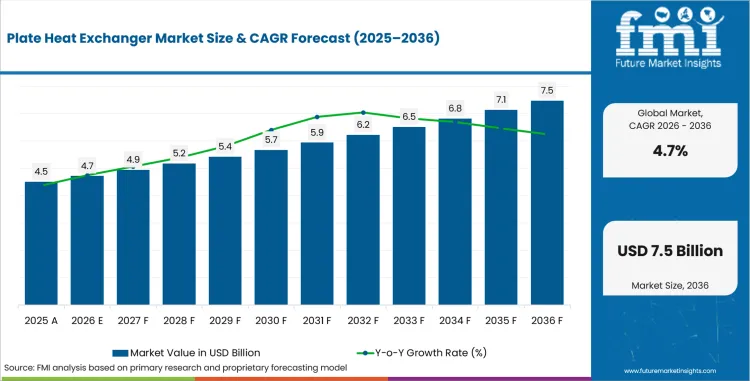
The plate heat exchanger market was valued at USD 4.5 billion in 2025. The market is set to reach USD 4.7 billion by 2026-end and grow at a CAGR of 4.7% between 2026-2036 to reach USD 7.5 billion by 2036. Gasketed Plate Heat Exchangers will dominate with a 45.0% share, while HVAC And Refrigeration will lead with a 38.0% share.
Key Takeaways, Market Size, and Forecast
- 2026 Market Size: USD 4.7 billion
- 2036 Market Size: USD 7.5 billion
- Forecast CAGR: 4.7% from 2026 to 2036
- Absolute $ Opportunity: USD 2.75 billion between 2026 and 2036
- Leading Product: Gasketed Plate Heat Exchangers
- Gasketed Plate Heat Exchangers Share in 2026: 45.0%
- Fastest-growing Country: China
- China CAGR: 6.35% through 2036
| Parameter | Details |
|---|---|
| Market Size in 2026 (Value) | USD 4.7 billion |
| Market Forecast in 2036 (Value) | USD 7.5 billion |
| CAGR (2026 to 2036) | 4.7% |
| Years Considered | 2021 to 2036 |
| Base Year | 2026 |
| Forecast Period | 2026 to 2036 |
| Units Considered | Value (USD Bn) |
| Leading Sub-Region | China |
Summary of the Plate Heat Exchanger Market
- Demand and Growth Drivers
- HVAC energy efficiency requirements and industrial process optimization are expected to sustain demand for plate heat exchangers through the forecast period.
- Adoption of brazed and welded plate heat exchangers is increasing in applications requiring higher pressure and temperature ratings beyond gasketed plate capabilities.
- Expansion of district heating, data center cooling, and heat pump installations is creating demand for compact, high-efficiency heat transfer solutions.
- Product and Segment View
- Gasketed plate heat exchangers account for 45.0% of the product segment, reflecting versatility, serviceability, and cost-effectiveness across HVAC, process, and utility applications.
- HVAC and refrigeration holds 38.0%, driven by building climate control, chiller systems, and refrigeration equipment requiring compact heat transfer.
- Stainless steel plates at 41.2% reflect the dominant material for corrosion resistance and hygienic applications across food, pharmaceutical, and HVAC.
- Geography and Competitive Outlook
- China is expected to lead growth at 6.35% CAGR through 2036, driven by district heating expansion, industrial efficiency programs, and HVAC system investment in commercial construction.
- Europe accounts for the largest market share, sustained by district heating infrastructure, industrial process optimization, and energy efficiency regulation compliance.
- Alfa Laval holds an estimated 23.0% market share, supported by the broadest plate heat exchanger portfolio, global industrial distribution, and technology leadership in thermal transfer.
- Analyst Opinion
- Nikhil Kaitwade, Principal Consultant at FMI says, 'Manufacturers that can deliver application-engineered plate heat exchanger solutions with documented energy efficiency gains and lifecycle cost advantages are positioned to capture share as building codes tighten and industrial operators prioritize thermal energy recovery.'
- Growth reflects energy efficiency investment, HVAC modernization, and industrial heat recovery expansion.
- Demand is supported by building energy codes, industrial process optimization, and district heating system expansion.
- Adoption of higher-specification welded and brazed units is increasing as applications push beyond gasketed plate pressure and temperature limitations.
Plate Heat Exchanger Market Definition
The plate heat exchanger market includes gasketed, brazed, welded, and semi-welded plate heat exchangers used for thermal energy transfer in HVAC, refrigeration, process, power generation, and marine applications.
Plate Heat Exchanger Market Inclusions
Market scope covers products segmented by product (gasketed, brazed, welded, semi-welded), application (HVAC and refrigeration, industrial process, power generation, marine, food and beverage), material (stainless steel, titanium, nickel alloys), flow configuration (single pass, multi pass), end-use industry (energy, industrial, commercial, residential), capacity (low, medium, high), and installation (fixed, modular). Revenue estimates span 2026 to 2036.
Plate Heat Exchanger Market Exclusions
The scope excludes shell-and-tube heat exchangers, air-cooled heat exchangers, and finned tube heat exchangers.
Plate Heat Exchanger Market Research Methodology
- Primary Research: FMI analysts conducted interviews with HVAC system designers, industrial process engineers, and heat exchanger manufacturers across key markets.
- Desk Research: Combined data from HVAC equipment databases, industrial equipment trade statistics, and manufacturer disclosures.
- Market Sizing and Forecasting: Bottom-up aggregation of HVAC installation data, industrial process equipment procurement, and district heating system expansion across regions.
- Data Validation: Cross-checked quarterly against HVAC equipment trade data, industrial equipment indices, and manufacturer revenue disclosures.
Why is the Plate Heat Exchanger Market Growing?
- Building energy efficiency codes mandating higher HVAC system performance are driving specification of plate heat exchangers that deliver superior thermal efficiency in compact footprints compared to shell-and-tube alternatives.
- District heating expansion in Northern Europe, China, and South Korea is generating demand for large-capacity plate heat exchangers at heat substations connecting district networks to building systems.
- Data center cooling infrastructure growth is creating demand for high-capacity plate heat exchangers in free cooling, chiller, and heat recovery applications within hyperscale and enterprise data center facilities.
The plate heat exchanger market is expanding as energy efficiency requirements tighten across building and industrial applications. Plate heat exchangers offer thermal transfer coefficients 3 to 5 times higher than shell-and-tube designs in equivalent footprints, supporting compact installation in space-constrained environments. This performance advantage drives specification in HVAC systems, process heating/cooling, and utility applications where efficiency and space are procurement criteria.
Gasketed plate exchangers at 45.0% provide the broadest application range through field-serviceable designs that allow plate cleaning, gasket replacement, and capacity modification. Brazed units serve high-pressure refrigeration and HVAC applications. Welded and semi-welded designs address aggressive media and high-temperature industrial processes.
China leads growth at 6.35% reflecting district heating network expansion, industrial energy efficiency mandates, and commercial HVAC investment. India at 5.88% reflects industrial process modernization and HVAC adoption in commercial construction. Mature European and North American markets sustain demand through replacement cycles and energy efficiency upgrades.
Market Segmentation Analysis
- Gasketed at 45.0% reflects versatility and serviceability across HVAC, process, and utility applications.
- HVAC and refrigeration at 38.0% drives procurement through building climate control and chiller systems.
- Stainless steel at 41.2% dominates material selection for corrosion resistance and hygienic performance.
The market is segmented by product, application, material, flow, end-use, capacity, and installation.
Insights into the Gasketed PHE Segment
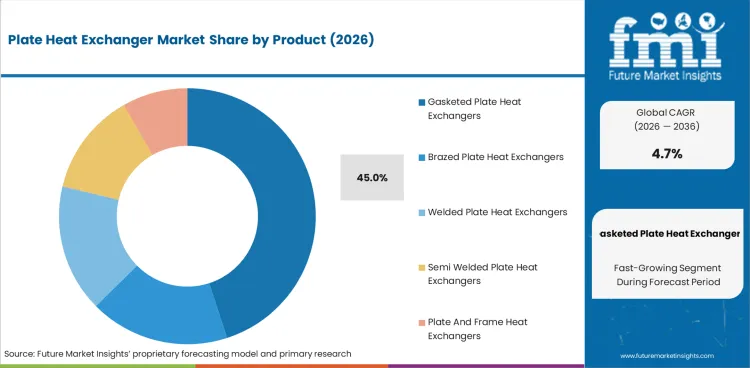
Gasketed at 45.0% serves the broadest application range. Field serviceability allows plate additions for capacity increase, gasket replacement, and cleaning for fouled applications.
Insights into the Brazed PHE Segment
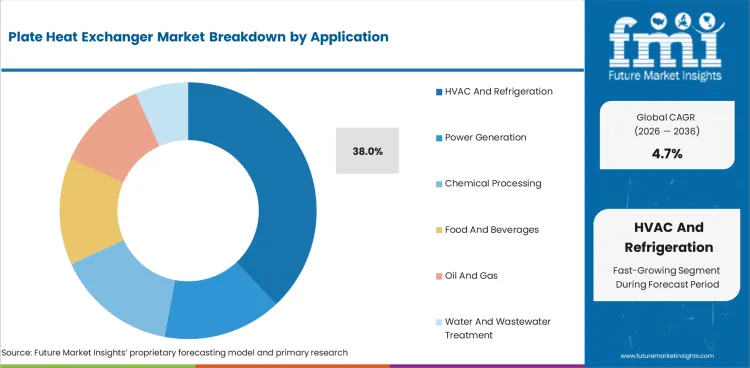
Brazed units serve HVAC and refrigeration with copper-brazed construction providing high-pressure capability in compact packages for chiller, heat pump, and economizer applications.
Plate Heat Exchanger Market Drivers, Restraints, and Opportunities
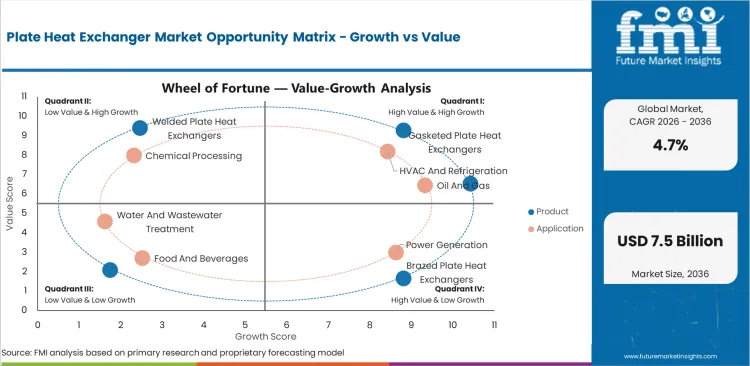
- Energy efficiency regulation creates structural demand through building code compliance and industrial efficiency targets.
- Material cost for stainless steel and titanium plates influences equipment pricing and procurement economics.
- District heating and data center cooling create high-growth application channels.
The market benefits from efficiency regulation, HVAC investment, and industrial optimization. Restraints include material costs and design engineering complexity. Opportunities exist in district heating, data center cooling, and heat pump integration.
Energy Efficiency Driver
Demand reflects tightening building codes and industrial efficiency targets that favor plate heat exchanger thermal performance.
District Heating Growth
Growth in district heating networks across China, Northern Europe, and South Korea creates demand for large substation heat exchangers.
Data Center Cooling
Hyperscale data center construction creates demand for high-capacity plate exchangers in cooling and heat recovery systems.
Analysis of Plate Heat Exchanger Market By Key Countries
.webp "Top Country Growth Comparison Plate Heat Exchanger Market Cagr (2026 2036)")
| Country | CAGR |
|---|---|
| China | 6.35% |
| India | 5.88% |
| USA | 4.9% |
| EU | 4.8% |
| South Korea | 4.7% |
Source: FMI analysis based on primary research and proprietary forecasting model
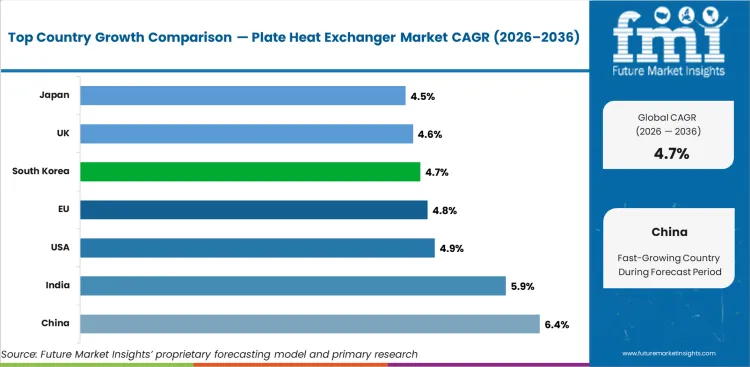
- China leads at 6.35% CAGR through district heating, industrial efficiency, and HVAC investment.
- India at 5.88% reflects industrial modernization and commercial HVAC adoption.
- The USA (4.9%) and the EU (4.8%) sustain demand through replacement cycles and efficiency upgrades.
The global plate heat exchanger market is projected to grow at 4.7% CAGR from 2026 to 2036.
Sales Analysis of Plate Heat Exchanger Market in China
District heating expansion and industrial efficiency programs define the Chinese market. Growth at 6.35% through 2036 reflects government energy conservation, HVAC modernization, and domestic manufacturer scaling.
- District heating network expansion in northern Chinese cities creates multi-year procurement for large plate exchangers at substations.
- 14th Five-Year Plan industrial energy efficiency targets mandate heat recovery installations driving PHE procurement.
- Domestic manufacturers including Sondex China and API China compete with established European brands on pricing.
Demand Outlook for Plate Heat Exchanger Market in India
Industrial process modernization and commercial construction drive demand. Growth at 5.88% through 2036 reflects manufacturing efficiency, HVAC adoption, and food processing capacity expansion.
- Manufacturing facility modernization under PLI schemes includes process heat recovery using plate exchangers.
- Commercial construction boom in tier-1 cities creates HVAC system demand specifying plate heat exchangers.
- Food and pharmaceutical processing expansion generates demand for hygienic stainless steel plate exchangers.
In-depth Analysis of Plate Heat Exchanger Market in the United States
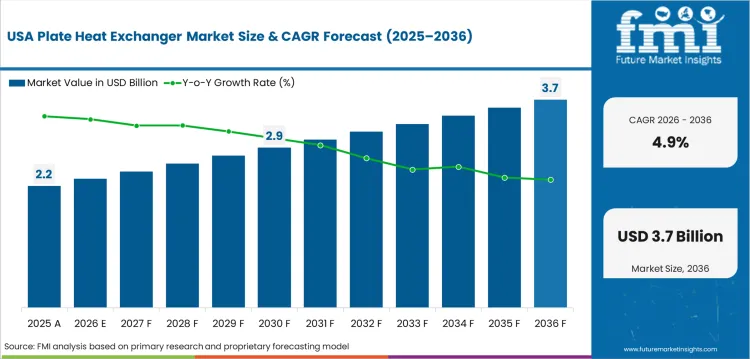
HVAC efficiency standards and data center cooling define the US market. Growth at 4.9% through 2036 reflects building code compliance, data center construction, and industrial heat recovery.
- ASHRAE 90.1 energy efficiency standards drive HVAC specification of high-efficiency plate heat exchangers in commercial buildings.
- Hyperscale data center construction by AWS, Microsoft, and Google creates demand for large-capacity cooling plate exchangers.
- Industrial heat recovery using plate exchangers generates energy cost savings that justify capital investment in manufacturing facilities.
Opportunity Analysis of Plate Heat Exchanger Market in the EU
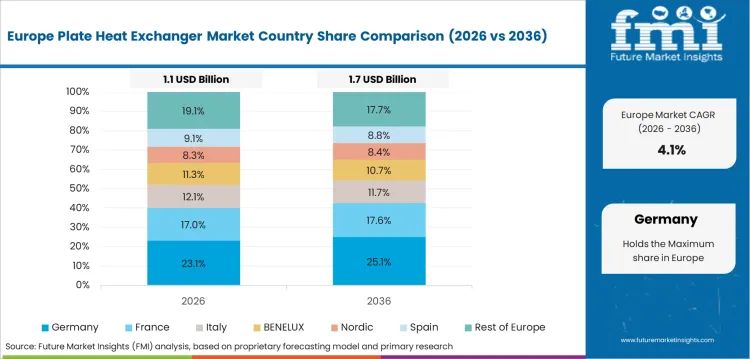
District heating infrastructure and energy efficiency directives define the European market. Growth at 4.8% through 2036 reflects EED compliance, district heating, and heat pump integration.
- EU Energy Efficiency Directive compliance drives HVAC and industrial heat recovery investment using plate heat exchangers.
- Scandinavian and German district heating networks sustain procurement for substation heat exchangers across extensive urban networks.
- Heat pump system integration creates demand for compact brazed plate exchangers serving reversible heating/cooling applications.
Future Outlook for Plate Heat Exchanger Market in South Korea
District heating and industrial infrastructure shape the Korean market. Growth at 4.7% through 2036 reflects HVAC modernization, semiconductor cooling, and district heating maintenance.
- Korean district heating networks serving apartment complexes create structured procurement for substation plate exchangers.
- Semiconductor manufacturing cooling systems require high-purity plate exchangers for process temperature management.
- Korean HVAC system manufacturers specify plate exchangers for energy-efficient building climate control systems.
Competitive Landscape and Strategic Positioning
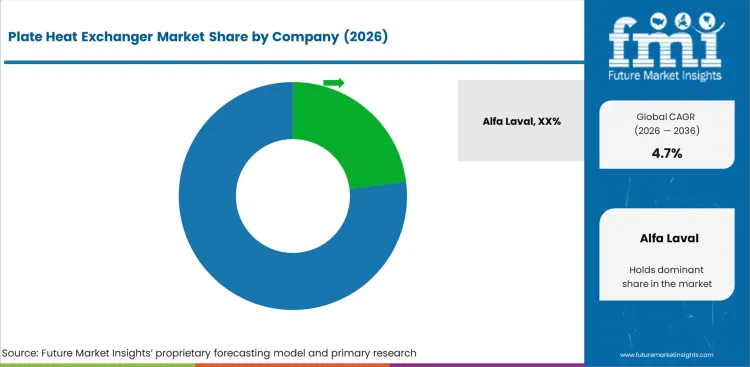
- Alfa Laval holds an estimated 23.0% market share through the broadest plate heat exchanger portfolio and global industrial distribution.
- Danfoss and Kelvion maintain positions through HVAC and industrial plate heat exchanger technology.
- SWEP and Hisaka Works serve focused segments including brazed HVAC and Japanese industrial applications.
Alfa Laval leads through comprehensive product range and global distribution. Danfoss competes through HVAC-focused plate exchangers. Kelvion serves industrial process applications.
Barriers include application engineering capability, manufacturing precision for plate pressing, global distribution, and the service infrastructure for gasketed PHE maintenance.
Key Companies in the Plate Heat Exchanger Market
Key global companies leading the plate heat exchanger market include:
- Alfa Laval (Sweden), Danfoss (Denmark), and Kelvion (Germany) lead with comprehensive PHE portfolios and global distribution.
- SWEP (Sweden), Hisaka Works (Japan), and Xylem (USA) maintain positions in HVAC, industrial, and utility segments.
- API Heat Transfer (USA), SPX Flow (USA), and Tranter (USA) serve regional and specialized applications.
Competitive Benchmarking: Plate Heat Exchanger Market
| Company | Product Range | Technology | Distribution | Geographic Footprint |
|---|---|---|---|---|
| Alfa Laval | High | High | Strong | Global |
| Danfoss | High | High | Strong | Global |
| Kelvion | High | High | Strong | Europe, Global |
| SWEP | Medium | High | Moderate | Europe, Global |
| Hisaka Works | Medium | High | Moderate | Japan, Asia |
| API Heat Transfer | Medium | Medium | Moderate | N. America |
| SPX Flow | Medium | Medium | Moderate | Global |
Source: Future Market Insights competitive analysis, 2026.
Key Developments in Plate Heat Exchanger Market
- In 2025, Alfa Laval launched a high-efficiency gasketed plate heat exchanger series with 15% improved thermal transfer for district heating substation applications.
- In 2025, Danfoss introduced a micro-channel brazed plate heat exchanger targeting heat pump and reversible HVAC system integration.
Key Players in the Plate Heat Exchanger Market
Major Global Players
- Alfa Laval
- Danfoss
- Kelvion
- SWEP
- Hisaka Works Ltd.
Emerging Players/Startups
- Xylem Inc.
- API Heat Transfer
- SPX Flow Inc.
- Tranter
- GEA Group
Report Scope and Coverage
| Parameter | Details |
|---|---|
| Market size by 2036 | USD 7.47 billion |
| Growth rate | 4.7% CAGR (2026 to 2036) |
| Base year value (2026) | USD 4.72 billion |
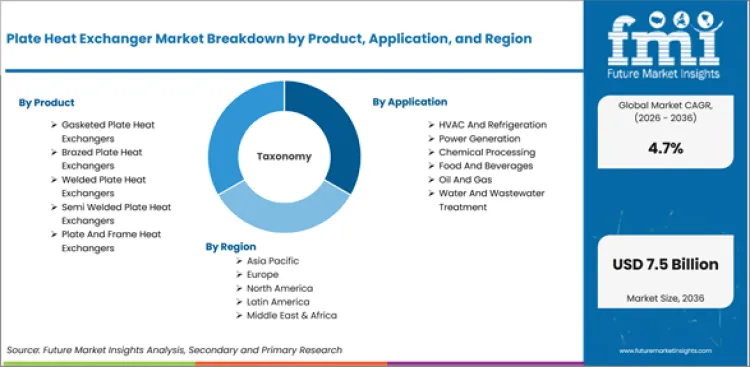
| By Product | Gasketed, Brazed, Welded, Semi-Welded, Plate And Frame Heat Exchangers |
| By Application | HVAC And Refrigeration, Chemical Processing, Power Generation, Water And Wastewater Treatment, Food And Beverages, Oil And Gas |
| By Material | Stainless Steel, Titanium, Nickel Alloys, Carbon Steel |
| Regions covered | North America, Latin America, Europe, East Asia, South Asia and Pacific, Middle East and Africa |
| Countries covered | USA, UK, Germany, France, South Korea, Japan, China, India, 30 plus countries |
| Key companies profiled | Alfa Laval, Danfoss, Kelvion, SWEP, Hisaka, Xylem, API, SPX Flow |
| Approach | Hybrid bottom-up and top-down methodology starting with HVAC installation and industrial equipment data. |
Segmentation
Plate Heat Exchanger Market Segmented by Product:
- Gasketed Plate Heat Exchangers
- Industrial Gasketed Systems
- Single Pass Heat Exchangers
- Multi Pass Heat Exchangers
- High Pressure Gasketed Units
- Industrial Gasketed Systems
- Brazed Plate Heat Exchangers
- Compact Brazed Systems
- Copper Brazed Units
- Nickel Brazed Units
- Sealed Plate Heat Exchangers
- Compact Brazed Systems
- Welded Plate Heat Exchangers
- Fully Welded Systems
- Laser Welded Plates
- Fusion Bonded Units
- High Temperature Exchangers
- Fully Welded Systems
- Semi Welded Plate Heat Exchangers
- Partially Welded Systems
- Hybrid Plate Assemblies
- Corrosion Resistant Units
- Partially Welded Systems
- Plate And Frame Heat Exchangers
- Modular Frame Systems
- Expandable Plate Packs
- Custom Industrial Frames
- Modular Frame Systems
Plate Heat Exchanger Market Segmented by Application:
- HVAC And Refrigeration
- Cooling Systems
- Chiller Units
- Air Conditioning Systems
- Cooling Systems
- Power Generation
- Thermal Power Plants
- Boiler Heat Recovery
- Steam Condensation Systems
- Thermal Power Plants
- Chemical Processing
- Process Industry Applications
- Reactor Cooling Systems
- Heat Recovery Units
- Process Industry Applications
- Food And Beverages
- Food Processing Systems
- Pasteurization Units
- Dairy Processing Equipment
- Food Processing Systems
- Oil And Gas
- Refinery Operations
- Crude Oil Cooling
- Gas Processing Systems
- Refinery Operations
- Water And Wastewater Treatment
- Water Management Systems
- Desalination Plants
- Effluent Treatment Systems
- Water Management Systems
Plate Heat Exchanger Market Segmented by Material:
- Stainless Steel Plates
- Corrosion Resistant Material
- Austenitic Stainless Steel
- Duplex Stainless Steel
- Corrosion Resistant Material
- Titanium Plates
- High Corrosion Resistance
- Seawater Applications
- Marine Grade Plates
- High Corrosion Resistance
- Nickel Alloys
- High Temperature Material
- Chemical Industry Alloys
- Acid Resistant Plates
- High Temperature Material
- Carbon Steel
- Cost Effective Material
- Industrial Grade Steel
- General Purpose Applications
- Cost Effective Material
Plate Heat Exchanger Market Segmented by Flow Configuration:
- Single Pass Configuration
- Linear Flow Systems
- Simple Heat Exchange Design
- Linear Flow Systems
- Multi Pass Configuration
- Complex Flow Systems
- Enhanced Heat Transfer Efficiency
- Complex Flow Systems
- Counter Current Flow
- Opposite Direction Flow
- High Efficiency Systems
- Opposite Direction Flow
- Co Current Flow
- Same Direction Flow
- Low Temperature Gradient Systems
- Same Direction Flow
Plate Heat Exchanger Market Segmented by End Use Industry:
- Energy And Utilities
- Power Plants
- Thermal Power Generation
- Renewable Energy Systems
- Power Plants
- Industrial Manufacturing
- Process Industries
- Chemical Manufacturing
- Food Processing
- Process Industries
- Oil And Gas Industry
- Upstream And Downstream
- Refineries
- Gas Processing Plants
- Upstream And Downstream
- Commercial Sector
- Building Systems
- HVAC Applications
- District Cooling Systems
- Building Systems
Plate Heat Exchanger Market Segmented by Capacity:
- Low Capacity Systems
- Below 1 MW
- Small Scale Applications
- Below 1 MW
- Medium Capacity Systems
- 1 MW To 10 MW
- Industrial Applications
- 1 MW To 10 MW
- High Capacity Systems
- Above 10 MW
- Large Scale Plants
- Above 10 MW
Plate Heat Exchanger Market Segmented by Installation Type:
- Fixed Installation
- Permanent Systems
- Industrial Plant Setup
- Utility Infrastructure
- Permanent Systems
- Portable Systems
- Mobile Units
- Temporary Cooling Solutions
- Rental Equipment
- Mobile Units
Plate Heat Exchanger Market by Region:
- North America
- USA
- Canada
- Mexico
- Latin America
- Brazil
- Chile
- Rest of Latin America
- Western Europe
- Germany
- UK
- Italy
- Spain
- France
- Nordic
- BENELUX
- Rest of Western Europe
- Eastern Europe
- Russia
- Poland
- Hungary
- Balkan & Baltic
- Rest of Eastern Europe
- East Asia
- China
- Japan
- South Korea
- South Asia and Pacific
- India
- ASEAN
- Australia & New Zealand
- Rest of South Asia and Pacific
- Middle East & Africa
- Kingdom of Saudi Arabia
- Other GCC Countries
- Turkiye
- South Africa
- Other African Union
- Rest of Middle East & Africa
Research Sources and Bibliography
- 1. ASHRAE. (2025). ASHRAE 90.1 Energy Standard for Buildings. ASHRAE.
- 2. European Commission. (2024). EC Energy Efficiency Directive. EC.
- 3. International Energy Agency. (2025). IEA District Heating Report. IEA.
- 4. International Organization for Standardization. (2024). ISO 15547 Plate Heat Exchanger Standards. ISO.
- 5. World Energy Council. (2025). WEC Heating and Cooling Report. WEC.
This bibliography is provided for reader reference. The full Future Market Insights report contains the complete reference list with publication dates, URLs, and supporting data for all cited works.
This Report Answers
- Estimating market size from 2026 to 2036.
- Segmentation by product, application, material, flow, end use.
- Regional insights across 30+ markets.
- Technology analysis.
- Competitive assessment.
- Investment opportunities.
- Supply chain analysis.
- PDF and Excel delivery.
Frequently Asked Questions
How big is the plate heat exchanger market in 2026?
The global plate heat exchanger market is estimated to be valued at USD 4.7 billion in 2026.
What will be the size of plate heat exchanger market in 2036?
The market size for the plate heat exchanger market is projected to reach USD 7.5 billion by 2036.
How much will be the plate heat exchanger market growth between 2026 and 2036?
The plate heat exchanger market is expected to grow at a 4.7% CAGR between 2026 and 2036.
What are the key product types in the plate heat exchanger market?
The key product types in plate heat exchanger market are Gasketed Plate Heat Exchangers, Brazed Plate Heat Exchangers, Welded Plate Heat Exchangers, Semi Welded Plate Heat Exchangers and Plate and Frame Heat Exchangers.
Which application segment is expected to contribute significant share in the plate heat exchanger market in 2026?
In terms of application, hvac and refrigeration segment is expected to command 38.0% share in the plate heat exchanger market in 2026.
Preview the report firsthand - request a free sample
Get SampleGet the brochure for pricing and purchase details.
Get PDFTable of Content
- Executive Summary
- Global Market Outlook
- Demand-side Trends
- Supply-side Trends
- Technology Roadmap Analysis
- Analysis and Recommendations
- Market Overview
- Market Coverage / Taxonomy
- Market Definition / Scope / Limitations
- Research Methodology
- Chapter Orientation
- Analytical Lens and Working Hypotheses
- Market Structure, Signals, and Trend Drivers
- Benchmarking and Cross-market Comparability
- Market Sizing, Forecasting, and Opportunity Mapping
- Research Design and Evidence Framework
- Desk Research Programme (Secondary Evidence)
- Company Annual and Sustainability Reports
- Peer-reviewed Journals and Academic Literature
- Corporate Websites, Product Literature, and Technical Notes
- Earnings Decks and Investor Briefings
- Statutory Filings and Regulatory Disclosures
- Technical White Papers and Standards Notes
- Trade Journals, Industry Magazines, and Analyst Briefs
- Conference Proceedings, Webinars, and Seminar Materials
- Government Statistics Portals and Public Data Releases
- Press Releases and Reputable Media Coverage
- Specialist Newsletters and Curated Briefings
- Sector Databases and Reference Repositories
- FMI Internal Proprietary Databases and Historical Market Datasets
- Subscription Datasets and Paid Sources
- Social Channels, Communities, and Digital Listening Inputs
- Additional Desk Sources
- Expert Input and Fieldwork (Primary Evidence)
- Primary Modes
- Qualitative Interviews and Expert Elicitation
- Quantitative Surveys and Structured Data Capture
- Blended Approach
- Why Primary Evidence is Used
- Field Techniques
- Interviews
- Surveys
- Focus Groups
- Observational and In-context Research
- Social and Community Interactions
- Stakeholder Universe Engaged
- C-suite Leaders
- Board Members
- Presidents and Vice Presidents
- R&D and Innovation Heads
- Technical Specialists
- Domain Subject-matter Experts
- Scientists
- Physicians and Other Healthcare Professionals
- Governance, Ethics, and Data Stewardship
- Research Ethics
- Data Integrity and Handling
- Primary Modes
- Tooling, Models, and Reference Databases
- Desk Research Programme (Secondary Evidence)
- Data Engineering and Model Build
- Data Acquisition and Ingestion
- Cleaning, Normalisation, and Verification
- Synthesis, Triangulation, and Analysis
- Quality Assurance and Audit Trail
- Market Background
- Market Dynamics
- Drivers
- Restraints
- Opportunity
- Trends
- Scenario Forecast
- Demand in Optimistic Scenario
- Demand in Likely Scenario
- Demand in Conservative Scenario
- Opportunity Map Analysis
- Product Life Cycle Analysis
- Supply Chain Analysis
- Investment Feasibility Matrix
- Value Chain Analysis
- PESTLE and Porter’s Analysis
- Regulatory Landscape
- Regional Parent Market Outlook
- Production and Consumption Statistics
- Import and Export Statistics
- Market Dynamics
- Global Market Analysis 2021 to 2025 and Forecast, 2026 to 2036
- Historical Market Size Value (USD Billion) Analysis, 2021 to 2025
- Current and Future Market Size Value (USD Billion) Projections, 2026 to 2036
- Y to o to Y Growth Trend Analysis
- Absolute $ Opportunity Analysis
- Global Market Pricing Analysis 2021 to 2025 and Forecast 2026 to 2036
- Global Market Analysis 2021 to 2025 and Forecast 2026 to 2036, By Product
- Introduction / Key Findings
- Historical Market Size Value (USD Billion) Analysis By Product , 2021 to 2025
- Current and Future Market Size Value (USD Billion) Analysis and Forecast By Product , 2026 to 2036
- Gasketed Plate Heat Exchangers
- Industrial Gasketed Systems
- Single Pass Heat Exchangers
- Multi Pass Heat Exchangers
- High Pressure Gasketed Value (USD Billion)s
- Industrial Gasketed Systems
- Brazed Plate Heat Exchangers
- Compact Brazed Systems
- Copper Brazed Value (USD Billion)s
- Nickel Brazed Value (USD Billion)s
- Sealed Plate Heat Exchangers
- Compact Brazed Systems
- Welded Plate Heat Exchangers
- Fully Welded Systems
- Laser Welded Plates
- Fusion Bonded Value (USD Billion)s
- High Temperature Exchangers
- Fully Welded Systems
- Semi Welded Plate Heat Exchangers
- Partially Welded Systems
- Hybrid Plate Assemblies
- Corrosion Resistant Value (USD Billion)s
- Partially Welded Systems
- Plate And Frame Heat Exchangers
- Modular Frame Systems
- Expandable Plate Packs
- Custom Industrial Frames
- Modular Frame Systems
- Gasketed Plate Heat Exchangers
- Y to o to Y Growth Trend Analysis By Product , 2021 to 2025
- Absolute $ Opportunity Analysis By Product , 2026 to 2036
- Global Market Analysis 2021 to 2025 and Forecast 2026 to 2036, By Application
- Introduction / Key Findings
- Historical Market Size Value (USD Billion) Analysis By Application, 2021 to 2025
- Current and Future Market Size Value (USD Billion) Analysis and Forecast By Application, 2026 to 2036
- HVAC And Refrigeration
- Cooling Systems
- Chiller Value (USD Billion)s
- Air Conditioning Systems
- Cooling Systems
- Power Generation
- Thermal Power Plants
- Boiler Heat Recovery
- Steam Condensation Systems
- Thermal Power Plants
- Chemical Processing
- Process Industry Applications
- Reactor Cooling Systems
- Heat Recovery Value (USD Billion)s
- Process Industry Applications
- Food And Beverages
- Food Processing Systems
- Pasteurization Value (USD Billion)s
- Dairy Processing Equipment
- Food Processing Systems
- Oil And Gas
- Refinery Operations
- Crude Oil Cooling
- Gas Processing Systems
- Refinery Operations
- Water And Wastewater Treatment
- Water Management Systems
- Desalination Plants
- Effluent Treatment Systems
- Water Management Systems
- HVAC And Refrigeration
- Y to o to Y Growth Trend Analysis By Application, 2021 to 2025
- Absolute $ Opportunity Analysis By Application, 2026 to 2036
- Global Market Analysis 2021 to 2025 and Forecast 2026 to 2036, By Material
- Introduction / Key Findings
- Historical Market Size Value (USD Billion) Analysis By Material, 2021 to 2025
- Current and Future Market Size Value (USD Billion) Analysis and Forecast By Material, 2026 to 2036
- Stainless Steel Plates
- Corrosion Resistant Material
- Austenitic Stainless Steel
- Duplex Stainless Steel
- Corrosion Resistant Material
- Titanium Plates
- High Corrosion Resistance
- Seawater Applications
- Marine Grade Plates
- High Corrosion Resistance
- Nickel Alloys
- High Temperature Material
- Chemical Industry Alloys
- Acid Resistant Plates
- High Temperature Material
- Carbon Steel
- Cost Effective Material
- Industrial Grade Steel
- General Purpose Applications
- Cost Effective Material
- Stainless Steel Plates
- Y to o to Y Growth Trend Analysis By Material, 2021 to 2025
- Absolute $ Opportunity Analysis By Material, 2026 to 2036
- Global Market Analysis 2021 to 2025 and Forecast 2026 to 2036, By Flow Configuration
- Introduction / Key Findings
- Historical Market Size Value (USD Billion) Analysis By Flow Configuration, 2021 to 2025
- Current and Future Market Size Value (USD Billion) Analysis and Forecast By Flow Configuration, 2026 to 2036
- Single Pass Configuration
- Linear Flow Systems
- Simple Heat Exchange Design
- Linear Flow Systems
- Multi Pass Configuration
- Complex Flow Systems
- Enhanced Heat Transfer Efficiency
- Complex Flow Systems
- Counter Current Flow
- Opposite Direction Flow
- High Efficiency Systems
- Opposite Direction Flow
- Co Current Flow
- Same Direction Flow
- Low Temperature Gradient Systems
- Same Direction Flow
- Single Pass Configuration
- Y to o to Y Growth Trend Analysis By Flow Configuration, 2021 to 2025
- Absolute $ Opportunity Analysis By Flow Configuration, 2026 to 2036
- Global Market Analysis 2021 to 2025 and Forecast 2026 to 2036, By End Use Industry
- Introduction / Key Findings
- Historical Market Size Value (USD Billion) Analysis By End Use Industry, 2021 to 2025
- Current and Future Market Size Value (USD Billion) Analysis and Forecast By End Use Industry, 2026 to 2036
- Energy And Utilities
- Power Plants
- Thermal Power Generation
- Renewable Energy Systems
- Power Plants
- Industrial Manufacturing
- Process Industries
- Chemical Manufacturing
- Food Processing
- Process Industries
- Oil And Gas Industry
- Upstream And Downstream
- Refineries
- Gas Processing Plants
- Upstream And Downstream
- Commercial Sector
- Building Systems
- HVAC Applications
- District Cooling Systems
- Building Systems
- Energy And Utilities
- Y to o to Y Growth Trend Analysis By End Use Industry, 2021 to 2025
- Absolute $ Opportunity Analysis By End Use Industry, 2026 to 2036
- Global Market Analysis 2021 to 2025 and Forecast 2026 to 2036, By Capacity
- Introduction / Key Findings
- Historical Market Size Value (USD Billion) Analysis By Capacity, 2021 to 2025
- Current and Future Market Size Value (USD Billion) Analysis and Forecast By Capacity, 2026 to 2036
- Low Capacity Systems
- Below 1 MW
- Small Scale Applications
- Below 1 MW
- Medium Capacity Systems
- 1 MW To 10 MW
- Industrial Applications
- 1 MW To 10 MW
- High Capacity Systems
- Above 10 MW
- Large Scale Plants
- Above 10 MW
- Low Capacity Systems
- Y to o to Y Growth Trend Analysis By Capacity, 2021 to 2025
- Absolute $ Opportunity Analysis By Capacity, 2026 to 2036
- Global Market Analysis 2021 to 2025 and Forecast 2026 to 2036, By Installation Type
- Introduction / Key Findings
- Historical Market Size Value (USD Billion) Analysis By Installation Type, 2021 to 2025
- Current and Future Market Size Value (USD Billion) Analysis and Forecast By Installation Type, 2026 to 2036
- Fixed Installation
- Permanent Systems
- Industrial Plant Setup
- Utility Infrastructure
- Permanent Systems
- Portable Systems
- Mobile Value (USD Billion)s
- Temporary Cooling Solutions
- Rental Equipment
- Mobile Value (USD Billion)s
- Fixed Installation
- Y to o to Y Growth Trend Analysis By Installation Type, 2021 to 2025
- Absolute $ Opportunity Analysis By Installation Type, 2026 to 2036
- Global Market Analysis 2021 to 2025 and Forecast 2026 to 2036, By Region
- Introduction
- Historical Market Size Value (USD Billion) Analysis By Region, 2021 to 2025
- Current Market Size Value (USD Billion) Analysis and Forecast By Region, 2026 to 2036
- North America
- Latin America
- Western Europe
- Eastern Europe
- East Asia
- South Asia and Pacific
- Middle East & Africa
- Market Attractiveness Analysis By Region
- North America Market Analysis 2021 to 2025 and Forecast 2026 to 2036, By Country
- Historical Market Size Value (USD Billion) Trend Analysis By Market Taxonomy, 2021 to 2025
- Market Size Value (USD Billion) Forecast By Market Taxonomy, 2026 to 2036
- By Country
- USA
- Canada
- Mexico
- By Product
- By Application
- By Material
- By Flow Configuration
- By End Use Industry
- By Capacity
- By Installation Type
- By Country
- Market Attractiveness Analysis
- By Country
- By Product
- By Application
- By Material
- By Flow Configuration
- By End Use Industry
- By Capacity
- By Installation Type
- Key Takeaways
- Latin America Market Analysis 2021 to 2025 and Forecast 2026 to 2036, By Country
- Historical Market Size Value (USD Billion) Trend Analysis By Market Taxonomy, 2021 to 2025
- Market Size Value (USD Billion) Forecast By Market Taxonomy, 2026 to 2036
- By Country
- Brazil
- Chile
- Rest of Latin America
- By Product
- By Application
- By Material
- By Flow Configuration
- By End Use Industry
- By Capacity
- By Installation Type
- By Country
- Market Attractiveness Analysis
- By Country
- By Product
- By Application
- By Material
- By Flow Configuration
- By End Use Industry
- By Capacity
- By Installation Type
- Key Takeaways
- Western Europe Market Analysis 2021 to 2025 and Forecast 2026 to 2036, By Country
- Historical Market Size Value (USD Billion) Trend Analysis By Market Taxonomy, 2021 to 2025
- Market Size Value (USD Billion) Forecast By Market Taxonomy, 2026 to 2036
- By Country
- Germany
- UK
- Italy
- Spain
- France
- Nordic
- BENELUX
- Rest of Western Europe
- By Product
- By Application
- By Material
- By Flow Configuration
- By End Use Industry
- By Capacity
- By Installation Type
- By Country
- Market Attractiveness Analysis
- By Country
- By Product
- By Application
- By Material
- By Flow Configuration
- By End Use Industry
- By Capacity
- By Installation Type
- Key Takeaways
- Eastern Europe Market Analysis 2021 to 2025 and Forecast 2026 to 2036, By Country
- Historical Market Size Value (USD Billion) Trend Analysis By Market Taxonomy, 2021 to 2025
- Market Size Value (USD Billion) Forecast By Market Taxonomy, 2026 to 2036
- By Country
- Russia
- Poland
- Hungary
- Balkan & Baltic
- Rest of Eastern Europe
- By Product
- By Application
- By Material
- By Flow Configuration
- By End Use Industry
- By Capacity
- By Installation Type
- By Country
- Market Attractiveness Analysis
- By Country
- By Product
- By Application
- By Material
- By Flow Configuration
- By End Use Industry
- By Capacity
- By Installation Type
- Key Takeaways
- East Asia Market Analysis 2021 to 2025 and Forecast 2026 to 2036, By Country
- Historical Market Size Value (USD Billion) Trend Analysis By Market Taxonomy, 2021 to 2025
- Market Size Value (USD Billion) Forecast By Market Taxonomy, 2026 to 2036
- By Country
- China
- Japan
- South Korea
- By Product
- By Application
- By Material
- By Flow Configuration
- By End Use Industry
- By Capacity
- By Installation Type
- By Country
- Market Attractiveness Analysis
- By Country
- By Product
- By Application
- By Material
- By Flow Configuration
- By End Use Industry
- By Capacity
- By Installation Type
- Key Takeaways
- South Asia and Pacific Market Analysis 2021 to 2025 and Forecast 2026 to 2036, By Country
- Historical Market Size Value (USD Billion) Trend Analysis By Market Taxonomy, 2021 to 2025
- Market Size Value (USD Billion) Forecast By Market Taxonomy, 2026 to 2036
- By Country
- India
- ASEAN
- Australia & New Zealand
- Rest of South Asia and Pacific
- By Product
- By Application
- By Material
- By Flow Configuration
- By End Use Industry
- By Capacity
- By Installation Type
- By Country
- Market Attractiveness Analysis
- By Country
- By Product
- By Application
- By Material
- By Flow Configuration
- By End Use Industry
- By Capacity
- By Installation Type
- Key Takeaways
- Middle East & Africa Market Analysis 2021 to 2025 and Forecast 2026 to 2036, By Country
- Historical Market Size Value (USD Billion) Trend Analysis By Market Taxonomy, 2021 to 2025
- Market Size Value (USD Billion) Forecast By Market Taxonomy, 2026 to 2036
- By Country
- Kingdom of Saudi Arabia
- Other GCC Countries
- Turkiye
- South Africa
- Other African Union
- Rest of Middle East & Africa
- By Product
- By Application
- By Material
- By Flow Configuration
- By End Use Industry
- By Capacity
- By Installation Type
- By Country
- Market Attractiveness Analysis
- By Country
- By Product
- By Application
- By Material
- By Flow Configuration
- By End Use Industry
- By Capacity
- By Installation Type
- Key Takeaways
- Key Countries Market Analysis
- USA
- Pricing Analysis
- Market Share Analysis, 2025
- By Product
- By Application
- By Material
- By Flow Configuration
- By End Use Industry
- By Capacity
- By Installation Type
- Canada
- Pricing Analysis
- Market Share Analysis, 2025
- By Product
- By Application
- By Material
- By Flow Configuration
- By End Use Industry
- By Capacity
- By Installation Type
- Mexico
- Pricing Analysis
- Market Share Analysis, 2025
- By Product
- By Application
- By Material
- By Flow Configuration
- By End Use Industry
- By Capacity
- By Installation Type
- Brazil
- Pricing Analysis
- Market Share Analysis, 2025
- By Product
- By Application
- By Material
- By Flow Configuration
- By End Use Industry
- By Capacity
- By Installation Type
- Chile
- Pricing Analysis
- Market Share Analysis, 2025
- By Product
- By Application
- By Material
- By Flow Configuration
- By End Use Industry
- By Capacity
- By Installation Type
- Germany
- Pricing Analysis
- Market Share Analysis, 2025
- By Product
- By Application
- By Material
- By Flow Configuration
- By End Use Industry
- By Capacity
- By Installation Type
- UK
- Pricing Analysis
- Market Share Analysis, 2025
- By Product
- By Application
- By Material
- By Flow Configuration
- By End Use Industry
- By Capacity
- By Installation Type
- Italy
- Pricing Analysis
- Market Share Analysis, 2025
- By Product
- By Application
- By Material
- By Flow Configuration
- By End Use Industry
- By Capacity
- By Installation Type
- Spain
- Pricing Analysis
- Market Share Analysis, 2025
- By Product
- By Application
- By Material
- By Flow Configuration
- By End Use Industry
- By Capacity
- By Installation Type
- France
- Pricing Analysis
- Market Share Analysis, 2025
- By Product
- By Application
- By Material
- By Flow Configuration
- By End Use Industry
- By Capacity
- By Installation Type
- India
- Pricing Analysis
- Market Share Analysis, 2025
- By Product
- By Application
- By Material
- By Flow Configuration
- By End Use Industry
- By Capacity
- By Installation Type
- ASEAN
- Pricing Analysis
- Market Share Analysis, 2025
- By Product
- By Application
- By Material
- By Flow Configuration
- By End Use Industry
- By Capacity
- By Installation Type
- Australia & New Zealand
- Pricing Analysis
- Market Share Analysis, 2025
- By Product
- By Application
- By Material
- By Flow Configuration
- By End Use Industry
- By Capacity
- By Installation Type
- China
- Pricing Analysis
- Market Share Analysis, 2025
- By Product
- By Application
- By Material
- By Flow Configuration
- By End Use Industry
- By Capacity
- By Installation Type
- Japan
- Pricing Analysis
- Market Share Analysis, 2025
- By Product
- By Application
- By Material
- By Flow Configuration
- By End Use Industry
- By Capacity
- By Installation Type
- South Korea
- Pricing Analysis
- Market Share Analysis, 2025
- By Product
- By Application
- By Material
- By Flow Configuration
- By End Use Industry
- By Capacity
- By Installation Type
- Russia
- Pricing Analysis
- Market Share Analysis, 2025
- By Product
- By Application
- By Material
- By Flow Configuration
- By End Use Industry
- By Capacity
- By Installation Type
- Poland
- Pricing Analysis
- Market Share Analysis, 2025
- By Product
- By Application
- By Material
- By Flow Configuration
- By End Use Industry
- By Capacity
- By Installation Type
- Hungary
- Pricing Analysis
- Market Share Analysis, 2025
- By Product
- By Application
- By Material
- By Flow Configuration
- By End Use Industry
- By Capacity
- By Installation Type
- Kingdom of Saudi Arabia
- Pricing Analysis
- Market Share Analysis, 2025
- By Product
- By Application
- By Material
- By Flow Configuration
- By End Use Industry
- By Capacity
- By Installation Type
- Turkiye
- Pricing Analysis
- Market Share Analysis, 2025
- By Product
- By Application
- By Material
- By Flow Configuration
- By End Use Industry
- By Capacity
- By Installation Type
- South Africa
- Pricing Analysis
- Market Share Analysis, 2025
- By Product
- By Application
- By Material
- By Flow Configuration
- By End Use Industry
- By Capacity
- By Installation Type
- USA
- Market Structure Analysis
- Competition Dashboard
- Competition Benchmarking
- Market Share Analysis of Top Players
- By Regional
- By Product
- By Application
- By Material
- By Flow Configuration
- By End Use Industry
- By Capacity
- By Installation Type
- Competition Analysis
- Competition Deep Dive
- Alfa Laval
- Overview
- Product Portfolio
- Profitability by Market Segments (Product/Age /Sales Channel/Region)
- Sales Footprint
- Strategy Overview
- Marketing Strategy
- Product Strategy
- Channel Strategy
- Danfoss
- Kelvion
- SWEP
- Hisaka Works Ltd.
- Xylem Inc.
- API Heat Transfer
- SPX Flow Inc.
- Dover Corporation
- Tranter Inc.
- Alfa Laval
- Competition Deep Dive
- Assumptions & Acronyms Used


