

- Industry Size (2026)
- USD 134 Mn
- Forecast (2036)
- USD 398 Mn
- CAGR (2026 to 2036)
- 11.5%
Non-Isocyanate Sealants for Vehicle Glazing Market Forecast and Outlook 2026 to 2036
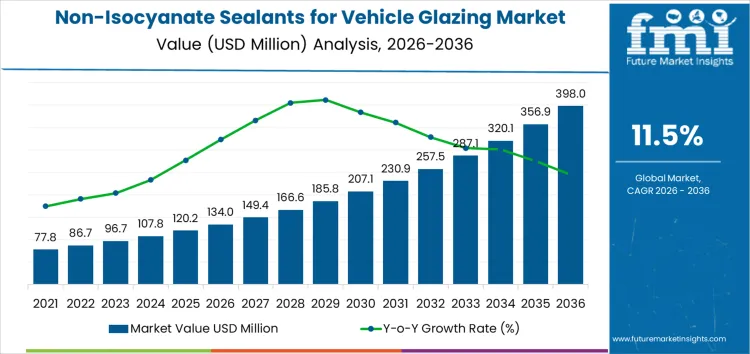
The non-isocyanate sealants for vehicle glazing market is valued at USD 134 million in 2026 and is projected to reach USD 398 million by 2036, reflecting a CAGR of 11.5%. Market expansion during this period is driven by formulation substitution rather than glazing volume growth. Cost structures are shaped by raw material selection, curing behavior, and compatibility with automated glazing lines. Sealants eliminating isocyanates require alternative chemistries that raise development expense but reduce handling risk. Suppliers controlling proprietary formulations achieve steadier pricing. Value creation favors firms aligning sealant performance with OEM process requirements rather than competing on unit pricing alone.
From 2026 to 2036, adoption patterns reflect manufacturing risk management and workforce exposure considerations. Vehicle producers prioritize materials that simplify compliance and reduce operator safeguards without disrupting assembly speed. Once approved, sealants remain specified due to tooling calibration and validation cost. Entry barriers persist through qualification timelines and limited tolerance for production disruption. Strategic trade offs emerge between formulation flexibility and long term durability performance. Suppliers offering process support alongside materials secure deeper integration. Profit concentration favors firms embedded in platform level glazing programs where replacement cycles are slow and contract continuity supports predictable margins.
Quick Stats for Non-Isocyanate Sealants for Vehicle Glazing Market
- Non-Isocyanate Sealants for Vehicle Glazing Market Value (2026): USD 134 million
- Non-Isocyanate Sealants for Vehicle Glazing Market Forecast Value (2036): USD 398 million
- Non-Isocyanate Sealants for Vehicle Glazing Market Forecast CAGR (2026 to 2036): 11.5%
- Leading Type in Non-Isocyanate Sealants for Vehicle Glazing Market: Non isocyanate polyurethane (NIPU / PHU) sealants
- Key Growth Regions in Non-Isocyanate Sealants for Vehicle Glazing Market: Asia Pacific, Europe, North America
- Top Players in Non-Isocyanate Sealants for Vehicle Glazing Market: Sika AG, Momentive Performance Materials Inc., 3M Company, H.B. Fuller Company, Wacker Chemie AG
What Is the Growth Forecast for Non-Isocyanate Sealants for Vehicle Glazing Market through 2036?
Occupational safety considerations and regulatory pressure on hazardous substances define the early growth phase of the non-isocyanate sealants for vehicle glazing market between 2026 and 2031. During this period, the market expands from USD 134 million to USD 210 million, adding USD 76 million in value. Annual progression from USD 73 million to USD 134 million reflects gradual replacement of traditional polyurethane systems in windshield and window bonding applications. Historical growth was limited by performance tradeoffs and installer familiarity with legacy chemistries. Forward expansion in this phase is supported by improved curing behavior, adequate structural strength, and increasing acceptance by automotive OEMs seeking safer handling profiles and regulatory alignment.
Chemistry standardization and platform level adoption drive growth from 2031 to 2036. Over this period, the market increases from USD 210 million to USD 398 million, adding USD 187 million and representing the stronger expansion window. Annual values rise from USD 235 million to USD 398 million, indicating accelerating year over year momentum. Earlier demand focused on selective vehicle programs, while future growth reflects broader rollout across passenger and commercial vehicle platforms. Wider installer training, stable long term performance, and compatibility with advanced glazing designs support sustained expansion as non-isocyanate sealants become viable alternatives in vehicle glazing applications.
Non-Isocyanate Sealants for Vehicle Glazing Market Key Takeaways
| Metric | Value |
|---|---|
| Market Value (2026) | USD 134 million |
| Forecast Value (2036) | USD 398 million |
| Forecast CAGR (2026 to 2036) | 11.5% |
What Is Driving Demand in the Non-Isocyanate Sealants for Vehicle Glazing Market?
Demand for non-isocyanate sealants in vehicle glazing is driven by evolving health, safety, and environmental requirements rather than routine adhesive replacement. Traditional urethane-based sealants rely on isocyanates, which pose respiratory sensitisation risk during application and require stringent handling controls in assembly plants. Automakers observed that worker exposure limits and regulatory scrutiny were increasing costs and compliance burden in high-volume production environments. Non-isocyanate formulations were introduced to reduce hazardous chemical use while maintaining adhesion to glass, painted metal, and composite substrates under dynamic loading. Early uptake occurred in regions with stricter occupational safety limits and where manufacturers sought to simplify ventilation and personal protective equipment requirements without compromising bond strength.
Future demand will be shaped by formal regulatory standards, material compliance criteria, and integration with automated assembly processes rather than gradual product substitution alone. Governments are tightening classifications and permissible exposure limits for isocyanates, prompting global manufacturers to adopt alternatives that meet equivalent performance specifications under thermal cycling, vibration, and weathering conditions. Non-isocyanate sealants are also aligning with broader vehicle electrification trends, where battery and sensor integration demands materials with defined outgassing and compatibility profiles. Advances in hybrid chemistry systems and polymer backbones are improving cure speed, elasticity, and resistance to environmental stress cracking.
What Factors Are Affecting the Demand for Non-Isocyanate Sealants for Vehicle Glazing Market in Terms of Sealant Type and Glazing Application?
The non-isocyanate sealants market for vehicle glazing is driven by occupational safety regulations, OEM chemical restrictions, and the shift toward low emission assembly materials. Demand centers on sealants that deliver structural bonding, weather resistance, and long term durability without isocyanate exposure risks. Adoption is shaped by glazing size, bonding criticality, and compatibility with automated installation processes. Market leadership reflects safety compliance, validated performance, and integration with existing glazing assembly standards rather than material novelty.
What Is Driving Leadership by Sealant Type in the Non Isocyanate Sealants for Vehicle Glazing Market?
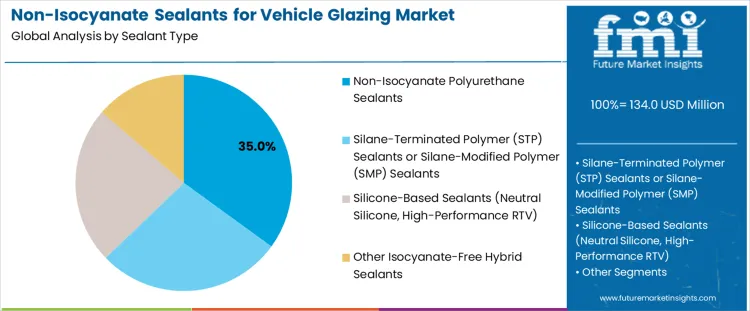
Non isocyanate polyurethane sealants account for about 35% of demand because they replicate many performance attributes of conventional PU systems while eliminating isocyanate hazards. These sealants provide strong adhesion to glass and painted metal, controlled elasticity, and resistance to weathering. Automotive manufacturers favor NIPU and PHU systems because they support structural glazing applications without requiring changes to installation equipment. Their curing profiles align with existing production cycle times, enabling straightforward substitution. Consistent mechanical performance under vibration and thermal cycling reinforces confidence for safety critical glazing bonds. These factors position non isocyanate polyurethanes as the leading chemistry for transitioning away from traditional PU adhesives in regulated automotive environments.
Silane terminated polymers, silicone sealants, and hybrid systems address specific needs but remain secondary. STP and SMP sealants offer flexibility and adhesion but lower structural strength. Silicone systems excel in weather resistance yet are less suited for load bearing bonds. Hybrid blends balance properties but add formulation complexity. These alternatives complement NIPU leadership rather than displace it. Sealant type dominance therefore reflects performance parity with legacy systems and ease of adoption rather than niche advantages.
What Is Driving Leadership by Glazing Application in the Non Isocyanate Sealants for Vehicle Glazing Market?
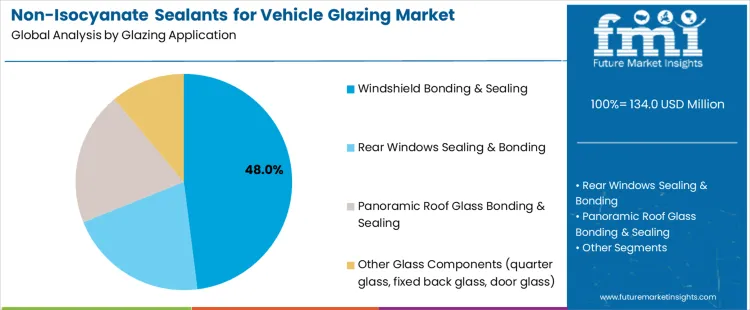
Windshield bonding and sealing account for about 48% of demand because windshields are structural components contributing to vehicle rigidity and occupant safety. Adhesives used in this application must meet strict crash performance and retention standards. OEMs prioritize proven non isocyanate systems for windshields due to high material volumes and direct safety implications. Large glass surface area and standardized installation processes reinforce consistent sealant consumption. As vehicles incorporate advanced driver assistance systems, windshield bonding quality becomes even more critical, sustaining demand concentration.
Side windows, rear windows, sunroofs, and other glass components represent secondary applications. These areas require sealing and weather resistance but face lower structural loads. Sunroof glazing emphasizes UV resistance and flexibility, while fixed glass focuses on durability. Although these segments add volume, adoption typically follows validation in windshield applications. Application leadership therefore reflects structural criticality and regulatory scrutiny rather than total number of glass components per vehicle.
How Are Non-Isocyanate Sealants for Vehicle Glazing Being Applied Across Automotive Assembly?
Use appears in passenger cars, commercial vehicles, and specialty vehicles where glass bonding requires durable, flexible, and environmentally compliant adhesives. Manufacturers adopt non-isocyanate sealants to replace conventional polyurethane-based products, reducing VOC emissions and worker exposure to toxic isocyanates. OEMs integrate these sealants for windshield, side, and rear glass installation, ensuring structural integrity, water tightness, and vibration resistance. These applications reflect operational and regulatory priorities rather than aesthetic objectives, with adoption driven by environmental compliance, adhesion performance, and vehicle safety.
What Operational and Material Conditions Support Adoption of Non-Isocyanate Sealants for Vehicle Glazing?
Selection aligns with automotive substrates such as glass, metal, and composite panels requiring strong adhesion, UV resistance, and thermal stability. Sealants are formulated for extrusion, bead consistency, and cure times compatible with high-speed assembly lines. Production teams monitor surface preparation, application rate, and curing conditions to ensure consistent performance. Quality control evaluates bond strength, flexibility, and water tightness to comply with OEM specifications and safety standards. These conditions emerge from operational reliability, environmental compliance, and structural performance priorities in structured vehicle assembly workflows.
Which Practical Considerations Limit Wider Use of Non-Isocyanate Sealants for Vehicle Glazing?
Higher formulation costs compared with conventional polyurethanes can influence adoption in cost-sensitive vehicle segments. Compatibility with primers, coatings, and sealant applicators must be verified. Cure speed and temperature sensitivity require careful process control. Regulatory approvals and performance certifications differ by region. These factors lead to selective deployment where adhesion reliability, environmental compliance, and vehicle safety justify incremental cost and operational adaptation.
What is the Demand for Non-Isocyanate Sealants for Vehicle Glazing by Country?
| Country | CAGR (%) |
|---|---|
| China | 13.0% |
| India | 12.2% |
| USA | 10.0% |
| Germany | 9.5% |
| Japan | 9.0% |
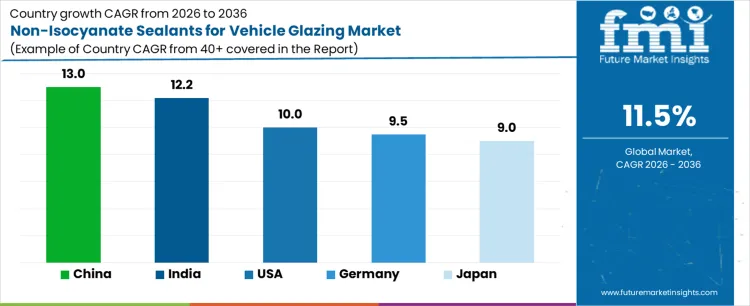
The demand for non-isocyanate sealants for vehicle glazing varies across countries, driven by automotive production, regulatory compliance, and adoption of environmentally friendly adhesives. China leads with a 13.0% CAGR, supported by growing automotive manufacturing, increasing use of eco-friendly materials, and regulatory initiatives to reduce isocyanate emissions. India follows at 12.2%, driven by expansion of vehicle production and adoption of sustainable glazing solutions. The USA grows at 10.0%, reflecting steady demand in automotive OEMs and aftermarket applications. Germany records 9.5%, shaped by stringent environmental regulations and mature automotive markets. Japan posts 9.0%, supported by adoption in vehicle manufacturing and sustainable material usage.
How Are Non-Isocyanate Sealants Expanding Vehicle Glazing Applications in China?
In China, the Non-Isocyanate Sealants for Vehicle Glazing Market is growing at a CAGR of 13% through 2036, driven by rapid automotive manufacturing expansion and increasing adoption of eco-friendly, low-VOC glazing solutions. OEMs and glass suppliers are integrating non-isocyanate sealants to enhance bond durability, reduce emissions, and comply with environmental regulations. Demand is concentrated in automotive manufacturing hubs, glass processing facilities, and tier-one glazing suppliers. Compared to the USA, China emphasizes large-scale industrial integration and high-volume adoption. Domestic suppliers provide high-performance, chemically compatible sealants suitable for recurring windshield and window assembly operations.
- Automotive manufacturing hubs, glass processing facilities, and tier-one suppliers drive adoption
- Sealants enhance bond durability and reduce VOC emissions
- Domestic suppliers provide high-performance, chemically compatible solutions
- Recurring windshield and window assembly cycles sustain adoption
How Are Industrial Growth and Sustainability Driving Adoption in India?
In India, revenue is growing at a CAGR of 12.2% through 2036, supported by increasing production of passenger vehicles, commercial vehicles, and premium automotive segments. Manufacturers are adopting non-isocyanate sealants to reduce VOC emissions, improve bond strength, and comply with emerging environmental regulations. Demand is concentrated in urban automotive clusters, glazing component manufacturers, and vehicle assembly plants. Compared to China, India emphasizes emerging industrial zones and regulatory incentives as growth drivers. Domestic suppliers provide cost-effective, high-performance sealants compatible with automated glazing assembly and recurring production operations.
- Urban automotive clusters, glazing component manufacturers, and assembly plants drive adoption
- Sealants reduce VOC emissions and improve bond strength
- Domestic suppliers provide cost-effective, high-performance solutions
- Recurring production cycles sustain adoption
How Are Eco-Friendly Regulations Supporting Growth in the United States?
In the United States, the market is expanding at a CAGR of 10% through 2036, driven by adoption of low-emission, non-isocyanate sealants in passenger and commercial vehicles. OEMs and tier-one suppliers are integrating these sealants to enhance glazing bond performance, comply with EPA regulations, and meet sustainability targets. Demand is concentrated in automotive manufacturing hubs, glazing assembly lines, and industrial glass processing facilities. Compared to Germany, the USA market emphasizes operational efficiency alongside regulatory compliance. Domestic suppliers provide high-performance adhesives suitable for recurring windshield and window assembly operations.
- Automotive hubs, glazing assembly lines, and industrial glass facilities drive adoption
- Sealants improve glazing bond performance and reduce emissions
- Domestic suppliers provide high-performance, production-compatible solutions
- Recurring windshield and window assembly operations sustain adoption
How Are Regulatory Standards Driving Adoption in Germany?
In Germany, revenue is growing at a CAGR of 9.5% through 2036, supported by stringent EU environmental regulations and automotive quality standards. Manufacturers are adopting non-isocyanate sealants for vehicle glazing to ensure compliance, durability, and low-emission assembly. Demand is concentrated in automotive hubs, tier-one glazing suppliers, and industrial glass processing facilities. Compared to the USA, Germany emphasizes regulatory compliance and quality assurance over operational efficiency. Domestic suppliers provide EU-certified, high-performance sealants suitable for automated glazing assembly and recurring production cycles.
- Automotive hubs, glazing suppliers, and industrial glass facilities drive adoption
- Sealants ensure compliance, durability, and low emissions
- Domestic suppliers provide EU-certified, high-performance solutions
- Recurring glazing assembly cycles sustain adoption
How Are Vehicle Safety and Production Standards Supporting Market Growth in Japan?
In Japan, the market is expanding at a CAGR of 9% through 2036, driven by adoption of non-isocyanate sealants in passenger vehicles and industrial glazing applications. Manufacturers are integrating these adhesives to improve bond reliability, reduce emissions, and comply with domestic environmental and automotive standards. Demand is concentrated in automotive manufacturing hubs, glass component facilities, and tier-one suppliers. Compared to China and India, adoption emphasizes precision, quality, and compliance rather than high-volume industrial integration. Domestic suppliers provide high-performance, chemically compatible sealants suitable for recurring glazing assembly and inspection operations.
- Automotive hubs, glass component facilities, and tier-one suppliers drive adoption
- Sealants improve bond reliability and reduce emissions
- Domestic suppliers provide high-performance, chemically compatible solutions
- Recurring glazing assembly and inspection cycles sustain adoption
Which Strategic Approaches Define Competition in the Non-Isocyanate Sealants for Vehicle Glazing Market amid Regulatory and Assembly Line Shifts?
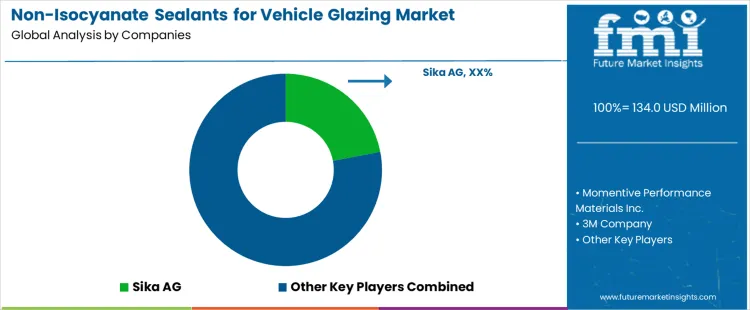
Competition in non-isocyanate sealants for vehicle glazing is shaped by regulatory pressure to eliminate hazardous chemistries while preserving bonding reliability and assembly efficiency. Sika AG approaches this market by reformulating glazing systems around silane terminated and alternative reactive chemistries that maintain adhesion, elasticity, and crash performance without isocyanates. Wacker Chemie AG and Momentive Performance Materials focus on silicone based sealants, positioning their strategies around long term weathering resistance, optical stability, and compatibility with modern glass coatings. These suppliers emphasize consistency in cure behavior and modulus control to ensure predictable installation across automated and manual glazing lines. OEM qualification centers on durability, fogging behavior, and long term adhesion under thermal cycling rather than curing speed alone.
Process integration and risk reduction define secondary competitive strategies. H.B. Fuller competes through application driven formulation tuning, aligning non-isocyanate sealants with specific glazing geometries, bead profiles, and dispensing equipment. 3M participates selectively where glazing sealants intersect with vibration damping, acoustic control, or multifunctional bonding requirements. Across the market, suppliers prioritize backward compatibility with existing assembly infrastructure to limit capital disruption. Extensive validation under vehicle aging protocols and conservative formulation evolution are used to protect existing approvals. Competitive advantage is built through regulatory resilience, manufacturability, and predictable in service performance rather than aggressive material substitution or rapid portfolio expansion.
Key Players in the Non Isocyanate Sealants for Vehicle Glazing Market
- Sika AG
- Momentive Performance Materials Inc.
- 3M Company
- H.B. Fuller Company
- Wacker Chemie AG
Scope of the Report
| Items | Values |
|---|---|
| Quantitative Units (2026) | USD million |
| Type | Non Isocyanate Polyurethane Sealants, Silane-Terminated Polymer or Silane-Modified Polymer Sealants, Silicone-Based Sealants, Other Isocyanate-Free Hybrid Sealants |
| Application | Windshield Bonding and Sealing, Rear Window Sealing and Bonding, Panoramic Roof Glass Bonding and Sealing, Other Fixed and Door Glass Components |
| End Users | Automotive OEMs, Tier-1 Glazing System Suppliers, Automotive Glass Manufacturers, Vehicle Assembly Plants |
| Regions Covered | Asia Pacific, Europe, North America, Latin America, Middle East and Africa |
| Countries Covered | China, India, United States, Germany, Japan, South Korea, United Kingdom, France, Italy, Canada, Mexico, Brazil, ASEAN countries, GCC countries, and other global regions |
| Key Companies Profiled | Sika AG, Momentive Performance Materials Inc., 3M Company, H.B. Fuller Company, Wacker Chemie AG |
| Additional Attributes | Dollar by sales across sealant type and glazing application, regulatory compliance requirements related to isocyanate restrictions, compatibility with automated glazing assembly lines, curing behavior and long term durability assessment, regional adoption trends across passenger and commercial vehicle platforms |
Non-Isocyanate Sealants for Vehicle Glazing Market Segmentation
Sealant Type:
- Non-Isocyanate Polyurethane (NIPU / PHU) Sealants
- Silane-Terminated Polymer (STP) Sealants or Silane-Modified Polymer (SMP) Sealants
- Silicone-Based Sealants (Neutral Silicone, High-Performance RTV)
- Other Isocyanate-Free Hybrid Sealants (e.g. MS-Hybrid, Silane/Silicone Blends)
Glazing Application:
- Windshield Bonding & Sealing
- Rear Windows Sealing & Bonding
- Panoramic Roof Glass Bonding & Sealing
- Other Glass Components (quarter glass, fixed back glass, door glass)
Vehicle Segment:
- Passenger Cars
- SUVs & Crossovers
- Commercial Vehicles (LCV, Vans, Buses)
- Electric Vehicles (EVs)
Region
- Asia Pacific
- China
- Japan
- South Korea
- India
- Australia & New Zealand
- ASEAN
- Rest of Asia Pacific
- Europe
- Germany
- United Kingdom
- France
- Italy
- Spain
- Nordic
- BENELUX
- Rest of Europe
- North America
- United States
- Canada
- Mexico
- Latin America
- Brazil
- Chile
- Rest of Latin America
- Middle East & Africa
- Kingdom of Saudi Arabia
- Other GCC Countries
- Turkey
- South Africa
- Other African Union
- Rest of Middle East & Africa
Frequently Asked Questions
How big is the non-isocyanate sealants for vehicle glazing market in 2026?
The global non-isocyanate sealants for vehicle glazing market is estimated to be valued at USD 134.0 million in 2026.
What will be the size of non-isocyanate sealants for vehicle glazing market in 2036?
The market size for the non-isocyanate sealants for vehicle glazing market is projected to reach USD 398.0 million by 2036.
How much will be the non-isocyanate sealants for vehicle glazing market growth between 2026 and 2036?
The non-isocyanate sealants for vehicle glazing market is expected to grow at a 11.5% CAGR between 2026 and 2036.
What are the key product types in the non-isocyanate sealants for vehicle glazing market?
The key product types in non-isocyanate sealants for vehicle glazing market are non-isocyanate polyurethane sealants, silane-terminated polymer (stp) sealants or silane-modified polymer (smp) sealants, silicone-based sealants (neutral silicone, high-performance rtv) and other isocyanate-free hybrid sealants .
Which glazing application segment to contribute significant share in the non-isocyanate sealants for vehicle glazing market in 2026?
In terms of glazing application, windshield bonding & sealing segment to command 48.0% share in the non-isocyanate sealants for vehicle glazing market in 2026.
Preview the report firsthand - request a free sample
Get SampleGet the brochure for pricing and purchase details.
Get PDFTable of Content
- Executive Summary
- Global Market Outlook
- Demand-side Trends
- Supply-side Trends
- Technology Roadmap Analysis
- Analysis and Recommendations
- Market Overview
- Market Coverage / Taxonomy
- Market Definition / Scope / Limitations
- Market Background
- Market Dynamics
- Drivers
- Restraints
- Opportunity
- Trends
- Scenario Forecast
- Demand in Optimistic Scenario
- Demand in Likely Scenario
- Demand in Conservative Scenario
- Opportunity Map Analysis
- Product Life Cycle Analysis
- Supply Chain Analysis
- Investment Feasibility Matrix
- Value Chain Analysis
- PESTLE and Porter’s Analysis
- Regulatory Landscape
- Regional Parent Market Outlook
- Production and Consumption Statistics
- Import and Export Statistics
- Market Dynamics
- Global Market Analysis 2021 to 2025 and Forecast, 2026 to 2036
- Historical Market Size Value (USD Million) Analysis, 2021 to 2025
- Current and Future Market Size Value (USD Million) Projections, 2026 to 2036
- Y-o-Y Growth Trend Analysis
- Absolute $ Opportunity Analysis
- Global Market Pricing Analysis 2021 to 2025 and Forecast 2026 to 2036
- Global Market Analysis 2021 to 2025 and Forecast 2026 to 2036, By Sealant Type
- Introduction / Key Findings
- Historical Market Size Value (USD Million) Analysis By Sealant Type , 2021 to 2025
- Current and Future Market Size Value (USD Million) Analysis and Forecast By Sealant Type , 2026 to 2036
- Non-Isocyanate Polyurethane Sealants
- Silane-Terminated Polymer (STP) Sealants or Silane-Modified Polymer (SMP) Sealants
- Silicone-Based Sealants (Neutral Silicone, High-Performance RTV)
- Other Isocyanate-Free Hybrid Sealants
- Non-Isocyanate Polyurethane Sealants
- Y-o-Y Growth Trend Analysis By Sealant Type , 2021 to 2025
- Absolute $ Opportunity Analysis By Sealant Type , 2026 to 2036
- Global Market Analysis 2021 to 2025 and Forecast 2026 to 2036, By Glazing Application
- Introduction / Key Findings
- Historical Market Size Value (USD Million) Analysis By Glazing Application, 2021 to 2025
- Current and Future Market Size Value (USD Million) Analysis and Forecast By Glazing Application, 2026 to 2036
- Windshield Bonding & Sealing
- Rear Windows Sealing & Bonding
- Panoramic Roof Glass Bonding & Sealing
- Other Glass Components (quarter glass, fixed back glass, door glass)
- Windshield Bonding & Sealing
- Y-o-Y Growth Trend Analysis By Glazing Application, 2021 to 2025
- Absolute $ Opportunity Analysis By Glazing Application, 2026 to 2036
- Global Market Analysis 2021 to 2025 and Forecast 2026 to 2036, By Vehicle Segment
- Introduction / Key Findings
- Historical Market Size Value (USD Million) Analysis By Vehicle Segment, 2021 to 2025
- Current and Future Market Size Value (USD Million) Analysis and Forecast By Vehicle Segment, 2026 to 2036
- Passenger Cars
- SUVs & Crossovers
- Commercial Vehicles (LCV, Vans, Buses)
- Electric Vehicles (EVs)
- Passenger Cars
- Y-o-Y Growth Trend Analysis By Vehicle Segment, 2021 to 2025
- Absolute $ Opportunity Analysis By Vehicle Segment, 2026 to 2036
- Global Market Analysis 2021 to 2025 and Forecast 2026 to 2036, By Region
- Introduction
- Historical Market Size Value (USD Million) Analysis By Region, 2021 to 2025
- Current Market Size Value (USD Million) Analysis and Forecast By Region, 2026 to 2036
- North America
- Latin America
- Western Europe
- Eastern Europe
- East Asia
- South Asia and Pacific
- Middle East & Africa
- Market Attractiveness Analysis By Region
- North America Market Analysis 2021 to 2025 and Forecast 2026 to 2036, By Country
- Historical Market Size Value (USD Million) Trend Analysis By Market Taxonomy, 2021 to 2025
- Market Size Value (USD Million) Forecast By Market Taxonomy, 2026 to 2036
- By Country
- USA
- Canada
- Mexico
- By Sealant Type
- By Glazing Application
- By Vehicle Segment
- By Country
- Market Attractiveness Analysis
- By Country
- By Sealant Type
- By Glazing Application
- By Vehicle Segment
- Key Takeaways
- Latin America Market Analysis 2021 to 2025 and Forecast 2026 to 2036, By Country
- Historical Market Size Value (USD Million) Trend Analysis By Market Taxonomy, 2021 to 2025
- Market Size Value (USD Million) Forecast By Market Taxonomy, 2026 to 2036
- By Country
- Brazil
- Chile
- Rest of Latin America
- By Sealant Type
- By Glazing Application
- By Vehicle Segment
- By Country
- Market Attractiveness Analysis
- By Country
- By Sealant Type
- By Glazing Application
- By Vehicle Segment
- Key Takeaways
- Western Europe Market Analysis 2021 to 2025 and Forecast 2026 to 2036, By Country
- Historical Market Size Value (USD Million) Trend Analysis By Market Taxonomy, 2021 to 2025
- Market Size Value (USD Million) Forecast By Market Taxonomy, 2026 to 2036
- By Country
- Germany
- UK
- Italy
- Spain
- France
- Nordic
- BENELUX
- Rest of Western Europe
- By Sealant Type
- By Glazing Application
- By Vehicle Segment
- By Country
- Market Attractiveness Analysis
- By Country
- By Sealant Type
- By Glazing Application
- By Vehicle Segment
- Key Takeaways
- Eastern Europe Market Analysis 2021 to 2025 and Forecast 2026 to 2036, By Country
- Historical Market Size Value (USD Million) Trend Analysis By Market Taxonomy, 2021 to 2025
- Market Size Value (USD Million) Forecast By Market Taxonomy, 2026 to 2036
- By Country
- Russia
- Poland
- Hungary
- Balkan & Baltic
- Rest of Eastern Europe
- By Sealant Type
- By Glazing Application
- By Vehicle Segment
- By Country
- Market Attractiveness Analysis
- By Country
- By Sealant Type
- By Glazing Application
- By Vehicle Segment
- Key Takeaways
- East Asia Market Analysis 2021 to 2025 and Forecast 2026 to 2036, By Country
- Historical Market Size Value (USD Million) Trend Analysis By Market Taxonomy, 2021 to 2025
- Market Size Value (USD Million) Forecast By Market Taxonomy, 2026 to 2036
- By Country
- China
- Japan
- South Korea
- By Sealant Type
- By Glazing Application
- By Vehicle Segment
- By Country
- Market Attractiveness Analysis
- By Country
- By Sealant Type
- By Glazing Application
- By Vehicle Segment
- Key Takeaways
- South Asia and Pacific Market Analysis 2021 to 2025 and Forecast 2026 to 2036, By Country
- Historical Market Size Value (USD Million) Trend Analysis By Market Taxonomy, 2021 to 2025
- Market Size Value (USD Million) Forecast By Market Taxonomy, 2026 to 2036
- By Country
- India
- ASEAN
- Australia & New Zealand
- Rest of South Asia and Pacific
- By Sealant Type
- By Glazing Application
- By Vehicle Segment
- By Country
- Market Attractiveness Analysis
- By Country
- By Sealant Type
- By Glazing Application
- By Vehicle Segment
- Key Takeaways
- Middle East & Africa Market Analysis 2021 to 2025 and Forecast 2026 to 2036, By Country
- Historical Market Size Value (USD Million) Trend Analysis By Market Taxonomy, 2021 to 2025
- Market Size Value (USD Million) Forecast By Market Taxonomy, 2026 to 2036
- By Country
- Kingdom of Saudi Arabia
- Other GCC Countries
- Turkiye
- South Africa
- Other African Union
- Rest of Middle East & Africa
- By Sealant Type
- By Glazing Application
- By Vehicle Segment
- By Country
- Market Attractiveness Analysis
- By Country
- By Sealant Type
- By Glazing Application
- By Vehicle Segment
- Key Takeaways
- Key Countries Market Analysis
- USA
- Pricing Analysis
- Market Share Analysis, 2025
- By Sealant Type
- By Glazing Application
- By Vehicle Segment
- Canada
- Pricing Analysis
- Market Share Analysis, 2025
- By Sealant Type
- By Glazing Application
- By Vehicle Segment
- Mexico
- Pricing Analysis
- Market Share Analysis, 2025
- By Sealant Type
- By Glazing Application
- By Vehicle Segment
- Brazil
- Pricing Analysis
- Market Share Analysis, 2025
- By Sealant Type
- By Glazing Application
- By Vehicle Segment
- Chile
- Pricing Analysis
- Market Share Analysis, 2025
- By Sealant Type
- By Glazing Application
- By Vehicle Segment
- Germany
- Pricing Analysis
- Market Share Analysis, 2025
- By Sealant Type
- By Glazing Application
- By Vehicle Segment
- UK
- Pricing Analysis
- Market Share Analysis, 2025
- By Sealant Type
- By Glazing Application
- By Vehicle Segment
- Italy
- Pricing Analysis
- Market Share Analysis, 2025
- By Sealant Type
- By Glazing Application
- By Vehicle Segment
- Spain
- Pricing Analysis
- Market Share Analysis, 2025
- By Sealant Type
- By Glazing Application
- By Vehicle Segment
- France
- Pricing Analysis
- Market Share Analysis, 2025
- By Sealant Type
- By Glazing Application
- By Vehicle Segment
- India
- Pricing Analysis
- Market Share Analysis, 2025
- By Sealant Type
- By Glazing Application
- By Vehicle Segment
- ASEAN
- Pricing Analysis
- Market Share Analysis, 2025
- By Sealant Type
- By Glazing Application
- By Vehicle Segment
- Australia & New Zealand
- Pricing Analysis
- Market Share Analysis, 2025
- By Sealant Type
- By Glazing Application
- By Vehicle Segment
- China
- Pricing Analysis
- Market Share Analysis, 2025
- By Sealant Type
- By Glazing Application
- By Vehicle Segment
- Japan
- Pricing Analysis
- Market Share Analysis, 2025
- By Sealant Type
- By Glazing Application
- By Vehicle Segment
- South Korea
- Pricing Analysis
- Market Share Analysis, 2025
- By Sealant Type
- By Glazing Application
- By Vehicle Segment
- Russia
- Pricing Analysis
- Market Share Analysis, 2025
- By Sealant Type
- By Glazing Application
- By Vehicle Segment
- Poland
- Pricing Analysis
- Market Share Analysis, 2025
- By Sealant Type
- By Glazing Application
- By Vehicle Segment
- Hungary
- Pricing Analysis
- Market Share Analysis, 2025
- By Sealant Type
- By Glazing Application
- By Vehicle Segment
- Kingdom of Saudi Arabia
- Pricing Analysis
- Market Share Analysis, 2025
- By Sealant Type
- By Glazing Application
- By Vehicle Segment
- Turkiye
- Pricing Analysis
- Market Share Analysis, 2025
- By Sealant Type
- By Glazing Application
- By Vehicle Segment
- South Africa
- Pricing Analysis
- Market Share Analysis, 2025
- By Sealant Type
- By Glazing Application
- By Vehicle Segment
- USA
- Market Structure Analysis
- Competition Dashboard
- Competition Benchmarking
- Market Share Analysis of Top Players
- By Regional
- By Sealant Type
- By Glazing Application
- By Vehicle Segment
- Competition Analysis
- Competition Deep Dive
- Sika AG
- Overview
- Product Portfolio
- Profitability by Market Segments (Product/Age /Sales Channel/Region)
- Sales Footprint
- Strategy Overview
- Marketing Strategy
- Product Strategy
- Channel Strategy
- Momentive Performance Materials Inc.
- 3M Company
- H.B. Fuller Company
- Wacker Chemie AG
- Sika AG
- Competition Deep Dive
- Assumptions & Acronyms Used
- Research Methodology


