

- Industry Size (2026)
- USD 5.6 Bn
- Forecast (2036)
- USD 10.2 Bn
- CAGR (2026 to 2036)
- 6.2%
Power Seat Adjustment Motors Market Forecast and Outlook 2026 to 2036
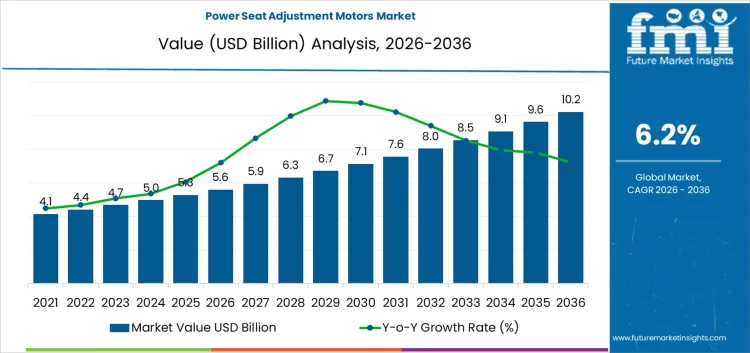
The power seat adjustment motors market is likely to be valued at USD 5.6 billion in 2026 and is projected to reach USD 10.2 billion by 2036, reflecting a CAGR of 6.2%. Early period demand is shaped by rising fitment rates in passenger cars and higher installation depth in mid-priced vehicles. Procurement remains tied to platform level decisions rather than trim level upgrades. Volume growth follows vehicle production, while value growth tracks the shift from manual to powered seat systems. Suppliers compete on motor reliability, noise control, and cycle life. Regional growth differences reflect local comfort feature penetration and the pace of model refresh cycles across major automotive markets.
As the period advances, purchasing patterns move toward standardized motor assemblies shared across vehicle platforms. Cost control and parts commonality shape sourcing strategies more than feature differentiation. Replacement demand begins to matter in regions with large vehicle fleets and longer ownership cycles. Growth remains linked to vehicle output, though price pressure limits margin expansion for smaller suppliers. Production capacity follows long term supply agreements rather than spot orders. The market shows steadier expansion in the later years, supported by gradual increases in powered seat penetration and consistent replacement needs tied to wear, usage intensity, and service intervals in high mileage vehicles.
Quick Stats of the Power Seat Adjustment Motors Market
- Power Seat Adjustment Motors Market Value (2026): USD 5.6 billion
- Power Seat Adjustment Motors Forecast Value (2036): USD 10.2 billion
- Power Seat Adjustment Motors Forecast CAGR 2026 to 2036: 6.2%
- Leading Motor Type in Power Seat Systems: Brushed DC Motors (52% share)
- Leading Seat Function in Power Seat Systems: Fore-Aft and Height Adjustment (38% share)
- Key Growth Regions in Power Seat Adjustment Motors Market: China, India, South Korea, USA, Germany
- Top Players in Power Seat Adjustment Motors Market: Brose, Johnson Electric, Nidec, Bosch, Denso, Mitsuba, Valeo, Mabuchi Motor, Hi-Lex, MinebeaMitsumi
What is the Growth Forecast for Power Seat Adjustment Motors Market through 2036?
Between 2026 and 2031, the power seat adjustment motors market is expected to move from USD 5.6 billion toward the middle of the decade growth path implied by a 6.2% CAGR, supported by steady content expansion rather than abrupt changes in vehicle volumes. The period reflects a normalization of electrically adjustable seats in mid-range vehicles, where fore-aft, height, and recline functions shift from optional to standard equipment. Brushed DC motors continue to account for the majority of installed units because cost, packaging familiarity, and proven reliability suit high-volume platforms. OEM purchasing strategies emphasize component standardization across multiple seat frames, which increases motor volumes per platform. Assembly plants focus on throughput stability and warranty performance, making motor durability and noise control more influential than peak output specifications.
From 2031 to 2036, the market is projected to reach USD 10.2 billion, with growth shaped by function density rather than simple seat penetration. Premium and upper mid-range vehicles increasingly adopt multi-axis adjustment, memory systems, and integrated lumbar and comfort modules, which raises the number of motors per seat even when vehicle sales grow at a slower pace. The mix gradually shifts toward BLDC and higher-precision solutions in applications where noise, efficiency, and service life carry higher design weight. Sales remain dominated by OEM and Tier 1 supply relationships, with limited influence from aftermarket channels. Supplier competitiveness depends on platform integration capability, cost control at scale, and long-term supply reliability, favoring groups such as Brose, Johnson Electric, Nidec, Bosch, Denso, Mitsuba, Valeo, Mabuchi Motor, Hi-Lex, and MinebeaMitsumi.
Power Seat Adjustment Motors Market Key Takeaways
| Metric | Value |
|---|---|
| Market Value (2026) | USD 5.6 billion |
| Forecast Value (2036) | USD 10.2 billion |
| Forecast CAGR 2026 to 2036 | 6.2% |
How Are Power Seat Adjustment Motors Enhancing Vehicle Comfort and Functionality?
Power seat adjustment motors are increasingly adopted to provide automated seating positions, improving driver and passenger comfort, ergonomics, and convenience in vehicles. Historically, manual seat adjustment relied on mechanical levers, limiting precision, ease of use, and adaptability to occupant preferences. Modern power seat motors integrate compact electric actuators, control modules, and feedback sensors to enable multi-directional movement, memory functions, and synchronized adjustments with other interior systems. Automotive OEMs, seat manufacturers, and aftermarket suppliers prioritize motor reliability, smooth operation, and integration with vehicle electronics. Early adoption focused on premium and luxury vehicles, while current demand spans SUVs, passenger cars, and electric vehicles, driven by user convenience expectations, interior customization trends, and ergonomic considerations. Motor durability, torque output, and noise levels influence supplier selection.
Rising consumer demand for comfort, vehicle interior customization, and integration with advanced driver assistance systems are shaping market growth. Compared with manual seat mechanisms, power seat motors emphasize precision, silent operation, and compatibility with electronic control systems. Cost structures depend on motor design, actuator quality, and electronics integration, concentrating margins among suppliers capable of delivering reliable, high-performance solutions. Vehicle manufacturers adopt power seat motors to enhance occupant experience, support ergonomic compliance, and differentiate interior features. By 2036, power seat adjustment motors are expected to become standard across passenger, commercial, and electric vehicles, supporting comfort, functionality, and advanced interior control systems.
What Factors Are Influencing the Demand for Power Seat Adjustment Motors by Motor Type and Seat Function in 2026?
The power seat adjustment motors market in 2026 is segmented by motor type and seat function. By motor type, demand is divided into brushed DC, BLDC, stepper, and other designs, each selected according to cost targets, control requirements, and durability expectations within specific vehicle programs. By seat function, demand is organized around fore aft and height movement, recline, lumbar support, and other adjustments that define seat architecture and user interface design. These segments reflect how automakers balance electrical load planning, module complexity, supplier sourcing, and assembly time while aligning comfort features with vehicle positioning, trim strategies, and long term service and replacement considerations across global production portfolios today.
Why Do Brushed DC Motors Hold the Largest Share in Power Seat Systems?
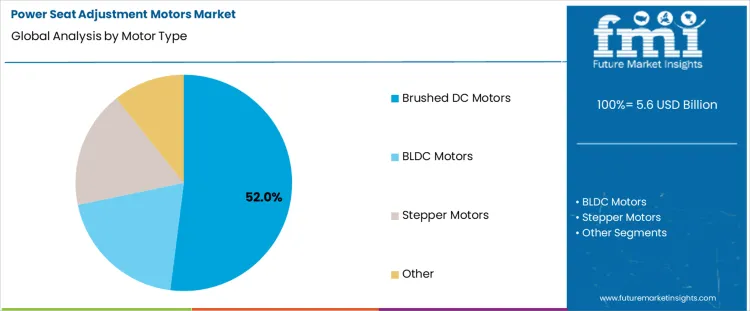
Brushed DC motors account for about 52% of demand in 2026, placing them ahead of BLDC and stepper designs across most volume vehicle programs. This position reflects procurement decisions that prioritize predictable torque behavior, simple control electronics, and stable unit pricing under long term supply agreements. These motors fit well within established seat module designs, which limits requalification work during platform updates. Assembly lines benefit from consistent mounting interfaces and wiring layouts, reducing changeover risk in mixed model production. Suppliers can support high volumes with mature manufacturing processes and well understood quality controls. The segment also aligns with service expectations, since replacement parts remain widely available and technicians face few diagnostic complexities during routine repair cycles nationwide.
BLDC and stepper motors serve narrower roles shaped by efficiency targets, noise limits, and positioning accuracy. BLDC units appear in trims where lower current draw and longer service life justify higher component costs and more complex controllers. Stepper motors support functions that require precise incremental movement, which suits certain adjustment axes but adds calibration steps during assembly. Both designs increase electronic content and software validation work, which extends development schedules and raises integration costs. Their adoption depends on vehicle electrical architecture and the number of adjustable axes specified in a seat.
Why Does Fore Aft and Height Adjustment Represent the Leading Seat Function Segment?

The fore aft and height adjustment segment represents about 38% of demand in 2026, making it the most widely specified function within powered seat systems. This share reflects its role as the foundation of driver positioning, which is required across a broad range of vehicle categories and trim levels. Automakers treat these movements as core features that support visibility, pedal reach, and basic comfort expectations. Integration remains straightforward because seat frames and floor interfaces are already designed around these axes. High installation rates support scale production of standardized motor and gearbox modules, which stabilizes costs and simplifies sourcing. Service and warranty planning also benefit from consistent component usage across large fleets of vehicles in daily operation.
Recline and lumbar support functions follow different demand patterns linked to comfort positioning and brand differentiation. Recline motors are specified where powered backrest movement is part of the seating package, which depends on trim strategy and vehicle class. Lumbar systems focus on targeted comfort rather than fundamental seating geometry, which limits installation rates in entry models. Both functions add mechanical linkages, switches, and control logic, which increases assembly time and testing requirements. Their inclusion depends on how manufacturers distribute features across trim ladders and regional offerings. Volumes remain lower than fore aft and height adjustments because these functions serve differentiation goals rather than baseline usability requirements in most global vehicle programs today.
Why is Seating Architecture, Not Comfort Features, Driving the Power Seat Adjustment Motors Market through 2036?
Demand for power seat adjustment motors grows because seat systems have become load bearing modules rather than trim items. Vehicle programs now treat seating as a packaged subsystem with defined weight targets, noise limits, and assembly takt time. Electric vehicles intensify this shift by relocating structures and changing floor heights, which forces new seat geometries and more axes of movement. Fleet buyers value reduced adjustment effort and positioning for vehicles. OEMs also pursue higher content per vehicle to offset pricing pressure elsewhere. Motors that meet cycle life limits become specified parts, not options. That procurement behavior sustains volume growth globally.
What Cost and Validation Barriers Are Holding Back Wider Motor Penetration in Seat Systems?
Growth is limited by the economics of seat systems, not by interest in comfort. Motors compete for space, current budget, and cost within a tightly costed module. Each extra axis requires wiring, controllers, and validation, which raises warranty exposure. Automakers also impose long qualification cycles because noise, vibration, and endurance failures trigger recalls. Commodity motor suppliers struggle to carry tooling and testing costs while meeting price down targets. In lower priced vehicle segments, manual mechanisms remain acceptable and free up mass and cash for other features. These tradeoffs cap penetration rates and slow mix shifts in many vehicle programs today.
How Are Platform Strategies and Sourcing Models Changing the Structure of This Category?
Procurement patterns are reshaping the category more than product features. Platform strategies push seats toward standardized frames with configurable motor packs, which changes how volumes are awarded. Software defined interiors make memory and profile functions mandatory, shifting value toward integrated motor and controller sets. Several OEMs are consolidating suppliers to reduce interfaces, while others localize sourcing to stabilize logistics and currency exposure. Aftermarket demand remains limited, so scale comes from factory fitment decisions rather than service channels. Over the period, winners will be those that align with platform cadence and can reconfigure output quickly without disrupting seat assembly lines operations.
What is the Demand for Power Seat Adjustment Motors by Country?
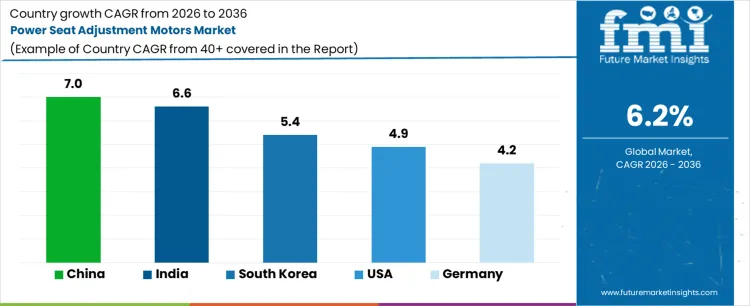
| Country | CAGR (%) |
|---|---|
| China | 7.0% |
| India | 6.6% |
| USA | 4.9% |
| Germany | 4.2% |
| South Korea | 5.4% |
Demand for power seat adjustment motors is rising as automotive manufacturers focus on passenger comfort, luxury features, and ergonomic vehicle interiors. China leads with a 7.0% CAGR, driven by rapid growth in passenger vehicle production and adoption of electrically adjustable seats in mid-to-high-end models. India follows at 6.6%, supported by expanding automotive manufacturing, rising consumer preference for comfort features, and growth in premium vehicles. South Korea grows at 5.4%, shaped by domestic vehicle production and high adoption of adjustable seating technologies. The USA records 4.9% growth, reflecting mature market penetration and replacement demand. Germany shows 4.2% CAGR, influenced by established automotive markets and gradual integration of advanced seat adjustment systems.
How is China experiencing growth in the power seat adjustment motors market?
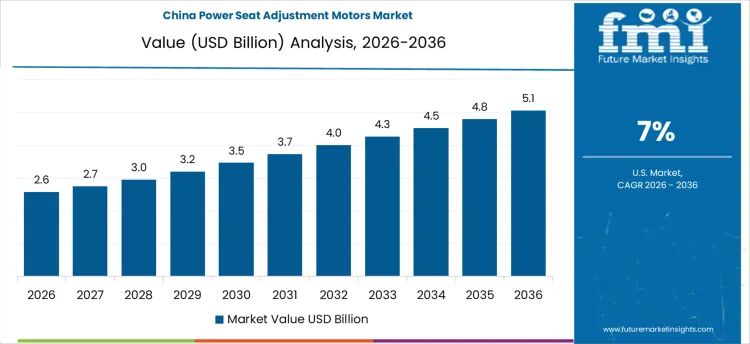
China is experiencing growth at a CAGR of 7%, supported by adoption of power seat adjustment motors market solutions to improve automotive seating comfort, customization, and operational efficiency. Manufacturers and suppliers are producing motors optimized for precise positioning, durability, and integration with vehicle electronic systems. Demand is concentrated in automotive production hubs, seating assembly plants, and R&D centers. Investments focus on motor performance, material quality, and compliance with automotive standards rather than fleet-scale deployment. Growth reflects increasing vehicle production, industrial adoption of advanced seating systems, and rising consumer preference for comfort and adjustability.
- Automotive comfort drives adoption.
- Motors optimize positioning precision and durability.
- Production hubs and R&D centers concentrate demand.
- Material quality and compliance guide investment.
How is India witnessing growth in the power seat adjustment motors market?
India is witnessing growth at a CAGR of 6.6%, fueled by adoption of power seat adjustment motors market solutions to enhance seating comfort, adjustability, and operational reliability in vehicles. Manufacturers and suppliers are deploying motors optimized for durability, precision control, and integration with vehicle electronic systems. Demand is concentrated in automotive manufacturing hubs, seating assembly facilities, and R&D centers. Investments prioritize motor performance, material quality, and adherence to automotive standards rather than fleet-scale deployment. Growth reflects rising vehicle production, industrial adoption of advanced seat adjustment systems, and increasing consumer demand for comfort features.
- Vehicle seating comfort drives adoption.
- Motors ensure durability and precision control.
- Automotive hubs and assembly centers concentrate demand.
- Material quality and standards compliance guide investment.
How is the United States experiencing growth in the power seat adjustment motors market?
United States is experiencing growth at a CAGR of 4.9%, supported by adoption of power seat adjustment motors market solutions to improve seat positioning, operational reliability, and comfort in passenger vehicles and SUVs. Manufacturers and suppliers are producing motors optimized for precise adjustment, durability, and integration with vehicle electronic modules. Demand is concentrated in automotive assembly plants, seating production hubs, and R&D centers. Investments focus on material quality, motor performance, and compliance with automotive standards rather than fleet-scale deployment. Growth reflects moderate vehicle production, industrial adoption of comfort systems, and rising consumer preference for adjustable seating.
- Seat positioning drives adoption.
- Motors optimize adjustment precision and durability.
- Assembly plants and production hubs concentrate demand.
- Material quality and performance guide investment.
How is Germany witnessing growth in the power seat adjustment motors market?
Germany is witnessing growth at a CAGR of 4.2%, fueled by adoption of power seat adjustment motors market solutions to enhance seating comfort, precision control, and operational reliability in vehicles. Manufacturers and suppliers are deploying motors optimized for durability, precise movement, and integration with automotive electronic systems. Demand is concentrated in automotive production hubs, seating assembly plants, and R&D centers. Investments prioritize motor performance, material quality, and adherence to automotive standards rather than large-scale deployment. Growth reflects moderate vehicle production, industrial adoption of advanced seat adjustment systems, and consumer demand for comfortable, adjustable seating.
- Seating comfort drives adoption.
- Motors ensure durability and precise movement.
- Production hubs and R&D centers concentrate demand.
- Material quality and standards compliance guide investment.
How is South Korea experiencing growth in the power seat adjustment motors market?
South Korea is experiencing growth at a CAGR of 5.4%, supported by adoption of power seat adjustment motors market solutions to improve seat positioning, operational reliability, and passenger comfort. Manufacturers and suppliers are producing motors optimized for precision control, durability, and integration with vehicle electronic modules. Demand is concentrated in automotive manufacturing hubs, seating assembly facilities, and R&D centers. Investments focus on material performance, motor reliability, and compliance with automotive standards rather than fleet-scale deployment. Growth reflects industrial adoption of advanced seating systems, increasing vehicle production, and consumer preference for adjustable, comfortable seating.
- Passenger comfort drives adoption.
- Motors optimize precision control and durability.
- Automotive hubs and assembly centers concentrate demand.
- Material performance and compliance guide investment.
Who Competes in the Power Seat Adjustment Motors Market and What Defines Their Capabilities?
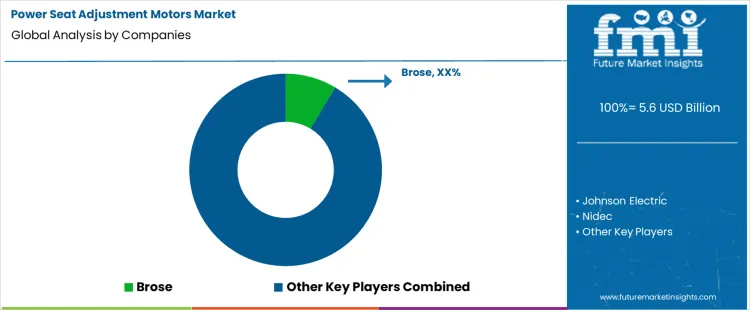
Competition in the power seat adjustment motors market is defined by torque output, energy efficiency, and integration with automotive seat control systems. Brose supplies seat adjustment motors engineered for high torque, smooth operation, and long-term reliability in driver and passenger seating. Johnson Electric develops compact motors optimized for precise seat positioning and low energy consumption. Nidec provides motors with high efficiency and consistent performance for front and rear seat adjustments. Bosch delivers integrated motor solutions compatible with seat memory and safety systems. Denso focuses on motors engineered for durability, thermal stability, and seamless integration with electronic seat controls.
Mitsuba supplies seat adjustment motors with high torque-to-size ratios and vibration resistance. Valeo provides motors integrated with ergonomic seat control modules and safety features. Mabuchi Motor delivers compact motors designed for small-space applications while maintaining precision and reliability. MinebeaMitsumi supplies high-performance motors designed for smooth and accurate seat actuation. Other regional and specialty suppliers provide motors for niche vehicle platforms, emphasizing energy efficiency, reliability, and integration with electronic seat controls. Competitive differentiation arises from torque performance, precision, thermal management, durability, and system integration with vehicle comfort and safety features.
Key Players in the Power Seat Adjustment Motors Market
- Brose
- Johnson Electric
- Nidec
- Bosch
- Denso
- Mitsuba
- Valeo
- Mabuchi Motor
- Hi-Lex
- MinebeaMitsumi
Scope of the Report
| Items | Values |
|---|---|
| Quantitative Units (2026) | USD billion |
| Motor Type | Brushed DC Motors, BLDC Motors, Stepper Motors, Other |
| Seat Function | Fore-Aft and Height, Recline, Lumbar Support, Other |
| Vehicle Segment | Mid-Range Vehicles, Premium/Luxury Vehicles, Entry-Level, Commercial Vehicles |
| Sales Channel | OEM/Tier 1 Supply, Aftermarket Service, Remanufacturing, Other |
| Region | Asia Pacific, Europe, North America, Latin America, Middle East & Africa |
| Key Countries Covered | China, India, USA, Germany, South Korea |
| Key Companies Profiled | Brose, Johnson Electric, Nidec, Bosch, Denso, Mitsuba, Valeo, Mabuchi Motor, Hi-Lex, MinebeaMitsumi |
| Additional Attributes | Dollar sales by motor type, seat function, and vehicle segment; regional CAGR, volume and value growth projections; adoption across mid-range, premium/luxury, entry-level, and commercial vehicles; focus on torque, precision, noise control, and cycle life; margins concentrated among suppliers delivering validated, high-performance motors; competitive advantage from OEM/Tier 1 integration, reliability, thermal management, and system compatibility; aftermarket and remanufacturing contribute limited incremental demand. |
Power Seat Adjustment Motors Market Segmentation
Motor Type:
- Brushed DC Motors
- BLDC Motors
- Stepper Motors
- Other
Seat Function:
- Fore-Aft and Height
- Recline
- Lumbar Support
- Other
Vehicle Segment:
- Mid-Range Vehicles
- Premium/Luxury Vehicles
- Entry-Level
- Commercial Vehicles
Sales Channel:
- OEM/Tier 1 Supply
- Aftermarket Service
- Remanufacturing
- Other
Region
- Asia Pacific
- China
- Japan
- South Korea
- India
- Australia & New Zealand
- ASEAN
- Rest of Asia Pacific
- Europe
- Germany
- United Kingdom
- France
- Italy
- Spain
- Nordic
- BENELUX
- Rest of Europe
- North America
- United States
- Canada
- Mexico
- Latin America
- Brazil
- Chile
- Rest of Latin America
- Middle East & Africa
- Kingdom of Saudi Arabia
- Other GCC Countries
- Turkey
- South Africa
- Other African Union
- Rest of Middle East & Africa
Bibliography
- National Highway Traffic Safety Administration (NHTSA). (2024). Federal Motor Vehicle Safety Standard (FMVSS) No. 207: Seating systems. USA Department of Transportation.
- National Highway Traffic Safety Administration (NHTSA). (2024). Federal Motor Vehicle Safety Standard (FMVSS) No. 210: Seat belt assembly anchorages. USA Department of Transportation.
- United Nations Economic Commission for Europe (UNECE). (2024). UN Regulation No. 17: Seats, their anchorages and head restraints.
- International Organization for Standardization (ISO). (2024). ISO 13216: Road vehicles - Seat anchorage systems and seat installations.
- SAE International. (2023). SAE J1367: Seat track and seat adjuster systems - Performance requirements.
Frequently Asked Questions
How big is the power seat adjustment motors market in 2026?
The global power seat adjustment motors market is estimated to be valued at USD 5.6 billion in 2026.
What will be the size of power seat adjustment motors market in 2036?
The market size for the power seat adjustment motors market is projected to reach USD 10.2 billion by 2036.
How much will be the power seat adjustment motors market growth between 2026 and 2036?
The power seat adjustment motors market is expected to grow at a 6.2% CAGR between 2026 and 2036.
What are the key product types in the power seat adjustment motors market?
The key product types in power seat adjustment motors market are brushed dc motors, bldc motors, stepper motors and other.
Which seat function segment to contribute significant share in the power seat adjustment motors market in 2026?
In terms of seat function, fore-aft and height segment to command 38.0% share in the power seat adjustment motors market in 2026.
Preview the report firsthand - request a free sample
Get SampleGet the brochure for pricing and purchase details.
Get PDFTable of Content
- Executive Summary
- Global Market Outlook
- Demand-side Trends
- Supply-side Trends
- Technology Roadmap Analysis
- Analysis and Recommendations
- Market Overview
- Market Coverage / Taxonomy
- Market Definition / Scope / Limitations
- Market Background
- Market Dynamics
- Drivers
- Restraints
- Opportunity
- Trends
- Scenario Forecast
- Demand in Optimistic Scenario
- Demand in Likely Scenario
- Demand in Conservative Scenario
- Opportunity Map Analysis
- Product Life Cycle Analysis
- Supply Chain Analysis
- Investment Feasibility Matrix
- Value Chain Analysis
- PESTLE and Porter’s Analysis
- Regulatory Landscape
- Regional Parent Market Outlook
- Production and Consumption Statistics
- Import and Export Statistics
- Market Dynamics
- Global Market Analysis 2021 to 2025 and Forecast, 2026 to 2036
- Historical Market Size Value (USD Million) Analysis, 2021 to 2025
- Current and Future Market Size Value (USD Million) Projections, 2026 to 2036
- Y-o-Y Growth Trend Analysis
- Absolute $ Opportunity Analysis
- Global Market Pricing Analysis 2021 to 2025 and Forecast 2026 to 2036
- Global Market Analysis 2021 to 2025 and Forecast 2026 to 2036, By Motor Type
- Introduction / Key Findings
- Historical Market Size Value (USD Million) Analysis By Motor Type , 2021 to 2025
- Current and Future Market Size Value (USD Million) Analysis and Forecast By Motor Type , 2026 to 2036
- Brushed DC Motors
- BLDC Motors
- Stepper Motors
- Other
- Brushed DC Motors
- Y-o-Y Growth Trend Analysis By Motor Type , 2021 to 2025
- Absolute $ Opportunity Analysis By Motor Type , 2026 to 2036
- Global Market Analysis 2021 to 2025 and Forecast 2026 to 2036, By Seat Function
- Introduction / Key Findings
- Historical Market Size Value (USD Million) Analysis By Seat Function, 2021 to 2025
- Current and Future Market Size Value (USD Million) Analysis and Forecast By Seat Function, 2026 to 2036
- Fore-Aft and Height
- Recline
- Lumbar Support
- Other
- Fore-Aft and Height
- Y-o-Y Growth Trend Analysis By Seat Function, 2021 to 2025
- Absolute $ Opportunity Analysis By Seat Function, 2026 to 2036
- Global Market Analysis 2021 to 2025 and Forecast 2026 to 2036, By Vehicle Segment
- Introduction / Key Findings
- Historical Market Size Value (USD Million) Analysis By Vehicle Segment, 2021 to 2025
- Current and Future Market Size Value (USD Million) Analysis and Forecast By Vehicle Segment, 2026 to 2036
- Mid-Range Vehicles
- Premium and Luxury Vehicles
- Entry-Level
- Commercial Vehicles
- Mid-Range Vehicles
- Y-o-Y Growth Trend Analysis By Vehicle Segment, 2021 to 2025
- Absolute $ Opportunity Analysis By Vehicle Segment, 2026 to 2036
- Global Market Analysis 2021 to 2025 and Forecast 2026 to 2036, By Sales Channel
- Introduction / Key Findings
- Historical Market Size Value (USD Million) Analysis By Sales Channel, 2021 to 2025
- Current and Future Market Size Value (USD Million) Analysis and Forecast By Sales Channel, 2026 to 2036
- OEM and Tier 1 Supply
- Aftermarket Service
- Remanufacturing
- Other
- OEM and Tier 1 Supply
- Y-o-Y Growth Trend Analysis By Sales Channel, 2021 to 2025
- Absolute $ Opportunity Analysis By Sales Channel, 2026 to 2036
- Global Market Analysis 2021 to 2025 and Forecast 2026 to 2036, By Region
- Introduction
- Historical Market Size Value (USD Million) Analysis By Region, 2021 to 2025
- Current Market Size Value (USD Million) Analysis and Forecast By Region, 2026 to 2036
- North America
- Latin America
- Western Europe
- Eastern Europe
- East Asia
- South Asia and Pacific
- Middle East & Africa
- Market Attractiveness Analysis By Region
- North America Market Analysis 2021 to 2025 and Forecast 2026 to 2036, By Country
- Historical Market Size Value (USD Million) Trend Analysis By Market Taxonomy, 2021 to 2025
- Market Size Value (USD Million) Forecast By Market Taxonomy, 2026 to 2036
- By Country
- USA
- Canada
- Mexico
- By Motor Type
- By Seat Function
- By Vehicle Segment
- By Sales Channel
- By Country
- Market Attractiveness Analysis
- By Country
- By Motor Type
- By Seat Function
- By Vehicle Segment
- By Sales Channel
- Key Takeaways
- Latin America Market Analysis 2021 to 2025 and Forecast 2026 to 2036, By Country
- Historical Market Size Value (USD Million) Trend Analysis By Market Taxonomy, 2021 to 2025
- Market Size Value (USD Million) Forecast By Market Taxonomy, 2026 to 2036
- By Country
- Brazil
- Chile
- Rest of Latin America
- By Motor Type
- By Seat Function
- By Vehicle Segment
- By Sales Channel
- By Country
- Market Attractiveness Analysis
- By Country
- By Motor Type
- By Seat Function
- By Vehicle Segment
- By Sales Channel
- Key Takeaways
- Western Europe Market Analysis 2021 to 2025 and Forecast 2026 to 2036, By Country
- Historical Market Size Value (USD Million) Trend Analysis By Market Taxonomy, 2021 to 2025
- Market Size Value (USD Million) Forecast By Market Taxonomy, 2026 to 2036
- By Country
- Germany
- UK
- Italy
- Spain
- France
- Nordic
- BENELUX
- Rest of Western Europe
- By Motor Type
- By Seat Function
- By Vehicle Segment
- By Sales Channel
- By Country
- Market Attractiveness Analysis
- By Country
- By Motor Type
- By Seat Function
- By Vehicle Segment
- By Sales Channel
- Key Takeaways
- Eastern Europe Market Analysis 2021 to 2025 and Forecast 2026 to 2036, By Country
- Historical Market Size Value (USD Million) Trend Analysis By Market Taxonomy, 2021 to 2025
- Market Size Value (USD Million) Forecast By Market Taxonomy, 2026 to 2036
- By Country
- Russia
- Poland
- Hungary
- Balkan & Baltic
- Rest of Eastern Europe
- By Motor Type
- By Seat Function
- By Vehicle Segment
- By Sales Channel
- By Country
- Market Attractiveness Analysis
- By Country
- By Motor Type
- By Seat Function
- By Vehicle Segment
- By Sales Channel
- Key Takeaways
- East Asia Market Analysis 2021 to 2025 and Forecast 2026 to 2036, By Country
- Historical Market Size Value (USD Million) Trend Analysis By Market Taxonomy, 2021 to 2025
- Market Size Value (USD Million) Forecast By Market Taxonomy, 2026 to 2036
- By Country
- China
- Japan
- South Korea
- By Motor Type
- By Seat Function
- By Vehicle Segment
- By Sales Channel
- By Country
- Market Attractiveness Analysis
- By Country
- By Motor Type
- By Seat Function
- By Vehicle Segment
- By Sales Channel
- Key Takeaways
- South Asia and Pacific Market Analysis 2021 to 2025 and Forecast 2026 to 2036, By Country
- Historical Market Size Value (USD Million) Trend Analysis By Market Taxonomy, 2021 to 2025
- Market Size Value (USD Million) Forecast By Market Taxonomy, 2026 to 2036
- By Country
- India
- ASEAN
- Australia & New Zealand
- Rest of South Asia and Pacific
- By Motor Type
- By Seat Function
- By Vehicle Segment
- By Sales Channel
- By Country
- Market Attractiveness Analysis
- By Country
- By Motor Type
- By Seat Function
- By Vehicle Segment
- By Sales Channel
- Key Takeaways
- Middle East & Africa Market Analysis 2021 to 2025 and Forecast 2026 to 2036, By Country
- Historical Market Size Value (USD Million) Trend Analysis By Market Taxonomy, 2021 to 2025
- Market Size Value (USD Million) Forecast By Market Taxonomy, 2026 to 2036
- By Country
- Kingdom of Saudi Arabia
- Other GCC Countries
- Turkiye
- South Africa
- Other African Union
- Rest of Middle East & Africa
- By Motor Type
- By Seat Function
- By Vehicle Segment
- By Sales Channel
- By Country
- Market Attractiveness Analysis
- By Country
- By Motor Type
- By Seat Function
- By Vehicle Segment
- By Sales Channel
- Key Takeaways
- Key Countries Market Analysis
- USA
- Pricing Analysis
- Market Share Analysis, 2025
- By Motor Type
- By Seat Function
- By Vehicle Segment
- By Sales Channel
- Canada
- Pricing Analysis
- Market Share Analysis, 2025
- By Motor Type
- By Seat Function
- By Vehicle Segment
- By Sales Channel
- Mexico
- Pricing Analysis
- Market Share Analysis, 2025
- By Motor Type
- By Seat Function
- By Vehicle Segment
- By Sales Channel
- Brazil
- Pricing Analysis
- Market Share Analysis, 2025
- By Motor Type
- By Seat Function
- By Vehicle Segment
- By Sales Channel
- Chile
- Pricing Analysis
- Market Share Analysis, 2025
- By Motor Type
- By Seat Function
- By Vehicle Segment
- By Sales Channel
- Germany
- Pricing Analysis
- Market Share Analysis, 2025
- By Motor Type
- By Seat Function
- By Vehicle Segment
- By Sales Channel
- UK
- Pricing Analysis
- Market Share Analysis, 2025
- By Motor Type
- By Seat Function
- By Vehicle Segment
- By Sales Channel
- Italy
- Pricing Analysis
- Market Share Analysis, 2025
- By Motor Type
- By Seat Function
- By Vehicle Segment
- By Sales Channel
- Spain
- Pricing Analysis
- Market Share Analysis, 2025
- By Motor Type
- By Seat Function
- By Vehicle Segment
- By Sales Channel
- France
- Pricing Analysis
- Market Share Analysis, 2025
- By Motor Type
- By Seat Function
- By Vehicle Segment
- By Sales Channel
- India
- Pricing Analysis
- Market Share Analysis, 2025
- By Motor Type
- By Seat Function
- By Vehicle Segment
- By Sales Channel
- ASEAN
- Pricing Analysis
- Market Share Analysis, 2025
- By Motor Type
- By Seat Function
- By Vehicle Segment
- By Sales Channel
- Australia & New Zealand
- Pricing Analysis
- Market Share Analysis, 2025
- By Motor Type
- By Seat Function
- By Vehicle Segment
- By Sales Channel
- China
- Pricing Analysis
- Market Share Analysis, 2025
- By Motor Type
- By Seat Function
- By Vehicle Segment
- By Sales Channel
- Japan
- Pricing Analysis
- Market Share Analysis, 2025
- By Motor Type
- By Seat Function
- By Vehicle Segment
- By Sales Channel
- South Korea
- Pricing Analysis
- Market Share Analysis, 2025
- By Motor Type
- By Seat Function
- By Vehicle Segment
- By Sales Channel
- Russia
- Pricing Analysis
- Market Share Analysis, 2025
- By Motor Type
- By Seat Function
- By Vehicle Segment
- By Sales Channel
- Poland
- Pricing Analysis
- Market Share Analysis, 2025
- By Motor Type
- By Seat Function
- By Vehicle Segment
- By Sales Channel
- Hungary
- Pricing Analysis
- Market Share Analysis, 2025
- By Motor Type
- By Seat Function
- By Vehicle Segment
- By Sales Channel
- Kingdom of Saudi Arabia
- Pricing Analysis
- Market Share Analysis, 2025
- By Motor Type
- By Seat Function
- By Vehicle Segment
- By Sales Channel
- Turkiye
- Pricing Analysis
- Market Share Analysis, 2025
- By Motor Type
- By Seat Function
- By Vehicle Segment
- By Sales Channel
- South Africa
- Pricing Analysis
- Market Share Analysis, 2025
- By Motor Type
- By Seat Function
- By Vehicle Segment
- By Sales Channel
- USA
- Market Structure Analysis
- Competition Dashboard
- Competition Benchmarking
- Market Share Analysis of Top Players
- By Regional
- By Motor Type
- By Seat Function
- By Vehicle Segment
- By Sales Channel
- Competition Analysis
- Competition Deep Dive
- Brose
- Overview
- Product Portfolio
- Profitability by Market Segments (Product/Age /Sales Channel/Region)
- Sales Footprint
- Strategy Overview
- Marketing Strategy
- Product Strategy
- Channel Strategy
- Johnson Electric
- Nidec
- Bosch
- Denso
- Mitsuba
- Valeo
- Mabuchi Motor
- Hi-Lex
- MinebeaMitsumi
- Brose
- Competition Deep Dive
- Assumptions & Acronyms Used
- Research Methodology


