

- Industry Size (2026)
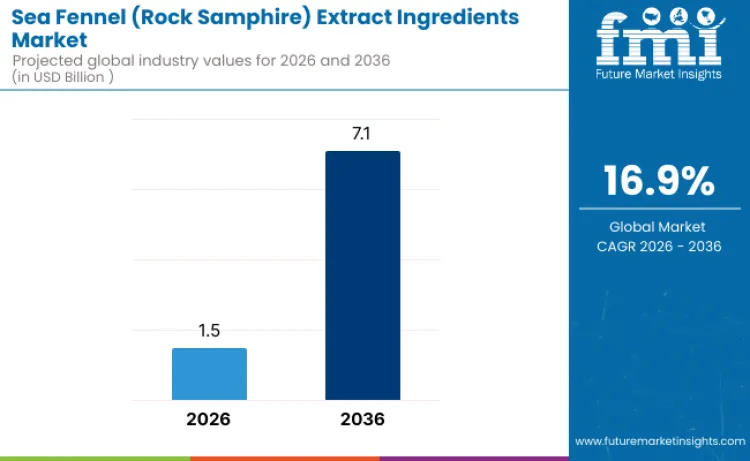
- USD 1.5 Bn
- Forecast (2036)
- USD 7.1 Bn
- CAGR (2026 to 2036)
- 16.9%
Sea Fennel (Rock Samphire) Extract Ingredients Market Forecast and Outlook 2026 to 2036
The sea fennel (rock samphire) extract ingredients market is valued at USD 1.5 billion in 2026 and is projected to reach USD 7.1 billion by 2036, reflecting a CAGR of 16.9%. Demand grows as sea fennel gains traction in beauty, nutraceutical, and functional food formulations due to its antioxidant, skin-regenerative, and mineral-rich profile. Interest in coastal botanicals and marine-inspired wellness adds momentum across premium product categories.
Whole-plant sea fennel extract leads extract-type usage because processing the full aerial plant captures synergistic polyphenols, carotenoids, essential oils, and marine minerals that define its bioactivity. Mild extraction processes strengthen aroma retention and maintain stability of sensitive actives suited for skincare serums, detox blends, and functional nutrition applications. Standardization enhances consistency for large-scale formulation.
China, India, USA, and Japan act as major global growth regions due to rising demand for botanicals with Mediterranean provenance, clean-label skincare ingredients, and functional coastal plant extracts. Nexira, Naturex (Givaudan), Greentech, FLAVEX, and Martin Bauer Group guide competitive activity through controlled coastal harvesting programs, high-precision extraction technologies, and application support for cosmetic, supplement, and functional food developers using sea fennel–based ingredients.
Quick Stats for Sea Fennel (Rock Samphire) Extract Ingredients Market
- Market Value (2026): USD 1.5 billion
- Market Forecast Value (2036): USD 7.1 billion
- Market Forecast CAGR (2026–2036): 16.9%
- Leading Extract Type in Global Demand: Whole-plant sea fennel extract
- Key Growth Regions in Global Demand: China, India, USA, Japan
- Top Players in Global Demand: Nexira, Naturex (Givaudan), Greentech, FLAVEX, Martin Bauer Group
Sea Fennel (Rock Samphire) Extract Ingredients Market Key Takeaways
| Metric | Value |
|---|---|
| Market Value (2026) | USD 1.5 billion |
| Market Forecast Value (2036) | USD 7.1 billion |
| Forecast CAGR (2026-2036) | 16.9% |
How Are the Segments Classified in the Sea Fennel (Rock Samphire) Extract Ingredients Market?
Demand for sea fennel extract ingredients is shaped by interest in coastal botanicals rich in marine antioxidants, detox-support compounds, and skin-regenerative phytochemicals. Buyers evaluate polyphenol density, aromatic fraction purity, hydrosol stability, and suitability for cosmetic, nutraceutical, and functional-food formulations. Adoption patterns reflect increased use of sustainably harvested rock samphire, valued for bioactive content influenced by saline, wind-exposed Mediterranean and Atlantic coastal environments.
Which Extract Type Accounts for the Largest Share of Global Demand?
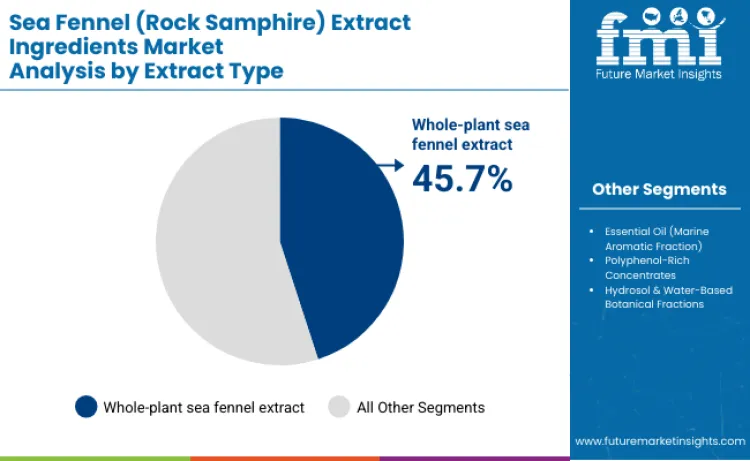
Whole-plant sea fennel extract holds 45.7%, making it the leading extract-type segment globally. Whole-plant extraction captures carotenoids, chlorogenic acids, marine polyphenols, and aromatic compounds that support detoxification and skin-rejuvenation functions. Essential oil fractions supply concentrated marine aromatic notes rich in limonene and sabinene. Polyphenol-rich concentrates target antioxidant demand in supplements and functional foods. Hydrosol and water-based botanical fractions support gentle cosmetic formulations. Extract-type distribution reflects strong interest in full-spectrum whole-plant profiles.
Key Points:
- Whole-plant extracts deliver broad-spectrum marine phytochemicals.
- Essential oils supply concentrated aromatic components.
- Polyphenol concentrates target antioxidant applications.
- Hydrosols support mild cosmetic and wellness formulations.
Which Extraction Method Represents the Largest Share of Global Demand?
Steam distillation holds 44.3%, making it the largest extraction-method segment globally. This method efficiently recovers volatile marine aromatics and hydrosol components while maintaining pesticide-free purity for coastal botanicals. Supercritical CO₂ extraction enhances yield of heat-sensitive lipophilic compounds. Solvent-free bioactive retention extraction supports high-purity polyphenol recovery for regulated nutraceutical uses. Cold-press mechanical extraction provides minimally processed outputs with preserved natural composition. Extraction-method distribution reflects broad use of steam distillation for both essential oils and hydrosols.
Key Points:
- Steam distillation recovers volatile marine aromatics and hydrosols.
- Supercritical CO₂ preserves heat-sensitive bioactives.
- Solvent-free retention methods concentrate polyphenols.
- Cold-press extraction supports minimally processed formats.
Which Application Accounts for the Largest Share of Global Demand?
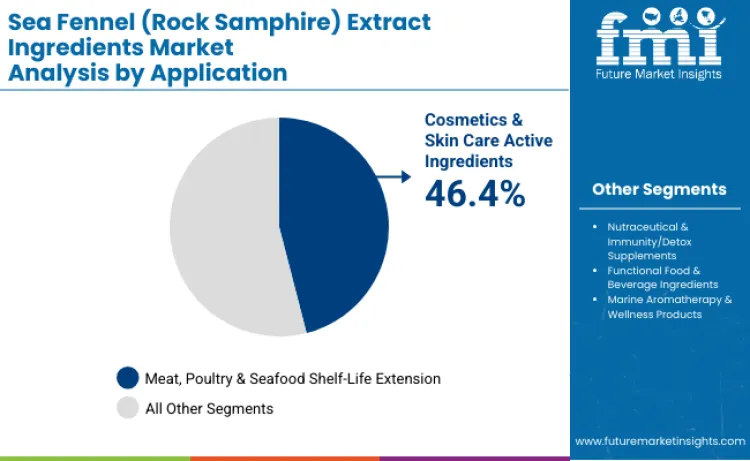
Cosmetics and skin-care active ingredients hold 46.4%, making them the leading application segment globally. Sea fennel extracts provide antioxidant protection, skin-brightening support, and mild exfoliating action through natural retinoid-like compounds. Nutraceutical detox and immunity supplements use polyphenol-rich fractions for cellular-protection benefits. Functional food and beverage formulations incorporate extracts for marine-derived antioxidant activity. Marine aromatherapy and wellness products rely on essential oil fractions for coastal aromatic identity. Application distribution reflects strong cosmetic-sector adoption driven by skin-regeneration claims.
Key Points:
- Skin-care actives use extracts for antioxidant and renewal functions.
- Supplements rely on polyphenol-rich detox-support fractions.
- Functional foods adopt marine antioxidants for health positioning.
- Aromatherapy products use essential oils for coastal aromatic profiles.
What are the Key Dynamics in the Sea Fennel (Rock Samphire) Extract Ingredients Market?
Global demand rises as food, nutraceutical, and cosmetic sectors adopt sea fennel extracts valued for mineral-rich, antioxidant, and aromatic profiles. Ingredients derived from coastal rock samphire support clean-label positioning, marine-origin storytelling, and natural preservation functions. Brands evaluate extracts for hydration, soothing, and detox alignment in topical products, while food producers explore use in gourmet seasonings and functional beverages. Interest grows as consumers seek traceable coastal botanicals with distinctive sensory characteristics.
How are marine botanical trends and functional ingredient needs shaping adoption of sea fennel extract ingredients?
Sea fennel accumulates bioactive compounds including vitamin C, polyphenols, and essential minerals influenced by saline, wind-exposed coastal environments. Nutraceutical companies explore extracts for metabolic and antioxidant formulations. Cosmetic brands use sea fennel for skin-conditioning, anti-inflammatory, and barrier-support functions in serums and creams. Food developers adopt extracts for briny aromatic profiles suited to gourmet applications. Suppliers stabilize extracts to ensure consistency in aroma and potency. Clean-label demand strengthens adoption, as sea fennel offers plant-derived functionality without synthetic additives. Marine-origin ingredients gain traction among brands seeking differentiation through regional coastal sourcing narratives.
How do habitat constraints, compositional variability, and regulatory demands influence scalability?
Wild sea fennel availability depends on coastal ecosystem health and controlled harvesting to prevent habitat depletion. Compositional variability arises from differences in salinity, microclimate, and seasonal growth, requiring precise standardization. Extraction processes must preserve volatile aromatic compounds while maintaining purity for food and cosmetic use. Regulatory frameworks vary across markets, influencing allowable usage levels, solvent systems, and claim language. Documentation on allergen status, contaminants, and geographic origin is essential for compliance. Scaling supply requires partnerships with coastal cultivators or managed foraging systems that support dependable volumes and long-term ecological sustainability.
How is Demand for Sea Fennel (Rock Samphire) Extract Ingredients Market Evolving Across Key Countries?
Demand for the sea fennel (rock samphire) extract ingredients market is rising due to increased interest in marine-sourced botanicals, expansion of natural antioxidant and anti-inflammatory ingredient applications, and strong clean-label formulation trends. China records a CAGR of 18.1% supported by growing nutraceutical and personal-care sectors. India shows a 17.4% CAGR driven by herbal and functional-food expansion. USA posts a 16.3% CAGR supported by natural-ingredient and wellness demand. Japan holds a 15.4% CAGR linked with precision botanical-processing capabilities. UK records a 14.8% CAGR supported by natural-extract adoption across food, beverage, and wellness categories.
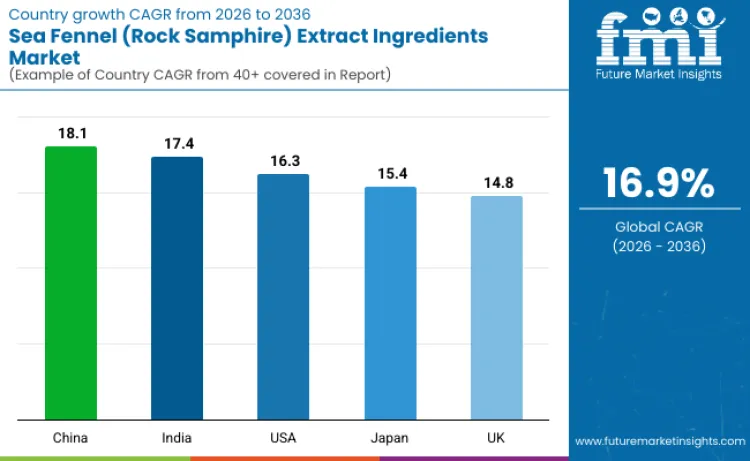
| Country | CAGR (%) |
|---|---|
| China | 18.1% |
| India | 17.4% |
| USA | 16.3% |
| Japan | 15.4% |
| UK | 14.8% |
How is China driving demand for Sea Fennel (Rock Samphire) Extract Ingredients?
China drives demand due to rapid growth in nutraceuticals, functional foods, and marine-derived ingredient research. The country’s CAGR of 18.1% reflects increased use of sea fennel extracts rich in polyphenols, minerals, carotenoids, and aromatic compounds. Extraction firms enhance supercritical-CO₂, ultrasonic, and low-temperature processing to preserve bioactivity. Food producers incorporate sea fennel extracts for natural preservation, antioxidant enhancement, and flavor complexity. Personal-care brands use high-purity fractions in skin-protection, anti-inflammatory, and toning formulations. National focus on innovative natural ingredients strengthens long-term development.
- Growth in nutraceutical and functional-food applications
- Scale-up of optimized extraction technologies
- Use in natural preservation and antioxidant roles
- Increased personal-care adoption for skin-protective effects
How is India driving demand for Sea Fennel (Rock Samphire) Extract Ingredients?
India supports rising demand due to expansion of herbal wellness systems, increased integration of marine botanicals, and adoption of natural preservatives and antioxidants. The country’s CAGR of 17.4% reflects broader use of sea fennel extracts in supplements, herbal formulations, and functional foods. Extraction firms refine CO₂ and solvent-free processing to retain minerals and phenolic compounds. Food producers explore sea fennel’s aromatic notes and stability-enhancing properties. Personal-care brands adopt extract fractions for anti-inflammatory, toning, and skin-conditioning functions. Growing natural-ingredient infrastructure strengthens sustained demand.
- Adoption in supplements and herbal blends
- Improved extraction preserving bioactive components
- Food-industry use for flavor and antioxidant stability
- Personal-care integration for anti-inflammatory benefits
How is the USA driving demand for Sea Fennel (Rock Samphire) Extract Ingredients?
USA drives demand through strong clean-label trends, increased use of marine botanicals, and broad adoption of natural antioxidants across food, beverage, and personal-care categories. The country’s CAGR of 16.3% reflects incorporation of sea fennel extracts in functional foods, natural preservatives, and wellness-oriented supplements. Manufacturers refine extraction and standardization processes ensuring consistent mineral and polyphenol profiles. Food and beverage brands explore sea fennel for flavor, antioxidant support, and natural stabilization. Personal-care firms adopt extracts in skin-rejuvenation and toning products. Natural-ingredient development accelerates continued growth.
- Integration into functional foods and supplements
- Standardization of extracts for consistent bioactive content
- Use in natural food preservation and flavor enhancement
- Personal-care adoption for skin-rejuvenation applications
How is Japan driving demand for Sea Fennel (Rock Samphire) Extract Ingredients?
Japan drives demand due to strict purity expectations, advanced botanical-processing technologies, and strong interest in marine-derived antioxidants. The country’s CAGR of 15.4% reflects adoption of refined sea fennel extracts in functional foods, beverages, and cosmetics. Producers use supercritical-CO₂, membrane filtration, and enzymatic extraction to enhance purity and preserve volatile components. Food firms incorporate extracts to support flavor stability and antioxidant function. Cosmetic companies use sea fennel fractions in anti-inflammatory, brightening, and firming formulations. Emphasis on precision formulations sustains market growth.
- Precision extraction for high-purity marine-botanical ingredients
- Use in functional foods for stability and antioxidant benefits
- Cosmetic integration for brightening and anti-inflammatory effects
- High formulation standards supporting adoption
How is the UK driving demand for Sea Fennel (Rock Samphire) Extract Ingredients?
UK supports demand through clean-label product expansion, increased interest in marine botanicals, and broader adoption of natural antioxidants and skin-care actives. The country’s CAGR of 14.8% reflects use of sea fennel extracts in supplements, herbal infusions, and food-preservation applications. Food brands explore extract functions supporting flavor and oxidative stability. Personal-care producers incorporate sea fennel fractions in toning, firming, and protective formulations. Regulatory support for natural ingredients reinforces broad acceptance across wellness sectors.
- Use in supplements and herbal infusions
- Food-preservation and flavor-stability adoption
- Personal-care use for firming and protective applications
- Regulatory support for marine-derived botanical ingredients
What is the competitive landscape of demand for sea fennel (rock samphire) extract ingredients globally?
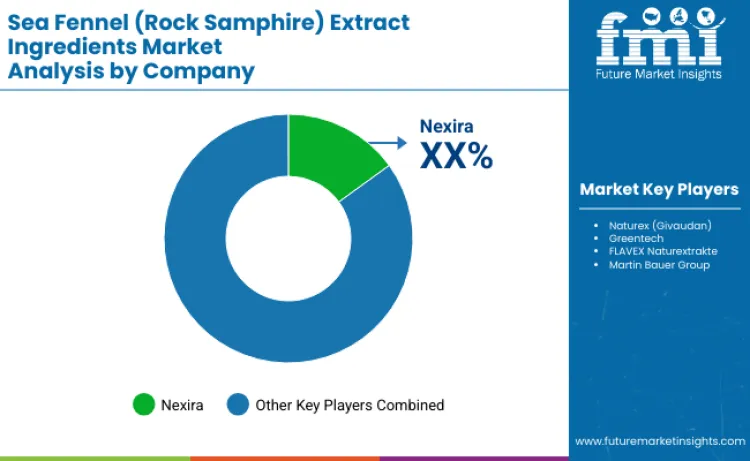
Demand for sea fennel extract ingredients grows as food, nutraceutical, and personal care producers expand use of coastal botanicals containing marine-adapted phytonutrients. Requirements center on validated botanical identity, controlled harvesting from Mediterranean coastal zones, and extraction processes preserving chlorogenic acids, carotenoids, and mineral-rich fractions. Buyers evaluate purity, sensory attributes, microbial stability, and solvent-residue limits supporting functional beverages, culinary seasonings, topical formulations, and wellness products. Procurement teams prioritize sustainable wild-harvest or cultivated supply networks, batch consistency, and traceability aligned with regulatory expectations for natural extracts. Trend in the global market reflects increased interest in maritime botanicals offering antioxidant activity, mineral enrichment, and clean-label positioning.
Nexira holds an estimated 27.0% share. Position strengthens through standardized marine botanical extracts supported by controlled sourcing partnerships along Mediterranean regions. Naturex (Givaudan) participates with sea fennel extracts incorporated into flavor, nutrition, and cosmetic formulations requiring validated phytochemical profiles. Greentech maintains visibility with bioactive marine-plant fractions developed for dermocosmetic and wellness applications. FLAVEX Naturextrakte contributes CO₂-extracted sea fennel concentrates offering controlled purity and aromatic stability. Martin Bauer Group supports demand with coastal botanical ingredients integrated into herbal and functional formulations. Competitive positioning globally reflects extraction efficiency, phytochemical standardization, sourcing transparency, and regulatory compliance supporting food, nutraceutical, and personal care applications.
Key Players in the Sea Fennel (Rock Samphire) Extract Ingredients Market
- Nexira
- Naturex (Givaudan)
- Greentech
- FLAVEX Naturextrakte
- Martin Bauer Group
Scope of the Report
| Items | Values |
|---|---|
| Quantitative Units | USD billion |
| Extract Type | Whole-Plant Sea Fennel Extract; Essential Oil (Marine Aromatic Fraction); Polyphenol-Rich Concentrates; Hydrosol & Water-Based Botanical Fractions |
| Extraction Method | Steam Distillation; Supercritical CO₂ Extraction; Solvent-Free Bioactive Retention Extraction; Cold-Press Mechanical Extraction |
| Application | Cosmetics & Skin Care Active Ingredients; Nutraceutical & Immunity/Detox Supplements; Functional Food & Beverage Ingredients; Marine Aromatherapy & Wellness Products |
| End-User | Cosmetic & Personal Care Brands; Nutraceutical Manufacturers; Food & Beverage Companies; Botanical Extract & Ingredient Suppliers |
| Regions Covered | Asia Pacific, Europe, North America, Latin America, Middle East & Africa |
| Countries Covered | India, China, USA, Germany, South Korea, Japan, Italy, and 40+ countries |
| Key Companies Profiled | Nexira; Naturex (Givaudan); Greentech; FLAVEX Naturextrakte; Martin Bauer Group |
| Additional Attributes | Dollar sales by extract type and extraction method; adoption trends in cosmetic actives featuring marine botanicals; rising use of sea fennel polyphenols in detox and immunity nutraceuticals; demand uptake in functional beverages and marine aromatherapy; technological advancements in solvent-free and supercritical CO₂ extraction for marine plants; sustainability and traceability considerations for coastal foraged botanicals; competitive landscape of marine botanical ingredient suppliers. |
Sea Fennel (Rock Samphire) Extract Ingredients Market by Segment
By Extract Type:
- Whole-Plant Sea Fennel Extract
- Essential Oil (Marine Aromatic Fraction)
- Polyphenol-Rich Concentrates
- Hydrosol & Water-Based Botanical Fractions
By Extraction Method:
- Steam Distillation
- Supercritical CO₂ Extraction
- Solvent-Free Bioactive Retention Extraction
- Cold-Press Mechanical Extraction
By Application:
- Cosmetics & Skin Care Active Ingredients
- Nutraceutical & Immunity/Detox Supplements
- Functional Food & Beverage Ingredients
- Marine Aromatherapy & Wellness Products
By End-User:
- Cosmetic & Personal Care Brands
- Nutraceutical Manufacturers
- Food & Beverage Companies
- Botanical Extract & Ingredient Suppliers
Region:
- Asia Pacific
- China
- Japan
- South Korea
- India
- Australia & New Zealand
- ASEAN
- Rest of Asia Pacific
- Europe
- Germany
- United Kingdom
- France
- Italy
- Spain
- Nordic
- BENELUX
- Rest of Europe
- North America
- United States
- Canada
- Mexico
- Latin America
- Brazil
- Chile
- Rest of Latin America
- Middle East & Africa
- Kingdom of Saudi Arabia
- Other GCC Countries
- Turkey
- South Africa
- Other African Union
- Rest of Middle East & Africa
Frequently Asked Questions
What is the size of the sea fennel (rock samphire) extract ingredients market in 2026?
The market is valued at USD 1.5 billion in 2026 due to increased adoption of marine botanical extracts in skincare and health applications.
What will be the industry size by 2036?
Industry value will reach USD 7.1 billion by 2036 as manufacturers scale extraction capacity and expand use of sea fennel ingredients in premium formulations.
What is the CAGR for 2026-2036?
The sea fennel extract ingredients market expands at a 16.9% CAGR during the forecast period.
Which extract-type segment leads in 2026?
Whole-plant sea fennel extract holds 45.7% share, reflecting strong demand for full-spectrum marine botanical compositions.
Which extraction-method segment holds the highest share?
Steam distillation leads with 44.3% share due to established suitability for aromatic and nutrient-rich marine plant extracts.
Preview the report firsthand - request a free sample
Get SampleGet the brochure for pricing and purchase details.
Get PDFTable of Content
- Executive Summary
- Rosemary-Citrus Synergy Antioxidant Systems Market Overview
- Global Market Size and Value Analysis, 2020 to 2026
- Global Market Forecast and Growth Outlook, 2026 to 2036
- Natural Antioxidant Ingredient Value Chain Analysis
- Role of Botanical Synergy in Oxidative Stability Enhancement
- Market Dynamics and Industry Fundamentals
- Key Market Drivers
- Raw Material and Processing Constraints
- Opportunities in Clean Label and Synthetic Antioxidant Replacement
- Regulatory, Safety, and Labeling Considerations
- Market Segmentation Analysis by Blend Type
- Rosemary-Citrus Synergistic Antioxidant Blends
- Carnosic Acid plus Citrus Bioflavonoid Systems
- Rosemary Polyphenol plus Citrus Terpenoid Blends
- Multi-Component Natural Antioxidant Complexes
- Market Segmentation Analysis by Citrus Component
- Citrus Bioflavonoid Extracts Hesperidin and Naringin
- Cold-Pressed Citrus Peel Essential Oils
- Citrus Terpene Fractions Limonene-Rich
- Water-Soluble Citrus Antioxidant Concentrates
- Market Segmentation Analysis by Application
- Meat, Poultry, and Seafood Shelf-Life Extension
- Functional Food and Beverage Preservation
- Nutraceutical and Immune Support Formulations
- Natural Antioxidants for Bakery and Snack Products
- Market Segmentation Analysis by End-User
- Food and Nutraceutical Brands
- Meat and Poultry Processors
- Functional Beverage Producers
- Botanical Extract and Ingredient Manufacturers
- Regional Market Analysis
- North America Market Analysis
- Latin America Market Analysis
- Western Europe Market Analysis
- Eastern Europe Market Analysis
- South Asia and Pacific Market Analysis
- East Asia Market Analysis
- Middle East and Africa Market Analysis
- Country-Level Market Analysis
- United States
- Canada
- Mexico
- Brazil
- Argentina
- Germany
- France
- United Kingdom
- Italy
- Spain
- Netherlands
- China
- India
- Japan
- South Korea
- ANZ
- GCC Countries
- South Africa
- Competitive Landscape Analysis
- Global Competitive Structure
- Market Share Analysis of Botanical Antioxidant Suppliers
- Extraction Technology and Standardization Differentiation
- Application Support and Customer Integration Strategies
- Company Profiles
- Scope of the Report
- Research Methodology
- Assumptions and Acronyms


