

- Market Size (2026)
- USD 29.2 Mn
- Forecast (2036)
- USD 58.0 Mn
- CAGR (2026 to 2036)
- 41.0%
Red Orange Anthocyanin Extract Ingredients Market Size, Market Forecast and Outlook By FMI
The red orange anthocyanin extract ingredients market crossed a valuation of USD 27.3 million in 2025. Demand is set to value at USD 29.2 million in 2026 and reach USD 58.0 million by 2036, reflecting a 7.1% CAGR during the forecast period. Clinical support for skin health applications, along with steady investment in high-value citrus bioactives, is helping sustain demand for red orange anthocyanin extract ingredients over other citrus-derived options.
Summary of Red Orange Anthocyanin Extract Ingredients Market
- Market Snapshot
- The red orange anthocyanin extract ingredients market valuation was USD 27.3 million in 2025 and is projected to reach USD 58.0 million by 2036.
- The red orange anthocyanin extract ingredients market is expected to register a 7.1% CAGR from 2026 to 2036.
- Revenue coverage includes anthocyanin-rich extracts derived from red or blood oranges for supplements, food colors, functional beverages, and selected personal-care uses.
- Market relevance continues to strengthen alongside rising preference for natural color systems across the United States and Europe, supported by ongoing commercial acceptance of anthocyanins as a pigment family.
- Demand and Growth Drivers
- Food and beverage manufacturers are showing more interest in anthocyanin sources as pressure rises to replace petroleum-based synthetic dyes with natural alternatives.
- Blood-orange extracts carry added value because color functionality comes together with antioxidant and nutraceutical appeal, opening wider use beyond food coloration alone.
- Sicily remains central to blood-orange cultivation and extract branding, while Spain and other producing regions add seasonal support to raw-material availability.
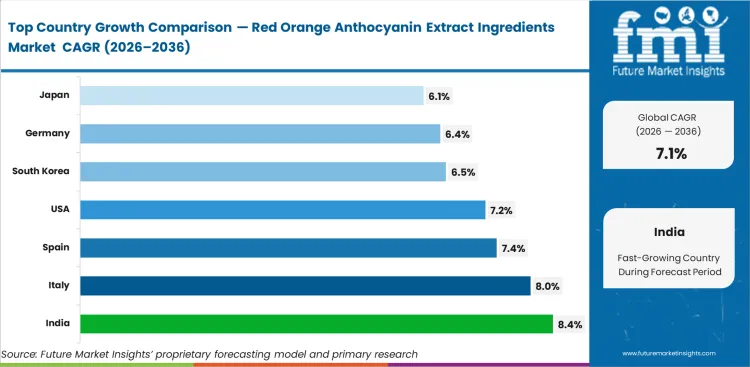
- India records the fastest pace at 8.4% CAGR, followed by Italy at 8.0%, Spain at 7.4%, United States at 7.2%, South Korea at 6.5%, Germany at 6.4%, and Japan at 6.1%.
- Growth remains moderated by raw-material concentration risk, anthocyanin stability limits in some finished systems, and blood orange’s smaller raw-material base relative to black carrot, grape skin, and berry sources.
- Product and Segment View
- Market coverage spans powder, liquid, granule, and emulsion formats, sold mainly as anthocyanin-standardized or polyphenol-standardized extracts.
- End-use demand comes from dietary supplements, functional beverages, food colors, and personal care.
- Moro is set to hold a 41.0% share in the source variety segment, supported by stronger pigmentation and the visibility of Moro-based branded extracts.
- Powder is expected to account for a 48.0% share in the form segment, driven by easier handling, smoother blending, and longer shelf stability for ingredient buyers.
- Dietary supplements are projected to capture a 44.0% share in the application segment, supported by stronger visibility of branded blood-orange extracts in weight-management and antioxidant positioning.
- Anthocyanin-standardized extracts segment is likely to secure a 52.0% share in the standardization segment, reflecting buyer preference for measurable active loading over generic citrus solids.
- Direct B2B is anticipated to command a 62.0% share in the sales channel segment, since most volume moves through ingredient suppliers, formulators, and contract manufacturers instead of retail packs.
- Scope includes bulk ingredient revenue from blood-orange-derived anthocyanin extracts and standardized red-orange complexes, while excluding finished supplement sales, retail juice value, citrus essential oils, and non-anthocyanin orange flavor systems.
- Geography and Competitive Outlook
- India, Italy, and Spain represent faster-growth pockets in this market, while the United States and Germany continue as stable high-value formulation and consumption bases.
- Competitive advantage depends on branded extract platforms, distributor reach, and consistent supply of standardized anthocyanin content backed by technical documentation.
- Key participants include Bionap S.r.l., Branded Ingredients LLC, Native Extracts Pty Ltd, Natherm Group Sdn Bhd, and Bioway.
- Market concentration remains limited, though Bionap appears to hold the clearest branded leadership position with majority share.
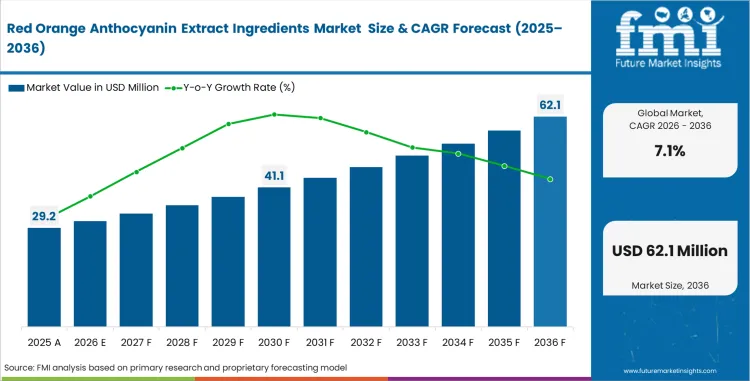
Key Takeaways, Market Size, and Forecast
- Red Orange Anthocyanin Extract Ingredients Market is projected to grow from USD 29.2 million in 2026 to USD 58.0 million by 2036, at a CAGR of 7.1%.
- The red orange anthocyanin extract ingredients market was valued at USD 27.3 million in 2025.
- By 2036, the Red Orange Anthocyanin Extract Ingredients Market is expected to be worth USD 58.0 million.
- From 2026 to 2036, the market is projected to expand at a CAGR of 7.1%.
- The market is projected to create an incremental opportunity of USD 28.8 million between 2026 and 2036.
- In 2026, Moro is expected to account for 41.0% of the source variety segment.
- India (8.4%) and Italy (8.0%) are two of the fastest growing markets.
Red Orange Anthocyanin Extract Ingredients Market Key Takeaways
| Metric | Details |
|---|---|
| Industry Size (2026) | USD 29.2 million |
| Industry Value (2036) | USD 58.0 million |
| CAGR (2026–2036) | 7.1% |
Source: Future Market Insights (FMI) analysis, based on proprietary forecasting model and primary research
Demand continues to build through two clear commercial channels. Nutraceutical brands are using red orange extracts in metabolic health, antioxidants, and healthy-aging product lines. Food and beverage manufacturers are also adopting these ingredients for naturally sourced color and polyphenol positioning in premium formulations.
Product adoption remains selective because anthocyanins are chemically sensitive, and stability across extraction, storage, and finished-product shelf life still affects buyer confidence. Beverage testing has also indicated a mismatch in some products between label positioning and retained anthocyanin color performance. Standardization, stabilization, and analytical verification remain central to supplier credibility. Suppliers holding stronger control over Sicilian raw material access, pigment retention, and finished-format consistency are positioned to sustain a stronger market position through 2036.
India is expected to register an 8.4% CAGR during the forecast period, supported by domestic contract manufacturers expanding citrus processing capacity for export-oriented demand. Italy is estimated to grow at an 8.0% CAGR over the forecast period, backed by Sicilian agricultural cooperatives operating across tightly held premium cultivation areas. Spain is poised to expand at a 7.4% CAGR during the study period, aided by established citrus-processing expertise and continued interest in natural color ingredients. During the assessment period, demand in the United States is projected to rise at a 7.2% CAGR, supported by premium nutraceutical and functional beverage adoption. South Korea is set to advance at a 6.5% CAGR, Germany and Japan are anticipated to record CAGRs of 6.4% and 6.1%, respectively.
Segmental Analysis
Red Orange Anthocyanin Extract Ingredients Market Analysis by Source Variety
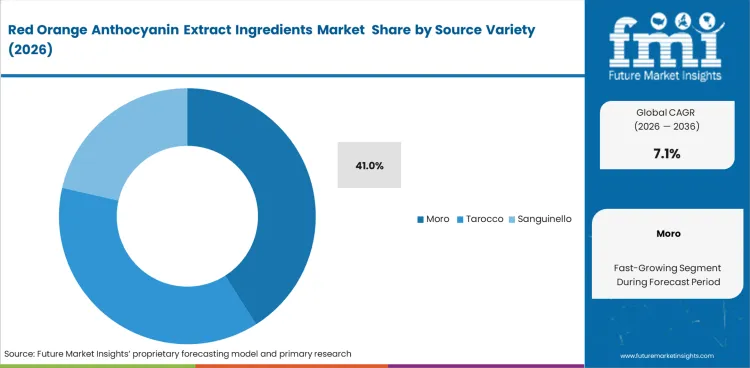
Demand for natural pigments continues to rise as brands move away from synthetic red shades that create label risk and reformulation pressure. Moro remains the preferred cultivar in this ingredient space because its deeper native pigmentation supports stronger output per unit of extract, while richer anthocyanin density adds value in premium nutraceutical and beauty-positioned formulations. Long-established cultivation across Sicily also supports steadier raw material access, a major commercial advantage linked closely to seasonal fruit quality and harvest adherence. In 2026, the Moro segment is poised to account for 41.0% of market share. Preference for this cultivar also reflects easier color standardization in large production batches and a better fit for buyers seeking consistent visual intensity across capsules, powders, sachets, and functional blends.
- Initial pigment validation: Incoming lots undergo close review for color density and anthocyanin strength before acceptance into commercial production. Teams comparing Moro with Tarocco or Sanguinello generally favor inputs that deliver target shade intensity without pushing dosage too high. Lower inclusion rates support cleaner formulations, tighter batch economics, and better flexibility in finished-product design.
- Batch color consistency: Active compound consistency matters across repeat production cycles, especially in premium supplements and powdered drink mixes. Any swing in shade strength or anthocyanin concentration can complicate line calibration, label claims, and sensory alignment. Moro often gains preference under this filter because stronger pigmentation gives manufacturers a wider operating cushion during blending and filling.
- Brand formulation loyalty: Once a successful launch gains shelf traction with a defined visual profile, ingredient changes become far less attractive. Stable cultivar identity supports long-term product continuity, stronger consumer recognition, and cleaner regulatory documentation. That commercial stickiness adds another layer of advantage for Moro-based sourcing programs.
Red Orange Anthocyanin Extract Ingredients Market Analysis by Form
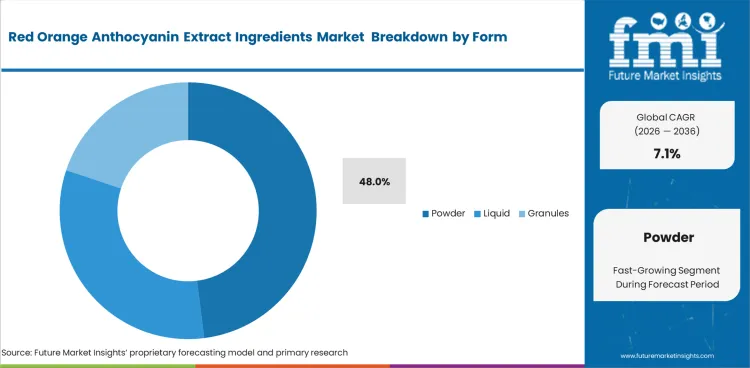
Product form selection carries major implications for transport, storage, handling, and retained activity across commercial shelf life. Powder remains the leading format because dry systems offer better physical stability than liquid alternatives in a category sensitive to oxidation, light exposure, and temperature drift. Free-flowing powders also integrate more smoothly into capsules, stick packs, tablets, and dry beverage premixes, giving manufacturers broader downstream flexibility without major process redesign. The powder segment is likely to account for 48.0% share in 2026. Another point supporting powder adoption is easier warehousing under ambient conditions, reduced freight complexity, and stronger fit with global ingredient distribution models serving manufacturers and formulation houses.
- Storage logistics optimization: Ambient-stable inputs reduce dependence on cold-chain handling and simplify inventory planning across regional warehouses. Bulk buyers often prefer powder for this reason alone, since dry material generally carries lower spoilage risk during transport delays or fluctuating warehouse throughput. This advantage becomes more meaningful in export-oriented supply programs.
- Processing machinery compatibility: Powdered ingredients move more cleanly through high-speed encapsulation, sachet filling, and dry blending systems. Liquid formats can introduce dosing complexity, residue buildup, or additional cleaning cycles on equipment not designed for viscous botanical inputs. Smoother line operation improves throughput and reduces avoidable process disruption.
- Lifecycle stability auditing: Retained anthocyanin activity and visible color integrity remain central to buyer confidence. Powder formats often perform better during long storage studies, giving brands stronger support for shelf-life claims and finished-product consistency. Reliability supports broader adoption across premium supplement and functional nutrition applications.
Red Orange Anthocyanin Extract Ingredients Market Analysis by Application
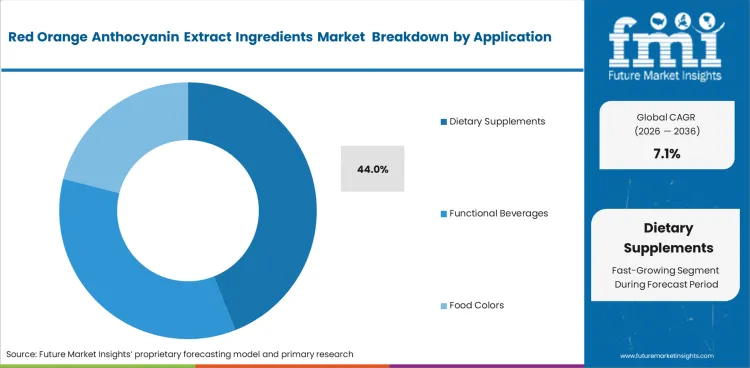
Dietary supplements segment is projected to secure 44.0% share in 2026. This application also offers stronger pricing power, more room for branded ingredient positioning, and a clearer route to premium product differentiation. Demand remains high in dietary supplements, largely because capsule and tablet delivery formats allow formulators to use concentrated extracts without exposing consumers to bitterness or color instability common in certain beverage systems. Clinical and commercial interest tied to antioxidant support, metabolic-health positioning, skin-focused formulations, and broader healthy-aging narratives also align more naturally with supplement formats than with mass-market food coloring use. Supplement brands can present standardized active loading more clearly on-pack, adding credibility in premium retail channels and practitioner-led categories.
- Therapeutic claim substantiation: Clinical backing remains important in premium botanical supplements. Standardized red orange anthocyanin extracts fit well in products built around measurable active content, giving brands clearer support for benefit communication. This creates a clearer commercial pathway than basic color-driven positioning.
- Sensory impact limitations: Beverage development often runs into formulation trade-offs once active loading moves higher. Bitterness, acidity interaction, and color drift can limit dosage flexibility in ready-to-drink systems. Encapsulated delivery avoids many of these constraints and gives brands a more practical route toward higher-value positioning.
- Margin expansion potential: Premium supplements built around branded botanicals often support higher average selling prices than mainstream functional foods. Retailers and e-commerce platforms also tend to reward clinically supported ingredient narratives with stronger category visibility. Commercial environment continues to favor supplement-led demand for red orange anthocyanin extracts.
Red Orange Anthocyanin Extract Ingredients Market Analysis by Standardization
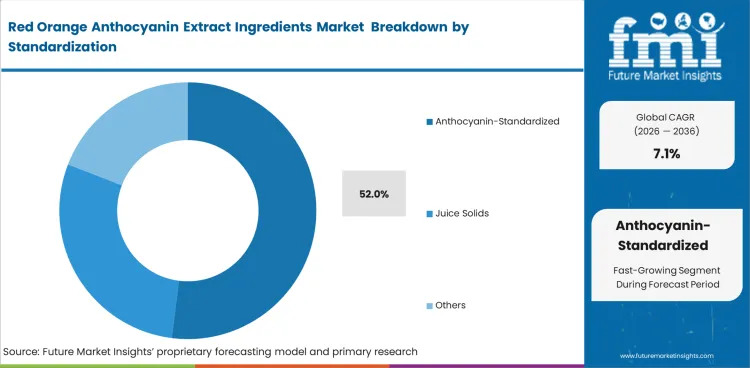
Standardization remains a core buying requirement in this market because commercial users need dependable anthocyanin loading rather than broad citrus solids with variable activity. Precise analytical targets make formulation work easier, reduce batch correction, and support stronger confidence in efficacy-linked positioning. Anthocyanin-standardized material also gives buyers a clearer basis for vendor comparison, especially in premium nutricosmetic and supplement programs that rely on consistent active dosage from batch to batch. In 2026, the anthocyanin-standardized segment is expected to contribute 52.0% of total market share. Continued preference for this route reflects its importance in supplier qualification, specification control, and finished-product consistency across long production cycles. That reliability remains central in a category shaped by raw material seasonality and visible quality variation.
- Analytical verification protocols: Incoming material generally faces laboratory review for anthocyanin markers, active concentration, and purity profile before release into production. Strict adherence to testing protects premium product lines from dilution risk, weak performance, or mismatch between label claims and actual active loading. Buyers place high value on this form of chemical clarity.
- Manufacturing process adjustment: Stable active concentration reduces the need for repeated line recalibration or formula correction during production. Predictable input quality supports better throughput planning and tighter control over blending ratios, fill weights, and finished-product appearance. That operational benefit adds direct commercial value beyond the extract itself.
- Long-term supplier qualification: Approved-vendor status in this market depends heavily on documentation consistency, harvest-to-harvest reproducibility, and technical credibility. Suppliers able to maintain tight standardization across multiple seasons gain stronger standing with global buyers. That advantage can support longer contract visibility and deeper account retention.
Red Orange Anthocyanin Extract Ingredients Market Analysis by Sales Channel
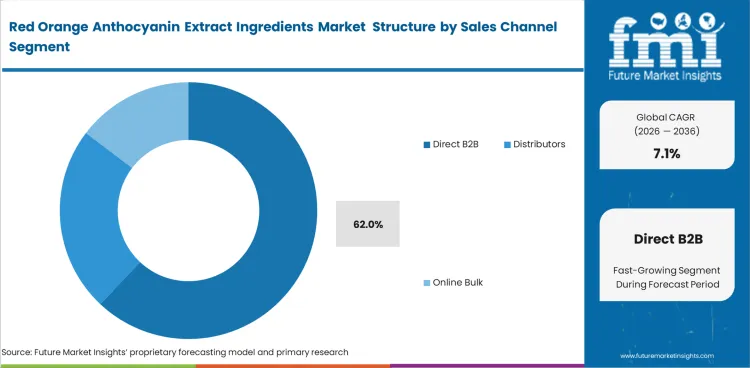
Direct B2B is expected to be the dominant sales channel because ingredient selection often involves technical discussion around particle size, solubility, standardization range, documentation quality, and finished-use compatibility. Direct B2B is set to represent 62.0% of market share in 2026. Another factor behind this lead comes from pricing efficiency, since direct sourcing can reduce intermediary margin layers and create cleaner communication across qualification, sampling, scale-up, and repeat ordering. Direct engagement between extract supplier and formulation buyer also improves visibility into harvest conditions, volume planning, and lead-time management in a category built on agricultural raw materials. Large buyers often prefer this model for supply assurance, traceability depth, and better control over custom specifications tied to branded formulations or export-market requirements.
- Custom specification development: Product developers often need tailored particle size, active range, solubility behavior, or excipient compatibility for proprietary delivery systems. Direct supplier collaboration makes such refinement far easier than catalog-based sourcing through general distribution channels. This factor supports differentiation in tablets, sachets, fast-dissolve powders, and premium ingestible beauty products.
- Volume allocation priority: Multi-season supply planning becomes especially important in fruit-derived ingredient categories with variable harvest output. Direct contracts can improve access to committed volumes and clearer production scheduling, helping buyers protect launch timelines and customer service levels. Cost visibility also improves under more structured procurement agreements.
- Supply chain visibility: Full documentation covering agricultural origin, extraction process, contaminant testing, and active specification has become a basic requirement for many serious buyers. Direct relationships support faster issue resolution and stronger traceability across audit preparation, export compliance, and customer due diligence. Transparency strengthens trust and supports repeat business across high-value accounts.
Red Orange Anthocyanin Extract Ingredients Market Drivers, Restraints, and Opportunities
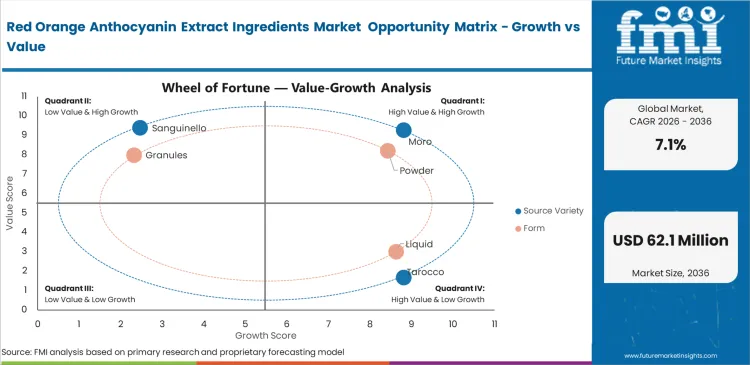
Red orange anthocyanin extract ingredients adoption gains momentum across nutraceuticals, beverages, and premium food formulations as brands shift from synthetic additives and toward natural food colors and plant-derived ingredients carrying both color value and antioxidant appeal. Blood orange cultivars from Sicily, especially Moro, Tarocco, and Sanguinello, bring stronger commercial appeal because anthocyanin density supports richer pigmentation while Mediterranean provenance adds premium product identity. This positioning gives extract suppliers an edge in clean-label development, beauty-from-within concepts, antioxidant supplementation, and premium beverage innovation. Additional advantage comes from recovery of valuable compounds from red orange juice and peel side streams, allowing processors to lift value realization from existing citrus throughput while strengthening upcycled ingredient positioning. Commercial interest also benefits from rising preference for ingredients tied to origin specificity, measurable polyphenol content, and formulations that carry both visual and wellness relevance across premium retail categories.
Commercial expansion still faces challenges because anthocyanin concentration and color retention remain sensitive to temperature shifts, seasonal fruit variation, postharvest handling procedure, oxygen exposure, light conditions, and processing intensity. Research across blood oranges continues to show that climatic variation affects pigment development, while excessive heat during concentration, drying, or liquid processing can reduce anthocyanin integrity and weaken finished-product performance. Qualification becomes more demanding for buyers needing repeatable potency, stable appearance, and dependable shelf-life outcomes across beverages, supplements, and cosmetic-adjacent applications.
Opportunities in the Red Orange Anthocyanin Extract Ingredients Market
- Nutricosmetic expansion protocols: Nutricosmetic demand presents a strong avenue for future value creation. Water-compatible flavonoid systems align well with ingestible beauty products positioned around skin radiance, oxidative stress support, and healthy-aging routines. Premium supplement brands are showing rising interest in ingredients that combine visual appeal, antioxidant relevance, and Mediterranean sourcing, giving red orange extracts a differentiated role across capsules, sachets, gummies, and powdered beauty formats.
- Beverage stabilization technologies: Beverage innovation offers another promising growth path. Advanced stabilization technologies, including emulsion design, encapsulation, and protective carrier selection, improve color retention in acidic drinks and create more room for functional beverage launches carrying both natural color and polyphenol positioning. This strengthens formulation flexibility while improving commercial appeal in premium beverage categories.
- By-product upcycling streams: Upcycling provides an additional commercial advantage. Extraction from juice and peel residues converts underused biomass into higher-value ingredient streams, improving plant economics, reducing waste burdens, and reinforcing sustainability claims valued by premium consumer brands, retail buyers, and export-oriented ingredient suppliers.
Regional Analysis
.webp "Top Country Growth Comparison Red Orange Anthocyanin Extract Ingredients Market Cagr (2026 2036)")
Based on regional analysis, the red orange anthocyanin extract ingredients market is segmented into North America, Europe, Asia Pacific, Latin America, and Middle East & Africa, across 40 plus countries.
| Country | CAGR (2026 to 2036) |
|---|---|
| India | 8.4% |
| Italy | 8.0% |
| Spain | 7.4% |
| United States | 7.2% |
| South Korea | 6.5% |
| Germany | 6.4% |
| Japan | 6.1% |
Source: Future Market Insights (FMI) analysis, based on proprietary forecasting model and primary research
Asia Pacific Red Orange Anthocyanin Extract Ingredients Market Analysis
Growth in Asia Pacific is supported by strong contract manufacturing capacity, expanding supplement production, and rising acceptance of plant-based functional ingredients across beauty, wellness, and nutrition formats. Export-focused formulators are shifting from using synthetic dyes and toward natural color systems that align more closely with clean-label expectations in Europe and other premium consumption markets. Processing upgrades across India, South Korea, Japan, China, and parts of ASEAN are improving extraction quality, analytical validation, and active-compound preservation, giving regional producers a stronger role in global value chains. Direct sourcing from Mediterranean suppliers also gives manufacturers more control over input quality, specification matching, and production planning across high-volume finished goods programs.
- India: Local manufacturing capability is expanding at a meaningful pace as supplement producers, nutraceutical packagers, and contract formulators invest in higher-value botanical ingredients rather than relying only on imported finished inputs. Red orange anthocyanin extract ingredients demand across India is set to rise at 8.4% CAGR through 2036. Growth is being supported by improving laboratory infrastructure, wider use of chromatography-based quality testing, rising export orientation in botanical processing, and deeper integration between citrus raw material handling and value-added formulation work. India also benefits from an extensive base of capsule, tablet, gummy, and sachet manufacturing assets, giving ingredient suppliers a ready downstream customer base for standardized botanical active ingredients.
- South Korea: Beauty-from-within demand, strong capsule manufacturing standards, and premium consumer preference for clinically supported formulations continue to support market development across South Korea. Brands in the market place high value on measurable efficacy, refined positioning, and ingredient narratives tied to antioxidant support, skin appearance, and ingestible wellness. Red orange anthocyanin extract ingredients adoption in South Korea is likely to advance at a CAGR of 6.5% by 2036. Market expansion also benefits from strong retail acceptance of premium nutricosmetic products, product development cycles, and ongoing investment in formulation systems that pair visual appeal with functional benefit claims.
- Japan: Japan continues to favor highly specified nutraceutical ingredients supported by regulatory framework, quality documentation, and consistent finished-product performance. Demand remains strongest in applications related to healthy aging, antioxidant support, and daily wellness maintenance, particularly across capsules, powders, and premium packaged nutrition formats. Red orange anthocyanin extract ingredients sales in Japan are poised to grow at a CAGR of 6.1% during the assessment period. Market progress also reflects strong consumer willingness to pay for validated functional ingredients, plus a mature preference for precision, consistency, and clearly documented active content.
FMI’s report includes China, Australia, and ASEAN countries. Rising disposable income across Southeast Asia is improving premium beverage and supplement demand, encouraging producers to adopt natural color systems and antioxidant-rich botanical ingredients in place of legacy artificial additives.
Europe Red Orange Anthocyanin Extract Ingredients Market Analysis
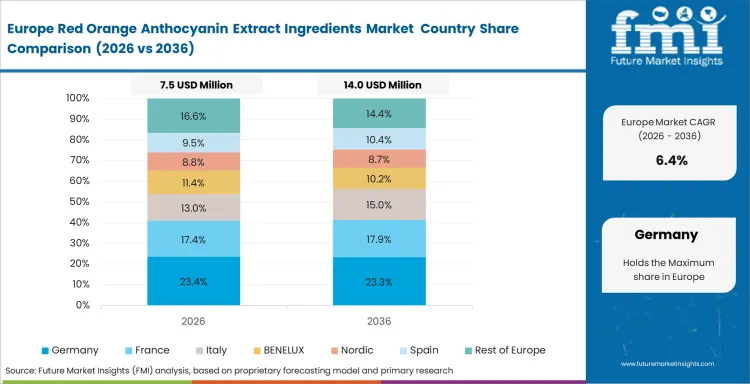
Europe remains central to this market because blood orange cultivation, anthocyanin-rich raw material availability, and extract identity are closely linked with Mediterranean agriculture, especially Sicily. Long-established cultivation expertise, strong geographic indication value, and deeper familiarity with Moro, Tarocco, and Sanguinello cultivars support premium positioning across regional and export markets. Ingredient processors across Italy and Spain continue to refine extraction, stabilization, and standardization systems to meet demand from supplements, beverages, food color applications, and beauty-oriented nutrition products. Regulatory preference for cleaner labels and consumer awareness around natural pigments also reinforce Europe’s importance as both a supply base and a high-value consumption region.
- Italy: Sicily remains a critical origin point for authentic blood orange raw material, giving Italy a structural advantage in cultivar access, origin branding, and extract credibility. Close coordination between growers, processors, and branded ingredient suppliers supports stronger control over pigment quality, harvest timing, and anthocyanin preservation throughout processing. Demand for red orange anthocyanin extract ingredients in Italy is anticipated to rise at a CAGR of 8.0% through 2036. Market strength also reflects long experience with blood orange cultivation, premium global recognition associated with Sicilian provenance, and a more established ecosystem for converting fruit output into standardized extracts for nutraceutical and functional uses.
- Spain: Spain is gaining importance as an alternative Mediterranean supply source, supported by broad citrus expertise, modern agricultural systems, and strong export logistics. Continued movement into higher-value cultivars is helping Spain-based producers participate more actively in premium botanical ingredient markets rather than focusing only on conventional citrus output. Sales of red orange anthocyanin extract ingredients in Spain are expected to increase at a CAGR of 7.4% during the forecast period. Competitive pricing, irrigation modernization, and efficient shipping access across Europe and overseas markets are also improving Spain’s attractiveness as a complementary sourcing base. This role becomes more valuable during variable harvest conditions in other Mediterranean growing zones.
- Germany: Germany remains a hub because clean-label food and supplements are well developed, and consumer scrutiny of ingredient lists remains high across premium retail channels. Natural color adoption, organic positioning, and preference for documented botanical quality continue to create room for standardized anthocyanin ingredients in both nutrition and selected food applications. Red orange anthocyanin extract ingredients are anticipated to gain importance in Germany, with demand rising at an estimated CAGR of 6.4% over the forecast period. Strong purchasing power, mature health retail infrastructure, and broad acceptance of evidence-backed wellness products also support market expansion.
FMI’s report includes the United Kingdom, France, and Nordic countries. Across northern Europe, growing preference for plant-based reformulation and removal of artificial additives continues to create opportunities for natural pigment systems with added antioxidant positioning.
North America Red Orange Anthocyanin Extract Ingredients Market Analysis
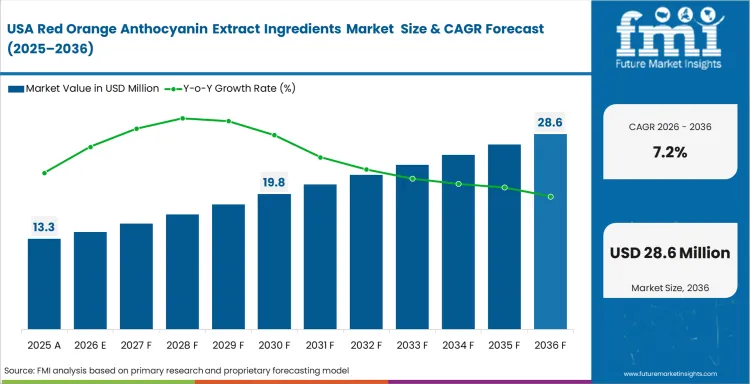
Product demand in North America is rising as food, beverage, and supplement brands continue shifting toward cleaner labels and plant-based ingredients with stronger wellness associations. Natural color adoption is gaining traction across reformulated beverages, nutrition products, and premium supplement lines, especially in categories seeking a stronger link between visual appeal and antioxidant value. Large-scale contract manufacturing capacity across the United States, Canada, and Mexico also supports higher-volume use of imported botanical extracts in finished-product production. Dependence on Mediterranean raw material and extract supply, however, keeps sourcing strategy, documentation quality, and inventory planning central to buyer decision-making across this region.
- United States: Reformulation activity in food, beverage, and supplements continues to encourage interest in natural alternatives to legacy synthetic color systems. Demand is also benefiting from rising consumer engagement with preventative wellness, antioxidant supplementation, beauty-from-within concepts, and premium botanical ingredients carrying a clear active-compound story. The United States is forecast to record steady growth in red orange anthocyanin extract ingredients at a CAGR of 7.2% through 2036. Commercial momentum also reflects strong scale in contract manufacturing, broader retailer preference for cleaner-label assortments, and deeper use of imported Mediterranean ingredients in high-value supplement and functional beverage launches.
FMI’s report includes Canada and Mexico. Cross-border manufacturing and packaging relationships continue to improve regional production efficiency, while premium imported botanical inputs support differentiated positioning across North American wellness, nutrition, and clean-label product categories.
Competitive Aligners for Market Players
Bionap S.r.l. appears to hold a leading position by supporting its red orange complex with strong clinical documentation. Buyers select suppliers strictly based on high-performance liquid chromatography verification rather than simple physical pricing matrices. Quality assurance personnel at major supplement brands analyzing red orange extract key players refuse to qualify vendors lacking comprehensive batch-to-batch consistency records, eliminating low-tier suppliers immediately.
Incumbents possess deep agricultural relationships with localized Sicilian farming cooperatives. Challengers struggle immensely to secure sufficient raw material during poor harvest seasons without these historical generational connections. Leading extraction facilities maintain highly proprietary drying technologies that protect fragile citrus bioflavonoid compounds from thermal degradation. Competitors lacking advanced processing infrastructure deliver products with vastly inferior shelf stability, resulting in canceled procurement contracts.
Buyers often try to avoid vendor lock-in by qualifying multiple European extract producers at the same time. Formulation chemists intentionally design liquid products capable of accepting slight pigment variations to strictly maintain supply chain flexibility. Regional distributors frequently conduct rigorous blood orange extract supplier comparisons to aggregate bulk output from smaller Spanish producers, directly challenging dominant Italian extraction facilities for mid-tier contract manufacturing accounts.
Key Players in the Red Orange Anthocyanin Extract Ingredients Market
- Bionap S.r.l.
- Branded Ingredients LLC
- Native Extracts Pty Ltd
- Natherm Group Sdn Bhd
- Bioway
Scope of the Report
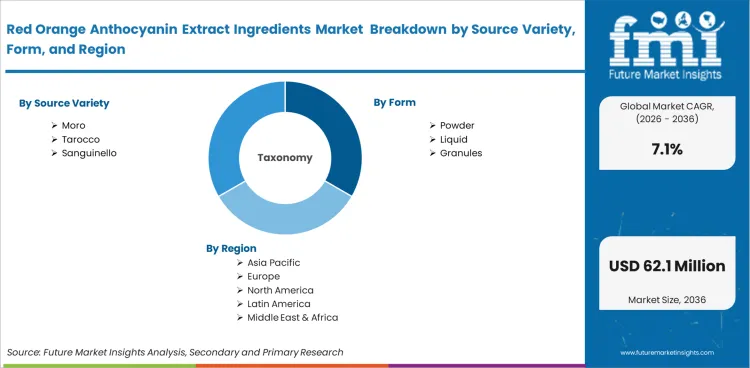
| Metric | Value |
|---|---|
| Quantitative Units | USD 29.2 million to USD 58.0 million, at a CAGR of 7.1% |
| Market Definition | This sector covers bioactive pigments extracted from blood orange cultivars. Its value comes from concentrating these flavonoids rather than producing generic citrus flavor or bulk dietary fiber. Product classification depends on documented sourcing from Moro, Tarocco, or Sanguinello varieties. |
| Segmentation | Source Variety, Form, Application, Standardization, Sales Channel, Region |
| Regions Covered | North America, Latin America, Western Europe, Eastern Europe, Asia Pacific, Middle East and Africa |
| Countries Covered | India, Italy, Spain, United States, South Korea, Germany, Japan |
| Key Companies Profiled | Bionap S.r.l., Branded Ingredients LLC, Native Extracts Pty Ltd, Natherm Group Sdn Bhd, Bioway |
| Forecast Period | 2026 to 2036 |
| Approach | Extraction facility capacity volumes benchmarked against Sicilian harvest yields cross-referenced with import declarations. |
Source: Future Market Insights (FMI) analysis, based on proprietary forecasting model and primary research
Red Orange Anthocyanin Extract Ingredients Market Analysis by Segments
Source Variety
- Moro
- Tarocco
- Sanguinello
- Blends
Form
- Powder
- Liquid
- Granules
- Emulsions
Application
- Dietary Supplements
- Functional Beverages
- Food Colors
- Personal Care
Standardization
- Anthocyanin-standardized
- Polyphenol-standardized
- Juice solids
- By-product extracts
Sales Channel
- Direct B2B
- Distributors
- Contract blends
- Online bulk
Region
- North America
- United States
- Canada
- Europe
- Germany
- United Kingdom
- France
- Italy
- Spain
- Asia Pacific
- China
- Japan
- South Korea
- Taiwan
- Singapore
- Latin America
- Brazil
- Mexico
- Argentina
- Middle East & Africa
- GCC Countries
- South Africa
- Israel
- Rest of Middle East & Africa
Bibliography
- Liu, H., Jin, Y., Huang, L., Miao, C., Tang, J., Zhang, H., Yin, H., Lu, X., Li, N., Dai, S., Gentile, A., Zhang, L., & Sheng, L. (2024). Transcriptomics and metabolomics reveal the underlying mechanism of drought treatment on anthocyanin accumulation in postharvest blood orange fruit.
- Modica, G., Legua, P., La Malfa, S., Gentile, A., & Continella, A. (2024). Qualitative traits and antioxidant properties of blood oranges are affected by the genotype and the climatic conditions.
- Zhang, P., Zhao, Q., Song, Y., et al. (2025). Identification of key genes controlling anthocyanin biosynthesis in the fruits of a bud variety of Tarocco blood-orange.
- Modica, G., Pulvirenti, L., Strano, T., La Malfa, S., Gentile, A., Drago, C., Continella, A., & Siracusa, L. (2025). Metabolite content and antioxidant potential of blood oranges as affected by rootstock.
- Giménez-Sanchis, A., Bonet, L., Bermejo, A., Pérez-Pérez, J. G., & Besada, C. (2025). Determination of chilling requirements for anthocyanin accumulation in blood orange ‘Tarocco Ippolito’.
- Habibi, F., Shahid, M. A., Jacobson, T., Voiniciuc, C., Brecht, J. K., & Sarkhosh, A. (2025). Postharvest quality and biochemical changes in blood orange fruit exposed to various non-chilling storage temperatures.
This bibliography is provided for reader reference. The full FMI report contains the complete reference list with primary source documentation.
This Report Addresses
- Regulatory substitution mechanisms forcing beverage manufacturers toward natural colorants.
- Geographic concentration risks inherent in Sicilian blood orange agricultural dependencies.
- Clinical substantiation requirements necessary for premium nutricosmetic brand positioning.
- Extraction yield variances impacting standardized botanical ingredient unit economics.
- Manufacturing challenges regarding liquid extract degradation under standard warehousing conditions.
- Direct sourcing strategies utilized by major contract supplement manufacturers to ensure volume.
- Analytical testing protocols mandated by quality assurance personnel to verify flavonoid content.
- Regional adoption discrepancies between European compliance environments and Asian beauty markets.
Frequently Asked Questions
What is the red orange anthocyanin extract ingredients market?
This sector encompasses standardized bioactive pigments extracted from specific blood orange cultivars, primarily Moro, Tarocco, and Sanguinello. Formulators utilize these concentrated flavonoids for dual-purpose natural coloring and physiological benefit applications across supplements and beverages.
How big is the blood orange anthocyanin extract market?
This sector was valued at USD 27.3 million in 2025. The blood orange extract market forecast 2036 estimates demand is poised to reach USD 58.0 million, growing at a 7.1% CAGR as clinical substantiation isolates these compounds from generic citrus additives.
Why is Moro blood orange extract commercially important?
Moro dominates commercial output because it possesses a naturally higher baseline pigment concentration compared to other cultivars. Formulation managers specify Moro to achieve maximum color payload per gram, significantly improving manufacturing efficiency for contract packagers.
Which applications use red orange anthocyanin ingredients most?
Dietary supplements represent the primary application, accounting for 44.0% share in 2026. Clinical documentation linking blood orange flavonoids to skin health and weight management convinces brand managers to utilize these extracts for therapeutic dosing rather than basic food coloring.
How does blood orange extract vs black carrot anthocyanin evaluations compare?
Blood orange derivatives provide premium clinical substantiation for nutricosmetic claims, allowing brands to charge higher retail prices. While black carrot offers cheaper bulk pigmentation, it entirely lacks the proprietary physiological documentation brands require for premium product positioning.
How does blood orange extract vs grape skin extract affect formulation costs?
Grape skin extracts supply generic color stability at a lower unit cost, while blood orange commands a significant premium based on standardized flavonoid efficacy profiles that appeal specifically to supplement developers.
Who are the top red orange extract ingredient suppliers?
Key participants driving bulk ingredient volume include Bionap S.r.l., Branded Ingredients LLC, Native Extracts Pty Ltd, Natherm Group Sdn Bhd, and Bioway.
What regulations support natural anthocyanin ingredient demand?
Approaching regulatory deadlines banning synthetic artificial food dyes force immediate reformulation efforts. European Food Safety Authority permissions and FDA natural color authorizations provide a secure legal framework for formulators transitioning to botanical pigment alternatives.
How to choose a blood orange extract supplier?
Procurement personnel evaluating blood orange extract powder suppliers prioritize high-performance liquid chromatography verification. Quality assurance managers demand comprehensive batch-to-batch consistency records to prevent adulteration from generic non-pigmented citrus extracts.
What specific operational consequence does unstandardized material create?
Production supervisors must constantly recalibrate blending machinery to accommodate varying active loads. Purchasing unverified juice solids forces engineering teams to waste significant time adjusting formulas to match target visual hues.
How does South Korea utilize these compounds differently than Germany?
Asian buyers prioritize clinical skin-health outcomes for premium nutricosmetic supplements. European formulators utilize these exact same extracts primarily as clean-label pigmentation agents to replace synthetic artificial food dyes.
What forces buyers toward direct B2B relationships instead of brokers?
Custom formulation requirements demand precise technical communication. R&D personnel need direct factory access to specify custom particle sizes for advanced encapsulation machinery, a process distributors cannot effectively mediate.
How does extraction yield impact long-term commercial viability?
Seasonal weather variations dramatically alter internal fruit pigmentation levels. Supply chain personnel negotiate multi-year volume contracts to insulate themselves against sudden unit cost spikes during climatically poor Mediterranean harvest years.
What happens to brands delaying synthetic dye replacement?
Mainstream grocery chains aggressively enforce clean-label mandates across their aisles. Category managers immediately delist products utilizing artificial red colorants, instantly destroying established retail distribution networks for slow-moving beverage brands.
Why do cosmetic chemists specify these botanical ingredients?
Antioxidant compounds provide dual benefits in topical applications. Formulators utilize natural pigmentation to color skincare serums while simultaneously claiming free-radical protection capabilities, satisfying consumer demand for multifunctional cosmetic products.
What gate prevents mass-market adoption in value products?
Baseline unit economics remain significantly higher than synthetic alternatives. Until extraction facilities achieve massive economies of scale through continuous processing, procurement personnel restrict these ingredients entirely to premium and super-premium retail tiers.
How do regional distributors survive despite the direct B2B trend?
Small-scale craft beverage producers lack minimum order volumes required by primary extraction facilities. Distributors survive by breaking bulk shipments into accessible quantities for regional startups experimenting with clean-label reformulations.
What drives Spanish agricultural expansion in this sector?
European ingredient buyers actively seek supply chain redundancy. Buyers may support Spanish cultivation projects to reduce dependence on Sicily and build secondary sourcing options.
How do unverified extracts impact finished product compliance?
Regulatory affairs officers require unbroken traceability documentation. Utilizing grey-market citrus extracts completely voids European food additive certifications, exposing finished product manufacturers to immediate product seizures and regulatory fines.
Preview the report firsthand - request a free sample
Get SampleGet the brochure for pricing and purchase details.
Get PDFTable of Content
- Executive Summary
- Global Market Outlook
- Demand-side Trends
- Supply-side Trends
- Technology Roadmap Analysis
- Analysis and Recommendations
- Market Overview
- Market Coverage / Taxonomy
- Market Definition / Scope / Limitations
- Research Methodology
- Chapter Orientation
- Analytical Lens and Working Hypotheses
- Market Structure, Signals, and Trend Drivers
- Desk Research Programme (Secondary Evidence)
- Company Annual and Sustainability Reports
- Peer-reviewed Journals and Academic Literature
- Corporate Websites, Product Literature, and Technical Notes
- Earnings Decks and Investor Briefings
- Statutory Filings and Regulatory Disclosures
- Technical White Papers and Standards Notes
- Trade Journals, Industry Magazines, and Analyst Briefs
- Conference Proceedings, Webinars, and Seminar Materials
- Government Statistics Portals and Public Data Releases
- Press Releases and Reputable Media Coverage
- Specialist Newsletters and Curated Briefings
- Sector Databases and Reference Repositories
- FMI Internal Proprietary Databases and Historical Market Datasets
- Subscription Datasets and Paid Sources
- Social Channels, Communities, and Digital Listening Inputs
- Why Primary Evidence is Used
- Field Techniques
- Interviews
- Surveys
- Focus Groups
- Observational and In-context Research
- Social and Community Interactions
- Stakeholder Universe Engaged
- C-suite Leaders
- Board Members
- Presidents and Vice Presidents
- R&D and Innovation Heads
- Technical Specialists
- Domain Subject-matter Experts
- Scientists
- Physicians and Other Healthcare Professionals
- Governance, Ethics, and Data Stewardship
- Research Ethics
- Data Integrity and Handling
- Tooling, Models, and Reference Databases
- Data Engineering and Model Build
- Data Acquisition and Ingestion
- Cleaning, Normalisation, and Verification
- Synthesis, Triangulation, and Analysis
- Quality Assurance and Audit Trail
- Market Background
- Market Dynamics
- Drivers
- Restraints
- Opportunity
- Trends
- Scenario Forecast
- Global Market Analysis 2021 to 2025 and Forecast, 2026 to 2036
- Historical Market Size Value (USD Million) Analysis, 2021 to 2025
- Current and Future Market Size Value (USD Million) Projections, 2026 to 2036
- Y-o-Y Growth Trend Analysis
- Absolute $ Opportunity Analysis
- Global Market Pricing Analysis 2021 to 2025 and Forecast 2026 to 2036
- Global Market Analysis 2021 to 2025 and Forecast 2026 to 2036, By Source Variety
- Introduction / Key Findings
- Historical Market Size Value (USD Million) Analysis By Source Variety , 2021 to 2025
- Current and Future Market Size Value (USD Million) Analysis and Forecast By Source Variety , 2026 to 2036
- Moro
- Tarocco
- Sanguinello
- Moro
- Y-o-Y Growth Trend Analysis By Source Variety , 2021 to 2025
- Absolute $ Opportunity Analysis By Source Variety , 2026 to 2036
- Global Market Analysis 2021 to 2025 and Forecast 2026 to 2036, By Form
- Introduction / Key Findings
- Historical Market Size Value (USD Million) Analysis By Form, 2021 to 2025
- Current and Future Market Size Value (USD Million) Analysis and Forecast By Form, 2026 to 2036
- Powder
- Liquid
- Granules
- Powder
- Y-o-Y Growth Trend Analysis By Form, 2021 to 2025
- Absolute $ Opportunity Analysis By Form, 2026 to 2036
- Global Market Analysis 2021 to 2025 and Forecast 2026 to 2036, By Application
- Introduction / Key Findings
- Historical Market Size Value (USD Million) Analysis By Application, 2021 to 2025
- Current and Future Market Size Value (USD Million) Analysis and Forecast By Application, 2026 to 2036
- Dietary Supplements
- Functional Beverages
- Food Colors
- Dietary Supplements
- Y-o-Y Growth Trend Analysis By Application, 2021 to 2025
- Absolute $ Opportunity Analysis By Application, 2026 to 2036
- Global Market Analysis 2021 to 2025 and Forecast 2026 to 2036, By Standardization
- Introduction / Key Findings
- Historical Market Size Value (USD Million) Analysis By Standardization, 2021 to 2025
- Current and Future Market Size Value (USD Million) Analysis and Forecast By Standardization, 2026 to 2036
- Anthocyanin-Standardized
- Juice Solids
- Others
- Anthocyanin-Standardized
- Y-o-Y Growth Trend Analysis By Standardization, 2021 to 2025
- Absolute $ Opportunity Analysis By Standardization, 2026 to 2036
- Global Market Analysis 2021 to 2025 and Forecast 2026 to 2036, By Sales Channel
- Introduction / Key Findings
- Historical Market Size Value (USD Million) Analysis By Sales Channel, 2021 to 2025
- Current and Future Market Size Value (USD Million) Analysis and Forecast By Sales Channel, 2026 to 2036
- Direct B2B
- Distributors
- Online Bulk
- Direct B2B
- Y-o-Y Growth Trend Analysis By Sales Channel, 2021 to 2025
- Absolute $ Opportunity Analysis By Sales Channel, 2026 to 2036
- Global Market Analysis 2021 to 2025 and Forecast 2026 to 2036, By Region
- Introduction
- Historical Market Size Value (USD Million) Analysis By Region, 2021 to 2025
- Current Market Size Value (USD Million) Analysis and Forecast By Region, 2026 to 2036
- North America
- Latin America
- Western Europe
- Eastern Europe
- East Asia
- South Asia and Pacific
- Middle East & Africa
- Market Attractiveness Analysis By Region
- North America Market Analysis 2021 to 2025 and Forecast 2026 to 2036, By Country
- Historical Market Size Value (USD Million) Trend Analysis By Market Taxonomy, 2021 to 2025
- Market Size Value (USD Million) Forecast By Market Taxonomy, 2026 to 2036
- By Country
- USA
- Canada
- Mexico
- By Source Variety
- By Form
- By Application
- By Standardization
- By Sales Channel
- By Country
- Market Attractiveness Analysis
- By Country
- By Source Variety
- By Form
- By Application
- By Standardization
- By Sales Channel
- Key Takeaways
- Latin America Market Analysis 2021 to 2025 and Forecast 2026 to 2036, By Country
- Historical Market Size Value (USD Million) Trend Analysis By Market Taxonomy, 2021 to 2025
- Market Size Value (USD Million) Forecast By Market Taxonomy, 2026 to 2036
- By Country
- Brazil
- Chile
- Rest of Latin America
- By Source Variety
- By Form
- By Application
- By Standardization
- By Sales Channel
- By Country
- Market Attractiveness Analysis
- By Country
- By Source Variety
- By Form
- By Application
- By Standardization
- By Sales Channel
- Key Takeaways
- Western Europe Market Analysis 2021 to 2025 and Forecast 2026 to 2036, By Country
- Historical Market Size Value (USD Million) Trend Analysis By Market Taxonomy, 2021 to 2025
- Market Size Value (USD Million) Forecast By Market Taxonomy, 2026 to 2036
- By Country
- Germany
- UK
- Italy
- Spain
- France
- Nordic
- BENELUX
- Rest of Western Europe
- By Source Variety
- By Form
- By Application
- By Standardization
- By Sales Channel
- By Country
- Market Attractiveness Analysis
- By Country
- By Source Variety
- By Form
- By Application
- By Standardization
- By Sales Channel
- Key Takeaways
- Eastern Europe Market Analysis 2021 to 2025 and Forecast 2026 to 2036, By Country
- Historical Market Size Value (USD Million) Trend Analysis By Market Taxonomy, 2021 to 2025
- Market Size Value (USD Million) Forecast By Market Taxonomy, 2026 to 2036
- By Country
- Russia
- Poland
- Hungary
- Balkan & Baltic
- Rest of Eastern Europe
- By Source Variety
- By Form
- By Application
- By Standardization
- By Sales Channel
- By Country
- Market Attractiveness Analysis
- By Country
- By Source Variety
- By Form
- By Application
- By Standardization
- By Sales Channel
- Key Takeaways
- East Asia Market Analysis 2021 to 2025 and Forecast 2026 to 2036, By Country
- Historical Market Size Value (USD Million) Trend Analysis By Market Taxonomy, 2021 to 2025
- Market Size Value (USD Million) Forecast By Market Taxonomy, 2026 to 2036
- By Country
- China
- Japan
- South Korea
- By Source Variety
- By Form
- By Application
- By Standardization
- By Sales Channel
- By Country
- Market Attractiveness Analysis
- By Country
- By Source Variety
- By Form
- By Application
- By Standardization
- By Sales Channel
- Key Takeaways
- South Asia and Pacific Market Analysis 2021 to 2025 and Forecast 2026 to 2036, By Country
- Historical Market Size Value (USD Million) Trend Analysis By Market Taxonomy, 2021 to 2025
- Market Size Value (USD Million) Forecast By Market Taxonomy, 2026 to 2036
- By Country
- India
- ASEAN
- Australia & New Zealand
- Rest of South Asia and Pacific
- By Source Variety
- By Form
- By Application
- By Standardization
- By Sales Channel
- By Country
- Market Attractiveness Analysis
- By Country
- By Source Variety
- By Form
- By Application
- By Standardization
- By Sales Channel
- Key Takeaways
- Middle East & Africa Market Analysis 2021 to 2025 and Forecast 2026 to 2036, By Country
- Historical Market Size Value (USD Million) Trend Analysis By Market Taxonomy, 2021 to 2025
- Market Size Value (USD Million) Forecast By Market Taxonomy, 2026 to 2036
- By Country
- Kingdom of Saudi Arabia
- Other GCC Countries
- Turkiye
- South Africa
- Other African Union
- Rest of Middle East & Africa
- By Source Variety
- By Form
- By Application
- By Standardization
- By Sales Channel
- By Country
- Market Attractiveness Analysis
- By Country
- By Source Variety
- By Form
- By Application
- By Standardization
- By Sales Channel
- Key Takeaways
- Key Countries Market Analysis
- USA
- Pricing Analysis
- Market Share Analysis, 2025
- By Source Variety
- By Form
- By Application
- By Standardization
- By Sales Channel
- Canada
- Pricing Analysis
- Market Share Analysis, 2025
- By Source Variety
- By Form
- By Application
- By Standardization
- By Sales Channel
- Mexico
- Pricing Analysis
- Market Share Analysis, 2025
- By Source Variety
- By Form
- By Application
- By Standardization
- By Sales Channel
- Brazil
- Pricing Analysis
- Market Share Analysis, 2025
- By Source Variety
- By Form
- By Application
- By Standardization
- By Sales Channel
- Chile
- Pricing Analysis
- Market Share Analysis, 2025
- By Source Variety
- By Form
- By Application
- By Standardization
- By Sales Channel
- Germany
- Pricing Analysis
- Market Share Analysis, 2025
- By Source Variety
- By Form
- By Application
- By Standardization
- By Sales Channel
- UK
- Pricing Analysis
- Market Share Analysis, 2025
- By Source Variety
- By Form
- By Application
- By Standardization
- By Sales Channel
- Italy
- Pricing Analysis
- Market Share Analysis, 2025
- By Source Variety
- By Form
- By Application
- By Standardization
- By Sales Channel
- Spain
- Pricing Analysis
- Market Share Analysis, 2025
- By Source Variety
- By Form
- By Application
- By Standardization
- By Sales Channel
- France
- Pricing Analysis
- Market Share Analysis, 2025
- By Source Variety
- By Form
- By Application
- By Standardization
- By Sales Channel
- India
- Pricing Analysis
- Market Share Analysis, 2025
- By Source Variety
- By Form
- By Application
- By Standardization
- By Sales Channel
- ASEAN
- Pricing Analysis
- Market Share Analysis, 2025
- By Source Variety
- By Form
- By Application
- By Standardization
- By Sales Channel
- Australia & New Zealand
- Pricing Analysis
- Market Share Analysis, 2025
- By Source Variety
- By Form
- By Application
- By Standardization
- By Sales Channel
- China
- Pricing Analysis
- Market Share Analysis, 2025
- By Source Variety
- By Form
- By Application
- By Standardization
- By Sales Channel
- Japan
- Pricing Analysis
- Market Share Analysis, 2025
- By Source Variety
- By Form
- By Application
- By Standardization
- By Sales Channel
- South Korea
- Pricing Analysis
- Market Share Analysis, 2025
- By Source Variety
- By Form
- By Application
- By Standardization
- By Sales Channel
- Russia
- Pricing Analysis
- Market Share Analysis, 2025
- By Source Variety
- By Form
- By Application
- By Standardization
- By Sales Channel
- Poland
- Pricing Analysis
- Market Share Analysis, 2025
- By Source Variety
- By Form
- By Application
- By Standardization
- By Sales Channel
- Hungary
- Pricing Analysis
- Market Share Analysis, 2025
- By Source Variety
- By Form
- By Application
- By Standardization
- By Sales Channel
- Kingdom of Saudi Arabia
- Pricing Analysis
- Market Share Analysis, 2025
- By Source Variety
- By Form
- By Application
- By Standardization
- By Sales Channel
- Turkiye
- Pricing Analysis
- Market Share Analysis, 2025
- By Source Variety
- By Form
- By Application
- By Standardization
- By Sales Channel
- South Africa
- Pricing Analysis
- Market Share Analysis, 2025
- By Source Variety
- By Form
- By Application
- By Standardization
- By Sales Channel
- USA
- Market Structure Analysis
- Competition Dashboard
- Competition Benchmarking
- Market Share Analysis of Top Players
- By Regional
- By Source Variety
- By Form
- By Application
- By Standardization
- By Sales Channel
- Competition Analysis
- Competition Deep Dive
- Competition Deep Dive
- Market Dynamics
- Assumptions & Acronyms Used


