

- Industry Size (2025)
- USD 16.0 Mn
- Forecast (2035)
- USD 45.3 Mn
- CAGR (2025 to 2035)
- 11.0%
Sea Fennel Extract Market Forecast and Outlook 2025 to 2035
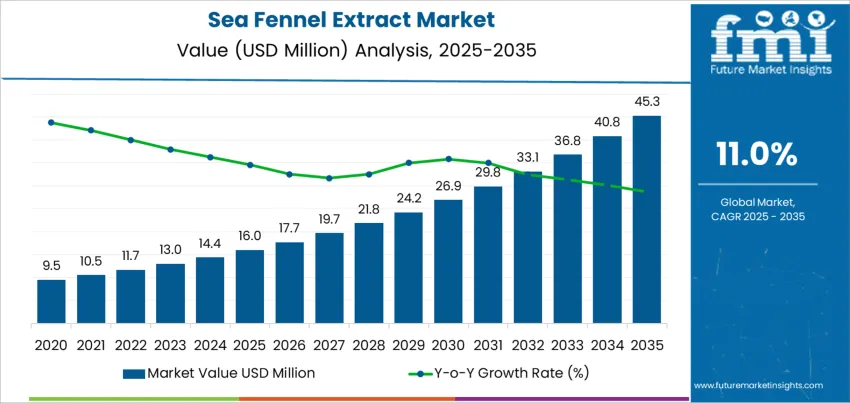
In 2025, the sea fennel extract market is valued at USD 16.0 million and is expected to reach USD 45.3 million by 2035 at a CAGR of 11.0%. Early market development is shaped by growing use of coastal plant actives in skin care, nutraceuticals, and functional food formulations. Sea fennel is favored for its mineral content, antioxidant profile, and natural preservation properties. Cosmetic formulators use the extract in hydration serums, barrier-repair creams, and marine-based cleansing products. Food and beverage brands use it in botanical blends, savory extracts, and wellness drinks. Supply chains remain closely linked to controlled coastal harvesting and cultivated plots, with procurement guided by freshness, extraction yield, and consistent aromatic profiles.
From 2030 onward, market expansion reflects higher formulation loading and broader end-use depth rather than simple category entry. Market value advances from about USD 26.9 million in 2030 toward USD 45.3 million by 2035 as dermocosmetic, ingestible beauty, and functional nutrition applications increase active concentration per product. Extract standardization becomes more important as brands prioritize reproducible mineral and phenolic content across batches. Product formats diversify into liquid concentrates, encapsulated powders, and oil-soluble fractions to suit different formulation systems. Regional processors invest in drying, cold extraction, and solvent recovery to improve output consistency. Long term growth is shaped by botanical sourcing reliability, climate-linked harvest variability, and the ability of suppliers to meet tightening quality and traceability requirements across personal care and nutrition markets.
Quick Stats of the Sea Fennel Extract Market
- Sea Fennel Extract Market Value (2025): USD 16.0 million
- Sea Fennel Extract Market Forecast Value (2035): USD 45.3 million
- Sea Fennel Extract Market Forecast CAGR (2025 to 2035): 11.0%
- Leading Product Form in Sea Fennel Extract Market: Powder (15.2%)
- Key Growth Regions in Sea Fennel Extract Market: Asia Pacific, Europe
- Top Players in Sea Fennel Extract Market: BASF SE, Croda International, Evonik Industries, Symrise (incl. IFF/Givaudan actives), Dow / Dow Inc., Ashland, Clariant, Seppic
What is the Growth Forecast for the Sea Fennel Extract Market through 2035?
The global sea fennel extract market expands from USD 16.0 million in 2025 to USD 24.2 million by 2030, recording an absolute increase of USD 8.2 million in the first half of the forecast period. This phase reflects rising utilization of sea fennel as a marine-derived botanical active in cosmetic hydration systems, anti-fatigue skincare, and scalp care formulations. Growth is also supported by its emerging role in functional foods and specialty condiments where mineral content and aromatic compounds are valued. Demand during this period remains formulation-led, driven by premium personal care brands and niche food producers rather than mass-market food scaling. Value growth is supported by extraction standardization, traceability, and clean-label positioning.
From 2030 to 2035, the market accelerates from USD 24.2 million to USD 45.3 million, adding a larger USD 21.1 million in the second half of the decade. This back-weighted expansion reflects broader commercial adoption across ingestible beauty products, stress-recovery supplements, and marine-based nutritional blends. Demand also deepens across pharmaceutical-adjacent skincare and clinical nutrition where antioxidant and osmoprotective properties support higher pricing. As controlled coastal cultivation and biomass processing scale, sea fennel extract transitions from a limited regional specialty into a globally traded marine bioactive, materially lifting total market value through 2035.
Sea Fennel Extract Industry Key Takeaways
| Metric | Value |
|---|---|
| Industry Value (2025) | USD 16.0 million |
| Forecast Value (2035) | USD 45.3 million |
| Forecast CAGR (2025 to 2035) | 11.0% |
How Is the Sea Fennel Extract Market Developing Across Food, Cosmetic, and Functional Ingredient Applications?
The sea fennel extract market has evolved from niche coastal foraging traditions into a specialized ingredient segment serving food, cosmetic, and wellness industries. Historically, sea fennel was used in small scale culinary and herbal preparations due to its aromatic profile and mineral rich composition. Commercial interest expanded as processors identified its antioxidant content, unique flavor profile, and compatibility with clean label positioning. Food producers adopted sea fennel extracts for gourmet condiments, marinades, and specialty seasonings where marine herbal notes add differentiation. Cosmetic formulators integrated the extract into skin care products focused on hydration, barrier protection, and oxidative stress control. This multi application relevance supported gradual but steady commercial expansion.
Future growth of the sea fennel extract market will be shaped by rising demand for marine botanical ingredients, natural antioxidants, and traceable coastal plant sources. Expansion is expected in functional foods, nutraceutical blends, and premium cosmetic formulations where niche marine extracts support product storytelling and ingredient transparency. Barriers include limited large scale cultivation infrastructure, seasonal harvesting constraints, and variability in bioactive concentration depending on growing conditions. Processing costs remain higher than for land based botanicals, which limits use in mass market products. Regulatory scrutiny on marine sourced ingredients and competition from more established plant extracts will influence adoption speed. Long term growth will depend on cultivation standardization, supply reliability, and consistent functional performance.
How Are End Use Application and Product Form Structuring the Demand for Sea Fennel Extract?
The demand for sea fennel extract is structured by end use application and product form. Skin care represents 11.8% of total demand, followed by body care, hair care, sun care, color cosmetics, men grooming, baby and kids care, and dermocosmetic and professional care. By product form, powder accounts for 15.2% of total consumption, followed by granules and agglomerates, flakes, pellets and prills, liquid solutions, high active concentrates, dispersions and suspensions, emulsions, pastes, gels, wax or solid blocks, and oils. Demand behavior is shaped by antioxidant retention, osmotic stress resistance, sensory neutrality, botanical sourcing preferences, and compatibility with marine inspired topical formulations.
Why Does Skin Care Lead the Sea Fennel Extract End Use Demand?
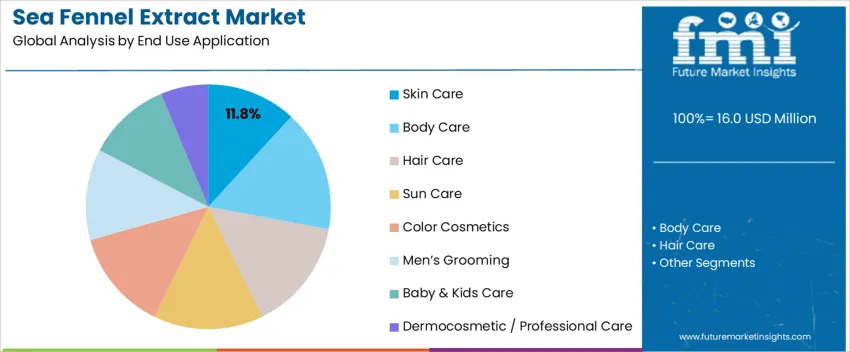
Skin care accounts for 11.8% of total sea fennel extract demand due to its functional role in antioxidant defense, mineral balance support, and cellular vitality positioning. Sea fennel is rich in vitamin C, polyphenols, iodine derivatives, and trace minerals that contribute to protection against oxidative damage and support skin tone uniformity. These properties support its use in brightening serums, anti fatigue creams, urban defense products, and revitalizing facial treatments.
Sea fennel is also valued for its ability to support hydration balance under environmental stress conditions such as salt exposure, wind, and UV radiation. This makes it suitable for coastal themed, detox focused, and protective daily care formulations. Its botanical origin aligns with clean label skin care positioning. These functional antioxidant properties, protective skin support roles, and formulation compatibility factors sustain skin care as the leading end use segment within sea fennel extract demand.
Why Does Powder Lead the Sea Fennel Extract Product Form Demand?
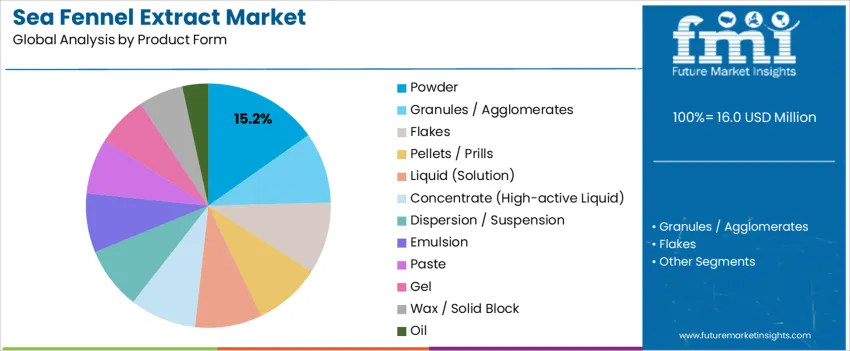
Powder accounts for 15.2% of total sea fennel extract demand due to its stability against oxidation, ease of standardization, and precision in formulation dosing. Powdered sea fennel extracts retain polyphenols and vitamin derivatives more effectively under controlled drying conditions. This allows manufacturers to maintain consistent antioxidant activity across long production cycles. Low moisture content reduces clumping and microbial risk during storage and transport.
Powder form also supports flexible integration into emulsions, gels, masks, and professional treatment products during hydration at the mixing stage. It allows adjustment of extract concentration without impacting base viscosity. Packaging in lined drums and barrier bags preserves aroma neutrality and bioactive integrity. These formulation control, storage durability, and logistics efficiency advantages position powder as the leading product form within the sea fennel extract demand structure.
Why Has Sea Fennel Extract Shifted from Coastal Folk Use to a Precision Active Ingredient?
Global demand for sea fennel extract is no longer tied to traditional coastal consumption but to its concentrated bioactive profile. The plant contains vitamin C analogs, polyphenols, and anti-inflammatory compounds that support oxidative stress control and skin regeneration. Unlike broad herbal extracts, sea fennel delivers targeted cellular effects at low dosage. Its transition into standardized extracts allows controlled use in cosmetics, nutricosmetics, and functional formulations. Demand growth is now driven by formulation performance, not by regional culinary heritage or general botanical appeal.
How Do Wild Harvest Limits and Shallow-Water Cultivation Shape Supply Behavior?
Sea fennel grows in narrow coastal zones exposed to salinity spray, tidal stress, and rocky substrates. Large-scale mechanized farming is difficult due to shallow root systems and fragile habitat dependence. Most commercial supply depends on controlled wild harvesting or small plot coastal cultivation. Yield fluctuates with storm cycles, coastal erosion, and water salinity shifts. Post-harvest dehydration must occur rapidly to preserve volatile compounds. These biological and geographic constraints make supply expansion structurally slower than inland medicinal crops and tightly linked to shoreline ecosystem stability.
What Regulatory Classification and Safety Validation Restrain Food-Grade Scaling?
Sea fennel extract faces complex classification across cosmetic, nutraceutical, and food safety frameworks. Its strong bioactive concentration requires toxicology validation before large-scale food inclusion. In several regions, it remains approved primarily for topical and supplement use rather than routine food fortification. Allergen cross-reactivity with other Apiaceae plants also requires label caution. Metal accumulation risk in coastal plants adds another layer of safety screening. These regulatory and physiological checks temper aggressive food-market expansion even as functional interest continues to rise.
How Are Skin Barrier Repair, Blue-Light Defense, and Anti-Pollution Systems Driving Future Demand?
Future sea fennel extract demand is increasingly shaped by its role in environmental skin protection. Blue-light exposure, urban pollution, and oxidative surface stress drive its use in barrier-repair and anti-photoaging systems. Its capacity to stimulate keratinocyte renewal supports inclusion in recovery-focused skincare and post-procedure formulations. Nutricosmetic use targets collagen stability and vascular protection from within. These applications reposition sea fennel from a niche botanical into a defensive bioactive layer responding to modern environmental stress exposure rather than dietary supplementation alone.
What is the Global Growth Outlook for the Sea Fennel Extract Industry by Country?
| Country | CAGR (%) |
|---|---|
| India | 14.8% |
| China | 13.7% |
| Japan | 12.6% |
| UK | 11.5% |
| Germany | 10.4% |
| USA | 9.3% |
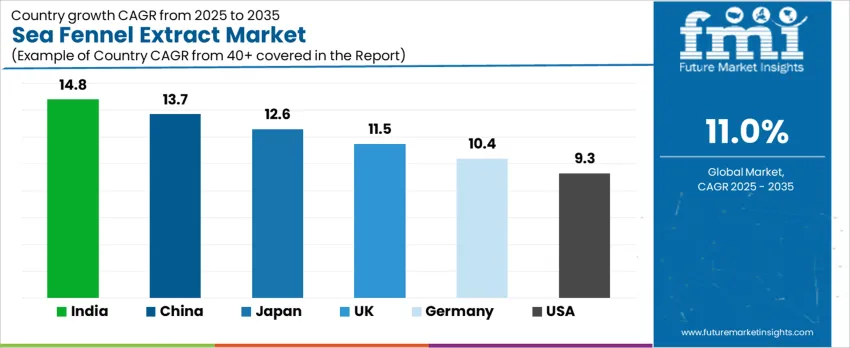
The sea fennel extract industry is showing strong global expansion across both Asian and Western economies, led by India at a 14.8% CAGR. Growth in India is supported by rising use of botanical extracts in nutraceuticals, functional foods, and cosmetic formulations, along with increasing interest in marine derived ingredients. China follows at 13.7%, driven by expanding extraction capacity, strong ingredient manufacturing infrastructure, and growing domestic demand from personal care and nutrition producers. Japan at 12.6% reflects steady adoption in skincare, functional beverages, and dietary supplements. The UK and Germany record 11.5% and 10.4% growth, supported by clean label trends, plant based product development, and wellness focused consumption. The USA at 9.3% reflects a mature but steadily expanding market driven by supplements, beauty from within products, and functional ingredient applications.
What Is Driving Rapid Sea Fennel Extract Adoption in India?
Expansion in India is progressing at a CAGR of 14.8% through 2035 for sea fennel extract demand, driven by fast growth in herbal cosmetics, plant based supplements, and marine derived functional ingredients. Urban skincare brands apply sea fennel for hydration support, antioxidant positioning, and anti aging formulations. Nutraceutical companies use the extract in detox capsules and immunity blends. Imports dominate supply due to the absence of large scale domestic coastal harvesting. Demand remains formulation led and trend supported, shaped by strong natural beauty adoption, rising preventive health interest, and expanding online wellness retail distribution.
- Natural skincare formulations anchor primary demand
- Detox and immunity supplements support nutraceutical usage
- Import based sourcing dominates raw material supply
- Ecommerce channels expand national product visibility
How Is China Scaling Industrial Processing of Sea Fennel Extract?
Growth in China reflects a CAGR of 13.7% through 2035 for sea fennel extract utilization, supported by marine botanical processing, cosmetic active manufacturing, and functional food ingredient production. Sea fennel is applied in hydration serums, anti pollution skincare, and antioxidant beverage blends. Domestic coastal processing facilities ensure cost control and steady extract availability. Export oriented cosmetic ingredient suppliers also serve global personal care brands. Demand remains production driven and volume oriented, aligned with marine bioprocessing scale, rising clean beauty exports, and steady expansion of botanical actives across food and cosmetic manufacturing.
- Coastal processing facilities stabilize extract supply
- Skincare hydration products drive cosmetic grade volume
- Functional beverages add secondary food grade demand
- Export oriented production supports global distribution
Why Does Japan Remain a High Value Market for Sea Fennel Extract?
Demand in Japan is increasing at a CAGR of 12.6% through 2035 for sea fennel extract usage, sustained by advanced cosmetic science, marine based wellness traditions, and premium ingredient research programs. Sea fennel is incorporated into anti aging serums, eye care products, and nutricosmetic supplements. Clinical beauty nutrition and dermatologist guided formulation sustain consistent utilization. Domestic marine research supports high purity extract refinement. Demand stays innovation driven and quality focused, supported by aging population skincare needs, continuous cosmetic reformulation, and strong consumer trust in marine derived actives.
- Anti aging skincare anchors premium extract consumption
- Nutricosmetic supplements support internal beauty demand
- Domestic refinement stabilizes quality consistency
- Research driven formulation sustains long term utilization
What Is Supporting Sea Fennel Extract Market Expansion in the United Kingdom?
Growth in the UK is advancing at a CAGR of 11.5% through 2035 for sea fennel extract demand, supported by clean label skincare, vegan cosmetics, and premium botanical supplement development. Sea fennel appears in hydrating creams, antioxidant face oils, and plant based wellness drops. Specialty beauty retailers and online platforms expand national accessibility. Imports dominate raw material sourcing. Demand remains retail driven and innovation focused, shaped by rising natural beauty adoption, steady growth in vegan personal care, and strong penetration of marine botanicals across premium cosmetic brands.
- Clean label beauty drives consistent retail uptake
- Vegan cosmetics support botanical active integration
- Online platforms strengthen national product visibility
- Import reliance dominates extract sourcing
How Is Germany Integrating Sea Fennel into Regulated Cosmetic and Nutrition Products?
Growth in Germany reflects a CAGR of 10.4% through 2035 for sea fennel extract consumption, driven by certified organic cosmetics, regulated dermaceuticals, and antioxidant nutritional formulations. Sea fennel is used for moisture retention, skin barrier repair, and oxidative stress protection. Strict ingredient testing and labeling standards guide supplier qualification. Imports remain the primary supply route. Demand stays quality focused and regulation aligned, supported by preventive skincare habits, controlled supplement usage, and steady expansion of marine derived botanical actives across pharmacy and organic retail networks.
- Certified organic cosmetics anchor regulated demand
- Dermaceutical products drive hydration active usage
- Testing standards shape sourcing and traceability
- Pharmacy and organic retail stabilize long term turnover
What Is Driving Measured Sea Fennel Extract Growth in the United States?
Expansion in the United States is moving at a CAGR of 9.3% through 2035 for sea fennel extract demand, supported by clean beauty brand development, functional skincare innovation, and nutricosmetic integration. Sea fennel extracts appear in anti-fatigue creams, hydration mists, wellness capsules, and antioxidant drink blends. Coastal wellness markets lead early adoption, with gradual expansion into national retail chains. Imports supply most raw material. Demand remains innovation driven and application diverse, shaped by strong clean beauty positioning, steady nutraceutical development, and widening acceptance of marine botanicals across mainstream personal care and wellness segments.
- Clean beauty brands drive skincare formulation demand
- Nutricosmetics support supplement based consumption
- Functional mists and creams add topical application growth
- Import based sourcing dominates national procurement
What Is Driving the Global Demand for Sea Fennel (Crithmum maritimum) Extract and Who Are the Key Suppliers Meeting That Demand?
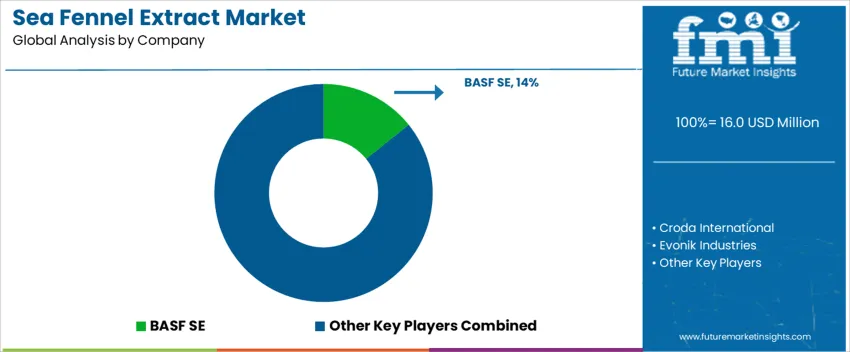
Global demand for sea fennel extract is rising as manufacturers in cosmetics, personal care, nutraceuticals and functional foods seek natural, marine-derived ingredients with multiple bioactive properties. Sea fennel is rich in antioxidants, vitamins (notably A, C, E), minerals and polyphenols, which support skin hydration, antioxidant defense, anti-inflammatory effects and skin barrier health. Its use as a “natural retinol alternative,” with potential to boost collagen synthesis, reduce visible signs of aging, and soothe irritation, increases its appeal in the anti-aging and skincare segments. The growing consumer preference for “clean label,” eco-friendly, natural ingredients further broadens adoption. Advances in extraction and purification technologies improve extract stability and consistency, enabling integration into creams, serums, dietary supplements, and functional formulations.
Key global suppliers positioned to supply sea fennel and similar marine-derived extracts include BASF SE, Croda International, Evonik Industries, Symrise (including its active-ingredient division), Dow Inc., Ashland, Clariant, and specialist ingredient firms such as Seppic, Lubrizol, Lonza, and Inolex. Large players supply standardized, large-volume extracts suited to mass-market cosmetics, skincare and nutraceutical brands. Smaller specialized firms offer high-purity or tailored sea-fennel-derived actives for premium, natural-cosmetic or functional-food applications. This diversified supply base supports global demand by balancing scale, quality, formulation readiness and flexibility of application across skin-care, wellness and food industries.
Key Players in the Sea Fennel (Crithmum maritimum) Extract Market
- BASF SE
- Croda International
- Evonik Industries
- Symrise (incl. IFF/Givaudan actives)
- Dow / Dow Inc.
- Ashland
- Clariant
- Seppic
- Others
Scope of the Report
| Items | Values |
|---|---|
| Quantitative Units (2025) | USD million |
| End-Use Applications | Skin Care, Body Care, Hair Care, Sun Care, Color Cosmetics, Men’s Grooming, Baby & Kids Care, Dermocosmetic / Professional Care |
| Product Forms | Powder, Granules/Agglomerates, Flakes, Pellets/Prills, Liquid (Solution), Concentrate (High-active Liquid), Dispersion/Suspension, Emulsion, Paste, Gel, Wax / Solid Block, Oil |
| Regions Covered | Asia Pacific, Europe, North America, Latin America, Middle East & Africa |
| Countries Covered | China, Japan, South Korea, India, Australia & New Zealand, ASEAN, Germany, United Kingdom, France, Italy, Spain, Nordic, BENELUX, USA, Canada, Mexico, Brazil, Chile, Saudi Arabia, Turkey, South Africa, plus 40+ additional countries globally |
| Key Companies Profiled | BASF SE, Croda International, Evonik Industries, Symrise (incl. IFF/Givaudan actives), Dow Inc., Ashland, Clariant, Seppic, Lubrizol, Lonza, Inolex |
| Additional Attributes | Dollar by sales breakdown by region, country, end-use, and product form; global growth projections; multi-sector adoption (cosmetic, nutraceutical, functional food); extract bioactivity profiling; iodine and polyphenol standardization; contract harvesting; vertical integration; supply chain stability; regulatory compliance; sensory and bioavailability performance |
Sea Fennel (Crithmum maritimum) Extract Market Segmentation
End Use Application:
- Skin Care
- Body Care
- Hair Care
- Sun Care
- Color Cosmetics
- Men’s Grooming
- Baby & Kids Care
- Dermocosmetic / Professional Care
Product Form:
- Powder
- Granules / Agglomerates
- Flakes
- Pellets / Prills
- Liquid (Solution)
- Concentrate (High-active Liquid)
- Dispersion / Suspension
- Emulsion
- Paste
- Gel
- Wax / Solid Block
- Oil
Region
- Asia Pacific
- China
- Japan
- South Korea
- India
- Australia & New Zealand
- ASEAN
- Rest of Asia Pacific
- Europe
- Germany
- United Kingdom
- France
- Italy
- Spain
- Nordic
- BENELUX
- Rest of Europe
- North America
- United States
- Canada
- Mexico
- Latin America
- Brazil
- Chile
- Rest of Latin America
- Middle East & Africa
- Kingdom of Saudi Arabia
- Other GCC Countries
- Turkey
- South Africa
- Other African Union
- Rest of Middle East & Africa
Frequently Asked Questions
How big is the sea fennel extract market in 2025?
The global sea fennel extract market is estimated to be valued at USD 16.0 million in 2025.
What will be the size of sea fennel extract market in 2035?
The market size for the sea fennel extract market is projected to reach USD 45.3 million by 2035.
How much will be the sea fennel extract market growth between 2025 and 2035?
The sea fennel extract market is expected to grow at a 11.0% CAGR between 2025 and 2035.
What are the key product types in the sea fennel extract market?
The key product types in sea fennel extract market are skin care, body care, hair care, sun care, color cosmetics, men’s grooming, baby & kids care and dermocosmetic / professional care.
Which product form segment to contribute significant share in the sea fennel extract market in 2025?
In terms of product form , powder segment to command 15.2% share in the sea fennel extract market in 2025.
Preview the report firsthand - request a free sample
Get SampleGet the brochure for pricing and purchase details.
Get PDFTable of Content
- Executive Summary
- Global Market Outlook
- Demand-side Trends
- Supply-side Trends
- Technology Roadmap Analysis
- Analysis and Recommendations
- Market Overview
- Market Coverage / Taxonomy
- Market Definition / Scope / Limitations
- Market Background
- Market Dynamics
- Drivers
- Restraints
- Opportunity
- Trends
- Scenario Forecast
- Demand in Optimistic Scenario
- Demand in Likely Scenario
- Demand in Conservative Scenario
- Opportunity Map Analysis
- Product Life Cycle Analysis
- Supply Chain Analysis
- Investment Feasibility Matrix
- Value Chain Analysis
- PESTLE and Porter’s Analysis
- Regulatory Landscape
- Regional Parent Market Outlook
- Production and Consumption Statistics
- Import and Export Statistics
- Market Dynamics
- Global Market Analysis 2020 to 2024 and Forecast, 2025 to 2035
- Historical Market Size Value (USD Million) Analysis, 2020 to 2024
- Current and Future Market Size Value (USD Million) Projections, 2025 to 2035
- Y-o-Y Growth Trend Analysis
- Absolute $ Opportunity Analysis
- Global Market Pricing Analysis 2020 to 2024 and Forecast 2025 to 2035
- Global Market Analysis 2020 to 2024 and Forecast 2025 to 2035, By End Use Application
- Introduction / Key Findings
- Historical Market Size Value (USD Million) Analysis By End Use Application , 2020 to 2024
- Current and Future Market Size Value (USD Million) Analysis and Forecast By End Use Application , 2025 to 2035
- Skin Care
- Body Care
- Hair Care
- Sun Care
- Color Cosmetics
- Men’s Grooming
- Baby & Kids Care
- Dermocosmetic / Professional Care
- Y-o-Y Growth Trend Analysis By End Use Application , 2020 to 2024
- Absolute $ Opportunity Analysis By End Use Application , 2025 to 2035
- Global Market Analysis 2020 to 2024 and Forecast 2025 to 2035, By Product Form
- Introduction / Key Findings
- Historical Market Size Value (USD Million) Analysis By Product Form, 2020 to 2024
- Current and Future Market Size Value (USD Million) Analysis and Forecast By Product Form, 2025 to 2035
- Powder
- Granules / Agglomerates
- Flakes
- Pellets / Prills
- Liquid (Solution)
- Concentrate (High-active Liquid)
- Dispersion / Suspension
- Emulsion
- Paste
- Gel
- Wax / Solid Block
- Y-o-Y Growth Trend Analysis By Product Form, 2020 to 2024
- Absolute $ Opportunity Analysis By Product Form, 2025 to 2035
- Global Market Analysis 2020 to 2024 and Forecast 2025 to 2035, By Region
- Introduction
- Historical Market Size Value (USD Million) Analysis By Region, 2020 to 2024
- Current Market Size Value (USD Million) Analysis and Forecast By Region, 2025 to 2035
- North America
- Latin America
- Western Europe
- Eastern Europe
- East Asia
- South Asia and Pacific
- Middle East & Africa
- Market Attractiveness Analysis By Region
- North America Market Analysis 2020 to 2024 and Forecast 2025 to 2035, By Country
- Historical Market Size Value (USD Million) Trend Analysis By Market Taxonomy, 2020 to 2024
- Market Size Value (USD Million) Forecast By Market Taxonomy, 2025 to 2035
- By Country
- USA
- Canada
- Mexico
- By End Use Application
- By Product Form
- By Country
- Market Attractiveness Analysis
- By Country
- By End Use Application
- By Product Form
- Key Takeaways
- Latin America Market Analysis 2020 to 2024 and Forecast 2025 to 2035, By Country
- Historical Market Size Value (USD Million) Trend Analysis By Market Taxonomy, 2020 to 2024
- Market Size Value (USD Million) Forecast By Market Taxonomy, 2025 to 2035
- By Country
- Brazil
- Chile
- Rest of Latin America
- By End Use Application
- By Product Form
- By Country
- Market Attractiveness Analysis
- By Country
- By End Use Application
- By Product Form
- Key Takeaways
- Western Europe Market Analysis 2020 to 2024 and Forecast 2025 to 2035, By Country
- Historical Market Size Value (USD Million) Trend Analysis By Market Taxonomy, 2020 to 2024
- Market Size Value (USD Million) Forecast By Market Taxonomy, 2025 to 2035
- By Country
- Germany
- UK
- Italy
- Spain
- France
- Nordic
- BENELUX
- Rest of Western Europe
- By End Use Application
- By Product Form
- By Country
- Market Attractiveness Analysis
- By Country
- By End Use Application
- By Product Form
- Key Takeaways
- Eastern Europe Market Analysis 2020 to 2024 and Forecast 2025 to 2035, By Country
- Historical Market Size Value (USD Million) Trend Analysis By Market Taxonomy, 2020 to 2024
- Market Size Value (USD Million) Forecast By Market Taxonomy, 2025 to 2035
- By Country
- Russia
- Poland
- Hungary
- Balkan & Baltic
- Rest of Eastern Europe
- By End Use Application
- By Product Form
- By Country
- Market Attractiveness Analysis
- By Country
- By End Use Application
- By Product Form
- Key Takeaways
- East Asia Market Analysis 2020 to 2024 and Forecast 2025 to 2035, By Country
- Historical Market Size Value (USD Million) Trend Analysis By Market Taxonomy, 2020 to 2024
- Market Size Value (USD Million) Forecast By Market Taxonomy, 2025 to 2035
- By Country
- China
- Japan
- South Korea
- By End Use Application
- By Product Form
- By Country
- Market Attractiveness Analysis
- By Country
- By End Use Application
- By Product Form
- Key Takeaways
- South Asia and Pacific Market Analysis 2020 to 2024 and Forecast 2025 to 2035, By Country
- Historical Market Size Value (USD Million) Trend Analysis By Market Taxonomy, 2020 to 2024
- Market Size Value (USD Million) Forecast By Market Taxonomy, 2025 to 2035
- By Country
- India
- ASEAN
- Australia & New Zealand
- Rest of South Asia and Pacific
- By End Use Application
- By Product Form
- By Country
- Market Attractiveness Analysis
- By Country
- By End Use Application
- By Product Form
- Key Takeaways
- Middle East & Africa Market Analysis 2020 to 2024 and Forecast 2025 to 2035, By Country
- Historical Market Size Value (USD Million) Trend Analysis By Market Taxonomy, 2020 to 2024
- Market Size Value (USD Million) Forecast By Market Taxonomy, 2025 to 2035
- By Country
- Kingdom of Saudi Arabia
- Other GCC Countries
- Turkiye
- South Africa
- Other African Union
- Rest of Middle East & Africa
- By End Use Application
- By Product Form
- By Country
- Market Attractiveness Analysis
- By Country
- By End Use Application
- By Product Form
- Key Takeaways
- Key Countries Market Analysis
- USA
- Pricing Analysis
- Market Share Analysis, 2024
- By End Use Application
- By Product Form
- Canada
- Pricing Analysis
- Market Share Analysis, 2024
- By End Use Application
- By Product Form
- Mexico
- Pricing Analysis
- Market Share Analysis, 2024
- By End Use Application
- By Product Form
- Brazil
- Pricing Analysis
- Market Share Analysis, 2024
- By End Use Application
- By Product Form
- Chile
- Pricing Analysis
- Market Share Analysis, 2024
- By End Use Application
- By Product Form
- Germany
- Pricing Analysis
- Market Share Analysis, 2024
- By End Use Application
- By Product Form
- UK
- Pricing Analysis
- Market Share Analysis, 2024
- By End Use Application
- By Product Form
- Italy
- Pricing Analysis
- Market Share Analysis, 2024
- By End Use Application
- By Product Form
- Spain
- Pricing Analysis
- Market Share Analysis, 2024
- By End Use Application
- By Product Form
- France
- Pricing Analysis
- Market Share Analysis, 2024
- By End Use Application
- By Product Form
- India
- Pricing Analysis
- Market Share Analysis, 2024
- By End Use Application
- By Product Form
- ASEAN
- Pricing Analysis
- Market Share Analysis, 2024
- By End Use Application
- By Product Form
- Australia & New Zealand
- Pricing Analysis
- Market Share Analysis, 2024
- By End Use Application
- By Product Form
- China
- Pricing Analysis
- Market Share Analysis, 2024
- By End Use Application
- By Product Form
- Japan
- Pricing Analysis
- Market Share Analysis, 2024
- By End Use Application
- By Product Form
- South Korea
- Pricing Analysis
- Market Share Analysis, 2024
- By End Use Application
- By Product Form
- Russia
- Pricing Analysis
- Market Share Analysis, 2024
- By End Use Application
- By Product Form
- Poland
- Pricing Analysis
- Market Share Analysis, 2024
- By End Use Application
- By Product Form
- Hungary
- Pricing Analysis
- Market Share Analysis, 2024
- By End Use Application
- By Product Form
- Kingdom of Saudi Arabia
- Pricing Analysis
- Market Share Analysis, 2024
- By End Use Application
- By Product Form
- Turkiye
- Pricing Analysis
- Market Share Analysis, 2024
- By End Use Application
- By Product Form
- South Africa
- Pricing Analysis
- Market Share Analysis, 2024
- By End Use Application
- By Product Form
- USA
- Market Structure Analysis
- Competition Dashboard
- Competition Benchmarking
- Market Share Analysis of Top Players
- By Regional
- By End Use Application
- By Product Form
- Competition Analysis
- Competition Deep Dive
- BASF SE
- Overview
- Product Portfolio
- Profitability by Market Segments (Product/Age /Sales Channel/Region)
- Sales Footprint
- Strategy Overview
- Marketing Strategy
- Product Strategy
- Channel Strategy
- Croda International
- Evonik Industries
- Symrise (incl. IFF/Givaudan actives)
- Dow / Dow Inc.
- Ashland
- Clariant
- Seppic
- Others
- BASF SE
- Competition Deep Dive
- Assumptions & Acronyms Used
- Research Methodology


