

- Industry Size (2026)
- USD 3.350 Bn
- Forecast (2036)
- USD 5.304 Bn
- CAGR (2026 to 2036)
- 4.7%
Seaweed Derived Minerals Market Size, Market Forecast and Outlook By FMI
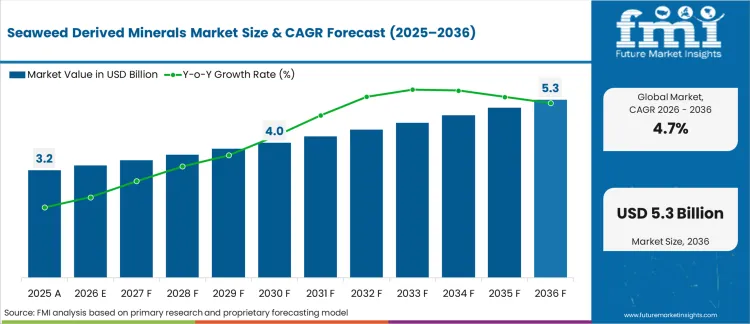
In 2025, the seaweed derived minerals market was valued at USD 3.200 billion. Based on Future Market Insights' analysis, demand for seaweed derived minerals is estimated to grow to USD 3.350 billion in 2026 and USD 5.304 billion by 2036. FMI projects a CAGR of 4.7% during the forecast period.
Absolute dollar growth of USD 1.954 billion over the decade reflects both the market's entry into regulated health claim territory and the structural shift in procurement behavior among nutraceutical and functional food manufacturers who are moving from unspecified mineral blends toward traceable, species-identified, third-party tested seaweed mineral concentrates. The market's trajectory is shaped by two converging forces: growing consumer demand for plant-derived calcium and magnesium alternatives in clean-label supplement formulations, and the expansion of seaweed biorefinery capacity that is improving yield consistency and purity levels to pharmaceutical-adjacent standards.
In June 2025, Acadian Seaplants completed a specialized microbial testing laboratory at its Cornwallis facility, enabling it to certify safety and purity of seaweed-derived minerals across all batches destined for export to over 80 countries, a quality infrastructure investment that directly addresses the traceability and documentation requirements of EU, US, and Japanese regulatory frameworks for marine-derived dietary ingredients. [1]
Summary of Seaweed Derived Minerals Market
- Seaweed Derived Minerals Market Definition
- The market covers mineral-concentrated extracts and preparations sourced from marine red, brown, and green algae species, supplying bioavailable calcium, magnesium, iodine, and trace mineral complexes to dietary supplement, functional food, agricultural, and animal nutrition manufacturers.
- Demand Drivers in the Market
- Consumer preference shift toward plant-derived and marine-sourced mineral alternatives in clean-label dietary supplement and functional food formulations is compelling nutraceutical manufacturers to substitute synthetically derived calcium and magnesium with certified seaweed-origin mineral concentrates in premium product lines.
- Expansion of pharmaceutical-grade purity testing and third-party traceability certification among leading seaweed mineral producers is unlocking qualification in regulated dietary ingredient markets in the EU, USA, and Japan, where documentation of marine biomass source, species identity, and contaminant absence is required for import and label claim authorization.
- Growth of integrated multi-trophic aquaculture and responsible marine management programs is improving the consistency, sustainability certification, and year-round supply reliability of seaweed biomass inputs, reducing procurement risk for manufacturers who previously faced seasonal availability and quality variability constraints when sourcing wild-harvested algae.
- Key Segments Analyzed in the FMI Report
- Form: Powder holds approximately 42.6% share as the most versatile and stable format for blending into dietary supplement capsules, functional food formulations, and animal feed matrices, with consistent mineral density and dissolution performance across manufacturing processes.
- Source: Red Algae accounts for approximately 51.3% by source, driven by the high calcium and trace mineral density of species such as Lithothamnion and Phymatolithon, which are widely used in plant-based calcium supplement formulations across North American and European nutraceutical markets.
- End-use: Dietary Supplements represent approximately 38.6% of demand, anchored by premium bone health, cardiovascular support, and sports nutrition product categories where marine-derived mineral bioavailability claims provide commercial differentiation versus synthetic mineral alternatives.
- Analyst Opinion at FMI
- Nandini Roy Choudhury, Principal Consultant for Food and Beverage Industry at Future Market Insights, opines, 'In the updated version of the Seaweed Derived Minerals Market Report for 2026 to 2036, CXOs will find that the central commercial risk in this market is the growing divergence between premium certified seaweed mineral suppliers with documented species identity, purity testing, and sustainable sourcing credentials and bulk undifferentiated marine mineral powder producers competing purely on price. My findings indicate that regulatory tightening in the EU and Japan around marine-derived dietary ingredient documentation requirements will accelerate this stratification, effectively partitioning the market into a high-margin certified segment and a commoditized lower tier, with mid-market suppliers facing displacement unless they invest in biorefinery quality infrastructure before 2028.'
- Strategic Implications / Executive Takeaways
- Invest in biorefinery-grade microbial testing, species authentication, and contaminant screening infrastructure as a prerequisite for qualification in regulated EU, US, and Japanese dietary ingredient import channels, where documentation requirements are tightening and creating a certification barrier that will structurally advantage early-compliant suppliers.
- Develop branded seaweed mineral concentrates with published bioavailability data and species-level traceability to differentiate from bulk commodity mineral powder suppliers and qualify for premium nutraceutical private-label and branded ingredient procurement programs demanding documented health claim substantiation.
- Target the precision nutrition segment with seaweed mineral concentrates formulated to controlled mineral density specifications, enabling nutraceutical manufacturers to build scientifically validated dosing regimens rather than relying on commodity inputs with variable mineral content across batches.
- Methodology
- Validated through primary interviews with seaweed processing operators and nutraceutical manufacturers across Europe, North America, and Asia-Pacific.
- Zero reliance on speculative third-party market research reports; benchmarks sourced from FAO aquaculture statistics and verified company sustainability disclosures.
- Based on verified seaweed biomass production data, extraction yield coefficients, and published capacity announcements from major biorefinery and marine ingredient operators.
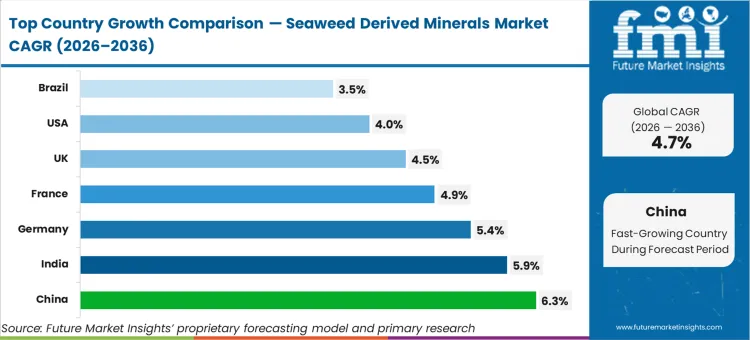
China (6.3% CAGR) leads growth as domestic algae cultivation capacity expands and nutraceutical manufacturers integrate seaweed mineral concentrates into product portfolios targeting urban health-conscious consumers. India (5.9% CAGR) reflects accelerating dietary supplement market development and growing aquaculture-linked seaweed cultivation programs. Germany (5.4% CAGR) generates demand through functional food innovation and strict EU bioavailability documentation requirements. France (4.9% CAGR) benefits from its proximity to Atlantic brown algae harvesting regions and established seaweed processing infrastructure.
UK (4.5% CAGR) and USA (4.0% CAGR) represent mature but expanding markets through premium nutraceutical and sports nutrition channel growth. Powder form holds approximately 42.6% share; Red Algae sourcing accounts for approximately 51.3% by source; Organic nature captures approximately 58.7% by nature; Dietary Supplements represent approximately 38.6% of end-use demand.
Seaweed Derived Minerals Market Definition
The seaweed derived minerals market comprises the global production and supply of mineral-concentrated extracts, isolates, and preparations sourced from marine macroalgae species including red, brown, and green algae, used across dietary supplement, functional food and beverage, agricultural biostimulant, animal nutrition, and meat processing applications. These products deliver bioavailable forms of calcium, magnesium, iodine, iron, zinc, and trace mineral complexes derived from marine biomass through aqueous extraction, biorefinery, and drying processes. The market covers both organic-certified and conventional seaweed mineral preparations supplied in powder, solid, granule, flake, and liquid formats for industrial, nutraceutical, and food manufacturing end uses.
Seaweed Derived Minerals Market Inclusions
The report includes Global and Regional Market Sizes (Volume and Value) and a 10-year Forecast (2026 to 2036). Coverage spans segmental breakdowns by form (Powder, Solid, Granules, Flakes, and Liquid), source (Red Algae, Brown Algae, and Green Algae), nature (Organic and Conventional), end-use (Dietary Supplements, Food and Beverage Industry, Fertilizers, Animal Nutrition and Pet Food, and Meat Processing Industry), and geography across 40-plus countries.
Seaweed Derived Minerals Market Exclusions
The scope excludes mineral preparations derived from terrestrial botanical or synthetic sources, including calcium carbonate, magnesium oxide, and zinc sulfate formulations not sourced from marine algae biomass. Whole dried seaweed food products sold as culinary ingredients in retail channels without mineral concentration processing are outside the reportable market boundary. Seaweed-derived carrageenan, agar, and alginates are excluded unless sold specifically as mineral-enriched preparations. Microalgae-derived mineral products from cultivation systems not classified as macroalgae biorefinery processes are outside scope.
Seaweed Derived Minerals Market Research Methodology
- Primary Research: Interviews were conducted with seaweed harvesting and cultivation operators, marine extract processing companies, nutraceutical formulators, functional food manufacturers, agricultural biostimulant distributors, and regulatory affairs specialists across Europe, North America, Asia-Pacific, and Latin America.
- Desk Research: Production data from national aquaculture agencies, FAO fisheries and aquaculture statistics, seaweed industry association reports, company annual reports and sustainability disclosures, and peer-reviewed marine science publications supported volume and value benchmarking.
- Market-Sizing and Forecasting: A hybrid top-down and bottom-up model was developed. Demand was reconstructed from seaweed biomass production data, extraction yield coefficients by algae species, mineral content standardization metrics, and end-use application penetration rates, then validated against processing capacity announcements from major biorefinery operators.
- Data Validation and Update Cycle: Outputs undergo cross-validation against international seaweed trade flow statistics, regulatory certification records for marine-derived dietary ingredients, and structured peer review prior to release.
Why is the Seaweed Derived Minerals Market Growing?
The Seaweed Derived Minerals market is experiencing consistent growth driven by the rising adoption of natural and sustainable mineral sources across food, dietary supplements, pharmaceuticals, and cosmetics. In 2025, the market is witnessing significant traction due to the increasing preference for organic and plant-based ingredients, which are considered safer and environmentally friendly compared to synthetic alternatives.
The global shift toward healthier lifestyles, coupled with growing awareness about the nutritional benefits of seaweed-derived minerals, is influencing market expansion. Additionally, technological advancements in extraction and processing methods have enhanced the bioavailability and purity of these minerals, enabling manufacturers to deliver high-quality products at scale.
As consumer demand for functional foods, nutraceuticals, and personal care products continues to rise, the market is expected to benefit from innovative formulations and applications The ongoing focus on sustainability and regulatory incentives for natural products further supports long-term growth, creating opportunities for market players to expand product portfolios and explore emerging markets with high demand for organic mineral supplements.
Segmental Analysis
The seaweed derived minerals market is segmented by form, source, nature, end-use, and geographic regions. By form, seaweed derived minerals market is divided into Powder, Solid, Granules, Flakes, and Liquid. In terms of source, seaweed derived minerals market is classified into Red algae, Brown algae, and Green algae. Based on nature, seaweed derived minerals market is segmented into Organic and Conventional. By end-use, seaweed derived minerals market is segmented into Fertilizers, Food & Beverage Industry, Dietary Supplements, Animal Nutrition & Pet Food, and Meat Processing Industry. Regionally, the seaweed derived minerals industry is classified into North America, Latin America, Western Europe, Eastern Europe, Balkan & Baltic Countries, Russia & Belarus, Central Asia, East Asia, South Asia & Pacific, and the Middle East & Africa.
Insights into the Powder Form Segment
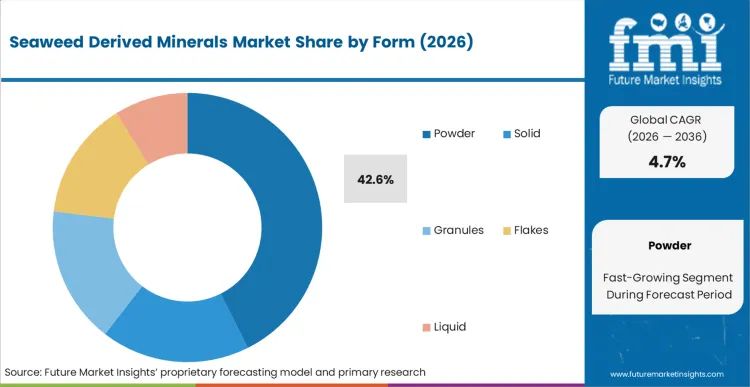
The powder form segment is projected to hold 42.60% of the Seaweed Derived Minerals market revenue share in 2026, making it the leading form type. This dominance is attributed to its versatility in end-use applications, ease of blending into food and beverage products, and suitability for nutraceutical formulations.
The powder form allows precise dosing, improved solubility, and consistent quality, which is critical for both industrial manufacturers and consumer-facing products. Additionally, powdered minerals can be easily incorporated into capsules, tablets, and functional foods without altering the product texture or flavor, increasing adoption across various industries.
The scalability of powder processing and the ability to maintain nutritional integrity during manufacturing have reinforced its preference among producers As product innovation continues and clean-label trends gain traction, the powder form segment is expected to maintain its market leadership, driven by the convenience it provides for formulation flexibility and widespread commercial application.
Insights into the Red Algae Source Segment
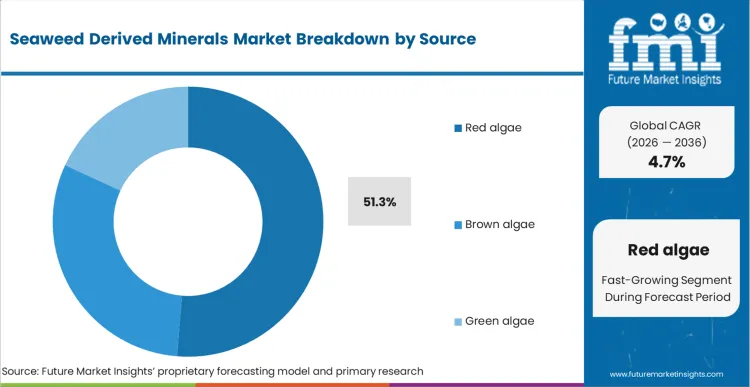
The red algae source segment is anticipated to account for 51.30% of the total Seaweed Derived Minerals market revenue in 2026, positioning it as the largest source category. This leadership is being driven by the high mineral content, including calcium, magnesium, and trace elements, naturally found in red algae, which enhances its nutritional profile and functionality in dietary supplements.
Red algae is also favored for its consistent availability and ease of cultivation, ensuring reliable supply for industrial-scale production. The segment has benefited from increased consumer awareness regarding the natural origin of minerals and the preference for sustainably sourced ingredients.
Furthermore, red algae is compatible with advanced extraction techniques that maximize yield while preserving bioactive compounds, which supports its use in high-value nutraceutical and functional food products As sustainability and natural product trends continue to influence purchasing decisions, the red algae source segment is expected to remain dominant, offering high-quality mineral content with broad applicability across multiple industries.
Insights into the Organic Nature Segment
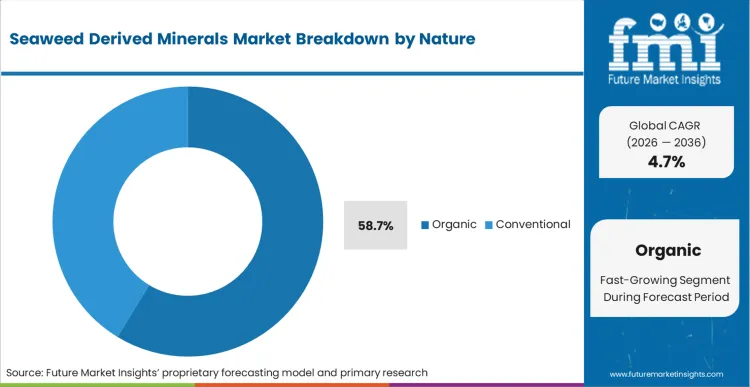
The organic nature segment is projected to hold 58.70% of the Seaweed Derived Minerals market revenue share in 2026, making it the leading category in terms of product nature. This dominance is being driven by the growing global demand for organic and clean-label products, as consumers increasingly prefer ingredients that are free from synthetic additives and chemical processing.
Organic seaweed-derived minerals are considered safer and environmentally sustainable, enhancing their appeal across food, beverage, and personal care industries. Adoption has been further supported by the rising awareness of the health benefits of naturally sourced minerals, including improved bioavailability and minimal contamination risk.
The segment also benefits from regulatory incentives and certifications that encourage the use of organic ingredients, fostering consumer trust and confidence As sustainability and health-conscious trends continue to influence product development, the organic nature segment is expected to maintain market leadership, supported by strong consumer preference and widespread industrial acceptance.
Market Overview
Seaweed Derived Minerals Market Outlook 2026 to 2036
The Seaweed Derived Minerals Market is valued at USD 3.350 billion in 2026 and is anticipated to reach USD 5.304 billion by 2036. The market is expected to grow at a CAGR of 4.7% from 2026 to 2036.
Seaweed derived minerals are essential trace elements such as iodine, potassium, magnesium, calcium, iron, and pigments extracted from seaweeds.
Seaweed derived minerals are particularly significant ingredients in the food industry as consumers are demanding specialized salt-free products or those which are bereft of MSG, and seaweed derived ingredients, being naturally salty offer a promising opportunity for the manufacturers to cut down salts in finished food products.
Consumers often find salt-free products bland and tasteless while seaweed derived minerals offer a savory and meaty flavor to the food, overcoming the savory issues of the salt-free products.
In the overall salt substitute industry, a key emphasis is being paid to the flavor language of consumers and hence research and development is a fundamental regulator in governing the seaweed derived minerals market growth. Also, in the finished products, seaweed derived minerals bear the flag of salt substitutes.
| Attributes | Details |
|---|---|
| Seaweed Derived Minerals Market Size Value in 2026 | USD 3.350 billion |
| Seaweed Derived Minerals Market Projected Size Value in 2036 | USD 5.304 billion |
| Global Growth Rate (2026 to 2036) | 4.7% CAGR |
| Forecast Period | (2026 to 2036) |
The launch of a wide range of products with a focus on product developments while taking into consideration the rising demand for Seaweed Derived Minerals in numerous End Use Applications. The numerous health benefits obtained from these products prove to be a significant driving factor for the market's growth. The market is expected to expand throughout the forecast period.
Future Market Insights projects the market to remain lucrative, exhibiting growth at 4.7% CAGR between 2026 and 2036 in comparison to the CAGR of 5.1% posted between 2026 and 2026.
2026 to 2026 Seaweed Derived Minerals Market Outlook in Comparison to 2026 to 2036 Growth Forecast
A new report published by Future market insights, titled, "Seaweed Derived Minerals Market - FMI 2026-2036," projects the global Seaweed Derived Minerals market to reach USD 4,455.3 Million by 2036 and is expected to grow at a CAGR of 4.7% from 2026 to 2036. The market grew at a CAGR of 5.1% between 2026 and 2026. Forecasts for growth remain optimistic, with the sales of Seaweed Derived Minerals predicted to grow at a CAGR of 4.7% between 2026 to 2036. This period marked the entry of various market players and product innovations.
In the upcoming years, it is anticipated that factors including Globalization, shifting consumer preferences, and rising health consciousness will increase demand for salt free products to the trend of Asian food products. Also, apart from being a salt substitute, seaweed derived minerals also act as flavor enhancers being the major factors driving the market growth.
Also, product improvements are anticipated to expand the Seaweed Derived Minerals in the coming years. The leading players in the Seaweed Derived Minerals now have a sizable window of opportunity thanks to rising demand.
Seaweed derived minerals are making a splash in the specialty ingredients segment
With an increase in the specialty ingredients industry, Seaweed Derived Minerals Market is expected to witness exponential growth over the forecast period. Apart from being a salt substitute, seaweed derived minerals also act as flavor enhancers. Globalization and the trend of Asian food products have also propelled the growth of the seaweed derived minerals market as seaweed is traditionally consumed in Asia through soups and broths.
The seaweed derived minerals add umami-like indulgent flavors to the salt-free products. As the trend for Asian food products continues to mount amongst western consumers, this trend is graciously coupled with the manufacturers' efforts to cater to consumer demand, and hence, the seaweed derived minerals are forecasted to achieve considerable growth over the forecast period. The quality and versatility of seaweed derived minerals in food products are of greatest concern to the manufacturers as seaweed derived minerals are known to be not fully soluble and sometimes disrupt the texture and appearance of the finished products.
Another factor which may hinder the seaweed derived minerals market growth is the supply of the base raw material pacing with sustainability. Manufacturers have to constantly focus on sourcing seaweed derived minerals from a seaweed species which is both scalable and sustainable.
Manufacturers now have numerous opportunities to serve to the growing demand. Global Seaweed Derived Minerals Market: Examples of some of the market participants in the global seaweed derived minerals market identified across the value chain include Marigot Ltd., Maxicrop USA, Inc., Alesco S.r.l., Celtic Minerals Ltd., Humates and Seaweeds Pvt Ltd, BioFlora, LLC, Sar Agrochemicals & Fertilizers Pvt. Ltd and HMHS Solutions Limited amongst others.
Opportunities for Seaweed Derived Minerals Market Participants
Encouraging the incorporation of seaweed derived minerals in food products such as bread, cheese, snacks, ready meals, and frozen meat at the industrial food processing level offer ample opportunities for seaweed derived minerals manufacturers, as these processed products are the most common route of high salt intake amongst consumers.
Educational marketing will ease the issues regarding lack of consumer awareness as consumer understanding and acceptance play a central role in promoting the seaweed derived minerals market growth.
Brief Approach to Research
A modelling-based approach and triangulation methodology will be followed to estimate the data covered in this report.
A detailed market understanding and assessment of the product types and end uses of the target product covered in the study is followed by carrying out a demand-side approach to estimate the sales of target product segments, which is then cross-referenced with a supply-side assessment of value generated over a pre-defined period.
The statistics and data are collected at a regional level, consolidated, and synthesized at a global level to estimate the overall market sizes.
Country Wise Insights
What are the Prospects for the Growth of Seaweed Derived Minerals Sales in the USA?
The USA is a prominent market for Seaweed Derived Minerals with a dominant market share of 30.2% globally and is also expected to exhibit high growth over the forecast period. According to the latest study, the Seaweed Derived Minerals Market is anticipated to grow substantially and register a significant CAGR over the forecast period.
According to the FMI’s regional analysis, the region of North America has had the fastest growth due to the enormous demand and supply that exist for Seaweed Derived Minerals products. The rise in health consciousness among consumers and the increase in demand for salt free products are some of the key factors driving the growth of the market.
Rapid research and development by the major market players have helped the market to experience significant growth and to focus on potential consumers to sustain long-term product sales. This research and development aim to understand and provide sustainable solutions for the increasing demand for healthy and convenient food options that are fuelling the growth of the Seaweed Derived Minerals Market in the USA.
What is the UK's outlook in the Seaweed Derived Minerals market?
The UK Seaweed Derived Minerals Market research gives context for and insight into how, despite the market's slower-than-anticipated growth, opportunities in the UK Seaweed Derived Minerals Market are still quite attractive, exhibiting a sizeable market share globally, The Seaweed Derived Minerals Market in the UK is anticipated to grow at a lucrative CAGR of 3.4% during 2026.
According to the FMI analysis, the increased popularity of products with natural salt is boosting the use of Seaweed Derived Minerals in the Food & Beverage Industry, Dietary Supplements, Animal Nutrition & Pet Food, and the Meat Processing Industry in the UK. This market will have the quickest growth in the supplements category due to numerous studies that are anticipated to release a variety of new products over the forecast period in the UK.
These factors have made it essential for players operating in the market to maintain high-quality standards in the production of Seaweed Derived Minerals for sustaining sales through 2036.
What are the Growth prospects of the Seaweed Derived Minerals Market in Germany?
The FMI analysis of the German Seaweed Derived Minerals Market shows how, the factors such as increased disposable income, brisk middle-class population expansion, high purchasing power, and the popularity of supplements have increased due to the increasing number of fitness enthusiasts and their reliance on high-protein diets will contribute to the rapid growth.
A significant rate of growth in the use of Seaweed Derived Minerals is projected due to the rising demand from numerous industries. All these significant drivers of growth are increasing the demand in Germany, Accounting for a sizeable market share of 22.0% globally. Manufacturers are expected to use innovative marketing and promotional techniques to boost sales during the forecast period.
China Demand Outlook of Seaweed Derived Minerals
The China seaweed derived minerals market is diverse and rapidly growing industry, with a wide range of products being produced and consumed. Seaweed is a highly nutritious and versatile food source and has been used in Chinese cuisine for thousands of years. In recent years, seaweed has seen a resurgence in popularity in China, as consumers look for healthier and more sustainable food options.
In China, many new startups and established companies are leveraging this trend to reach new customers and expand their reach. With more people shopping online and seeking out new and innovative food products, the market in China is poised for continued growth during the forecast period. Therefore, the market in China is expected to grow at a CAGR of 6.2% from 2026 to 2036.
Rise of Plant-based and Sustainable Foods Fuels Powdered Seaweed Derived Minerals Market Dominance
Based on form, the market is dominated by the powder segment. The dominance of powdered seaweed derived minerals in the market can be attributed to several factors. Firstly, it is a versatile ingredient that can be easily incorporated into different food and beverage products, providing a nutritious boost. Secondly, the powder form offers greater convenience and easier storage compared to other forms. Additionally, the powdered form also allows for more efficient and cost-effective transportation and distribution.
The increasing demand for plant-based and sustainable food products, in addition to the recognition of seaweed derived minerals as a superfood, has led to a rise in the popularity of seaweed derived minerals powder. Furthermore, seaweed derived minerals powder is increasingly in demand from the dietary supplements sector. These factors have collectively contributed to the dominance of powdered seaweed in the market.
Competitive Landscape
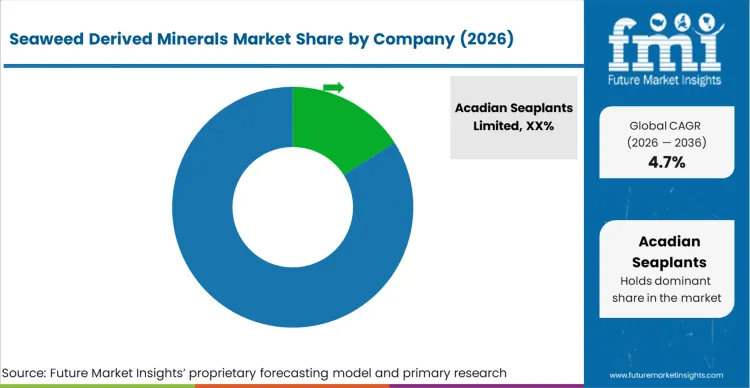
The Seaweed Derived Minerals Market was impacted by COVID 19, although only to a limited extent. Changes in factors such as demand, consumption, transportation, consumer behavior, supply chain management, import, export, and production were constrained.
Research & development is the major modicum for the seaweed derived minerals market growth as the growth of the market is spurred by innovation in food ingredients. The seaweed derived minerals market currently hosts several players engaged in product innovation and marketing them for the health conscious demo graph.
Due to the presence of several local and regional competitors, the industry is extremely fragmented and competitive globally. As a part of their growth strategies, leading players in the market emphasize strategic partnerships, mergers, and acquisitions to establish a firm foothold. Apart from collaborations, a profound emphasis on research and development for better product rollout will help solidify growth prospects during the assessment period. For instance
Recent Developments
The report includes full coverage of key trends from competitive benchmarking. Some of the recent developments covered in the reports:
- In February 2026, dsm-firmenich entered into a definitive agreement with CVC Capital Partners to divest its Animal Nutrition and Health business for an enterprise value of EUR 2.2 billion, refocusing the company's resources on its 'Taste, Texture and Health' and 'Health, Nutrition and Care' segments that prioritize high-growth human mineral enrichment and functional ingredients, including its algae-based lipid and mineral portfolios. [2]
- In March 2025, Algaia, two years after joining the JRS Group, announced a major industrial transformation program at its Saint-Lo facility targeting leadership in brown seaweed biorefining, including a new building permit submission for production scaling of high-purity seaweed extracts, and a strategic focus on upcycling marine biomass into mineral-rich ingredients for the nutraceutical and pharmaceutical sectors. [3]
- In November 2025, Cargill announced a significant increase in its micronutrition production capacity to meet surging global demand for high-purity mineral ingredients, enhancing its ability to process and distribute mineral-dense marine and botanical inputs including its WavePure seaweed-based stabilizers and mineral enrichment solutions, directly supporting the 2026 precision nutrition trend. [4]
- In June 2025, Acadian Seaplants submitted its 2025 Communication on Progress to the United Nations Global Compact and completed a specialized microbial testing laboratory at its Cornwallis facility, ensuring the safety and purity of seaweed-derived minerals for global export to over 80 countries. [1]
Analysis of Seaweed Derived Minerals Market By Key Countries
.webp "Top Country Growth Comparison Seaweed Derived Minerals Market Cagr (2026 2036)")
| Country | CAGR |
|---|---|
| China | 6.3% |
| India | 5.9% |
| Germany | 5.4% |
| France | 4.9% |
| UK | 4.5% |
| USA | 4.0% |
| Brazil | 3.5% |
Country-wise Analysis
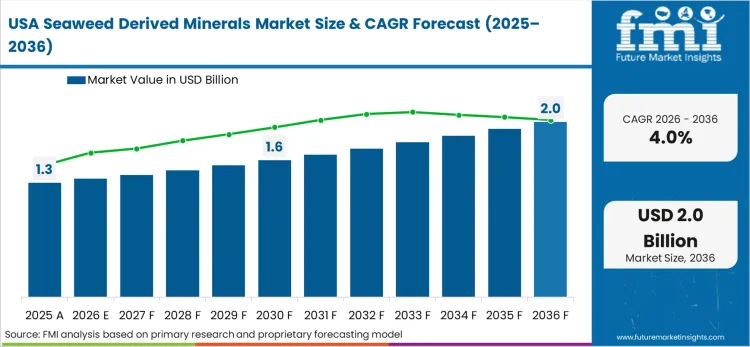
The Seaweed Derived Minerals Market is expected to register a CAGR of 4.7% during the forecast period, exhibiting varied country level momentum. China leads with the highest CAGR of 6.3%, followed by India at 5.9%. Developed markets such as Germany, France, and the UK continue to expand steadily, while the USA is likely to grow at consistent rates. Brazil posts the lowest CAGR at 3.5%, yet still underscores a broadly positive trajectory for the global Seaweed Derived Minerals Market. In 2024, Germany held a dominant revenue in the Western Europe market and is expected to grow with a CAGR of 5.4%. The USA Seaweed Derived Minerals Market is estimated to be valued at USD 1.2 billion in 2025 and is anticipated to reach a valuation of USD 1.8 billion by 2035. Sales are projected to rise at a CAGR of 4.0% over the forecast period between 2025 and 2035. While Japan and South Korea markets are estimated to be valued at USD 153.8 million and USD 110.9 million respectively in 2025.
Key Players in the Seaweed Derived Minerals Market
- Acadian Seaplants Limited
- Cargill, Incorporated
- DuPont de Nemours, Inc.
- Irish Seaweeds
- Green Rise Agro Industries
- VietDelta Ltd.
- Ocean Rainforest
- Thorverk hf.
Scope of the Report
| Metric | Value |
|---|---|
| Quantitative Units | USD 3.350 billion (2026) to USD 5.304 billion (2036), at a CAGR of 4.7% |
| Market Definition | The seaweed derived minerals market covers mineral-concentrated extracts and preparations sourced from marine red, brown, and green algae species, delivering bioavailable calcium, magnesium, iodine, and trace minerals for dietary supplement, functional food, agricultural, and animal nutrition applications. |
| Form Segmentation | Powder, Solid, Granules, Flakes, Liquid |
| Source Segmentation | Red Algae, Brown Algae, Green Algae |
| Nature Segmentation | Organic, Conventional |
| End-use Segmentation | Dietary Supplements, Food and Beverage Industry, Fertilizers, Animal Nutrition and Pet Food, Meat Processing Industry |
| Regions Covered | North America, Latin America, Europe, East Asia, South Asia, Oceania, Middle East and Africa |
| Countries Covered | China, India, Germany, France, United Kingdom, United States, Brazil and 40 plus countries |
| Key Companies Profiled | Acadian Seaplants Limited, Cargill Incorporated, DuPont de Nemours Inc., Irish Seaweeds, Green Rise Agro Industries, VietDelta Ltd., Ocean Rainforest, Thorverk hf. |
| Forecast Period | 2026 to 2036 |
| Approach | Hybrid top-down and bottom-up market modeling validated through primary interviews with seaweed processing operators and nutraceutical manufacturers, supported by FAO aquaculture statistics and verified biorefinery capacity disclosures |
Seaweed Derived Minerals Market by Segments
Form:
- Powder
- Solid
- Granules
- Flakes
- Liquid
Source:
- Red algae
- Brown algae
- Green algae
Nature:
- Organic
- Conventional
End-use:
- Fertilizers
- Food & Beverage Industry
- Dietary Supplements
- Animal Nutrition & Pet Food
- Meat Processing Industry
Region:
- North America
- USA
- Canada
- Mexico
- Latin America
- Brazil
- Chile
- Rest of Latin America
- Western Europe
- Germany
- UK
- Italy
- Spain
- France
- Nordic
- BENELUX
- Rest of Western Europe
- Eastern Europe
- Russia
- Poland
- Hungary
- Balkan & Baltic
- Rest of Eastern Europe
- East Asia
- China
- Japan
- South Korea
- South Asia and Pacific
- India
- ASEAN
- Australia & New Zealand
- Rest of South Asia and Pacific
- Middle East & Africa
- Kingdom of Saudi Arabia
- Other GCC Countries
- Turkiye
- South Africa
- Other African Union
- Rest of Middle East & Africa
Bibliography
- [1] Acadian Seaplants Limited. (2025). Acadian Seaplants 2025 Communication on Progress: UN Global Compact reporting and completion of Cornwallis microbial testing laboratory for seaweed mineral export certification. Corporate Sustainability Report, June 2025. https
- [2] dsm-firmenich. (2026). dsm-firmenich announces agreement to divest Animal Nutrition and Health to CVC Capital Partners for EUR 2.2 billion. Corporate Press Release, February 2026.
- [3] Algaia (JRS Group). (2025). Algaia announces industrial transformation program at Saint-Lo facility targeting brown seaweed biorefining leadership and high-purity nutraceutical extract production. Corporate Announcement, March 2025
- [4] Cargill Incorporated. (2025). Cargill increases micronutrition production capacity to meet global demand for high-purity mineral ingredients including WavePure seaweed-based mineral enrichment solutions. Corporate Press Release, November 2025.
- [5] FAO. (2025). The state of world fisheries and aquaculture 2025: seaweed production statistics and aquaculture volume data. Rome: Food and Agriculture Organization of the United Nations
- [6] Global Seaweed Industry Association. (2025). Global seaweed market overview: production, trade, and applications 2025.
This Report Addresses
- Market intelligence to enable structured sourcing and product development strategy for nutraceutical formulators, functional food manufacturers, and agricultural biostimulant producers requiring certified seaweed-derived mineral ingredients
- Market size estimation and 10-year revenue forecasts from 2026 to 2036, supported by validated seaweed biomass production benchmarks and mineral extraction yield data
- Growth opportunity mapping across algae forms, sources, and end-use applications with emphasis on premium certified organic and pharmaceutical-grade purity segment transitions
- Segment and regional revenue forecasts covering dietary supplements, food and beverage, fertilizers, animal nutrition, and meat processing applications across key consuming geographies
- Competition strategy assessment including species authentication capability, biorefinery purity infrastructure investment, and sustainable marine sourcing certification benchmarking
- Product compliance and regulatory tracking including EU and US dietary ingredient documentation requirements, organic certification status, and marine-derived mineral health claim substantiation standards
- Regulatory impact analysis covering EU Novel Food framework application to marine-derived ingredients, Japanese Food Labeling Act requirements, and US DSHEA documentation standards for marine mineral dietary supplements
- Market report delivery in PDF, Excel, PPT, and interactive dashboard formats for executive and operational use
Frequently Asked Questions
How large is the demand for seaweed derived minerals in the global market in 2026?
Demand for seaweed derived minerals in the global market is estimated to be valued at USD 3.350 billion in 2026.
What will be the market size of seaweed derived minerals by 2036?
Market size for seaweed derived minerals is projected to reach USD 5.304 billion by 2036.
What is the expected CAGR for the seaweed derived minerals market between 2026 and 2036?
Demand for seaweed derived minerals is expected to grow at a CAGR of 4.7% between 2026 and 2036.
Which form of seaweed derived minerals holds the largest market share?
Powder holds approximately 42.6% share as the most versatile and stable format for blending into dietary supplement capsules, functional food formulations, and animal feed matrices with consistent mineral density and dissolution performance.
Which source segment dominates the seaweed derived minerals market?
Red Algae accounts for approximately 51.3% by source, driven by the high calcium and trace mineral density of species such as Lithothamnion and Phymatolithon used in plant-based calcium supplement formulations across North American and European nutraceutical markets.
Which end-use segment generates the highest demand for seaweed derived minerals?
Dietary Supplements represent approximately 38.6% of end-use demand, anchored by premium bone health, cardiovascular support, and sports nutrition product categories where marine-derived mineral bioavailability claims provide commercial differentiation versus synthetic alternatives.
Which countries show the fastest growth in seaweed derived minerals demand?
China leads at 6.3% CAGR through 2036, followed by India at 5.9% and Germany at 5.4%, with growth driven by nutraceutical market expansion, aquaculture-linked algae cultivation programs, and strict bioavailability documentation requirements in regulated supplement markets.
What is the significance of organic certification in the seaweed derived minerals market?
Organic nature captures approximately 58.7% of market demand by nature classification, reflecting that premium nutraceutical, functional food, and clean-label agricultural application customers consistently specify certified organic seaweed mineral inputs as a procurement requirement for product line positioning.
Is Brazil covered in this report?
Yes, Brazil is covered within the Latin America regional scope at 3.5% CAGR through 2036, reflecting growing dietary supplement market development and agricultural biostimulant adoption driven by precision agriculture programs in major crop-producing regions.
How does FMI validate the seaweed derived minerals market forecast?
The forecast uses a hybrid model validated through primary interviews with seaweed processing operators and nutraceutical manufacturers, cross-referenced against FAO fisheries and aquaculture statistics, international seaweed trade flow data, and verified biorefinery capacity announcements from major producers.
Preview the report firsthand - request a free sample
Get SampleGet the brochure for pricing and purchase details.
Get PDFTable of Content
- Executive Summary
- Global Market Outlook
- Demand-side Trends
- Supply-side Trends
- Technology Roadmap Analysis
- Analysis and Recommendations
- Market Overview
- Market Coverage / Taxonomy
- Market Definition / Scope / Limitations
- Research Methodology
- Chapter Orientation
- Analytical Lens and Working Hypotheses
- Market Structure, Signals, and Trend Drivers
- Benchmarking and Cross-market Comparability
- Market Sizing, Forecasting, and Opportunity Mapping
- Research Design and Evidence Framework
- Desk Research Programme (Secondary Evidence)
- Company Annual and Sustainability Reports
- Peer-reviewed Journals and Academic Literature
- Corporate Websites, Product Literature, and Technical Notes
- Earnings Decks and Investor Briefings
- Statutory Filings and Regulatory Disclosures
- Technical White Papers and Standards Notes
- Trade Journals, Industry Magazines, and Analyst Briefs
- Conference Proceedings, Webinars, and Seminar Materials
- Government Statistics Portals and Public Data Releases
- Press Releases and Reputable Media Coverage
- Specialist Newsletters and Curated Briefings
- Sector Databases and Reference Repositories
- FMI Internal Proprietary Databases and Historical Market Datasets
- Subscription Datasets and Paid Sources
- Social Channels, Communities, and Digital Listening Inputs
- Additional Desk Sources
- Expert Input and Fieldwork (Primary Evidence)
- Primary Modes
- Qualitative Interviews and Expert Elicitation
- Quantitative Surveys and Structured Data Capture
- Blended Approach
- Why Primary Evidence is Used
- Field Techniques
- Interviews
- Surveys
- Focus Groups
- Observational and In-context Research
- Social and Community Interactions
- Stakeholder Universe Engaged
- C-suite Leaders
- Board Members
- Presidents and Vice Presidents
- R&D and Innovation Heads
- Technical Specialists
- Domain Subject-matter Experts
- Scientists
- Physicians and Other Healthcare Professionals
- Governance, Ethics, and Data Stewardship
- Research Ethics
- Data Integrity and Handling
- Primary Modes
- Tooling, Models, and Reference Databases
- Desk Research Programme (Secondary Evidence)
- Data Engineering and Model Build
- Data Acquisition and Ingestion
- Cleaning, Normalisation, and Verification
- Synthesis, Triangulation, and Analysis
- Quality Assurance and Audit Trail
- Market Background
- Market Dynamics
- Drivers
- Restraints
- Opportunity
- Trends
- Scenario Forecast
- Demand in Optimistic Scenario
- Demand in Likely Scenario
- Demand in Conservative Scenario
- Opportunity Map Analysis
- Product Life Cycle Analysis
- Supply Chain Analysis
- Investment Feasibility Matrix
- Value Chain Analysis
- PESTLE and Porter’s Analysis
- Regulatory Landscape
- Regional Parent Market Outlook
- Production and Consumption Statistics
- Import and Export Statistics
- Market Dynamics
- Global Market Analysis 2021 to 2025 and Forecast, 2026 to 2036
- Historical Market Size Value (USD Million) Analysis, 2021 to 2025
- Current and Future Market Size Value (USD Million) Projections, 2026 to 2036
- Y-o-Y Growth Trend Analysis
- Absolute $ Opportunity Analysis
- Global Market Pricing Analysis 2021 to 2025 and Forecast 2026 to 2036
- Global Market Analysis 2021 to 2025 and Forecast 2026 to 2036, By Form
- Introduction / Key Findings
- Historical Market Size Value (USD Million) Analysis By Form , 2021 to 2025
- Current and Future Market Size Value (USD Million) Analysis and Forecast By Form , 2026 to 2036
- Powder
- Solid
- Granules
- Flakes
- Liquid
- Powder
- Y-o-Y Growth Trend Analysis By Form , 2021 to 2025
- Absolute $ Opportunity Analysis By Form , 2026 to 2036
- Global Market Analysis 2021 to 2025 and Forecast 2026 to 2036, By Source
- Introduction / Key Findings
- Historical Market Size Value (USD Million) Analysis By Source, 2021 to 2025
- Current and Future Market Size Value (USD Million) Analysis and Forecast By Source, 2026 to 2036
- Red algae
- Brown algae
- Green algae
- Red algae
- Y-o-Y Growth Trend Analysis By Source, 2021 to 2025
- Absolute $ Opportunity Analysis By Source, 2026 to 2036
- Global Market Analysis 2021 to 2025 and Forecast 2026 to 2036, By Nature
- Introduction / Key Findings
- Historical Market Size Value (USD Million) Analysis By Nature, 2021 to 2025
- Current and Future Market Size Value (USD Million) Analysis and Forecast By Nature, 2026 to 2036
- Organic
- Conventional
- Organic
- Y-o-Y Growth Trend Analysis By Nature, 2021 to 2025
- Absolute $ Opportunity Analysis By Nature, 2026 to 2036
- Global Market Analysis 2021 to 2025 and Forecast 2026 to 2036, By End-use
- Introduction / Key Findings
- Historical Market Size Value (USD Million) Analysis By End-use, 2021 to 2025
- Current and Future Market Size Value (USD Million) Analysis and Forecast By End-use, 2026 to 2036
- Dietary Supplements
- Food & Beverage Industry
- Fertilizers
- Animal Nutrition & Pet Food
- Meat Processing Industry
- Dietary Supplements
- Y-o-Y Growth Trend Analysis By End-use, 2021 to 2025
- Absolute $ Opportunity Analysis By End-use, 2026 to 2036
- Global Market Analysis 2021 to 2025 and Forecast 2026 to 2036, By Region
- Introduction
- Historical Market Size Value (USD Million) Analysis By Region, 2021 to 2025
- Current Market Size Value (USD Million) Analysis and Forecast By Region, 2026 to 2036
- North America
- Latin America
- Western Europe
- Eastern Europe
- East Asia
- South Asia and Pacific
- Middle East & Africa
- Market Attractiveness Analysis By Region
- North America Market Analysis 2021 to 2025 and Forecast 2026 to 2036, By Country
- Historical Market Size Value (USD Million) Trend Analysis By Market Taxonomy, 2021 to 2025
- Market Size Value (USD Million) Forecast By Market Taxonomy, 2026 to 2036
- By Country
- USA
- Canada
- Mexico
- By Form
- By Source
- By Nature
- By End-use
- By Country
- Market Attractiveness Analysis
- By Country
- By Form
- By Source
- By Nature
- By End-use
- Key Takeaways
- Latin America Market Analysis 2021 to 2025 and Forecast 2026 to 2036, By Country
- Historical Market Size Value (USD Million) Trend Analysis By Market Taxonomy, 2021 to 2025
- Market Size Value (USD Million) Forecast By Market Taxonomy, 2026 to 2036
- By Country
- Brazil
- Chile
- Rest of Latin America
- By Form
- By Source
- By Nature
- By End-use
- By Country
- Market Attractiveness Analysis
- By Country
- By Form
- By Source
- By Nature
- By End-use
- Key Takeaways
- Western Europe Market Analysis 2021 to 2025 and Forecast 2026 to 2036, By Country
- Historical Market Size Value (USD Million) Trend Analysis By Market Taxonomy, 2021 to 2025
- Market Size Value (USD Million) Forecast By Market Taxonomy, 2026 to 2036
- By Country
- Germany
- UK
- Italy
- Spain
- France
- Nordic
- BENELUX
- Rest of Western Europe
- By Form
- By Source
- By Nature
- By End-use
- By Country
- Market Attractiveness Analysis
- By Country
- By Form
- By Source
- By Nature
- By End-use
- Key Takeaways
- Eastern Europe Market Analysis 2021 to 2025 and Forecast 2026 to 2036, By Country
- Historical Market Size Value (USD Million) Trend Analysis By Market Taxonomy, 2021 to 2025
- Market Size Value (USD Million) Forecast By Market Taxonomy, 2026 to 2036
- By Country
- Russia
- Poland
- Hungary
- Balkan & Baltic
- Rest of Eastern Europe
- By Form
- By Source
- By Nature
- By End-use
- By Country
- Market Attractiveness Analysis
- By Country
- By Form
- By Source
- By Nature
- By End-use
- Key Takeaways
- East Asia Market Analysis 2021 to 2025 and Forecast 2026 to 2036, By Country
- Historical Market Size Value (USD Million) Trend Analysis By Market Taxonomy, 2021 to 2025
- Market Size Value (USD Million) Forecast By Market Taxonomy, 2026 to 2036
- By Country
- China
- Japan
- South Korea
- By Form
- By Source
- By Nature
- By End-use
- By Country
- Market Attractiveness Analysis
- By Country
- By Form
- By Source
- By Nature
- By End-use
- Key Takeaways
- South Asia and Pacific Market Analysis 2021 to 2025 and Forecast 2026 to 2036, By Country
- Historical Market Size Value (USD Million) Trend Analysis By Market Taxonomy, 2021 to 2025
- Market Size Value (USD Million) Forecast By Market Taxonomy, 2026 to 2036
- By Country
- India
- ASEAN
- Australia & New Zealand
- Rest of South Asia and Pacific
- By Form
- By Source
- By Nature
- By End-use
- By Country
- Market Attractiveness Analysis
- By Country
- By Form
- By Source
- By Nature
- By End-use
- Key Takeaways
- Middle East & Africa Market Analysis 2021 to 2025 and Forecast 2026 to 2036, By Country
- Historical Market Size Value (USD Million) Trend Analysis By Market Taxonomy, 2021 to 2025
- Market Size Value (USD Million) Forecast By Market Taxonomy, 2026 to 2036
- By Country
- Kingdom of Saudi Arabia
- Other GCC Countries
- Turkiye
- South Africa
- Other African Union
- Rest of Middle East & Africa
- By Form
- By Source
- By Nature
- By End-use
- By Country
- Market Attractiveness Analysis
- By Country
- By Form
- By Source
- By Nature
- By End-use
- Key Takeaways
- Key Countries Market Analysis
- USA
- Pricing Analysis
- Market Share Analysis, 2025
- By Form
- By Source
- By Nature
- By End-use
- Canada
- Pricing Analysis
- Market Share Analysis, 2025
- By Form
- By Source
- By Nature
- By End-use
- Mexico
- Pricing Analysis
- Market Share Analysis, 2025
- By Form
- By Source
- By Nature
- By End-use
- Brazil
- Pricing Analysis
- Market Share Analysis, 2025
- By Form
- By Source
- By Nature
- By End-use
- Chile
- Pricing Analysis
- Market Share Analysis, 2025
- By Form
- By Source
- By Nature
- By End-use
- Germany
- Pricing Analysis
- Market Share Analysis, 2025
- By Form
- By Source
- By Nature
- By End-use
- UK
- Pricing Analysis
- Market Share Analysis, 2025
- By Form
- By Source
- By Nature
- By End-use
- Italy
- Pricing Analysis
- Market Share Analysis, 2025
- By Form
- By Source
- By Nature
- By End-use
- Spain
- Pricing Analysis
- Market Share Analysis, 2025
- By Form
- By Source
- By Nature
- By End-use
- France
- Pricing Analysis
- Market Share Analysis, 2025
- By Form
- By Source
- By Nature
- By End-use
- India
- Pricing Analysis
- Market Share Analysis, 2025
- By Form
- By Source
- By Nature
- By End-use
- ASEAN
- Pricing Analysis
- Market Share Analysis, 2025
- By Form
- By Source
- By Nature
- By End-use
- Australia & New Zealand
- Pricing Analysis
- Market Share Analysis, 2025
- By Form
- By Source
- By Nature
- By End-use
- China
- Pricing Analysis
- Market Share Analysis, 2025
- By Form
- By Source
- By Nature
- By End-use
- Japan
- Pricing Analysis
- Market Share Analysis, 2025
- By Form
- By Source
- By Nature
- By End-use
- South Korea
- Pricing Analysis
- Market Share Analysis, 2025
- By Form
- By Source
- By Nature
- By End-use
- Russia
- Pricing Analysis
- Market Share Analysis, 2025
- By Form
- By Source
- By Nature
- By End-use
- Poland
- Pricing Analysis
- Market Share Analysis, 2025
- By Form
- By Source
- By Nature
- By End-use
- Hungary
- Pricing Analysis
- Market Share Analysis, 2025
- By Form
- By Source
- By Nature
- By End-use
- Kingdom of Saudi Arabia
- Pricing Analysis
- Market Share Analysis, 2025
- By Form
- By Source
- By Nature
- By End-use
- Turkiye
- Pricing Analysis
- Market Share Analysis, 2025
- By Form
- By Source
- By Nature
- By End-use
- South Africa
- Pricing Analysis
- Market Share Analysis, 2025
- By Form
- By Source
- By Nature
- By End-use
- USA
- Market Structure Analysis
- Competition Dashboard
- Competition Benchmarking
- Market Share Analysis of Top Players
- By Regional
- By Form
- By Source
- By Nature
- By End-use
- Competition Analysis
- Competition Deep Dive
- Acadian Seaplants Limited
- Overview
- Product Portfolio
- Profitability by Market Segments (Product/Age /Sales Channel/Region)
- Sales Footprint
- Strategy Overview
- Marketing Strategy
- Product Strategy
- Channel Strategy
- Cargill, Incorporated
- DuPont de Nemours, Inc.
- Irish Seaweeds
- Green Rise Agro Industries
- VietDelta Ltd.
- Ocean Rainforest
- Thorverk hf.
- Acadian Seaplants Limited
- Competition Deep Dive
- Assumptions & Acronyms Used


