

- Industry Size (2026)
- USD 163.2 Mn
- Forecast (2036)
- USD 356.3 Mn
- CAGR (2026 to 2036)
- 8.1%
Sea buckthorn Berry Extract Market Size, Market Forecast and Outlook By FMI
The sea buckthorn berry extract market crossed a valuation of USD 151.0 million in 2025. Industry valuation is estimated to reach USD 163.2 million in 2026 and is projected to expand at a CAGR of 8.1% from 2026 to 2036. The market is expected to attain USD 356.3 million by 2036 as formulation teams increase the use of whole-matrix botanical ingredients in place of synthetic omega blends, especially where standardized active profiles are becoming more important.
Summary of Sea Buckthorn Berry Extract Market
- The market is forecast to reach USD 356.3 million by 2036.
- The market is expected to grow at a CAGR of 8.1% from 2026 to 2036.
- The market was estimated at USD 151.0 million in 2025.
- The forecast period represents an incremental opportunity of USD 193.1 million.
- The market is a niche botanical ingredient segment where extract standardization, quality, and formulation compatibility drive value.
- Growth is supported by rising use of sea buckthorn in dietary supplements, skin care, scalp care, and functional wellness products.
- Standardized liquid and oil-rich extracts are gaining traction due to their antioxidant, vitamin, and fatty acid content.
- China, India, and South Korea are among the fastest-growing markets, with China leading at a 9.4% CAGR through 2036.
- Liquid extracts dominate the form segment, while dietary supplements remain the leading application area.
- B2B ingredient sales account for the majority share, supported by contract formulation and private-label demand.
- Key players in the market include SeabuckWonders, Botanic Healthcare, Aromtech, FLAVEX Naturextrakte, and Actylis.
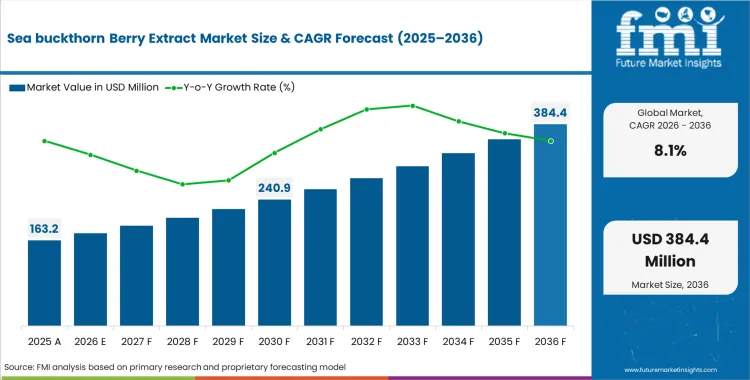
Supplement and personal care formulators are placing greater weight on ingredients that can deliver documented omega-7 performance from a single botanical source. Multi-ingredient antioxidant systems often create added complexity in sourcing, validation, and label positioning, which is increasing interest in sea buckthorn extracts with clearer identity. Delays in qualifying reliable supply can raise development timelines and input costs, particularly in skin health and barrier-support formulations where consistency matters more than ingredient novelty. Sea buckthorn continues to attract attention in this setting because its lipid profile remains difficult to replicate with simpler botanical substitutions.
Processing conditions remain a key commercial variable because post-harvest handling has a direct effect on active-compound retention and finished extract quality. Better access to localized pre-cooling and stabilization infrastructure can reduce raw material deterioration and improve extraction efficiency in major cultivation zones. That improvement supports more stable active concentrations at the ingredient level, which in turn strengthens confidence among formulators building repeat-use product lines around sea buckthorn extracts.
China is projected to expand at a CAGR of 9.4% through 2036, supported by concentrated cultivation resources and stronger downstream processing depth. India is estimated to rise at 9.1%, with processing investment and fruit-handling capacity supporting wider ingredient use. South Korea is likely to record 8.7% CAGR during the forecast period, backed by continued use in cosmetic and dermaceutical formulations. Germany is anticipated to grow at 7.9% as established formulation demand supports steady adoption. The United States is expected to register 7.6%, while Japan is set to post 7.1% through 2036 on the strength of premium wellness and beauty applications. The United Kingdom is projected to witness 6.8% CAGR in the market, reflecting measured but steady demand for standardized botanical actives. Country-level variation will continue to depend on the strength of cultivation, post-harvest control, and high-value formulation demand.
Segmental Analysis
Sea buckthorn Berry Extract Market Analysis by Form
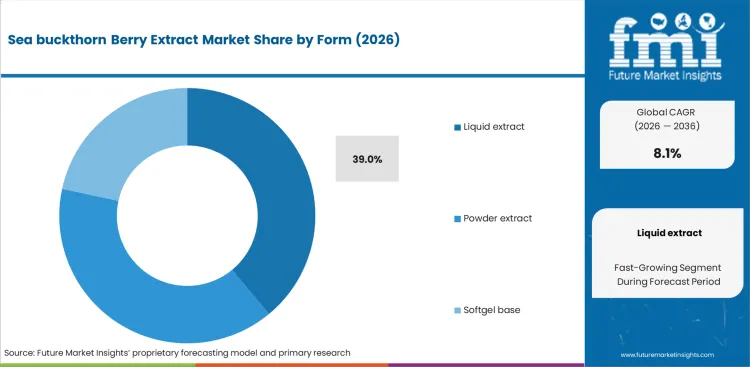
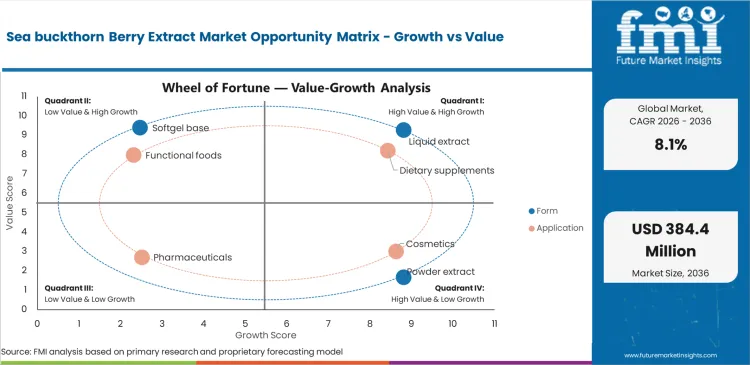
Format selection in this market is shaped largely by mixing performance, handling practicality, and storage risk across commercial production systems. Liquid extract remains the preferred format because it blends more easily into emulsions and removes the extra solubilization step often required with powder formats. FMI estimates liquid extract to account for 39.0% share in 2026. Its lead comes mainly from process convenience in premium cosmetic manufacturing rather than from any broad shelf-life advantage.
Storage performance still needs closer attention. Liquid variants can face greater oxidation exposure during storage and after opening, especially when stabilization systems are not strong enough to protect the formulation. Brands that judge botanical extracts mainly on upfront purchase cost can miss this risk and run into separation, color drift, or shorter finished-product life after launch. Repeat demand depends less on simple format preference and more on whether batch consistency holds through processing, filling, and shelf use.
- Initial Screening: Liquid formats reduce mixing difficulty and allow smoother incorporation into existing production systems. Throughput becomes easier to maintain where continuous processing matters.
- Qualification Barrier: Stability testing often shows faster oxidation risk in fluid extracts. Better storage control is needed to preserve quality over time.
- Renewal Criteria: Repeat purchasing depends heavily on color consistency and lot-to-lot reliability. Weak batch uniformity can affect finished-product performance and brand acceptance.
Sea buckthorn Berry Extract Market Analysis by Application
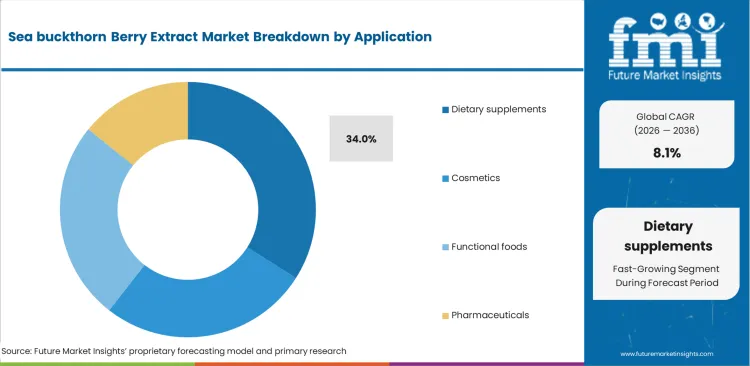
Dietary supplements remain the strongest application because they give brands a direct route to standardized dosing and clearer consumer communication around omega-rich wellness positioning. Softgel and capsule formats also remove some of the formulation difficulty seen in food systems and more complex topical products. FMI projects dietary supplements to secure 34.0% share in 2026. That lead is tied closely to the commercial value of palmitoleic acid positioning and to broader demand for vegan-compatible wellness formulations. Product developers also use botanical bioactives to strengthen differentiation across ingestible and skin-focused products, which keeps this application commercially relevant beyond volume alone.
- Sourcing Baseline: Vegan-compatible omega positioning provides a useful advantage over fish-derived alternatives. Brands can widen consumer appeal with that distinction.
- Hidden Expenditures: Standardizing active ratios requires more analytical testing than basic cost assumptions usually indicate. Quality-control spending can rise materially as a result.
- Lifecycle Comparison: Pure berry-derived actives can reduce reliance on additional stabilizing inputs. Formulation efficiency can improve over time even when starting cost is higher.
Sea buckthorn Berry Extract Market Analysis by Extraction Type
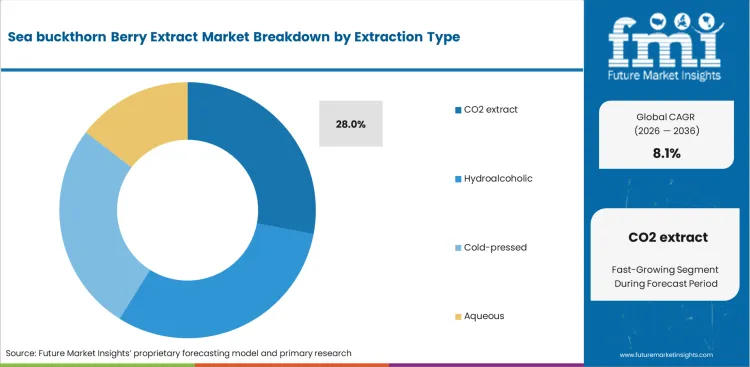
Extraction choice has become a direct quality and compliance consideration in this category. Supercritical processing is drawing stronger interest because it protects delicate lipid fractions and avoids the residue concerns often associated with harsher solvent-based methods. FMI expects CO2 extract to represent 28.0% share in 2026, reflecting its alignment with purity-focused positioning in premium applications. This method also supports cleaner-label claims and tighter quality control for buyers using botanical co2 extracts in high-specification formulations. Cost remains the main constraint, since supercritical systems require higher capital investment and are available through a narrower processor base than conventional extraction routes. Lower-cost methods may appear more economical at the sourcing stage, though downstream audit issues and residue risk can reduce that advantage quickly.
- Oxidation Prevention: Low-temperature, oxygen-limited extraction helps preserve sensitive compounds more effectively. Active integrity is easier to maintain in the finished material.
- Residual Exposure: Solvent-based methods often require additional cleanup to meet stricter quality expectations. Weak residue control can raise compliance risk.
- Benefit Realization: Premium extract quality delivers full value only when storage and logistics are managed properly. Poor handling can erode processing advantages before the material reaches end use.
Sea buckthorn Berry Extract Market Analysis by Nature
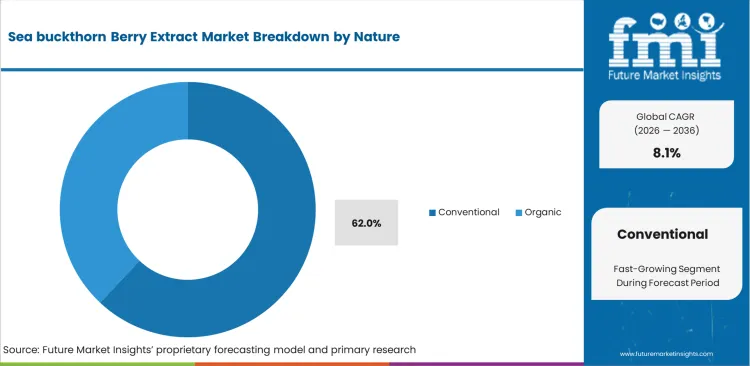
Nature positioning in this market still depends on how brands balance premium messaging with the practical limits of source availability. Conventional material remains the dominant supply route because it is easier to secure at commercial scale and supports more workable pricing across mainstream supplement and skincare channels. Wild-harvest dependence in key source regions also makes certified conversion harder than headline category narratives often imply. FMI estimates the conventional segment to account for 62.0% share in 2026. That lead comes from sourcing practicality rather than weak demand for organic positioning. Many brands continue to market around purity, traceability, and natural sourcing, yet still rely on conventional botanical ingredients to keep volume and margin aligned with retail expectations.
- Dominant Producers: Wild-harvest and decentralized collection networks still account for a large share of available material. That structure supports higher-volume supply at more accessible price points.
- Supply Bottlenecks: Harvest variability can tighten raw material availability with little warning. Inventory planning remains important for production continuity.
- Future Landscape: Cultivated supply models are expanding gradually as brands seek stronger traceability. Sourcing control may improve over time, though commercial scale remains limited.
Sea buckthorn Berry Extract Market Analysis by Sales Channel
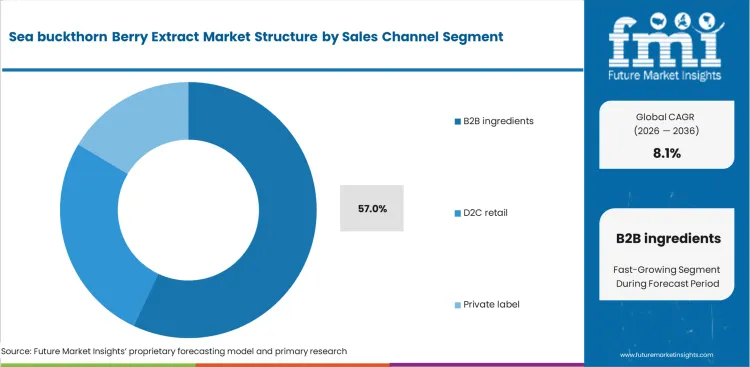
Concentrated sea buckthorn extracts are rarely suitable for direct consumer sale in raw form. Most commercial volumes move through ingredient focused B2B routes, where specialized processors, formulators, and contract manufacturers convert concentrated material into usable systems for supplement and cosmetic brands. Lipid concentration, homogenization, and stability requirements make this route the more practical commercial model. FMI estimates the B2B ingredients channel to account for 57.0% share in 2026. That lead also reflects the role of intermediaries in converting functional extracts into standardized bases that smaller brands can use without building full in-house processing capability. Reduced visibility into origin and handling can become a drawback once material passes through several conversion stages.
- Early Adopters: Contract manufacturers purchase concentrated extracts to create standardized bases across multiple client programs. Development timelines become easier to manage for downstream brands.
- Secondary Integration: Consumer-facing brands often prefer pre blended systems instead of handling raw extracts directly. Internal manufacturing complexity stays lower under that model.
- Final Conversion: White label and finished product supply models become more common closer to the retail end of the chain. Brand owners can place greater focus on market access while technical processing remains upstream.
Sea buckthorn Berry Extract Market Drivers, Restraints, and Opportunities
Clean-label mandates force cosmetic formulators to replace synthetic emollients with botanical lipid matrices immediately. Skincare brands face consumer backlash over petroleum-derived ingredients. Delaying this transition exposes companies to rapid market share erosion as retailers actively delist non-compliant products. This commercial pressure accelerates adoption of standardized botanical alternatives offering documented omega-7 stability. Companies evaluating sea buckthorn extract vs amla extract select hippophae rhamnoides due to unmatched performance in skin-barrier restoration formulas, since amla lacks comparable lipophilic profiles.
Decentralized wild-harvesting infrastructure creates severe supply inconsistency. Quality control directors struggle to maintain lot-to-lot active compound standardization because raw berries originate from varied high-altitude microclimates. This structural variability forces extraction facilities to blend multiple harvests, increasing processing costs and delaying shipment schedules. While cultivation projects attempt to domesticate production, wild-harvested material remains the primary supply source, keeping batch consistency highly volatile.
Opportunities in the Sea buckthorn Berry Extract Market
- Pre-cooling infrastructure integration: Operations directors investing in localized pre-cooling assets capture massive yield advantages. Post-harvest stabilization directly dictates final active concentration.
- Clinical efficacy documentation: Regulatory teams securing clinical trials for specific mucosal hydration claims unlock high-margin pharmaceutical applications. Medical marketing directors differentiate products entirely from cosmetic competitors.
- Solvent-free process upgrades: Formulation scientists standardizing around supercritical CO2 extracts bypass future regulatory compliance barriers. Integrating pure bioactive ingredient streams ensures long-term European market access.
Regional Analysis
Based on regional analysis, sea buckthorn berry extract market is segmented into East Asia, North America, and Western Europe across 40 plus countries.
.webp "Top Country Growth Comparison Sea Buckthorn Berry Extract Market Cagr (2026 2036)")
| Country | CAGR (2026 to 2036) |
|---|---|
| China | 9.4% |
| India | 9.1% |
| South Korea | 8.7% |
| Germany | 7.9% |
| United States | 7.6% |
| Japan | 7.1% |
| United Kingdom | 6.8% |
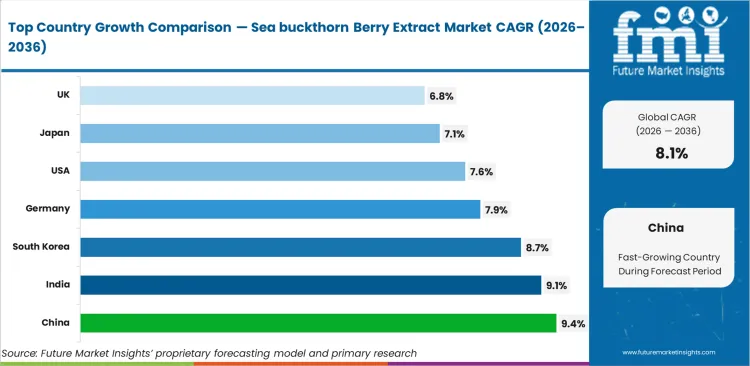
Source: Future Market Insights (FMI) analysis, based on proprietary forecasting model and primary research
East Asia Sea buckthorn Berry Extract Market Analysis
Heavy state investment in processing clusters transforms regional production capabilities. Cultivation volume heavily concentrates across the region, setting dominant global pricing floors for raw materials within the China sea buckthorn extract industry. Manufacturers process berries rapidly post-harvest to maximize lipid retention. Japanese cosmetic brands require highly refined extracts for premium anti-aging formulations, demanding stringent purity standards. South Korean manufacturers integrate these compounds across broad skincare portfolios, accelerating mainstream adoption. Securing nutraceutical ingredients directly from cooperative processors remains a priority to ensure supply chain traceability.
- China: Government subsidies targeting rural agricultural zones rapidly expand total cultivation acreage. Buyers secure massive volume contracts at baseline pricing due to this highly concentrated output. Demand for sea buckthorn berry extract in China is anticipated to rise at a CAGR of 9.4% from 2026 to 2036. Regional processors capture significant cost advantages over international competitors by scaling their extraction operations to meet global supply requirements.
- South Korea: Skincare brands integrate omega-rich berry extracts directly into mainstream barrier-repair formulas. Consumer demand for botanical efficacy drives consistent formulation updates across the personal care sector. South Korea is set to record a CAGR of 8.7% in sea buckthorn berry extract during the assessment period. Establishing early supplier relationships helps regional manufacturers lock in premium cosmetic-grade material for future advanced product pipelines.
- Japan: Cosmetic brands mandate extreme purity standards for premium anti-aging lines. Quality control departments reject extracts failing rigorous lipid profile tests, elevating the required processing standards. Japan is anticipated to witness sea buckthorn berry extract grow at a CAGR of 7.1% over the forecast period. Exacting specifications push regional suppliers to upgrade extraction technology continually to satisfy these high-end buyer expectations.
FMI's report includes Taiwan and Mongolia. Mongolia presents unique wild-harvesting conditions yielding distinct bioactive ratios currently under clinical evaluation by specialized pharmaceutical manufacturers.
South Asia Sea buckthorn Berry Extract Market Analysis
State subsidies targeting fruit-processing assets lower upstream bottlenecks across high-altitude regions. Cultivation initiatives specifically support indigenous farmers, stabilizing historically erratic harvest volumes for the India sea buckthorn extract segment. Manufacturers use these regional outputs to develop culturally relevant Ayurvedic supplements. Logistical challenges persist when transporting temperature-sensitive extracts from mountainous processing zones to coastal manufacturing hubs. Consumer brands rely heavily on nutricosmetic ingredients and verify every sea buckthorn extract supplier in India to meet domestic beauty-from-within consumer trends.
- India: Expanding cultivation infrastructure across Ladakh significantly increases total raw material availability. Manufacturers using state-subsidized pre-cooling units reduce harvest spoilage drastically before processing begins. India is forecast to record steady growth in sea buckthorn berry extract at a CAGR of 9.1% through 2036. Domestic nutraceutical brands continue launching premium product lines supported by this newly stabilized and highly scalable local supply chain.
FMI's report includes Nepal and Bhutan. High-altitude microclimates across these zones produce unique flavonoid profiles highly sought by specialized functional food manufacturers.
Western Europe Sea buckthorn Berry Extract Market Analysis
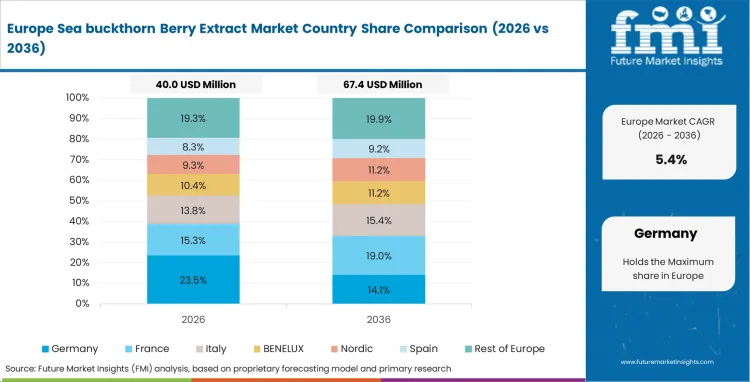
Strict regulatory frameworks dictate exact solvent residue limits across regional manufacturing facilities. Compliance with European Food Safety Authority standards requires advanced supercritical CO2 extraction methods. Premium cosmetic brands use verified botanical origins to command high retail margins. Manufacturers actively replace synthetic vitamins with whole-matrix extracts to satisfy clean-label consumer preferences. European buyers prioritize verified botanical supplements sourcing to successfully navigate and bypass rigorous import audits.
- Germany: Mature formulation demand stabilizes long-term supply contracts across the regional manufacturing base. Retailers stock diverse dietary supplement lines featuring standardized berry compounds to meet holistic consumer health goals. Sea buckthorn berry extract sales in Germany are poised to grow at a CAGR of 7.9% during the assessment period. Regional processors establish benchmark quality standards that ultimately influence and elevate global botanical extraction protocols.
- United Kingdom: Clean-beauty trends accelerate demand for natural lipid matrices in modern skincare formulations. Cosmetic brands redesign emulsion bases around botanical active ingredients to meet strict environmental standards. The adoption of sea buckthorn berry extract in the United Kingdom is expected to move ahead at a CAGR of 6.8% from 2026 to 2036. Companies achieving verifiable organic status dominate luxury retail channels, driving sustained ingredient consumption.
FMI's report includes France and Italy. Luxury fragrance and cosmetic houses across these zones demand highly specialized olfactory-neutral extracts for delicate topical applications.
Competitive Aligners for Market Players
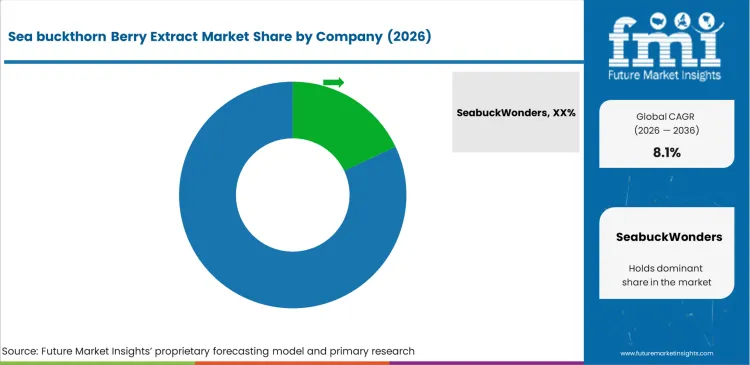
Supply chain integration plays a defining role in competitive strength across specialized botanical processing tiers. SeabuckWonders and Aromtech remain prominent in this market. Larger suppliers often secure direct control over harvesting networks, which helps them avoid the instability of spot sourcing and maintain tighter oversight on raw material flow. Buyers also place significant weight on cold-storage capability, since weak temperature control can undermine extract quality before processing begins. This capital requirement creates a clear divide between established manufacturers and intermediary traders. Suppliers with supercritical CO2 capability are better positioned for premium cosmetic programs because high-margin topical applications tend to demand tighter quality assurance and cleaner extraction profiles than solvent-based routes can reliably offer.
Incumbent suppliers also benefit from deeper technical validation around performance claims, which raises the entry barrier for challengers. New entrants seeking to displace established players often need to finance independent testing and claim support before they can gain comparable commercial acceptance. Validated herbal nutraceuticals carry added value in this setting because downstream brands need stronger support for audit readiness, formulation consistency, and product positioning. Market access depends as much on evidence quality and processing reliability as on extract availability.
Large dietary supplement brands also try to avoid overdependence on a single supplier by limiting reliance on highly proprietary extract systems. Formulations are often built around standardized omega-7 ratios that more than one processor can supply, preserving flexibility during annual sourcing discussions. Botanical manufacturers respond by developing more specialized lipid delivery systems based on food supplement ingredients that are harder to replace without reformulation. Competitive advantage therefore rests on a combination of source control, processing capability, and formulation dependence.
Key Players in Sea buckthorn Berry Extract Market
- SeabuckWonders
- Botanic Healthcare
- Aromtech
- FLAVEX Naturextrakte
- Actylis
- Phyto Life Sciences
Scope of the Report
| Metric | Value |
|---|---|
| Quantitative Units | USD 163.2 million to USD 356.3 million, at a CAGR of 8.1% |
| Market Definition | Standardized liquid, powder, and lipid-based compounds derived from Hippophae rhamnoides berries featuring quantified omega-7 profiles. |
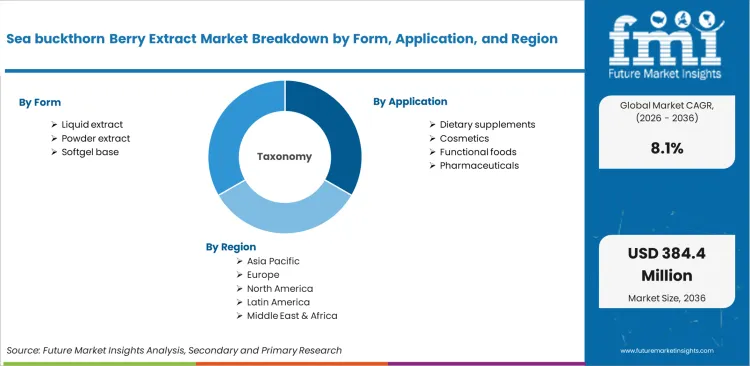
| Segmentation | Form, Application, Extraction type, Nature, Sales channel, Region |
| Regions Covered | North America, Latin America, Western Europe, Eastern Europe, South Asia & Pacific, East Asia, Middle East & Africa |
| Countries Covered | China, India, South Korea, Germany, United States, Japan, United Kingdom |
| Key Companies Profiled | SeabuckWonders, Botanic Healthcare, Aromtech, FLAVEX Naturextrakte, Actylis, Phyto Life Sciences |
| Forecast Period | 2026 to 2036 |
| Approach | Standardized extract import volumes cross-referenced against raw berry harvest yields. |
Source: Future Market Insights (FMI) analysis, based on proprietary forecasting model and primary research
Sea buckthorn Berry Extract Market Analysis by Segments
Form
- Liquid extract
- Powder extract
- Softgel base
Application
- Dietary supplements
- Cosmetics
- Functional foods
- Pharmaceuticals
Extraction type
- CO2 extract
- Hydroalcoholic
- Cold-pressed
- Aqueous
Nature
- Conventional
- Organic
Sales channel
- B2B ingredients
- D2C retail
- Private label
Region:
- North America
- United States
- Canada
- Europe
- Germany
- United Kingdom
- France
- Italy
- Spain
- Asia Pacific
- China
- Japan
- South Korea
- Taiwan
- Singapore
- Latin America
- Brazil
- Mexico
- Argentina
- Middle East & Africa
- GCC Countries
- South Africa
Bibliography
- Dubey, R. K., Shukla, S., Shukla, V., & Singh, S. (2024). Sea buckthorn: A potential dietary supplement with multifaceted therapeutic activities. Intelligent Pharmacy, 2(5), 681-687.
- Danielski, R., & Shahidi, F. (2024). Phenolic composition and bioactivities of sea buckthorn (Hippophae rhamnoides L.) fruit and seeds: An unconventional source of natural antioxidants in North America. Journal of the Science of Food and Agriculture, 104(9), 5553-5564.
- Kim, S., Lee, J., Son, H., Lee, K. H., Chun, Y., Lee, J. H., Lee, T., & Yoo, H. Y. (2024). Improvement in natural antioxidant recovery from sea buckthorn berries using predictive model-based optimization. Agriculture, 14(7), 1095.
- Wang, Z., Zou, J., & Shi, Y. (2024). Extraction techniques, structural features and biological functions of Hippophae rhamnoides polysaccharides: A review. International Journal of Biological Macromolecules, 263(Pt 1), 130206.
- Yu, W., Du, Y., Li, S., Wu, L., Guo, X., Qin, W., Kuang, X., Gao, X., Wang, Q., & Kuang, H. (2024). Sea buckthorn-nutritional composition, bioactivity, safety, and applications: A review. Journal of Food Composition and Analysis, 133, 106371.
- Chen, Y., He, W., Cao, H., Wang, Z., Liu, J., Wang, B., & Wang, C. (2024). Research progress of sea buckthorn (Hippophae rhamnoides L.) in prevention and treatment of cardiovascular disease. Frontiers in Cardiovascular Medicine, 11, 1477636.
This bibliography is provided for reader reference. The full FMI report contains the complete reference list with primary source documentation.
This Report Addresses
- Companies navigating variable botanical yield contracts across Asian wild-harvest networks.
- Formulation scientists specifying supercritical CO2 lipid fractions for strict clean-label compliance.
- Cosmetic chemists integrating stable omega-7 matrices into sensitive emulsion-based barrier creams.
- Dietary supplement brand managers identifying vegan alternatives to traditional fish-derived essential fatty acids.
- Quality control departments designing testing parameters for highly volatile hydroalcoholic botanical concentrates.
- Operations managers justifying capital expenditure requests for localized agricultural pre-cooling infrastructure.
- Sourcing directors analyzing state-subsidized fruit processing capacity expansion across the Ladakh region.
- Regulatory affairs specialists documenting exact palmitoleic acid concentrations for advanced function claims.
Frequently Asked Questions
What is the size of the sea buckthorn berry extract market?
Industry valuation reached USD 151.0 million in 2025. This metric highlights immediate processing capacity limitations before state-funded cultivation clusters fully mature.
What CAGR is expected for sea buckthorn berry extract through 2036?
Forecast models indicate total sales crossing USD 356.3 million by 2036 at a CAGR of 8.1%. Sustained demand for standardized botanical lipids runs this compounding trajectory.
Which applications drive sea buckthorn berry extract demand?
Dietary supplements and cosmetics lead adoption. Nutraceutical product managers target vegan omega profiles, while cosmetic chemists utilize lipid-based formats for barrier creams.
Why is China important in sea buckthorn extract supply?
Government subsidies targeting rural agricultural zones rapidly expand total cultivation acreage across China. This establishes dominant global pricing floors for raw materials.
How is sea buckthorn berry extract used in supplements and cosmetics?
Formulators use extracts for their rare palmitoleic acid profile. It supports mucosal membrane hydration in supplements and replaces synthetic emollients in skin-barrier restoration formulas.
Which extraction method is preferred for premium sea buckthorn ingredients?
Carbon dioxide supercritical extraction acts as a tunable solvent capturing precise lipid fractions without leaving harmful residues behind. Quality assurance teams mandate this method to preserve delicate antioxidant matrices.
Who are the leading companies in the sea buckthorn berry extract market?
Key players include SeabuckWonders, Botanic Healthcare, Aromtech, FLAVEX Naturextrakte, Actylis, and Phyto Life Sciences. These incumbents establish direct control over remote harvesting cooperatives.
How does sea buckthorn extract compare with amla and acai extracts?
Companies pivot back to hippophae rhamnoides due to unmatched lipid profiles. Amla and acai provide antioxidants but lack the critical palmitoleic acid structures found in sea buckthorn.
What is the role of omega-7 in sea buckthorn ingredient demand?
Vegan-certified consumer demographics demand standardized botanical omega sources. Clinical regulatory teams select sea buckthorn primarily for its rare palmitoleic acid (omega-7) profile.
Which countries are likely to grow faster in sea buckthorn extract demand?
China and India lead expansion rates due to massive state investment in processing clusters. South Korea follows closely driven by mainstream skincare formulation updates.
Why does liquid extract dominate formatting?
Miscibility requirements dictate sourcing preferences across premium cosmetic manufacturing lines. Liquid compounds integrate readily into existing emulsion bases without requiring secondary solubilization steps.
Why do cosmetic formulators resist powder formats?
Granular powders often present clumping risks during high-shear mixing procedures. Operations managers select liquid alternatives to maintain continuous manufacturing processes.
Why do mid-sized buyers struggle securing CO2 extracts?
High equipment capitalization costs restrict supercritical processing to elite manufacturing tiers. This limitation leaves smaller brands heavily dependent on just three global suppliers for premium grade material.
Why does conventional harvesting maintain volume leadership?
Decentralized wild-harvesting networks across Asian mountain ranges supply raw material at prices organic cooperatives cannot match. Companies depend on these networks to fulfill mass-market retail contracts.
Why is certified organic extraction difficult to verify?
Harvest certification remains virtually impossible across decentralized wild-collection zones. Companies pushing for unverified organic claims face immediate legal liabilities.
How do formulation scientists view synthetic omega blends?
Clinical regulatory teams privately reject synthetic blends due to bioavailability concerns. Formulators specify whole-matrix botanical sources offering documented omega-7 stability.
What drives B2B ingredient dominance?
Handling highly concentrated lipid extracts requires specialized heating and homogenization equipment. Contract manufacturers serve as critical intermediaries diluting pure compounds into workable formulation bases.
Why do consumer brands avoid raw extract processing?
Firms reduce internal manufacturing complexity by purchasing pre-blended bases rather than raw extracts. Direct processing requires massive capital investment in specialized blending infrastructure.
How do Indian subsidies alter supply chains?
State subsidies targeting fruit-processing assets lower upstream bottlenecks across high-altitude regions. Operations managers utilizing subsidized pre-cooling units reduce raw material spoilage drastically.
What causes twelve-month product launch delays?
Shifting from cold-pressed to supercritical CO2 completely alters lipid profiles. Regulatory teams must re-verify bioactive shelf life activating mandatory stability retesting cycles.
What dictates final active concentration?
Post-harvest stabilization directly determines raw material degradation rates. Localized pre-cooling infrastructure stops active compound breakdown immediately after harvesting.
Why do European customs seize hydroalcoholic extracts?
Hydroalcoholic methods leave trace solvents requiring secondary distillation. Operations managers skipping secondary distillation risk product seizure during rigorous European purity audits.
Preview the report firsthand - request a free sample
Get SampleGet the brochure for pricing and purchase details.
Get PDFTable of Content
- Executive Summary
- Global Market Outlook
- Demand-side Trends
- Supply-side Trends
- Technology Roadmap Analysis
- Analysis and Recommendations
- Market Overview
- Market Coverage / Taxonomy
- Market Definition / Scope / Limitations
- Research Methodology
- Chapter Orientation
- Analytical Lens and Working Hypotheses
- Market Structure, Signals, and Trend Drivers
- Benchmarking and Cross-market Comparability
- Market Sizing, Forecasting, and Opportunity Mapping
- Research Design and Evidence Framework
- Desk Research Programme (Secondary Evidence)
- Company Annual and Sustainability Reports
- Peer-reviewed Journals and Academic Literature
- Corporate Websites, Product Literature, and Technical Notes
- Earnings Decks and Investor Briefings
- Statutory Filings and Regulatory Disclosures
- Technical White Papers and Standards Notes
- Trade Journals, Industry Magazines, and Analyst Briefs
- Conference Proceedings, Webinars, and Seminar Materials
- Government Statistics Portals and Public Data Releases
- Press Releases and Reputable Media Coverage
- Specialist Newsletters and Curated Briefings
- Sector Databases and Reference Repositories
- FMI Internal Proprietary Databases and Historical Market Datasets
- Subscription Datasets and Paid Sources
- Social Channels, Communities, and Digital Listening Inputs
- Additional Desk Sources
- Expert Input and Fieldwork (Primary Evidence)
- Primary Modes
- Qualitative Interviews and Expert Elicitation
- Quantitative Surveys and Structured Data Capture
- Blended Approach
- Why Primary Evidence is Used
- Field Techniques
- Interviews
- Surveys
- Focus Groups
- Observational and In-context Research
- Social and Community Interactions
- Stakeholder Universe Engaged
- C-suite Leaders
- Board Members
- Presidents and Vice Presidents
- R&D and Innovation Heads
- Technical Specialists
- Domain Subject-matter Experts
- Scientists
- Physicians and Other Healthcare Professionals
- Governance, Ethics, and Data Stewardship
- Research Ethics
- Data Integrity and Handling
- Primary Modes
- Tooling, Models, and Reference Databases
- Desk Research Programme (Secondary Evidence)
- Data Engineering and Model Build
- Data Acquisition and Ingestion
- Cleaning, Normalisation, and Verification
- Synthesis, Triangulation, and Analysis
- Quality Assurance and Audit Trail
- Market Background
- Market Dynamics
- Drivers
- Restraints
- Opportunity
- Trends
- Scenario Forecast
- Demand in Optimistic Scenario
- Demand in Likely Scenario
- Demand in Conservative Scenario
- Opportunity Map Analysis
- Product Life Cycle Analysis
- Supply Chain Analysis
- Investment Feasibility Matrix
- Value Chain Analysis
- PESTLE and Porter’s Analysis
- Regulatory Landscape
- Regional Parent Market Outlook
- Production and Consumption Statistics
- Import and Export Statistics
- Market Dynamics
- Global Market Analysis 2021 to 2025 and Forecast, 2026 to 2036
- Historical Market Size Value (USD Million) Analysis, 2021 to 2025
- Current and Future Market Size Value (USD Million) Projections, 2026 to 2036
- Y-o-Y Growth Trend Analysis
- Absolute $ Opportunity Analysis
- Global Market Pricing Analysis 2021 to 2025 and Forecast 2026 to 2036
- Global Market Analysis 2021 to 2025 and Forecast 2026 to 2036, By Form
- Introduction / Key Findings
- Historical Market Size Value (USD Million) Analysis By Form , 2021 to 2025
- Current and Future Market Size Value (USD Million) Analysis and Forecast By Form , 2026 to 2036
- Liquid extract
- Powder extract
- Softgel base
- Liquid extract
- Y-o-Y Growth Trend Analysis By Form , 2021 to 2025
- Absolute $ Opportunity Analysis By Form , 2026 to 2036
- Global Market Analysis 2021 to 2025 and Forecast 2026 to 2036, By Application
- Introduction / Key Findings
- Historical Market Size Value (USD Million) Analysis By Application, 2021 to 2025
- Current and Future Market Size Value (USD Million) Analysis and Forecast By Application, 2026 to 2036
- Dietary supplements
- Cosmetics
- Functional foods
- Pharmaceuticals
- Dietary supplements
- Y-o-Y Growth Trend Analysis By Application, 2021 to 2025
- Absolute $ Opportunity Analysis By Application, 2026 to 2036
- Global Market Analysis 2021 to 2025 and Forecast 2026 to 2036, By Extraction Type
- Introduction / Key Findings
- Historical Market Size Value (USD Million) Analysis By Extraction Type, 2021 to 2025
- Current and Future Market Size Value (USD Million) Analysis and Forecast By Extraction Type, 2026 to 2036
- CO2 extract
- Hydroalcoholic
- Cold-pressed
- Aqueous
- CO2 extract
- Y-o-Y Growth Trend Analysis By Extraction Type, 2021 to 2025
- Absolute $ Opportunity Analysis By Extraction Type, 2026 to 2036
- Global Market Analysis 2021 to 2025 and Forecast 2026 to 2036, By Nature
- Introduction / Key Findings
- Historical Market Size Value (USD Million) Analysis By Nature, 2021 to 2025
- Current and Future Market Size Value (USD Million) Analysis and Forecast By Nature, 2026 to 2036
- Conventional
- Organic
- Conventional
- Y-o-Y Growth Trend Analysis By Nature, 2021 to 2025
- Absolute $ Opportunity Analysis By Nature, 2026 to 2036
- Global Market Analysis 2021 to 2025 and Forecast 2026 to 2036, By Sales Channel
- Introduction / Key Findings
- Historical Market Size Value (USD Million) Analysis By Sales Channel, 2021 to 2025
- Current and Future Market Size Value (USD Million) Analysis and Forecast By Sales Channel, 2026 to 2036
- B2B ingredients
- D2C retail
- Private label
- B2B ingredients
- Y-o-Y Growth Trend Analysis By Sales Channel, 2021 to 2025
- Absolute $ Opportunity Analysis By Sales Channel, 2026 to 2036
- Global Market Analysis 2021 to 2025 and Forecast 2026 to 2036, By Region
- Introduction
- Historical Market Size Value (USD Million) Analysis By Region, 2021 to 2025
- Current Market Size Value (USD Million) Analysis and Forecast By Region, 2026 to 2036
- North America
- Latin America
- Western Europe
- Eastern Europe
- East Asia
- South Asia and Pacific
- Middle East & Africa
- Market Attractiveness Analysis By Region
- North America Market Analysis 2021 to 2025 and Forecast 2026 to 2036, By Country
- Historical Market Size Value (USD Million) Trend Analysis By Market Taxonomy, 2021 to 2025
- Market Size Value (USD Million) Forecast By Market Taxonomy, 2026 to 2036
- By Country
- USA
- Canada
- Mexico
- By Form
- By Application
- By Extraction Type
- By Nature
- By Sales Channel
- By Country
- Market Attractiveness Analysis
- By Country
- By Form
- By Application
- By Extraction Type
- By Nature
- By Sales Channel
- Key Takeaways
- Latin America Market Analysis 2021 to 2025 and Forecast 2026 to 2036, By Country
- Historical Market Size Value (USD Million) Trend Analysis By Market Taxonomy, 2021 to 2025
- Market Size Value (USD Million) Forecast By Market Taxonomy, 2026 to 2036
- By Country
- Brazil
- Chile
- Rest of Latin America
- By Form
- By Application
- By Extraction Type
- By Nature
- By Sales Channel
- By Country
- Market Attractiveness Analysis
- By Country
- By Form
- By Application
- By Extraction Type
- By Nature
- By Sales Channel
- Key Takeaways
- Western Europe Market Analysis 2021 to 2025 and Forecast 2026 to 2036, By Country
- Historical Market Size Value (USD Million) Trend Analysis By Market Taxonomy, 2021 to 2025
- Market Size Value (USD Million) Forecast By Market Taxonomy, 2026 to 2036
- By Country
- Germany
- UK
- Italy
- Spain
- France
- Nordic
- BENELUX
- Rest of Western Europe
- By Form
- By Application
- By Extraction Type
- By Nature
- By Sales Channel
- By Country
- Market Attractiveness Analysis
- By Country
- By Form
- By Application
- By Extraction Type
- By Nature
- By Sales Channel
- Key Takeaways
- Eastern Europe Market Analysis 2021 to 2025 and Forecast 2026 to 2036, By Country
- Historical Market Size Value (USD Million) Trend Analysis By Market Taxonomy, 2021 to 2025
- Market Size Value (USD Million) Forecast By Market Taxonomy, 2026 to 2036
- By Country
- Russia
- Poland
- Hungary
- Balkan & Baltic
- Rest of Eastern Europe
- By Form
- By Application
- By Extraction Type
- By Nature
- By Sales Channel
- By Country
- Market Attractiveness Analysis
- By Country
- By Form
- By Application
- By Extraction Type
- By Nature
- By Sales Channel
- Key Takeaways
- East Asia Market Analysis 2021 to 2025 and Forecast 2026 to 2036, By Country
- Historical Market Size Value (USD Million) Trend Analysis By Market Taxonomy, 2021 to 2025
- Market Size Value (USD Million) Forecast By Market Taxonomy, 2026 to 2036
- By Country
- China
- Japan
- South Korea
- By Form
- By Application
- By Extraction Type
- By Nature
- By Sales Channel
- By Country
- Market Attractiveness Analysis
- By Country
- By Form
- By Application
- By Extraction Type
- By Nature
- By Sales Channel
- Key Takeaways
- South Asia and Pacific Market Analysis 2021 to 2025 and Forecast 2026 to 2036, By Country
- Historical Market Size Value (USD Million) Trend Analysis By Market Taxonomy, 2021 to 2025
- Market Size Value (USD Million) Forecast By Market Taxonomy, 2026 to 2036
- By Country
- India
- ASEAN
- Australia & New Zealand
- Rest of South Asia and Pacific
- By Form
- By Application
- By Extraction Type
- By Nature
- By Sales Channel
- By Country
- Market Attractiveness Analysis
- By Country
- By Form
- By Application
- By Extraction Type
- By Nature
- By Sales Channel
- Key Takeaways
- Middle East & Africa Market Analysis 2021 to 2025 and Forecast 2026 to 2036, By Country
- Historical Market Size Value (USD Million) Trend Analysis By Market Taxonomy, 2021 to 2025
- Market Size Value (USD Million) Forecast By Market Taxonomy, 2026 to 2036
- By Country
- Kingdom of Saudi Arabia
- Other GCC Countries
- Turkiye
- South Africa
- Other African Union
- Rest of Middle East & Africa
- By Form
- By Application
- By Extraction Type
- By Nature
- By Sales Channel
- By Country
- Market Attractiveness Analysis
- By Country
- By Form
- By Application
- By Extraction Type
- By Nature
- By Sales Channel
- Key Takeaways
- Key Countries Market Analysis
- USA
- Pricing Analysis
- Market Share Analysis, 2025
- By Form
- By Application
- By Extraction Type
- By Nature
- By Sales Channel
- Canada
- Pricing Analysis
- Market Share Analysis, 2025
- By Form
- By Application
- By Extraction Type
- By Nature
- By Sales Channel
- Mexico
- Pricing Analysis
- Market Share Analysis, 2025
- By Form
- By Application
- By Extraction Type
- By Nature
- By Sales Channel
- Brazil
- Pricing Analysis
- Market Share Analysis, 2025
- By Form
- By Application
- By Extraction Type
- By Nature
- By Sales Channel
- Chile
- Pricing Analysis
- Market Share Analysis, 2025
- By Form
- By Application
- By Extraction Type
- By Nature
- By Sales Channel
- Germany
- Pricing Analysis
- Market Share Analysis, 2025
- By Form
- By Application
- By Extraction Type
- By Nature
- By Sales Channel
- UK
- Pricing Analysis
- Market Share Analysis, 2025
- By Form
- By Application
- By Extraction Type
- By Nature
- By Sales Channel
- Italy
- Pricing Analysis
- Market Share Analysis, 2025
- By Form
- By Application
- By Extraction Type
- By Nature
- By Sales Channel
- Spain
- Pricing Analysis
- Market Share Analysis, 2025
- By Form
- By Application
- By Extraction Type
- By Nature
- By Sales Channel
- France
- Pricing Analysis
- Market Share Analysis, 2025
- By Form
- By Application
- By Extraction Type
- By Nature
- By Sales Channel
- India
- Pricing Analysis
- Market Share Analysis, 2025
- By Form
- By Application
- By Extraction Type
- By Nature
- By Sales Channel
- ASEAN
- Pricing Analysis
- Market Share Analysis, 2025
- By Form
- By Application
- By Extraction Type
- By Nature
- By Sales Channel
- Australia & New Zealand
- Pricing Analysis
- Market Share Analysis, 2025
- By Form
- By Application
- By Extraction Type
- By Nature
- By Sales Channel
- China
- Pricing Analysis
- Market Share Analysis, 2025
- By Form
- By Application
- By Extraction Type
- By Nature
- By Sales Channel
- Japan
- Pricing Analysis
- Market Share Analysis, 2025
- By Form
- By Application
- By Extraction Type
- By Nature
- By Sales Channel
- South Korea
- Pricing Analysis
- Market Share Analysis, 2025
- By Form
- By Application
- By Extraction Type
- By Nature
- By Sales Channel
- Russia
- Pricing Analysis
- Market Share Analysis, 2025
- By Form
- By Application
- By Extraction Type
- By Nature
- By Sales Channel
- Poland
- Pricing Analysis
- Market Share Analysis, 2025
- By Form
- By Application
- By Extraction Type
- By Nature
- By Sales Channel
- Hungary
- Pricing Analysis
- Market Share Analysis, 2025
- By Form
- By Application
- By Extraction Type
- By Nature
- By Sales Channel
- Kingdom of Saudi Arabia
- Pricing Analysis
- Market Share Analysis, 2025
- By Form
- By Application
- By Extraction Type
- By Nature
- By Sales Channel
- Turkiye
- Pricing Analysis
- Market Share Analysis, 2025
- By Form
- By Application
- By Extraction Type
- By Nature
- By Sales Channel
- South Africa
- Pricing Analysis
- Market Share Analysis, 2025
- By Form
- By Application
- By Extraction Type
- By Nature
- By Sales Channel
- USA
- Market Structure Analysis
- Competition Dashboard
- Competition Benchmarking
- Market Share Analysis of Top Players
- By Region
- By Form
- By Application
- By Extraction Type
- By Nature
- By Sales Channel
- Competition Analysis
- Competition Deep Dive
- SeabuckWonders
- Overview
- Product Portfolio
- Profitability by Market Segments (Product/Age /Sales Channel/Region)
- Sales Footprint
- Strategy Overview
- Marketing Strategy
- Product Strategy
- Channel Strategy
- Botanic Healthcare
- Aromtech
- FLAVEX Naturextrakte
- Actylis
- Phyto Life Sciences
- SeabuckWonders
- Competition Deep Dive
- Assumptions & Acronyms Used


