

- Industry Size (2026)
- USD 690.0 Mn
- Forecast (2036)
- USD 1980.0 Mn
- CAGR (2026 to 2036)
- 10.8%
Cranberry Proanthocyanidin Extract Market Size, Market Forecast and Outlook By FMI
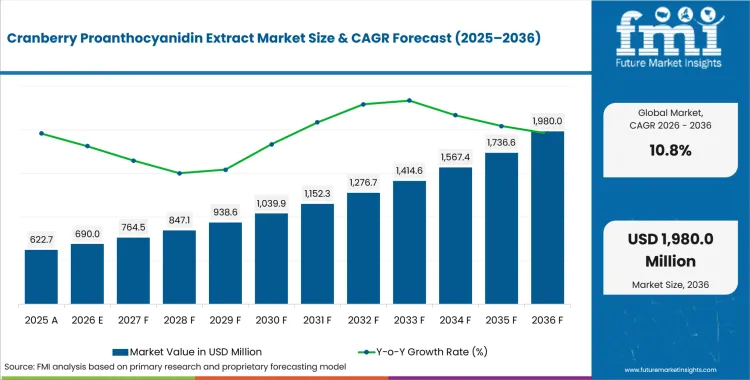
In 2025, the Cranberry Proanthocyanidin Extract market surpassed a value of USD 640.0 million and is projected to reach USD 690.0 million in 2026 and USD 1,980.0 million by 2036, reflecting a CAGR of 10.8% over the forecast period.
Raised clinical thresholds reset minimum prophylactic capabilities and bring forward procurement of standardized botanical extracts. Medical guidelines rebalance prescribing behaviors away from generic formulations toward highly concentrated active compounds. In April 2025, clinical benchmarks proved 500 mg daily doses lowered culture-confirmed incidence by 52%, pushing urologists to endorse specific dosages [2]. Buyers prioritize verified active compounds over bulk fruit powder.
Summary of Cranberry Proanthocyanidin Extract
- Cranberry Proanthocyanidin Extract Market Definition
- Cranberry Proanthocyanidin Extract includes standardized botanical derivatives used in preventative clinical applications, primarily for inhibiting bacterial adhesion along mucosal walls, particularly in urinary tract health.
- Demand Drivers in the Market
- Rising antimicrobial resistance patterns.
- Updated clinical guidelines favoring preventative botanicals.
- Consumer recalibration toward active functional nutrition.
- Key Segments Analyzed in the FMI Report
- Product Form: Standardized powder extract (45%) versus liquid extracts, capsules, and gummies.
- Application: Dietary supplements (47% of total volume) versus functional foods, pharmaceuticals, cosmetics, and animal nutrition.
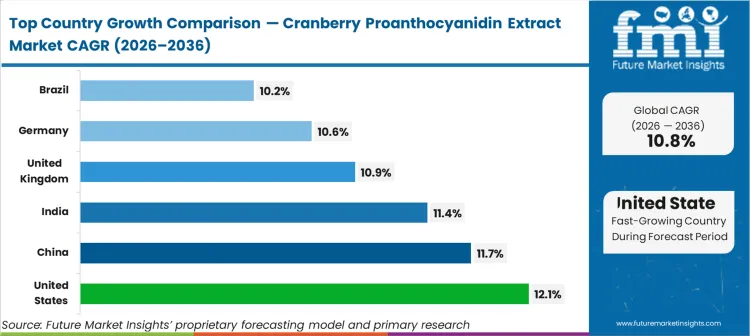
- Geography: High-growth North America and Asia-Pacific (United States 12.1%, China 11.7%, India 11.4%) versus regulation-driven Europe (United Kingdom 10.9%, Germany 10.6%).
- Analyst Opinion at FMI
- Nandini Roy Choudhury, Principal Consultant for Food & Beverage at Future Market Insights, opines, “In our recent Cranberry Proanthocyanidin Extract Market evaluation, my team and I have identified formulation synergy as a rising strategic lever. PAC extracts are increasingly combined with D-mannose, probiotics, and vitamin C to create multi-mechanism urinary health solutions. However, polyphenol interaction stability and taste masking remain technical hurdles. Suppliers that optimize extract purity while ensuring compatibility in complex blends will define premium differentiation in next-generation women’s health portfolios.”
- Strategic Implications/Executive Takeaways
- Pivot production toward standardized testing capabilities.
- Target urological clinics for direct practitioner endorsement.
- Secure long-term raw material sourcing contracts.
- Methodology
- Validated through first-hand corporate production and capacity data.
- Zero reliance on speculative third-party market research reports.
- Based on verifiable industrial benchmarks and verified sources.
Evolving resistance profiles recalibrate therapeutic economics toward prevention. As noted by Terri Wade, CEO of Solv Wellness, "Antibiotic resistance is a growing concern globally. With GennaMD, we are not only reaffirming our commitment to raise the bar for evidence-based UTI solutions, but also embarking on an ambitious plan to make effective non-antibiotic UTI prevention more accessible for UTI sufferers around the globe." [17] Clinical protocol changes move specialized interventions from optional purchases to required daily routines. Product pipelines favor verified concentrations clearing medical review panels within shorter budget cycles.
Country dispersion skews toward preventive healthcare corridors; United States, China, India, United Kingdom, Germany, and Brazil post higher conversion where clinical guidelines mandate natural interventions. Procurement clusters around verified clinical efficacy, favoring suppliers with standardized testing capabilities.
Cranberry Proanthocyanidin Extract Market Key Takeaways
| Metric | Details |
|---|---|
| Industry Size (2026) | USD 690.0 million |
| Industry Value (2036) | USD 1,980.0 million |
| CAGR (2026-2036) | 10.8% |
Cranberry Proanthocyanidin Extract Definition
The sector includes high-concentration active compounds isolated from cranberry fruit biomass, standardized to specific milligram dosages. These extracts are used in preventative healthcare to inhibit bacterial adhesion along mucosal walls, particularly for urinary tract health.
Cranberry Proanthocyanidin Extract Inclusions
Inclusions cover standardized powder compounds, liquid tinctures, formulated preventative capsules, and active botanical bioactive derived from cranberry proanthocyanidins. These products are incorporated into healthcare formulations for their recognized health benefits in preventing bacterial adhesion.
Cranberry Proanthocyanidin Extract Exclusions
Exclusions encompass generic dried fruit snacks, unstandardized commercial juices, and raw agricultural biomass. These items do not contain high-concentration, standardized proanthocyanidin extracts used in healthcare applications for bacterial adhesion inhibition and related health benefits.
Cranberry Proanthocyanidin Extract Market Research Methodology
- Primary Research: Interviews with extract processors and clinical researchers validating output purity.
- Desk Research: Review of agricultural crop yields from national bodies determining raw material availability.
- Market-Sizing and Forecasting: Top-down modeling derived from baseline consumption rates.
- Data Validation and Update Cycle: Variance checks against processor earnings disclosures.
Segmental Analysis
Cranberry Proanthocyanidin Extract Market Analysis by Product Form
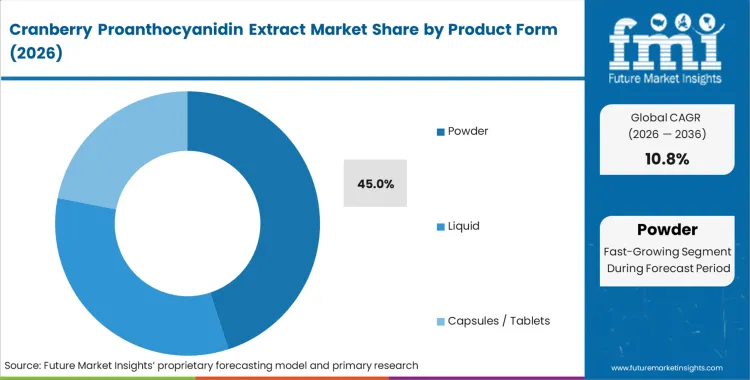
Standardized Powder Extract commands 45% of total value in 2026. Processors prioritize dry formats to maximize active compound stability during extended shelf life. As per FMI's projection, dry blending flexibility ensures efficient integration into varied consumer delivery systems. Formulation teams specify dry extracts to avoid liquid degradation risks.
- Formulation stability: Powdered formats resist oxidative degradation during supply chain transit. Encapsulation teams select dry inputs to maintain strict active milligram counts ahead of commercial rollouts, supported by trials confirming 18% risk reduction when utilizing precise dosages [3].
- Dosage density: High concentration ratios reduce required pill sizes for patient compliance. Brands launched ultra-concentrated preventative solutions demanding 30% pure active dry inputs to satisfy clinical requirements [8].
- Manufacturing integration: Dry extracts blend efficiently with complementary active ingredients like D-mannose. Collaborative partnerships integrating artificial intelligence algorithms optimize powder formulation cycles [14].
Cranberry Proanthocyanidin Extract Market Analysis by Application
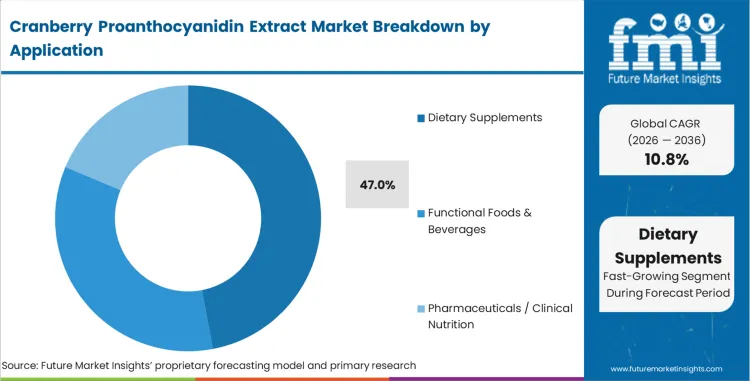
Dietary Supplements lead segment demand with 47% share in 2026. Preventive healthcare paradigms push consumers toward specialized urology supplements. FMI analysts opine that recurring infection rates trigger automated subscription purchases for standardized formulations. Procurement teams lock in raw material volumes to meet steady retail consumption.
- Clinical endorsement: Professional medical guidelines elevate supplements from optional to recommended status. Urologists specify minimum active compound levels for preventative routines following formal amendments offering non-antibiotic prophylaxis options [4].
- Format optimization: Brands deploy targeted formulations designed for specific patient profiles. Accelerated market entry occurs for scientifically validated supplement combinations matching findings on intestinal and urinary barrier integrity [5].
- Consumer compliance: Easy-to-consume capsules encourage daily preventative adherence. Brands launching highly concentrated options report improved patient retention rates after delayed time to first infection incidents demonstrated an adjusted hazard ratio of 0.36 [7].
Cranberry Proanthocyanidin Extract Market Drivers, Restraints, and Opportunities
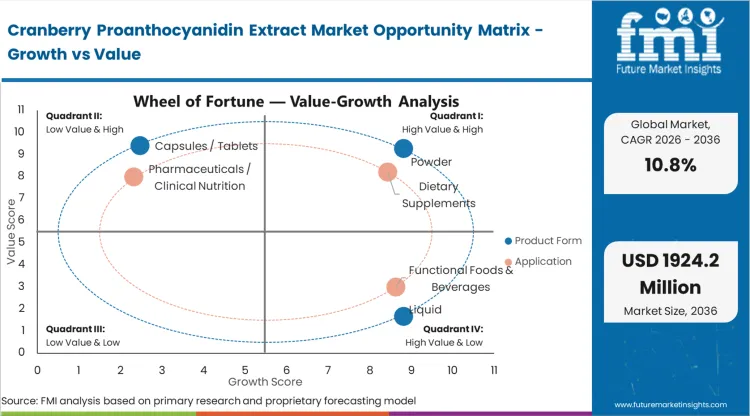
Updated clinical guidelines fundamentally alter procurement behaviors. Professional medical associations now recommend non-pharmaceutical prophylactic interventions for recurrent urological conditions. According to FMI's estimates, official clinical backing legitimizes botanical supplements across mainstream medical networks. Doctors directing patients toward active preventative compounds recalibrate demand curves permanently. Recent reviews confirming anti-adhesive activity against uropathogenic bacterial strains accelerate clinical endorsement across specialized wards [6]. Manufacturers securing clinical-grade extract capacities capture premium margins as healthcare systems pivot.
Volatile agricultural yields constrain stable active compound production. Unpredictable weather events impact raw fruit harvesting volumes and subsequent extract availability. Fluctuating biomass inputs compress margins for downstream supplement manufacturers. In November 2025, national agricultural trackers forecasted crop reductions dropping below long-term averages to 8.13 million barrels [1]. Processors mitigate volatility by deploying high-efficiency extraction technologies to maximize active compound yield per harvested barrel.
- Ingredient Optimization: Concentrated extraction methods yield higher margins for processors. Facilities deploying advanced concentration processes capture premium pricing from clinical supplement brands.
- Combination Formulas: Blending active extracts with complementary ingredients expands addressable consumer bases. Brands launching synergistic combinations scale retail velocity rapidly across digital channels.
- Convenience Formats: Portable preventative solutions attract active consumer segments. Partnerships introducing antioxidant drinks access incremental revenue outside traditional pill formats.
Regional Analysis
Based on the regional analysis, Cranberry Proanthocyanidin Extract market is segmented into North America, Latin America, Europe, East Asia, South Asia, Oceania and Middle East & Africa across 40+ countries. The full report also offers market attractiveness analysis based on regional trends.
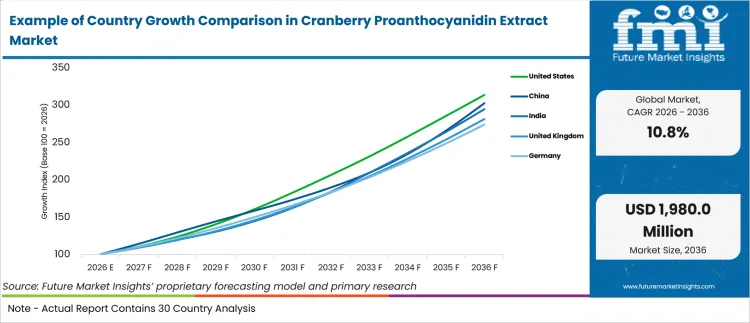
| Country | CAGR (2026 to 2036) |
|---|---|
| United States | 12.1% |
| China | 11.7% |
| India | 11.4% |
| United Kingdom | 10.9% |
| Germany | 10.6% |
| Brazil | 10.2% |
Source: Future Market Insights (FMI) analysis, based on proprietary forecasting model and primary research
North America Cranberry Proanthocyanidin Extract Analysis
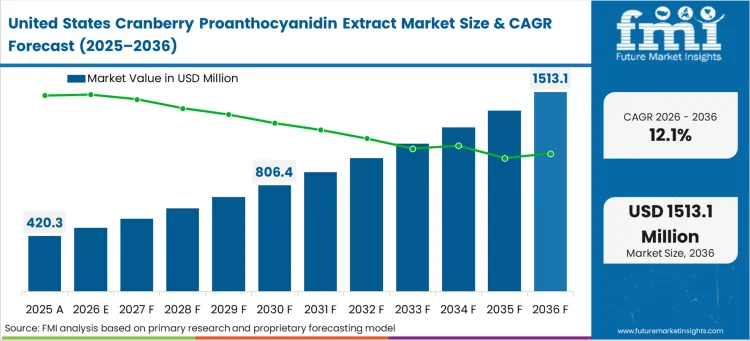
North American healthcare systems prioritize preventative interventions to combat rising pharmaceutical resistance. Regional processors deploy advanced extraction technologies to secure pure active compounds. As per FMI's projection, clinical validation speeds outsized domestic consumption across specialized wellness brands. Sourcing teams secure long-term agricultural contracts to stabilize production costs. Local agricultural dominance provides structural advantages for domestic extract manufacturers.
- United States: Demand for standardized extracts in United States is set to grow at 12.1% CAGR through 2036, supported by updated uncomplicated urinary tract infection treatment protocols before procurement cycles translate into higher deployment volumes. Regional manufacturers expanded local Wisconsin production capacity to secure pure active compounds [12]. Domestic suppliers utilize local harvest proximity to stabilize supply chains.
Canada and Mexico witness rapid regulatory harmonization expediting cross-border active ingredient trade. Product teams tracking localized urological health trends anticipate strong adoption for standardized preventative formulas.
Latin America Cranberry Proanthocyanidin Extract Analysis
Latin American consumption scales as preventive healthcare awareness expands among urban populations. Regional brands formulate accessible preventative solutions utilizing imported active compounds. Procurement networks establish reliable international supply lines to maintain formulation consistency. Local distributors expand reach through digital health platforms.
- Brazil: In Brazil, demand for standardized extracts is strengthening as urban health initiatives place greater emphasis on preventive care, translating policy direction into tangible procurement activity. During 2025, brands incorporated verified active compounds into convenient powdered drink mixes to align with on-the-go wellness trends [11]. This shift is giving formulators greater flexibility to position preventative hydration formats, supporting growth at a 10.2% CAGR from 2026 to 2036.
Argentina and Chile experience rising urban consumer demand for specialized preventative nutrition. Local brands importing verified processed superfruits capture premium market segments quickly.
Europe Cranberry Proanthocyanidin Extract Analysis
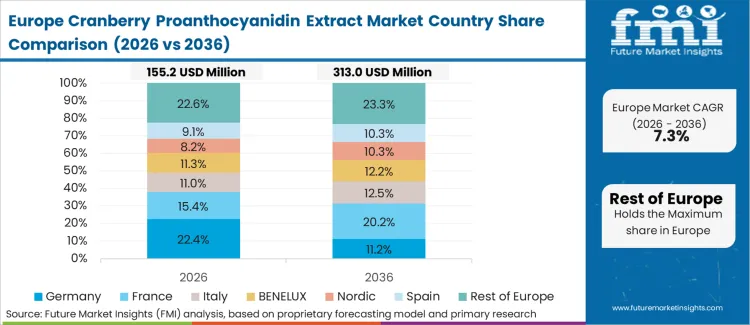
European regulatory frameworks enforce strict purity standards for active botanical extracts. Processors invest heavily in analytical testing infrastructure to satisfy stringent regional compliance checks. FMI analysts opine that quality verification becomes a mandatory procurement gate for regional formulators. Brands utilizing certified active compounds command premium shelf space across specialized pharmacies.
- United Kingdom: In the United Kingdom, the standardized extract sector is gaining traction as strict quality benchmarks continue to eliminate lower-grade alternatives from procurement channels. Companies have strengthened product portfolios, including the advancement of Ellura lines with bioavailable juice-based standardization to meet detailed compliance requirements [13]. Elevated purity expectations are rewarding suppliers that maintain rigorous analytical testing and quality controls, supporting expansion at a 10.9% CAGR from 2026 to 2036.
- Germany: Germany is expected to grow 10.6% CAGR in standardized extract demand over 2026 to 2036 as clinical research endorses preventative protocols, tightening the link between operational constraints and adoption-led investment. Health bodies formalized antimicrobial resistance updates prioritizing verified botanical prophylaxis across primary care networks [19]. Verification infrastructure limits market entry for uncertified botanical suppliers.
France and Italy maintain strict botanical regulations protecting market share for certified botanical ingredients processors. Regional wellness brands aggressively market scientifically validated preventative combinations.
East Asia Cranberry Proanthocyanidin Extract Analysis
East Asian populations rapidly adopt preventative nutritional routines utilizing specialized botanical derivatives. Regional formulators blend active compounds with traditional health systems to broaden consumer appeal. Digital distribution networks expedite product penetration across dense urban centers. Domestic brands prioritize formulations with transparent clinical backing.
- China: In China, standardized extract market is forecast to advance at 11.7% CAGR through 2036, with growth anchored in rising functional foods awareness that converts into measurable budget allocation. Global suppliers increased production of TotalPAC ingredients to meet surging regional dietary supplement demand [15]. Manufacturers secure bulk pure active inputs to formulate advanced wellness capsules.
Japan and South Korea face aging demographics triggering specialized urological health interventions. Digital platforms facilitate rapid distribution for imported high-concentration botanical solutions.
South Asia Cranberry Proanthocyanidin Extract Analysis
South Asian consumption expands following increasing preventative healthcare awareness across urban hubs. Consumers prioritize natural interventions over traditional pharmaceutical options for recurrent conditions. Direct-to-consumer wellness brands capture early adopters through targeted digital education campaigns. Formulators blend active ingredients into accessible daily hydration formats.
- India: In India, demand for standardized extracts is accelerating as digital wellness platforms expand rapidly and shape localized purchasing behavior. Producers strengthened distribution across functional beverage channels in 2025 to capture rising consumer interest in convenient health formats [16]. Affordable product innovations are further driving adoption among the growing middle-class population, supporting growth at an 11.4% CAGR over the forecast period.
ASEAN nations see preventive health awareness penetrating younger demographic groups prioritizing holistic wellness. Local distributors securing verified proanthocyanidins outcompete generic nutritional offerings.
Competitive Aligners for Market Players
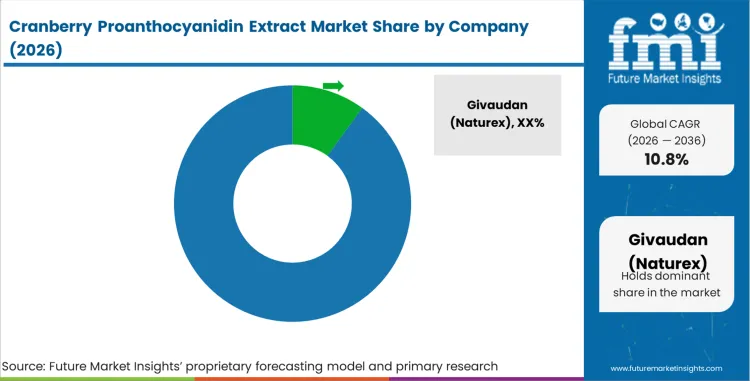
Processors face intense pressure to verify active compound concentrations for clinical supplement brands. Pure concentration ratios separate premium suppliers from bulk generic producers. Global botanical processors published comprehensive metrics establishing baseline active compound demands across regional supply chains [18]. Component tracing and batch testing infrastructure become mandatory requirements for supplier qualification.
Agricultural yield volatility forces processors to optimize extraction technologies. Extracting maximum active compounds from fluctuating raw biomass determines operational profitability. Facilities deploying advanced concentration processes absorb input cost shocks better than traditional processors.
Strategic collaborations expedite product format innovations across functional nutrition. Extract suppliers partnering directly with consumer brands speed novel delivery systems to market. Joint innovation pipelines shorten time-to-market for scientifically validated functional products.
Recent Developments
The report includes full coverage of key trends from competitive benchmarking. Some of the recent developments covered in the reports:
- In February 2026, Fruit d'Or introduced new 50:1 fruit ratio option for Cran d'Or TotalPAC cranberry nutraceutical ingredient. [9]
- In January 2026, Uqora launched Flush Advanced+ drink mix with whole-fruit cranberry powder and D-mannose for recurrent UTI risk reduction. [10]
Key Players in Cranberry Proanthocyanidin Extract
- Givaudan (Naturex)
- Indena S.p.A.
- Fruit d'Or
- Nexira
- Ethical Naturals, Inc.
- Ocean Spray Cranberries, Inc.
- Taiyo GmbH
Scope of the Report
| Metric | Value |
|---|---|
| Quantitative Units | USD 690.0 million (2026) to USD 1,980.0 million (2036), at a CAGR of 10.8% |
| Market Definition | Sector covers high-concentration active compounds isolated from raw fruit biomass for preventative clinical applications. |
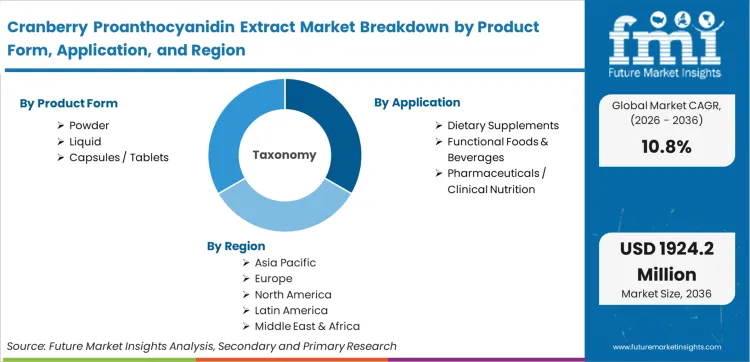
| Product Form Segmentation | Standardized Powder Extract, Liquid/Tincture Extracts, Capsules / Tablets, Gummies & Other Formats |
| Application Segmentation | Dietary Supplements, Functional Foods & Beverages, Pharmaceuticals / Clinical Nutrition, Cosmetics & Personal Care, Animal Nutrition |
| Regions Covered | North America, Latin America, Europe, East Asia, South Asia, Oceania, Middle East and Africa |
| Countries Covered | United States, Canada, Mexico, Brazil, Argentina, Germany, France, United Kingdom, Italy, Spain, China, India, Japan, South Korea, Indonesia, Australia and 40 plus countries |
| Key Companies Profiled | Givaudan (Naturex), Indena S.p.A., Fruit d'Or, Nexira, Ethical Naturals, Inc., Ocean Spray Cranberries, Inc., Taiyo GmbH |
| Forecast Period | 2026 to 2036 |
| Approach | Hybrid top-down and bottom-up market modeling, validated through primary interviews with cranberry extract producers and healthcare providers, supported by trade data benchmarking and product usage analysis across key applications |
Cranberry Proanthocyanidin Extract Market Analysis by Segments
Product Form:
- Standardized Powder Extract
- Liquid/Tincture Extracts
- Capsules / Tablets
- Gummies & Other Formats
Application:
- Dietary Supplements
- Functional Foods & Beverages
- Pharmaceuticals / Clinical Nutrition
- Cosmetics & Personal Care
- Animal Nutrition
Region:
- Asia Pacific
- India
- China
- Japan
- South Korea
- Indonesia
- Australia & New Zealand
- ASEAN
- Rest of Asia Pacific
- Europe
- Germany
- Italy
- France
- United Kingdom
- Spain
- Benelux
- Nordics
- Central & Eastern Europe
- Rest of Europe
- North America
- United States
- Canada
- Mexico
- Latin America
- Brazil
- Argentina
- Chile
- Rest of Latin America
- Middle East & Africa
- Kingdom of Saudi Arabia
- United Arab Emirates
- South Africa
- Turkey
- Rest of Middle East & Africa
Bibliography
- [1] USDA. (2025). USA cranberry crop forecast at 8.13 million barrels.
- [2] NIH/PMC. (2025). Whole cranberry fruit powder supplement reduced culture-confirmed UTI incidence.
- [3] Cranberry Institute. (2025). Cranberry PACs reduce UTI risk by 18%.
- [4] AUA. (2025). AUA/CUA/SUFU Guideline non-antibiotic prophylaxis options.
- [5] Cranberry Institute Press Release. (2025). Polyphenols prevent pathogenic bacterial adhesion.
- [6] PMC Review. (2025). Anti-adhesive activity against uropathogenic E. coli.
- [7] AJCN. (2025). Powder capsules delayed time to first UTI.
- [8] Solv Wellness. (2025). Launched GennaMD highly-concentrated cranberry PAC supplement.
- [9] Fruit d'Or. (2026). Introduced new 50:1 fruit ratio option.
- [10] Uqora. (2026). Launched Flush Advanced+ drink mix.
- [11] Ocean Spray Cranberries. (2025). Partnered with Dyla Brands to launch on-the-go powdered drink mixes.
- [12] Ocean Spray. (2025). Expanded Wisconsin production capacity.
- [13] Solv Wellness Trōphikōs. (2025). Advanced Ellura line updates.
- [14] Ocean Spray & Canomiks. (2025). AI-driven product innovation partnership.
- [15] Fruit d'Or Global. (2025). Increased production of TotalPAC.
- [16] Artemis International Market Share. (2025). Expanded distribution in supplements.
- [17] Solv Wellness. (2025). Press Release featuring Terri Wade quote.
- [18] NutraIngredients. (2025). Global cranberry PAC demand metrics.
- [19] World Health Organization. (2025). Antimicrobial resistance updates.
This bibliography is provided for reader reference and is not exhaustive. The full report contains the complete reference list and detailed citations.
This Report Addresses
- Market intelligence to enable structured strategic decision making across mature and emerging botanical economies.
- Market size estimation and 10 year revenue forecasts from 2026 to 2036, supported by validated capacity benchmarks.
- Growth opportunity mapping across powder and liquid formats with emphasis on standardized active compounds.
- Segment and regional revenue forecasts covering dietary supplements and functional food applications.
- Competition strategy assessment including integration models and compliance capability benchmarking.
- Product reformulation and efficacy compliance tracking including clinical validation parameters.
- Regulatory impact analysis covering medical prophylaxis mandates and product quality thresholds.
- Market report delivery in PDF, Excel, PPT, and interactive dashboard formats for executive use.
Frequently Asked Questions
How large is demand for Cranberry Proanthocyanidin Extract in global markets in 2026?
Demand for Cranberry Proanthocyanidin Extract in global markets reaches USD 690.0 million in 2026.
What will be market size of Cranberry Proanthocyanidin Extract in global markets by 2036?
Market size for Cranberry Proanthocyanidin Extract expands to USD 1,980.0 million by 2036.
What is expected demand growth for Cranberry Proanthocyanidin Extract in global markets between 2026 and 2036?
Demand for Cranberry Proanthocyanidin Extract in global markets grows at 10.8% CAGR between 2026 and 2036.
Which Product Form is poised to lead global sales by 2026?
Standardized Powder Extract captures 45% volume share in 2026, prioritizing dry formats to maximize active compound stability.
How material is role of Dietary Supplements in fueling Cranberry Proanthocyanidin Extract adoption in 2026?
Dietary Supplements capture 47% share as preventive healthcare paradigms push consumers toward specialized functional nutrition.
What triggers demand in United States?
Updated clinical protocols and professional guidelines endorsing non-antibiotic prophylaxis fuel domestic demand.
What compliance standards or regulations are referenced for United States?
AUA/CUA/SUFU Guideline recommendations guide standardized non-antibiotic prophylaxis protocols.
What is United States growth outlook in report?
United States posts 12.1% CAGR during 2026 to 2036.
Why is Europe described as a priority region in report?
European frameworks enforce strict purity standards, making quality verification a mandatory procurement gate.
What type of demand dominates in Europe?
High-purity regulatory compliance pushes demand for highly verified extract ingredients.
What is China growth outlook in report?
China expands at 11.7% CAGR through 2036.
Does report cover India in regional analysis?
Yes, India appears within South Asia regional scope.
What sources analyze India?
Company product launches and digital health platform expansion metrics analyze Indian performance.
What main demand theme links to India in region coverage?
Digital wellness platforms scaling functional drink formats anchor Indian growth.
Does report cover Brazil in regional analysis?
Yes, Brazil appears within Latin America regional scope.
What main Brazil related demand theme appears in region coverage?
Urban health initiatives prioritizing functional beverage integration anchor Brazilian growth.
Which product formats or configurations are strategically important for North America supply chains?
Concentrated dry extracts matching clinical efficacy thresholds dominate domestic supply chains.
What is Cranberry Proanthocyanidin Extract and what is main usage?
Extracts concentrate active compounds from fruit biomass for preventative urological healthcare applications.
What does Cranberry Proanthocyanidin Extract mean in report?
Sector covers standardized botanical derivatives formulated for preventative clinical applications.
What is included in scope of Cranberry Proanthocyanidin Extract report?
Standardized powder compounds, liquid tinctures, formulated capsules, and active botanical bioactives.
What is excluded from scope of report?
Generic dried fruit snacks, unstandardized commercial juices, and raw agricultural biomass.
What does market forecast mean on page?
Market forecast represents model based projections built on defined assumptions for strategic planning purposes.
How does FMI build and validate Cranberry Proanthocyanidin Extract forecast?
Forecast utilizes hybrid top down and bottom up modeling validated through primary interviews and industry benchmarking.
What does zero reliance on speculative third party market research mean here?
Primary interviews and verifiable public datasets construct estimates instead of unverified syndicated reports.
Preview the report firsthand - request a free sample
Get SampleGet the brochure for pricing and purchase details.
Get PDFTable of Content
- Executive Summary
- Global Market Outlook
- Demand-side Trends
- Supply-side Trends
- Technology Roadmap Analysis
- Analysis and Recommendations
- Market Overview
- Market Coverage / Taxonomy
- Market Definition / Scope / Limitations
- Research Methodology
- Chapter Orientation
- Analytical Lens and Working Hypotheses
- Market Structure, Signals, and Trend Drivers
- Benchmarking and Cross-market Comparability
- Market Sizing, Forecasting, and Opportunity Mapping
- Research Design and Evidence Framework
- Desk Research Programme (Secondary Evidence)
- Company Annual and Sustainability Reports
- Peer-reviewed Journals and Academic Literature
- Corporate Websites, Product Literature, and Technical Notes
- Earnings Decks and Investor Briefings
- Government Statistics Portals and Public Data Releases
- Press Releases and Reputable Media Coverage
- Specialist Newsletters and Curated Briefings
- Sector Databases and Reference Repositories
- FMI Internal Proprietary Databases and Historical Market Datasets
- Subscription Datasets and Paid Sources
- Social Channels, Communities, and Digital Listening Inputs
- Additional Desk Sources
- Expert Input and Fieldwork (Primary Evidence)
- Primary Modes
- Qualitative Interviews and Expert Elicitation
- Quantitative Surveys and Structured Data Capture
- Blended Approach
- Why Primary Evidence is Used
- Field Techniques
- Interviews
- Surveys
- Focus Groups
- Observational and In-context Research
- Social and Community Interactions
- Stakeholder Universe Engaged
- C-suite Leaders
- Board Members
- Presidents and Vice Presidents
- R&D and Innovation Heads
- Technical Specialists
- Domain Subject-matter Experts
- Scientists
- Physicians and Other Healthcare Professionals
- Governance, Ethics, and Data Stewardship
- Research Ethics
- Data Integrity and Handling
- Primary Modes
- Tooling, Models, and Reference Databases
- Desk Research Programme (Secondary Evidence)
- Data Engineering and Model Build
- Data Acquisition and Ingestion
- Cleaning, Normalisation, and Verification
- Synthesis, Triangulation, and Analysis
- Quality Assurance and Audit Trail
- Market Background
- Market Dynamics
- Drivers
- Restraints
- Opportunity
- Trends
- Scenario Forecast
- Demand in Optimistic Scenario
- Demand in Likely Scenario
- Demand in Conservative Scenario
- Opportunity Map Analysis
- Product Life Cycle Analysis
- Supply Chain Analysis
- Investment Feasibility Matrix
- Value Chain Analysis
- PESTLE and Porter’s Analysis
- Regulatory Landscape
- Regional Parent Market Outlook
- Production and Consumption Statistics
- Import and Export Statistics
- Market Dynamics
- Global Market Analysis 2021 to 2025 and Forecast, 2026 to 2036
- Historical Market Size Value (USD Million) Analysis, 2021 to 2025
- Current and Future Market Size Value (USD Million) Projections, 2026 to 2036
- Y-o-Y Growth Trend Analysis
- Absolute $ Opportunity Analysis
- Global Market Pricing Analysis 2021 to 2025 and Forecast 2026 to 2036
- Global Market Analysis 2021 to 2025 and Forecast 2026 to 2036, By Product Form
- Introduction / Key Findings
- Historical Market Size Value (USD Million) Analysis By Product Form , 2021 to 2025
- Current and Future Market Size Value (USD Million) Analysis and Forecast By Product Form , 2026 to 2036
- Powder
- Liquid
- Capsules / Tablets
- Powder
- Y-o-Y Growth Trend Analysis By Product Form , 2021 to 2025
- Absolute $ Opportunity Analysis By Product Form , 2026 to 2036
- Global Market Analysis 2021 to 2025 and Forecast 2026 to 2036, By Application
- Introduction / Key Findings
- Historical Market Size Value (USD Million) Analysis By Application, 2021 to 2025
- Current and Future Market Size Value (USD Million) Analysis and Forecast By Application, 2026 to 2036
- Dietary Supplements
- Functional Foods & Beverages
- Pharmaceuticals / Clinical Nutrition
- Dietary Supplements
- Y-o-Y Growth Trend Analysis By Application, 2021 to 2025
- Absolute $ Opportunity Analysis By Application, 2026 to 2036
- Global Market Analysis 2021 to 2025 and Forecast 2026 to 2036, By Region
- Introduction
- Historical Market Size Value (USD Million) Analysis By Region, 2021 to 2025
- Current Market Size Value (USD Million) Analysis and Forecast By Region, 2026 to 2036
- North America
- Latin America
- Western Europe
- Eastern Europe
- East Asia
- South Asia and Pacific
- Middle East & Africa
- Market Attractiveness Analysis By Region
- North America Market Analysis 2021 to 2025 and Forecast 2026 to 2036, By Country
- Historical Market Size Value (USD Million) Trend Analysis By Market Taxonomy, 2021 to 2025
- Market Size Value (USD Million) Forecast By Market Taxonomy, 2026 to 2036
- By Country
- USA
- Canada
- Mexico
- By Product Form
- By Application
- By Country
- Market Attractiveness Analysis
- By Country
- By Product Form
- By Application
- Key Takeaways
- Latin America Market Analysis 2021 to 2025 and Forecast 2026 to 2036, By Country
- Historical Market Size Value (USD Million) Trend Analysis By Market Taxonomy, 2021 to 2025
- Market Size Value (USD Million) Forecast By Market Taxonomy, 2026 to 2036
- By Country
- Brazil
- Chile
- Rest of Latin America
- By Product Form
- By Application
- By Country
- Market Attractiveness Analysis
- By Country
- By Product Form
- By Application
- Key Takeaways
- Western Europe Market Analysis 2021 to 2025 and Forecast 2026 to 2036, By Country
- Historical Market Size Value (USD Million) Trend Analysis By Market Taxonomy, 2021 to 2025
- Market Size Value (USD Million) Forecast By Market Taxonomy, 2026 to 2036
- By Country
- Germany
- UK
- Italy
- Spain
- France
- Nordic
- BENELUX
- Rest of Western Europe
- By Product Form
- By Application
- By Country
- Market Attractiveness Analysis
- By Country
- By Product Form
- By Application
- Key Takeaways
- Eastern Europe Market Analysis 2021 to 2025 and Forecast 2026 to 2036, By Country
- Historical Market Size Value (USD Million) Trend Analysis By Market Taxonomy, 2021 to 2025
- Market Size Value (USD Million) Forecast By Market Taxonomy, 2026 to 2036
- By Country
- Russia
- Poland
- Hungary
- Balkan & Baltic
- Rest of Eastern Europe
- By Product Form
- By Application
- By Country
- Market Attractiveness Analysis
- By Country
- By Product Form
- By Application
- Key Takeaways
- East Asia Market Analysis 2021 to 2025 and Forecast 2026 to 2036, By Country
- Historical Market Size Value (USD Million) Trend Analysis By Market Taxonomy, 2021 to 2025
- Market Size Value (USD Million) Forecast By Market Taxonomy, 2026 to 2036
- By Country
- China
- Japan
- South Korea
- By Product Form
- By Application
- By Country
- Market Attractiveness Analysis
- By Country
- By Product Form
- By Application
- Key Takeaways
- South Asia and Pacific Market Analysis 2021 to 2025 and Forecast 2026 to 2036, By Country
- Historical Market Size Value (USD Million) Trend Analysis By Market Taxonomy, 2021 to 2025
- Market Size Value (USD Million) Forecast By Market Taxonomy, 2026 to 2036
- By Country
- India
- ASEAN
- Australia & New Zealand
- Rest of South Asia and Pacific
- By Product Form
- By Application
- By Country
- Market Attractiveness Analysis
- By Country
- By Product Form
- By Application
- Key Takeaways
- Middle East & Africa Market Analysis 2021 to 2025 and Forecast 2026 to 2036, By Country
- Historical Market Size Value (USD Million) Trend Analysis By Market Taxonomy, 2021 to 2025
- Market Size Value (USD Million) Forecast By Market Taxonomy, 2026 to 2036
- By Country
- Kingdom of Saudi Arabia
- Other GCC Countries
- Turkiye
- South Africa
- Other African Union
- Rest of Middle East & Africa
- By Product Form
- By Application
- By Country
- Market Attractiveness Analysis
- By Country
- By Product Form
- By Application
- Key Takeaways
- Key Countries Market Analysis
- USA
- Pricing Analysis
- Market Share Analysis, 2025
- By Product Form
- By Application
- Canada
- Pricing Analysis
- Market Share Analysis, 2025
- By Product Form
- By Application
- Mexico
- Pricing Analysis
- Market Share Analysis, 2025
- By Product Form
- By Application
- Brazil
- Pricing Analysis
- Market Share Analysis, 2025
- By Product Form
- By Application
- Chile
- Pricing Analysis
- Market Share Analysis, 2025
- By Product Form
- By Application
- Germany
- Pricing Analysis
- Market Share Analysis, 2025
- By Product Form
- By Application
- UK
- Pricing Analysis
- Market Share Analysis, 2025
- By Product Form
- By Application
- Italy
- Pricing Analysis
- Market Share Analysis, 2025
- By Product Form
- By Application
- Spain
- Pricing Analysis
- Market Share Analysis, 2025
- By Product Form
- By Application
- France
- Pricing Analysis
- Market Share Analysis, 2025
- By Product Form
- By Application
- India
- Pricing Analysis
- Market Share Analysis, 2025
- By Product Form
- By Application
- ASEAN
- Pricing Analysis
- Market Share Analysis, 2025
- By Product Form
- By Application
- Australia & New Zealand
- Pricing Analysis
- Market Share Analysis, 2025
- By Product Form
- By Application
- China
- Pricing Analysis
- Market Share Analysis, 2025
- By Product Form
- By Application
- Japan
- Pricing Analysis
- Market Share Analysis, 2025
- By Product Form
- By Application
- South Korea
- Pricing Analysis
- Market Share Analysis, 2025
- By Product Form
- By Application
- Russia
- Pricing Analysis
- Market Share Analysis, 2025
- By Product Form
- By Application
- Poland
- Pricing Analysis
- Market Share Analysis, 2025
- By Product Form
- By Application
- Hungary
- Pricing Analysis
- Market Share Analysis, 2025
- By Product Form
- By Application
- Kingdom of Saudi Arabia
- Pricing Analysis
- Market Share Analysis, 2025
- By Product Form
- By Application
- Turkiye
- Pricing Analysis
- Market Share Analysis, 2025
- By Product Form
- By Application
- South Africa
- Pricing Analysis
- Market Share Analysis, 2025
- By Product Form
- By Application
- USA
- Market Structure Analysis
- Competition Dashboard
- Competition Benchmarking
- Market Share Analysis of Top Players
- By Regional
- By Product Form
- By Application
- Competition Analysis
- Competition Deep Dive
- Givaudan (Naturex)
- Overview
- Product Portfolio
- Profitability by Market Segments (Product/Age /Sales Channel/Region)
- Sales Footprint
- Strategy Overview
- Marketing Strategy
- Product Strategy
- Channel Strategy
- Indena S.p.A.
- Fruit d'Or
- Nexira
- Ethical Naturals, Inc.
- Ocean Spray Cranberries, Inc.
- Givaudan (Naturex)
- Competition Deep Dive
- Assumptions & Acronyms Used


