

- Industry Size (2026)
- USD 435.0 Mn
- Forecast (2036)
- USD 1165.0 Mn
- CAGR (2026 to 2036)
- 10.1%
Seaweed-Derived Carrageenan Alternative Market Size, Market Forecast and Outlook
In 2025, the seaweed-derived carrageenan alternative market crossed a valuation of USD 395.0 million. Based on Future Market Insights’ analysis, demand is estimated to grow to USD 435.0 million in 2026 and USD 1,165.0 million by 2036. FMI projects a CAGR of 10.1% during the forecast period.
Clean-label certification boards increasingly demand complete traceability from marine farm to finished powder, reshaping upstream supply dependencies. Global marine macroalgae production reached 37.8 million tons in 2022, highlighting a massive raw material base ready for industrial valorization [1]. Procurement teams aggressively secure contracts within this expanding pool to insulate food hydrocolloids production from synthetic additive bans.
Summary of Seaweed-Derived Carrageenan Alternative Market
- Seaweed-Derived Carrageenan Alternative Market Definition
- Marine extract operations supply natural binding agents synthesized from cultivated macroalgae to replace traditional red-algae thickeners.
- Demand Drivers in the Market
- Clean-label regulations restrict artificial binder usage across major food markets.
- Cosmetic formulators replace synthetic polymers with biodegradable marine alternatives.
- Government mariculture funding expands raw material availability for industrial processors.
- Key Segments Analyzed in the FMI Report
- Product Form: Dominant powder hydrocolloids (67%) versus liquid solutions and semi-solid gels.
- Source: Red seaweed (41% of total volume) versus brown and green seaweed derivatives.
- Geography: High-growth Asia-Pacific (India 12.4%, China 11.9%) versus regulatory-heavy mature markets in Europe and North America.
- Analyst Opinion at FMI
- Nandini Roy Choudhury, Principal Consultant for Food & Beverage at Future Market Insights, opines, “In our latest Seaweed-Derived Carrageenan Alternative Market study, my team and I have identified functionality under stress conditions as the true battleground. It is no longer sufficient for alternatives to simply mimic viscosity; they must withstand UHT processing, freeze-thaw cycles, and high-protein matrices without phase separation. Beverage and plant-based dairy formulators are prioritizing hydrocolloids that deliver long-term stability across extended shelf life. Suppliers that combine marine polysaccharide innovation with advanced rheology profiling will command premium formulation partnerships in the next growth phase.”
- Strategic Implications/Executive Takeaways
- Transition sourcing contracts to integrated suppliers holding verified sustainability credentials.
- Prioritize powder formats to mitigate global shipping risks and extend storage life.
- Audit regional biomass capacity before expanding clean-label product portfolios.
- Methodology
- Validated through first-hand corporate production and capacity data.
- Zero reliance on speculative third-party market research reports.
- Based on verifiable industrial benchmarks and verified sources.
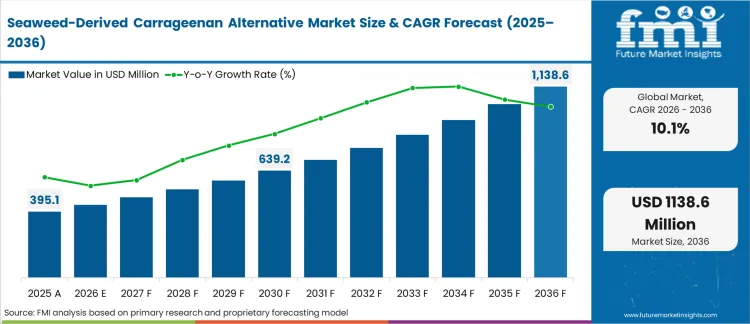
Seaweed-Derived Carrageenan Alternative Market Key Takeaways
| Metric | Details |
|---|---|
| Industry Size (2026) | USD 435.0 million |
| Industry Value (2036) | USD 1,165.0 million |
| CAGR (2026-2036) | 10.1% |
As regional processors expand extraction capabilities to meet this formulation shift, securing growth capital becomes critical for scaling niche high-fibre ingredients. “This funding comes at a pivotal time as we build relationships with customers who are eager to incorporate our Seafibrex high-fibre ingredient as well as our Thalivra and Revyntra fucoidan extracts into their products,” said Jay Dignan, CEO of BioMara, in a press release. [2]
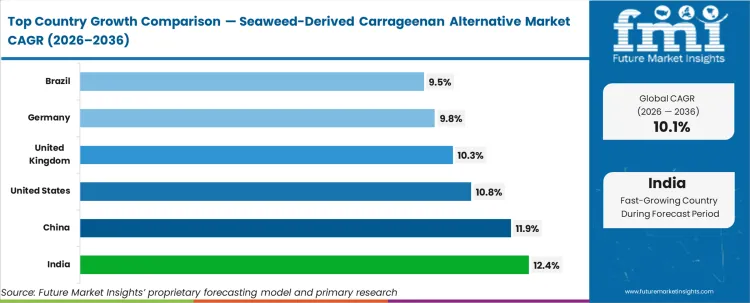
Emerging industrial hubs present significant untapped potential for localizing biomass supply chains, highlighted by the European Union's October 2025 launch of four sustainable algae projects backed by a EUR 5.7 million investment [3]. This capacity localization directly influences geographic adoption rates; demand in India is set to grow at 12.4% CAGR, China at 11.9%, the United States at 10.8%, the United Kingdom at 10.3%, Germany at 9.8%, and Brazil at 9.5%. Buyers in these corridors prioritize specialized extractors capable of delivering consistent carrageenan alternatives without international shipping delays.
Seaweed-Derived Carrageenan Alternative Market Definition
Marine extract operations supply natural binding agents synthesized from cultivated macroalgae to replace traditional red-algae carrageenan. Manufacturers process raw aquatic biomass into functional thickeners utilizing mechanical fractionation rather than harsh chemical modification. Final grades serve industrial buyers needing clean-label texturizers for processed foods and cosmetics.
Seaweed-Derived Carrageenan Alternative Market Inclusions
The Seaweed-Derived Carrageenan Alternative category comprises marine-based hydrocolloid systems extracted from sustainably cultivated red and brown algae and positioned as functional substitutes for conventional carrageenan. It includes powdered texturizers engineered to replicate kappa and iota performance in dairy and plant-based beverages, along with seaweed-derived stabilizing extracts used as primary structuring agents. Brown algae-based semi-solid gel matrices developed for cosmetic and personal care emulsions are included at the bulk ingredient stage.
Seaweed-Derived Carrageenan Alternative Market Exclusions
The scope excludes petrochemical-derived synthetic emulsifiers and legacy chemically modified carrageenan products retaining traditional E-number status. Whole edible seaweeds marketed for culinary use and land-sourced plant gums such as guar or locust bean gum are not considered within this definition.
Seaweed-Derived Carrageenan Alternative Market Research Methodology
- Primary Research: Direct consultations yield raw pricing data from marine biomass aggregators and processing facility managers.
- Desk Research: Analysts review official aquaculture production statistics and published corporate investment disclosures.
- Market-Sizing and Forecasting: Models combine top-down regional cultivation volumes with bottom-up industrial ingredient procurement records.
- Data Validation and Update Cycle: Expert panels cross-reference baseline extraction yields against final distribution figures before annual publication.
Segmental Analysis
Seaweed-Derived Carrageenan Alternative Market Analysis by Source
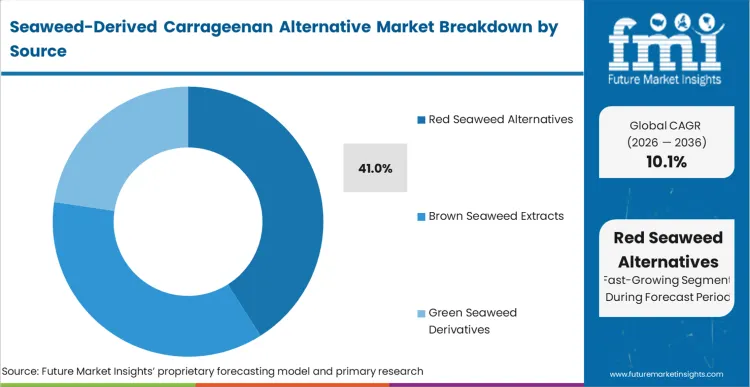
Upstream cultivation practices play a critical role in determining extract purity and rheological performance for alternative hydrocolloids. Red seaweed alternatives account for 41% of global consumption in 2026, reflecting strong industrial preference for reliable and scalable biomass sources. Tropical cultivated varieties offer fast growth cycles, supporting steady feedstock supply for large-scale processors. The availability of abundant raw material enables fractionators to expand capacity and reduce per-unit costs, improving affordability for downstream food and industrial users.
- Procurement trigger: Sourcing shifts toward cultivated red macroalgae as wild-harvest quotas limit traditional supply chains. An MoU signed in December 2024 between Sea6 Energy and HPCL targets tropical seaweed biomass scale-up [4]. Plentiful feedstock enables consistent pricing for industrial texturizers.
- Technology shift: Advanced marine agriculture systems optimize carbon capture alongside biomass yield. The National Institution for Transforming India calculated that mariculture seaweed sequesters up to 57.64 tCO₂/ha/yr [5]. Sustainable metrics improve the environmental footprint of finished cosmetic goods.
- Regulatory signal: Clean-label boards demand chemical-free fractionation methods. Umaro Foods raised USD 3.8 million in March 2024 to scale precise seaweed processing capabilities [6]. Advanced processing reduces waste and improves yield metrics.
Seaweed-Derived Carrageenan Alternative Market Analysis by Product Form
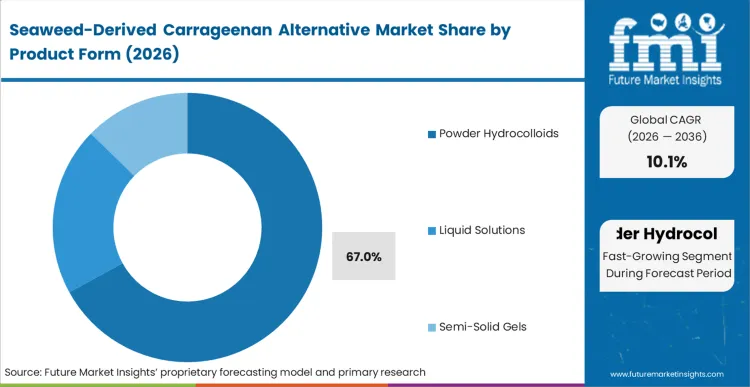
Powder Hydrocolloids dominate format preference with a 67% share in 2026. Dehydrated extracts offer unmatched logistical efficiency and prolonged shelf life compared to liquid suspensions. As per FMI's projection, manufacturers prioritize finely milled algae based ingredients to ensure rapid dispersion in cold-process manufacturing lines. Standardized powder specifications enable precise dosing for high-speed automated filling equipment.
- Logistics advantage: Dehydrated formats eliminate water weight from international shipping manifests. A World Bank report notes ten emerging seaweed markets hold potential to reach USD 11.8 billion by 2030 [7]. Efficient transport mechanisms unlock distant revenue pools.
- Formulation flexibility: Finely milled marine polymers blend seamlessly with dry ingredient premixes before hydration. BioMara achieved critical market validation in September 2025 when a seaweed-based powder won a major food-tech award [8]. High-performance powders accelerate new product development cycles.
- Buyer priority: Shelf stability dictates purchasing decisions for multinational food conglomerates managing complex global supply chains. Global exports of seaweed-based hydrocolloids hit USD 1.74 billion [9]. Robust powder formats secure immense cross-border trade flow.
Seaweed-Derived Carrageenan Alternative Market Drivers, Restraints, and Opportunities
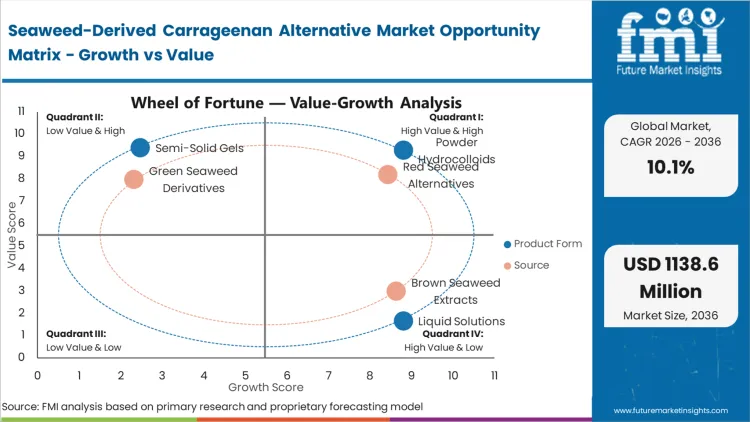
Strict clean-label regulatory mandates drive rapid substitution of synthetic binders across global consumer packaged goods sectors. Food safety authorities increasingly scrutinize chemically altered hydrocolloids, prompting multinational brands to reformulate flagship products with native marine extracts. Procurement teams aggressively phase out traditional carrageenan to secure premium, additive-free retail positioning. Processors pivot toward mechanical extraction techniques yielding high-viscosity polymers without triggering synthetic classification. Global mariculture operations scale rapidly to meet surging industrial demand for verifiable, unmodified raw biomass. Massive raw material availability empowers ingredient suppliers to offer consistent pricing for natural thickeners.
Cost volatility and complex extraction logistics restrain mass-market adoption of novel marine polymers. Processing raw seaweed into highly functional powder requires energy-intensive mechanical milling and precise thermal controls. FMI analysts opine that elevated manufacturing expenses force suppliers to price clean-label alternatives higher than legacy synthetic options. Mid-tier food and cosmetic brands struggle to absorb premium ingredient costs within tight margin structures. Formulators face significant technical friction when swapping legacy binders, often requiring extensive recipe adjustments to replicate exact mouthfeel and shelf-stability. Overcoming price parity remains a critical hurdle for widespread industry conversion.
- Capacity Expansion: Ingredient processors capture new industrial volume by scaling mechanical extraction facilities near major aquaculture zones. Localized processing infrastructure reduces raw biomass transport costs.
- Bioplastic Integration: Marine polymer suppliers unlock adjacent revenue streams by supplying high-viscosity resins to packaging manufacturers. Cross-industry application diversifies revenue and accelerates production scale.
- Cosmetic Reformulation: Distributors expand margins by routing premium seaweed extracts into luxury personal care emulsions. High-value cosmetic applications absorb premium processing costs effectively.
Regional Analysis
Based on the regional analysis, the Seaweed-Derived Carrageenan Alternative market is segmented into North America, Latin America, Europe, East Asia, South Asia, Oceania and Middle East & Africa across 40+ countries. The full report also offers market attractiveness analysis based on regional trends.
.webp "Top Country Growth Comparison Seaweed Derived Carrageenan Alternative Market Cagr (2026 2036)")
| Country | CAGR (2026 to 2036) |
|---|---|
| India | 12.4% |
| China | 11.9% |
| United States | 10.8% |
| United Kingdom | 10.3% |
| Germany | 9.8% |
| Brazil | 9.5% |
Source: Future Market Insights (FMI) analysis, based on proprietary forecasting model and primary research
Asia Pacific Seaweed-Derived Carrageenan Alternative Market Analysis
Asia Pacific controls primary biomass cultivation and early-stage fractionation due to immense coastal aquaculture infrastructure. Regional processors supply massive volumes of raw and semi-refined extracts to global ingredient conglomerates. Massive domestic consumer bases pull finished clean-label products, driving internal demand for high-quality texturizers. Investment flows toward optimizing tropical farming yields to stabilize input costs for downstream fractionation facilities. Vertical integration shields Asian suppliers from external raw material shocks.
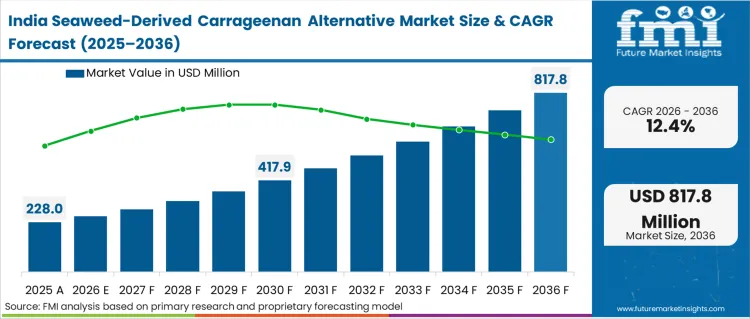
- India: Demand for marine extracts in India is set to grow at 12.4% CAGR through 2036, supported by aggressive government aquaculture targets before procurement cycles translate into higher deployment volumes. Current harvest from natural beds sits at 33,345 tons per year [12]. Expanding local supply chains reduces reliance on imported commercial seaweed.
- China: China’s expansive manufacturing base continues to generate steady demand for marine polymers, particularly as large-scale processors require consistent binder volumes for industrial applications. Consolidated regional processing infrastructure strengthens cost efficiency and supports competitive export pricing for texture-recovery hydrocolloids. As procurement pipelines mature and industrial usage expands, marine polymer sales in China are projected to grow at an 11.9% CAGR from 2026 to 2036.
FMI's report includes detailed analysis of East Asia and South Asia, covering Japan and South Korea. Procurement teams monitor Japanese extraction innovations to upgrade local manufacturing lines. Indonesian biomass targets remain critical for stabilizing global supply.
North America Seaweed-Derived Carrageenan Alternative Market Analysis
North America adoption tracks rapid clean-label reformulation cycles across major food and cosmetic sectors. Multinational brands actively strip artificial additives from ingredient lists to satisfy intense consumer scrutiny. According to FMI's estimates, procurement departments prioritize dual-source supply chains to insulate manufacturing lines from overseas logistics bottlenecks. Federal initiatives fund domestic mariculture expansion to establish localized raw material security. Domestic sourcing lowers transit emissions and ensures strict quality compliance.
- United States: The United States marine extract sector is poised to expand at 10.8% CAGR during 2026 to 2036 because stringent clean-label audits force recipe overhauls, which lifts utilization rates and justifies technology refresh decisions. NOAA proposed aquaculture opportunity areas totaling 16,500 acres for potential seaweed and shellfish cultivation [13]. Domestic capacity shields buyers from international freight volatility.
FMI's report includes a comprehensive evaluation of the North American landscape spanning Canada and Mexico. Canadian regulatory alignment speeds qualification of novel marine binders. Mexican farming cooperatives offer cost-effective raw material pathways for regional processors.
Europe Seaweed-Derived Carrageenan Alternative Market Analysis
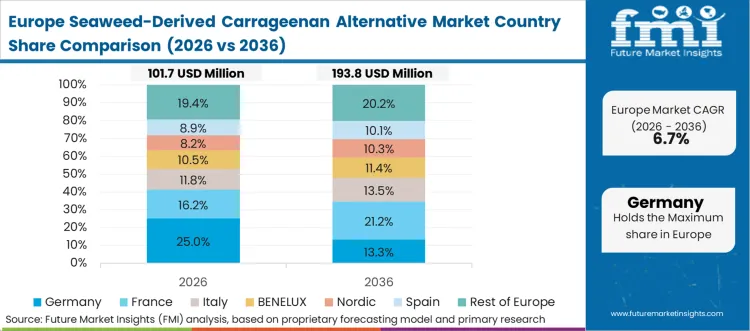
Europe leads rigorous regulatory reform regarding artificial food additives and cosmetic microplastics. Ingredient manufacturers deploy advanced mechanical extraction techniques to meet strict EU compliance standards without chemical modification. Capital flows into sustainable blue-economy projects to establish continent-wide biomass independence. Deep institutional support accelerates commercialization of premium marine polymers.
- United Kingdom: In the United Kingdom, premium retail brands are increasingly requiring sustainably sourced alternative binders, strengthening the connection between operational compliance and investment decisions. High-value cosmetic applications are particularly willing to absorb elevated processing costs in exchange for traceable, eco-aligned ingredients. As adoption widens across these premium segments, alternative binder demand in the country is projected to grow at a 10.3% CAGR between 2026 and 2036.
- Germany: In Germany, the natural thickener market is forecast to advance at 9.8% CAGR through 2036, with growth anchored in strict industrial compliance mandates that convert into measurable budget allocation. Eurostat reports European Union aquaculture yielded approximately 1.1 million tons in 2023 [14]. Buyers require rigorous documentation before integrating novel polymers.
FMI's report includes country-level assessments across France, Italy, and Spain. French cosmetic brands aggressively secure exclusive marine extract supplies. Spanish mariculture investments provide critical raw material volume for Southern European extraction facilities.
Latin America Seaweed-Derived Carrageenan Alternative Market Analysis
Latin America emerges as a vital cultivation hub supplying raw biomass to global fractionation networks. Regional governments promote coastal mariculture to diversify marine economies and establish sustainable export channels. Processors build local extraction capabilities to capture higher margins before shipping finished powders to North America. Value-added processing strengthens regional economic resilience.
- Brazil: Natural polymer uptake in Brazil is anticipated to climb at 9.5% CAGR over the forecast period as expanding industrial food production demands reliable stabilizers, helping suppliers align positioning with local buying triggers. Upgrading regional extraction capabilities supports long-term industrial growth.
FMI's report includes emerging supply hubs such as Chile, Argentina, and Peru. Chilean cultivation standards set benchmarks for regional export quality. Peruvian coastal initiatives focus on scaling native red algae strains for international markets.
Competitive Aligners for Market Players
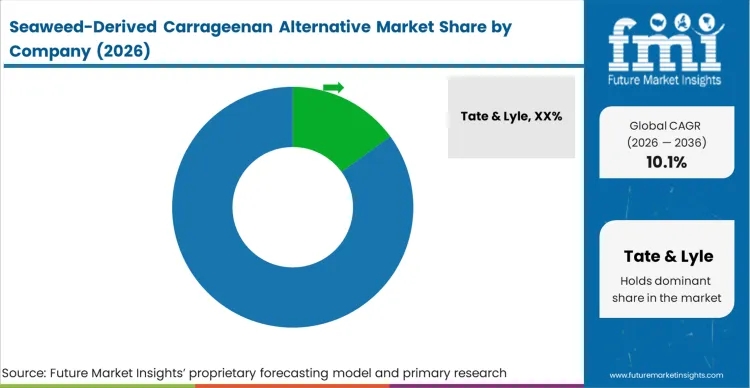
Consolidation reshapes vendor leverage as massive ingredient conglomerates absorb specialized marine extractors. Combined entities offer extensive formulation support, forcing independent processors to compete on niche applications rather than broad commodity pricing.
Technical partnerships accelerate product commercialization across adjacent industrial sectors. Collaborative research distributes immense R&D expenses while unlocking massive packaging revenue streams previously dominated by petrochemical polymers.
Distribution agreements dictate regional market penetration for mid-sized marine extract manufacturers. Securing exclusive regional distributors ensures rapid fulfillment and critical technical support for local food and cosmetic brands.
Recent Developments
The report includes full coverage of key trends from competitive benchmarking. Some of the recent developments covered in the reports:
- In April 2025, THG Labs partnered with Carbonwave to incorporate seaweed-derived emulsifiers into extensive skincare and haircare formulation libraries. [11]
- In February 2025, BioMara secured USD 150,000 to advance the production of Seafibrex and fucoidan extracts. [10]
Key Players in Seaweed-Derived Carrageenan Alternative Market
- Tate & Lyle
- CP Kelco
- DSM-Firmenich
- Univar Solutions
- Gelymar
- Sea6 Energy
- Sway
- Umaro Foods
- Carbonwave
- BioMara
Scope of the Report
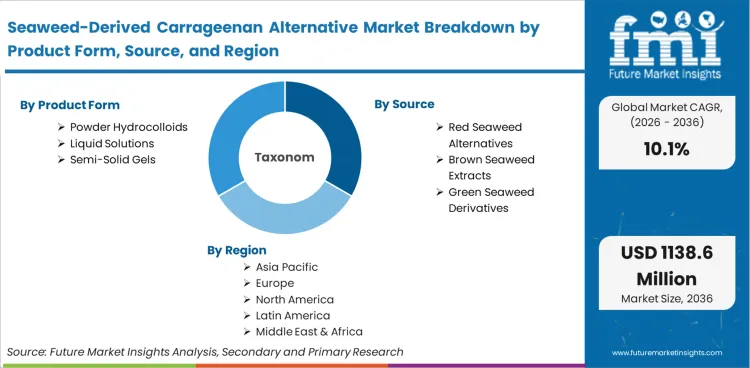
| Metric | Value |
|---|---|
| Quantitative Units | USD 435.0 million (2026) to USD 1,165.0 million (2036), at a CAGR of 10.1% |
| Market Definition | Marine extract operations supply natural binding agents synthesized from cultivated macroalgae to replace traditional red-algae carrageenan. |
| Source Segmentation | Red Seaweed Alternatives, Brown Seaweed Extracts, Green Seaweed Derivatives |
| Product Form Segmentation | Powder Hydrocolloids, Liquid Solutions, Semi-Solid Gels |
| Application Coverage | Food & Beverage Stabilizers, Personal Care & Cosmetics, Pharmaceuticals, Industrial Uses |
| Regions Covered | North America, Latin America, Europe, East Asia, South Asia, Oceania, Middle East & Africa |
| Countries Covered | United States, Canada, Mexico, Brazil, Argentina, Germany, France, United Kingdom, Italy, Spain, China, India, Japan, South Korea, Indonesia, Australia and 40 plus countries |
| Key Companies Profiled | Tate & Lyle, CP Kelco, DSM-Firmenich, Univar Solutions, Gelymar, Sea6 Energy, Sway, Umaro Foods, Carbonwave, BioMara |
| Forecast Period | 2026 to 2036 |
| Approach | Hybrid top down and bottom up market modeling validated through primary interviews with marine biomass aggregators and processing facility managers, supported by trade data benchmarking and plant level capacity verification |
Seaweed-Derived Carrageenan Alternative Market Analysis by Segments
Source
- Red Seaweed Alternatives
- Brown Seaweed Extracts
- Green Seaweed Derivatives
Product Form
- Powder Hydrocolloids
- Liquid Solutions
- Semi-Solid Gels
Application
- Food & Beverage Stabilizers
- Personal Care & Cosmetics
- Pharmaceuticals
- Industrial Uses
Distribution Channel
- Specialty Ingredient Suppliers
- Direct Sales
- Online Distributors
Region
- Asia Pacific
- India
- China
- Japan
- South Korea
- Indonesia
- Australia & New Zealand
- ASEAN
- Rest of Asia Pacific
- Europe
- Germany
- Italy
- France
- United Kingdom
- Spain
- Benelux
- Nordics
- Central & Eastern Europe
- Rest of Europe
- North America
- United States
- Canada
- Mexico
- Latin America
- Brazil
- Argentina
- Chile
- Rest of Latin America
- Middle East & Africa
- Kingdom of Saudi Arabia
- United Arab Emirates
- South Africa
- Turkey
- Rest of Middle East & Africa
Bibliography
- [1] FAO. (2024). FAO report: Global fisheries and aquaculture production reaches a new record high. FAO Newsroom.
- [2] The Fish Site. (2025). BioMara lands $150,000 boost for fucoidan production. The Fish Site.
- [3] CINEA. (2025). Four new projects launched to advance sustainable algae farming and blue innovation hubs. European Commission.
- [4] Tata Capital. (2024). Sea6 and HPCL sign a MoU to carry out research on conversion of tropical seaweed biomass to sustainable fuels. Tata Capital Media Center.
- [5] NITI Aayog. (2026). Model Curriculum for Diploma in Seaweed Farming. Government of India.
- [6] Green Queen. (2024). Shark Tank Alum Umaro Foods Raises $3.8M for Vegan Seaweed Bacon. Green Queen.
- [7] World Bank. (2025). 10 emerging global seaweed markets. World Bank Document Repository.
- [8] FoodNavigator.com. (2025). Seaweed-based functional ingredient scoops top food-tech award. FoodNavigator.
- [9] NITI Aayog. (2024). Global Trade Data. Strategy for the Development of Seaweed Value Chain.
- [10] The Fish Site. (2024). BioMara lands £150,000 boost for fucoidan production.
- [11] THG Labs. (2025). THG LABS joins forces with Carbonwave. THG Labs Press Releases.
- [12] NITI Aayog. (2024). Strategy for the Development of Seaweed Value Chain. Government of India.
- [13] NOAA Fisheries. (2025). NOAA Aquaculture Program Highlights. NOAA Fisheries.
- [14] European Commission. (2023). Aquaculture statistics. Eurostat.
This bibliography is provided for reader reference and is not exhaustive. The full report contains the complete reference list and detailed citations.
This Report Addresses
- Market intelligence to enable structured strategic decision making across mature and emerging marine polymer economies
- Market size estimation and 10 year revenue forecasts from 2026 to 2036, supported by validated biomass capacity and trade benchmarks
- Growth opportunity mapping across powder, liquid, and semi-solid forms with emphasis on clean-label grade transitions
- Segment and regional revenue forecasts covering food stabilizers, personal care, pharmaceuticals, and industrial applications
- Competition strategy assessment including integration models, cost survivability positioning, and compliance capability benchmarking
- Product reformulation and regulatory compliance tracking including natural extraction methods and chemical-free processing declarations
- Regulatory impact analysis covering synthetic additive mandates, formulation safety thresholds, and export driven specification upgrades
- Market report delivery in PDF, Excel, PPT, and interactive dashboard formats for executive and operational use
Frequently Asked Questions
How large is the demand for Seaweed-Derived Carrageenan Alternative in the global market in 2026?
Demand for Seaweed-Derived Carrageenan Alternative in the global market is estimated to be valued at USD 435.0 million in 2026.
What will be the market size of Seaweed-Derived Carrageenan Alternative in the global market by 2036?
Market size for Seaweed-Derived Carrageenan Alternative is projected to reach USD 1,165.0 million by 2036.
What is the expected demand growth for Seaweed-Derived Carrageenan Alternative in the global market between 2026 and 2036?
Demand for Seaweed-Derived Carrageenan Alternative in the global market is expected to grow at a CAGR of 10.1% between 2026 and 2036.
Which Product Form is poised to lead global sales by 2026?
Powder Hydrocolloids is expected to be the dominant format, capturing approximately 67% of global share in 2026 due to unmatched logistical efficiency and prolonged shelf life.
How significant is the role of Food & Beverage Stabilizers in driving Seaweed-Derived Carrageenan Alternative adoption in 2026?
Food & Beverage Stabilizers represent a critical segment, projected to hold a substantial 48% share in 2026 as consumer aversion to synthetic additives drives brands to reformulate dairy and plant-based milks.
What is driving demand in India?
Aggressive government aquaculture targets and scalable cultivation potential drive unprecedented local capacity expansion to lower hydrocolloid costs.
What compliance standards or regulations are referenced for India?
The National Institution for Transforming India (NITI Aayog) cultivation guidelines are referenced as key regulatory benchmarks.
What is the India growth outlook in this report?
India is projected to grow at a CAGR of 12.4% during 2026 to 2036.
Why is North America described as a priority region in this report?
Intense consumer scrutiny over artificial additives and federal funding for localized mariculture infrastructure make it a critical adoption zone.
What type of demand dominates in North America?
Clean-label reformulation demand from major multinational food and cosmetic brands dominates regional consumption.
What is China growth outlook in this report?
China is projected to expand at a CAGR of 11.9% during 2026 to 2036.
Does the report cover United States in its regional analysis?
United States is included within North America under the regional scope of analysis.
What are the sources referred to for analyzing United States?
Official marine statistics published by NOAA Fisheries and corporate funding rounds for domestic processing facilities are cited as primary reference sources.
What is the main demand theme linked to United States in its region coverage?
Stringent clean-label audits force recipe overhauls, lifting utilization rates for domestic marine polymer suppliers.
Does the report cover United Kingdom in its regional analysis?
United Kingdom is included within Europe under the regional coverage framework.
What is the main United Kingdom related demand theme in its region coverage?
High-end retail brands mandate sustainable ingredients, driving rapid procurement of traceable alternative binders.
Which product formats or configurations are strategically important for Asia Pacific supply chains?
Powder hydrocolloids are prioritized due to lower storage risk and reduced logistical constraints across complex export channels.
What is Seaweed-Derived Carrageenan Alternative and what is it mainly used for?
Marine extract operations supply natural binding agents synthesized from cultivated macroalgae to stabilize processed foods, dairy alternatives, and cosmetic emulsions.
What does Seaweed-Derived Carrageenan Alternative mean in this report?
The sector refers to the global production, fractionation, and industrial distribution of unmodified marine polymers designed to replace chemically processed carrageenan.
What is included in the scope of this Seaweed-Derived Carrageenan Alternative report?
Scope covers red and brown seaweed extracts, powder hydrocolloids, and primary applications spanning food stabilizers and personal care.
What is excluded from the scope of this report?
Synthetic emulsifiers, chemically modified E-number carrageenan, and whole seaweeds sold for direct culinary consumption are excluded.
What does market forecast mean on this page?
Market forecast represents a model-based projection built on defined adoption and biomass supply assumptions for strategic planning purposes.
How does FMI build and validate the Seaweed-Derived Carrageenan Alternative forecast?
Forecast is developed using hybrid top-down and bottom-up modeling validated through marine biomass trade data, processing capacity checks, and expert review.
What does zero reliance on speculative third party market research mean here?
Primary consultations with marine aggregators and verifiable aquaculture datasets are used instead of unverified syndicated market estimates.
Preview the report firsthand - request a free sample
Get SampleGet the brochure for pricing and purchase details.
Get PDFTable of Content
- Executive Summary
- Global Market Outlook
- Demand-side Trends
- Supply-side Trends
- Technology Roadmap Analysis
- Analysis and Recommendations
- Market Overview
- Market Coverage / Taxonomy
- Market Definition / Scope / Limitations
- Research Methodology
- Chapter Orientation
- Analytical Lens and Working Hypotheses
- Market Structure, Signals, and Trend Drivers
- Benchmarking and Cross-market Comparability
- Market Sizing, Forecasting, and Opportunity Mapping
- Research Design and Evidence Framework
- Desk Research Programme (Secondary Evidence)
- Company Annual and Sustainability Reports
- Peer-reviewed Journals and Academic Literature
- Corporate Websites, Product Literature, and Technical Notes
- Earnings Decks and Investor Briefings
- Statutory Filings and Regulatory Disclosures
- Technical White Papers and Standards Notes
- Trade Journals, Industry Magazines, and Analyst Briefs
- Conference Proceedings, Webinars, and Seminar Materials
- Government Statistics Portals and Public Data Releases
- Press Releases and Reputable Media Coverage
- Specialist Newsletters and Curated Briefings
- Sector Databases and Reference Repositories
- FMI Internal Proprietary Databases and Historical Market Datasets
- Subscription Datasets and Paid Sources
- Social Channels, Communities, and Digital Listening Inputs
- Additional Desk Sources
- Expert Input and Fieldwork (Primary Evidence)
- Primary Modes
- Qualitative Interviews and Expert Elicitation
- Quantitative Surveys and Structured Data Capture
- Blended Approach
- Why Primary Evidence is Used
- Field Techniques
- Interviews
- Surveys
- Focus Groups
- Observational and In-context Research
- Social and Community Interactions
- Stakeholder Universe Engaged
- C-suite Leaders
- Board Members
- Presidents and Vice Presidents
- R&D and Innovation Heads
- Technical Specialists
- Domain Subject-matter Experts
- Scientists
- Physicians and Other Healthcare Professionals
- Governance, Ethics, and Data Stewardship
- Research Ethics
- Data Integrity and Handling
- Primary Modes
- Tooling, Models, and Reference Databases
- Desk Research Programme (Secondary Evidence)
- Data Engineering and Model Build
- Data Acquisition and Ingestion
- Cleaning, Normalisation, and Verification
- Synthesis, Triangulation, and Analysis
- Quality Assurance and Audit Trail
- Market Background
- Market Dynamics
- Drivers
- Restraints
- Opportunity
- Trends
- Scenario Forecast
- Demand in Optimistic Scenario
- Demand in Likely Scenario
- Demand in Conservative Scenario
- Opportunity Map Analysis
- Product Life Cycle Analysis
- Supply Chain Analysis
- Investment Feasibility Matrix
- Value Chain Analysis
- PESTLE and Porter’s Analysis
- Regulatory Landscape
- Regional Parent Market Outlook
- Production and Consumption Statistics
- Import and Export Statistics
- Market Dynamics
- Global Market Analysis 2021 to 2025 and Forecast, 2026 to 2036
- Historical Market Size Value (USD Million) Analysis, 2021 to 2025
- Current and Future Market Size Value (USD Million) Projections, 2026 to 2036
- Y-o-Y Growth Trend Analysis
- Absolute $ Opportunity Analysis
- Global Market Pricing Analysis 2021 to 2025 and Forecast 2026 to 2036
- Global Market Analysis 2021 to 2025 and Forecast 2026 to 2036, By Product Form
- Introduction / Key Findings
- Historical Market Size Value (USD Million) Analysis By Product Form , 2021 to 2025
- Current and Future Market Size Value (USD Million) Analysis and Forecast By Product Form , 2026 to 2036
- Powder Hydrocolloids
- Liquid Solutions
- Semi-Solid Gels
- Powder Hydrocolloids
- Y-o-Y Growth Trend Analysis By Product Form , 2021 to 2025
- Absolute $ Opportunity Analysis By Product Form , 2026 to 2036
- Global Market Analysis 2021 to 2025 and Forecast 2026 to 2036, By Source
- Introduction / Key Findings
- Historical Market Size Value (USD Million) Analysis By Source, 2021 to 2025
- Current and Future Market Size Value (USD Million) Analysis and Forecast By Source, 2026 to 2036
- Red Seaweed Alternatives
- Brown Seaweed Extracts
- Green Seaweed Derivatives
- Red Seaweed Alternatives
- Y-o-Y Growth Trend Analysis By Source, 2021 to 2025
- Absolute $ Opportunity Analysis By Source, 2026 to 2036
- Global Market Analysis 2021 to 2025 and Forecast 2026 to 2036, By Region
- Introduction
- Historical Market Size Value (USD Million) Analysis By Region, 2021 to 2025
- Current Market Size Value (USD Million) Analysis and Forecast By Region, 2026 to 2036
- North America
- Latin America
- Western Europe
- Eastern Europe
- East Asia
- South Asia and Pacific
- Middle East & Africa
- Market Attractiveness Analysis By Region
- North America Market Analysis 2021 to 2025 and Forecast 2026 to 2036, By Country
- Historical Market Size Value (USD Million) Trend Analysis By Market Taxonomy, 2021 to 2025
- Market Size Value (USD Million) Forecast By Market Taxonomy, 2026 to 2036
- By Country
- USA
- Canada
- Mexico
- By Product Form
- By Source
- By Country
- Market Attractiveness Analysis
- By Country
- By Product Form
- By Source
- Key Takeaways
- Latin America Market Analysis 2021 to 2025 and Forecast 2026 to 2036, By Country
- Historical Market Size Value (USD Million) Trend Analysis By Market Taxonomy, 2021 to 2025
- Market Size Value (USD Million) Forecast By Market Taxonomy, 2026 to 2036
- By Country
- Brazil
- Chile
- Rest of Latin America
- By Product Form
- By Source
- By Country
- Market Attractiveness Analysis
- By Country
- By Product Form
- By Source
- Key Takeaways
- Western Europe Market Analysis 2021 to 2025 and Forecast 2026 to 2036, By Country
- Historical Market Size Value (USD Million) Trend Analysis By Market Taxonomy, 2021 to 2025
- Market Size Value (USD Million) Forecast By Market Taxonomy, 2026 to 2036
- By Country
- Germany
- UK
- Italy
- Spain
- France
- Nordic
- BENELUX
- Rest of Western Europe
- By Product Form
- By Source
- By Country
- Market Attractiveness Analysis
- By Country
- By Product Form
- By Source
- Key Takeaways
- Eastern Europe Market Analysis 2021 to 2025 and Forecast 2026 to 2036, By Country
- Historical Market Size Value (USD Million) Trend Analysis By Market Taxonomy, 2021 to 2025
- Market Size Value (USD Million) Forecast By Market Taxonomy, 2026 to 2036
- By Country
- Russia
- Poland
- Hungary
- Balkan & Baltic
- Rest of Eastern Europe
- By Product Form
- By Source
- By Country
- Market Attractiveness Analysis
- By Country
- By Product Form
- By Source
- Key Takeaways
- East Asia Market Analysis 2021 to 2025 and Forecast 2026 to 2036, By Country
- Historical Market Size Value (USD Million) Trend Analysis By Market Taxonomy, 2021 to 2025
- Market Size Value (USD Million) Forecast By Market Taxonomy, 2026 to 2036
- By Country
- China
- Japan
- South Korea
- By Product Form
- By Source
- By Country
- Market Attractiveness Analysis
- By Country
- By Product Form
- By Source
- Key Takeaways
- South Asia and Pacific Market Analysis 2021 to 2025 and Forecast 2026 to 2036, By Country
- Historical Market Size Value (USD Million) Trend Analysis By Market Taxonomy, 2021 to 2025
- Market Size Value (USD Million) Forecast By Market Taxonomy, 2026 to 2036
- By Country
- India
- ASEAN
- Australia & New Zealand
- Rest of South Asia and Pacific
- By Product Form
- By Source
- By Country
- Market Attractiveness Analysis
- By Country
- By Product Form
- By Source
- Key Takeaways
- Middle East & Africa Market Analysis 2021 to 2025 and Forecast 2026 to 2036, By Country
- Historical Market Size Value (USD Million) Trend Analysis By Market Taxonomy, 2021 to 2025
- Market Size Value (USD Million) Forecast By Market Taxonomy, 2026 to 2036
- By Country
- Kingdom of Saudi Arabia
- Other GCC Countries
- Turkiye
- South Africa
- Other African Union
- Rest of Middle East & Africa
- By Product Form
- By Source
- By Country
- Market Attractiveness Analysis
- By Country
- By Product Form
- By Source
- Key Takeaways
- Key Countries Market Analysis
- USA
- Pricing Analysis
- Market Share Analysis, 2025
- By Product Form
- By Source
- Canada
- Pricing Analysis
- Market Share Analysis, 2025
- By Product Form
- By Source
- Mexico
- Pricing Analysis
- Market Share Analysis, 2025
- By Product Form
- By Source
- Brazil
- Pricing Analysis
- Market Share Analysis, 2025
- By Product Form
- By Source
- Chile
- Pricing Analysis
- Market Share Analysis, 2025
- By Product Form
- By Source
- Germany
- Pricing Analysis
- Market Share Analysis, 2025
- By Product Form
- By Source
- UK
- Pricing Analysis
- Market Share Analysis, 2025
- By Product Form
- By Source
- Italy
- Pricing Analysis
- Market Share Analysis, 2025
- By Product Form
- By Source
- Spain
- Pricing Analysis
- Market Share Analysis, 2025
- By Product Form
- By Source
- France
- Pricing Analysis
- Market Share Analysis, 2025
- By Product Form
- By Source
- India
- Pricing Analysis
- Market Share Analysis, 2025
- By Product Form
- By Source
- ASEAN
- Pricing Analysis
- Market Share Analysis, 2025
- By Product Form
- By Source
- Australia & New Zealand
- Pricing Analysis
- Market Share Analysis, 2025
- By Product Form
- By Source
- China
- Pricing Analysis
- Market Share Analysis, 2025
- By Product Form
- By Source
- Japan
- Pricing Analysis
- Market Share Analysis, 2025
- By Product Form
- By Source
- South Korea
- Pricing Analysis
- Market Share Analysis, 2025
- By Product Form
- By Source
- Russia
- Pricing Analysis
- Market Share Analysis, 2025
- By Product Form
- By Source
- Poland
- Pricing Analysis
- Market Share Analysis, 2025
- By Product Form
- By Source
- Hungary
- Pricing Analysis
- Market Share Analysis, 2025
- By Product Form
- By Source
- Kingdom of Saudi Arabia
- Pricing Analysis
- Market Share Analysis, 2025
- By Product Form
- By Source
- Turkiye
- Pricing Analysis
- Market Share Analysis, 2025
- By Product Form
- By Source
- South Africa
- Pricing Analysis
- Market Share Analysis, 2025
- By Product Form
- By Source
- USA
- Market Structure Analysis
- Competition Dashboard
- Competition Benchmarking
- Market Share Analysis of Top Players
- By Regional
- By Product Form
- By Source
- Competition Analysis
- Competition Deep Dive
- Tate & Lyle
- Overview
- Product Portfolio
- Profitability by Market Segments (Product/Age /Sales Channel/Region)
- Sales Footprint
- Strategy Overview
- Marketing Strategy
- Product Strategy
- Channel Strategy
- CP Kelco
- DSM-Firmenich
- Univar Solutions
- Gelymar
- Sea6 Energy
- Sway
- Umaro Foods
- Tate & Lyle
- Competition Deep Dive
- Assumptions & Acronyms Used


