

- Industry Size (2026)
- USD 1.6 Bn
- Forecast (2036)
- USD 2.8 Bn
- CAGR (2026 to 2036)
- 5.75%
Savory Flavor Modulators Market Size, Market Forecast and Outlook By FMI
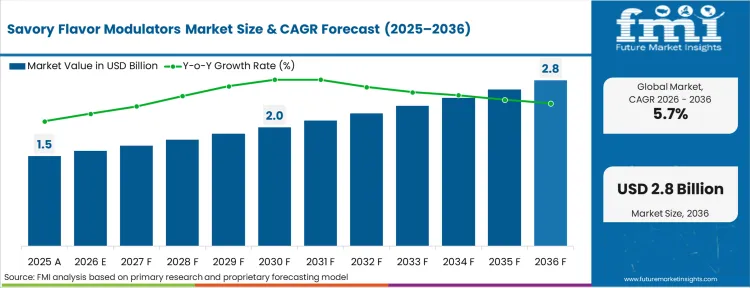
The savory flavor modulators market was valued at USD 1.5 billion in 2025. Sales are poised to cross USD 1.6 billion in 2026 at a CAGR of 5.75% during the forecast period. The cumulative buildup propels the valuation to USD 2.8 billion through 2036 as retail gatekeepers enforce strict clean-label mandates, forcing formulation teams to shift from simple sodium reduction to complex, foundational umami and kokumi building.
Formulation teams are currently forced to navigate a critical decision threshold between natural declaration credentials and cost-optimized sensory performance. As inflationary pressures compress margins across the food sector, procurement directors can no longer justify premium clean-label ingredients that fail to deliver exact parity with legacy artificial enhancers. The commercial stakes of delaying this optimization result in direct delisting by major grocery networks that increasingly use clean ingredient decks as a primary shelf-space filter. A crucial challenge often overlooked is that the actual formulation gap lies not in replicating saltiness, but in matching the temporal mouthfeel and linger that traditional sodium provides, a dynamic driving the adoption of advanced yeast extracts. FMI analysts opine that vendors failing to map these temporal profiles struggle to pass initial sensory gates.
Summary of Savory Flavor Modulators Market
- Savory Flavor Modulators Market Definition:
- This category consists of advanced ingredients that manipulate taste receptor perception to enhance umami and saltiness or mask off-notes. They allow food manufacturers to achieve required sensory profiles and mouthfeel while lowering total sodium and synthetic additive levels to meet regulatory and retail pressures.
- Demand Drivers in the Market:
- Stringent nutritional profiling algorithms enforced by major retail chains compel food manufacturing formulation teams to reformulate legacy product lines.
- Sustained consumer hostility toward monosodium glutamate (MSG) declarations on ingredient decks forces procurement directors to source recognizable, natural-sounding alternatives.
- Astringent off-notes inherent in pea and soy proteins obligate plant-based product developers to utilize complex masking and enhancement systems to achieve parity with animal-derived counterparts.
- Key Segments Analyzed in the FMI Report:
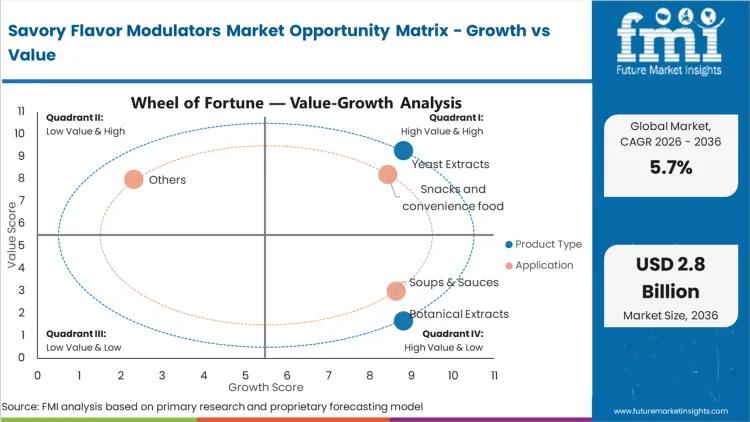
- Yeast Extracts: Yeast Extracts are expected to hold 34.2% share in 2026, driven by their ability to provide foundational umami and kokumi while maintaining a universally accepted clean-label declaration.
- Snacks & Convenience Foods: Snacks & Convenience Foods is projected to garner the leading share in 2026, as the nature of topical snack seasoning requires intense, immediate receptor activation to offset base carbohydrate blandness.
- Powder: Powder is poised to record 65.8% share in 2026, as dry blending remains the dominant manufacturing process in commercial seasoning and soup mix production.
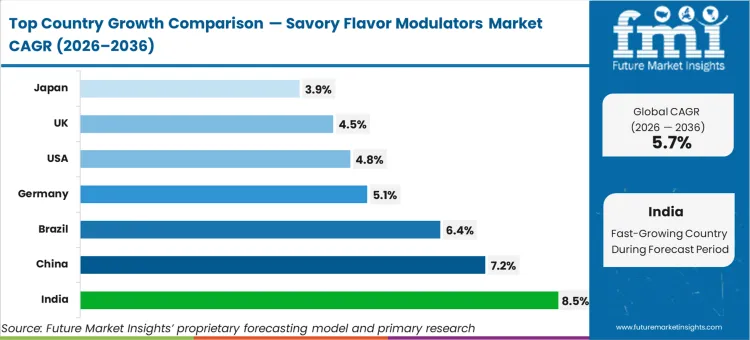
- India: 8.5% compound growth, reflecting the rapid transition of domestic snack food consumption from informal regional producers to highly standardized, national branded networks.
- Analyst Opinion at FMI:
- Nandini Roy Choudhury, Principal Analyst, Food and Beverage, at FMI, opines, "The general industry assumption is that savory modulators are purchased primarily to achieve sodium reduction targets on nutritional panels. However, the exact condition where this breaks down is in plant-based meat analogs. Here, procurement teams are buying modulators almost entirely for their masking properties and kokumi-building effects to hide protein astringency. If a modulator only enhances saltiness but fails to round out the mid-palate void typical of extruded soy, it fails qualification entirely, regardless of its clean-label credentials."
- Strategic Implications / Executive Takeaways:
- Formulation leads must integrate predictive sensory modeling to accelerate product qualification cycles before primary competitors secure exclusive supply agreements.
- Category managers should phase out legacy artificial enhancers to avoid automatic disqualification by European retail procurement algorithms.
- Ingredient suppliers face limitations in botanical extract consistency that require investment in standardized fermentation technologies.
- Methodology:
- Research parameters integrate interviews with FMCG procurement directors and flavor house formulation leads. Baseline sizing anchors to observable MSG displacement volumes across industrial food processing lines, triangulated against primary supplier capacity expansion data to ensure forecast validity.
The transition accelerates once flavor houses move beyond trial-and-error formulation and implement predictive sensory modeling. Once flavor suppliers can definitively map how a specific modulator will behave within a complex extruded carbohydrate matrix before physical trials, the qualification cycle for fast-moving consumer goods brands shortens significantly. This modeling capability fundamentally changes the vendor-buyer relationship, shifting modulators from reactive problem-solvers to foundational baseline ingredients.
India is expected to track at a CAGR of 8.5%, driven by the formalization of its packaged snack sector. China follows closely, projected to expand at 7.2% as urban retail networks demand extended shelf-stability without chemical preservatives. Brazil is poised to record a 6.4% rate, reflecting procurement shifts in its dominant meat processing industry. The United States is likely to post a 4.8% growth rate, heavily influenced by maturity in the plant-based category. Germany is estimated to garner a 5.1% CAGR as regulatory pressure on sodium content reshapes foundational recipes. The United Kingdom is anticipated to register 4.5% growth, while Japan is forecast to grow at 3.9%. This divergence reflects the fundamental difference between markets executing compliance-driven recipe overhauls and those experiencing first-wave industrialization of their local snack food categories.
Savory Flavor Modulators Market Key Takeaways
| Metric | Details |
|---|---|
| Industry Size (2026) | USD 1.6 billion |
| Industry Value (2036) | USD 2.8 billion |
| CAGR (2026-2036) | 5.75% |
Source: Future Market Insights (FMI) analysis, based on proprietary forecasting model and primary research
Savory Flavor Modulators Market Definition
The savory flavor modulators space encompasses specialized ingredients designed to alter, enhance, or mask specific taste profiles, primarily umami, kokumi, and saltiness, without functioning as the primary flavoring agent themselves. Functionally, these compounds alter the receptor perception of savory notes, enabling significant reductions in sodium or monosodium glutamate (MSG) while maintaining the original sensory identity and mouthfeel of the finished food matrix.
Savory Flavor Modulators Market Inclusions
This sector includes yeast extracts, hydrolyzed vegetable proteins (HVPs), specialized botanical extracts, high-nucleotide compounds, and targeted amino acid blends utilized specifically for taste alteration. It also encompasses both natural and synthetically derived sensory modulators applied within food manufacturing. The scope covers formulations applied to snacks, prepared meals, processed meats, and the rapidly scaling plant based formulation segment where masking off-notes from alternative proteins is a critical operational requirement.
Savory Flavor Modulators Market Exclusions
The scope explicitly excludes primary bulk flavorings, table salt (sodium chloride), traditional raw spices, and basic culinary herbs. Standard texturants and purely functional binders are also omitted. These categories are excluded because they either provide the foundational taste itself rather than modifying receptor perception, or they serve purposes independent of the specific umami or kokumi sensory mechanisms that define true modulation capabilities.
Savory Flavor Modulators Market Research Methodology
- Primary Research: Procurement directors at tier-1 FMCG food brands, R&D formulation leads at specialized flavor houses, and regulatory compliance officers in food manufacturing networks.
- Desk Research: Aggregation of regional food safety authority sodium guidelines, corporate clean-label pledge databases, and formulation patent filings concerning umami and kokumi receptor interaction.
- Market-Sizing and Forecasting: The baseline anchors to the verifiable volume of monosodium glutamate (MSG) displacement tracked across top-tier processed food manufacturing facilities globally.
- Data Validation and Update Cycle: Forecasts are triangulated against capital expenditure reports from major ingredient suppliers expanding fermentation and extraction capacities for yeast and botanical derivatives.
Segmental Analysis
Savory Flavor Modulators Market Analysis by Product Type
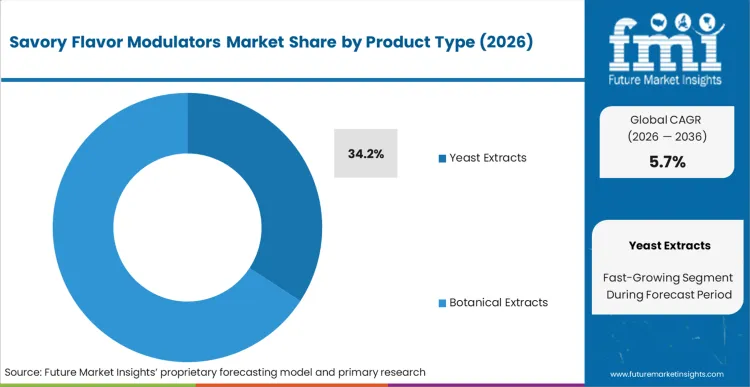
Top-tier FMCG brands are actively displacing legacy artificial enhancers because those formulations trigger automatic delisting algorithms in modern retail procurement systems. This displacement dynamic explains why yeast extracts hold a commanding 34.2% share. Procurement directors at global food conglomerates cannot afford the commercial friction of maintaining separate "clean" and "conventional" supply chains for identical product lines. According to FMI's estimates, yeast-derived compounds offer the specific advantage of delivering a universally recognizable ingredient declaration while performing the complex mid-palate rounding that basic salt reduction leaves vacant. Formulators who select botanical alternatives often face immediate supply-side consistency issues across different crop yields. The consequence for formulation teams who delay standardizing on scalable extract bases is prolonged product development cycles that miss critical seasonal retail resets.
- Initial screening: Clean-label declaration serves as the primary gateway, dictating whether a modulator even reaches the formulation bench for physical testing. Modulators that fail this hurdle are immediately disqualified by brand managers.
- Sensory validation: Efficacy is proven not just by peak umami intensity, but by the temporal linger matching legacy sodium profiles during blind panel testing. Formulators reject options that exhibit rapid flavor drop-off.
- Commercial expansion: Consistent batch-to-batch performance and price stability dictate whether a qualified modulator is rolled out across the entire corporate portfolio. Procurement teams drop vendors unable to scale without price volatility.
Savory Flavor Modulators Market Analysis by Application
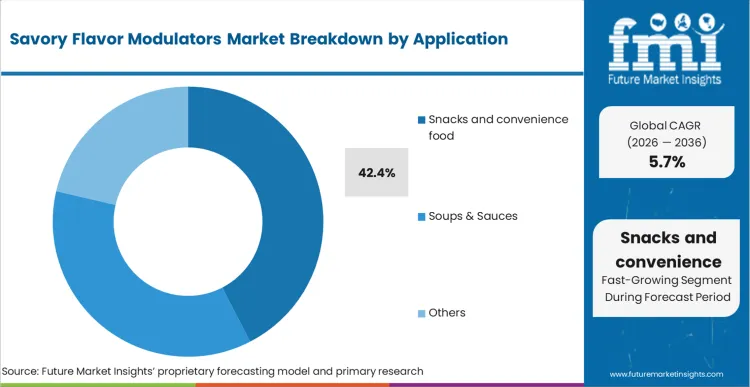
Snacks and convenience food developers face an immediate decision regarding how to deliver intense topical flavor bursts without exceeding new regional sodium guidelines. This specific pressure forces the snacks & convenience foods segment to dominate application share of 42.4%, as the underlying extruded carbohydrate bases offer zero inherent flavor masking. The application requires aggressive flavor enhancement solutions capable of surviving high-heat processing and long-term shelf storage without degrading. Based on FMI's assessment, formulators operating in this space rely on dry powder modulators because liquid alternatives compromise the integrity and moisture specifications of the final snack matrix. A failure to balance the modulator intensity against the base starch results in a flat flavor profile that consumers immediately reject. Procurement directors who fail to secure thermally stable modulators face direct brand equity erosion as core product lines lose their signature taste identity upon reformulation.
- Thermal degradation: Modulators applied pre-extrusion often lose potency under severe heat and shear forces. Formulators are forced to either overdose the ingredient or shift to topical application systems.
- Moisture migration: Hygroscopic modulators pull ambient moisture into the snack matrix, destroying the required crunch and shortening shelf life. Packaging engineers must overcompensate with expensive high-barrier films if the modulator is inherently unstable.
- Application adherence: To capture the full sensory benefit, the topical modulator must physically adhere to the snack surface without excess dusting. Operators must carefully calibrate oil slurries to ensure consistent flavor distribution.
Savory Flavor Modulators Market Analysis by Form
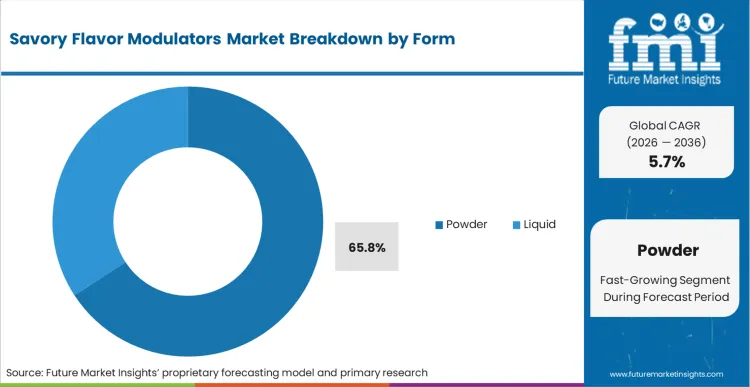
The reason the powder segment accounts for 65.8% of the total volume is rooted in the economics of industrial seasoning blending. Powdered modulators allow flavor houses and primary food manufacturers to utilize existing dry blending infrastructure without investing in specialized liquid injection systems. As per FMI's projection, this form factor eliminates the hidden logistical costs associated with transporting water weight and managing the complex sanitation protocols required for bulk liquid storage. Dry forms offer absolute precision in micro-dosing, which is critical when working with high-intensity kokumi compounds where a fraction of a percent dictates success or failure. Formulators specifying liquid formats for applications that eventually undergo dehydration processes introduce unnecessary thermal processing steps. Plant managers who attempt to retrofit liquid systems into legacy dry-mix environments routinely encounter severe cross-contamination risks and elevated line changeover times.
- Procurement baseline: Powdered formats establish the baseline cost-in-use metric due to their extended shelf stability and lack of specialized ambient storage requirements. Operations teams capture immediate margin relief through reduced spoilage.
- Blending friction: Poor flowability or clumping in lower-grade powders requires the addition of anti-caking agents, which clutters the final ingredient deck. Manufacturing engineers must balance modulator cost against operational downtime caused by blocked hoppers.
- Lifecycle parity: Total operational economics consistently favor dry forms when factoring in global shipping, warehousing, and ease of integration into established pre-mix recipes. Procurement consolidates around powder to simplify global supply chain complexity.
Savory Flavor Modulators Market Drivers, Restraints, and Opportunities
The pressure imposed by European and North American retail consortiums, which now actively filter inbound products based on nutritional scoring algorithms, forces R&D formulation leads to fundamentally rebuild core product architectures. This is not a consumer-led awareness trend; it is a hard commercial gate dictated by the entities controlling shelf space. Formulators are compelled to deploy advanced modulators to offset the severe flavor deficits caused by mandatory 20% to 30% sodium reductions. Brands that attempt to achieve these reductions without utilizing sophisticated kokumi and umami replacements suffer immediate velocity drops at the retail level, as consumers reject the altered, flattened flavor profiles of legacy products.
A primary friction slowing adoption is the exact cost-in-use disparity between advanced modulators and the legacy commodities they replace, specifically MSG and basic sodium chloride. Procurement directors face the reality that a highly engineered botanical extract may cost exponentially more per kilogram than synthetic alternatives, destroying the unit economics of low-margin convenience foods. This friction is because the raw material extraction and fermentation processes required for clean-label modulators are inherently capital-intensive. While early-stage precision fermentation offers a partial solution for scaling consistent umami peptides, the technology remains largely inaccessible to mid-tier regional food manufacturers operating on constrained capital expenditure budgets.
Opportunities in the Savory Flavor Modulators Market
- Precision fermentation scaling: Advancements in biotechnology enable flavor houses to produce complex, targeted umami peptides independent of agricultural supply chains. Formulation leads who secure these novel proteins achieve clean-label parity without the traditional botanical cost premiums.
- Plant-based masking: The inherent astringency and beany off-notes in alternative proteins require sophisticated taste masking properties. Product developers targeting the flexitarian segment capture significant market share by achieving meat-equivalent mouthfeel using specialized kokumi modulators.
- Sodium-free functional snacking: Regulatory pressure creates a vacuum for high-flavor, zero-sodium extruded snacks. Agile regional brands capture premium shelf placement by utilizing yeast-derived modulators that deliver intense savory profiles without triggering high-salt retail penalties.
Regional Analysis
Based on the regional analysis, the savory flavor modulators market is segmented into North America, Europe, Asia Pacific, and other key regions across 40 plus countries.
.webp "Top Country Growth Comparison Savory Flavor Modulators Market Cagr (2026 2036)")
| Country | CAGR (2026 to 2036) |
|---|---|
| India | 8.5% |
| China | 7.2% |
| Brazil | 6.4% |
| Germany | 5.1% |
| United States | 4.8% |
| United Kingdom | 4.5% |
| Japan | 3.9% |
Source: Future Market Insights (FMI) analysis, based on proprietary forecasting model and primary research
North America Savory Flavor Modulators Market Analysis
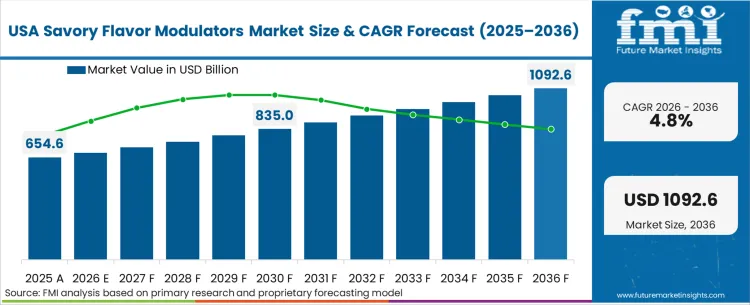
Cost structures, severe margin compression, and institutionalized retail procurement practices dictate the adoption parameters across North American food manufacturing networks. Formulation teams in this region do not transition away from cost-effective legacy enhancers out of preference; they do so when the total lifecycle cost of losing premium retail shelf placement outweighs the ingredient premium of advanced modulators. In FMI's view, the maturity of the region's food processing infrastructure means that modulators must seamlessly drop into existing high-speed blending operations without requiring capital retrofits. The dominance of private equity ownership in mid-tier food brands further accelerates the demand for modulators that can unify formulation across disparate acquired brand portfolios.
- United States: The intense concentration of plant-based alternative protein manufacturing in the US forces formulators to prioritize kokumi modulators specifically calibrated to mask pea and soy isolates. This operational requirement fundamentally alters procurement timelines, moving modulators from late-stage additives to early-phase necessities. The market for savory flavor modulators in the United States is forecast to register a CAGR of 4.8%. Brands that secure early access to next-generation masking peptides capture distinct commercial opportunities in the premium flexitarian category, effectively blocking competitors who rely on legacy salt-heavy masking techniques.
FMI's report includes analysis of the Canadian and Mexican markets. Across these adjacent North American territories, a distinct pattern of cross-border supply chain integration requires modulators to comply with a unified, stricter continental labeling standard, preventing brands from running dual-quality formulations.
Europe Savory Flavor Modulators Market Analysis
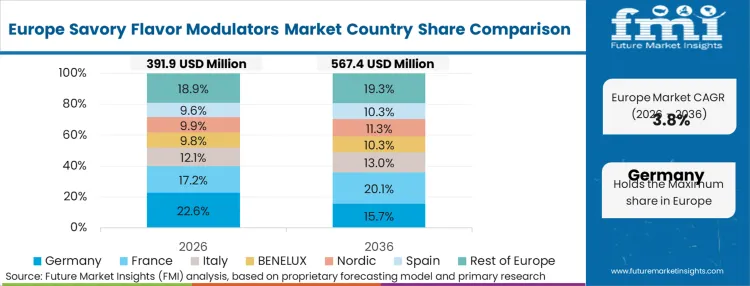
The European landscape is entirely governed by how aggressively national regulatory bodies and dominant retail consortiums enforce front-of-pack nutritional scoring systems like Nutri-Score. This policy-led environment compels procurement directors to strip legacy artificial flavor enhancers and excess sodium from ingredient decks simply to qualify for retail distribution. FMI analysts opine that European adoption is characterized by a strict intolerance for synthetic-sounding chemical names, heavily skewing procurement toward yeast extracts and natural botanical derivatives regardless of the cost-in-use penalty. The reality is that European food brands treat modulator integration as a baseline compliance expenditure rather than an optional product enhancement.
- Germany: Rigid interpretation of clean-label standards forces its extensive processed meat sector to systematically replace MSG and high-sodium curing blends with specialized yeast-derived umami compounds. This alters the formulation timeline, requiring extensive microbial stability testing to ensure the new modulators do not compromise the shelf life of packaged sausages and cold cuts. FMI estimates the savory flavor modulators market in Germany to expand at an annual growth rate of 5.1%. The reality on the ground is that formulators spend more time battling the subtle color changes induced by yeast extracts in light-colored meats than they do balancing the actual flavor profile.
- United Kingdom: Procurement directives mandated by the UK's top four supermarket chains effectively ban certain artificial enhancers from private-label portfolios, requiring suppliers to execute rapid recipe overhauls. Food manufacturers operating in this ecosystem must pivot to natural modulators that can withstand high-volume, continuous production without scaling issues. A CAGR of 4.5% is expected for savory flavor modulators in the UK over the forecast period. When adoption is successfully achieved, the operational outcome is a streamlined, universally compliant base recipe that eliminates the need for complex, retailer-specific production runs.
FMI's report includes assessments of France, Italy, and the broader Nordic region. Across these European markets, a unified push toward ultra-clean ingredient decks is forcing even legacy artisanal brands to explore subtle fermentation-based modulators to maintain traditional flavor profiles under modern regulatory scrutiny.
Asia Pacific Savory Flavor Modulators Market Analysis
The physical and digital modernization of cold chain logistics and formal retail distribution networks shapes how savory modulators are deployed across the Asia Pacific corridor. As regional populations transition from fresh, daily market purchasing to packaged, shelf-stable convenience foods, the requirement for robust flavor stability over extended supply chains becomes critical. According to FMI's estimates, procurement directors in this region prioritize modulators that can deliver high-impact umami notes capable of surviving severe ambient temperature fluctuations during distribution. Unlike Western markets driven by sodium reduction, the initial adoption wave here is driven by the need to standardize flavor profiles across newly built, massive-scale mega-facilities.
- India: The explosive formalization of India's indigenous savory snack (namkeen) sector forces regional producers to abandon informal spice blending in favor of highly standardized, industrially produced flavor modulators. This operational shift requires plant managers to train workforce on precise micro-dosing techniques, fundamentally changing the technological baseline of the production floor. India's savory flavor modulators industry is expected to demonstrate a CAGR of 8.5%. The trajectory points toward a rapid consolidation of local flavor suppliers as national FMCG brands demand consistency volumes that only tier-1 global flavor houses can currently provide.
- China: China's sprawling instant noodle and ready-to-eat meal sectors operate under immense scale constraints, compelling R&D teams to utilize modulators that deliver maximum sensory impact at the absolute lowest inclusion rate. The focus is strictly on highly concentrated umami delivery systems to offset the blandness of mass-produced wheat and rice bases. Demand for savory flavor modulators in China is estimated to expand at a CAGR of 7.2%. This trajectory positions Chinese food manufacturers to aggressively export their highly optimized, cost-effective formulations into adjacent Southeast Asian markets, placing significant pressure on local competitors still relying on older MSG technology.
- Japan: Highly mature, hyper-segmented convenience food sector in Japan operates under a different dynamic, where formulators utilize advanced kokumi modulators to create micro-differentiations in premium soups and sauces. Formulators here face grueling qualification cycles, evaluating modulators on molecular-level receptor interactions rather than broad flavor enhancement. The Japanese market for savory flavor modulators is likely to post a CAGR of 3.9%. The practitioner reality is that Japanese flavor houses prioritize the subtle perception of "thickness" and mouthfeel over peak saltiness, driving proprietary innovations that Western markets are only beginning to understand.
FMI's report includes analysis of the ASEAN markets and Australasia. A distinct pattern across these expanding economies is the aggressive localization of global flavor profiles, requiring modulators that can bridge the gap between Western snack formats and intense, localized regional spice palates.
Competitive Aligners for Market Players
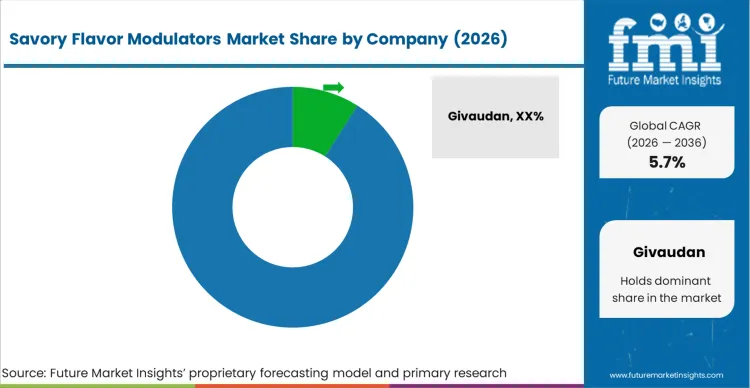
The savory flavor modulators market exhibits a highly concentrated structure at the pinnacle of formulation IP, counterbalanced by fragmentation at the raw material extraction level. This concentration exists structurally because the scientific capability required to map human taste receptor interactions and develop precise kokumi molecules requires massive, sustained capital investment in sensory laboratories. Leading entities like Givaudan, Firmenich SA, and Kerry Group dominate because buyers ultimately use regulatory compliance and global supply chain reliability as the primary variables to distinguish qualified partners from unproven vendors.
Incumbents like Symrise AG and Ajinomoto Co. Inc. maintain advantages through their deep vertical integration into raw material fermentation and extraction. This integration persists as an advantage because it insulates them from the severe agricultural price volatility that plagues formulators relying purely on outsourced botanical extracts. A challenger attempting to disrupt this hierarchy must build independent fermentation technology platforms capable of producing consistent umami peptides at scale, a capability far more complex than simply blending existing market ingredients.
Large multinational food brands actively resist vendor lock-in by designing their product briefs to require modulators based on universally accessible natural substrates rather than highly proprietary, single-source synthetic molecules. The tension between FMCG procurement teams demanding commoditized pricing and flavor houses pushing proprietary IP will define the market's trajectory through 2036. The sector is structurally compelled toward further consolidation, as mid-tier flavor blenders lacking in-house predictive sensory modeling are acquired by apex players seeking to expand their regional footprint.
Key Players in Savory Flavor Modulators Market
- Givaudan
- DSM-Firmenich
- International Flavors & Fragrances (IFF)
- Symrise AG
- Kerry Group plc
- Ajinomoto Co., Inc.
- Sensient Technologies Corporation
- Takasago International Corporation
- MANE SA
- T. Hasegawa Co., Ltd.
Scope of the Report
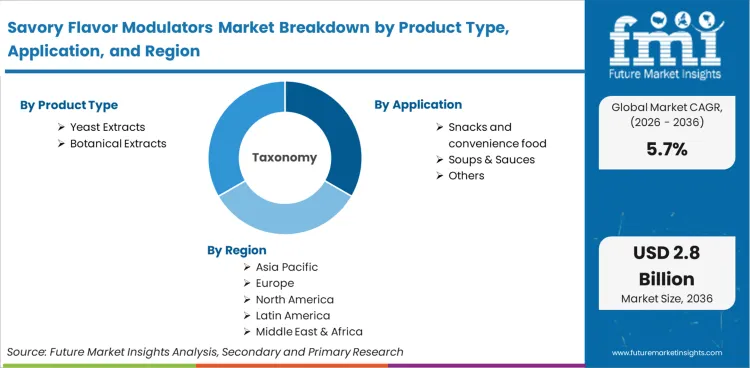
| Metric | Value |
|---|---|
| Quantitative Units | USD 1.6 billion to USD 2.8 billion, at a CAGR of 5.75% |
| Market Definition | Specialized ingredients that manipulate taste receptor perception to enhance umami and saltiness or mask off-notes without functioning as primary flavoring agents. |
| Product Type Segmentation | Yeast Extracts, Botanical Extracts, Amino Acids, Artificial Modulators |
| Application Segmentation | Snacks & Convenience Foods, Soups & Sauces, Meat & Poultry Products, Plant-Based Alternatives |
| Form Segmentation | Powder, Liquid |
| Regions Covered | North America, Europe, Asia Pacific, Latin America, Middle East & Africa |
| Countries Covered | United States, China, Germany, India, United Kingdom, Japan, Brazil, and 40 plus countries |
| Key Companies Profiled | Kerry Group, Symrise AG, Givaudan, Firmenich SA, Sensient Technologies, International Flavors & Fragrances (IFF), Ajinomoto Co. Inc., DSM-Firmenich |
| Forecast Period | 2026 to 2036 |
| Approach | Primary research integrates interviews with FMCG procurement directors and flavor formulation leads. Desk research aggregates regional sodium guidelines and clean-label databases. The baseline anchors to observable MSG displacement volumes across industrial processing lines. |
Source: Future Market Insights (FMI) analysis, based on proprietary forecasting model and primary research
Savory Flavor Modulators Market Analysis by Segments
Product Type:
- Yeast Extracts
- Botanical Extracts
- Amino Acids
- Artificial Modulators
Application:
- Snacks & Convenience Foods
- Soups & Sauces
- Meat & Poultry Products
- Plant-Based Alternatives
Form:
- Powder
- Liquid
Region:
- North America
- United States
- Canada
- Europe
- Germany
- United Kingdom
- France
- Italy
- Asia Pacific
- China
- India
- Japan
- ASEAN
- Latin America
- Brazil
- Mexico
- Middle East & Africa
- GCC
- South Africa
Bibliography
- Hossain, M. J., Rahman, M. S., & Islam, M. T. (2024, May). Umami characteristics and taste improvement mechanisms in food systems. Food Science & Nutrition.
- Cai, L., Sun, B., & Zhao, M. (2024, October). Molecular simulation screening and sensory evaluation of novel peptides with umami and kokumi taste-enhancing effects. Food Chemistry.
- Cai, L., Sun, B., & Zhao, M. (2024, October). Enzymatic synthesis and sensory evaluation of kokumi-active peptides for flavor enhancement. Food Chemistry.
- Institute of Food Technologists. (2024, November). Flavor modulation strategies for sodium reduction and taste optimization in food formulations. IFT Scientific Publications.
- Xu, C., Zhao, Y., & Wang, L. (2025, August). Functional umami peptides: Taste perception mechanisms and applications in food formulation. Food Quality and Preference.
- AOCS (American Oil Chemists’ Society). (2025, April). Decoding the taste of peptides: Structure, receptor interactions, and flavor enhancement. Journal of Surfactants and Detergents / Specialty Food Publications.
- European Food Safety Authority. (2024, May). Evaluation of flavoring substances and taste-modifying compounds used in foods. EFSA Journal.
This bibliography is provided for reader reference. The full FMI report contains the complete reference list with primary source documentation.
This Report Addresses
- Market intelligence to support strategic decision making across Yeast Extracts, Botanical Extracts, and Artificial Modulators
- Market size estimation and 10-year revenue forecasts from 2026 to 2036, supported by observable MSG displacement tracking
- Growth opportunity mapping across Application and Form dimensions with emphasis on the integration of predictive sensory modeling
- Segment and regional revenue forecasts covering Snacks & Convenience Foods across rigid European Nutri-Score compliance environments
- Competition strategy assessment including global supply chain reliability, fermentation IP, and raw material vertical integration
- Product development tracking including clean-label botanical extraction, precision fermentation peptides, and advanced kokumi compounds
- Market access analysis covering North American retail procurement algorithms and European front-of-pack nutritional scoring frameworks
- Market report delivery in PDF, Excel, PPT, and interactive dashboard formats for executive strategy, FMCG formulation planning, and operational benchmarking use
Frequently Asked Questions
How large is the savory flavor modulators market in 2026?What prevents brands from maintaining dual-quality formulations across North America?
The valuation sits at USD 1.6 billion. This figure indicates that food manufacturers have moved beyond simple pilot testing and are actively executing mass-scale recipe overhauls across their core legacy portfolios.
What will it be valued at by 2036?
It is projected to reach USD 2.8 billion. This trajectory signals the transition of modulators from reactive compliance solutions to foundational baseline ingredients integrated into the primary base of processed foods.
What CAGR is projected?
A 5.75% compound annual growth rate is forecast. This rate reflects the deliberate, highly regulated pace at which global retail networks enforce new sodium benchmarks, dictating the capital expenditure cycles of major food brands.
Which product type segment leads?
Yeast extracts dominate the material landscape. Procurement directors select them because they survive the initial clean-label screening algorithms of major retailers while delivering the complex mid-palate rounding that basic sodium reduction removes.
Which application segment leads?
Snacks & convenience foods command the application share. Extruded carbohydrate bases offer zero inherent masking, requiring formulators to deploy highly intense, thermally stable topical modulators to prevent consumer rejection of flattened flavor profiles.
Which Form segment leads?
Powder formats lead industrial utilization. Manufacturing engineers rely on dry blending because it utilizes existing commercial seasoning infrastructure, avoiding the hidden logistical costs and sanitation bottlenecks associated with liquid injection retrofits.
What drives rapid growth?
Strict nutritional profiling algorithms deployed by top retail chains act as the primary catalyst. These systems automatically penalize or delist high-sodium products with artificial enhancers, forcing brands to adopt advanced modulators simply to maintain their current shelf placement.
What is the primary restraint?
The exact cost-in-use disparity between engineered botanical extracts and legacy MSG remains a severe friction point. Plant managers struggle to justify the ingredient premium of natural modulators when producing low-margin convenience items.
Which country grows fastest?
India outpaces other regions structurally because its massive unorganized snack sector is rapidly formalizing. Unlike mature markets executing recipe tweaks, India is building industrial-scale FMCG networks that require immediate, standardized flavor consistency across vast distribution footprints.
How does European regulation impact ingredient sourcing?
The European enforcement of Nutri-Score and similar frameworks creates a zero-tolerance environment for synthetic-sounding chemical names. Procurement directors are compelled to buy yeast or botanical derivatives, regardless of the cost penalty, treating them as mandatory compliance expenditures rather than optional upgrades.
Why is predictive sensory modeling critical for this market?
Predictive modeling allows flavor houses to map how a kokumi molecule behaves in an extruded matrix before running physical trials. This capability shortens the qualification cycle for FMCG brands, accelerating the time-to-market for reformulated products.
How do mid-tier flavor houses compete against apex incumbents?
Mid-tier formulators generally lack the massive sensory laboratories required for foundational molecule discovery. They compete by specializing in highly localized, regional taste profiles, bridging the gap between global ingredient platforms and specific local spice preferences.
Why are modulators critical for plant-based meat alternatives?
Procurement teams in the alternative protein space buy modulators primarily for their masking properties, not just sodium reduction. If a modulator fails to round out the mid-palate void and hide the astringency typical of extruded soy, it cannot be used.
How does thermal processing affect modulator selection in snacks?
Modulators applied before high-heat extrusion often degrade and lose potency under severe shear forces. Packaging and formulation engineers must shift to topical powder applications to ensure the flavor profile survives industrial processing.
What prevents brands from maintaining dual-quality formulations across North America?
Cross-border supply chain integration between the US, Canada, and Mexico makes running separate recipes highly inefficient. Brands adopt unified, stricter continental labeling standards to streamline production, pushing modulator adoption universally across the bloc.
Why do Japanese formulators focus on kokumi rather than basic umami?
The Japanese convenience food sector is hyper-segmented and mature. Formulators execute micro-differentiations in premium products by utilizing kokumi modulators to manipulate the perception of "thickness" and mouthfeel, moving beyond simple salt reduction.
How does the shift from informal to formal retail in Asia Pacific drive volume?
As populations move to packaged, shelf-stable foods, the requirement for robust flavor stability over extended, fluctuating ambient temperature supply chains becomes critical. Modulators must deliver high-impact umami that survives these distribution realities.
What advantage does vertical integration provide to major market players?
Companies integrated into raw material fermentation and extraction are insulated from severe agricultural price volatility. They can offer FMCG procurement directors consistent, scalable pricing that formulators relying on outsourced botanicals cannot match.
How do large food conglomerates avoid vendor lock-in?
FMCG procurement teams write product briefs requiring modulators based on universally accessible natural substrates. This prevents single-source dependency on highly proprietary synthetic molecules controlled by a single flavor house.
Why are liquid modulators largely avoided in seasoning production?
Liquid formats introduce water weight logistics and require complex sanitation protocols for bulk storage. Plant managers attempting retrofits face severe cross-contamination risks and elevated line changeover times compared to dry powder blending.
How does the UK's retail environment dictate formulation?
The top supermarket chains in the UK mandate private-label portfolios that effectively ban certain artificial enhancers. Suppliers must execute rapid recipe overhauls using natural modulators capable of high-volume, continuous production without batch variance.
What role does precision fermentation play moving toward 2036?
Biotechnological advancements allow the production of complex umami peptides independent of agricultural supply chains. This technology offers clean-label parity without traditional botanical cost premiums, restructuring the economics of flavor modulation.
Preview the report firsthand - request a free sample
Get SampleGet the brochure for pricing and purchase details.
Get PDFTable of Content
- Executive Summary
- Global Market Outlook
- Demand-side Trends
- Supply-side Trends
- Technology Roadmap Analysis
- Analysis and Recommendations
- Market Overview
- Market Coverage / Taxonomy
- Market Definition / Scope / Limitations
- Research Methodology
- Chapter Orientation
- Analytical Lens and Working Hypotheses
- Market Structure, Signals, and Trend Drivers
- Benchmarking and Cross-market Comparability
- Market Sizing, Forecasting, and Opportunity Mapping
- Research Design and Evidence Framework
- Desk Research Programme (Secondary Evidence)
- Company Annual and Sustainability Reports
- Peer-reviewed Journals and Academic Literature
- Corporate Websites, Product Literature, and Technical Notes
- Earnings Decks and Investor Briefings
- Statutory Filings and Regulatory Disclosures
- Technical White Papers and Standards Notes
- Trade Journals, Industry Magazines, and Analyst Briefs
- Conference Proceedings, Webinars, and Seminar Materials
- Government Statistics Portals and Public Data Releases
- Press Releases and Reputable Media Coverage
- Specialist Newsletters and Curated Briefings
- Sector Databases and Reference Repositories
- FMI Internal Proprietary Databases and Historical Market Datasets
- Subscription Datasets and Paid Sources
- Social Channels, Communities, and Digital Listening Inputs
- Additional Desk Sources
- Expert Input and Fieldwork (Primary Evidence)
- Primary Modes
- Qualitative Interviews and Expert Elicitation
- Quantitative Surveys and Structured Data Capture
- Blended Approach
- Why Primary Evidence is Used
- Field Techniques
- Interviews
- Surveys
- Focus Groups
- Observational and In-context Research
- Social and Community Interactions
- Stakeholder Universe Engaged
- C-suite Leaders
- Board Members
- Presidents and Vice Presidents
- R&D and Innovation Heads
- Technical Specialists
- Domain Subject-matter Experts
- Scientists
- Physicians and Other Healthcare Professionals
- Governance, Ethics, and Data Stewardship
- Research Ethics
- Data Integrity and Handling
- Primary Modes
- Tooling, Models, and Reference Databases
- Desk Research Programme (Secondary Evidence)
- Data Engineering and Model Build
- Data Acquisition and Ingestion
- Cleaning, Normalisation, and Verification
- Synthesis, Triangulation, and Analysis
- Quality Assurance and Audit Trail
- Market Background
- Market Dynamics
- Drivers
- Restraints
- Opportunity
- Trends
- Scenario Forecast
- Demand in Optimistic Scenario
- Demand in Likely Scenario
- Demand in Conservative Scenario
- Opportunity Map Analysis
- Product Life Cycle Analysis
- Supply Chain Analysis
- Investment Feasibility Matrix
- Value Chain Analysis
- PESTLE and Porter’s Analysis
- Regulatory Landscape
- Regional Parent Market Outlook
- Production and Consumption Statistics
- Import and Export Statistics
- Market Dynamics
- Global Market Analysis 2021 to 2025 and Forecast, 2026 to 2036
- Historical Market Size Value (USD Million) Analysis, 2021 to 2025
- Current and Future Market Size Value (USD Million) Projections, 2026 to 2036
- Y-o-Y Growth Trend Analysis
- Absolute $ Opportunity Analysis
- Global Market Pricing Analysis 2021 to 2025 and Forecast 2026 to 2036
- Global Market Analysis 2021 to 2025 and Forecast 2026 to 2036, By Product Type
- Introduction / Key Findings
- Historical Market Size Value (USD Million) Analysis By Product Type , 2021 to 2025
- Current and Future Market Size Value (USD Million) Analysis and Forecast By Product Type , 2026 to 2036
- Yeast Extracts
- Botanical Extracts
- Yeast Extracts
- Y-o-Y Growth Trend Analysis By Product Type , 2021 to 2025
- Absolute $ Opportunity Analysis By Product Type , 2026 to 2036
- Global Market Analysis 2021 to 2025 and Forecast 2026 to 2036, By Application
- Introduction / Key Findings
- Historical Market Size Value (USD Million) Analysis By Application, 2021 to 2025
- Current and Future Market Size Value (USD Million) Analysis and Forecast By Application, 2026 to 2036
- Snacks and convenience food
- Soups & Sauces
- Others
- Snacks and convenience food
- Y-o-Y Growth Trend Analysis By Application, 2021 to 2025
- Absolute $ Opportunity Analysis By Application, 2026 to 2036
- Global Market Analysis 2021 to 2025 and Forecast 2026 to 2036, By Form
- Introduction / Key Findings
- Historical Market Size Value (USD Million) Analysis By Form, 2021 to 2025
- Current and Future Market Size Value (USD Million) Analysis and Forecast By Form, 2026 to 2036
- Powder
- Liquid
- Powder
- Y-o-Y Growth Trend Analysis By Form, 2021 to 2025
- Absolute $ Opportunity Analysis By Form, 2026 to 2036
- Global Market Analysis 2021 to 2025 and Forecast 2026 to 2036, By Region
- Introduction
- Historical Market Size Value (USD Million) Analysis By Region, 2021 to 2025
- Current Market Size Value (USD Million) Analysis and Forecast By Region, 2026 to 2036
- North America
- Latin America
- Western Europe
- Eastern Europe
- East Asia
- South Asia and Pacific
- Middle East & Africa
- Market Attractiveness Analysis By Region
- North America Market Analysis 2021 to 2025 and Forecast 2026 to 2036, By Country
- Historical Market Size Value (USD Million) Trend Analysis By Market Taxonomy, 2021 to 2025
- Market Size Value (USD Million) Forecast By Market Taxonomy, 2026 to 2036
- By Country
- USA
- Canada
- Mexico
- By Product Type
- By Application
- By Form
- By Country
- Market Attractiveness Analysis
- By Country
- By Product Type
- By Application
- By Form
- Key Takeaways
- Latin America Market Analysis 2021 to 2025 and Forecast 2026 to 2036, By Country
- Historical Market Size Value (USD Million) Trend Analysis By Market Taxonomy, 2021 to 2025
- Market Size Value (USD Million) Forecast By Market Taxonomy, 2026 to 2036
- By Country
- Brazil
- Chile
- Rest of Latin America
- By Product Type
- By Application
- By Form
- By Country
- Market Attractiveness Analysis
- By Country
- By Product Type
- By Application
- By Form
- Key Takeaways
- Western Europe Market Analysis 2021 to 2025 and Forecast 2026 to 2036, By Country
- Historical Market Size Value (USD Million) Trend Analysis By Market Taxonomy, 2021 to 2025
- Market Size Value (USD Million) Forecast By Market Taxonomy, 2026 to 2036
- By Country
- Germany
- UK
- Italy
- Spain
- France
- Nordic
- BENELUX
- Rest of Western Europe
- By Product Type
- By Application
- By Form
- By Country
- Market Attractiveness Analysis
- By Country
- By Product Type
- By Application
- By Form
- Key Takeaways
- Eastern Europe Market Analysis 2021 to 2025 and Forecast 2026 to 2036, By Country
- Historical Market Size Value (USD Million) Trend Analysis By Market Taxonomy, 2021 to 2025
- Market Size Value (USD Million) Forecast By Market Taxonomy, 2026 to 2036
- By Country
- Russia
- Poland
- Hungary
- Balkan & Baltic
- Rest of Eastern Europe
- By Product Type
- By Application
- By Form
- By Country
- Market Attractiveness Analysis
- By Country
- By Product Type
- By Application
- By Form
- Key Takeaways
- East Asia Market Analysis 2021 to 2025 and Forecast 2026 to 2036, By Country
- Historical Market Size Value (USD Million) Trend Analysis By Market Taxonomy, 2021 to 2025
- Market Size Value (USD Million) Forecast By Market Taxonomy, 2026 to 2036
- By Country
- China
- Japan
- South Korea
- By Product Type
- By Application
- By Form
- By Country
- Market Attractiveness Analysis
- By Country
- By Product Type
- By Application
- By Form
- Key Takeaways
- South Asia and Pacific Market Analysis 2021 to 2025 and Forecast 2026 to 2036, By Country
- Historical Market Size Value (USD Million) Trend Analysis By Market Taxonomy, 2021 to 2025
- Market Size Value (USD Million) Forecast By Market Taxonomy, 2026 to 2036
- By Country
- India
- ASEAN
- Australia & New Zealand
- Rest of South Asia and Pacific
- By Product Type
- By Application
- By Form
- By Country
- Market Attractiveness Analysis
- By Country
- By Product Type
- By Application
- By Form
- Key Takeaways
- Middle East & Africa Market Analysis 2021 to 2025 and Forecast 2026 to 2036, By Country
- Historical Market Size Value (USD Million) Trend Analysis By Market Taxonomy, 2021 to 2025
- Market Size Value (USD Million) Forecast By Market Taxonomy, 2026 to 2036
- By Country
- Kingdom of Saudi Arabia
- Other GCC Countries
- Turkiye
- South Africa
- Other African Union
- Rest of Middle East & Africa
- By Product Type
- By Application
- By Form
- By Country
- Market Attractiveness Analysis
- By Country
- By Product Type
- By Application
- By Form
- Key Takeaways
- Key Countries Market Analysis
- USA
- Pricing Analysis
- Market Share Analysis, 2025
- By Product Type
- By Application
- By Form
- Canada
- Pricing Analysis
- Market Share Analysis, 2025
- By Product Type
- By Application
- By Form
- Mexico
- Pricing Analysis
- Market Share Analysis, 2025
- By Product Type
- By Application
- By Form
- Brazil
- Pricing Analysis
- Market Share Analysis, 2025
- By Product Type
- By Application
- By Form
- Chile
- Pricing Analysis
- Market Share Analysis, 2025
- By Product Type
- By Application
- By Form
- Germany
- Pricing Analysis
- Market Share Analysis, 2025
- By Product Type
- By Application
- By Form
- UK
- Pricing Analysis
- Market Share Analysis, 2025
- By Product Type
- By Application
- By Form
- Italy
- Pricing Analysis
- Market Share Analysis, 2025
- By Product Type
- By Application
- By Form
- Spain
- Pricing Analysis
- Market Share Analysis, 2025
- By Product Type
- By Application
- By Form
- France
- Pricing Analysis
- Market Share Analysis, 2025
- By Product Type
- By Application
- By Form
- India
- Pricing Analysis
- Market Share Analysis, 2025
- By Product Type
- By Application
- By Form
- ASEAN
- Pricing Analysis
- Market Share Analysis, 2025
- By Product Type
- By Application
- By Form
- Australia & New Zealand
- Pricing Analysis
- Market Share Analysis, 2025
- By Product Type
- By Application
- By Form
- China
- Pricing Analysis
- Market Share Analysis, 2025
- By Product Type
- By Application
- By Form
- Japan
- Pricing Analysis
- Market Share Analysis, 2025
- By Product Type
- By Application
- By Form
- South Korea
- Pricing Analysis
- Market Share Analysis, 2025
- By Product Type
- By Application
- By Form
- Russia
- Pricing Analysis
- Market Share Analysis, 2025
- By Product Type
- By Application
- By Form
- Poland
- Pricing Analysis
- Market Share Analysis, 2025
- By Product Type
- By Application
- By Form
- Hungary
- Pricing Analysis
- Market Share Analysis, 2025
- By Product Type
- By Application
- By Form
- Kingdom of Saudi Arabia
- Pricing Analysis
- Market Share Analysis, 2025
- By Product Type
- By Application
- By Form
- Turkiye
- Pricing Analysis
- Market Share Analysis, 2025
- By Product Type
- By Application
- By Form
- South Africa
- Pricing Analysis
- Market Share Analysis, 2025
- By Product Type
- By Application
- By Form
- USA
- Market Structure Analysis
- Competition Dashboard
- Competition Benchmarking
- Market Share Analysis of Top Players
- By Regional
- By Product Type
- By Application
- By Form
- Competition Analysis
- Competition Deep Dive
- Givaudan
- Overview
- Product Portfolio
- Profitability by Market Segments (Product/Age /Sales Channel/Region)
- Sales Footprint
- Strategy Overview
- Marketing Strategy
- Product Strategy
- Channel Strategy
- DSM-Firmenich
- International Flavors & Fragrances (IFF)
- Symrise AG
- Kerry Group plc
- Ajinomoto Co., Inc.
- Givaudan
- Competition Deep Dive
- Assumptions & Acronyms Used


