

- Industry Size (2026):
- USD 454.8 Mn
- Forecast (2036)
- USD 1057.1 Mn
- CAGR (2026 to 2036)
- 8.8%
Salt Perception Enhancing Flavor Modulators Market Forecast and Outlook 2026 to 2036
The salt perception enhancing flavor modulators market is valued at USD 454.8 million in 2026 and is forecasted to reach USD 1,057.1 million by 2036, reflecting a CAGR of 8.8%. Performance across the forecast period is shaped by how effectively these systems substitute the functional role of sodium rather than by the speed of sodium reduction initiatives alone. Salt contributes not only salinity but also flavor amplification, mouthfeel balance, and aroma release, making direct removal a high-risk reformulation step.
Value concentrates around modulators that deliver consistent sensory lift across processing conditions and shelf life, allowing manufacturers to reduce sodium without destabilizing established product profiles. Cost structures favor solutions that minimize reformulation cycles, reduce sensory panel iterations, and limit post-launch corrections, since taste failure directly impacts repeat purchase and brand equity.
Purchasing behavior remains conservative and technically driven. Food manufacturers prioritize flavor modulators with validated performance across multiple matrices, as switching costs rise sharply once reduced-sodium products scale into mass distribution. Procurement teams assess suppliers on sensory reliability, regulatory coverage, and documentation depth, rather than headline cost per kilogram. Clean-label constraints further narrow acceptable options, reinforcing dependence on vendors able to balance perception enhancement with ingredient transparency.
Margin concentration sits with platforms that integrate salt enhancement, bitterness control, and flavor rounding within a single system, lowering formulation complexity. Growth quality between 2026 and 2036 is determined by risk-managed reformulation strategies, disciplined buyer selection, and supplier capability to deliver repeatable salt perception outcomes under commercial manufacturing pressure, rather than aggressive sodium cuts or experimental flavor technologies.
Quick Stats for Salt Perception Enhancing Flavor Modulators Market
- Salt Perception Enhancing Flavor Modulators Market Value (2026): USD 454.8 million
- Salt Perception Enhancing Flavor Modulators Market Forecast Value (2036): USD 1,057.1 million
- Salt Perception Enhancing Flavor Modulators Market Forecast CAGR (2026–2036): 8.8%
- Leading Application Segment in Global Demand: Dairy
- Fastest-Growing Countries: China, France, USA, Germany
- Key Players in Global Demand: Givaudan, IFF, Kerry, DSM-Firmenich, Symrise, T. Hasegawa
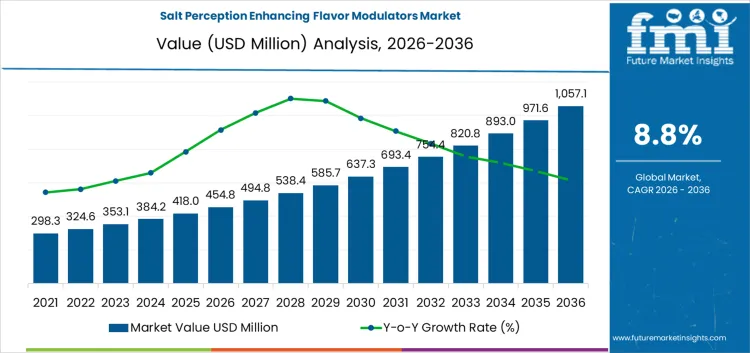
Salt Perception Enhancing Flavor Modulators Market Key Takeaways
| Metric | Value |
|---|---|
| Market Value (2026) | USD 454.8 million |
| Market Forecast Value (2036) | USD 1,057.1 million |
| Forecast CAGR (2026-2036) | 8.8% |
Why Is the Demand for Salt Perception Enhancing Flavor Modulators Market Growing?
Demand for salt perception enhancing flavor modulators is growing globally due to increasing consumer and regulatory focus on sodium reduction without compromising taste quality in foods and beverages. Excessive sodium intake is linked to health risks such as hypertension and cardiovascular disease, prompting public health campaigns and government guidelines in multiple regions that encourage reformulation to lower salt levels. Food manufacturers adopt flavor modulators that enhance the perception of saltiness so products can achieve desirable taste profiles with reduced actual sodium content. These modulators work by interacting with taste receptors and flavor networks to amplify salty perception and maintain consumer satisfaction in snacks, soups, sauces, processed meats, and convenience foods.
Regulatory frameworks emphasize sodium disclosure and voluntary reduction targets, which strengthens procurement of functional flavor solutions that support compliance while preserving product acceptability. Advances in formulation science improve stability, compatibility with diverse food matrices, and minimal impact on other sensory attributes. Growth in health oriented and clean label food segments reinforces adoption of modulators derived from natural or recognizable sources that align with safety and transparency requirements. Retail expansion through mass market, specialty, and online channels increases accessibility to reduced sodium products formulated with salt perception enhancers.
How Is the Global Salt Perception Enhancing Flavor Modulators Market Structured?
The global salt perception enhancing flavor modulators market addresses a critical formulation challenge created by sodium reduction mandates and public health pressure to lower dietary salt intake. Direct salt reduction often results in flat, unbalanced flavor profiles and reduced palatability, particularly in processed foods where sodium contributes to taste intensity, mouthfeel, and flavor release. Salt perception enhancers allow formulators to reduce actual sodium levels while maintaining or amplifying perceived saltiness through sensory modulation rather than mineral replacement alone. Adoption is driven by regulatory sodium targets, clean-label reformulation strategies, and the need to preserve consumer acceptance during sodium reduction initiatives across mass-market food categories.
Which Application Segment Represents the Largest Share of Global Demand?
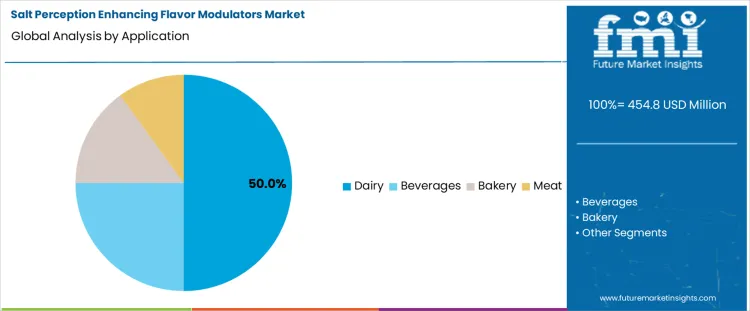
Dairy applications account for the largest share at 50.0%, reflecting extensive sodium reduction efforts in cheese, processed dairy foods, savory yogurts, spreads, and dairy-based sauces. In these products, salt plays a structural and flavor-balancing role, influencing protein interactions, fermentation behavior, and overall taste delivery. Beverages represent 25.0% of global demand, primarily driven by savory beverages, electrolyte drinks, functional broths, and reduced-sodium plant-based formulations where salt perception enhancers help maintain taste clarity without excessive mineral content. Bakery applications hold a 15.0% share, as sodium reduction impacts dough handling, yeast activity, and flavor development in breads and baked snacks. Meat applications account for 10.0%, reflecting controlled use in processed meats, where salt reduction must be carefully balanced against preservation, texture, and flavor masking requirements.
Key Takeaways:
- Dairy leads due to high flavor sensitivity to sodium reduction
- Beverages rely on modulators to avoid mineral off-notes
- Bakery and meat show targeted but essential adoption
Which Ingredient Type Is Most Widely Used for Salt Perception Enhancement Globally?
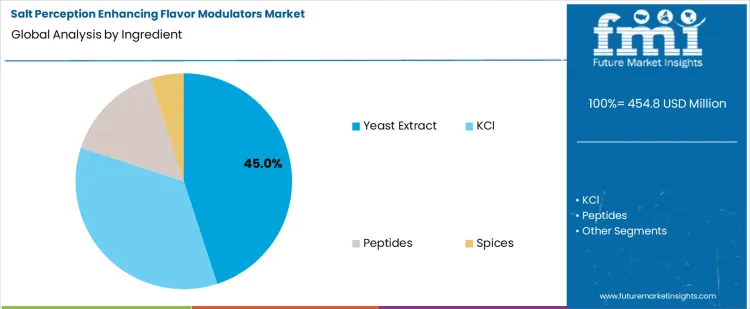
Yeast extract-based modulators dominate with a 45.0% share, supported by their strong umami contribution, clean-label positioning, and ability to enhance savory depth while boosting perceived saltiness. Yeast extracts interact synergistically with existing flavor systems, making them highly effective in complex formulations such as dairy and meat products. Potassium chloride (KCl) follows at 35.0%, widely used as a direct sodium replacement, although its adoption is often paired with masking agents to address bitterness and metallic notes. Peptide-based modulators account for 15.0%, valued for their targeted taste receptor interaction and ability to enhance salt perception at low inclusion levels. Spices represent 5.0%, mainly used as complementary flavor builders rather than primary salt perception enhancers.
Key Takeaways:
- Yeast extracts lead due to umami-driven salt enhancement
- KCl remains important but requires taste masking
- Peptides offer precision modulation in advanced formulations
Which Distribution Channel Controls the Majority of Global Supply?
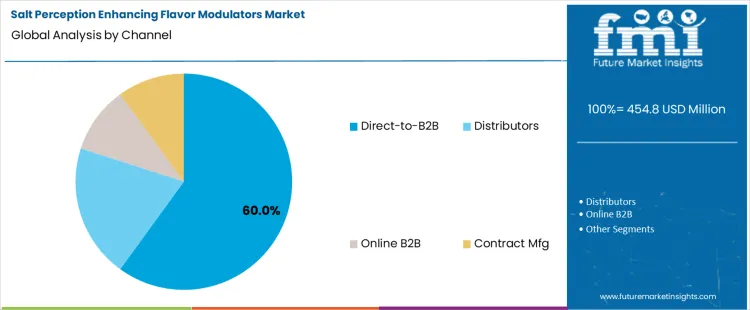
Direct-to-B2B channels account for 60.0% of global distribution, reflecting the formulation-specific nature of salt perception enhancement. Food manufacturers typically require customized solutions tailored to product matrices, processing conditions, and sodium reduction targets, favoring direct technical collaboration with ingredient suppliers. Distributors hold a 20.0% share, serving standardized flavor modulator systems for regional producers and mid-scale brands. Online B2B platforms represent 10.0%, supporting innovation-stage brands, pilot reformulations, and rapid ingredient sourcing. Contract manufacturing accounts for the remaining 10.0%, where salt perception enhancers are incorporated into proprietary seasoning blends, functional premixes, or turnkey flavor systems supplied under private-label or co-development agreements.
Key Takeaways:
- Direct B2B dominates due to customization and sensory validation needs
- Distributors enable scale and regional accessibility
- Contract manufacturing supports integrated flavor solutions
What are the Key Dynamics in the Salt Perception Enhancing Flavor Modulators Market?
Global demand rises as food and beverage manufacturers adopt salt perception enhancing flavor modulators to reduce sodium content while maintaining salty taste and consumer acceptability. These modulators intensify salt perception through taste receptor interaction, flavor synergy, or taste profile masking, supporting formulation of lower-sodium products across snacks, sauces, processed meats, ready meals, and prepared foods. Adoption aligns with public health campaigns targeting dietary sodium reduction, regulatory encouragement of nutrient reformulation, and growing consumer health awareness in North America, Europe, Asia-Pacific, and Latin America.
How do public health goals and consumer taste expectations shape adoption?
Consumers increasingly seek healthier products with reduced sodium due to links between high salt intake and hypertension and cardiovascular risk factors. Food developers integrate flavor modulating systems that enhance salt perception at lower actual sodium levels to deliver familiar taste profiles without compromising flavor satisfaction. Snack producers adjust seasoning blends to retain crisp, savory impact while meeting sodium targets. Sauce and condiment formulators employ modulators to balance mouthfeel, umami notes, and overall flavor intensity. Retailers emphasize products that achieve sodium reduction without sensory trade-off to meet shopper health preferences without diminishing repeat purchase likelihood. Performance criteria include consistency across production runs, stability during processing, and minimal off-notes or aftertastes.
How does formulation complexity, cost pressures, and regulatory frameworks influence market scalability?
Salt perception enhancers often require precise blending with native flavor profiles and other taste modulators, adding formulation complexity relative to straightforward sodium chloride adjustment. Ingredient cost premiums for advanced modulators influence product pricing strategies, particularly in cost-sensitive categories. Interactions with other taste-active components, such as sweeteners, acids, and bitter blockers, demand careful optimization to avoid unintended flavor imbalance. Regulatory frameworks governing additive approval, health claims, and labeling vary across markets, shaping compliance efforts for global distribution. Availability and sourcing variability for specialized modulators affect supply consistency and cost planning. Long-term market growth depends on continued innovation in effective, clean-taste enhancing systems and harmonized safety and labeling standards supporting transparent communication of sodium reduction benefits while meeting diverse regional regulatory requirements.
How Is Demand for Salt Perception Enhancing Flavor Modulators Evolving Globally?
Demand for salt perception enhancing flavor modulators is increasing globally due to sodium reduction targets, public health pressure, and manufacturer need to preserve taste intensity in reformulated foods. China leads with an 11.8% CAGR, supported by large-scale packaged food reformulation and national salt reduction initiatives. France follows at 11.2%, driven by regulatory guidance and culinary quality expectations. USA records a 10.9% CAGR, shaped by labeling scrutiny and sodium benchmarks across processed foods. Germany posts 10.7%, reflecting disciplined reformulation practices and strong consumer sensitivity to flavor integrity. Growth reflects rising adoption of flavor modulators that enhance perceived saltiness without increasing sodium content.
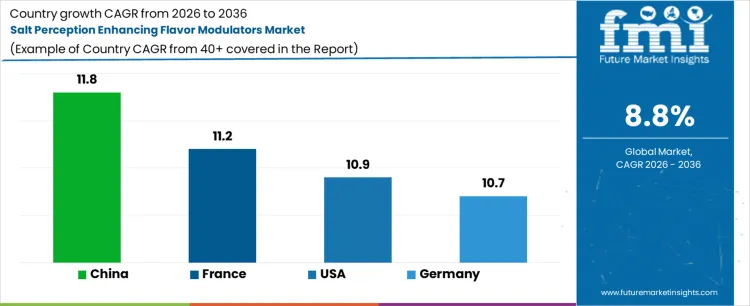
| Country | CAGR (%) |
|---|---|
| China | 11.8% |
| France | 11.2% |
| USA | 10.9% |
| Germany | 10.7% |
What is driving strong adoption of salt perception enhancers in China?
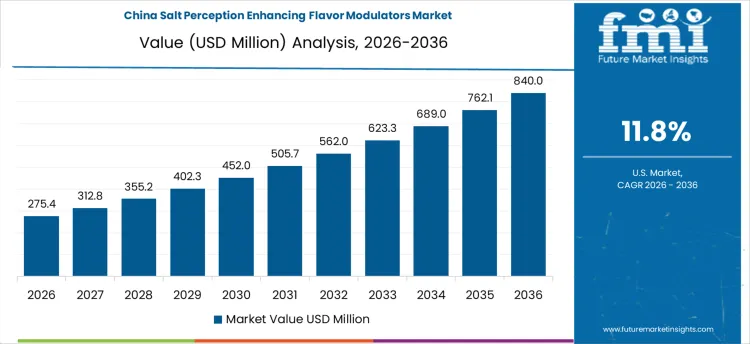
China demand is driven by widespread sodium reduction across packaged foods, sauces, and ready meals. CAGR of 11.8% reflects adoption of flavor modulators that maintain savory intensity while lowering salt inclusion rates. Large manufacturers reformulate extensive product portfolios under government-led salt reduction campaigns. High-volume production environments require stable and cost-effective flavor solutions. Sensory consistency remains critical for consumer retention. Domestic ingredient suppliers expand portfolios of yeast extracts, amino acid blends, and taste enhancers. Growth remains scale-driven and policy-aligned, supported by national nutrition objectives and mass-market reformulation activity.
- Government-led sodium reduction initiatives
- Large-scale reformulation of packaged foods
- Need for sensory consistency at reduced salt levels
- Expansion of domestic flavor ingredient capabilities
How is France sustaining growth in salt perception modulator adoption?
France demand reflects regulatory alignment with sodium reduction goals and strong culinary quality standards. CAGR of 11.2% is supported by use of flavor modulators in soups, sauces, cheeses, and prepared foods. Manufacturers prioritize maintaining balance and mouthfeel while reducing salt. Culinary heritage places high importance on flavor authenticity. Ingredient solutions focus on natural and fermentation-derived modulators. Technical formulation teams integrate sensory testing into reformulation workflows. Growth remains quality-driven and regulation-aligned, supported by consumer acceptance of gradual sodium reduction strategies.
- Regulatory guidance on sodium intake reduction
- Emphasis on flavor balance and authenticity
- Adoption in soups, sauces, and prepared foods
- Use of natural and fermentation-based modulators
What factors are shaping demand growth in the USA for salt perception enhancers?
USA demand is shaped by sodium labeling requirements, health advocacy, and reformulation across processed food categories. CAGR of 10.9% reflects increased use of flavor modulators in snacks, ready meals, and meat alternatives. Brands seek to meet sodium benchmarks without compromising taste. Consumer sensitivity to flavor loss influences formulation decisions. Approved flavor technologies provide scalable solutions. Ingredient suppliers offer application-specific modulators. Growth remains brand-led and compliance-focused, aligned with reformulation cycles and competitive positioning in reduced-sodium products.
- Sodium labeling and benchmark pressure
- Reformulation across snacks and prepared foods
- Consumer resistance to flavor degradation
- Availability of scalable flavor modulation systems
Why is Germany showing steady expansion in salt perception modulator usage?
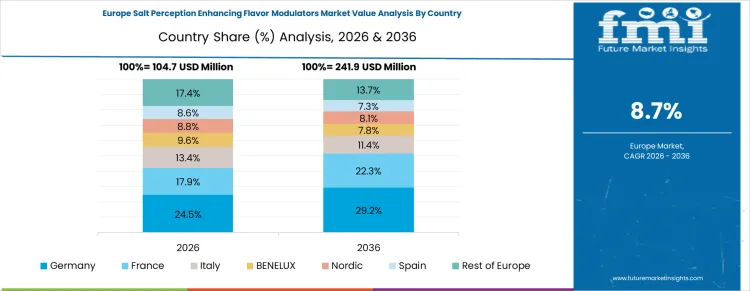
Germany demand reflects regulatory discipline, strong food quality standards, and consumer focus on taste reliability. CAGR of 10.7% is supported by adoption of salt perception enhancers in bakery, processed meats, and convenience foods. Manufacturers emphasize functional predictability and regulatory compliance. Gradual sodium reduction strategies reduce risk of consumer rejection. Ingredient selection prioritizes transparency and consistency. Domestic suppliers support tailored applications. Growth remains quality-focused and regulation-aligned, supported by structured reformulation programs and high trust in food standards.
- Strong regulatory and quality compliance culture
- Gradual sodium reduction implementation
- Adoption across bakery and processed foods
- Preference for predictable and transparent solutions
What is the competitive landscape for salt perception enhancing flavor modulators?
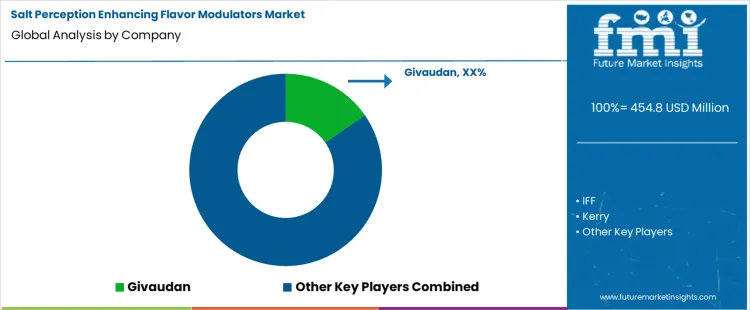
Demand for salt perception enhancing flavor modulators is driven by sodium reduction targets, public health guidelines, and reformulation pressure across processed foods. These modulators are used to maintain perceived saltiness and flavor balance in snacks, sauces, soups, meats, and dairy products while reducing actual sodium content. Buyers evaluate enhancement efficacy at different reduction levels, temporal flavor delivery, matrix compatibility, and stability under thermal and shelf-life conditions. Procurement teams prioritize suppliers with sensory science capabilities, regulatory compliance across regions, and application support enabling category-specific sodium reduction strategies. Trend in the global market reflects intensified reformulation timelines, expansion of front-of-pack labeling, and increased reliance on taste modulation rather than direct salt replacement.
Givaudan holds leading positioning through proprietary salt taste modulation technologies supported by advanced sensory research and application laboratories. IFF supports demand with flavor modulation platforms designed to rebalance taste perception in reduced-sodium formulations. Kerry contributes integrated taste systems combining salt enhancement with overall flavor optimization. DSM-Firmenich advances perception-based solutions linking flavor science with nutrition objectives across food categories. Symrise supplies salt modulation ingredients and flavor systems applied widely in savory and convenience foods. Competitive differentiation depends on perceptual accuracy, versatility across food matrices, sensory validation depth, and ability to deliver consistent sodium reduction outcomes at industrial scale.
Key Players in the Salt Perception Enhancing Flavor Modulators Market
- Givaudan
- IFF
- Kerry
- DSM-Firmenich
- Symrise
- T. Hasegawa
Scope of the Report
| Items | Values |
|---|---|
| Quantitative Units | USD million |
| Application | Dairy; Beverages; Bakery; Meat |
| Ingredient | Yeast Extract; KCl; Peptides; Spices |
| Channel | Direct-to-B2B; Distributors; Online B2B; Contract Mfg |
| Regions Covered | Asia Pacific, Europe, North America, Latin America, Middle East & Africa |
| Countries Covered | China, France, USA, Germany, and 40+ countries |
| Key Companies Profiled | Givaudan; IFF; Kerry; DSM-Firmenich; Symrise; T. Hasegawa |
| Additional Attributes | Dollar sales by application and ingredient; adoption trends for salt perception enhancers supporting sodium reduction strategies; sensory amplification efficiency, taste masking, and temporal flavor release performance metrics; compatibility with dairy, beverage, bakery, and meat matrices under thermal and shear processing; interactions with KCl, yeast extracts, and peptide systems; regulatory compliance, labeling considerations, and clean-label standards influencing salt perception modulator selection. |
Salt Perception Enhancing Flavor Modulators Market by Segment
Application:
- Dairy
- Beverages
- Bakery
- Meat
Ingredient:
- Yeast Extract
- KCl
- Peptides
- Spices
Channel:
- Direct-to-B2B
- Distributors
- Online B2B
- Contract Mfg
Region:
- Asia Pacific
- China
- Japan
- South Korea
- India
- Australia & New Zealand
- ASEAN
- Rest of Asia Pacific
- Europe
- Germany
- United Kingdom
- France
- Italy
- Spain
- Nordic
- BENELUX
- Rest of Europe
- North America
- United States
- Canada
- Mexico
- Latin America
- Brazil
- Chile
- Rest of Latin America
- Middle East & Africa
- Kingdom of Saudi Arabia
- Other GCC Countries
- Turkey
- South Africa
- Other African Union
- Rest of Middle East & Africa
Frequently Asked Questions
How big is the salt perception enhancing flavor modulators market in 2026?
The global salt perception enhancing flavor modulators market is estimated to be valued at USD 454.8 million in 2026.
What will be the size of salt perception enhancing flavor modulators market in 2036?
The market size for the salt perception enhancing flavor modulators market is projected to reach USD 1,057.1 million by 2036.
How much will be the salt perception enhancing flavor modulators market growth between 2026 and 2036?
The salt perception enhancing flavor modulators market is expected to grow at a 8.8% CAGR between 2026 and 2036.
What are the key application types in the salt perception enhancing flavor modulators market?
The key application types in salt perception enhancing flavor modulators market are dairy, beverages, bakery and meat.
Which ingredient segment will contribute significant share in the salt perception enhancing flavor modulators market in 2026?
In terms of ingredient, yeast extract segment to command 45.0% share in the salt perception enhancing flavor modulators market in 2026.
Preview the report firsthand - request a free sample
Get SampleGet the brochure for pricing and purchase details.
Get PDFTable of Content
- Executive Summary
- Global Market Outlook
- Demand-side Trends
- Supply-side Trends
- Technology Roadmap Analysis
- Analysis and Recommendations
- Market Overview
- Market Coverage / Taxonomy
- Market Definition / Scope / Limitations
- Market Background
- Market Dynamics
- Drivers
- Restraints
- Opportunity
- Trends
- Scenario Forecast
- Demand in Optimistic Scenario
- Demand in Likely Scenario
- Demand in Conservative Scenario
- Opportunity Map Analysis
- Product Life Cycle Analysis
- Supply Chain Analysis
- Investment Feasibility Matrix
- Value Chain Analysis
- PESTLE and Porter’s Analysis
- Regulatory Landscape
- Regional Parent Market Outlook
- Production and Consumption Statistics
- Import and Export Statistics
- Market Dynamics
- Global Market Analysis 2021 to 2025 and Forecast, 2026 to 2036
- Historical Market Size Value (USD Million) Analysis, 2021 to 2025
- Current and Future Market Size Value (USD Million) Projections, 2026 to 2036
- Y-o-Y Growth Trend Analysis
- Absolute $ Opportunity Analysis
- Global Market Pricing Analysis 2021 to 2025 and Forecast 2026 to 2036
- Global Market Analysis 2021 to 2025 and Forecast 2026 to 2036, By Application
- Introduction / Key Findings
- Historical Market Size Value (USD Million) Analysis By Application , 2021 to 2025
- Current and Future Market Size Value (USD Million) Analysis and Forecast By Application , 2026 to 2036
- Dairy
- Beverages
- Bakery
- Meat
- Dairy
- Y-o-Y Growth Trend Analysis By Application , 2021 to 2025
- Absolute $ Opportunity Analysis By Application , 2026 to 2036
- Global Market Analysis 2021 to 2025 and Forecast 2026 to 2036, By Ingredient
- Introduction / Key Findings
- Historical Market Size Value (USD Million) Analysis By Ingredient, 2021 to 2025
- Current and Future Market Size Value (USD Million) Analysis and Forecast By Ingredient, 2026 to 2036
- Yeast Extract
- KCl
- Peptides
- Spices
- Yeast Extract
- Y-o-Y Growth Trend Analysis By Ingredient, 2021 to 2025
- Absolute $ Opportunity Analysis By Ingredient, 2026 to 2036
- Global Market Analysis 2021 to 2025 and Forecast 2026 to 2036, By Channel
- Introduction / Key Findings
- Historical Market Size Value (USD Million) Analysis By Channel, 2021 to 2025
- Current and Future Market Size Value (USD Million) Analysis and Forecast By Channel, 2026 to 2036
- Direct-to-B2B
- Distributors
- Online B2B
- Contract Mfg
- Direct-to-B2B
- Y-o-Y Growth Trend Analysis By Channel, 2021 to 2025
- Absolute $ Opportunity Analysis By Channel, 2026 to 2036
- Global Market Analysis 2021 to 2025 and Forecast 2026 to 2036, By Region
- Introduction
- Historical Market Size Value (USD Million) Analysis By Region, 2021 to 2025
- Current Market Size Value (USD Million) Analysis and Forecast By Region, 2026 to 2036
- North America
- Latin America
- Western Europe
- Eastern Europe
- East Asia
- South Asia and Pacific
- Middle East & Africa
- Market Attractiveness Analysis By Region
- North America Market Analysis 2021 to 2025 and Forecast 2026 to 2036, By Country
- Historical Market Size Value (USD Million) Trend Analysis By Market Taxonomy, 2021 to 2025
- Market Size Value (USD Million) Forecast By Market Taxonomy, 2026 to 2036
- By Country
- USA
- Canada
- Mexico
- By Application
- By Ingredient
- By Channel
- By Country
- Market Attractiveness Analysis
- By Country
- By Application
- By Ingredient
- By Channel
- Key Takeaways
- Latin America Market Analysis 2021 to 2025 and Forecast 2026 to 2036, By Country
- Historical Market Size Value (USD Million) Trend Analysis By Market Taxonomy, 2021 to 2025
- Market Size Value (USD Million) Forecast By Market Taxonomy, 2026 to 2036
- By Country
- Brazil
- Chile
- Rest of Latin America
- By Application
- By Ingredient
- By Channel
- By Country
- Market Attractiveness Analysis
- By Country
- By Application
- By Ingredient
- By Channel
- Key Takeaways
- Western Europe Market Analysis 2021 to 2025 and Forecast 2026 to 2036, By Country
- Historical Market Size Value (USD Million) Trend Analysis By Market Taxonomy, 2021 to 2025
- Market Size Value (USD Million) Forecast By Market Taxonomy, 2026 to 2036
- By Country
- Germany
- UK
- Italy
- Spain
- France
- Nordic
- BENELUX
- Rest of Western Europe
- By Application
- By Ingredient
- By Channel
- By Country
- Market Attractiveness Analysis
- By Country
- By Application
- By Ingredient
- By Channel
- Key Takeaways
- Eastern Europe Market Analysis 2021 to 2025 and Forecast 2026 to 2036, By Country
- Historical Market Size Value (USD Million) Trend Analysis By Market Taxonomy, 2021 to 2025
- Market Size Value (USD Million) Forecast By Market Taxonomy, 2026 to 2036
- By Country
- Russia
- Poland
- Hungary
- Balkan & Baltic
- Rest of Eastern Europe
- By Application
- By Ingredient
- By Channel
- By Country
- Market Attractiveness Analysis
- By Country
- By Application
- By Ingredient
- By Channel
- Key Takeaways
- East Asia Market Analysis 2021 to 2025 and Forecast 2026 to 2036, By Country
- Historical Market Size Value (USD Million) Trend Analysis By Market Taxonomy, 2021 to 2025
- Market Size Value (USD Million) Forecast By Market Taxonomy, 2026 to 2036
- By Country
- China
- Japan
- South Korea
- By Application
- By Ingredient
- By Channel
- By Country
- Market Attractiveness Analysis
- By Country
- By Application
- By Ingredient
- By Channel
- Key Takeaways
- South Asia and Pacific Market Analysis 2021 to 2025 and Forecast 2026 to 2036, By Country
- Historical Market Size Value (USD Million) Trend Analysis By Market Taxonomy, 2021 to 2025
- Market Size Value (USD Million) Forecast By Market Taxonomy, 2026 to 2036
- By Country
- India
- ASEAN
- Australia & New Zealand
- Rest of South Asia and Pacific
- By Application
- By Ingredient
- By Channel
- By Country
- Market Attractiveness Analysis
- By Country
- By Application
- By Ingredient
- By Channel
- Key Takeaways
- Middle East & Africa Market Analysis 2021 to 2025 and Forecast 2026 to 2036, By Country
- Historical Market Size Value (USD Million) Trend Analysis By Market Taxonomy, 2021 to 2025
- Market Size Value (USD Million) Forecast By Market Taxonomy, 2026 to 2036
- By Country
- Kingdom of Saudi Arabia
- Other GCC Countries
- Turkiye
- South Africa
- Other African Union
- Rest of Middle East & Africa
- By Application
- By Ingredient
- By Channel
- By Country
- Market Attractiveness Analysis
- By Country
- By Application
- By Ingredient
- By Channel
- Key Takeaways
- Key Countries Market Analysis
- USA
- Pricing Analysis
- Market Share Analysis, 2025
- By Application
- By Ingredient
- By Channel
- Canada
- Pricing Analysis
- Market Share Analysis, 2025
- By Application
- By Ingredient
- By Channel
- Mexico
- Pricing Analysis
- Market Share Analysis, 2025
- By Application
- By Ingredient
- By Channel
- Brazil
- Pricing Analysis
- Market Share Analysis, 2025
- By Application
- By Ingredient
- By Channel
- Chile
- Pricing Analysis
- Market Share Analysis, 2025
- By Application
- By Ingredient
- By Channel
- Germany
- Pricing Analysis
- Market Share Analysis, 2025
- By Application
- By Ingredient
- By Channel
- UK
- Pricing Analysis
- Market Share Analysis, 2025
- By Application
- By Ingredient
- By Channel
- Italy
- Pricing Analysis
- Market Share Analysis, 2025
- By Application
- By Ingredient
- By Channel
- Spain
- Pricing Analysis
- Market Share Analysis, 2025
- By Application
- By Ingredient
- By Channel
- France
- Pricing Analysis
- Market Share Analysis, 2025
- By Application
- By Ingredient
- By Channel
- India
- Pricing Analysis
- Market Share Analysis, 2025
- By Application
- By Ingredient
- By Channel
- ASEAN
- Pricing Analysis
- Market Share Analysis, 2025
- By Application
- By Ingredient
- By Channel
- Australia & New Zealand
- Pricing Analysis
- Market Share Analysis, 2025
- By Application
- By Ingredient
- By Channel
- China
- Pricing Analysis
- Market Share Analysis, 2025
- By Application
- By Ingredient
- By Channel
- Japan
- Pricing Analysis
- Market Share Analysis, 2025
- By Application
- By Ingredient
- By Channel
- South Korea
- Pricing Analysis
- Market Share Analysis, 2025
- By Application
- By Ingredient
- By Channel
- Russia
- Pricing Analysis
- Market Share Analysis, 2025
- By Application
- By Ingredient
- By Channel
- Poland
- Pricing Analysis
- Market Share Analysis, 2025
- By Application
- By Ingredient
- By Channel
- Hungary
- Pricing Analysis
- Market Share Analysis, 2025
- By Application
- By Ingredient
- By Channel
- Kingdom of Saudi Arabia
- Pricing Analysis
- Market Share Analysis, 2025
- By Application
- By Ingredient
- By Channel
- Turkiye
- Pricing Analysis
- Market Share Analysis, 2025
- By Application
- By Ingredient
- By Channel
- South Africa
- Pricing Analysis
- Market Share Analysis, 2025
- By Application
- By Ingredient
- By Channel
- USA
- Market Structure Analysis
- Competition Dashboard
- Competition Benchmarking
- Market Share Analysis of Top Players
- By Regional
- By Application
- By Ingredient
- By Channel
- Competition Analysis
- Competition Deep Dive
- Givaudan
- Overview
- Product Portfolio
- Profitability by Market Segments (Product/Age /Sales Channel/Region)
- Sales Footprint
- Strategy Overview
- Marketing Strategy
- Product Strategy
- Channel Strategy
- IFF
- Kerry
- DSM-Firmenich
- Symrise
- T. Hasegawa
- Givaudan
- Competition Deep Dive
- Assumptions & Acronyms Used
- Research Methodology


