

- Market Size (2026)
- USD 28.0 Bn
- Forecast (2036)
- USD 44.1 Bn
- CAGR (2026 to 2036)
- 4.6%
Flavour Capsule Cigarette Market Size, Market Forecast and Outlook By FMI
The flavour capsule cigarette market was valued at USD 26.8 billion in 2025 and is expected to reach USD 28.0 billion in 2026. The market is anticipated to register a 4.6% CAGR during the forecast period and reach USD 44.1 billion by 2036. Menthol capsule is likely to lead flavour type with a 30.0% share, while convenience stores are projected to account for 26.0% share of distribution channel demand in 2026.
Summary of the Flavour Capsule Cigarette Market
- Demand and Growth Drivers
- Portfolio renewal is expected to support capsule cigarette launches across mature combustible tobacco categories.
- Flavor control is likely to help brands maintain shelf interest without changing the full cigarette format.
- Premium positioning is anticipated to support selective capsule extensions where brands need stronger trade-up cues.
- Product and Segment View
- Menthol capsule is expected to lead the flavour type segment because cooling familiarity supports repeat purchase.
- Convenience stores are likely to remain the main distribution channel due to impulse buying and fast replenishment.
- Single-capsule formats are anticipated to support broader rollout because they are easier to standardize across SKUs.
- Geography and Competitive Outlook
- Indonesia is expected to lead country-level expansion due to stronger retail tolerance for differentiated cigarette formats.
- Brazil is likely to record steady growth as flavour novelty remains aligned with everyday cigarette purchasing habits.
- Companies with stronger flavour design and pack communication are anticipated to improve their competitive position.
- Analyst Opinion
- Nandini Roy Choudhury, Principal consultant for Food and Beverage at FMI, suggests, “The flavour capsule cigarette market is moving toward disciplined portfolio extensions rather than broad flavour proliferation. Menthol-led formats are likely to retain advantage as brand owners seek familiar taste cues, clear activation messaging, and stronger shelf differentiation within a mature tobacco category.”
- Flavour Capsule Cigarette Market Value Analysis
- The flavour capsule cigarette market is moving from novelty-led launches into a more standardized portfolio extension model.
- Demand is likely to rise as cigarette brands use capsule formats to refresh shelf appeal and protect pricing.
- Adoption is expected to improve where retailers can manage capsule variants without creating excess SKU complexity.
- Spending is anticipated to be supported by premium cigarette positioning and stronger convenience-store execution.
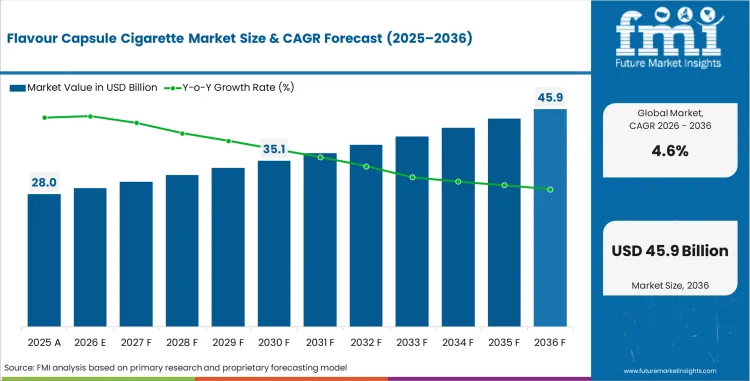
Key Takeaways, Market Size, and Forecast
| Metric | Value |
|---|---|
| Market Size (2025) | USD 26.8 Billion |
| Market Size (2026) | USD 28.0 Billion |
| Market Size (2036) | USD 44.1 Billion |
| CAGR (2026–2036) | 4.6% |
| Leading Flavour Type (2026) | Menthol Capsule |
| Menthol Capsule Share (2026) | 30.0% |
| Leading Distribution Channel (2026) | Convenience Stores |
| Convenience Stores Share (2026) | 26.0% |
| Fastest-Growing Country | Indonesia |
| Indonesia CAGR | 5.5% |
Flavour Capsule Cigarette Market Key Takeaways
| Parameter | Details |
| Market value (2026) | USD 28.0 billion |
| Forecast value (2036) | USD 44.1 billion |
| CAGR (2026 to 2036) | 4.6% |
| Estimated market value (2025) | USD 26.8 billion |
| Leading flavour type | Menthol capsule |
| Flavour type share (2026) | 30.0% |
| Leading price tier | Premium segment |
| Price tier share (2026) | 28.0% |
| Leading distribution channel | Convenience stores |
| Distribution channel share (2026) | 26.0% |
| Fastest-growing country | Indonesia |
| Indonesia CAGR | 5.5% |
Source: Future Market Insights, 2026.
Portfolio decisions in combustible tobacco are becoming more selective, with focus shifting toward formats that can sustain margin and shelf relevance rather than broad line expansion. Capsule cigarettes remain commercially important because they introduce flavor variation and user-controlled experience without requiring a full redesign of the cigarette format. This allows brand owners to refresh offerings while keeping production and distribution structures largely intact. Premium cigarettes, flavour capsule variants, and cooling essence formats help maintain retailer interest in a category facing overall volume pressure.
Sustained growth depends on moving capsule formats from limited launches to standardized extensions within product portfolios. This transition occurs when manufacturers, filter suppliers, and trade teams can manage flavor activation, pack rotation, and retail placement through routine processes. Once operational consistency is established, capsule formats can be scaled across multiple SKUs and channels with less risk. This makes them easier to integrate into long-term product strategies, supporting repeat launches and more predictable performance across markets.
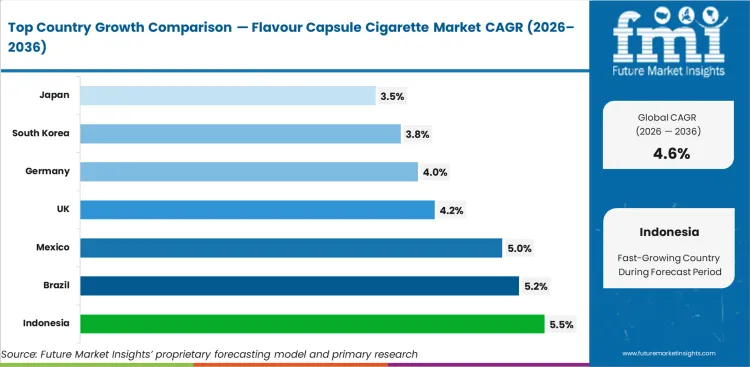
Indonesia is expected to expand at 5.5% CAGR, followed by Brazil at 5.2% and Mexico at 5.0%, supported by room for differentiated cigarette formats and continued consumer interest in capsule variants. The United Kingdom is projected at 4.2%, while Germany records 4.0%, reflecting tighter regulation and slower category expansion. South Korea is anticipated at 3.8%, and Japan at 3.5%, where growth is moderated by strong shifts toward alternatives such as nicotine pouches, disposable e-cigarettes, and other reduced-risk formats. Differences reflect regulatory intensity and substitution pressure across markets.
Segmental Analysis
Key Facts About Segments
- Menthol capsule is projected to account for 30.0% of total demand in 2026. Cooling familiarity, click activation, and better repeatability keep it ahead of fruit-led or shorter-cycle flavour formats.
- Premium segment is expected to capture 28.0% share in 2026. Capsule technology is easier to monetize when the pack already carries stronger trade-up cues and better margin tolerance.
- Convenience stores are likely to contribute 26.0% share in 2026. Immediate access, faster stock rotation, and strong point-of-purchase visibility continue to support channel strength.
- Single-capsule construction remains the more scalable operating format because it is easier to standardize across production runs and simpler for retailers and smokers to understand.
- Dual-capsule architecture stays important in selective premium launches where added flavour choice can justify more complex pack messaging and a stronger premium story.
- Young adult smokers remain commercially important in the consumer-profile view because capsule cigarettes still depend on novelty, flavour control, and visible product distinction to win trial.
Flavour Capsule Cigarette Market Analysis by Flavour Type
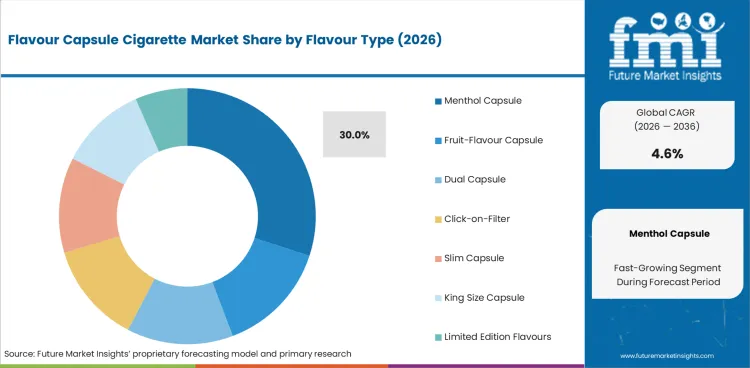
Cooling-driven preference continues to anchor this segment, keeping menthol capsule formats at the center of demand. Menthol capsule is expected to account for 30.0% share in 2026, as it offers a balance between flavor differentiation and familiarity for regular smokers. It allows brand owners to refresh the experience without disrupting established consumption patterns, making it easier to sustain repeat purchase. Fruit-flavor capsules and limited-edition variants can generate short-term interest, but they often come with higher rotation risk and shorter shelf cycles. Menthol’s strength lies in its consistency and ability to align with routine buying behavior rather than novelty alone. This reliability is important for distributors and retailers, as incorrect flavor mix decisions can lead to slower turnover, excess inventory, and increased reliance on discounting to clear stock.
- Cooling profile: Menthol formats give smokers a familiar sensory cue, which lowers the risk of rejection at the first trial.
- Range discipline: Brand teams can extend capsule lines with less taste confusion when the lead profile is already accepted.
- Shelf velocity: Retailers usually prefer formats that can move consistently instead of depending on novelty spikes.
Flavour Capsule Cigarette Market Analysis by Price Tier
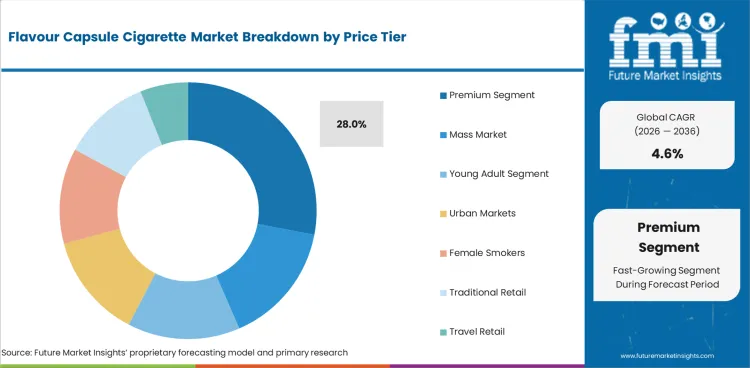
Margin protection shapes this segment more than price competition, keeping premium formats at the forefront of flavour capsule cigarettes. Premium lines combine flavor differentiation with trade-up cues such as refined packaging, perceived exclusivity, and stronger brand positioning, helping sustain pricing strength in a category under constant pressure. Premium segment is expected to account for 28.0% share in 2026 because the format can convert sensory upgrades into a clear value proposition at the shelf, while mass-market formats face tighter resistance when attempting similar positioning.
- Price defense: Premium lines give manufacturers more room to absorb feature costs without losing the value equation.
- Brand signaling: Capsule activation feels more credible when it sits inside a pack already positioned above basic stock.
- Trade resilience: Distributors are less likely to push back when premium mix supports stronger per-pack economics.
Flavour Capsule Cigarette Market Analysis by Distribution Channel
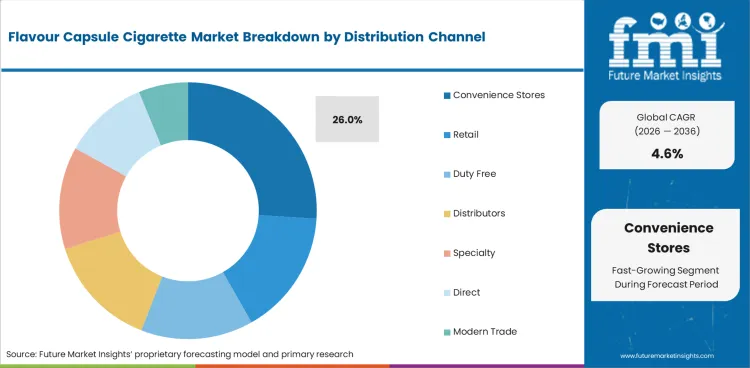
Immediate availability still shapes this channel more than elaborate comparison shopping, which is why convenience stores stay in front in the distribution mix. Convenience stores are projected to contribute 26.0% share in 2026 because capsule cigarette purchases often depend on impulse, pack visibility, and fast replenishment rather than a long decision cycle. Retail and modern trade add scale, yet convenience-led outlets remain important where cigarette buying is tied to routine store visits. FMI indicates this channel advantage also helps new capsule stock-keeping units’ test demand without waiting for wider format rollouts. A weak convenience presence makes market entry harder because slower channel feedback can leave brand owners guessing which flavour and price combination actually works.
- Impulse access: Convenience outlets convert pack visibility into purchase frequency more efficiently than slower-format channels.
- Rotation speed: Smaller but faster stores give suppliers quicker feedback on which capsule variants deserve repeat orders.
- Launch control: Channel partners with tight replenishment cycles reduce the risk of stale flavour mix sitting too long.
Flavour Capsule Cigarette Market Analysis by Format
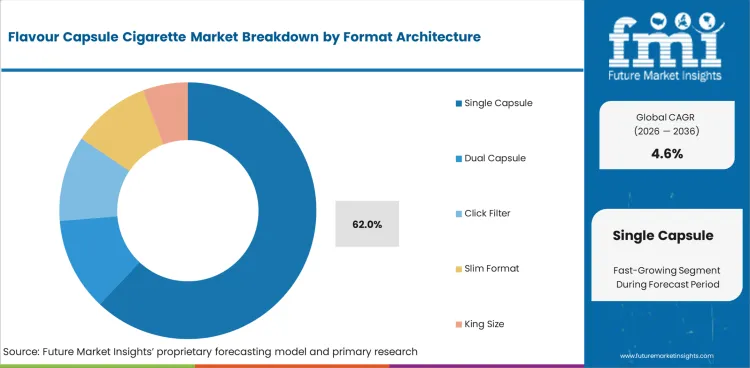
Single-capsule formats are estimated to account for 62.0% share in 2026, as operational ease continues to outweigh added feature layering in this segment. Single-capsule construction holds its position because it supports smoother production alignment, clearer messaging, and easier integration across multiple SKUs. Dual-capsule formats, while present, are anticipated to scale more selectively where premium positioning can justify the additional complexity. Format simplicity strengthens execution consistency, especially when portfolios expand across regions and channels. Dual capsules are not excluded, but their role is expected to stay limited to targeted launches where differentiation can translate into stronger perceived value.
- Filter efficiency: Single-capsule construction is easier to scale across multiple stock-keeping units and production runs.
- Message clarity: One activation point is easier for retailers and smokers to understand at first purchase.
- Cost control: Simpler filter architecture helps prevent needless complexity from eroding margin.
Flavour Capsule Cigarette Market Analysis by Format Architecture
Format architecture is expected to remain led by simpler designs, with single-capsule and click-filter variants anticipated to hold nearly 68.0% combined share in 2026, reflecting their ease of production and communication. Dual-capsule architecture continues to gain space in premium strategies where layered flavor delivery supports a stronger differentiation narrative. Dual formats are expected to reach significant share, particularly where brands seek to enhance user engagement through multiple activation points. However, added complexity increases execution pressure across packaging, retail communication, and production alignment.
- Feature depth: Dual-capsule construction creates a stronger taste-switch story when suppliers need clear premium separation.
- Pack communication: More complex filter architecture demands sharper messaging so shoppers understand the benefit quickly.
- Scale discipline: Format choices that are too elaborate can slow production planning and weaken rollout consistency.
Flavour Capsule Cigarette Market Drivers, Restraints, and Opportunities
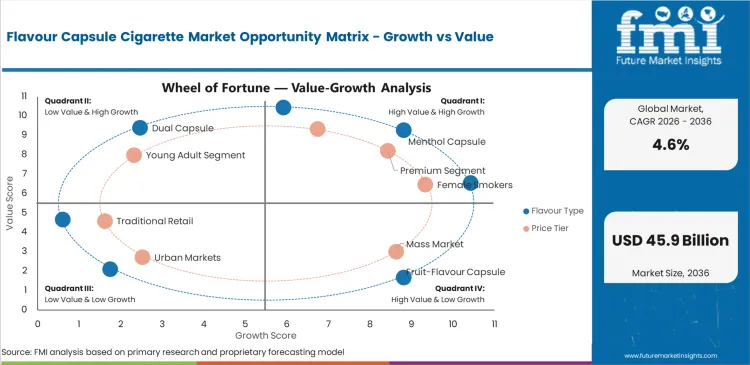
Buyers keep using capsule formats because the feature helps cigarette brands defend distinction inside a category where plain extensions often struggle to stay visible. Brand managers can refresh product perception, price architecture, and shelf conversation without changing the full cigarette base. That matters in portfolios already pressured by volume maturity and stronger competition from roll-your-own tobacco, shisha tobacco, and adjacent flavors categories. When capsule features fit an existing brand ladder, they support faster line refresh decisions and a cleaner trade-up story at retail.
Execution slows when portfolio teams cannot agree on which flavour, price point, and channel mix should carry the next launch. That is not a regulatory problem alone. It is an internal qualification problem tied to pack architecture, filter sourcing, retailer acceptance, and the risk of creating too many small stock-keeping units. Capsule formats look simple to the outside buyer, yet weak coordination between brand, operations, and trade teams can create launch overlap and underperforming assortments. That keeps adoption measured rather than explosive.
Opportunities in the Flavour Capsule Cigarette Market
- Portfolio renewal: Selective line extensions remain the clearest opportunity because suppliers can use capsule formats to renovate mature brands without a full platform restart.
- Channel targeting: Premium channel programs can work well when convenience-led outlets and travel-linked sellers are given capsule variants that match faster shopper decision patterns.
- Execution learning: Cross-learning from EU capsule demand, tobacco packaging, and inner liners can help suppliers align flavour delivery with better pack communication and shelf execution.
Regional Analysis
Key Facts About Country
- Retail tolerance for differentiated combustible formats keeps Indonesia in the strongest growth position. Flavour capsule cigarette demand in Indonesia is expected to rise at a CAGR of 5.5% through 2036.
- Brazil remains one of the faster-growth markets in this study because flavour novelty still fits everyday cigarette purchasing habits. Sales of flavour capsule cigarettes in Brazil are projected to increase at a CAGR of 5.2% through 2036.
- Differentiated shelf presence and travel-linked exposure continue to support Mexico. By 2036, Mexico is expected to post 5.0% CAGR in the flavour capsule cigarette market.
- Disciplined range planning and tighter product scrutiny shape the UK outlook. Flavour capsule cigarette demand across the UK is projected to increase at 4.2% CAGR by 2036.
- Selective variant acceptance keeps Germany on a measured path. A 4.0% CAGR is expected for flavour capsule cigarettes in Germany through 2036.
- Premium-oriented format differentiation keeps South Korea commercially relevant in this assessment. Market growth for flavour capsule cigarettes in South Korea is expected to run at a CAGR of 3.8% during the forecast period.
- Japan remains important, though expansion is more restrained in a disciplined tobacco environment. Through 2036, flavour capsule cigarette sales in Japan are expected to grow at a CAGR of 3.5%.
Based on the regional analysis, the Flavour Capsule Cigarette Market is segmented into Asia Pacific, Europe, Latin America, North America, and the Middle East and Africa across 40 plus countries.
.webp "Top Country Growth Comparison Flavour Capsule Cigarette Market Cagr (2026 2036)")
| Country | CAGR (2026 to 2036) |
|---|---|
| Japan | 3.5% |
| South Korea | 3.8% |
| Brazil | 5.2% |
| UK | 4.2% |
| Germany | 4.0% |
| Indonesia | 5.5% |
| Mexico | 5.0% |
Source: Future Market Insights (FMI) analysis and primary research.
Asia Pacific Flavour Capsule Cigarette Market Analysis
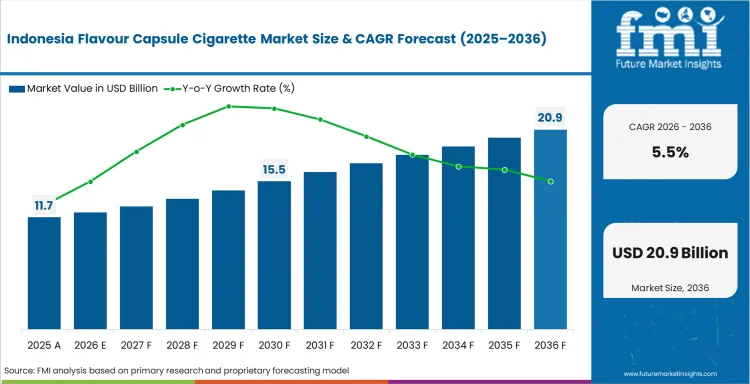
Buyer behavior in Asia Pacific still gives flavour-led combustible formats more room than in many heavily constrained mature markets, though that room is uneven across countries. Japan and South Korea remain commercially relevant because they show how capsule demand can survive inside disciplined retail and product environments, while Indonesia shows what stronger channel tolerance can do for category expansion. FMI analysis links this regional shape to how smokers respond to differentiated cigarette formats and how readily suppliers can move those formats through routine trade channels. Demand in this region also stays connected to adjacent categories such as cigarette filters, making equipment, and tobacco films.
- Japan: Flavor-led cigarette purchasing is more embedded in routine tobacco buying, which keeps Japan commercially relevant despite a slower expansion pace. Capsule formats are expected to align with disciplined portfolio planning and clear pack communication, as product structure is evaluated carefully. Japan is expected to see a CAGR of 3.5% from 2026 to 2036 in this segment, reflecting steady but controlled movement. Product complexity is managed closely, and features must fit established expectations. A weak match between format design and buyer preference can reduce repeat purchase quickly in a market that values consistency and clarity.
- South Korea: South Korea combines interest in format differentiation with a tighter premium mix, which supports a CAGR of 3.8% through the forecast period in flavour capsule cigarettes. In cities such as Seoul, retail visibility and product rotation highlight newer formats that balance novelty with familiarity. Capsule variants are expected to feel modern without pushing into overly experimental territory. Buyers respond to controlled innovation where flavor delivery remains consistent. Overly complex assortments can reduce clarity at the shelf. Poor assortment discipline often weakens reorder confidence, as products must align with both premium positioning and everyday usability to sustain repeat demand.
- Indonesia: Indonesia stands out as the fastest-growing country among those assessed, reaching 5.5% CAGR through 2036 in flavour capsule cigarettes. The category benefits from strong everyday retail presence, where new formats can scale beyond niche positioning. Growth is supported by wider acceptance of flavor variants across mass-market segments rather than limited premium pockets. Products that combine noticeable flavor shifts with easy accessibility tend to gain traction. However, timing matters. Slower rollout can reduce visibility, allowing faster-moving competitors to secure shelf space and build early repeat demand across high-frequency purchase channels.
FMI's report also includes broader Asia Pacific country analysis beyond the named markets. Across the wider region, suppliers usually win by pairing flavour differentiation with channel fit rather than by pushing the most complex format into every market at once.
Europe Flavour Capsule Cigarette Market Analysis
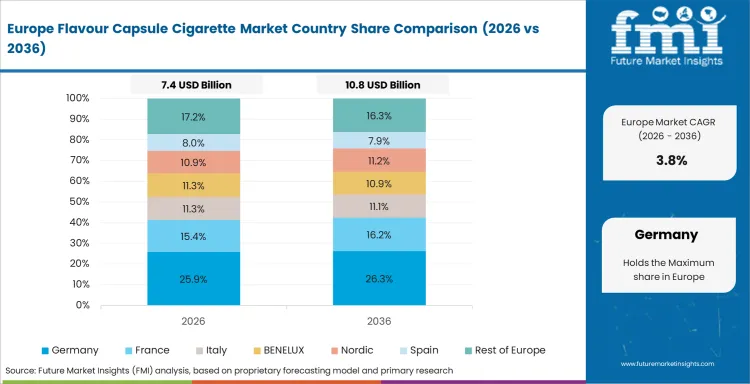
European demand is shaped by a tighter tension between product differentiation and oversight pressure. That makes the region important even when growth rates are lower than parts of Latin America or Southeast Asia. Capsule cigarettes can still sell in Europe, but they work best where suppliers keep the range disciplined, the positioning clear, and the retail ask realistic. FMI analysis suggests this is why country outcomes in Europe sit in a narrower band. Buyers must weigh how much capsule novelty is worth carrying when the category also competes with premium cigarettes, cigars and cigarillos, and smokeless options alternatives.
- UK: UK demand remains tied to whether capsule formats can justify their shelf slot within a more scrutinized tobacco environment. The country is expected to see a CAGR of 4.2% by 2036, where pack clarity and disciplined flavour positioning influence acceptance. Formats need to communicate purpose quickly at shelf. Variants that appear gimmicky or overly complex often lose trade support, as retail space is tightly managed and repeat performance matters more than novelty.
- Germany: Germany is projected to record a 4.0% CAGR over the assessment period in flavour capsule cigarettes, where differentiation still matters but only within controlled limits. The category operates within a structured retail environment where assortment discipline plays a key role in sustaining value. Products are expected to deliver clear positioning without overcomplicating the offer. Capsule formats that feel commercially grounded tend to retain space, especially when they align with consistent usage patterns. Excessive line extensions can dilute visibility and reduce category clarity at shelf. Repeat demand depends on maintaining balance between innovation and restraint. Variants that push too far into novelty without reinforcing everyday usability often struggle to secure long-term presence.
FMI's report covers additional European countries beyond the two named here. Across the region, the practical question is rarely whether capsule cigarettes can sell. It is whether they can sell without creating unnecessary assortment burden for retailers and distributors.
Latin America Flavour Capsule Cigarette Market Analysis
Latin America shows a stronger willingness to absorb differentiated cigarette formats when suppliers align flavour choice, price architecture, and retail execution. That matters because capsule formats perform best where smokers can access them easily and where the feature still feels distinct enough to justify repeat purchase. Brazil and Mexico both fit that pattern, though each does so for slightly different reasons. FMI analysis sees this region as one where demand remains linked to practical route-to-market strength as much as to flavour appeal itself. Adjacent lessons from EU capsule demand, tobacco packaging, and cigarette butt handling also matter because pack visibility and post-sale category scrutiny both influence the way suppliers plan launches.
- Brazil: Brazil is expected to see a CAGR of 5.2% from 2026 to 2036 in flavour capsule cigarettes, supported by the ability to combine novelty with everyday smoking habits. The category benefits from wider acceptance across mainstream segments, where new formats do not need to be overly complex to gain traction. Products that offer clear flavour differentiation without complicating usage tend to perform better. Retail execution still plays a major role. Inconsistent placement or weak visibility can slow repeat conversion, even in a stronger-growth environment where initial trial is easier to achieve.
- Mexico: Mexico continues to benefit from differentiated shelf presence and strong visibility across travel-linked and retail channels. Capsule formats gain attention when flavour cues and pack communication are easy to understand at first glance. Speed to shelf matters in this environment, as faster-moving variants tend to secure early traction. Delays in adapting flavour mix or packaging can reduce visibility and weaken competitive positioning. The country is likely to advance at a CAGR of 5.0% through 2036, as the category continues to reward clarity, accessibility, and timely execution.
FMI's report includes wider Latin American country coverage beyond Brazil and Mexico. Across the region, growth usually improves when suppliers keep the feature simple enough for mainstream adoption and distinctive enough to avoid becoming just another line extension.
Competitive Aligners for Market Players
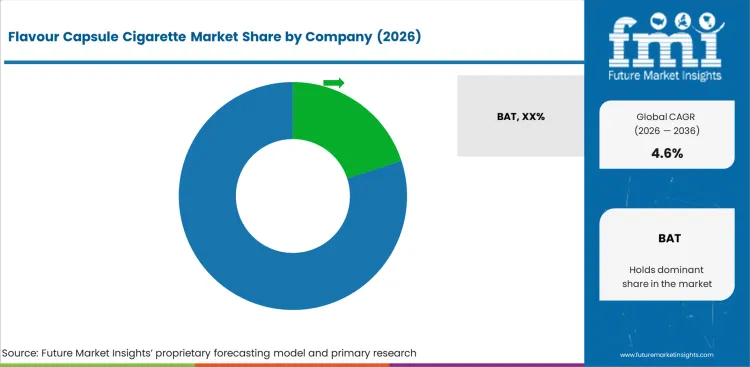
Competitive positioning in flavour capsule cigarettes depends more on alignment across flavour design, pack communication, and channel execution than on scale alone. Companies such as BAT, Philip Morris International, JTI, Imperial Brands, KT&G, ITC, and China National Tobacco Corporation compete within broader tobacco portfolios that allow selective investment in capsule formats. Buyers differentiate suppliers based on how effectively capsule lines can be extended without adding stock complexity or weakening shelf clarity. Supporting capabilities in filters, inner liners, and packaging remain important, even if not directly visible to the end user.
Established players benefit from control over brand portfolios, retail access, and the operational discipline required to introduce feature-led extensions without disrupting existing lines. New entrants can compete, but success depends on reliable distribution, coordinated supply, and a capsule concept that fits real retail conditions. Stronger suppliers are those that link flavour systems and cooling features to clear, shelf-level communication.
Retailers and distributors maintain leverage by avoiding formats that increase operational burden without improving repeat demand. This limits how far suppliers can push complexity. Through 2036, the market is expected to remain fragmented to moderately concentrated, as competition continues to revolve around flavour positioning, retail fit, and portfolio management rather than a single technological advantage.
Key Players in Flavour Capsule Cigarette Market
- BAT
- Philip Morris International
- JTI
- Imperial Brands
- KT&G
- ITC
- China National Tobacco Corporation
Scope of the Report
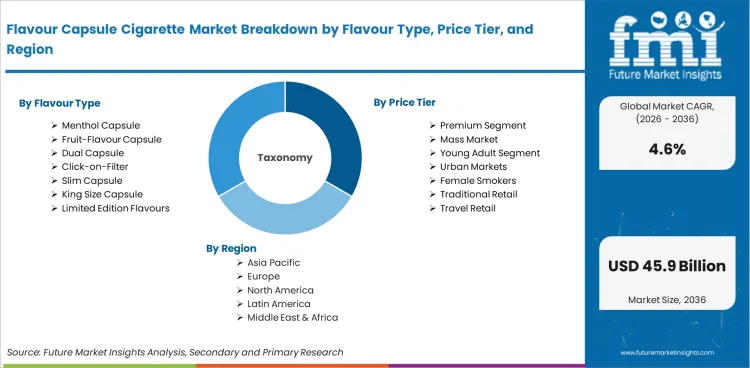
| Metric | Value |
|---|---|
| Quantitative Units | USD 28.0 billion to USD 44.1 billion, at a CAGR of 4.60% |
| Market Definition | This market covers combustible cigarettes fitted with crushable flavour capsules in the filter. It excludes smoke-free nicotine formats, heated tobacco consumables, and loose flavor accessories sold separately. |
| Flavour Type Segmentation | Menthol Capsule, Fruit-Flavour Capsule, Dual Capsule, Click-on-Filter, Slim Capsule, King Size Capsule, Limited Edition Flavours |
| Price Tier Segmentation | Premium Segment, Mass Market, Young Adult Segment, Urban Markets, Female Smokers, Traditional Retail, Travel Retail |
| Distribution Channel Segmentation | Convenience Stores, Retail, Duty Free, Distributors, Specialty, Direct, Modern Trade |
| Format Segmentation | Single Capsule, Dual Capsule, Click Filter, Slim Format, King Size |
| Format Architecture Segmentation | Single Capsule, Dual Capsule, Click Filter, Slim Format, King Size |
| Consumer Profile Segmentation | Young Adults, Female Smokers, Urban Smokers, Premium Buyers, Value Buyers |
| Retail Environment Segmentation | Convenience Stores, Duty Free, Modern Trade, Specialty Stores, Traditional Retail |
| Regions Covered | Asia Pacific, Europe, Latin America, North America, Middle East and Africa |
| Countries Covered | Japan, South Korea, Brazil, UK, Germany, Indonesia, Mexico, and 40 plus countries |
| Key Companies Profiled | BAT, Philip Morris International, JTI, Imperial Brands, KT&G, ITC, China National Tobacco Corporation |
| Forecast Period | 2026 to 2036 |
| Approach | FMI combines primary interviews with tobacco-category participants, brand-side portfolio teams, filter and packaging suppliers, and retail-channel stakeholders. Baseline assessment is anchored to market values and segment shares, then interpreted through flavour-format acceptance, price-tier behavior, channel execution, and smoker uptake patterns. |
Source: Future Market Insights (FMI) analysis and primary research.
Flavour Capsule Cigarette Market Analysis by Segments
Flavour Type
- Menthol Capsule
- Fruit-Flavour Capsule
- Dual Capsule
- Click-on-Filter
- Slim Capsule
- King Size Capsule
- Limited Edition Flavours
Price Tier
- Premium Segment
- Mass Market
- Young Adult Segment
- Urban Markets
- Female Smokers
- Traditional Retail
- Travel Retail
Distribution Channel
- Convenience Stores
- Retail
- Duty Free
- Distributors
- Specialty
- Direct
- Modern Trade
Retail Environment
- Convenience Stores
- Duty Free
- Modern Trade
- Specialty Stores
- Traditional Retail
Consumer Profile
- Young Adults
- Female Smokers
- Urban Smokers
- Premium Buyers
- Value Buyers
Format Architecture
- Single Capsule
- Dual Capsule
- Click Filter
- Slim Format
- King Size
Region:
- North America
- United States
- Canada
- Europe
- Germany
- United Kingdom
- France
- Italy
- Spain
- Asia Pacific
- China
- Japan
- South Korea
- Taiwan
- Singapore
- Latin America
- Brazil
- Mexico
- Argentina
- Middle East & Africa
- GCC Countries
- South Africa
- Israel
Bibliography
- Centers for Disease Control and Prevention. (2025, January). Menthol and Other Flavored Tobacco Products. CDC.
- BMJ Open. (2026). Prevalence and perceptions of flavour capsule cigarettes among adults who smoke in Brazil, Japan, Republic of Korea, Malaysia and Mexico: Findings from the ITC Project. BMJ Open.
- Tobacco Control. (2024). Global landscape of nicotine and tobacco products additives policies. Tobacco Control.
- Annual Review of Public Health. (2024). The scientific basis for the regulation of flavors in tobacco products. Annual Reviews.
- Nicotine & Tobacco Research. (2024). Use of menthol cigarettes and accessories among youth who smoke cigarettes in England and Canada after menthol cigarette bans. Oxford Academic.
This Report Addresses
- What keeps flavour capsule cigarettes commercially relevant in a mature tobacco category.
- How flavour-led filter innovation supports premium price architecture and shelf differentiation.
- Why menthol capsule remains the leading flavour format in the current segment mix.
- How convenience stores continue to shape repeat purchase and launch feedback.
- Why country growth rates diverge across Japan, South Korea, Brazil, the UK, Germany, Indonesia, and Mexico.
- What large tobacco suppliers compete on when expanding or defending capsule portfolios.
- Which adjacent tobacco and smoke-free formats pressure the category's growth ceiling.
- How the market boundary excludes heated tobacco, nicotine pouches, e-cigarettes, and loose flavor accessories.
Frequently Asked Questions
What is the estimated size of the Flavour Capsule Cigarette Market in 2026?
The market is estimated at USD 28.0 billion in 2026.
What will the market be worth by 2036?
FMI places the market at USD 44.1 billion by 2036. Growth from the 2026 base reflects continued use of capsule formats to defend pricing and portfolio differentiation.
What CAGR is expected for the market between 2026 and 2036?
The forecast CAGR is 4.6%. That places flavour capsule cigarettes in a measured growth band rather than a rapid-expansion pattern.
Which flavour type leads the market?
Menthol capsule leads the flavour mix with 30.0% share in 2026. Its advantage comes from combining a familiar cooling profile with click activation.
Which price tier leads the market?
Premium segment leads the price tier mix with 28.0% share. Capsule features are easier to monetize when they sit inside a trade-up story rather than a basic-value pack.
Which channel leads distribution?
Convenience stores lead the channel structure with 26.0% share in 2026. Fast access and visible shelf placement still matter in cigarette purchasing.
Which country grows fastest in this study?
Indonesia posts the highest country CAGR at 5.5%. The country still leaves more room for differentiated cigarette formats to build repeat demand through everyday retail circulation.
Which countries are included in the country outlook?
Japan, South Korea, Brazil, the UK, Germany, Indonesia, and Mexico are the seven named countries in this study. These countries provide a spread across Asia Pacific, Europe, and Latin America.
Why is Japan slower than Indonesia in the forecast?
Japan remains commercially relevant, yet its 3.5% CAGR reflects a more disciplined and regulated tobacco environment. Indonesia carries broader room for format differentiation and faster retail absorption.
Why does menthol remain stronger than fruit-led capsule variants?
Menthol works as a repeat-purchase flavour, not just a novelty cue. Fruit-led formats can create interest, but they often rely on a shorter launch window and tighter assortment control.
Why does premium segment stay ahead of mass market?
Capsule formats add feature value that is easier to defend in premium lines. Mass-market packs can carry capsule extensions, but they face tighter resistance when the added feature is asked to justify a higher price.
What does click-on-filter mean in this market?
It refers to capsule cigarettes where flavor release is activated by crushing or clicking the filter area. That activation step makes the product feel more interactive than a standard cigarette.
Are dual-capsule formats the main growth engine?
Dual-capsule variants widen flavour choice, but simpler constructions remain the core operating format because they scale more easily across broader product runs.
How important are convenience stores to new launches?
They matter because they provide faster feedback on which variants deserve repeat orders. A supplier can learn more quickly from convenience-led shelf performance than from a slower channel cycle.
What is the biggest commercial friction in this market?
The main friction is internal portfolio qualification rather than feature awareness alone. Teams need the flavour, pack, filter, and channel mix to work together before the launch can scale cleanly.
Do capsule cigarettes compete only with regular cigarettes?
No. They also face indirect pressure from nicotine pouches, disposable e-cigarettes, roll-your-own tobacco, and other differentiated smoking or nicotine formats.
How concentrated is the supplier structure?
The market is best described as fragmented to moderately concentrated. BAT is the largest named company at 18.0% share, yet several multinational and regional players still compete.
Why do retailers care about assortment discipline?
Too many small stock-keeping units can dilute reorder confidence and slow shelf velocity. Retailers usually prefer capsule lines that are easy to understand and easy to replenish.
What is included in the market scope?
The study includes combustible cigarettes fitted with crushable flavour capsules in the filter. It also includes click-activated variants sold through the listed price tiers and channels.
What is excluded from the market scope?
Heated tobacco sticks, nicotine pouches, e-cigarettes, and loose flavor accessories sold separately are excluded. Those categories do not fit the product boundary used in this report.
How should country CAGRs be interpreted?
Country CAGRs show the expected growth pace in individual markets and support regional comparisons; they do not represent market shares.
Why does the market still matter if cigarette volumes are mature?
Capsule formats matter because they help brands defend value, refresh shelf appeal, and manage selective line extension in a mature category. That makes them commercially relevant even without extreme growth.
Preview the report firsthand - request a free sample
Get SampleGet the brochure for pricing and purchase details.
Get PDFTable of Content
- Executive Summary
- Global Market Outlook
- Demand-side Trends
- Supply-side Trends
- Technology Roadmap Analysis
- Analysis and Recommendations
- Market Overview
- Market Coverage / Taxonomy
- Market Definition / Scope / Limitations
- Research Methodology
- Chapter Orientation
- Analytical Framework
- Market Structure, Signals, and Trend Drivers
- Benchmarking and Cross-market Comparability
- Market Sizing, Forecasting, and Opportunity Mapping
- Research Design and Evidence Framework
- Desk Research Programme (Secondary Evidence)
- Company Annual and Sustainability Reports
- Peer-reviewed Journals and Academic Literature
- Corporate Websites, Product Literature, and Technical Notes
- Earnings Decks and Investor Briefings
- Statutory Filings and Regulatory Disclosures
- Technical White Papers and Standards Notes
- Trade Journals, Industry Magazines, and Analyst Briefs
- Conference Proceedings, Webinars, and Seminar Materials
- Government Statistics Portals and Public Data Releases
- Press Releases and Reputable Media Coverage
- Specialist Newsletters and Curated Briefings
- Sector Databases and Reference Repositories
- FMI Proprietary Databases and Historical Market Data
- Subscription Datasets and Paid Sources
- Social Channels, Communities, and Digital Listening Inputs
- Additional Desk Sources
- Expert Input and Fieldwork (Primary Evidence)
- Primary Modes
- Qualitative Interviews and Expert Elicitation
- Quantitative Surveys and Structured Data Capture
- Blended Approach
- Why Primary Evidence is Used
- Field Techniques
- Interviews
- Surveys
- Focus Groups
- Observational and In-context Research
- Social and Community Interactions
- Stakeholder Universe Engaged
- C-suite Leaders
- Board Members
- Presidents and Vice Presidents
- R&D and Innovation Heads
- Technical Specialists
- Domain Subject-matter Experts
- Scientists
- Physicians and Other Healthcare Professionals
- Governance, Ethics, and Data Stewardship
- Research Ethics
- Data Integrity and Handling
- Primary Modes
- Research Methods and Reference Sources
- Desk Research Programme (Secondary Evidence)
- Market Data Analysis and Forecast Development
- Data Collection
- Data Review and Validation
- Regional Parent Market Outlook
- Production and Consumption Statistics
- Import and Export Statistics
- Global Market Analysis 2021 to 2025 and Forecast, 2026 to 2036
- Historical Market Size Value (USD Million) Analysis, 2021 to 2025
- Current and Future Market Size Value (USD Million) Projections, 2026 to 2036
- Y-o-Y Growth Trend Analysis
- Absolute $ Opportunity Analysis
- Global Market Pricing Analysis 2021 to 2025 and Forecast 2026 to 2036
- Global Market Analysis 2021 to 2025 and Forecast 2026 to 2036, By Flavour Type
- Introduction / Key Findings
- Historical Market Size Value (USD Million) Analysis By Flavour Type , 2021 to 2025
- Current and Future Market Size Value (USD Million) Analysis and Forecast By Flavour Type , 2026 to 2036
- Menthol Capsule
- Fruit-Flavour Capsule
- Dual Capsule
- Click-on-Filter
- Slim Capsule
- King Size Capsule
- Limited Edition Flavours
- Menthol Capsule
- Y-o-Y Growth Trend Analysis By Flavour Type , 2021 to 2025
- Absolute $ Opportunity Analysis By Flavour Type , 2026 to 2036
- Global Market Analysis 2021 to 2025 and Forecast 2026 to 2036, By Price Tier
- Introduction / Key Findings
- Historical Market Size Value (USD Million) Analysis By Price Tier, 2021 to 2025
- Current and Future Market Size Value (USD Million) Analysis and Forecast By Price Tier, 2026 to 2036
- Premium Segment
- Mass Market
- Young Adult Segment
- Urban Markets
- Female Smokers
- Traditional Retail
- Travel Retail
- Premium Segment
- Y-o-Y Growth Trend Analysis By Price Tier, 2021 to 2025
- Absolute $ Opportunity Analysis By Price Tier, 2026 to 2036
- Global Market Analysis 2021 to 2025 and Forecast 2026 to 2036, By Distribution Channel
- Introduction / Key Findings
- Historical Market Size Value (USD Million) Analysis By Distribution Channel, 2021 to 2025
- Current and Future Market Size Value (USD Million) Analysis and Forecast By Distribution Channel, 2026 to 2036
- Convenience Stores
- Retail
- Duty Free
- Distributors
- Specialty
- Direct
- Modern Trade
- Convenience Stores
- Y-o-Y Growth Trend Analysis By Distribution Channel, 2021 to 2025
- Absolute $ Opportunity Analysis By Distribution Channel, 2026 to 2036
- Global Market Analysis 2021 to 2025 and Forecast 2026 to 2036, By Format Architecture
- Introduction / Key Findings
- Historical Market Size Value (USD Million) Analysis By Format Architecture, 2021 to 2025
- Current and Future Market Size Value (USD Million) Analysis and Forecast By Format Architecture, 2026 to 2036
- Single Capsule
- Dual Capsule
- Click Filter
- Slim Format
- King Size
- Single Capsule
- Y-o-Y Growth Trend Analysis By Format Architecture, 2021 to 2025
- Absolute $ Opportunity Analysis By Format Architecture, 2026 to 2036
- Global Market Analysis 2021 to 2025 and Forecast 2026 to 2036, By Region
- Introduction
- Historical Market Size Value (USD Million) Analysis By Region, 2021 to 2025
- Current Market Size Value (USD Million) Analysis and Forecast By Region, 2026 to 2036
- North America
- Latin America
- Western Europe
- Eastern Europe
- East Asia
- South Asia and Pacific
- Middle East & Africa
- Market Attractiveness Analysis By Region
- North America Market Analysis 2021 to 2025 and Forecast 2026 to 2036, By Country
- Historical Market Size Value (USD Million) Trend Analysis By Market Taxonomy, 2021 to 2025
- Market Size Value (USD Million) Forecast By Market Taxonomy, 2026 to 2036
- By Country
- USA
- Canada
- Mexico
- By Flavour Type
- By Price Tier
- By Distribution Channel
- By Format Architecture
- By Country
- Market Attractiveness Analysis
- By Country
- By Flavour Type
- By Price Tier
- By Distribution Channel
- By Format Architecture
- Key Takeaways
- Latin America Market Analysis 2021 to 2025 and Forecast 2026 to 2036, By Country
- Historical Market Size Value (USD Million) Trend Analysis By Market Taxonomy, 2021 to 2025
- Market Size Value (USD Million) Forecast By Market Taxonomy, 2026 to 2036
- By Country
- Brazil
- Chile
- Rest of Latin America
- By Flavour Type
- By Price Tier
- By Distribution Channel
- By Format Architecture
- By Country
- Market Attractiveness Analysis
- By Country
- By Flavour Type
- By Price Tier
- By Distribution Channel
- By Format Architecture
- Key Takeaways
- Western Europe Market Analysis 2021 to 2025 and Forecast 2026 to 2036, By Country
- Historical Market Size Value (USD Million) Trend Analysis By Market Taxonomy, 2021 to 2025
- Market Size Value (USD Million) Forecast By Market Taxonomy, 2026 to 2036
- By Country
- Germany
- UK
- Italy
- Spain
- France
- Nordic
- BENELUX
- Rest of Western Europe
- By Flavour Type
- By Price Tier
- By Distribution Channel
- By Format Architecture
- By Country
- Market Attractiveness Analysis
- By Country
- By Flavour Type
- By Price Tier
- By Distribution Channel
- By Format Architecture
- Key Takeaways
- Eastern Europe Market Analysis 2021 to 2025 and Forecast 2026 to 2036, By Country
- Historical Market Size Value (USD Million) Trend Analysis By Market Taxonomy, 2021 to 2025
- Market Size Value (USD Million) Forecast By Market Taxonomy, 2026 to 2036
- By Country
- Russia
- Poland
- Hungary
- Balkan & Baltic
- Rest of Eastern Europe
- By Flavour Type
- By Price Tier
- By Distribution Channel
- By Format Architecture
- By Country
- Market Attractiveness Analysis
- By Country
- By Flavour Type
- By Price Tier
- By Distribution Channel
- By Format Architecture
- Key Takeaways
- East Asia Market Analysis 2021 to 2025 and Forecast 2026 to 2036, By Country
- Historical Market Size Value (USD Million) Trend Analysis By Market Taxonomy, 2021 to 2025
- Market Size Value (USD Million) Forecast By Market Taxonomy, 2026 to 2036
- By Country
- China
- Japan
- South Korea
- By Flavour Type
- By Price Tier
- By Distribution Channel
- By Format Architecture
- By Country
- Market Attractiveness Analysis
- By Country
- By Flavour Type
- By Price Tier
- By Distribution Channel
- By Format Architecture
- Key Takeaways
- South Asia and Pacific Market Analysis 2021 to 2025 and Forecast 2026 to 2036, By Country
- Historical Market Size Value (USD Million) Trend Analysis By Market Taxonomy, 2021 to 2025
- Market Size Value (USD Million) Forecast By Market Taxonomy, 2026 to 2036
- By Country
- India
- ASEAN
- Australia & New Zealand
- Rest of South Asia and Pacific
- By Flavour Type
- By Price Tier
- By Distribution Channel
- By Format Architecture
- By Country
- Market Attractiveness Analysis
- By Country
- By Flavour Type
- By Price Tier
- By Distribution Channel
- By Format Architecture
- Key Takeaways
- Middle East & Africa Market Analysis 2021 to 2025 and Forecast 2026 to 2036, By Country
- Historical Market Size Value (USD Million) Trend Analysis By Market Taxonomy, 2021 to 2025
- Market Size Value (USD Million) Forecast By Market Taxonomy, 2026 to 2036
- By Country
- Kingdom of Saudi Arabia
- Other GCC Countries
- Turkiye
- South Africa
- Other African Union
- Rest of Middle East & Africa
- By Flavour Type
- By Price Tier
- By Distribution Channel
- By Format Architecture
- By Country
- Market Attractiveness Analysis
- By Country
- By Flavour Type
- By Price Tier
- By Distribution Channel
- By Format Architecture
- Key Takeaways
- Key Countries Market Analysis
- USA
- Pricing Analysis
- Market Share Analysis, 2025
- By Flavour Type
- By Price Tier
- By Distribution Channel
- By Format Architecture
- Canada
- Pricing Analysis
- Market Share Analysis, 2025
- By Flavour Type
- By Price Tier
- By Distribution Channel
- By Format Architecture
- Mexico
- Pricing Analysis
- Market Share Analysis, 2025
- By Flavour Type
- By Price Tier
- By Distribution Channel
- By Format Architecture
- Brazil
- Pricing Analysis
- Market Share Analysis, 2025
- By Flavour Type
- By Price Tier
- By Distribution Channel
- By Format Architecture
- Chile
- Pricing Analysis
- Market Share Analysis, 2025
- By Flavour Type
- By Price Tier
- By Distribution Channel
- By Format Architecture
- Germany
- Pricing Analysis
- Market Share Analysis, 2025
- By Flavour Type
- By Price Tier
- By Distribution Channel
- By Format Architecture
- UK
- Pricing Analysis
- Market Share Analysis, 2025
- By Flavour Type
- By Price Tier
- By Distribution Channel
- By Format Architecture
- Italy
- Pricing Analysis
- Market Share Analysis, 2025
- By Flavour Type
- By Price Tier
- By Distribution Channel
- By Format Architecture
- Spain
- Pricing Analysis
- Market Share Analysis, 2025
- By Flavour Type
- By Price Tier
- By Distribution Channel
- By Format Architecture
- France
- Pricing Analysis
- Market Share Analysis, 2025
- By Flavour Type
- By Price Tier
- By Distribution Channel
- By Format Architecture
- India
- Pricing Analysis
- Market Share Analysis, 2025
- By Flavour Type
- By Price Tier
- By Distribution Channel
- By Format Architecture
- ASEAN
- Pricing Analysis
- Market Share Analysis, 2025
- By Flavour Type
- By Price Tier
- By Distribution Channel
- By Format Architecture
- Australia & New Zealand
- Pricing Analysis
- Market Share Analysis, 2025
- By Flavour Type
- By Price Tier
- By Distribution Channel
- By Format Architecture
- China
- Pricing Analysis
- Market Share Analysis, 2025
- By Flavour Type
- By Price Tier
- By Distribution Channel
- By Format Architecture
- Japan
- Pricing Analysis
- Market Share Analysis, 2025
- By Flavour Type
- By Price Tier
- By Distribution Channel
- By Format Architecture
- South Korea
- Pricing Analysis
- Market Share Analysis, 2025
- By Flavour Type
- By Price Tier
- By Distribution Channel
- By Format Architecture
- Russia
- Pricing Analysis
- Market Share Analysis, 2025
- By Flavour Type
- By Price Tier
- By Distribution Channel
- By Format Architecture
- Poland
- Pricing Analysis
- Market Share Analysis, 2025
- By Flavour Type
- By Price Tier
- By Distribution Channel
- By Format Architecture
- Hungary
- Pricing Analysis
- Market Share Analysis, 2025
- By Flavour Type
- By Price Tier
- By Distribution Channel
- By Format Architecture
- Kingdom of Saudi Arabia
- Pricing Analysis
- Market Share Analysis, 2025
- By Flavour Type
- By Price Tier
- By Distribution Channel
- By Format Architecture
- Turkiye
- Pricing Analysis
- Market Share Analysis, 2025
- By Flavour Type
- By Price Tier
- By Distribution Channel
- By Format Architecture
- South Africa
- Pricing Analysis
- Market Share Analysis, 2025
- By Flavour Type
- By Price Tier
- By Distribution Channel
- By Format Architecture
- USA
- Market Structure Analysis
- Competition Dashboard
- Competition Benchmarking
- Market Share Analysis of Top Players
- By Regional
- By Flavour Type
- By Price Tier
- By Distribution Channel
- By Format Architecture
- Competition Analysis
- Competition Deep Dive
- BAT
- Overview
- Product Portfolio
- Profitability by Market Segments (Product/Age /Sales Channel/Region)
- Sales Footprint
- Strategy Overview
- Marketing Strategy
- Product Strategy
- Channel Strategy
- Philip Morris International
- JTI
- Imperial Brands
- KT&G
- ITC
- China National Tobacco Corporation
- BAT
- Competition Deep Dive
- Assumptions & Acronyms Used


