

- Market Size (2026)
- USD 6.5 Bn
- Forecast (2036)
- USD 10.6 Bn
- CAGR (2026 to 2036)
- 5.1%
Liquid Flavour System Market Size, Market Forecast and Outlook By FMI
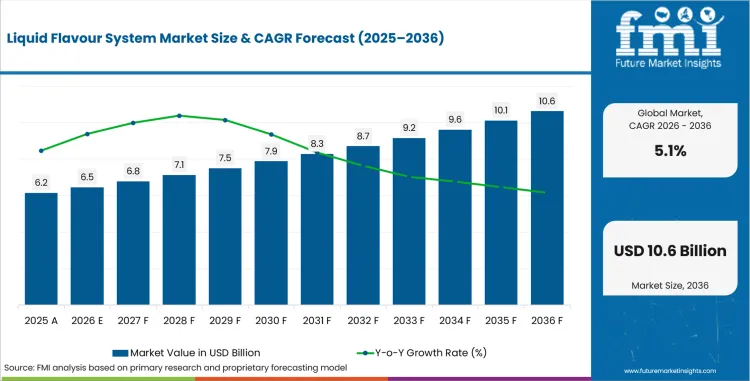
The liquid flavour system market was valued at USD 6.2 billion in 2025. The market is set to reach USD 6.5 billion by 2026-end and grow at a CAGR of 5.1% between 2026-2036 to reach USD 10.6 billion by 2036. Compound Flavour Systems will dominate with a 45.0% share, while Food and Beverages will lead with a 75.0% share.
Key Takeaways, Market Size, and Forecast
- 2026 Market Size: USD 6.5 billion
- 2036 Market Size: USD 10.6 billion
- Compound Annual Growth Rate (CAGR): 5.1% from 2026 to 2036
- Absolute $ Opportunity: USD 4.1 billion between 2026 and 2036
- Leading Product Segment: Compound Flavour Systems
- Compound Flavour Systems Share in 2026: 45.0%
- Fastest-growing Country: USA
- USA CAGR: 5.4% through 2036
| Parameter | Details |
|---|---|
| Market Size in 2026 (Value) | USD 6.5 billion |
| Market Forecast in 2036 (Value) | USD 10.6 billion |
| CAGR (2026 to 2036) | 5.1% from 2026 to 2036 |
| Years Considered | 2021 to 2036 |
| Base Year | 2025 |
| Forecast Period | 2026 to 2036 |
| Units Considered | Value (USD Bn) |
| Leading Sub-Region | USA |
Summary of the Liquid Flavour System Market
- Demand and Growth Drivers
- Growing food and beverage product differentiation requirements are expected to sustain demand for compound liquid flavour systems that combine multiple flavour notes into ready-to-use formulations.
- Clean label reformulation pressure is likely to accelerate adoption of plant-based and natural extraction flavour systems over synthetic alternatives.
- Beverage category expansion including functional drinks, flavored waters, and ready-to-drink formats is expected to generate incremental procurement from beverage manufacturers.
- Product and Segment View
- Compound flavour systems are estimated to account for 45.0% of product demand in 2026, driven by food manufacturer preference for pre-blended formulations that simplify production and ensure batch consistency.
- Food and beverages applications are likely to dominate at 75.0%, with flavored beverages, confectionery, bakery, and dairy products driving procurement volumes.
- Plant-based sources are expected to account for 65.0% of source demand, supported by clean label positioning and consumer preference for natural flavour ingredients.
- Geography and Competitive Outlook
- The USA is likely to lead country level growth at 5.4% through 2036, driven by beverage product differentiation, clean label reformulation, and functional food innovation.
- Western Europe and East Asia are expected to sustain demand through established food manufacturing sectors and regulatory frameworks favoring natural flavour ingredients.
- Companies with proprietary extraction technology, broad flavour compound libraries, and global application support are likely to strengthen their competitive positioning.
- Analyst Opinion
- Nandini Roy Choudhury, Principal Consultant at FMI says, 'Flavour suppliers that can deliver natural compound systems matching the performance of synthetic alternatives while meeting clean label and regulatory requirements across jurisdictions are positioned for sustained growth through 2036.'
- The liquid flavour system market is evolving toward natural and plant-based formulations as food manufacturers respond to clean label consumer demand.
- Adoption is increasing due to food manufacturer preference for compound systems that simplify production by providing pre-blended, ready-to-dose flavour solutions.
- The market is also benefiting from beverage category expansion, with new functional drinks and flavored water products creating incremental demand.
- Demand is further supported by regulatory trends favoring natural flavour ingredients in the EU, USA, and East Asian markets.
Liquid Flavour System Market Definition
The liquid flavour system market includes liquid-format flavour compounds, extracts, and blended flavour solutions used by food and beverage manufacturers. Products span compound flavour systems, single-note extracts, and custom blended formulations from plant-based, synthetic, and nature-identical sources using extraction, fermentation, and enzymatic processing technologies.
Liquid Flavour System Market Inclusions
Market scope encompasses all commercially traded liquid flavour systems categorized by product (compound flavour systems, single-note extracts, custom blends), application (food and beverages, pharmaceuticals, personal care), end use (food and beverage manufacturers, pharmaceutical companies, personal care manufacturers), source (plant based source, synthetic source, nature identical source), and technology (extraction technology, fermentation technology, enzymatic processing, chemical synthesis). Revenue scope covers 2026 to 2036.
Liquid Flavour System Market Exclusions
The scope does not include dry or powdered flavour systems, essential oils sold as aromatherapy or fragrance products, or raw flavour materials not processed into finished flavour systems.
Liquid Flavour System Market Research Methodology
- Primary Research: FMI analysts conducted interviews with flavour system manufacturers, food and beverage R&D managers, and ingredient procurement specialists across key manufacturing markets.
- Desk Research: Combined data from flavour industry trade statistics, food manufacturing production reports, and flavour company revenue disclosures.
- Market Sizing and Forecasting: Bottom-up aggregation across food and beverage, pharmaceutical, and personal care applications with regional adoption curves based on clean label regulatory development.
- Data Validation: Cross-checked quarterly against ingredient trade data, new product launch databases, and manufacturer production reports.
Why is the Liquid Flavour System Market Growing?
- Food manufacturer demand for compound flavour systems that simplify production and ensure batch-to-batch consistency is generating sustained procurement from the flavour industry.
- Clean label regulatory pressure and consumer preferences are accelerating the transition from synthetic to natural and plant-based liquid flavour systems across food and beverage applications.
- The USA leads country level growth at 5.4% CAGR, driven by beverage innovation, clean label reformulation, and functional food product development requiring differentiated flavour profiles.
The liquid flavour system market is expanding as food and beverage manufacturers invest in product differentiation through flavour innovation. Compound systems that deliver complex flavour profiles in ready-to-dose liquid formats reduce production complexity and support consistent product quality across manufacturing batches.
The transition from synthetic to natural flavour sources is reshaping the competitive environment. Plant-based extraction technology advancements are improving the yield and cost efficiency of natural flavour production, narrowing the price gap with synthetic alternatives. Regulatory frameworks in the EU and USA that restrict or require labeling of synthetic flavours accelerate this transition.
Beverage category expansion is a primary growth driver. Functional drinks, flavored waters, ready-to-drink teas and coffees, and alcoholic beverage innovation all require liquid flavour systems as core ingredients. The proliferation of new beverage product launches creates continuous demand for flavour development and custom blending services.
Market Segmentation Analysis
- Compound flavour systems lead at 45.0%, with pre-blended multi-note formulations serving food manufacturers seeking production efficiency and flavour consistency.
- Extraction technology accounts for 40.0% of technology demand, with solvent, supercritical CO2, and cold-press extraction methods serving natural flavour production.
- Food and beverage manufacturers dominate end-use at 70.0%, reflecting the concentration of flavour system procurement in the food manufacturing sector.
The liquid flavour system market is segmented by product, application, end use, source, and technology. Compound flavour systems lead product demand while food and beverages dominate application consumption.
Insights into the Compound Flavour Systems Product Segment
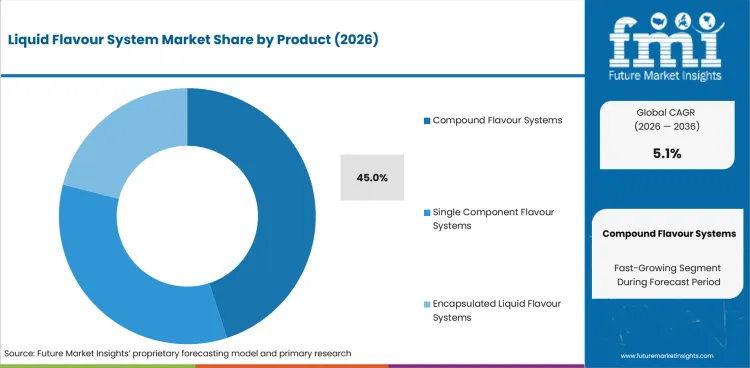
In 2026, compound flavour systems are estimated to account for 45.0% of total product demand. Pre-blended liquid compounds that combine multiple flavour notes, modifiers, and enhancers in a single dosing solution are preferred by food manufacturers for production simplicity and batch consistency. Custom compound development services by flavour houses create client-specific formulations that serve as product differentiation tools.
Compound systems range from standard catalogue flavours serving commodity food production to bespoke formulations developed through multi-month collaborative processes with brand manufacturers. The bespoke segment commands premium pricing and creates longer-term customer relationships.
Insights into the Food And Beverages Application Segment
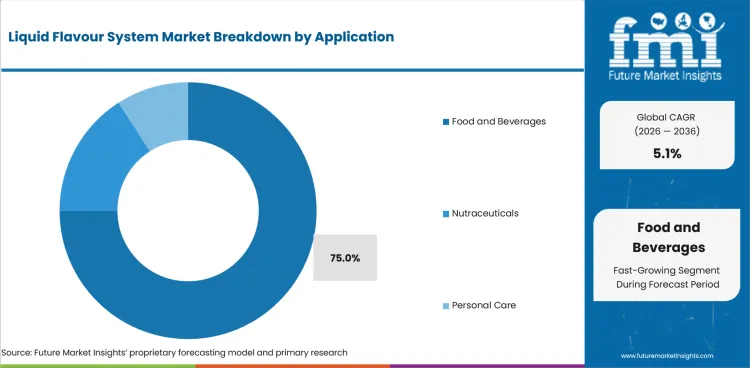
Food and beverages applications are expected to account for 75.0% of application demand in 2026, with beverages, confectionery, bakery, dairy, and savory food manufacturing driving procurement. Beverage applications represent the largest single sub-segment, with carbonated drinks, juices, functional beverages, and flavored waters requiring liquid flavour systems as core ingredients.
Confectionery and bakery applications utilize liquid flavour systems for consistent flavour distribution throughout product matrices. Dairy applications including flavored yoghurt, ice cream, and cheese products require flavour systems that perform in high-fat, fermented, and frozen product environments.
Liquid Flavour System Market Drivers, Restraints, and Opportunities
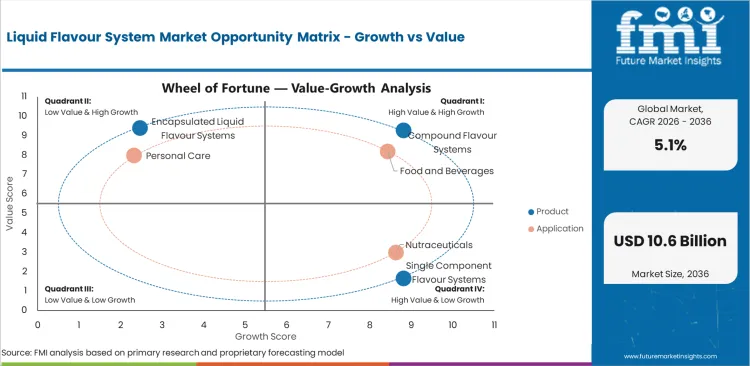
- Food manufacturer product differentiation and beverage category expansion sustain demand for compound liquid flavour systems with increasing complexity and natural sourcing.
- Raw material cost volatility for natural flavour inputs including vanilla, citrus, and berry extracts constrains margin stability for natural flavour system manufacturers.
- Clean label regulatory frameworks favoring natural flavours over synthetic alternatives create structural demand migration toward plant-based extraction technologies.
- Pharmaceutical and personal care applications provide diversification opportunities for flavour system manufacturers seeking growth beyond food and beverage.
The liquid flavour system market continues to grow based on food manufacturer innovation requirements, clean label pressure, and beverage category expansion. Natural ingredient costs and regulatory complexity shape the competitive environment.
Product Differentiation and Innovation Demand
Demand is shaped by food and beverage manufacturer requirements for unique flavour profiles that differentiate products in competitive retail environments. Flavour system suppliers with proprietary compound libraries and rapid prototyping capabilities serve as innovation partners for brand manufacturers developing new product lines.
Natural Ingredient Cost and Supply Dynamics
Growth in natural flavour systems is constrained by raw material cost volatility for botanical inputs. Vanilla, citrus, and specialty fruit extract prices fluctuate based on crop yields, weather events, and geographic supply concentration, directly impacting manufacturing costs for natural compound systems.
Clean Label Regulatory Acceleration
Adoption of natural flavour systems is increasing due to regulatory frameworks that require disclosure of synthetic flavour ingredients on product labels. EU flavour regulations and FDA labeling requirements create consumer transparency that advantages natural and plant-based flavour positioning.
Pharmaceutical and Personal Care Diversification
Flavour system manufacturers are expanding into pharmaceutical taste-masking and personal care flavour applications. Liquid flavour systems for oral pharmaceuticals and flavored personal care products create higher-margin application segments that complement core food and beverage demand.
Analysis of Liquid Flavour System Market By Key Countries
.webp "Top Country Growth Comparison Liquid Flavour System Market Cagr (2026 2036)")
| Country | CAGR |
|---|---|
| USA | 5.4% |
| Japan | 5.1% |
| South Korea | 5.0% |
| UK | 4.9% |
| EU | 4.8% |
Source: FMI analysis based on primary research and proprietary forecasting model
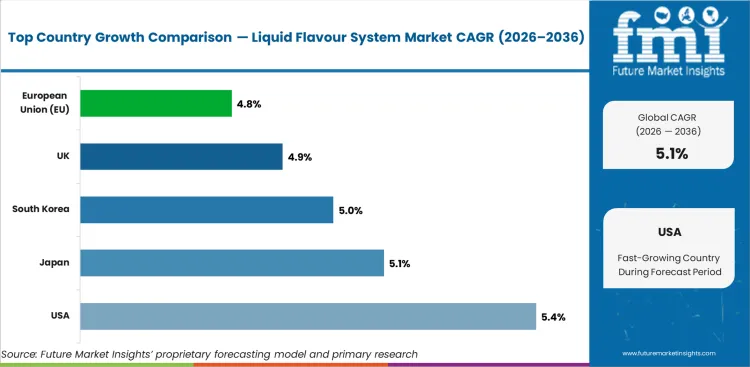
- The USA at 5.4% leads growth, driven by beverage innovation, clean label reformulation, and functional food product development requiring complex flavour profiles.
- Japan at 5.1% sustains demand through advanced food manufacturing and premium consumer preference for nuanced flavour experiences.
- South Korea at 5.0% reflects growing food and beverage product differentiation and increasing demand for natural flavour ingredients.
- The UK at 4.9% shows growth from beverage category expansion and clean label consumer preferences influencing flavour sourcing.
The global liquid flavour system market is projected to expand at 5.1% CAGR from 2026 to 2036. The study covers more than 30 countries, and the main markets are listed below.
Demand Outlook for Liquid Flavour System Market in USA
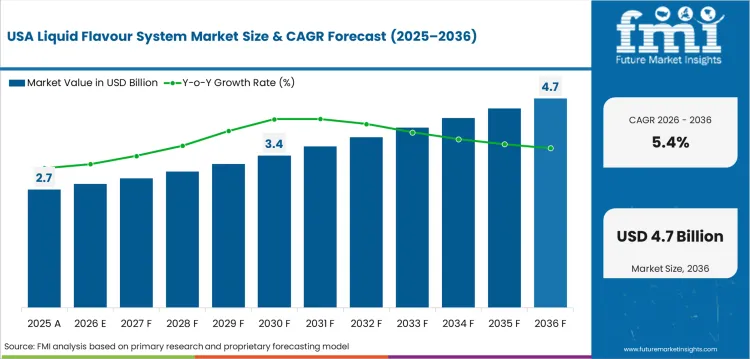
The USA is projected to record a 5.4% CAGR through 2036. Beverage product innovation and clean label reformulation are sustaining demand for natural compound flavour systems. FDA flavour regulations and labeling requirements influence sourcing decisions toward natural and plant-based alternatives.
- Beverage product innovation including functional drinks and flavored waters generates continuous demand for new compound flavour system development.
- FDA labeling requirements for flavour ingredient disclosure support the competitive positioning of natural flavour systems over synthetic alternatives.
- Reshoring of food manufacturing under domestic supply chain priorities creates proximity-driven demand for US-based flavour system suppliers.
Sales Analysis of Liquid Flavour System Market in Japan
Japan is estimated to grow at 5.1% through 2036. Advanced food manufacturing capabilities and premium consumer preference for subtle and complex flavour profiles sustain demand for high-quality liquid flavour systems. JIS compliance and strict ingredient purity standards govern flavour product specifications.
- Advanced food manufacturing capabilities create demand for precision-dosed compound flavour systems with tight specification tolerances.
- Strict JIS ingredient purity standards create quality requirements that favor established flavour manufacturers with documented supply chain traceability.
- Premium consumer preference for nuanced flavour experiences in beverages and confectionery supports demand for complex natural compound formulations.
Future Outlook for Liquid Flavour System Market in South Korea
South Korea is expected to grow at 5.0% through 2036. Growing food and beverage product differentiation and consumer demand for natural ingredients sustain flavour system procurement. Government R&D support for food technology innovation facilitates new flavour extraction and processing capabilities.
- Food and beverage product differentiation requirements create demand for custom compound flavour systems from Korean food manufacturers.
- Government R&D support for food technology innovation facilitates development of new natural extraction and processing capabilities.
- High consumer quality expectations sustain demand for premium flavour systems with consistent batch performance and documented sourcing.
Opportunity Analysis of Liquid Flavour System Market in UK
The UK is projected to record a 4.9% CAGR through 2036. Beverage category expansion and clean label consumer preferences sustain demand for natural liquid flavour systems. Post-Brexit food labeling regulations create distinct compliance requirements for flavour ingredient disclosure.
- Post-Brexit food labeling regulations establish UK-specific compliance requirements for flavour ingredient disclosure and sourcing transparency.
- Beverage category expansion including craft soft drinks and functional beverages creates procurement demand for differentiated flavour systems.
- Clean label consumer preferences in the UK market support natural and plant-based flavour sourcing across food and beverage manufacturing.
In-depth Analysis of Liquid Flavour System Market in the EU
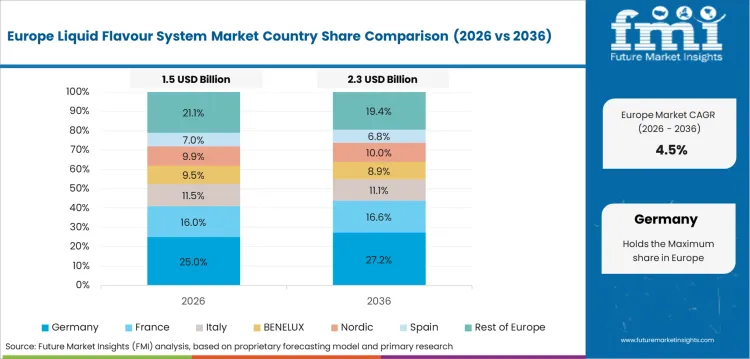
The EU is expected to grow at 4.8% through 2036. Harmonized EU flavour regulations and clean label preferences across member states sustain demand for natural compound flavour systems. The established food manufacturing sector creates consistent procurement volumes from major flavour houses.
- EU flavour regulation harmonization creates consistent compliance requirements across member states, simplifying multi-market formulation for food manufacturers.
- Established food manufacturing sectors in France, Italy, and the Netherlands sustain consistent procurement of liquid flavour systems from major suppliers.
- Clean label consumer preferences across Western European markets accelerate the transition from synthetic to natural flavour system sourcing.
Competitive Landscape and Strategic Positioning
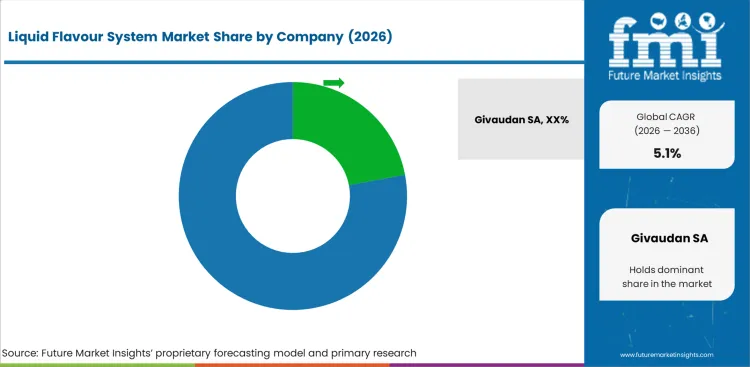
- Givaudan and IFF lead with the broadest compound flavour libraries, global manufacturing networks, and integrated R&D and application support capabilities.
- Symrise and Firmenich compete on natural flavour technology expertise and sustainability-positioned sourcing programs.
- Kerry Group serves the food manufacturer segment with application-specific flavour systems integrated into broader ingredient solutions.
Givaudan SA holds a leading position as the largest flavour and fragrance company by revenue, with the broadest compound flavour library and global manufacturing presence. IFF competes on integrated flavour and ingredient solutions following its merger with DuPont Nutrition. Both companies serve major food and beverage manufacturers with custom compound development and application technical support.
Symrise AG and Firmenich compete on natural and sustainable flavour technology expertise. Kerry Group serves the food manufacturer segment with flavour systems integrated into complete ingredient solutions including texture, color, and nutrition components.
Barriers to entry include proprietary flavour compound development, natural extraction technology investment, and the multi-year customer relationships required to become a qualified flavour supplier to major food manufacturers. Strategic priorities include natural flavour technology expansion, sustainability-certified sourcing, and digital flavour design capabilities.
Key Companies in the Liquid Flavour System Market
Key global companies leading the liquid flavour system market include:
- Givaudan SA (Switzerland), IFF (USA), Symrise AG (Germany), and Firmenich (Switzerland) maintain the broadest compound flavour libraries, global manufacturing networks, and integrated application support serving major food and beverage manufacturers.
- Kerry Group (Ireland) serves food manufacturers with application-specific flavour systems integrated into broader ingredient and taste solutions.
- Specialty and regional flavour companies compete in specific geographic and application segments with differentiated natural extraction technologies and local market expertise.
Competitive Benchmarking: Liquid Flavour System Market
| Company | Flavour Library | Natural Tech | Application Support | Geo. Reach |
|---|---|---|---|---|
| Givaudan SA | Very High | High | Global | Global |
| IFF | Very High | High | Global | Global |
| Symrise AG | High | High | Global | Global |
| Firmenich | High | High | Global | Global |
| Kerry Group | High | Medium | Regional | Global |
Source: Future Market Insights competitive analysis, 2026.
Key Developments in Liquid Flavour System Market
- In 2025, Givaudan launched a new plant-based compound flavour platform designed for clean label beverage applications, utilizing proprietary extraction technology for natural fruit and botanical flavour production.
- In 2025, IFF expanded its liquid flavour system manufacturing capacity at its European production facility to serve growing demand for natural compound formulations from food and beverage manufacturers.
Key Players in the Liquid Flavour System Market
Major Global Players
- Givaudan SA
- IFF
- Symrise AG
- Firmenich
- Kerry Group
Emerging Players/Startups
- Fungu'it
- BioMush
- EvodiaBio
Report Scope and Coverage
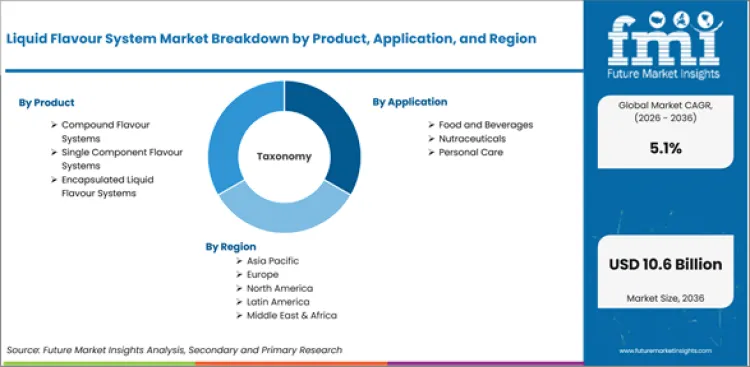
| Parameter | Details |
|---|---|
| Market size by 2036 | USD 10.6 billion |
| Growth rate | 5.1 % CAGR (2026 to 2036) |
| Forecast period | 2026 to 2036 |
| Base year value (2025) | USD 6.2 billion |
| Key Segment Covered | Product, Application, End Use, Source, Technology |
| Regions covered | North America, Latin America, Western Europe, Eastern Europe, East Asia, South Asia and Pacific, Middle East and Africa |
| Countries covered | USA, South Korea, UK, Japan, China, India, Germany, 30 plus countries |
| Key companies profiled | Givaudan SA, IFF, Symrise AG, Firmenich, Kerry Group |
| Approach | Hybrid bottom-up and top-down methodology starting with verified transaction data, projecting adoption velocity across segments and regions. |
Market Segmentation Analysis
Liquid Flavour System Market Segmented by Product:
- Compound Flavour Systems
- Blend Formulations
- Multi Fruit Blends
- Complex Flavor Profiles
- Emulsion Based Systems
- Oil in Water Systems
- Stable Emulsions
- Blend Formulations
- Single Component Flavour Systems
- Fruit Flavour Systems
- Citrus Flavours
- Berry Flavours
- Sweet Flavour Systems
- Vanilla
- Caramel
- Savory Flavour Systems
- Meat Flavours
- Spice Flavours
- Fruit Flavour Systems
- Encapsulated Liquid Flavour Systems
- Microencapsulated Systems
- Controlled Release
- Enhanced Stability
- Nano Encapsulated Systems
- High Efficiency Delivery
- Flavor Protection
- Microencapsulated Systems
Liquid Flavour System Market Segmented by Application:
- Food and Beverages
- Beverages
- Carbonated Drinks
- Functional Drinks
- Dairy Products
- Yogurt
- Flavored Milk
- Bakery and Confectionery
- Cakes and Pastries
- Candies
- Savory Products
- Snacks
- Ready Meals
- Beverages
- Nutraceuticals
- Functional Foods
- Dietary Supplements
- Health Drinks
- Functional Foods
- Personal Care
- Oral Care
- Toothpaste
- Mouthwash
- Cosmetics
- Skin Care
- Hair Care
- Oral Care
Liquid Flavour System Market Segmented by End Use:
- Food and Beverage Manufacturers
- Processed Food Companies
- Large Scale Production
- Private Label Brands
- Processed Food Companies
- Nutraceutical Companies
- Supplement Manufacturers
- Functional Product Brands
- Supplement Manufacturers
- Personal Care Manufacturers
- Cosmetic Brands
- Skin Care Products
- Hair Care Products
- Cosmetic Brands
Liquid Flavour System Market Segmented by Source:
- Plant Based Source
- Fruits
- Herbs and Spices
- Vegetables
- Animal Based Source
- Dairy Ingredients
- Meat Extracts
- Synthetic Source
- Chemical Compounds
- Nature Identical Systems
Liquid Flavour System Market Segmented by Technology:
- Extraction Technology
- Cold Press Extraction
- Low Temperature Processing
- Solvent Extraction
- High Yield Systems
- Cold Press Extraction
- Emulsion Technology
- Stable Emulsion Systems
- Long Shelf Life
- Uniform Dispersion
- Stable Emulsion Systems
- Encapsulation Technology
- Microencapsulation
- Controlled Release
- Flavor Protection
- Microencapsulation
Liquid Flavour System Market by Region:
- North America
- USA
- Canada
- Mexico
- Latin America
- Brazil
- Chile
- Rest of Latin America
- Western Europe
- Germany
- UK
- Italy
- Spain
- France
- Nordic
- BENELUX
- Rest of Western Europe
- Eastern Europe
- Russia
- Poland
- Hungary
- Balkan & Baltic
- Rest of Eastern Europe
- East Asia
- China
- Japan
- South Korea
- South Asia and Pacific
- India
- ASEAN
- Australia & New Zealand
- Rest of South Asia and Pacific
- Middle East & Africa
- Kingdom of Saudi Arabia
- Other GCC Countries
- Türkiye
- South Africa
- Other African Union
- Rest of Middle East & Africa
Research Sources and Bibliography
- 1. European Commission. (2025). EU Regulation on Flavourings and Flavouring Ingredients for Food. EC.
- 2. USA Food and Drug Administration. (2025). FDA GRAS Flavouring Substance Regulations. FDA.
- 3. International Organization of the Flavor Industry. (2025). IOFI Global Flavour Industry Statistical Report. IOFI.
- 4. Codex Alimentarius Commission. (2025). Codex Guidelines on Flavourings. FAO/WHO.
- 5. Flavor and Extract Manufacturers Association. (2025). FEMA GRAS Assessment Program and Industry Guidelines. FEMA.
This bibliography is provided for reader reference.
This Report Answers
- Estimating the size of the liquid flavour system market and projected revenue from 2026 to 2036.
- Segmentation by product, application, end use, source, and technology.
- Insights about more than 30 markets in the region.
- Analysis of technologies including extraction, fermentation, enzymatic processing, and chemical synthesis.
- Assessment of the competitive landscape.
- Identifying investment opportunities in beverage, confectionery, bakery, and pharmaceutical flavour applications.
- Tracking the supply chain from raw material extraction to food manufacturer delivery.
- Delivery of data in PDF and Excel formats.
Frequently Asked Questions
How big is the liquid flavour system market in 2026?
The global liquid flavour system market is estimated to be valued at USD 6.5 billion in 2026.
What will be the size of the liquid flavour system market in 2036?
The market size for the liquid flavour system market is projected to reach USD 10.6 billion by 2036.
How much will the liquid flavour system market growth be between 2026 and 2036?
The liquid flavour system market is expected to grow at a 5.1% CAGR between 2026 and 2036.
What are the key products in the liquid flavour system market?
The key products in the liquid flavour system market are Compound Flavour Systems, Single Component Flavour Systems and Encapsulated Liquid Flavour Systems.
Which application segment is expected to contribute a significant share in the liquid flavour system market in 2026?
In terms of application, the food and beverages segment is expected to command 75.0% share in the liquid flavour system market in 2026.
Preview the report firsthand - request a free sample
Get SampleGet the brochure for pricing and purchase details.
Get PDFTable of Content
- Key Takeaways
- Market Size and CAGR
- Top Growth Driver
- Fastest Growing Segment
- Leading Region
- Key Companies
- Emerging Opportunities
- Executive Summary
- Global Market Outlook
- Demand-side Trends
- Supply-side Trends
- Technology Roadmap Analysis
- Analysis and Recommendations
- Analyst Perspective (What is happening? Why now? What should investors know?)
- Key Questions Answered
- How large is the market?
- What is the CAGR?
- What are key trends?
- Which region dominates?
- Who are the leaders?
- Market Overview
- Market Coverage / Taxonomy
- Market Definition / Scope / Limitations
- Research Methodology
- Chapter Orientation
- Analytical Lens and Working Hypotheses
- Market Structure, Signals, and Trend Drivers
- Benchmarking and Cross-market Comparability
- Market Sizing, Forecasting, and Opportunity Mapping
- Research Design and Evidence Framework
- Desk Research Programme (Secondary Evidence)
- Expert Input and Fieldwork (Primary Evidence)
- Tooling, Models, and Reference Databases
- Data Engineering and Model Build
- Quality Assurance and Audit Trail
- Market Background
- Market Dynamics (Drivers, Restraints, Opportunity, Trends)
- Scenario Forecast (Optimistic, Likely, Conservative)
- Impact Analysis
- AI Impact
- Sustainability Impact
- Regulatory Impact
- Technology Impact
- Consumer / Buyer Analysis
- Purchase Drivers
- Adoption Barriers
- Buyer Journey
- Opportunity Map Analysis
- Product Life Cycle Analysis
- Supply Chain Analysis
- Investment Feasibility Matrix
- Value Chain Analysis
- PESTLE and Porter's Analysis
- Regulatory Landscape
- Regional Parent Market Outlook
- Production and Consumption Statistics
- Import and Export Statistics
- Global Market Analysis and Forecast, 2021 to 2036
- Historical Market Size Value (USD Million) Analysis, 2021 to 2025
- Current and Future Market Size Value (USD Million) Projections, 2026 to 2036
- Y-o-Y Growth Trend Analysis
- Absolute $ Opportunity Analysis
- Global Market Pricing Analysis, 2021 to 2036
- Global Market Analysis and Forecast, By Product, 2021 to 2036
- Introduction / Key Findings
- Historical Market Size Value (USD Million) Analysis By Product, 2021 to 2025
- Current and Future Market Size Value (USD Million) Analysis and Forecast By Product, 2026 to 2036
- Compound Flavour Systems
- Blend Formulations
- Emulsion Based Systems
- Single Component Flavour Systems
- Fruit Flavour Systems
- Sweet Flavour Systems
- Encapsulated Liquid Flavour Systems
- Microencapsulated Systems
- Nano Encapsulated Systems
- Compound Flavour Systems
- Y-o-Y Growth Trend Analysis By Product, 2021 to 2025
- Absolute $ Opportunity Analysis By Product, 2026 to 2036
- Global Market Analysis and Forecast, By Application, 2021 to 2036
- Introduction / Key Findings
- Historical Market Size Value (USD Million) Analysis By Application, 2021 to 2025
- Current and Future Market Size Value (USD Million) Analysis and Forecast By Application, 2026 to 2036
- Food and Beverages
- Beverages
- Dairy Products
- Bakery and Confectionery
- Savory Products
- Nutraceuticals
- Functional Foods
- Personal Care
- Oral Care
- Cosmetics
- Food and Beverages
- Y-o-Y Growth Trend Analysis By Application, 2021 to 2025
- Absolute $ Opportunity Analysis By Application, 2026 to 2036
- Global Market Analysis and Forecast, By End Use, 2021 to 2036
- Introduction / Key Findings
- Historical Market Size Value (USD Million) Analysis By End Use, 2021 to 2025
- Current and Future Market Size Value (USD Million) Analysis and Forecast By End Use, 2026 to 2036
- Food and Beverage Manufacturers
- Processed Food Companies
- Nutraceutical Companies
- Supplement Manufacturers
- Personal Care Manufacturers
- Cosmetic Brands
- Food and Beverage Manufacturers
- Y-o-Y Growth Trend Analysis By End Use, 2021 to 2025
- Absolute $ Opportunity Analysis By End Use, 2026 to 2036
- Global Market Analysis and Forecast, By Source, 2021 to 2036
- Introduction / Key Findings
- Historical Market Size Value (USD Million) Analysis By Source, 2021 to 2025
- Current and Future Market Size Value (USD Million) Analysis and Forecast By Source, 2026 to 2036
- Plant Based Source
- Fruits
- Herbs and Spices
- Vegetables
- Animal Based Source
- Dairy Ingredients
- Meat Extracts
- Synthetic Source
- Chemical Compounds
- Nature Identical Systems
- Plant Based Source
- Y-o-Y Growth Trend Analysis By Source, 2021 to 2025
- Absolute $ Opportunity Analysis By Source, 2026 to 2036
- Global Market Analysis and Forecast, By Technology, 2021 to 2036
- Introduction / Key Findings
- Historical Market Size Value (USD Million) Analysis By Technology, 2021 to 2025
- Current and Future Market Size Value (USD Million) Analysis and Forecast By Technology, 2026 to 2036
- Extraction Technology
- Cold Press Extraction
- Solvent Extraction
- Emulsion Technology
- Stable Emulsion Systems
- Encapsulation Technology
- Microencapsulation
- Extraction Technology
- Y-o-Y Growth Trend Analysis By Technology, 2021 to 2025
- Absolute $ Opportunity Analysis By Technology, 2026 to 2036
- Global Market Analysis and Forecast, By Region, 2021 to 2036
- Introduction
- Historical Market Size Value (USD Million) Analysis By Region, 2021 to 2025
- Current Market Size Value (USD Million) Analysis and Forecast By Region, 2026 to 2036
- North America
- Latin America
- Western Europe
- Eastern Europe
- East Asia
- South Asia and Pacific
- Middle East & Africa
- Market Attractiveness Analysis By Region
- North America Market Analysis and Forecast, By Country, 2021 to 2036
- Historical Market Size Value (USD Million) Trend Analysis By Market Taxonomy, 2021 to 2025
- Market Size Value (USD Million) Forecast By Market Taxonomy, 2026 to 2036
- By Country
- USA
- Canada
- Mexico
- By Product
- By Application
- By End Use
- By Source
- By Technology
- By Country
- Market Attractiveness Analysis
- By Country
- By Product
- By Application
- By End Use
- By Source
- By Technology
- Key Takeaways
- Latin America Market Analysis and Forecast, By Country
- Historical Market Size Value (USD Million) Trend Analysis By Market Taxonomy, 2021 to 2025
- Market Size Value (USD Million) Forecast By Market Taxonomy, 2026 to 2036
- By Country
- Brazil
- Chile
- Rest of Latin America
- By Product
- By Application
- By End Use
- By Source
- By Technology
- By Country
- Market Attractiveness Analysis
- By Country
- By Product
- By Application
- By End Use
- By Source
- By Technology
- Key Takeaways
- Western Europe Market Analysis and Forecast, By Country
- Historical Market Size Value (USD Million) Trend Analysis By Market Taxonomy, 2021 to 2025
- Market Size Value (USD Million) Forecast By Market Taxonomy, 2026 to 2036
- By Country
- Germany
- UK
- Italy
- Spain
- France
- Nordic
- BENELUX
- Rest of Western Europe
- By Product
- By Application
- By End Use
- By Source
- By Technology
- By Country
- Market Attractiveness Analysis
- By Country
- By Product
- By Application
- By End Use
- By Source
- By Technology
- Key Takeaways
- Eastern Europe Market Analysis and Forecast, By Country
- Historical Market Size Value (USD Million) Trend Analysis By Market Taxonomy, 2021 to 2025
- Market Size Value (USD Million) Forecast By Market Taxonomy, 2026 to 2036
- By Country
- Russia
- Poland
- Hungary
- Balkan & Baltic
- Rest of Eastern Europe
- By Product
- By Application
- By End Use
- By Source
- By Technology
- By Country
- Market Attractiveness Analysis
- By Country
- By Product
- By Application
- By End Use
- By Source
- By Technology
- Key Takeaways
- East Asia Market Analysis and Forecast, By Country
- Historical Market Size Value (USD Million) Trend Analysis By Market Taxonomy, 2021 to 2025
- Market Size Value (USD Million) Forecast By Market Taxonomy, 2026 to 2036
- By Country
- China
- Japan
- South Korea
- By Product
- By Application
- By End Use
- By Source
- By Technology
- By Country
- Market Attractiveness Analysis
- By Country
- By Product
- By Application
- By End Use
- By Source
- By Technology
- Key Takeaways
- South Asia and Pacific Market Analysis and Forecast, By Country
- Historical Market Size Value (USD Million) Trend Analysis By Market Taxonomy, 2021 to 2025
- Market Size Value (USD Million) Forecast By Market Taxonomy, 2026 to 2036
- By Country
- India
- ASEAN
- Australia & New Zealand
- Rest of South Asia and Pacific
- By Product
- By Application
- By End Use
- By Source
- By Technology
- By Country
- Market Attractiveness Analysis
- By Country
- By Product
- By Application
- By End Use
- By Source
- By Technology
- Key Takeaways
- Middle East & Africa Market Analysis and Forecast, By Country
- Historical Market Size Value (USD Million) Trend Analysis By Market Taxonomy, 2021 to 2025
- Market Size Value (USD Million) Forecast By Market Taxonomy, 2026 to 2036
- By Country
- Kingdom of Saudi Arabia
- Other GCC Countries
- Türkiye
- South Africa
- Other African Union
- Rest of Middle East & Africa
- By Product
- By Application
- By End Use
- By Source
- By Technology
- By Country
- Market Attractiveness Analysis
- By Country
- By Product
- By Application
- By End Use
- By Source
- By Technology
- Key Takeaways
- Key Countries Market Analysis
- USA
- Pricing Analysis
- Market Share Analysis, 2025
- By Product
- By Application
- By End Use
- By Source
- By Technology
- Canada
- Pricing Analysis
- Market Share Analysis, 2025
- By Product
- By Application
- By End Use
- By Source
- By Technology
- Mexico
- Pricing Analysis
- Market Share Analysis, 2025
- By Product
- By Application
- By End Use
- By Source
- By Technology
- Brazil
- Pricing Analysis
- Market Share Analysis, 2025
- By Product
- By Application
- By End Use
- By Source
- By Technology
- Chile
- Pricing Analysis
- Market Share Analysis, 2025
- By Product
- By Application
- By End Use
- By Source
- By Technology
- Germany
- Pricing Analysis
- Market Share Analysis, 2025
- By Product
- By Application
- By End Use
- By Source
- By Technology
- UK
- Pricing Analysis
- Market Share Analysis, 2025
- By Product
- By Application
- By End Use
- By Source
- By Technology
- Italy
- Pricing Analysis
- Market Share Analysis, 2025
- By Product
- By Application
- By End Use
- By Source
- By Technology
- Spain
- Pricing Analysis
- Market Share Analysis, 2025
- By Product
- By Application
- By End Use
- By Source
- By Technology
- France
- Pricing Analysis
- Market Share Analysis, 2025
- By Product
- By Application
- By End Use
- By Source
- By Technology
- India
- Pricing Analysis
- Market Share Analysis, 2025
- By Product
- By Application
- By End Use
- By Source
- By Technology
- ASEAN
- Pricing Analysis
- Market Share Analysis, 2025
- By Product
- By Application
- By End Use
- By Source
- By Technology
- Australia & New Zealand
- Pricing Analysis
- Market Share Analysis, 2025
- By Product
- By Application
- By End Use
- By Source
- By Technology
- China
- Pricing Analysis
- Market Share Analysis, 2025
- By Product
- By Application
- By End Use
- By Source
- By Technology
- Japan
- Pricing Analysis
- Market Share Analysis, 2025
- By Product
- By Application
- By End Use
- By Source
- By Technology
- South Korea
- Pricing Analysis
- Market Share Analysis, 2025
- By Product
- By Application
- By End Use
- By Source
- By Technology
- Russia
- Pricing Analysis
- Market Share Analysis, 2025
- By Product
- By Application
- By End Use
- By Source
- By Technology
- Poland
- Pricing Analysis
- Market Share Analysis, 2025
- By Product
- By Application
- By End Use
- By Source
- By Technology
- Hungary
- Pricing Analysis
- Market Share Analysis, 2025
- By Product
- By Application
- By End Use
- By Source
- By Technology
- Kingdom of Saudi Arabia
- Pricing Analysis
- Market Share Analysis, 2025
- By Product
- By Application
- By End Use
- By Source
- By Technology
- Türkiye
- Pricing Analysis
- Market Share Analysis, 2025
- By Product
- By Application
- By End Use
- By Source
- By Technology
- South Africa
- Pricing Analysis
- Market Share Analysis, 2025
- By Product
- By Application
- By End Use
- By Source
- By Technology
- USA
- Market Structure Analysis
- Competition Dashboard
- Competition Benchmarking
- Market Share Analysis of Top Players
- By Regional
- By Product
- By Application
- By End Use
- By Source
- By Technology
- Emerging Startups
- Innovation Benchmarking
- Competition Analysis
- Competition Deep Dive
- Givaudan SA
- Overview
- Product Portfolio
- Profitability by Market Segments (Product/Region/Sales Channel)
- Sales Footprint
- Strategy Overview
- Marketing Strategy
- Product Strategy
- Channel Strategy
- IFF
- Symrise AG
- Firmenich
- Kerry Group
- Other Key Players
- Givaudan SA
- Case Studies
- Success Stories
- Recent Developments
- Competition Deep Dive
- Assumptions & Acronyms Used


