

- Industry Size (2026)
- USD 336.4 Mn
- Forecast (2036)
- USD 649.5 Mn
- CAGR (2026 to 2036)
- 6.8%
Natural Deodorant Crystal Market Size, Market Forecast and Outlook By FMI
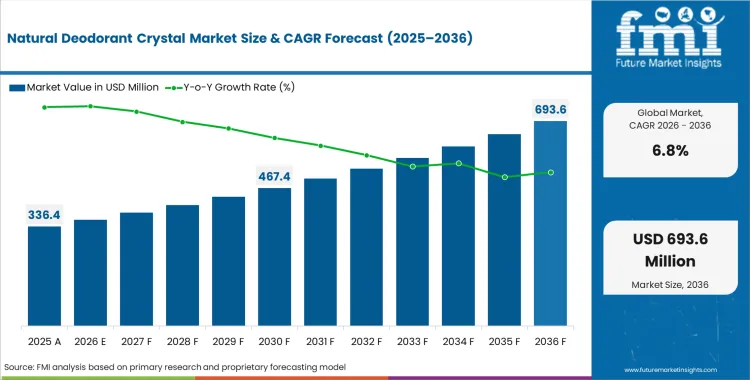
The natural deodorant crystal market crossed a valuation of USD 315.0 million in 2025 and is projected to reach USD 336.4 million in 2026, expanding at a CAGR of 6.8% during the forecast period. Sustained growth drives total valuation to USD 649.5 million by 2036 as consumers increasingly prioritize single-ingredient mineral deodorant formulations over complex chemical blends.
Summary of Natural Deodorant Crystal Market
- The market is forecast to reach USD 649.5 million by 2036.
- The market is expected to grow at a CAGR of 6.8% from 2026 to 2036.
- The market was estimated at USD 315.0 million in 2025.
- The forecast period represents an incremental opportunity of USD 313.1 million.
- The market focuses on mineral-based deodorants that prevent odor without blocking sweat, emphasizing simplicity and skin-friendliness.
- Growth is driven by rising demand for clean beauty products and avoidance of aluminum-based chemicals.
- Long product lifespan and reduced plastic usage are attracting environmentally conscious consumers.
- India, China, and Brazil are among the fastest-growing markets, with India leading at an 8.2% CAGR through 2036.
- Stone sticks dominate the product segment, while potassium alum remains the primary active ingredient.
- Online retail leads distribution due to consumer preference for ingredient transparency and reviews.
- Key players in the market include Salt of the Earth and Biork.
Shops are currently choosing between crystal deodorant vs roll on items to replace chemical-heavy brands before new safety laws take effect. Waiting too long to make this switch causes stores to lose their spot in the busy clean beauty body care aisle where shoppers are now spending more of their money. Experts looking at crystal deodorant demand trends see that people are actually very patient when letting their bodies get used to pure mineral stones. Such willingness to wait makes these mineral options a much safer bet for retailers than many complex natural creams.
Buying habits change fast when a large supermarket puts a deodorant stone on a prominent end-of-aisle display. Sales usually take off when these mineral items sit right next to regular brands instead of being tucked away in the natural pharmacy deodorant products corner. Better placement helps everyday shoppers find these alternatives during their normal routine. Moving raw stones into the main grooming section is the most effective way for a store to turn a niche item into a regular household staple.
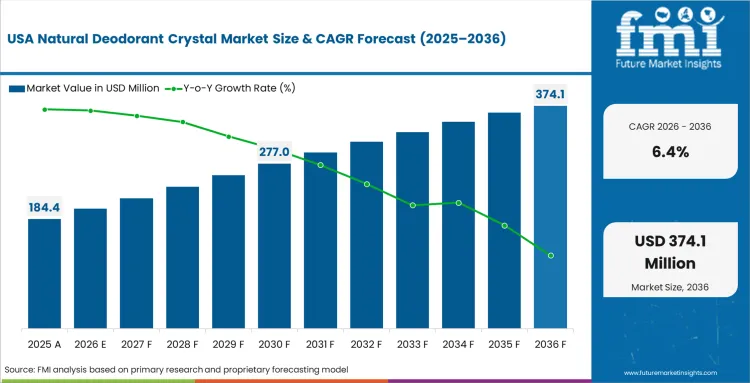
Industry divergence across the following regions depends on whether local health authorities classify alum as a cosmetic or a therapeutic mineral, shaping aluminum-free deodorant distribution pathways. On that regard, India is forecasted to lead at an anticipated 8.2% on the back of rising domestic extraction capabilities, while China likely to track at a predicted 7.7% driven by premiumization in personal grooming. Brazil poised to expands at an estimated 7.3%, seemingly followed closely by United Kingdom at a projected 7.1%. United States set to register an assessed 6.4% as established brands face intense competition from independent vegan deodorant labels. Germany poised to grow at an expected 5.9% and Japan likely to post an estimated 5.4% due to strict ingredient safety standards.
Segmental Analysis
Natural Deodorant Crystal Market Analysis by Product Form
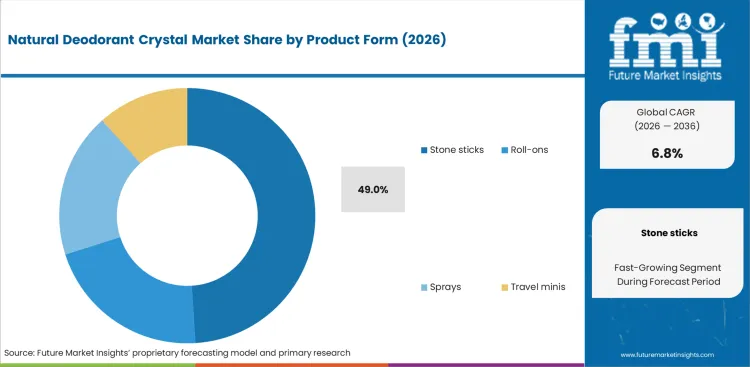
Shoppers moving toward plastic-free options are the main reason stone sticks are projected to secure an estimated 49.0% share in 2026. Retailers find that unshaped mineral blocks appeal to buyers who want the most natural experience, though these items require specific instructions for water activation. FMI notes that sales of the deodorant stick format remain steady because users appreciate how long a solid mineral block lasts compared to standard liquids. Manufacturers are successfully responding to this demand by creating solid deodorant sticks that combine raw mineral efficacy with better portability for travel. This shift toward solid forms reflects a broader move away from multi-ingredient chemical aerosols.
- Moisture Activation: Raw stones require surface wetting before application. Formulators must ensure surface smoothness prevents micro-abrasions during use.
- Longevity Economics: Solid blocks deplete at remarkably slow rates. Retailers face lower purchase frequencies but benefit from premium initial price points.
- Travel Friction: Heavy stone formats create portability issues. Packaging designers developing solid deodorant sticks introduce travel crystal deodorant versions to mitigate weight concerns.
Natural Deodorant Crystal Market Analysis by Ingredient Type
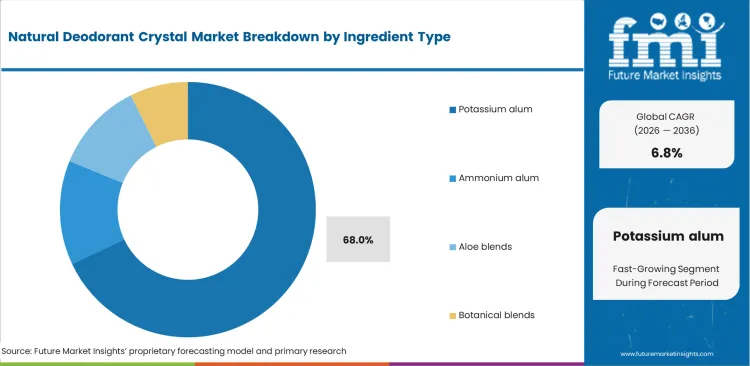
Skin sensitivity guides most buying decisions in this category. Manufacturers select specific mineral salts to ensure that products remain safe for all skin types. Industry analysts expect potassium alum to represent a projected 68.0% of market share in 2026 since its large molecules do not soak into the skin. This safety profile makes it a favorite for those avoiding synthetic chemicals like aluminum chlorohydrate. Brands that use high-quality potassium alum see higher repeat purchase rates from customers who have had bad experiences with complex formulas. Reliability in ingredient sourcing ensures that the final product remains free from unwanted impurities.
- Molecular Sizing: Potassium alum features large molecular dimensions. Chemists utilize this property to guarantee non-penetrating topical protection and clarify does potassium alum stop sweat organically.
- Solubility Rates: Mineral salts dissolve precisely upon contact with wet skin. Product developers calibrate block density to control dissolution speed.
- Sourcing Validation: Natural mining yields varying purity levels. Quality control technicians require rigorous testing protocols to confirm mineral safety.
Natural Deodorant Crystal Market Analysis by Packaging Type
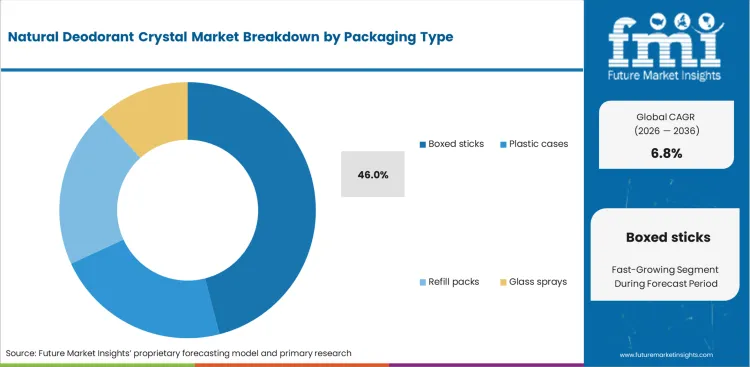
Fragile mineral blocks need sturdy protection during delivery to prevent them from breaking. Paperboard tubes and recycled boxes provide this cushion while satisfying plastic-free retail mandates. Designers working on beauty and personal care packaging are finding new ways to line cardboard with plant-based waxes to keep moisture from damaging the outer shell. These practical benefits are expected to see boxed sticks account for a predicted 46.0% share in 2026. Transitioning to paper materials has become a requirement for brands competing in the clean beauty space.
- Impact Resistance: Unprotected crystals shatter upon dropping. Packaging engineers design shock-absorbing paperboard structures to prevent transit damage.
- Moisture Barriers: Wet stones degrade paper enclosures. Designers incorporate plant-based wax linings to maintain structural integrity.
- End-Of-Life Disposal: Consumers expect fully compostable containers. Brands utilizing beauty and personal care packaging materials derived from recycled pulp gain market favor.
Natural Deodorant Crystal Market Analysis by Distribution Channel
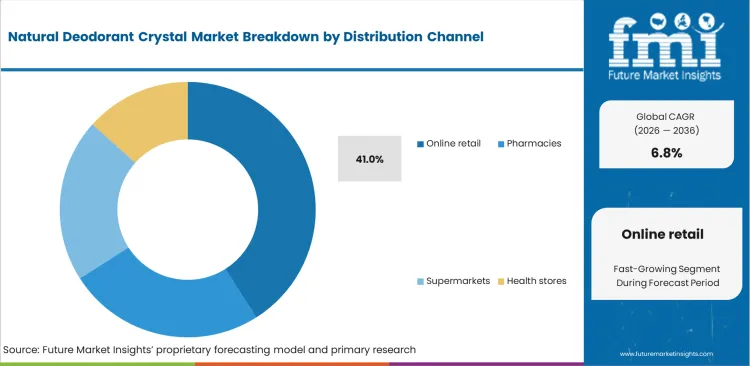
Digital platforms allow sellers to use videos and detailed guides to explain how mineral stones actually work. Education-heavy sales strategies are likely to see online retail account for an anticipated 41.0% share in 2026, helping shoppers understand the product before they buy. Shoppers looking for natural cosmetics often rely on online reviews to understand what to expect during the initial transition period. Brands that offer zero waste refill packaging through subscription services find it easier to keep customers engaged over the long term. Easy access to product information makes the web the primary starting point for most new buyers.
- Algorithm Discovery: Search algorithms match aluminum-free queries with crystal options. Digital marketers optimize content to capture niche health-conscious traffic.
- Review Validation: Transition periods cause initial user doubt. Peer reviews on digital platforms reassure new buyers during body adaptation phases.
- Subscription Models: Crystals last exceptionally long. E-commerce platforms adjusting zero waste refill packaging subscriptions to yearly intervals align better with actual usage rates.
Natural Deodorant Crystal Market Analysis by End User
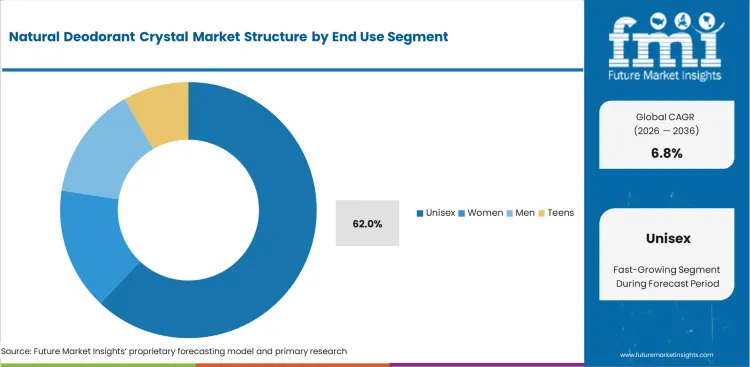
Household purchasing patterns continue to support unisex demand in the alum stone market. Many buyers prefer a single product that can be used across multiple members rather than maintaining separate variants by gender or fragrance profile. Neutral positioning also strengthens category appeal, especially where fragrance-free personal care remains important for consumers with sensitivity concerns. On that basis, the unisex segment is estimated to account for 62.0% share in 2026, supported by broad household usability and stronger acceptance of non-scented hygiene formats.
- Scent neutrality: Fragrance-free product characteristics are likely to remain a key purchase factor for consumers avoiding scented personal-care items. Neutral odor supports wider acceptance across users with sensitivity-driven preferences.
- Household adoption: Larger stone formats are expected to appeal to families seeking practical, shared-use hygiene products. A single product format often fits better within value-conscious household purchasing behavior than separate individualized options.
- Teenage transition: Chemical-conscious family buying is also likely to support adoption among younger users entering regular personal-care routines. Refillable, low-waste, and modular packaging can add appeal where sustainable hygiene habits are becoming part of early purchasing decisions
Natural Deodorant Crystal Market Drivers, Restraints and Opportunities
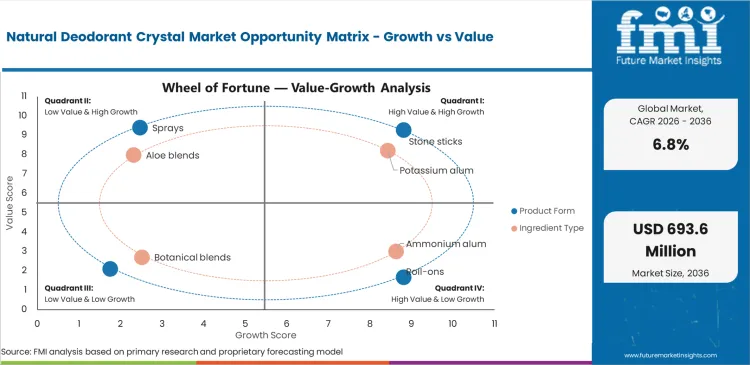
Demand for crystal deodorants is benefiting from wider consumer interest in simpler deodorant formats built around mineral-based positioning. Buyers are increasingly comparing ingredient familiarity, perceived skin tolerance, and daily-use comfort when moving away from conventional aerosol and roll-on products. Potassium alum formats continue to attract attention among consumers looking for odor control options with a more minimal product profile. Category relevance also improves when product education makes application easier, since habitual use depends heavily on understanding how the stone fits into a regular hygiene routine. Taken together, these factors are supporting continued movement in the mineral deodorant market.
Category expansion still faces a practical constraint in the form of product fragility. Solid crystal formats can chip or break during handling, storage, or bathroom use, which raises the risk of product waste and buyer dissatisfaction. Material limitations also make it harder to improve durability without changing the format or altering the product profile in ways that may weaken consumer acceptance. Packaging can reduce some transit damage, yet repeated exposure to moisture creates additional usability concerns after purchase. This combination of breakage risk, return exposure, and shelf damage can reduce category appeal, especially for smaller suppliers working with tighter margin structures.
Opportunities in the Natural Deodorant Crystal Market
- Aqueous spray development: Liquid formats derived from alum are likely to reduce breakage-related concerns while giving users a more familiar method of application. This format can widen appeal among consumers who prefer mineral positioning without the handling limitations of solid stones.
- Microbiome balancing: Combining mineral salts with skin-friendly supportive ingredients may help brands build a more differentiated deodorant proposition. Premium potential improves when odor control is paired with a skin-comfort message rather than relying on mineral positioning alone.
- Travel optimization: Smaller formats and more durable carrying solutions are expected to improve convenience for users who want mineral deodorants outside the home. Better portability can support repeat usage by making the product easier to store, transport, and apply during travel or everyday movement.
Regional Analysis
Based on regional analysis, the natural deodorant crystal sector spans across 40 plus countries, highlighting a clear global shift where local mineral availability and regional clean-beauty standards directly dictate product adoption speeds.
.webp "Top Country Growth Comparison Natural Deodorant Crystal Market Cagr (2026 2036)")
| Country | CAGR (2026 to 2036) |
|---|---|
| India | 8.2% |
| China | 7.7% |
| Brazil | 7.3% |
| United Kingdom | 7.1% |
| United States | 6.4% |
| Germany | 5.9% |
| Japan | 5.4% |
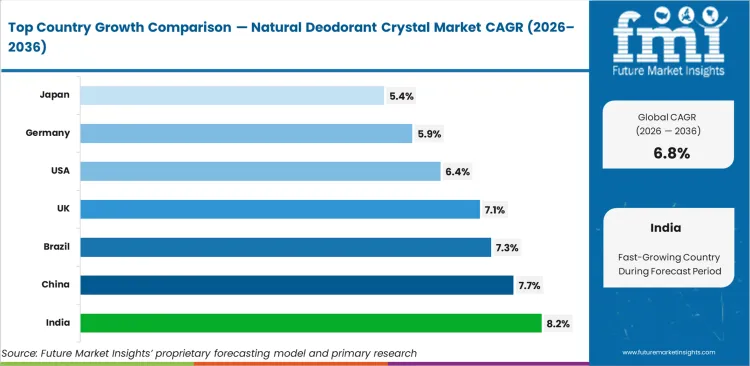
Source: Future Market Insights (FMI) analysis, based on proprietary forecasting model and primary research
Asia-Pacific Natural Deodorant Crystal Market Analysis
Rapid urbanization pushes hygiene awareness across heavily populated Asian nations. Domestic mineral processing capabilities expand rapidly to meet local demands, allowing local retailers to bypass high import tariffs on finished cosmetic goods. Regional suppliers aggressively scale mining operations to supply both domestic consumers and international cosmetic brands.
- India: Local extraction facilities lower final retail prices significantly, making these stones accessible to price-sensitive buyers. Reflecting this localized supply advantage, demand for crystal deodorant in India is anticipated to rise at a forecasted CAGR of 8.2% through 2036, pushing domestic producers to the forefront of the retail sector. Such cost advantages allow homegrown mineral brands to dominate local shelves over expensive imported alternatives.
- China: Premiumization in personal grooming drives interest toward imported natural stones among younger demographics. Category merchandisers actively promote clean-beauty imports to affluent urban shoppers seeking premium herbal personal care products. International brands secure high margins through specialty boutique placements, ensuring crystal deodorant in China is set to record an estimated CAGR of 7.7% during the assessment period as luxury hygiene trends solidify.
- Japan: Projected to witness a predicted 5.4% CAGR in crystal adoption through 2036, Japan relies heavily on strict regulatory standards regarding cosmetic ingredients to favor pure mineral formats. Formulators utilize certified alum to smoothly bypass complex chemical approval processes. Regulatory compliance speeds time-to-market for new items utilizing simple mineral bases.
FMI assesses, localized mineral refinement across the wider region secures stable supply chains for expanding clean beauty brands. The report also includes extensive data on Southeast Asian nations where high humidity drives specific deodorant formulation requirements.
North America & Latin America Natural Deodorant Crystal Market Analysis
Intense competition from independent zero-waste labels forces established brands across the Americas to reformulate. Consumers increasingly scrutinize ingredient lists for hidden synthetic compounds, punishing brands that fail to adapt. Retail chains now mandate strict clean-ingredient policies for new vendor onboarding.
- Brazil: Warm climates necessitate highly effective and reliable odor control solutions. Consumers actively transition from aerosol antiperspirants toward natural alum sprays, which is why crystal deodorant in Brazil is likely to post a predicted CAGR of 7.3% in natural deodorant sales by 2036. Formulators creating herbal beauty products with mineral actives capture significant market share in this high-heat environment.
- United States: Major retail chains actively delist underarm products containing controversial chemicals. Merchandisers replace these items with single-ingredient mineral blocks to satisfy clean-beauty demands. Securing shelf space requires brands to prove pure mineral origins, posing the crystal deodorant in the US sector to register an expected CAGR of 6.4% from 2026 to 2036 as mass retail adoption deepens.
FMI analyses, cross-border distribution networks help standardize clean ingredient requirements throughout the hemisphere. Report includes analysis of Canadian regions where cold-weather formulation stability dictates packaging choices.
Europe Natural Deodorant Crystal Market Analysis
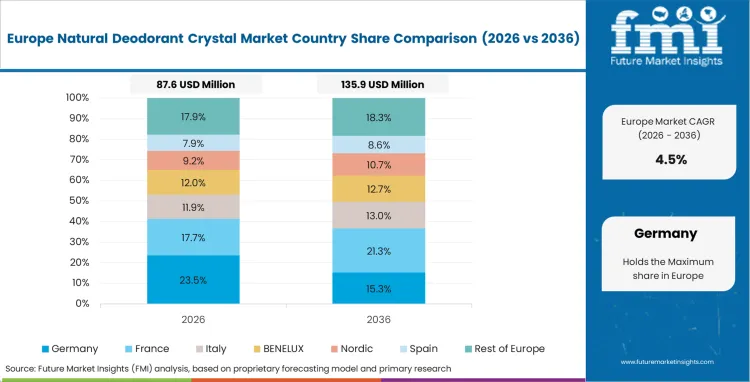
Stringent environmental packaging mandates dictate cosmetic container designs across European borders. Biodegradable housings become mandatory rather than optional for new product launches. Plastic-free initiatives completely reshape retail shelves, forcing packaging engineers to develop moisture-resistant paper tubes for wet alum stones.
- United Kingdom: Demand for crystal deodorant in the United Kingdom is projected to expand at a CAGR of 7.1% during 2026 to 2036. Consumer preference in this market is increasingly shaped by interest in lower-waste personal-care formats and simpler deodorant options with reduced packaging intensity. Solid crystal formats are likely to attract buyers looking for longer product life and a more minimal hygiene routine. Category growth is also supported by stronger alignment between sustainability-minded purchase behavior and durable daily-use deodorant products.
- Germany: Deep-rooted cultural preferences for natural medicine strongly support mineral deodorant adoption. Shoppers trust traditional apothecaries recommending pure alum stones, meaning crystal deodorant in Germany is forecast to record steady growth at a projected CAGR of 5.9% through 2036. Apothecary endorsements legitimize organic cosmetics utilizing traditional mineral ingredients.
FMI's report includes data on Nordic countries where minimalist skincare routines align perfectly with single-ingredient products. Strict European union guidelines on cosmetic safety continue to push synthetic alternatives off retail shelves.
Competitive Aligners for Market Players
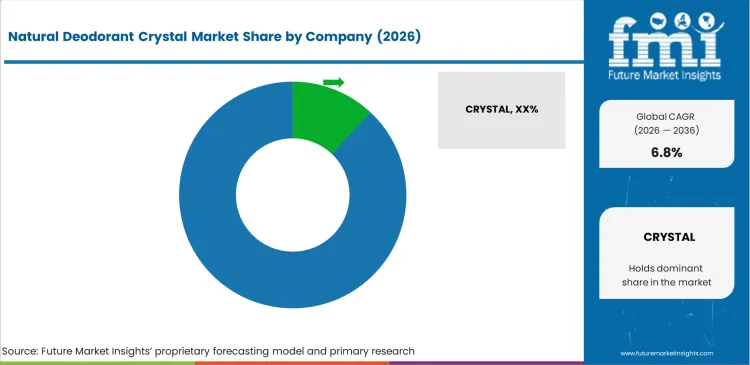
Manufacturers with stronger control over raw material sourcing are better positioned to manage pricing consistency, product quality, and supply continuity across retail channels. Smaller participants often face more pressure when sourcing through intermediary distribution networks, where input costs can shift more sharply and traceability may be harder to maintain. That cost and sourcing imbalance can make it difficult for less integrated suppliers to compete on both price stability and product assurance.
Quality documentation adds another layer of separation between established suppliers and newer entrants. Proven records around mineral purity, contaminant testing, and material consistency can strengthen buyer confidence, especially in a category where safety perception carries significant weight. Emerging participants may need to invest more heavily in testing and validation before they can reach the same level of market acceptance. Long-term channel access depends not only on product availability, but also on the ability to support quality claims with clear and reliable documentation. Strong traceability from sourcing through finished product handling remains central to category credibility.
Supply continuity also shapes broader competitive positioning in this market. Retail relationships are more durable when suppliers can maintain reliable product flow during periods of stronger seasonal demand. Disruptions in supply can weaken repeat purchase behavior, particularly when consumers can easily shift back to more familiar deodorant alternatives. Cross-border movement of raw materials and finished formats adds further operational pressure, making logistics discipline an important part of supplier performance. As wholesale demand becomes more visible across digital trade channels, suppliers with stronger production planning are likely to hold an advantage in managing volume swings without compromising consistency.
Key Players in Natural Deodorant Crystal Market
- CRYSTAL
- Salt of the Earth
- Lafe’s Natural BodyCare
- Deonat
- Deodorant Stones of America
- PitROK
- Biork
Scope of the Report
| Metric | Value |
|---|---|
| Quantitative Units | USD 336.4 million to USD 649.5 million, at a CAGR of 6.8% |
| Market Definition | Natural deodorant crystals are single-ingredient solid mineral blocks formulated to inhibit odor-causing bacterial growth. Mineral compositions consist primarily of potassium alum or ammonium alum. |
| Segmentation | Product form, Ingredient type, Packaging type, Distribution channel, End user, Region |
| Regions Covered | Asia-Pacific, North America & Latin America, Europe, Middle East & Africa |
| Countries Covered | India, China, Brazil, United Kingdom, United States, Germany, Japan |
| Key Companies Profiled | CRYSTAL, Salt of the Earth, Lafe’s Natural BodyCare, Deonat, Deodorant Stones of America, PitROK, Biork |
| Forecast Period | 2026 to 2036 |
| Approach | Baseline established through regional mineral extraction and refining volumes. |
Source: Future Market Insights (FMI) analysis, based on proprietary forecasting model and primary research
Segments
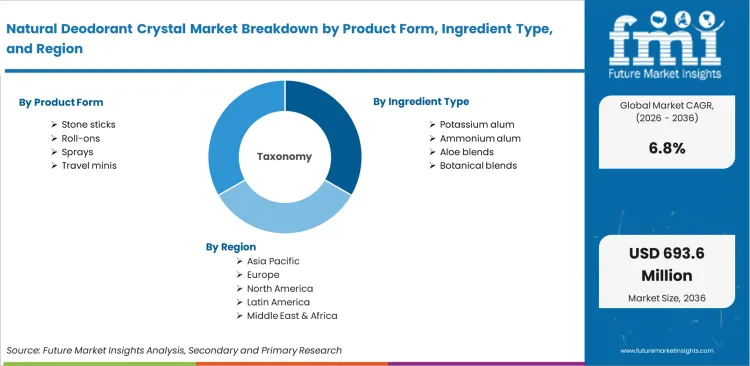
Product Form
- Stone sticks
- Roll-ons
- Sprays
- Travel minis
Ingredient Type
- Potassium alum
- Ammonium alum
- Aloe blends
- Botanical blends
Packaging Type
- Boxed sticks
- Plastic cases
- Refill packs
- Glass sprays
Distribution Channel
- Online retail
- Pharmacies
- Supermarkets
- Health stores
End User
- Unisex
- Women
- Men
- Teens
Regions:
- Asia Pacific
- India
- China
- Japan
- South Korea
- Indonesia
- Australia
- New Zealand
- ASEAN
- Rest of Asia Pacific
- Europe
- Germany
- Italy
- France
- United Kingdom
- Spain
- Benelux
- Nordics
- Central & Eastern Europe
- Rest of Europe
- North America
- United States
- Canada
- Mexico
- Latin America
- Brazil
- Argentina
- Chile
- Rest of Latin America
- Middle East & Africa
- Kingdom of Saudi Arabia
- United Arab Emirates
- South Africa
- Turkey
- Rest of Middle East & Africa
Bibliography
- Son, H. T., Choi, H.-S., Cho, S.-S., & Park, D.-H. (2025). Human body malodor and deodorants: The present and the future. International Journal of Molecular Sciences, 26(21), 10415.
- Zhang, J., Han, P., Yang, F., & Jiang, B. (2024). Advances in the treatment of axillary bromhidrosis. Skin Research and Technology, 30(8), e13895.
- Owsienko, D., Goppelt, L., Hierl, K., Schäfer, L., Croy, I., & Loos, H. M. (2024). Body odor samples from infants and post-pubertal children differ in their volatile profiles. Communications Chemistry, 7, 53.
- Haykal, D., Cartier, H., & Dréno, B. (2024). Dermatological health in the light of skin microbiome evolution. Journal of Cosmetic Dermatology, 23(12), 3836–3846.
- Mim, M. F., Sikder, M. H., Chowdhury, M. Z. H., Bhuiyan, A.-U.-A., Zinan, N., & Islam, S. M. N. (2024). The dynamic relationship between skin microbiomes and personal care products: A comprehensive review. Heliyon, 10(14), e34549.
This bibliography is provided for reader reference. The full FMI crystal deodorant market report contains the complete reference list with primary source documentation.
This Report Addresses
- Mineral extraction capabilities and raw natural deodorant crystal segmentation dynamics.
- Packaging transition from plastic cases to compostable paperboard tubes.
- Consumer adoption curves regarding single-ingredient grooming products.
- Skin sensitivity advantages of potassium alum over synthetic compounds.
- Retail shelf space reallocation toward clean beauty items.
- Impact resistance challenges facing brittle stone stick geometries.
- Online educational marketing strategies for alternative hygiene formats.
- Regulatory shifts restricting traditional chemical antiperspirant ingredients.
Frequently Asked Questions
Explain the natural deodorant crystal market.
Solid mineral blocks form this sector to inhibit odor-causing bacterial growth without blocking eccrine sweat glands.
Give me the market size of crystal deodorant.
The global size was valued at USD 315.0 million in 2025 and is expected to reach USD 336.4 million in 2026.
What drives stone sticks projected to hold 49.0% share in 2026?
Zero-waste packaging preferences push consumers toward self-supporting mineral shapes that eliminate secondary plastic cases.
Why is potassium alum poised to capture an estimated 68.0% share?
Large molecular structures prevent skin penetration, ensuring superficial bacterial neutralization without causing internal irritation.
What role do boxed sticks play in packaging?
Paperboard tubes protect brittle mineral cores during transit while satisfying plastic-free retail mandates.
How is online retail to secure an expected 41.0% share?
Digital storefronts facilitate deep educational engagement and peer review validation necessary for alternative grooming adoption.
Why does the unisex segment lead end user adoption?
Fragrance-free properties naturally appeal across demographic boundaries and encourage shared household usage.
What structural dynamic fuels an anticipated 8.2% CAGR in India?
Localized mineral processing capabilities lower retail prices and allow domestic producers to dominate shelves.
How is China poised to achieve a projected 7.7% CAGR?
Premiumization in personal grooming drives affluent urban shoppers toward imported natural stones.
Why is Brazil set to expand at an estimated 7.3%?
Warm climates necessitate highly effective odor control solutions, pushing consumers toward natural alum sprays.
What accelerates a predicted 7.1% CAGR in the United Kingdom?
Eco-boutiques champion plastic-free hygiene routines, encouraging shoppers to seek unwrapped raw stones.
How will the United States maintain the forecast of an assessed 6.4% CAGR?
Major retail chains actively delist deodorants containing controversial chemicals, replacing them with single-ingredient blocks.
What drives the predicted 5.9% CAGR in Germany?
Deep-rooted cultural preferences for natural medicine support mineral deodorant adoption through traditional apothecaries.
Why is Japan set to post a projected 5.4% CAGR?
Strict regulatory standards regarding cosmetic ingredients favor pure mineral formats to bypass chemical approval processes.
Is crystal deodorant a good low waste alternative?
Packaging engineers rely on solid forms to completely eliminate virgin plastics and transition to biodegradable cardboard tubes.
How do consumers activate raw stones?
Users must wet surface areas before application to ensure smooth gliding and prevent micro-abrasions.
What risk do dropped crystals face?
Unprotected raw minerals shatter easily upon impact with hard bathroom surfaces.
Why do mainstream brands struggle with solid formats?
Attempts to house raw stones in standard twist-up plastics create visual dissonance for eco-conscious buyers.
Is crystal deodorant safe for sensitive skin?
Large mineral molecules rest strictly on the skin's surface without penetrating, avoiding deep tissue irritation.
What advantage do major mining operations hold?
Established producers possess extensive certification libraries proving heavy metal absence in alum deposits.
Why do retail chains qualify multiple alum vendors?
Category buyers intentionally secure backup suppliers to prevent inventory shortages during peak summer seasons.
How long does crystal deodorant last?
Solid blocks deplete at remarkably slow rates, allowing a single stone to often outlast multiple conventional roll-ons.
What limits teen demographic adoption?
Transitioning adolescents require educational marketing regarding correct application techniques for raw stones.
Crystal deodorant vs antiperspirant?
Natural crystals neutralize odor-causing bacteria topically, whereas traditional antiperspirants physically block sweat ducts with synthetic chemicals.
Preview the report firsthand - request a free sample
Get SampleGet the brochure for pricing and purchase details.
Get PDFTable of Content
- Executive Summary
- Global Market Outlook
- Demand-side Trends
- Supply-side Trends
- Technology Roadmap Analysis
- Analysis and Recommendations
- Market Overview
- Market Coverage / Taxonomy
- Market Definition / Scope / Limitations
- Research Methodology
- Chapter Orientation
- Analytical Lens and Working Hypotheses
- Market Structure, Signals, and Trend Drivers
- Benchmarking and Cross-market Comparability
- Market Sizing, Forecasting, and Opportunity Mapping
- Research Design and Evidence Framework
- Desk Research Programme (Secondary Evidence)
- Company Annual and Sustainability Reports
- Peer-reviewed Journals and Academic Literature
- Corporate Websites, Product Literature, and Technical Notes
- Earnings Decks and Investor Briefings
- Statutory Filings and Regulatory Disclosures
- Technical White Papers and Standards Notes
- Trade Journals, Industry Magazines, and Analyst Briefs
- Conference Proceedings, Webinars, and Seminar Materials
- Government Statistics Portals and Public Data Releases
- Press Releases and Reputable Media Coverage
- Specialist Newsletters and Curated Briefings
- Sector Databases and Reference Repositories
- FMI Internal Proprietary Databases and Historical Market Datasets
- Subscription Datasets and Paid Sources
- Social Channels, Communities, and Digital Listening Inputs
- Additional Desk Sources
- Expert Input and Fieldwork (Primary Evidence)
- Primary Modes
- Qualitative Interviews and Expert Elicitation
- Quantitative Surveys and Structured Data Capture
- Blended Approach
- Why Primary Evidence is Used
- Field Techniques
- Interviews
- Surveys
- Focus Groups
- Observational and In-context Research
- Social and Community Interactions
- Stakeholder Universe Engaged
- C-suite Leaders
- Board Members
- Presidents and Vice Presidents
- R&D and Innovation Heads
- Technical Specialists
- Domain Subject-matter Experts
- Scientists
- Physicians and Other Healthcare Professionals
- Governance, Ethics, and Data Stewardship
- Research Ethics
- Data Integrity and Handling
- Primary Modes
- Tooling, Models, and Reference Databases
- Desk Research Programme (Secondary Evidence)
- Data Engineering and Model Build
- Data Acquisition and Ingestion
- Cleaning, Normalisation, and Verification
- Synthesis, Triangulation, and Analysis
- Quality Assurance and Audit Trail
- Market Background
- Market Dynamics
- Drivers
- Restraints
- Opportunity
- Trends
- Scenario Forecast
- Demand in Optimistic Scenario
- Demand in Likely Scenario
- Demand in Conservative Scenario
- Opportunity Map Analysis
- Product Life Cycle Analysis
- Supply Chain Analysis
- Investment Feasibility Matrix
- Value Chain Analysis
- PESTLE and Porter’s Analysis
- Regulatory Landscape
- Regional Parent Market Outlook
- Production and Consumption Statistics
- Import and Export Statistics
- Market Dynamics
- Global Market Analysis 2021 to 2025 and Forecast, 2026 to 2036
- Historical Market Size Value (USD Million) Analysis, 2021 to 2025
- Current and Future Market Size Value (USD Million) Projections, 2026 to 2036
- Y-o-Y Growth Trend Analysis
- Absolute $ Opportunity Analysis
- Global Market Pricing Analysis 2021 to 2025 and Forecast 2026 to 2036
- Global Market Analysis 2021 to 2025 and Forecast 2026 to 2036, By Product Form
- Introduction / Key Findings
- Historical Market Size Value (USD Million) Analysis By Product Form , 2021 to 2025
- Current and Future Market Size Value (USD Million) Analysis and Forecast By Product Form , 2026 to 2036
- Stone sticks
- Roll-ons
- Sprays
- Travel minis
- Stone sticks
- Y-o-Y Growth Trend Analysis By Product Form , 2021 to 2025
- Absolute $ Opportunity Analysis By Product Form , 2026 to 2036
- Global Market Analysis 2021 to 2025 and Forecast 2026 to 2036, By Ingredient Type
- Introduction / Key Findings
- Historical Market Size Value (USD Million) Analysis By Ingredient Type, 2021 to 2025
- Current and Future Market Size Value (USD Million) Analysis and Forecast By Ingredient Type, 2026 to 2036
- Potassium alum
- Ammonium alum
- Aloe blends
- Botanical blends
- Potassium alum
- Y-o-Y Growth Trend Analysis By Ingredient Type, 2021 to 2025
- Absolute $ Opportunity Analysis By Ingredient Type, 2026 to 2036
- Global Market Analysis 2021 to 2025 and Forecast 2026 to 2036, By Packaging Type
- Introduction / Key Findings
- Historical Market Size Value (USD Million) Analysis By Packaging Type, 2021 to 2025
- Current and Future Market Size Value (USD Million) Analysis and Forecast By Packaging Type, 2026 to 2036
- Boxed sticks
- Plastic cases
- Refill packs
- Glass sprays
- Boxed sticks
- Y-o-Y Growth Trend Analysis By Packaging Type, 2021 to 2025
- Absolute $ Opportunity Analysis By Packaging Type, 2026 to 2036
- Global Market Analysis 2021 to 2025 and Forecast 2026 to 2036, By Distribution Channel
- Introduction / Key Findings
- Historical Market Size Value (USD Million) Analysis By Distribution Channel, 2021 to 2025
- Current and Future Market Size Value (USD Million) Analysis and Forecast By Distribution Channel, 2026 to 2036
- Online retail
- Pharmacies
- Supermarkets
- Health stores
- Online retail
- Y-o-Y Growth Trend Analysis By Distribution Channel, 2021 to 2025
- Absolute $ Opportunity Analysis By Distribution Channel, 2026 to 2036
- Global Market Analysis 2021 to 2025 and Forecast 2026 to 2036, By End Use
- Introduction / Key Findings
- Historical Market Size Value (USD Million) Analysis By End Use, 2021 to 2025
- Current and Future Market Size Value (USD Million) Analysis and Forecast By End Use, 2026 to 2036
- Unisex
- Women
- Men
- Teens
- Unisex
- Y-o-Y Growth Trend Analysis By End Use, 2021 to 2025
- Absolute $ Opportunity Analysis By End Use, 2026 to 2036
- Global Market Analysis 2021 to 2025 and Forecast 2026 to 2036, By Region
- Introduction
- Historical Market Size Value (USD Million) Analysis By Region, 2021 to 2025
- Current Market Size Value (USD Million) Analysis and Forecast By Region, 2026 to 2036
- North America
- Latin America
- Western Europe
- Eastern Europe
- East Asia
- South Asia and Pacific
- Middle East & Africa
- Market Attractiveness Analysis By Region
- North America Market Analysis 2021 to 2025 and Forecast 2026 to 2036, By Country
- Historical Market Size Value (USD Million) Trend Analysis By Market Taxonomy, 2021 to 2025
- Market Size Value (USD Million) Forecast By Market Taxonomy, 2026 to 2036
- By Country
- USA
- Canada
- Mexico
- By Product Form
- By Ingredient Type
- By Packaging Type
- By Distribution Channel
- By End Use
- By Country
- Market Attractiveness Analysis
- By Country
- By Product Form
- By Ingredient Type
- By Packaging Type
- By Distribution Channel
- By End Use
- Key Takeaways
- Latin America Market Analysis 2021 to 2025 and Forecast 2026 to 2036, By Country
- Historical Market Size Value (USD Million) Trend Analysis By Market Taxonomy, 2021 to 2025
- Market Size Value (USD Million) Forecast By Market Taxonomy, 2026 to 2036
- By Country
- Brazil
- Chile
- Rest of Latin America
- By Product Form
- By Ingredient Type
- By Packaging Type
- By Distribution Channel
- By End Use
- By Country
- Market Attractiveness Analysis
- By Country
- By Product Form
- By Ingredient Type
- By Packaging Type
- By Distribution Channel
- By End Use
- Key Takeaways
- Western Europe Market Analysis 2021 to 2025 and Forecast 2026 to 2036, By Country
- Historical Market Size Value (USD Million) Trend Analysis By Market Taxonomy, 2021 to 2025
- Market Size Value (USD Million) Forecast By Market Taxonomy, 2026 to 2036
- By Country
- Germany
- UK
- Italy
- Spain
- France
- Nordic
- BENELUX
- Rest of Western Europe
- By Product Form
- By Ingredient Type
- By Packaging Type
- By Distribution Channel
- By End Use
- By Country
- Market Attractiveness Analysis
- By Country
- By Product Form
- By Ingredient Type
- By Packaging Type
- By Distribution Channel
- By End Use
- Key Takeaways
- Eastern Europe Market Analysis 2021 to 2025 and Forecast 2026 to 2036, By Country
- Historical Market Size Value (USD Million) Trend Analysis By Market Taxonomy, 2021 to 2025
- Market Size Value (USD Million) Forecast By Market Taxonomy, 2026 to 2036
- By Country
- Russia
- Poland
- Hungary
- Balkan & Baltic
- Rest of Eastern Europe
- By Product Form
- By Ingredient Type
- By Packaging Type
- By Distribution Channel
- By End Use
- By Country
- Market Attractiveness Analysis
- By Country
- By Product Form
- By Ingredient Type
- By Packaging Type
- By Distribution Channel
- By End Use
- Key Takeaways
- East Asia Market Analysis 2021 to 2025 and Forecast 2026 to 2036, By Country
- Historical Market Size Value (USD Million) Trend Analysis By Market Taxonomy, 2021 to 2025
- Market Size Value (USD Million) Forecast By Market Taxonomy, 2026 to 2036
- By Country
- China
- Japan
- South Korea
- By Product Form
- By Ingredient Type
- By Packaging Type
- By Distribution Channel
- By End Use
- By Country
- Market Attractiveness Analysis
- By Country
- By Product Form
- By Ingredient Type
- By Packaging Type
- By Distribution Channel
- By End Use
- Key Takeaways
- South Asia and Pacific Market Analysis 2021 to 2025 and Forecast 2026 to 2036, By Country
- Historical Market Size Value (USD Million) Trend Analysis By Market Taxonomy, 2021 to 2025
- Market Size Value (USD Million) Forecast By Market Taxonomy, 2026 to 2036
- By Country
- India
- ASEAN
- Australia & New Zealand
- Rest of South Asia and Pacific
- By Product Form
- By Ingredient Type
- By Packaging Type
- By Distribution Channel
- By End Use
- By Country
- Market Attractiveness Analysis
- By Country
- By Product Form
- By Ingredient Type
- By Packaging Type
- By Distribution Channel
- By End Use
- Key Takeaways
- Middle East & Africa Market Analysis 2021 to 2025 and Forecast 2026 to 2036, By Country
- Historical Market Size Value (USD Million) Trend Analysis By Market Taxonomy, 2021 to 2025
- Market Size Value (USD Million) Forecast By Market Taxonomy, 2026 to 2036
- By Country
- Kingdom of Saudi Arabia
- Other GCC Countries
- Turkiye
- South Africa
- Other African Union
- Rest of Middle East & Africa
- By Product Form
- By Ingredient Type
- By Packaging Type
- By Distribution Channel
- By End Use
- By Country
- Market Attractiveness Analysis
- By Country
- By Product Form
- By Ingredient Type
- By Packaging Type
- By Distribution Channel
- By End Use
- Key Takeaways
- Key Countries Market Analysis
- USA
- Pricing Analysis
- Market Share Analysis, 2025
- By Product Form
- By Ingredient Type
- By Packaging Type
- By Distribution Channel
- By End Use
- Canada
- Pricing Analysis
- Market Share Analysis, 2025
- By Product Form
- By Ingredient Type
- By Packaging Type
- By Distribution Channel
- By End Use
- Mexico
- Pricing Analysis
- Market Share Analysis, 2025
- By Product Form
- By Ingredient Type
- By Packaging Type
- By Distribution Channel
- By End Use
- Brazil
- Pricing Analysis
- Market Share Analysis, 2025
- By Product Form
- By Ingredient Type
- By Packaging Type
- By Distribution Channel
- By End Use
- Chile
- Pricing Analysis
- Market Share Analysis, 2025
- By Product Form
- By Ingredient Type
- By Packaging Type
- By Distribution Channel
- By End Use
- Germany
- Pricing Analysis
- Market Share Analysis, 2025
- By Product Form
- By Ingredient Type
- By Packaging Type
- By Distribution Channel
- By End Use
- UK
- Pricing Analysis
- Market Share Analysis, 2025
- By Product Form
- By Ingredient Type
- By Packaging Type
- By Distribution Channel
- By End Use
- Italy
- Pricing Analysis
- Market Share Analysis, 2025
- By Product Form
- By Ingredient Type
- By Packaging Type
- By Distribution Channel
- By End Use
- Spain
- Pricing Analysis
- Market Share Analysis, 2025
- By Product Form
- By Ingredient Type
- By Packaging Type
- By Distribution Channel
- By End Use
- France
- Pricing Analysis
- Market Share Analysis, 2025
- By Product Form
- By Ingredient Type
- By Packaging Type
- By Distribution Channel
- By End Use
- India
- Pricing Analysis
- Market Share Analysis, 2025
- By Product Form
- By Ingredient Type
- By Packaging Type
- By Distribution Channel
- By End Use
- ASEAN
- Pricing Analysis
- Market Share Analysis, 2025
- By Product Form
- By Ingredient Type
- By Packaging Type
- By Distribution Channel
- By End Use
- Australia & New Zealand
- Pricing Analysis
- Market Share Analysis, 2025
- By Product Form
- By Ingredient Type
- By Packaging Type
- By Distribution Channel
- By End Use
- China
- Pricing Analysis
- Market Share Analysis, 2025
- By Product Form
- By Ingredient Type
- By Packaging Type
- By Distribution Channel
- By End Use
- Japan
- Pricing Analysis
- Market Share Analysis, 2025
- By Product Form
- By Ingredient Type
- By Packaging Type
- By Distribution Channel
- By End Use
- South Korea
- Pricing Analysis
- Market Share Analysis, 2025
- By Product Form
- By Ingredient Type
- By Packaging Type
- By Distribution Channel
- By End Use
- Russia
- Pricing Analysis
- Market Share Analysis, 2025
- By Product Form
- By Ingredient Type
- By Packaging Type
- By Distribution Channel
- By End Use
- Poland
- Pricing Analysis
- Market Share Analysis, 2025
- By Product Form
- By Ingredient Type
- By Packaging Type
- By Distribution Channel
- By End Use
- Hungary
- Pricing Analysis
- Market Share Analysis, 2025
- By Product Form
- By Ingredient Type
- By Packaging Type
- By Distribution Channel
- By End Use
- Kingdom of Saudi Arabia
- Pricing Analysis
- Market Share Analysis, 2025
- By Product Form
- By Ingredient Type
- By Packaging Type
- By Distribution Channel
- By End Use
- Turkiye
- Pricing Analysis
- Market Share Analysis, 2025
- By Product Form
- By Ingredient Type
- By Packaging Type
- By Distribution Channel
- By End Use
- South Africa
- Pricing Analysis
- Market Share Analysis, 2025
- By Product Form
- By Ingredient Type
- By Packaging Type
- By Distribution Channel
- By End Use
- USA
- Market Structure Analysis
- Competition Dashboard
- Competition Benchmarking
- Market Share Analysis of Top Players
- By Region
- By Product Form
- By Ingredient Type
- By Packaging Type
- By Distribution Channel
- By End Use
- Competition Analysis
- Competition Deep Dive
- CRYSTAL
- Overview
- Product Portfolio
- Profitability by Market Segments (Product/Age /Sales Channel/Region)
- Sales Footprint
- Strategy Overview
- Marketing Strategy
- Product Strategy
- Channel Strategy
- Salt of the Earth
- Lafe’s Natural BodyCare
- Deonat
- Deodorant Stones of America
- PitROK
- CRYSTAL
- Competition Deep Dive
- Assumptions & Acronyms Used


