

- Industry Size (2026)
- USD 1425.1 Mn
- Forecast (2036)
- USD 1952.4 Mn
- CAGR (2026 to 2036)
- 3.2%
Demand for Epoxy Curing Agent in USA 2026 to 2036
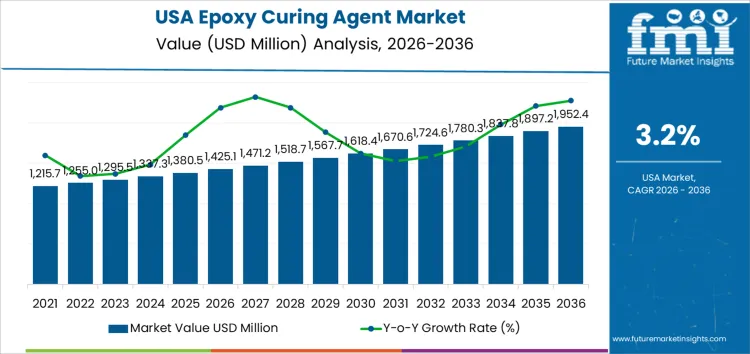
Demand for epoxy curing agent in USA is valued at USD 1,425.1 million in 2026 and is forecasted to reach USD 1,952.4 million by 2036, reflecting a CAGR of 3.2%. Demand remains supported by steady consumption across construction, coatings, adhesives, composites, and electrical applications requiring durable thermoset performance. Infrastructure maintenance, industrial flooring, and protective coating activity sustain baseline growth despite mature end-use penetration.
Quick Stats for Demand for Epoxy Curing Agent in USA
- USA Epoxy Curing Agent Sales Value (2026): USD 1,425.1 million
- USA Epoxy Curing Agent Forecast Value (2036): USD 1,952.4 million
- USA Epoxy Curing Agent Forecast CAGR (2026 to 2036): 3.2%
- Leading Raw Material Type in USA: Primary Amine-based Curing Agents
- Key Growth Regions in USA: West USA, South USA, Northeast USA, Midwest USA
- Top Players in USA: Olin Corporation, Huntsman Corporation, Hexion Inc., Aditya Birla Chemicals (Ashland), Evonik Industries
Primary amine-based curing agents lead raw material usage because these chemistries provide reliable cure speed, strong mechanical strength, and broad compatibility with epoxy resin systems. Formulators prefer primary amines for structural adhesives, industrial coatings, and composite fabrication where chemical resistance and thermal stability are required. Consistent performance across ambient and elevated curing conditions reinforces continued preference.
West USA, South USA, Northeast USA, and Midwest USA represent key growth regions supported by construction activity, manufacturing bases, and transportation infrastructure investment. Olin Corporation, Huntsman Corporation, Hexion Inc., Aditya Birla Chemicals (Ashland), and Evonik Industries anchor competitive activity through diversified curing agent portfolios, application-specific formulations, and supply reliability aligned with performance, regulatory, and processing requirements across USA epoxy end-use sectors.
USA Epoxy Curing Agent Key Takeaways
| Metric | Value |
|---|---|
| USA Epoxy Curing Agent Sales Value (2026) | USD 1,425.1 million |
| USA Epoxy Curing Agent Forecast Value (2036) | USD 1,952.4 million |
| USA Epoxy Curing Agent Forecast CAGR (2026 to 2036) | 3.2% |
Why is the Demand for Epoxy Curing Agent in USA Growing?
Demand for epoxy curing agents in the United States grows due to sustained activity across construction, industrial manufacturing, electronics, and transportation sectors. Infrastructure maintenance and commercial building projects rely on epoxy systems for coatings, flooring, and structural repairs that require controlled curing performance. Automotive and aerospace manufacturing use epoxy composites and adhesives to achieve strength, thermal stability, and fatigue resistance in lightweight assemblies. Growth in wind energy installations and electrical infrastructure increases use of epoxy based insulation, laminates, and protective coatings that depend on precise curing chemistry.
Electronics production applies epoxy encapsulants and potting compounds to protect components from moisture, vibration, and thermal stress. Industrial maintenance programs adopt epoxy coatings to extend asset life in corrosive environments across oil, gas, and chemical facilities. Formulators select specific curing agents to tailor cure speed, temperature tolerance, and mechanical properties for application requirements. Expansion of prefabrication and modular construction supports demand for fast curing systems that improve throughput. Domestic manufacturing emphasizes consistent quality and regulatory compliance, reinforcing use of standardized curing agents. Supply chain localization efforts strengthen procurement of curing chemistries produced and qualified within the country.
How Are the Segments Classified in the Demand for Epoxy Curing Agents in USA?
Demand for epoxy curing agents in USA is shaped by infrastructure refurbishment activity, industrial manufacturing intensity, and performance-focused coating requirements. Buyers evaluate curing behavior, mechanical strength, thermal stability, and compatibility with diverse epoxy resin formulations. Adoption patterns reflect steady usage across construction, transportation, electrical components, and industrial coatings, supported by emphasis on durability, predictable processing, and compliance with USA safety and material performance standards.
Which Raw Material Dominates Demand for Epoxy Curing Agents in USA?
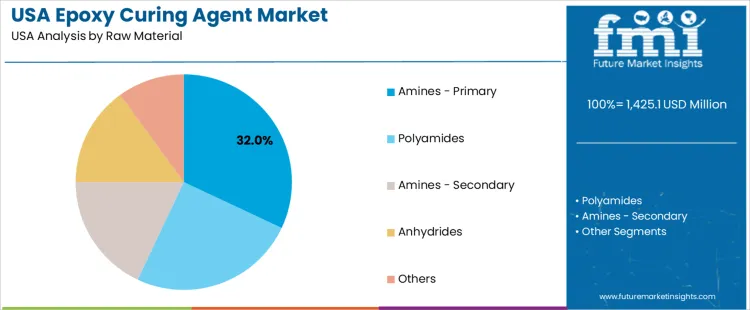
Primary amine-based curing agents hold 32.0%, making them the dominant raw material category in USA demand. These agents deliver high reactivity, strong crosslink density, and reliable mechanical strength across coatings, adhesives, and composite systems. Polyamides account for 25.0%, supporting flexibility, impact resistance, and moisture tolerance in protective coatings. Secondary amines hold 18.0%, offering moderated curing speed and improved handling safety. Anhydrides account for 15.0%, used in electrical insulation and high-temperature applications. Other raw materials hold 10.0%, addressing specialized formulation needs. Raw material distribution reflects preference for performance consistency and industrial processing reliability.
Key Points
- Primary amines lead due to high reactivity and strength.
- Polyamides support flexible and moisture-tolerant systems.
- Anhydrides serve high-temperature and electrical uses.
Which Grade Accounts for the Highest Share of Epoxy Curing Agent Demand in USA?
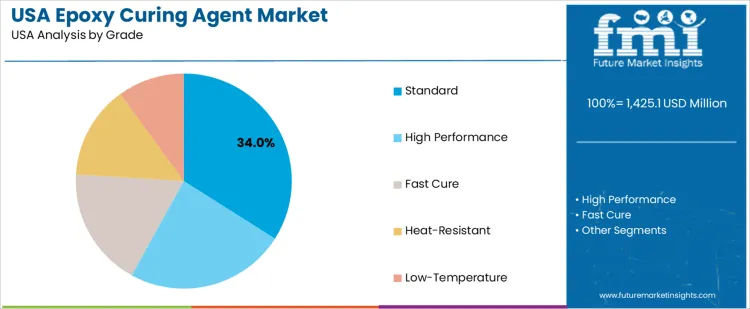
Standard grade curing agents hold 34.0%, representing the highest share within USA demand. Standard grades provide balanced performance, cost efficiency, and broad compatibility with common epoxy resin systems. High-performance grades account for 24.0%, supporting applications requiring enhanced durability and chemical resistance. Fast cure grades hold 18.0%, addressing rapid repair and installation needs. Heat-resistant grades represent 14.0%, applied in elevated temperature environments. Low-temperature grades hold 10.0%, enabling curing under cold operating conditions. Grade distribution reflects dominance of general-purpose formulations alongside specialized performance requirements.
Key Points
- Standard grades dominate due to versatility and cost balance.
- High-performance grades address demanding environments.
- Specialty grades support time- and temperature-sensitive use.
Which Curing Mechanism Is Most Widely Used in USA Epoxy Applications?
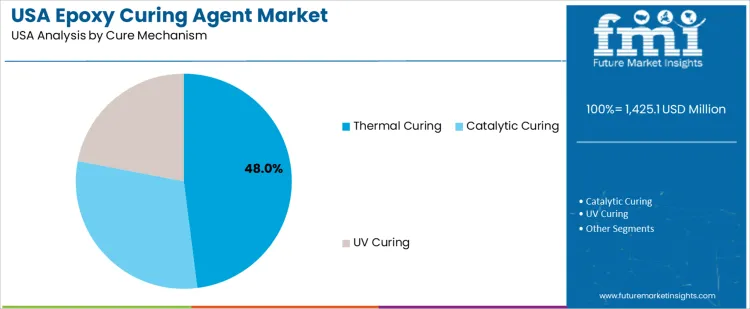
Thermal curing holds 48.0%, making it the most widely used curing mechanism in USA demand. Thermal systems provide uniform crosslinking, predictable cure profiles, and suitability for large-scale industrial operations. Catalytic curing accounts for 30.0%, enabling controlled reaction rates and reduced processing temperatures. UV curing holds 22.0%, supporting rapid curing cycles in electronics, coatings, and precision manufacturing. Cure mechanism distribution reflects strong reliance on proven thermal processes, with catalytic and UV methods serving efficiency-driven and precision-oriented applications.
Key Points
- Thermal curing leads due to scalability and process stability.
- Catalytic curing supports controlled reaction conditions.
- UV curing enables rapid processing in specialized uses.
What are the Key Dynamics in the Epoxy Curing Agent Industry?
Demand rises as coatings, adhesives, composites, and construction material manufacturers in USA rely on epoxy curing agents to achieve targeted mechanical performance, chemical resistance, and thermal stability. Usage aligns with automotive, aerospace, industrial flooring, wind energy, and electronics applications requiring durable crosslinked thermoset networks. Adoption reflects established manufacturing bases, infrastructure activity, and performance-driven specification practices across domestic production corridors.
How do industrial performance requirements and regulated coating standards drive demand in USA?
USA automotive and aerospace sectors use epoxy systems for structural adhesives, composite prepregs, and protective coatings where controlled cure profiles and bond strength are critical. Industrial coatings for pipelines, bridges, and heavy equipment prioritize corrosion resistance and long-term durability conferred by tailored curing agents. Wind turbine blade manufacturers and marine applications adopt specialized hardeners to support elevated performance under cyclic loading and environmental exposure. Electronics encapsulation and printed circuit board assembly use epoxy resins with specific curing chemistries to ensure insulation reliability. Demand reflects rigorous specification standards and quality expectations across regulated and performance-critical applications.
How do raw material cost volatility, environmental regulations, and formulation complexity influence demand stability in USA?
Epoxy curing agent pricing depends on aromatic amines, anhydrides, and other precursor availability, exposing demand to petrochemical feedstock volatility. Environmental regulations targeting volatile organic compound emissions and worker exposure influence selection of low-VOC and safer curing systems. Reformulation efforts require technical expertise to balance performance, cure kinetics, and regulatory compliance, increasing development time and cost. Small and mid-sized processors face capital barriers adopting advanced curing chemistries. Competitive alternatives such as polyurethane and polyester systems affect specification decisions in cost-sensitive segments. Demand remains stable where performance criteria dictate epoxy systems, while long-term growth depends on material cost management, regulatory alignment, and innovation in safer, compliant curing technologies within USA manufacturing environments.
How Is Demand for Epoxy Curing Agent in the USA Evolving by Region?
Demand for epoxy curing agent in the USA is increasing at a moderate pace due to infrastructure maintenance, composite material usage, and industrial coatings demand. West USA leads with a 3.7% CAGR, supported by construction activity, renewable energy installations, and aerospace composites. South USA follows at 3.3%, driven by industrial manufacturing, flooring systems, and protective coatings. Northeast USA records a 3.0% CAGR, shaped by infrastructure repair, corrosion protection, and building rehabilitation. Midwest USA posts 2.6%, reflecting automotive manufacturing, machinery maintenance, and cost-managed industrial applications. Regional variation reflects construction intensity, manufacturing base, infrastructure age, and pace of composite material adoption across the USA.
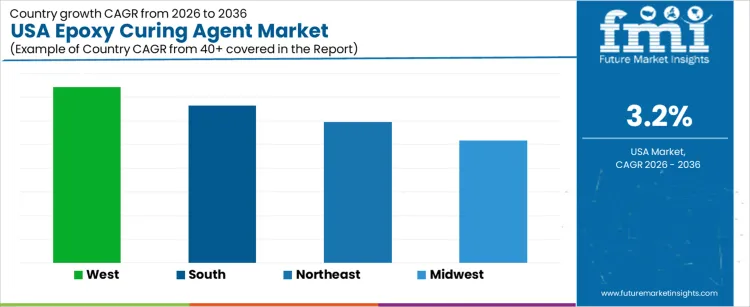
| Region | CAGR (2026 to 2036) |
|---|---|
| West USA | 3.7% |
| South USA | 3.3% |
| Northeast USA | 3.0% |
| Midwest USA | 2.6% |
What application trends are supporting epoxy curing agent demand in West USA?
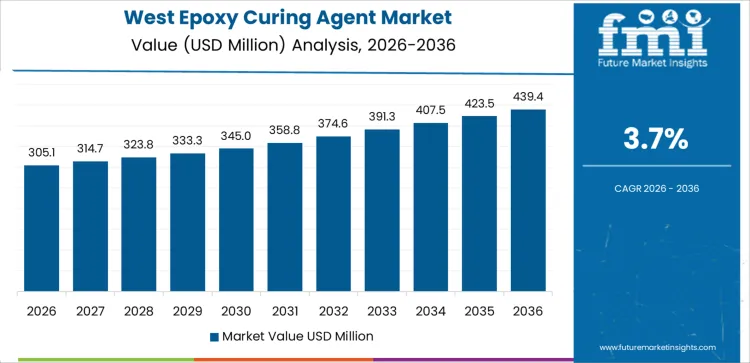
West USA drives demand through construction projects, renewable energy installations, and composite manufacturing. Region’s CAGR of 3.7% reflects use of epoxy curing agents in wind turbine blades, aerospace components, and protective coatings. Infrastructure repair and seismic retrofitting increase demand for high-performance epoxy systems. Manufacturers prioritize curing agents offering controlled cure times, thermal stability, and environmental compliance. Demand favors amine and modified curing agents’ compatible with low-VOC formulations. Growth remains project-led and specification-driven, aligned with infrastructure upgrades and composite material applications across coastal and inland markets.
- Renewable energy and composite manufacturing usage
- Infrastructure repair and seismic retrofitting
- Demand for controlled cure and performance stability
- Low-VOC and compliant formulation preference
Why does South USA show steady growth in epoxy curing agent consumption?
South USA demand is shaped by industrial manufacturing, warehouse construction, and protective flooring systems. Region’s CAGR of 3.3% reflects use of epoxy curing agents in industrial floors, tanks, and corrosion-resistant coatings. Chemical processing, oil and gas facilities, and food manufacturing drive consistent demand. Warm climate supports year-round construction and application. Buyers emphasize cost efficiency, durability, and compatibility with high-volume production. Demand growth remains steady and volume-driven, aligned with industrial expansion and maintenance activity rather than high-specification composites.
- Industrial flooring and coating applications
- Chemical and process industry demand
- Year-round construction activity
- Cost-efficient formulation focus
How do infrastructure repair needs influence demand in Northeast USA?
Northeast USA demand reflects aging infrastructure, building rehabilitation, and corrosion protection requirements. Region’s CAGR of 3.0% is supported by use of epoxy curing agents in bridge repair, concrete restoration, and protective coatings. Contractors prioritize reliable curing under variable temperature conditions. Regulatory standards influence material selection and application methods. Demand favors proven curing agents with predictable performance. Growth remains maintenance-led and specification-driven, aligned with public infrastructure investment and refurbishment programs.
- Bridge and concrete repair applications
- Corrosion protection and rehabilitation usage
- Performance under variable temperatures
- Specification-led procurement
What factors contribute to conservative growth in Midwest USA?
Midwest USA demand is anchored in automotive manufacturing, machinery maintenance, and industrial repair. Region’s CAGR of 2.6% reflects selective use of epoxy curing agents in tooling, adhesives, and protective coatings. Manufacturers prioritize cost control, durability, and compatibility with existing formulations. Adoption aligns with equipment replacement and maintenance cycles rather than new construction. Demand growth remains cautious and process-driven, reflecting stable industrial output and disciplined capital spending across mature manufacturing sectors.
- Automotive and machinery maintenance usage
- Tooling and adhesive applications
- Cost-controlled material selection
- Maintenance-cycle-driven demand
What is the competitive landscape of demand for epoxy curing agents in the USA?
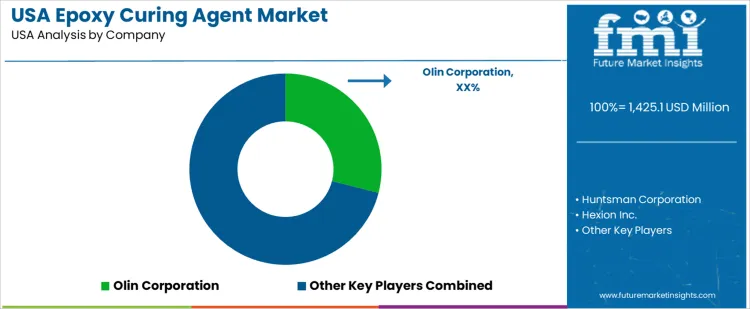
Demand for epoxy curing agents in the USA is driven by coatings, adhesives, composites, electronics encapsulation, and industrial flooring applications where cross-link density, cure speed, and thermal performance are critical. Buyers evaluate amine, anhydride, and polyamide hardeners based on reactivity profiles, pot life, humidity tolerance, and end-use performance requirements. Procurement teams prioritize suppliers with USA manufacturing or distribution, consistent quality control, regulatory compliance, and technical support for formulation optimization. Trend in the USA market reflects increased adoption of high-performance epoxy systems in aerospace and automotive composites, growth of industrial protective coatings, and demand for low-VOC and eco-compliant formulations.
Olin Corporation holds a leading position in the USA with an extensive portfolio of epoxy curing agents and amine derivatives used in coatings, adhesives, and composite formulations supported by domestic production and technical service. Huntsman Corporation participates with specialty curing agents and resin systems tailored for performance applications in aerospace, marine, and protective coatings. Hexion Inc. supports demand with a broad range of epoxy hardeners and cross-linkers used across industrial, construction, and electronic encapsulation markets. Aditya Birla Chemicals (Ashland) operates through USA distribution of epoxy curing systems with formulation support for adhesives and coatings. Evonik Industries supplies specialty hardeners and curing technologies used in engineered materials and advanced composites. Competitive positioning in the USA reflects formulation expertise, product consistency, service responsiveness, and alignment with evolving performance and regulatory requirements.
Key Players in USA Epoxy Curing Agent Demand
- Olin Corporation
- Huntsman Corporation
- Hexion Inc.
- Aditya Birla Chemicals (Ashland)
- Evonik Industries
Scope of the Report
| Items | Details |
|---|---|
| Quantitative Units | USD million |
| Raw Material | Amines – Primary; Polyamides; Amines – Secondary; Anhydrides; Others |
| Grade | Standard; High Performance; Fast Cure; Heat-Resistant; Low-Temperature |
| Cure Mechanism | Thermal Curing; Catalytic Curing; UV Curing |
| End Use | Paint and Coating; Adhesives and Sealants; Electrical and Electronics; Composites; Tooling and Molding |
| Regions Covered | West USA; South USA; Northeast USA; Midwest USA |
| Key Companies Profiled | Olin Corporation; Huntsman Corporation; Hexion Inc.; Aditya Birla Chemicals (Ashland); Evonik Industries |
| Additional Attributes | Demand is supported by infrastructure refurbishment, aerospace and automotive composites usage, and electronics encapsulation requirements. High-performance and fast-cure grades see wider adoption. Regional demand aligns with industrial manufacturing density, construction activity, and composite fabrication hubs across the United States. |
USA Epoxy Curing Agent Demand by Segments
Raw Material:
- Amines - Primary
- Polyamides
- Amines - Secondary
- Anhydrides
- Others
Grade:
- Standard
- High Performance
- Fast Cure
- Heat-Resistant
- Low-Temperature
Cure Mechanism:
- Thermal Curing
- Catalytic Curing
- UV Curing
End Use:
- Paint and Coating
- Adhesives and Sealants
- Electrical and Electronics
- Composites
- Tooling and Molding
Region:
- West USA
- South USA
- Northeast USA
- Midwest USA
Frequently Asked Questions
How big is the demand for epoxy curing agent in USA in 2026?
The demand for epoxy curing agent in USA is estimated to be valued at USD 1,425.1 million in 2026.
What will be the size of epoxy curing agent in USA in 2036?
The market size for the epoxy curing agent in USA is projected to reach USD 1,952.4 million by 2036.
How much will be the demand for epoxy curing agent in USA growth between 2026 and 2036?
The demand for epoxy curing agent in USA is expected to grow at a 3.2% CAGR between 2026 and 2036.
What are the key product types in the epoxy curing agent in USA?
The key product types in epoxy curing agent in USA are amines - primary, polyamides, amines - secondary, anhydrides and others.
Which grade segment is expected to contribute significant share in the epoxy curing agent in USA in 2026?
In terms of grade, standard segment is expected to command 34.0% share in the epoxy curing agent in USA in 2026.
Preview the report firsthand - request a free sample
Get SampleGet the brochure for pricing and purchase details.
Get PDFTable of Content
- Executive Summary
- USA Market Outlook
- Demand-side Trends
- Supply-side Trends
- Technology Roadmap Analysis
- Analysis and Recommendations
- Market Overview
- Market Coverage / Taxonomy
- Market Definition / Scope / Limitations
- Market Background
- Market Dynamics
- Drivers
- Restraints
- Opportunity
- Trends
- Scenario Forecast
- Demand in Optimistic Scenario
- Demand in Likely Scenario
- Demand in Conservative Scenario
- Opportunity Map Analysis
- Product Life Cycle Analysis
- Supply Chain Analysis
- Investment Feasibility Matrix
- Value Chain Analysis
- PESTLE and Porter’s Analysis
- Regulatory Landscape
- Regional Parent Market Outlook
- Production and Consumption Statistics
- Import and Export Statistics
- Market Dynamics
- USA Market Analysis 2021 to 2025 and Forecast, 2026 to 2036
- Historical Market Size Value (USD Million) Analysis, 2021 to 2025
- Current and Future Market Size Value (USD Million) Projections, 2026 to 2036
- Y-o-Y Growth Trend Analysis
- Absolute $ Opportunity Analysis
- USA Market Pricing Analysis 2021 to 2025 and Forecast 2026 to 2036
- USA Market Analysis 2021 to 2025 and Forecast 2026 to 2036, By Raw Material
- Introduction / Key Findings
- Historical Market Size Value (USD Million) Analysis By Raw Material , 2021 to 2025
- Current and Future Market Size Value (USD Million) Analysis and Forecast By Raw Material , 2026 to 2036
- Amines - Primary
- Polyamides
- Amines - Secondary
- Anhydrides
- Others
- Amines - Primary
- Y-o-Y Growth Trend Analysis By Raw Material , 2021 to 2025
- Absolute $ Opportunity Analysis By Raw Material , 2026 to 2036
- USA Market Analysis 2021 to 2025 and Forecast 2026 to 2036, By Grade
- Introduction / Key Findings
- Historical Market Size Value (USD Million) Analysis By Grade, 2021 to 2025
- Current and Future Market Size Value (USD Million) Analysis and Forecast By Grade, 2026 to 2036
- Standard
- High Performance
- Fast Cure
- Heat-Resistant
- Low-Temperature
- Standard
- Y-o-Y Growth Trend Analysis By Grade, 2021 to 2025
- Absolute $ Opportunity Analysis By Grade, 2026 to 2036
- USA Market Analysis 2021 to 2025 and Forecast 2026 to 2036, By Cure Mechanism
- Introduction / Key Findings
- Historical Market Size Value (USD Million) Analysis By Cure Mechanism, 2021 to 2025
- Current and Future Market Size Value (USD Million) Analysis and Forecast By Cure Mechanism, 2026 to 2036
- Thermal Curing
- Catalytic Curing
- UV Curing
- Thermal Curing
- Y-o-Y Growth Trend Analysis By Cure Mechanism, 2021 to 2025
- Absolute $ Opportunity Analysis By Cure Mechanism, 2026 to 2036
- USA Market Analysis 2021 to 2025 and Forecast 2026 to 2036, By End Use
- Introduction / Key Findings
- Historical Market Size Value (USD Million) Analysis By End Use, 2021 to 2025
- Current and Future Market Size Value (USD Million) Analysis and Forecast By End Use, 2026 to 2036
- Paint and Coating
- Adhesives and Sealants
- Electrical and Electronics
- Composites
- Tooling and Molding
- Paint and Coating
- Y-o-Y Growth Trend Analysis By End Use, 2021 to 2025
- Absolute $ Opportunity Analysis By End Use, 2026 to 2036
- Market Structure Analysis
- Competition Dashboard
- Competition Benchmarking
- Market Share Analysis of Top Players
- By Regional
- By Raw Material
- By Grade
- By Cure Mechanism
- By End Use
- Competition Analysis
- Competition Deep Dive
- Olin Corporation
- Overview
- Product Portfolio
- Profitability by Market Segments (Product/Age /Sales Channel/Region)
- Sales Footprint
- Strategy Overview
- Marketing Strategy
- Product Strategy
- Channel Strategy
- Huntsman Corporation
- Hexion Inc.
- Aditya Birla Chemicals (Ashland)
- Evonik Industries
- Olin Corporation
- Competition Deep Dive
- Assumptions & Acronyms Used
- Research Methodology


