

- Industry Size (2026)
- USD 342.3 Mn
- Forecast (2036)
- USD 920.5 Mn
- CAGR (2026 to 2036)
- 10.4%
Coagulants for Microfiber Capture in Laundry Effluents Market Forecast and Outlook 2026 to 2036
The coagulants for microfiber capture in laundry effluents market is valued at USD 342.3 million in 2026 and is projected to reach USD 920.5 million by 2036, growing at a compound annual growth rate (CAGR) of 10.4%. Regulatory oversight will play a pivotal role in driving market adoption as governments increasingly enforce stricter environmental standards related to wastewater treatment. Compliance costs associated with these regulations can be significant, particularly for smaller operators who may face challenges in scaling up to meet certification requirements.
Vendor positioning will hinge on the ability to navigate complex certification processes, ensuring that products not only meet regulatory demands but also demonstrate superior performance in microfiber capture. Suppliers that can offer streamlined certification pathways and cost-effective compliance solutions will have an advantage. Additionally, as regulations evolve globally, the complexity of maintaining product certifications will require ongoing investment in R&D and quality assurance, further shaping the competitive landscape.
Quick Stats of the Coagulants for Microfiber Capture in Laundry Effluents Market
- Coagulants for Microfiber Capture in Laundry Effluents Market Value (2026): USD 342.3 million
- Coagulants for Microfiber Capture in Laundry Effluents Market Forecast Value (2036): USD 920.5 million
- Coagulants for Microfiber Capture in Laundry Effluents Market Global Forecast CAGR (2026 to 2036): 10.4%
- Coagulants for Microfiber Capture in Laundry Effluents Market Leading Segment: Treatment Method (Chemical Dosing Coagulation) 38%
- Key Growth Regions in Coagulants for Microfiber Capture in Laundry Effluents Market: India
- Top Players in Coagulants for Microfiber Capture in Laundry Effluents Market: Kemira, SNF Floerger, Solenis, Ecolab, Veolia Water Technologies
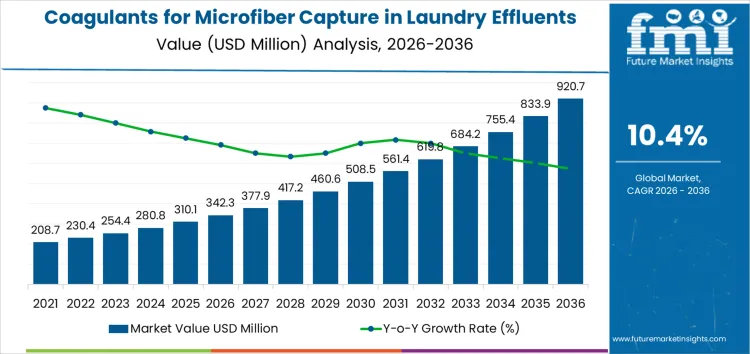
What is the Growth Forecast for the Coagulants for Microfiber Capture in Laundry Effluents Market through 2036?
The contribution of volume vs price growth in the coagulants for microfiber capture in laundry effluents market will be driven by both increased demand and improvements in chemical formulations. The primary driver of market growth will be volume growth, as the adoption of microfiber capture solutions becomes more widespread across industries like textiles, laundry services, and wastewater treatment. From 2026 to 2031, the market will increase from USD 342.3 million to USD 556 million, reflecting a growing volume of coagulants used in laundry effluent treatments. As microfiber pollution continues to gain attention, industries will increase their usage of coagulants, driving demand for higher volumes of these chemicals. By 2036, volume-driven growth will remain the dominant factor, accounting for a significant portion of the market's expansion.
Price growth will also contribute to the market’s expansion, though to a lesser extent compared to volume growth. As the technology behind coagulants improves and formulations become more efficient, the price of coagulants may rise due to innovations in their production and higher efficiency. Additionally, as regulations tighten and more industries are required to adopt microfiber capture solutions, suppliers may implement price increases. However, the market will remain price-sensitive, with competitive pricing ensuring that coagulants continue to be adopted at scale. The market value will grow steadily through both increased volume and the introduction of higher-value, more efficient formulations, with the price component adding a steady increase in value over time.
Coagulants for Microfiber Capture in Laundry Effluents Market Key Takeaways
| Metric | Value |
|---|---|
| Industry Sales Value (2026) | USD 342.3 million |
| Industry Forecast Value (2036) | USD 920.5 million |
| Industry Forecast CAGR (2026 to 2036) | 10.4% |
What Is Driving the Demand for the Coagulants for Microfiber Capture in Laundry Effluents Market Globally?
The global demand for coagulants for microfiber capture in laundry effluents is driven by increasing concern over microplastic pollution and regulatory attention on wastewater quality. Microfibers shed from textiles during laundering are a major source of microplastic contamination in aquatic environments. Conventional wastewater treatment systems often fail to retain these small fibers, allowing them to pass into rivers, lakes, and oceans where they persist and accumulate in food webs.
Municipal and industrial laundries, apparel manufacturers, and commercial laundromats are seeking solutions that improve fiber removal before effluents reach treatment plants. Coagulants serve to aggregate microfibers into larger, settleable flocs that can be removed by filtration, sedimentation, or other downstream processes. As public awareness of microplastic pollution grows and environmental groups highlight textile contributions to plastic loads, brands and facilities are responding with technologies that align with environmental stewardship and operational sustainability. Innovation in coagulant chemistry is expanding options that are compatible with existing wastewater infrastructure while offering enhanced capture efficiency.
Future demand for coagulants for microfiber capture in laundry effluents is expected to grow as environmental regulations, sustainability targets, and textile industry initiatives evolve. Governments in Europe, North America, and Asia are discussing or implementing standards that address microplastic discharges, which will drive adoption of technologies that can demonstrate measurable reductions in effluent fiber loads. Advances in coagulant formulations are improving performance across diverse water qualities and wash conditions, making these solutions more adaptable for residential, commercial, and industrial applications. Integration with lint filters, membrane systems, and decentralised treatment units will support broader uptake by offering multiple layers of fiber management.
Laundry appliance makers and detergent brands may also incorporate coagulant technologies into products or machine designs to differentiate offerings and meet consumer demand for environmental features. Expansion of laundering services and textile use in urban populations will sustain the volume of effluents requiring management, reinforcing the need for effective microfiber capture strategies. As sustainability commitments and regulatory clarity sharpen, coagulants that enhance microfiber removal while fitting operational and cost constraints are poised to see steady global market growth.
What are the Leading Segments in the Global Coagulants for Microfiber Capture in Laundry Effluents Market?
The global coagulants for microfiber capture in laundry effluents market is segmented by application area and treatment method. Among application areas, commercial & industrial laundry facilities lead the market, capturing 36% of the share, followed by household greywater treatment, textile manufacturing effluent, municipal wastewater treatment, and on-site decentralized treatment units. Commercial and industrial laundry facilities are the largest consumers of coagulants for microfiber capture due to the large volumes of laundry effluent they generate. On the treatment method side, chemical dosing coagulation dominates the market, holding 38% of the share, followed by coagulation + flocculation systems, membrane filtration with chemical aid, electrocoagulation with chemical enhancement, and hybrid & advanced treatment systems. Chemical dosing coagulation is widely used due to its simplicity and effectiveness in capturing microfibers and other contaminants from wastewater.
What Drives the Growth of Commercial & Industrial Laundry Facilities in the Coagulants for Microfiber Capture in Laundry Effluents Market?
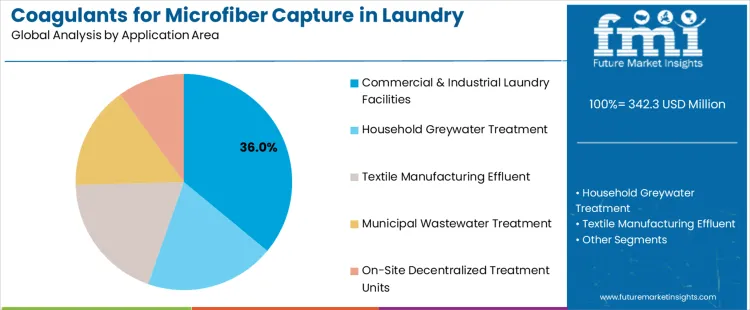
Commercial & industrial laundry facilities are the leading application area in the coagulants for microfiber capture in laundry effluents market, holding 36% of the share. This demand is driven by the high volume of wastewater generated by these facilities, which often contains significant amounts of microfibers from textiles during washing processes. Microfibers, particularly synthetic fibers like polyester and nylon, are a major environmental concern, as they can enter wastewater systems and ultimately reach oceans, contributing to microplastic pollution.
As regulations on wastewater discharge and environmental sustainability tighten, commercial and industrial laundries are increasingly adopting coagulants to capture and remove these microfibers from their effluent. Coagulation technologies are highly effective in aggregating the small fibers into larger particles that can be easily removed. The growing emphasis on eco-friendly practices and the need to reduce microfiber pollution are driving the demand for coagulants in commercial and industrial laundry operations.
What is Driving the Demand for Chemical Dosing Coagulation in the Coagulants for Microfiber Capture in Laundry Effluents Market?
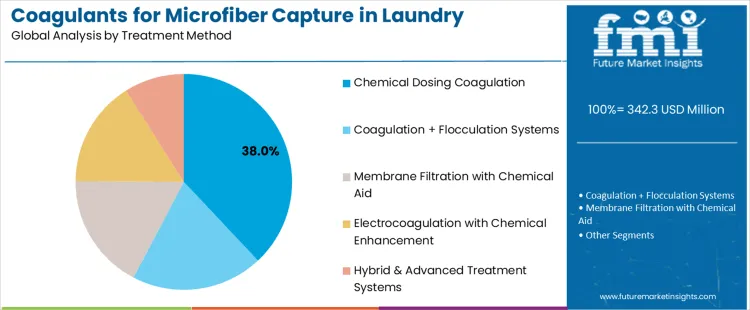
Chemical dosing coagulation is the leading treatment method in the coagulants for microfiber capture in laundry effluents market, holding 38% of the share. This method is preferred for its simplicity, efficiency, and cost-effectiveness in capturing microfibers and other particulate contaminants in wastewater. During chemical dosing coagulation, coagulants are added to wastewater to destabilize the particles, causing them to clump together into larger aggregates that can then be removed by filtration or settling.
Chemical dosing coagulation is widely used in laundry facilities because it is easy to implement and works well across a range of wastewater conditions. As industries, particularly in textiles and laundry services, face increasing pressure to comply with environmental regulations and reduce their environmental impact, the demand for this treatment method is growing. Chemical dosing coagulation is expected to remain a dominant solution in the market for microfiber capture due to its proven effectiveness and low operational costs.
What are the Key Dynamics in the Global Coagulants for Microfiber Capture in Laundry Effluents Market?
The global coagulants for microfiber capture in laundry effluents market is expanding as environmental concerns over microplastic release from domestic and commercial laundry increase. Coagulants are chemical agents that promote aggregation of suspended microfibers-tiny plastic fibers shed from textiles-so they can be more effectively captured by filters or settling systems in wastewater treatment. Growth reflects rising regulatory scrutiny of microplastic pollution, demand for sustainable wastewater solutions, and adoption of laundry systems in municipal and industrial laundries that minimise environmental discharge. Use spans residential, commercial and institutional laundry operations where improved effluent quality supports regulatory compliance and environmental stewardship.
What are the Key Drivers for the Coagulants for Microfiber Capture in Laundry Effluents Market?
Heightened awareness of microplastic pollution and its ecological impact is a major driver of market growth. Governments and water authorities are introducing guidelines and monitoring frameworks focused on reducing microplastic loads in wastewater, prompting interest in solutions that enhance capture prior to discharge. Advances in coagulant chemistry improve effectiveness at aggregating diverse microfiber types, enabling integration with primary and tertiary wastewater treatment processes. Expansion of urban wastewater infrastructure and sustainability commitments by commercial laundry services and hospitality sectors encourages adoption of technologies that support environmental performance. Consumer demand for greener laundry practices and corporate environmental reporting also stimulates interest in microfiber capture solutions.
What are the Restraints for the Coagulants for Microfiber Capture in Laundry Effluents Market?
A restraint is the variability of laundry wastewater characteristics, which can influence coagulant performance and require site specific optimisation. Effluent composition varies with detergent type, water hardness, fabric blends and wash cycle conditions, complicating standardised chemical dosing and performance prediction. Facilities may face cost concerns when adding or upgrading treatment stages with specialised coagulants, especially where basic regulatory requirements do not yet mandate microfiber capture. Some wastewater systems lack advanced filtration or settling infrastructure to fully take advantage of coagulated aggregates, limiting perceived benefit. Limited awareness of coagulant benefits among smaller laundries and municipal systems may slow adoption without clear regulatory drivers.
What are the Key Trends in the Coagulants for Microfiber Capture in Laundry Effluents Market?
A key trend is development of eco friendly and biodegradable coagulant chemistries that support microplastic aggregation while reducing potential impacts on downstream treatment and sludge management. Manufacturers are focusing on tailored polymers and organic coagulant systems that respond effectively across a range of laundry effluent conditions. Integration of microfiber capture solutions with enhanced filtration technologies-such as membrane bioreactors and fine screens-is gaining traction to improve overall removal efficiency. Real time monitoring and data analytics tools help optimise dosing and track performance, supporting continuous improvement and regulatory reporting. Collaboration across wastewater technology providers, commercial laundries and regulatory bodies is advancing best practices and specification of microfiber control strategies aligned with environmental goals.
What is the Country-Wise Analysis of the Coagulants for Microfiber Capture in Laundry Effluents Market?
The coagulants for microfiber capture in laundry effluents market is projected to grow steadily, driven by increasing environmental concerns regarding the release of microfibers from laundry wastewater into aquatic ecosystems. These coagulants help capture and remove microfibers, preventing them from entering water bodies and causing environmental damage. High-growth markets like India and China are seeing significant demand due to rapid industrialization, urbanization, and rising awareness about pollution control. Developed markets such as the United States, Germany, and South Korea are also experiencing steady growth, supported by stringent environmental regulations, technological advancements in wastewater treatment, and a growing emphasis on sustainability and eco-friendly practices in laundry and textile industries.
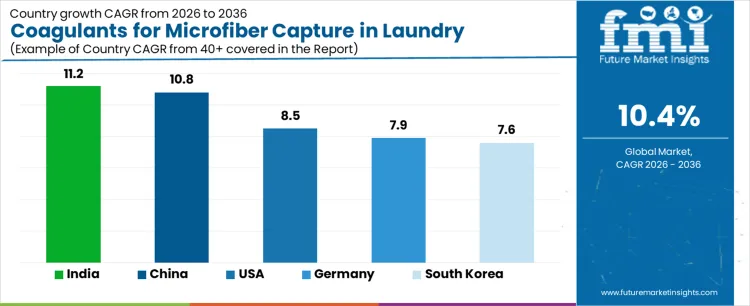
| Country | CAGR (2026-2036) |
|---|---|
| India | 11.2% |
| China | 10.8% |
| USA | 8.5% |
| Germany | 7.9% |
| South Korea | 7.6% |
What is the Growth Outlook for the Coagulants for Microfiber Capture in Laundry Effluents Market in India?
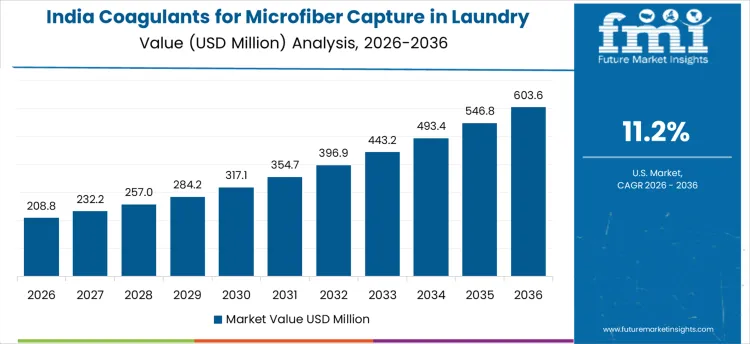
The coagulants for microfiber capture in laundry effluents market in India is expected to grow at the highest rate, with a projected CAGR of 11.2%. India’s rapidly expanding urban population and increasing industrial and commercial laundry activities are contributing to growing concerns about microfiber pollution in water bodies. With growing awareness about the environmental impact of laundry wastewater and the need to comply with global sustainability standards, the demand for microfiber capture solutions is rising. The Indian government’s increasing focus on water conservation, wastewater treatment, and pollution control is further driving the adoption of coagulants for microfiber capture. As the country moves toward more sustainable textile and laundry practices, the market for these coagulants is set for strong growth.
What is the Market Outlook for the Coagulants for Microfiber Capture in Laundry Effluents Market in China?
The coagulants for microfiber capture in laundry effluents market in China is projected to grow steadily, with a projected CAGR of 10.8%. China’s significant textile and garment industry, combined with rapid urbanization and industrialization, is generating large volumes of laundry effluents that contribute to microfiber pollution in water sources. The country is increasingly recognizing the need to address wastewater management issues and adopt eco-friendly solutions. As part of its efforts to improve environmental sustainability and reduce water contamination, China is driving the adoption of microfiber capture technologies in laundry systems. The growing focus on clean water initiatives and green manufacturing practices is expected to fuel the demand for coagulants in wastewater treatment, positioning China’s market for steady growth.
What is the Growth Forecast for the Coagulants for Microfiber Capture in Laundry Effluents Market in the United States?
The coagulants for microfiber capture in laundry effluents market in the United States is expected to grow steadily, with a projected CAGR of 8.5%. In the U.S., increasing concerns about microfiber pollution in aquatic ecosystems are driving the demand for effective water treatment solutions. With a strong regulatory framework aimed at reducing water contamination, the U.S. market is focusing on sustainable and eco-friendly technologies for wastewater management in industries like textiles and laundry. The growing emphasis on reducing microplastic pollution and improving water quality, coupled with the rise in sustainable textile manufacturing practices, is expected to boost the adoption of coagulants for microfiber capture in laundry effluents in the U.S. market.
What is the Market Outlook for the Coagulants for Microfiber Capture in Laundry Effluents Market in Germany?
The coagulants for microfiber capture in laundry effluents market in Germany is projected to grow at a steady pace, with a projected CAGR of 7.9%. Germany, with its strong environmental regulations and focus on sustainability, is driving the demand for technologies that address water pollution, including microfiber contamination from laundry effluents. The country’s textile and laundry industries are under increasing pressure to adopt cleaner technologies that comply with European Union directives on waste and water management. Germany’s commitment to reducing plastic pollution and improving water quality in water bodies is encouraging the adoption of microfiber capture solutions, leading to steady market growth for coagulants in wastewater treatment applications.
What are the Growth Prospects for the Coagulants for Microfiber Capture in Laundry Effluents Market in South Korea?
The coagulants for microfiber capture in laundry effluents market in South Korea is expected to grow steadily, with a projected CAGR of 7.6%. South Korea’s growing textile and garment industry, coupled with increasing awareness about environmental pollution, is driving demand for solutions to manage microfiber contamination. The government’s commitment to sustainability and improving water quality is encouraging industries to adopt wastewater treatment technologies that reduce the environmental impact of laundry operations. South Korea’s regulatory frameworks aimed at protecting water bodies and reducing pollution are expected to fuel the adoption of microfiber capture technologies, including coagulants, making the market in South Korea poised for steady growth.
What is the Competitive Landscape for the Coagulants for Microfiber Capture in Laundry Effluents Market?
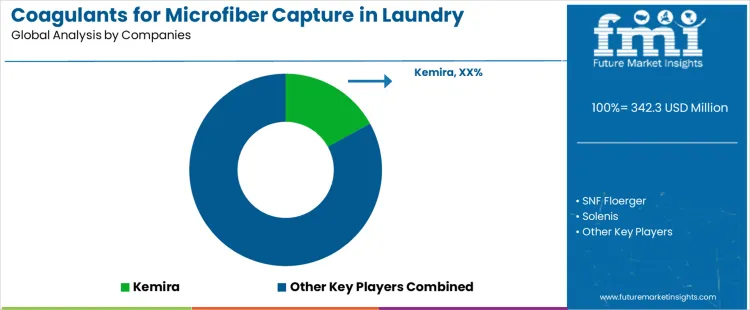
The coagulants for microfiber capture in laundry effluents market is experiencing growth as industries and municipalities seek sustainable solutions to address microfiber pollution in wastewater. Kemira leads the market with its advanced coagulant solutions, offering effective products designed to capture microfibers from laundry effluents, reducing the environmental impact of textile washing. Their focus on product performance, environmental sustainability, and regulatory compliance has positioned them as a dominant player in this sector.
SNF Floerger, Solenis, and Ecolab are significant competitors, each providing specialized coagulants designed to enhance microfiber removal in water treatment processes. SNF Floerger and Solenis offer high-quality coagulants that improve the efficiency of microfiber capture, while Ecolab emphasizes eco-friendly solutions that address water pollution in laundry and industrial effluents.
Veolia Water Technologies further strengthens the competitive landscape by offering innovative technologies and coagulant products aimed at improving water treatment and capturing microfibers in wastewater. Veolia Water Technologies focuses on providing sustainable and cost-effective solutions to improve wastewater treatment processes. These companies compete by focusing on product innovation, sustainability, and the ability to meet the growing demand for effective solutions to mitigate microfiber pollution in laundry effluents. As environmental awareness and regulatory pressures increase, the market for coagulants for microfiber capture is expected to continue growing, driving further advancements in the sector.
Key Players of the Coagulants for Microfiber Capture in Laundry Effluents Market
- Kemira
- SNF Floerger
- Solenis
- Ecolab
- Veolia Water Technologies
Scope of the Report
| Items | Values |
|---|---|
| Quantitative Units (2026) | USD Million |
| Coagulant Type | Inorganic Metal Salt Coagulants (Alum, FeCl₃), Organic Polymer Coagulants, Bio-Based & Plant-Derived Coagulants, Hybrid Coagulant-Flocculant Systems, Other Specialty Microfiber Capture Chemicals |
| Application Area | Commercial & Industrial Laundry Facilities, Household Greywater Treatment, Textile Manufacturing Effluent, Municipal Wastewater Treatment, On-Site Decentralized Treatment Units |
| Treatment Method | Chemical Dosing Coagulation, Coagulation + Flocculation Systems, Membrane Filtration with Chemical Aid, Electrocoagulation with Chemical Enhancement, Hybrid & Advanced Treatment Systems |
| Companies | Kemira, SNF Floerger, Solenis, Ecolab, Veolia Water Technologies |
| Regions Covered | North America, Latin America, Western Europe, Eastern Europe, South Asia and Pacific, East Asia, Middle East & Africa |
| Countries Covered | United States, Canada, Mexico, Brazil, Argentina, Germany, France, United Kingdom, Italy, Spain, Netherlands, China, India, Japan, South Korea, ANZ, GCC Countries, South Africa |
| Additional Attributes | Dollar by sales by coagulant type, application area, treatment method, and region. Includes market trends in coagulants for microfiber capture, performance in laundry effluent and wastewater treatment applications, cost-effectiveness, sustainability practices, regulatory compliance, market share and competitive positioning of key companies, and the role of coagulants in enhancing microfiber capture, improving treatment efficiency, and supporting cleaner water practices across commercial, industrial, and municipal sectors. |
Coagulants for Microfiber Capture in Laundry Effluents Market Segmentation
By Coagulant Type:
- Inorganic Metal Salt Coagulants (Alum, FeCl₃)
- Organic Polymer Coagulants
- Bio-Based & Plant-Derived Coagulants
- Hybrid Coagulant-Flocculant Systems
- Other Specialty Microfiber Capture Chemicals
Application Area:
- Commercial & Industrial Laundry Facilities
- Household Greywater Treatment
- Textile Manufacturing Effluent
- Municipal Wastewater Treatment
- On-Site Decentralized Treatment Units
Treatment Method:
- Chemical Dosing Coagulation
- Coagulation + Flocculation Systems
- Membrane Filtration with Chemical Aid
- Electrocoagulation with Chemical Enhancement
- Hybrid & Advanced Treatment Systems
By Region:
- Asia Pacific
- China
- Japan
- South Korea
- India
- Australia & New Zealand
- ASEAN
- Rest of Asia Pacific
- Europe
- Germany
- United Kingdom
- France
- Italy
- Spain
- Nordic
- BENELUX
- Rest of Europe
- North America
- United States
- Canada
- Mexico
- Latin America
- Brazil
- Chile
- Rest of Latin America
- Middle East & Africa
- Kingdom of Saudi Arabia
- Other GCC Countries
- Turkey
- South Africa
- Other African Union
- Rest of Middle East & Africa
Frequently Asked Questions
How big is the coagulants for microfiber capture in laundry effluents market in 2026?
The global coagulants for microfiber capture in laundry effluents market is estimated to be valued at USD 342.3 million in 2026.
What will be the size of coagulants for microfiber capture in laundry effluents market in 2036?
The market size for the coagulants for microfiber capture in laundry effluents market is projected to reach USD 920.7 million by 2036.
How much will be the coagulants for microfiber capture in laundry effluents market growth between 2026 and 2036?
The coagulants for microfiber capture in laundry effluents market is expected to grow at a 10.4% CAGR between 2026 and 2036.
What are the key product types in the coagulants for microfiber capture in laundry effluents market?
The key product types in coagulants for microfiber capture in laundry effluents market are inorganic metal salt coagulants (alum, fecl₃), organic polymer coagulants, bio-based & plant-derived coagulants, hybrid coagulant-flocculant systems and other specialty microfiber capture chemicals.
Which application area segment to contribute significant share in the coagulants for microfiber capture in laundry effluents market in 2026?
In terms of application area, commercial & industrial laundry facilities segment to command 36.0% share in the coagulants for microfiber capture in laundry effluents market in 2026.
Preview the report firsthand - request a free sample
Get SampleGet the brochure for pricing and purchase details.
Get PDFTable of Content
- Executive Summary
- Global Market Outlook
- Demand-side Trends
- Supply-side Trends
- Technology Roadmap Analysis
- Analysis and Recommendations
- Market Overview
- Market Coverage / Taxonomy
- Market Definition / Scope / Limitations
- Market Background
- Market Dynamics
- Drivers
- Restraints
- Opportunity
- Trends
- Scenario Forecast
- Demand in Optimistic Scenario
- Demand in Likely Scenario
- Demand in Conservative Scenario
- Opportunity Map Analysis
- Product Life Cycle Analysis
- Supply Chain Analysis
- Investment Feasibility Matrix
- Value Chain Analysis
- PESTLE and Porter’s Analysis
- Regulatory Landscape
- Regional Parent Market Outlook
- Production and Consumption Statistics
- Import and Export Statistics
- Market Dynamics
- Global Market Analysis 2021 to 2025 and Forecast, 2026 to 2036
- Historical Market Size Value (USD Million) Analysis, 2021 to 2025
- Current and Future Market Size Value (USD Million) Projections, 2026 to 2036
- Y-o-Y Growth Trend Analysis
- Absolute $ Opportunity Analysis
- Global Market Pricing Analysis 2021 to 2025 and Forecast 2026 to 2036
- Global Market Analysis 2021 to 2025 and Forecast 2026 to 2036, By Coagulant Type
- Introduction / Key Findings
- Historical Market Size Value (USD Million) Analysis By Coagulant Type , 2021 to 2025
- Current and Future Market Size Value (USD Million) Analysis and Forecast By Coagulant Type , 2026 to 2036
- Inorganic Metal Salt Coagulants (Alum, FeCl₃)
- Organic Polymer Coagulants
- Bio-Based & Plant-Derived Coagulants
- Hybrid Coagulant-Flocculant Systems
- Other Specialty Microfiber Capture Chemicals
- Inorganic Metal Salt Coagulants (Alum, FeCl₃)
- Y-o-Y Growth Trend Analysis By Coagulant Type , 2021 to 2025
- Absolute $ Opportunity Analysis By Coagulant Type , 2026 to 2036
- Global Market Analysis 2021 to 2025 and Forecast 2026 to 2036, By Application Area
- Introduction / Key Findings
- Historical Market Size Value (USD Million) Analysis By Application Area, 2021 to 2025
- Current and Future Market Size Value (USD Million) Analysis and Forecast By Application Area, 2026 to 2036
- Commercial & Industrial Laundry Facilities
- Household Greywater Treatment
- Textile Manufacturing Effluent
- Municipal Wastewater Treatment
- On-Site Decentralized Treatment Value (USD Million)s
- Commercial & Industrial Laundry Facilities
- Y-o-Y Growth Trend Analysis By Application Area, 2021 to 2025
- Absolute $ Opportunity Analysis By Application Area, 2026 to 2036
- Global Market Analysis 2021 to 2025 and Forecast 2026 to 2036, By Treatment Method
- Introduction / Key Findings
- Historical Market Size Value (USD Million) Analysis By Treatment Method, 2021 to 2025
- Current and Future Market Size Value (USD Million) Analysis and Forecast By Treatment Method, 2026 to 2036
- Chemical Dosing Coagulation
- Coagulation + Flocculation Systems
- Membrane Filtration with Chemical Aid
- Electrocoagulation with Chemical Enhancement
- Hybrid & Advanced Treatment Systems
- Chemical Dosing Coagulation
- Y-o-Y Growth Trend Analysis By Treatment Method, 2021 to 2025
- Absolute $ Opportunity Analysis By Treatment Method, 2026 to 2036
- Global Market Analysis 2021 to 2025 and Forecast 2026 to 2036, By Region
- Introduction
- Historical Market Size Value (USD Million) Analysis By Region, 2021 to 2025
- Current Market Size Value (USD Million) Analysis and Forecast By Region, 2026 to 2036
- North America
- Latin America
- Western Europe
- Eastern Europe
- East Asia
- South Asia and Pacific
- Middle East & Africa
- Market Attractiveness Analysis By Region
- North America Market Analysis 2021 to 2025 and Forecast 2026 to 2036, By Country
- Historical Market Size Value (USD Million) Trend Analysis By Market Taxonomy, 2021 to 2025
- Market Size Value (USD Million) Forecast By Market Taxonomy, 2026 to 2036
- By Country
- USA
- Canada
- Mexico
- By Coagulant Type
- By Application Area
- By Treatment Method
- By Country
- Market Attractiveness Analysis
- By Country
- By Coagulant Type
- By Application Area
- By Treatment Method
- Key Takeaways
- Latin America Market Analysis 2021 to 2025 and Forecast 2026 to 2036, By Country
- Historical Market Size Value (USD Million) Trend Analysis By Market Taxonomy, 2021 to 2025
- Market Size Value (USD Million) Forecast By Market Taxonomy, 2026 to 2036
- By Country
- Brazil
- Chile
- Rest of Latin America
- By Coagulant Type
- By Application Area
- By Treatment Method
- By Country
- Market Attractiveness Analysis
- By Country
- By Coagulant Type
- By Application Area
- By Treatment Method
- Key Takeaways
- Western Europe Market Analysis 2021 to 2025 and Forecast 2026 to 2036, By Country
- Historical Market Size Value (USD Million) Trend Analysis By Market Taxonomy, 2021 to 2025
- Market Size Value (USD Million) Forecast By Market Taxonomy, 2026 to 2036
- By Country
- Germany
- UK
- Italy
- Spain
- France
- Nordic
- BENELUX
- Rest of Western Europe
- By Coagulant Type
- By Application Area
- By Treatment Method
- By Country
- Market Attractiveness Analysis
- By Country
- By Coagulant Type
- By Application Area
- By Treatment Method
- Key Takeaways
- Eastern Europe Market Analysis 2021 to 2025 and Forecast 2026 to 2036, By Country
- Historical Market Size Value (USD Million) Trend Analysis By Market Taxonomy, 2021 to 2025
- Market Size Value (USD Million) Forecast By Market Taxonomy, 2026 to 2036
- By Country
- Russia
- Poland
- Hungary
- Balkan & Baltic
- Rest of Eastern Europe
- By Coagulant Type
- By Application Area
- By Treatment Method
- By Country
- Market Attractiveness Analysis
- By Country
- By Coagulant Type
- By Application Area
- By Treatment Method
- Key Takeaways
- East Asia Market Analysis 2021 to 2025 and Forecast 2026 to 2036, By Country
- Historical Market Size Value (USD Million) Trend Analysis By Market Taxonomy, 2021 to 2025
- Market Size Value (USD Million) Forecast By Market Taxonomy, 2026 to 2036
- By Country
- China
- Japan
- South Korea
- By Coagulant Type
- By Application Area
- By Treatment Method
- By Country
- Market Attractiveness Analysis
- By Country
- By Coagulant Type
- By Application Area
- By Treatment Method
- Key Takeaways
- South Asia and Pacific Market Analysis 2021 to 2025 and Forecast 2026 to 2036, By Country
- Historical Market Size Value (USD Million) Trend Analysis By Market Taxonomy, 2021 to 2025
- Market Size Value (USD Million) Forecast By Market Taxonomy, 2026 to 2036
- By Country
- India
- ASEAN
- Australia & New Zealand
- Rest of South Asia and Pacific
- By Coagulant Type
- By Application Area
- By Treatment Method
- By Country
- Market Attractiveness Analysis
- By Country
- By Coagulant Type
- By Application Area
- By Treatment Method
- Key Takeaways
- Middle East & Africa Market Analysis 2021 to 2025 and Forecast 2026 to 2036, By Country
- Historical Market Size Value (USD Million) Trend Analysis By Market Taxonomy, 2021 to 2025
- Market Size Value (USD Million) Forecast By Market Taxonomy, 2026 to 2036
- By Country
- Kingdom of Saudi Arabia
- Other GCC Countries
- Turkiye
- South Africa
- Other African Union
- Rest of Middle East & Africa
- By Coagulant Type
- By Application Area
- By Treatment Method
- By Country
- Market Attractiveness Analysis
- By Country
- By Coagulant Type
- By Application Area
- By Treatment Method
- Key Takeaways
- Key Countries Market Analysis
- USA
- Pricing Analysis
- Market Share Analysis, 2025
- By Coagulant Type
- By Application Area
- By Treatment Method
- Canada
- Pricing Analysis
- Market Share Analysis, 2025
- By Coagulant Type
- By Application Area
- By Treatment Method
- Mexico
- Pricing Analysis
- Market Share Analysis, 2025
- By Coagulant Type
- By Application Area
- By Treatment Method
- Brazil
- Pricing Analysis
- Market Share Analysis, 2025
- By Coagulant Type
- By Application Area
- By Treatment Method
- Chile
- Pricing Analysis
- Market Share Analysis, 2025
- By Coagulant Type
- By Application Area
- By Treatment Method
- Germany
- Pricing Analysis
- Market Share Analysis, 2025
- By Coagulant Type
- By Application Area
- By Treatment Method
- UK
- Pricing Analysis
- Market Share Analysis, 2025
- By Coagulant Type
- By Application Area
- By Treatment Method
- Italy
- Pricing Analysis
- Market Share Analysis, 2025
- By Coagulant Type
- By Application Area
- By Treatment Method
- Spain
- Pricing Analysis
- Market Share Analysis, 2025
- By Coagulant Type
- By Application Area
- By Treatment Method
- France
- Pricing Analysis
- Market Share Analysis, 2025
- By Coagulant Type
- By Application Area
- By Treatment Method
- India
- Pricing Analysis
- Market Share Analysis, 2025
- By Coagulant Type
- By Application Area
- By Treatment Method
- ASEAN
- Pricing Analysis
- Market Share Analysis, 2025
- By Coagulant Type
- By Application Area
- By Treatment Method
- Australia & New Zealand
- Pricing Analysis
- Market Share Analysis, 2025
- By Coagulant Type
- By Application Area
- By Treatment Method
- China
- Pricing Analysis
- Market Share Analysis, 2025
- By Coagulant Type
- By Application Area
- By Treatment Method
- Japan
- Pricing Analysis
- Market Share Analysis, 2025
- By Coagulant Type
- By Application Area
- By Treatment Method
- South Korea
- Pricing Analysis
- Market Share Analysis, 2025
- By Coagulant Type
- By Application Area
- By Treatment Method
- Russia
- Pricing Analysis
- Market Share Analysis, 2025
- By Coagulant Type
- By Application Area
- By Treatment Method
- Poland
- Pricing Analysis
- Market Share Analysis, 2025
- By Coagulant Type
- By Application Area
- By Treatment Method
- Hungary
- Pricing Analysis
- Market Share Analysis, 2025
- By Coagulant Type
- By Application Area
- By Treatment Method
- Kingdom of Saudi Arabia
- Pricing Analysis
- Market Share Analysis, 2025
- By Coagulant Type
- By Application Area
- By Treatment Method
- Turkiye
- Pricing Analysis
- Market Share Analysis, 2025
- By Coagulant Type
- By Application Area
- By Treatment Method
- South Africa
- Pricing Analysis
- Market Share Analysis, 2025
- By Coagulant Type
- By Application Area
- By Treatment Method
- USA
- Market Structure Analysis
- Competition Dashboard
- Competition Benchmarking
- Market Share Analysis of Top Players
- By Regional
- By Coagulant Type
- By Application Area
- By Treatment Method
- Competition Analysis
- Competition Deep Dive
- Kemira
- Overview
- Product Portfolio
- Profitability by Market Segments (Product/Age /Sales Channel/Region)
- Sales Footprint
- Strategy Overview
- Marketing Strategy
- Product Strategy
- Channel Strategy
- SNF Floerger
- Solenis
- Ecolab
- Veolia Water Technologies
- Kemira
- Competition Deep Dive
- Assumptions & Acronyms Used
- Research Methodology


