

- Industry Size (2026)
- USD 455.6 Mn
- Forecast (2036)
- USD 909.4 Mn
- CAGR (2026 to 2036)
- 7.15%
Formaldehyde Free Textile Crosslinkers Market Size, Market Forecast and Outlook By FMI
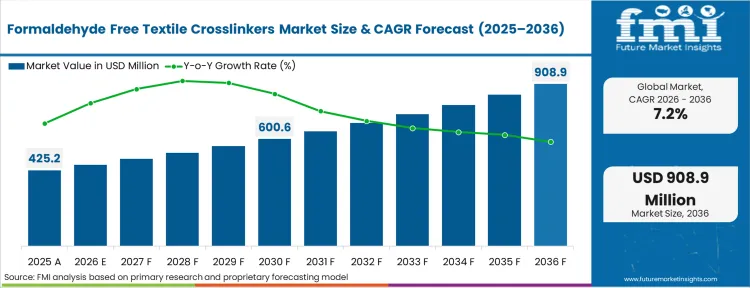
The formaldehyde free textile crosslinkers market was valued at USD 425.2 million in 2025 and is expected to reach USD 455.6 million in 2026, growing at a CAGR of 7.15%. Sector is projected to expand to USD 909.4 million by 2036, driven by stringent zero‑tolerance restricted substance policies enforced by Western retail brands, which are compelling tier‑1 export mills to replace legacy resins to retain approved vendor status.
Mill operations directors are currently navigating a forced operational calculation: absorb the elevated energy costs associated with curing non-formaldehyde systems or forfeit access to high-margin Western export contracts entirely. This dynamic shifts the procurement of apparel processing specifications from a cost-driven purchasing decision to a fundamental market access requirement. Facilities that delay integration risk immediate removal from tier-1 approved vendor lists, a status notoriously difficult to regain mid-season. The transition is governed less by local environmental legislation and almost entirely by the legal liability global brands face from consumer advocacy monitoring.
Before growth becomes fully self-reinforcing, the industry must clear a specific chemical engineering gate: the commercialization of low-temperature curing catalysts. Currently, the higher thermal requirement of non-formaldehyde resins taxes older continuous stenter frames. Once catalyst formulators close this thermal gap, the operational penalty of switching vanishes, making the final unit of legacy replacement commercially frictionless.
Summary of Formaldehyde Free Textile Crosslinkers Market
- Formaldehyde Free Textile Crosslinkers Market Definition
- This market tracks the deployment of zero-emission bonding chemistries used to stabilize textile fibers. It is structurally defined by the absolute elimination of formaldehyde-donor mechanisms, replacing legacy crosslinkers with acid-based or polyurethane architectures that comply with zero-tolerance global apparel standards.
- Demand Drivers in the Market
- Brand-level restricted substance mandates compel tier-1 mill operators to purge legacy resins from their entire inventory to clear seasonal compliance audits.
- Consumer advocacy pressure forces retail sourcing directors to demand verifiable zero-toxicity chemical supply chains before allocating high-volume production contracts.
- Advancements in catalyst efficiency enable chemical formulators to drop the required curing temperatures, lowering the adoption barrier for commission finishers.
- Key Segments Analyzed in the FMI Report
- Polycarboxylic Acids (PCAs): Polycarboxylic Acids are expected to grab 42.5% share in 2026, as they remain the only commercially scaled chemistry that achieves acceptable durable press ratings without requiring mills to redesign their application infrastructure.
- Crease Resistance: Crease Resistance is estimated to hold 38.2% share in 2026, driven by the structural requirement of cotton-heavy apparel categories that cannot tolerate the wrinkling inherent to natural cellulosic fibers.
- Cotton & Cellulosic Blends: Cotton & Cellulosic Blends are poised to account for 55.4% share in 2026, owing to the high swelling property of cellulosic fibers that absolutely mandates internal crosslinking to maintain dimensional stability post-laundering.
- Vietnam: 9.2% compound growth, reflecting a highly concentrated export sector tethered to North American compliance mandates that cannot absorb legacy formulations.
- Analyst Opinion at FMI
- Nikhil Kaitwade, Principal Analyst, Chemicals, at FMI, opines, "The incentive misalignment here dictates the adoption curve. Western retail brands demand the zero-formaldehyde specification, but the Asian mill operators bear the entire energy penalty of the higher-temperature curing required to achieve it. Because the brands control the contracts, the mills have no choice but to adopt, but they actively throttle their transition pace until chemical formulators provide better low-temperature catalysts to protect their operational margins."
- Strategic Implications / Executive Takeaways
- Chemical formulators must prioritize catalyst innovation to lower curing temperatures, securing volume contracts from energy-sensitive Asian mill operators.
- Mill production directors should schedule capital upgrades for stenter frames to handle higher thermal requirements before compliance audits disqualify their current capabilities.
- Retail sourcing teams face tightening approved-vendor pools that require longer-term capacity commitments to secure fully compliant finishing volumes.
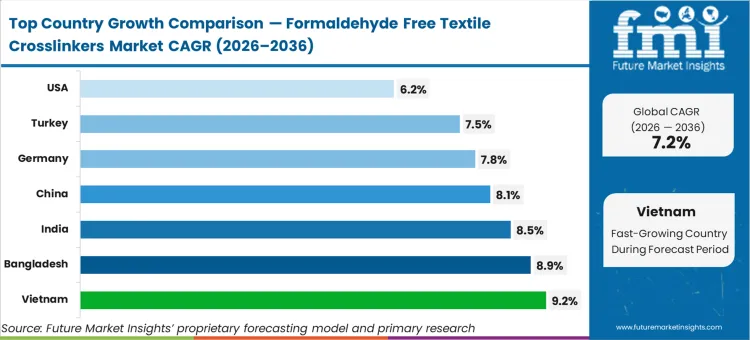
Vietnam is estimated to advance at 9.2%, followed by Bangladesh registering 8.9%, India expanding at 8.5%, China tracking at 8.1%, Germany garnering 7.8%, Turkey posting 7.5%, and the USA growing at 6.2%. This structural divergence reflects the concentration of export-dependent textile infrastructure; hubs heavily tethered to North American retail compliance mandates are cycling through their chemical inventories significantly faster than regions where domestic consumption provides a buffer for legacy formulations.
Formaldehyde Free Textile Crosslinkers Market Key Takeaways
| Metric | Details |
|---|---|
| Industry Size (2026) | USD 455.6 million |
| Industry Value (2036) | USD 909.4 million |
| CAGR (2026-2036) | 7.15% |
Formaldehyde Free Textile Crosslinkers Market Definition
The formaldehyde-free textile crosslinkers market encompasses chemical agents engineered to form covalent bonds between polymer chains within textile substrates without the use, generation, or release of formaldehyde compounds. Structurally, these chemistries replace traditional urea-formaldehyde and melamine-formaldehyde resins, providing durable press and dimensional stability to fabrics while strictly satisfying zero-detectable limits mandated by global apparel toxicity standards.
Formaldehyde Free Textile Crosslinkers Market Inclusions
The scope captures all primary synthetic and bio-based crosslinking agents utilized in textile finishing, specifically polycarboxylic acids (PCAs), glyoxal-based resins formulated without formaldehyde donors, polyurethane dispersions, and specific acrylate polymers. It includes the necessary catalyst systems packaged and sold explicitly to activate these finishing agent formulations during the high-temperature curing phase of textile production.
Formaldehyde Free Textile Crosslinkers Market Exclusions
The market explicitly excludes low-formaldehyde or "ultra-low" formaldehyde resins. These are excluded because they still rely on traditional formaldehyde-releasing chemistry mechanisms and fail to meet the absolute zero-tolerance thresholds required by stringent zero-discharge frameworks. Baseline textile softeners and non-crosslinking surface coatings are excluded too, as they do not form the internal structural bonds required to deliver permanent dimensional stability.
Formaldehyde Free Textile Crosslinkers Market Research Methodology
- Primary Research: Procurement directors at tier-1 garment manufacturing groups, chemical formulation leads at global specialty chemical providers, and compliance auditors for Western retail brands.
- Desk Research: Aggregation of Restricted Substance List (RSL) updates from major apparel consortiums, chemical hazard safety data sheets, and certification registry volumes (e.g., OEKO-TEX, ZDHC).
- Market-Sizing and Forecasting: Baseline sizing anchors to total annual yardage of woven cellulosic fabric processed for durable press finishes, cross-referenced against the penetration rate of certified green chemistry usage in major export hubs.
- Data Validation and Update Cycle: Forecasts are triangulated against the capital expenditure cycles of textile finishing machinery, specifically tracking upgrades to high-temperature stenter frames required for non-formaldehyde curing.
Segmental Analysis
Formaldehyde Free Textile Crosslinkers Market Analysis by Chemistry Type
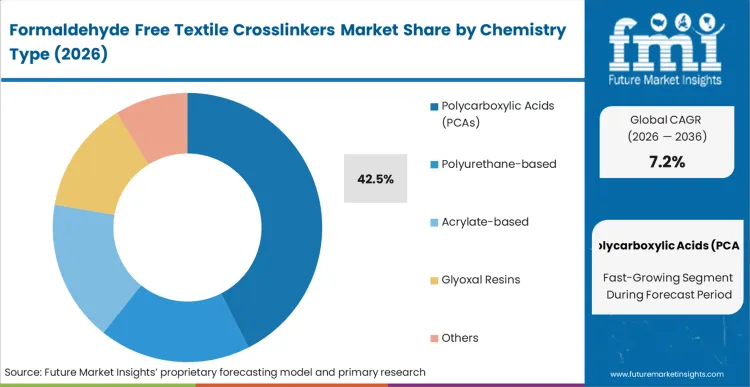
The reason Polycarboxylic Acids (PCAs) command 42.5% of this market stems from a singular operational reality: they require no fundamental redesign of the mill's existing application architecture. According to FMI's estimates, while alternative sustainable chemistry portfolios exist, PCAs integrate seamlessly into the standard pad-dry-cure workflows that commission finishers have utilized for decades. Mill operations directors select acid-based curing agents because they reliably deliver the required crosslinking density to cellulosic fibers without risking batch-to-batch inconsistency. The decision pattern here prioritizes predictable runability over theoretical chemical efficiency; operators will readily accept the known variables of PCA chemistry to maintain continuous line speeds. Facilities that attempt to circumvent this by testing unproven proprietary resins routinely encounter uncorrectable variations in fabric hand-feel, leading to costly substrate rejections by brand quality auditors.
- Initial Qualification: Mill technicians approve PCA formulations primarily because their rheology matches legacy urea-formaldehyde, allowing immediate drop-in replacement on existing padding mangles.
- Validation Checkpoint: Brand quality auditors validate the choice by confirming the finished yardage passes strict tensile strength and tear-resistance limits after industrial laundering protocols.
- Renewal Driver: Procurement directors renew PCA contracts based on the chemical supplier's ability to bundle customized catalysts that marginally reduce the required stenter curing temperature.
Formaldehyde Free Textile Crosslinkers Market Analysis by Application
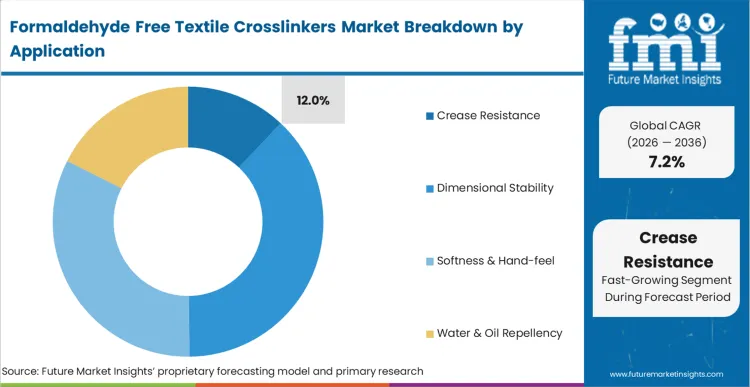
Legacy approaches to dimensional stability failed to address the specific performance demands of modern lightweight wovens, which shrink aggressively during consumer laundering if not internally stabilized. To prevent this, crease resistance formulations dominate, utilizing crosslinking agents to react with the hydroxyl groups of the cellulose polymer. This forms rigid covalent ester bridges between adjacent chains, severely restricting the chain slippage that naturally occurs during aqueous swelling. FMI analysts opine that finishing supervisors apply these specific wrinkle recovery treatments because the structural penalty for failure is an unwearable garment after a single wash. The operational shift requires precision moisture control before the curing chamber; if the fabric enters the stenter too dry, the crosslinking fails to penetrate the fiber core. Mills that mismanage this moisture threshold during application produce brittle yardage that shatters under seam stress, forcing the entire production lot to be scrapped before garment assembly.
- Fibrillation Prevention: Covalent bridging prevents the swelling and subsequent micro-fibrillation of the fiber surface. Mills that fail to achieve adequate penetration produce fabrics that pill excessively during the first consumer wash cycle.
- Tensile Degradation: The aggressive acidic curing environment inherently weakens the cellulosic backbone. The residual risk remains that an over-cured batch will fail the brand's minimum tear-strength specifications, requiring chemical softeners to mask the damage.
- Process Calibration: To capture the full durable press benefit without destroying the substrate, operators must continuously monitor and adjust the dwell time inside the curing chamber based on the specific weight of the fabric lot.
Formaldehyde Free Textile Crosslinkers Market Analysis by Substrate Type
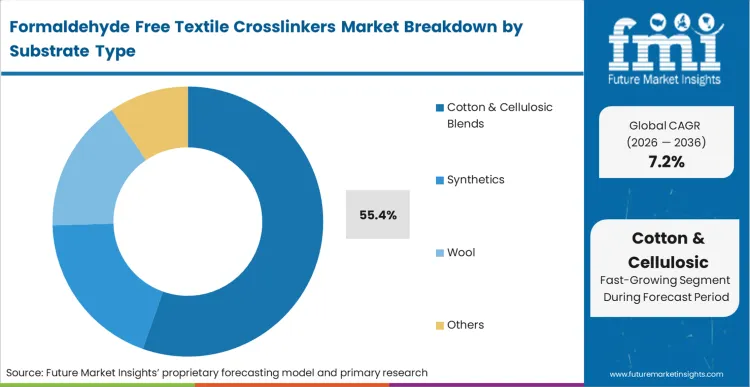
The commercial consequence of inadequate crosslinking on cotton substrates is an immediate failure in the physical testing lab, long before the fabric reaches the cutting room floor. Because cotton and cellulosic blends inherently lack structural memory, they require intensive chemical intervention; this absolute necessity drives the segment to capture 55.4% of the market.
Based on FMI's assessment, procurement managers sourcing woven cellulosic substrates accept the high chemical cost because untreated cotton cannot meet the minimum dimensional stability parameters required for structured apparel. The integration of formaldehyde-free variants shifts the cost burden from environmental compliance to energy consumption, as the required curing temperatures increase substantially. Finishers who delay their transition to optimised catalyst systems absorb continuous margin erosion through inflated natural gas or electricity expenditures at the stenter frame.
- Chemical Procurement: The initial cost savings of cheap legacy resins are completely negated the moment a brand auditor detects formaldehyde, resulting in the confiscation or destruction of the entire fabric inventory.
- Thermal Expenditure: The hidden operational cost emerges in the continuous curing phase, where maintaining highly elevated temperatures demands significantly higher energy input than traditional low-temperature systems.
- Lifecycle Assessment: Total lifecycle cost comparisons reveal that the premium paid for advanced zero-formaldehyde crosslinkers is offset by the preservation of high-margin retail contracts that strictly penalize non-compliance.
Formaldehyde Free Textile Crosslinkers Market Drivers, Restraints, and Opportunities
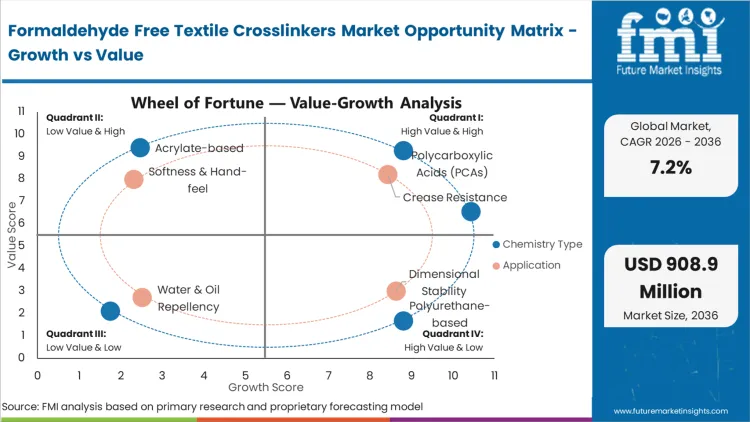
The absolute mandate from tier-1 Western apparel brands enforcing zero-detectable formaldehyde limits compels Asian mill operations directors to purge legacy resins from their supply chains. This is not a slow phasing-out process driven by consumer awareness; it is a binary qualification hurdle required to participate in seasonal sourcing bids. Brands facing immense legal and reputational liability from global chemical watchdog groups push this compliance risk entirely onto the manufacturing tier. Mill operators must execute this transition to maintain their approved vendor status, knowing that failure to pass an unannounced chemical inventory audit results in immediate contract termination and exclusion from future high-volume procurement cycles.
The single biggest structural friction dragging adoption is the elevated curing temperature required to activate non-formaldehyde chemistries, which disrupts the delicate energy-margin models of high-volume commission finishers. Unlike legacy systems that cure efficiently at moderate heat, advanced polycarboxylic acids require significantly higher thermal energy, directly inflating the continuous natural gas or electricity costs of the mill processing environments. While specialty chemical providers are formulating novel catalysts to address this, the current solutions remain highly sensitive to local water hardness and fabric pH, preventing a universal drop-in solution and forcing mills to conduct expensive, time-consuming pilot runs for every new fabric blend.
Opportunities in the Formaldehyde Free Textile Crosslinkers Market
- Catalyst Optimization: The high thermal requirement for curing PCAs creates an immediate opening for specialty chemical providers. Formulators who engineer low-temperature catalyst systems capture exclusive, long-term supply contracts from energy-sensitive commission finishers.
- Compliance Integration: Brands demanding total transparency require verifiable chemical lot tracking. Software-integrated chemical distributors who map exact batch compliance directly to the brand's digital portal secure preferred vendor status over pure-play chemical manufacturers.
- Blend-Specific Formulations: The tensile strength degradation seen in lightweight cottons demands tailored solutions. R&D teams that develop crosslinkers specifically buffered for low-weight shirting fabrics command premium pricing from high-end apparel manufacturers.
Regional Analysis
Based on the regional analysis, the Formaldehyde Free Textile Crosslinkers Market is segmented into North America, Latin America, Europe, East Asia, South Asia, Oceania, and Middle East & Africa across 40 plus countries.
.webp "Top Country Growth Comparison Formaldehyde Free Textile Crosslinkers Market Cagr (2026 2036)")
| Country | CAGR (2026 to 2036) |
|---|---|
| Vietnam | 9.2% |
| Bangladesh | 8.9% |
| India | 8.5% |
| China | 8.1% |
| Germany | 7.8% |
| Turkey | 7.5% |
| USA | 6.2% |
Asia Formaldehyde Free Textile Crosslinkers Market Analysis
The structural dominance of Asia in this market is dictated by Western brand procurement practices rather than domestic environmental legislation. Sourcing directors dictate chemical input standards from thousands of miles away, forcing the concentrated export hubs to adapt their technical infrastructure.
FMI analysts opine that because these regions operate as the manufacturing floor for global retail, their adoption patterns reflect the strict, calendar-driven audit cycles of foreign buyers. A mill operations head in this region evaluates chemical purchases based entirely on the risk of failing a third-party compliance test, overriding standard cost-optimization models. This dynamic heavily penalizes mid-tier facilities that lack the capital to upgrade their curing machinery, slowly concentrating production volumes among a smaller group of highly capitalized, fully compliant mega-mills.
- Vietnam: Vietnam's deep integration into North American free-trade agreements forces its young textile infrastructure to align instantly with zero-tolerance chemical discharge standards. Mill procurement heads here operate under constant threat of unannounced audits from tier-1 sportswear and fashion brands. The market expands at a 9.2% CAGR through 2036. Facilities that aggressively validate their zero-formaldehyde processes lock in multi-year capacity agreements with Western buyers who are actively migrating their sourcing volumes out of less transparent jurisdictions.
- Bangladesh: Over the forecast period, the sector is set for a CAGR of 8.9%. The intense concentration of high-volume, low-margin cotton apparel manufacturing in Bangladesh makes the energy penalty of non-formaldehyde crosslinkers acutely painful. Finishing directors face the immense challenge of maintaining line speeds while elevating stenter temperatures to cure export garment compliance chemistries. Once a mill successfully calibrates its continuous machinery to handle these advanced catalysts, it eliminates a massive internal bottleneck, achieving the throughput necessary to secure premium European retail contracts.
- India: FMI estimates the formaldehyde-free textile crosslinkers market in India to expand at an annual growth rate of 8.5%. India's dual exposure to both massive domestic consumption and stringent export demands creates a bifurcated adoption landscape. While domestic-focused units delay upgrades, export-oriented textile parks must integrate high-performance PCAs to satisfy European REACH expectations. This parallel structure allows fully compliant Indian mills to aggressively outmanoeuvre regional competitors, capturing high-value woven shirting programs that neighbouring countries cannot chemically qualify for.
- China: The tightening of central government environmental mandates compounds the external pressure from global brands, forcing a rapid, forced modernization of China's legacy finishing sector. Operations directors must completely overhaul their chemical supply chains or face immediate municipal shutdowns. A CAGR of 8.1% is expected for formaldehyde-free textile crosslinkers in China over the forecast period. The sheer scale of this transition ensures that the baseline chemistry of global textile manufacturing permanently shifts, making non-formaldehyde systems the default global standard rather than a premium outlier.
FMI's report includes secondary Asian markets such as Indonesia and Thailand. These adjacent hubs are experiencing a rapid acceleration in green chemistry trials as they position themselves to absorb overflow contracts from capacity-constrained tier-1 export nations.
Europe Formaldehyde Free Textile Crosslinkers Market Analysis
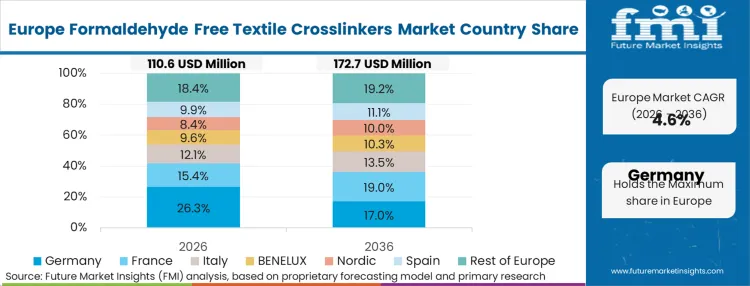
European adoption is governed by an aggressive, proactive regulatory environment that penalizes hazardous chemical usage long before consumer products reach the shelf. The European Chemicals Agency (ECHA) and localized extended producer responsibility frameworks create a baseline where legacy resins are essentially uninsurable.
As per FMI's projection, procurement directors operating inside this bloc do not weigh the cost of non-formaldehyde systems against traditional options; traditional options simply do not exist in their viable supply chain. The regulatory calendar forces continuous iteration, pushing European technical textile manufacturers to adopt next-generation polyurethane and acrylate crosslinkers that bypass the limitations of standard acid-based systems.
- Germany: The German formaldehyde free textile crosslinkers industry is expected to demonstrate a CAGR of 7.8%. Germany's uncompromising chemical safety legislation creates a hyper-scrutinized environment where even traceable limits trigger immediate product recalls. Supply chain managers do not merely purchase compliant chemicals; they demand exhaustive toxicology dossiers from their formulators. While the growth rate appears moderate, it obscures the reality on the ground: German facilities are not just adopting zero-formaldehyde systems; they are co-developing the complex, low-temperature catalysts that the rest of the world will eventually procure.
- Turkey: Turkey's unique geographic and commercial position requires it to act as the rapid-response manufacturing arm for European fast fashion, necessitating absolute adherence to EU chemical directives. Finishing facilities must maintain massive inventories of fully certified crosslinkers to execute lightning-fast production turnarounds without risking customs rejections. Turkey is expected to see its formaldehyde free textile crosslinkers sector grow at a compound annual rate of 7.5%. Turkish mills that master the rapid application and curing of these advanced resins capture the highly lucrative, short-lead-time contracts that European brands refuse to send to Asia.
FMI's report includes secondary European markets such as Italy and Portugal. These countries leverage advanced crosslinking chemistries heavily in their high-end luxury and performance shirting sectors, prioritizing exceptional fabric hand-feel alongside total regulatory compliance.
North America Formaldehyde Free Textile Crosslinkers Market Analysis
The North American landscape is driven primarily by the cost structures and liability models of massive retail conglomerates rather than federal chemical bans. Capital availability allows the remaining domestic textile base to invest in highly automated, energy-efficient curing technologies that mitigate the thermal penalties of green chemistry.
In FMI's view, operations heads in this region treat zero-formaldehyde finishes as a fundamental baseline for mitigating legal exposure to state-level regulations like California's Proposition 65. The focus here shifts away from achieving basic compliance and toward optimizing the total lifecycle cost of the finishing process through precision chemical dosing and advanced moisture-control systems.
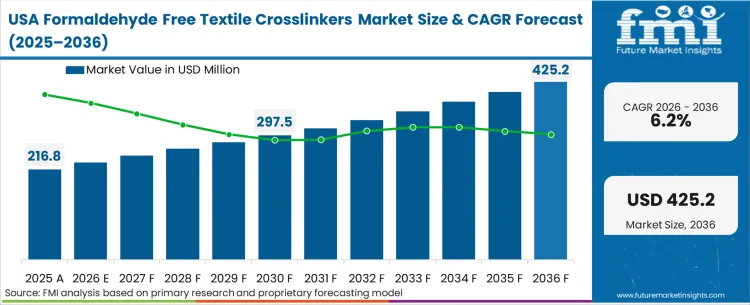
- USA: The domestic textile sector in the USA focuses heavily on technical and military applications where performance specifications and chemical safety are equally rigid. The USA market for formaldehyde free textile crosslinkers is likely to post a CAGR of 6.2%. Procurement teams require highly specialised, domestically sourced crosslinking agents to meet the strict parameters of government contracts. By fully integrating these advanced, zero-emission finishing protocols, US-based technical weavers maintain a distinct, heavily defended technological gap against cheaper imported fabrics that struggle to meet combined performance and toxicity standards.
FMI's report includes Canada and Mexico. The nearshoring of apparel production to Mexico is forcing a rapid influx of compliant chemical capabilities into the region to satisfy the immediate audit requirements of US-based retail brands.
Competitive Aligners for Market Players
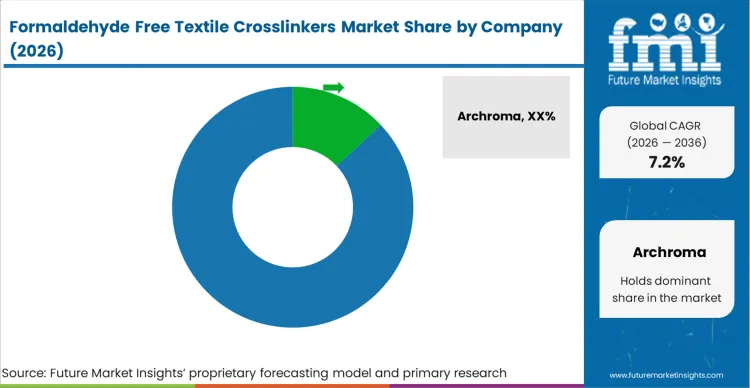
The competitive structure of this market is highly concentrated, governed by the intense R&D required to synthesise catalyst systems that make zero-formaldehyde resins operationally viable. Buyers specifically mill procurement directors do not distinguish vendors based on the basic ability to supply polycarboxylic acids; they qualify partners strictly on the technical support provided to dial in the curing parameters on the mill floor. Companies like Archroma, which significantly consolidated the market following its 2023 acquisition of Huntsman Textile Effects, and DyStar Group hold dominant positions because they embed their technical engineers directly into the customer's finishing department to prevent the tensile strength degradation that occurs when these chemicals are misapplied.
The primary structural advantage held by incumbents is their massive library of proprietary catalyst formulations, which allows them to fine-tune the curing temperature based on the specific stenter frame capabilities of the buyer. This advantage persists because duplicating this trial-and-error data across thousands of fabric blends is prohibitively expensive for new entrants. To effectively challenge the leaders, a new specialty formulation providers must build an integrated application testing facility that proves their chemistry works at lower temperatures before a mill will even authorize a pilot run.
Through 2036, the structural tension between buyer margin protection and vendor R&D recovery will define the competitive trajectory. Large export mills actively resist lock-in by demanding open-source compatibility for catalysts, while dominant chemical vendors incentivize exclusive contracts through bundled volume discounts. The market will steadily consolidate as smaller, regional chemical blenders fail to keep pace with the increasingly complex, energy-efficient polymer architectures required by the world's largest apparel brands.
Key Players in Formaldehyde Free Textile Crosslinkers Market
- Archroma
- Dystar Group
- CHT Group
- Rudolf GmbH
- Sarex Chemicals
- Indokem Ltd.
- Pulcra Chemicals
Scope of the Report
| Metric | Value |
|---|---|
| Quantitative Units | USD 455.6 million to USD 909.4 million, at a CAGR of 7.15% |
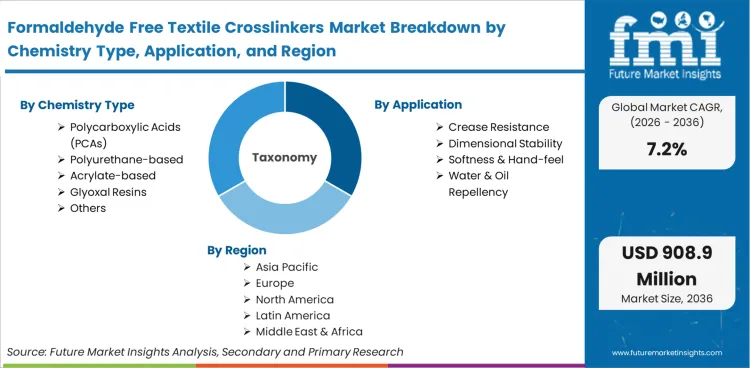
| Market Definition | The formaldehyde free textile crosslinkers market encompasses chemical agents engineered to form covalent bonds between polymer chains within textile substrates without the use, generation, or release of formaldehyde compounds. It structurally replaces legacy urea-formaldehyde resins to deliver durable press finishes. |
| Chemistry Type Segmentation | Polycarboxylic Acids (PCAs), Polyurethane-based, Acrylate-based, Glyoxal Resins, Others |
| Application Segmentation | Crease Resistance, Dimensional Stability, Softness & Hand-feel, Water & Oil Repellency |
| Substrate Type Segmentation | Cotton & Cellulosic Blends, Synthetics, Wool, Others |
| Regions Covered | North America, Latin America, Europe, East Asia, South Asia, Oceania, Middle East and Africa |
| Countries Covered | Vietnam, Bangladesh, India, China, Germany, Turkey, USA, and 40 plus countries |
| Key Companies Profiled | Archroma, Dystar Group, CHT Group, Rudolf GmbH, Sarex Chemicals, Indokem Ltd., Pulcra Chemicals |
| Forecast Period | 2026 to 2036 |
| Approach | Primary research engaged procurement directors and chemical formulation leads to anchor baseline application volumes. Data models trace the penetration of certified green chemistries against global woven fabric production. Forecasts are cross-validated using capital expenditure tracking for stenter frame upgrades. |
Formaldehyde Free Textile Crosslinkers Market Analysis by Segments
-
Chemistry Type:
- Polycarboxylic Acids (PCAs)
- Polyurethane-based
- Acrylate-based
- Glyoxal Resins
- Others
-
Application:
- Crease Resistance
- Dimensional Stability
- Softness & Hand-feel
- Water & Oil Repellency
-
Substrate Type:
- Cotton & Cellulosic Blends
- Synthetics
- Wool
- Others
-
Region:
- North America
- Europe
- Asia-Pacific
- Rest of the World
- Latin America
- Middle East, and Africa
Bibliography
- Apparel and Footwear International RSL Management (AFIRM) Group. (2024, April 4). AFIRM restricted substances list (Version 09). AFIRM Group.
- Akhtar, K. S., Anam, W., Mohsin, M., Sardar, S., & Qutab, H. G. (2024). Performance enhancement of non-toxic and bio-based textile finishes through novel and sustainable ozonation. Journal of Industrial Textiles, 54.
- Jiang, H., Bu, Y., Liu, G., Zhang, W., & Cheng, X.-W. (2024). Comparative study of polycarboxylic acids for sustainable crosslinking of silk fabrics: Evaluating flame retardancy and physical performances. International Journal of Biological Macromolecules, 273(Part 2), 133129.
- Lehrhofer, A. F., Fliri, L., Bacher, M., Budischowsky, D., Sulaeva, I., Hummel, M., Rosenau, T., & Hettegger, H. (2024). A mechanistic study on the alleged cellulose cross-linking system: Maleic acid/sodium hypophosphite. Carbohydrate Polymers, 346, 122653.
- OEKO-TEX Service GmbH. (2025, February 4). OEKO-TEX® STANDARD 100 (Edition 02.2025). OEKO-TEX.
This bibliography is provided for reader reference. The full FMI report contains the complete reference list with primary source documentation.
This Report Addresses
- Market intelligence to support strategic decision making across durable press finishes, non-formaldehyde resins, and cellulosic crosslinking categories
- Market size estimation and 10-year revenue forecasts from 2026 to 2036, supported by baseline tracking of global woven fabric production volumes
- Growth opportunity mapping across Chemistry Type and Application dimensions with emphasis on the commercialization of low-temperature curing catalysts
- Segment and regional revenue forecasts covering PCAs and Crease Resistance formulations across the strict seasonal audit environments of tier-1 export hubs
- Competition strategy assessment including proprietary catalyst formulations, application testing capabilities, and embedded technical engineering support
- Capability development tracking including ZDHC MRSL Version 3.1, OEKO-TEX STANDARD 100, and ECHA regulatory compliance frameworks
- Market access analysis covering North American retail brand restricted substance lists and European extended producer responsibility pathways
- Market report delivery in PDF, Excel, PPT, and interactive dashboard formats for executive strategy, mill capacity planning, and operational benchmarking use
Frequently Asked Questions
How large is the Formaldehyde Free Textile Crosslinkers Market in 2026?
The market is valued at USD 455.6 million in 2026. This figure reflects the immediate capital deployed by tier-1 export mills forced to purge legacy resins ahead of seasonal brand audits.
What will it be valued at by 2036?
It is projected to reach USD 909.4 million by 2036. This valuation demonstrates that zero-formaldehyde performance is shifting from a premium sustainability specification to a mandatory baseline for all woven apparel contracts.
What CAGR is projected?
A CAGR of 7.15% is expected from 2026 to 2036. This rate tracks the actual speed at which Asian finishing facilities can absorb the energy penalty of non-formaldehyde curing, rather than the speed of regulatory announcements.
Which Chemistry Type segment leads?
Polycarboxylic Acids (PCAs) lead with 42.5% share in 2026. They dominate because they allow commission finishers to drop compliant chemistry into existing pad-dry-cure infrastructure without completely redesigning their application lines.
Which Application segment leads?
Crease Resistance captures 38.2% share in 2026. This dominance is driven by the structural reality that modern lightweight cotton apparel requires aggressive internal crosslinking to prevent severe shrinkage and fibrillation during consumer laundering.
Which Substrate Type segment leads?
Cotton & Cellulosic Blends command 55.4% share in 2026. Unlike synthetics, natural cellulosic fibers lack inherent structural memory, making heavy chemical intervention an absolute necessity for durable press functionality.
What drives rapid growth?
Growth is forced by Western retail brands enforcing zero-tolerance restricted substance lists during quarterly sourcing reviews. Mill operators must eliminate legacy urea-formaldehyde immediately, or they lose their approved vendor status and forfeit major contracts.
What is the primary restraint?
The significant thermal penalty required to cure advanced PCAs disrupts established mill margins. Because these chemistries require stenter temperatures nearly 30°C higher than legacy resins, finishing plants face a massive increase in natural gas or electricity consumption.
Which country grows fastest?
Vietnam grows at the fastest rate of 9.2%. Unlike the USA (6.2%), Vietnam’s deeply export-dependent infrastructure forces rapid compliance with North American brand mandates, leaving no domestic buffer to absorb legacy chemical inventories.
How do brand audit schedules impact chemical procurement?
Procurement directors at finishing mills do not purchase non-formaldehyde resins based on standard depletion cycles; they align their inventory overhauls strictly with the unannounced chemical audit schedules of their largest retail buyers.
Why is catalyst formulation the critical competitive battleground?
Chemical vendors who engineer catalysts capable of lowering the curing temperature of PCAs directly reduce the mill's energy bill, solving the single biggest operational friction dragging the market's expansion.
How do incumbents maintain their market share?
Dominant players like Archroma maintain share not just by selling resin, but by embedding their technical engineers inside the mill to prevent fabric strength degradation during the complex curing phase.
What happens to mills that fail to adopt these crosslinkers?
Mills that fail brand chemical audits are immediately removed from tier-1 approved vendor lists, forcing them to compete for lower-margin, domestic contracts where zero-discharge frameworks are not yet enforced.
How does European regulation differ from Asian adoption drivers?
European adoption is driven by proactive, state-level REACH directives and extended producer responsibility, whereas Asian adoption is almost entirely reactive to the private procurement mandates of foreign apparel brands.
Why are low-formaldehyde resins excluded from this market analysis?
Low-formaldehyde variants still rely on formaldehyde-donor mechanisms that trigger failures during sensitive ZDHC compliance tests, rendering them obsolete under true zero-tolerance frameworks.
What makes cotton substrates more chemical-intensive than wool?
Cotton's highly porous, swelling nature means it readily loses its dimensional stability when wet, requiring deep internal covalent bridging that wool's natural protein structure does not necessitate.
How do Turkish mills leverage these chemistries?
Turkish finishers utilize advanced zero-formaldehyde systems to guarantee compliance for short-lead-time, fast-fashion contracts, capturing European orders that require rapid turnaround without the risk of customs delays.
What role does testing and certification play in vendor selection?
Mill operations directors demand chemical suppliers provide comprehensive, pre-certified toxicology dossiers, as the mill itself cannot afford the time or capital to independently verify the chemical safety of generic resin formulations.
Why is the market highly concentrated?
The multi-year R&D required to synthesize viable low-temperature catalyst systems creates a massive barrier to entry, preventing smaller regional chemical blenders from offering a complete, operationally safe solution.
How does water hardness affect crosslinker adoption?
Advanced PCAs are highly sensitive to local water pH and mineral content, forcing formulators to customize their catalyst packages for individual finishing plants to prevent catastrophic batch failures on the stenter frame.
What is the commercial consequence of under-curing PCAs?
If a mill lowers the stenter temperature to save energy, the PCA fails to fully crosslink, resulting in fabric that passes initial chemical tests but shrinks excessively and pills during the first consumer wash.
How are US-based technical weavers utilizing zero-formaldehyde resins?
Domestic US weavers integrate these advanced finishes to meet the strict toxicity and durability parameters of government and military contracts, maintaining a defensible technological gap against imported commodity textiles.
Preview the report firsthand - request a free sample
Get SampleGet the brochure for pricing and purchase details.
Get PDFTable of Content
- Executive Summary
- Global Market Outlook
- Demand-side Trends
- Supply-side Trends
- Technology Roadmap Analysis
- Analysis and Recommendations
- Market Overview
- Market Coverage / Taxonomy
- Market Definition / Scope / Limitations
- Research Methodology
- Chapter Orientation
- Analytical Lens and Working Hypotheses
- Market Structure, Signals, and Trend Drivers
- Benchmarking and Cross-market Comparability
- Market Sizing, Forecasting, and Opportunity Mapping
- Research Design and Evidence Framework
- Desk Research Programme (Secondary Evidence)
- Company Annual and Sustainability Reports
- Peer-reviewed Journals and Academic Literature
- Corporate Websites, Product Literature, and Technical Notes
- Earnings Decks and Investor Briefings
- Statutory Filings and Regulatory Disclosures
- Technical White Papers and Standards Notes
- Trade Journals, Industry Magazines, and Analyst Briefs
- Conference Proceedings, Webinars, and Seminar Materials
- Government Statistics Portals and Public Data Releases
- Press Releases and Reputable Media Coverage
- Specialist Newsletters and Curated Briefings
- Sector Databases and Reference Repositories
- FMI Internal Proprietary Databases and Historical Market Datasets
- Subscription Datasets and Paid Sources
- Social Channels, Communities, and Digital Listening Inputs
- Additional Desk Sources
- Expert Input and Fieldwork (Primary Evidence)
- Primary Modes
- Qualitative Interviews and Expert Elicitation
- Quantitative Surveys and Structured Data Capture
- Blended Approach
- Why Primary Evidence is Used
- Field Techniques
- Interviews
- Surveys
- Focus Groups
- Observational and In-context Research
- Social and Community Interactions
- Stakeholder Universe Engaged
- C-suite Leaders
- Board Members
- Presidents and Vice Presidents
- R&D and Innovation Heads
- Technical Specialists
- Domain Subject-matter Experts
- Scientists
- Physicians and Other Healthcare Professionals
- Governance, Ethics, and Data Stewardship
- Research Ethics
- Data Integrity and Handling
- Primary Modes
- Tooling, Models, and Reference Databases
- Desk Research Programme (Secondary Evidence)
- Data Engineering and Model Build
- Data Acquisition and Ingestion
- Cleaning, Normalisation, and Verification
- Synthesis, Triangulation, and Analysis
- Quality Assurance and Audit Trail
- Market Background
- Market Dynamics
- Drivers
- Restraints
- Opportunity
- Trends
- Scenario Forecast
- Demand in Optimistic Scenario
- Demand in Likely Scenario
- Demand in Conservative Scenario
- Opportunity Map Analysis
- Product Life Cycle Analysis
- Supply Chain Analysis
- Investment Feasibility Matrix
- Value Chain Analysis
- PESTLE and Porter’s Analysis
- Regulatory Landscape
- Regional Parent Market Outlook
- Production and Consumption Statistics
- Import and Export Statistics
- Market Dynamics
- Global Market Analysis 2021 to 2025 and Forecast, 2026 to 2036
- Historical Market Size Value (USD Million) Analysis, 2021 to 2025
- Current and Future Market Size Value (USD Million) Projections, 2026 to 2036
- Y-o-Y Growth Trend Analysis
- Absolute $ Opportunity Analysis
- Global Market Pricing Analysis 2021 to 2025 and Forecast 2026 to 2036
- Global Market Analysis 2021 to 2025 and Forecast 2026 to 2036, By Chemistry Type
- Introduction / Key Findings
- Historical Market Size Value (USD Million) Analysis By Chemistry Type , 2021 to 2025
- Current and Future Market Size Value (USD Million) Analysis and Forecast By Chemistry Type , 2026 to 2036
- Polycarboxylic Acids (PCAs)
- Polyurethane-based
- Acrylate-based
- Glyoxal Resins
- Others
- Polycarboxylic Acids (PCAs)
- Y-o-Y Growth Trend Analysis By Chemistry Type , 2021 to 2025
- Absolute $ Opportunity Analysis By Chemistry Type , 2026 to 2036
- Global Market Analysis 2021 to 2025 and Forecast 2026 to 2036, By Application
- Introduction / Key Findings
- Historical Market Size Value (USD Million) Analysis By Application, 2021 to 2025
- Current and Future Market Size Value (USD Million) Analysis and Forecast By Application, 2026 to 2036
- Crease Resistance
- Dimensional Stability
- Softness & Hand-feel
- Water & Oil Repellency
- Crease Resistance
- Y-o-Y Growth Trend Analysis By Application, 2021 to 2025
- Absolute $ Opportunity Analysis By Application, 2026 to 2036
- Global Market Analysis 2021 to 2025 and Forecast 2026 to 2036, By Substrate Type
- Introduction / Key Findings
- Historical Market Size Value (USD Million) Analysis By Substrate Type, 2021 to 2025
- Current and Future Market Size Value (USD Million) Analysis and Forecast By Substrate Type, 2026 to 2036
- Cotton & Cellulosic Blends
- Synthetics
- Wool
- Others
- Cotton & Cellulosic Blends
- Y-o-Y Growth Trend Analysis By Substrate Type, 2021 to 2025
- Absolute $ Opportunity Analysis By Substrate Type, 2026 to 2036
- Global Market Analysis 2021 to 2025 and Forecast 2026 to 2036, By Region
- Introduction
- Historical Market Size Value (USD Million) Analysis By Region, 2021 to 2025
- Current Market Size Value (USD Million) Analysis and Forecast By Region, 2026 to 2036
- North America
- Latin America
- Western Europe
- Eastern Europe
- East Asia
- South Asia and Pacific
- Middle East & Africa
- Market Attractiveness Analysis By Region
- North America Market Analysis 2021 to 2025 and Forecast 2026 to 2036, By Country
- Historical Market Size Value (USD Million) Trend Analysis By Market Taxonomy, 2021 to 2025
- Market Size Value (USD Million) Forecast By Market Taxonomy, 2026 to 2036
- By Country
- USA
- Canada
- Mexico
- By Chemistry Type
- By Application
- By Substrate Type
- By Country
- Market Attractiveness Analysis
- By Country
- By Chemistry Type
- By Application
- By Substrate Type
- Key Takeaways
- Latin America Market Analysis 2021 to 2025 and Forecast 2026 to 2036, By Country
- Historical Market Size Value (USD Million) Trend Analysis By Market Taxonomy, 2021 to 2025
- Market Size Value (USD Million) Forecast By Market Taxonomy, 2026 to 2036
- By Country
- Brazil
- Chile
- Rest of Latin America
- By Chemistry Type
- By Application
- By Substrate Type
- By Country
- Market Attractiveness Analysis
- By Country
- By Chemistry Type
- By Application
- By Substrate Type
- Key Takeaways
- Western Europe Market Analysis 2021 to 2025 and Forecast 2026 to 2036, By Country
- Historical Market Size Value (USD Million) Trend Analysis By Market Taxonomy, 2021 to 2025
- Market Size Value (USD Million) Forecast By Market Taxonomy, 2026 to 2036
- By Country
- Germany
- UK
- Italy
- Spain
- France
- Nordic
- BENELUX
- Rest of Western Europe
- By Chemistry Type
- By Application
- By Substrate Type
- By Country
- Market Attractiveness Analysis
- By Country
- By Chemistry Type
- By Application
- By Substrate Type
- Key Takeaways
- Eastern Europe Market Analysis 2021 to 2025 and Forecast 2026 to 2036, By Country
- Historical Market Size Value (USD Million) Trend Analysis By Market Taxonomy, 2021 to 2025
- Market Size Value (USD Million) Forecast By Market Taxonomy, 2026 to 2036
- By Country
- Russia
- Poland
- Hungary
- Balkan & Baltic
- Rest of Eastern Europe
- By Chemistry Type
- By Application
- By Substrate Type
- By Country
- Market Attractiveness Analysis
- By Country
- By Chemistry Type
- By Application
- By Substrate Type
- Key Takeaways
- East Asia Market Analysis 2021 to 2025 and Forecast 2026 to 2036, By Country
- Historical Market Size Value (USD Million) Trend Analysis By Market Taxonomy, 2021 to 2025
- Market Size Value (USD Million) Forecast By Market Taxonomy, 2026 to 2036
- By Country
- China
- Japan
- South Korea
- By Chemistry Type
- By Application
- By Substrate Type
- By Country
- Market Attractiveness Analysis
- By Country
- By Chemistry Type
- By Application
- By Substrate Type
- Key Takeaways
- South Asia and Pacific Market Analysis 2021 to 2025 and Forecast 2026 to 2036, By Country
- Historical Market Size Value (USD Million) Trend Analysis By Market Taxonomy, 2021 to 2025
- Market Size Value (USD Million) Forecast By Market Taxonomy, 2026 to 2036
- By Country
- India
- ASEAN
- Australia & New Zealand
- Rest of South Asia and Pacific
- By Chemistry Type
- By Application
- By Substrate Type
- By Country
- Market Attractiveness Analysis
- By Country
- By Chemistry Type
- By Application
- By Substrate Type
- Key Takeaways
- Middle East & Africa Market Analysis 2021 to 2025 and Forecast 2026 to 2036, By Country
- Historical Market Size Value (USD Million) Trend Analysis By Market Taxonomy, 2021 to 2025
- Market Size Value (USD Million) Forecast By Market Taxonomy, 2026 to 2036
- By Country
- Kingdom of Saudi Arabia
- Other GCC Countries
- Turkiye
- South Africa
- Other African Union
- Rest of Middle East & Africa
- By Chemistry Type
- By Application
- By Substrate Type
- By Country
- Market Attractiveness Analysis
- By Country
- By Chemistry Type
- By Application
- By Substrate Type
- Key Takeaways
- Key Countries Market Analysis
- USA
- Pricing Analysis
- Market Share Analysis, 2025
- By Chemistry Type
- By Application
- By Substrate Type
- Canada
- Pricing Analysis
- Market Share Analysis, 2025
- By Chemistry Type
- By Application
- By Substrate Type
- Mexico
- Pricing Analysis
- Market Share Analysis, 2025
- By Chemistry Type
- By Application
- By Substrate Type
- Brazil
- Pricing Analysis
- Market Share Analysis, 2025
- By Chemistry Type
- By Application
- By Substrate Type
- Chile
- Pricing Analysis
- Market Share Analysis, 2025
- By Chemistry Type
- By Application
- By Substrate Type
- Germany
- Pricing Analysis
- Market Share Analysis, 2025
- By Chemistry Type
- By Application
- By Substrate Type
- UK
- Pricing Analysis
- Market Share Analysis, 2025
- By Chemistry Type
- By Application
- By Substrate Type
- Italy
- Pricing Analysis
- Market Share Analysis, 2025
- By Chemistry Type
- By Application
- By Substrate Type
- Spain
- Pricing Analysis
- Market Share Analysis, 2025
- By Chemistry Type
- By Application
- By Substrate Type
- France
- Pricing Analysis
- Market Share Analysis, 2025
- By Chemistry Type
- By Application
- By Substrate Type
- India
- Pricing Analysis
- Market Share Analysis, 2025
- By Chemistry Type
- By Application
- By Substrate Type
- ASEAN
- Pricing Analysis
- Market Share Analysis, 2025
- By Chemistry Type
- By Application
- By Substrate Type
- Australia & New Zealand
- Pricing Analysis
- Market Share Analysis, 2025
- By Chemistry Type
- By Application
- By Substrate Type
- China
- Pricing Analysis
- Market Share Analysis, 2025
- By Chemistry Type
- By Application
- By Substrate Type
- Japan
- Pricing Analysis
- Market Share Analysis, 2025
- By Chemistry Type
- By Application
- By Substrate Type
- South Korea
- Pricing Analysis
- Market Share Analysis, 2025
- By Chemistry Type
- By Application
- By Substrate Type
- Russia
- Pricing Analysis
- Market Share Analysis, 2025
- By Chemistry Type
- By Application
- By Substrate Type
- Poland
- Pricing Analysis
- Market Share Analysis, 2025
- By Chemistry Type
- By Application
- By Substrate Type
- Hungary
- Pricing Analysis
- Market Share Analysis, 2025
- By Chemistry Type
- By Application
- By Substrate Type
- Kingdom of Saudi Arabia
- Pricing Analysis
- Market Share Analysis, 2025
- By Chemistry Type
- By Application
- By Substrate Type
- Turkiye
- Pricing Analysis
- Market Share Analysis, 2025
- By Chemistry Type
- By Application
- By Substrate Type
- South Africa
- Pricing Analysis
- Market Share Analysis, 2025
- By Chemistry Type
- By Application
- By Substrate Type
- USA
- Market Structure Analysis
- Competition Dashboard
- Competition Benchmarking
- Market Share Analysis of Top Players
- By Regional
- By Chemistry Type
- By Application
- By Substrate Type
- Competition Analysis
- Competition Deep Dive
- Archroma
- Overview
- Product Portfolio
- Profitability by Market Segments (Product/Age /Sales Channel/Region)
- Sales Footprint
- Strategy Overview
- Marketing Strategy
- Product Strategy
- Channel Strategy
- Dystar Group
- CHT Group
- Rudolf GmbH
- Sarex Chemicals
- Indokem Ltd.
- Pulcra Chemicals
- Archroma
- Competition Deep Dive
- Assumptions & Acronyms Used


