

- Industry Size (2026)
- USD 1.42 Bn
- Forecast (2036)
- USD 3.42 Bn
- CAGR (2026 to 2036)
- 9.20%
Corn-Based Plastics for Packaging Market Size, Market Forecast and Outlook By FMI
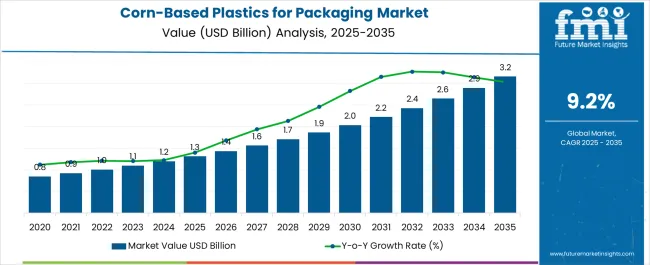
The corn-based plastics for packaging market was valued at USD 1.30 billion in 2025, projected to reach USD 1.42 billion in 2026, and is forecast to expand to USD 3.42 billion by 2036 at a 9.20% CAGR. As per FMI, the incremental opportunity across the forecast period amounts to USD 2.00 billion, reflecting a steady expansion trajectory shaped by evolving end-use requirements and shifting procurement patterns across global supply chains.
Summary of Corn-Based Plastics for Packaging Market
- Market Snapshot
- The corn-based plastics for packaging market is valued at USD 1.30 billion in 2025 and is projected to reach USD 3.42 billion by 2036.
- The industry is expected to grow at a 9.20% CAGR from 2026 to 2036, creating an incremental opportunity of USD 2.00 billion.
- The market is a regulation-driven bio-based material substitution category, where single-use plastics ban enforcement, composting infrastructure availability, and food contact certification define the pace of PLA adoption across packaging applications.
- Demand and Growth Drivers
- Demand is driven by regulatory bans on conventional single-use plastics compelling food service operators, retailers, and consumer goods companies to procure certified compostable corn-based packaging alternatives.
- Quick-service restaurant chains and fresh produce packagers are specifying PLA containers and wraps to meet municipal and state-level compostable packaging mandates in major consumer markets.
- Corn starch-to-PLA resin production capacity expansion in China and the United States is improving supply availability and reducing price premiums relative to petroleum-derived packaging polymers.
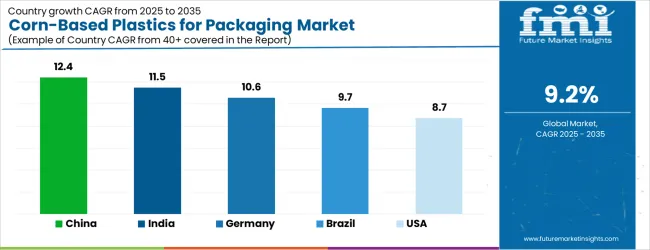
- Among key countries, China at 12.4%, India at 11.5%, Germany at 10.6%, Brazil at 9.7%, USA at 8.7%, UK at 7.8%, Japan at 6.9%.
- Product and Segment View
- The market includes polylactic acid (PLA) and related corn starch-derived bioplastic packaging products across food containers, wraps, bags, pharmaceutical blister packs, agricultural films, and textile packaging formats.
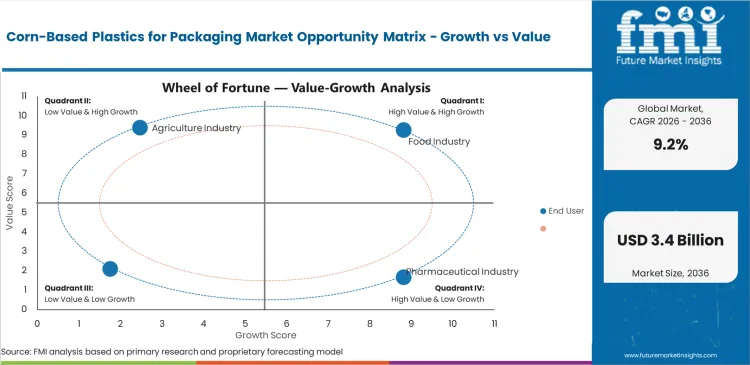
- The food industry commands the leading end-use share, driven by compostable food service packaging mandates, fresh produce container specifications, and single-serve wrap requirements.
- The scope includes corn-based (PLA) plastics used in packaging applications, while excluding PLA used in 3D printing filaments, medical implant materials, textile fibers, and durable goods not classified as packaging.
- Food Industry leads by End User with 45.0% share in 2026.
- Geography and Competitive Outlook
- China and India are the fastest-growing markets driven by PLA production capacity expansion and single-use plastics regulation enforcement, while North America and Europe sustain value through food service packaging mandates and established composting infrastructure.
- Competition is shaped by product specification depth, material performance certification, and supply chain reliability, with key players including CornWare, Natureworks, Klockner Pentaplast, Braskem, NatureWorks, Novamont, BASF, Corbion, PSM, DuPont, Arkema, Kingfa.
- Analyst Opinion at FMI
- Ismail Sutaria, Principal Consultant, opines: 'In my analysis, I have observed that the corn-based plastics packaging market is reaching an inflection point where PLA supply capacity expansion is converging with accelerating regulatory enforcement to create procurement-scale availability for the first time in major food service and retail packaging channels. Packaging converters who delay PLA processing capability investment face growing disqualification from brand owner and retailer approved material lists as compostable packaging mandates take effect.'
- Strategic Implications / Executive Takeaways
- Packaging converters must invest in PLA thermoforming and extrusion processing capability to qualify for food service and retail packaging contracts specifying certified compostable materials.
- Food service operators should establish direct PLA packaging supply agreements to secure allocation priority as regulatory enforcement timelines compress demand into concentrated procurement windows.
- Agricultural film producers must evaluate corn-based mulch film alternatives against conventional polyethylene to meet soil-biodegradable film mandates emerging in European and Asian markets.
Corn-Based Plastics for Packaging Market Key Takeaways
| Metric | Details |
|---|---|
| Industry Size (2026) | USD 1.42 Billion |
| Industry Value (2036) | USD 3.42 Billion |
| CAGR (2026-2036) | 9.20% |
Source: Future Market Insights, 2026
Based on FMI's report, the corn-based plastics for packaging market is expected to create an incremental opportunity of USD 2.00 billion between 2026 and 2036. FMI analysts project that end-use procurement patterns and regional supply chain dynamics will shape the distribution of this opportunity across segments and geographies.
Accelerating regulatory bans on conventional single-use plastics and expanding corporate commitments to bio-based material sourcing are driving rapid procurement growth for corn-based (PLA) plastics across food, pharmaceutical, agricultural, and textile packaging applications. Polylactic acid derived from corn starch fermentation offers a compostable, bio-based alternative to petroleum-derived polyethylene and polypropylene in applications where industrial composting infrastructure is accessible. FMI analysts note that the food industry remains the dominant consumption channel, driven by quick-service restaurant packaging mandates, fresh produce container requirements, and single-serve food wrap specifications that require certified compostable materials.
Regional demand for corn-based plastics in packaging reflects the geographic intersection of single-use plastics regulation intensity, industrial composting infrastructure availability, and food packaging conversion activity. China at 12.4% CAGR, India at 11.5% CAGR, Germany at 10.6% CAGR, Brazil at 9.7% CAGR, USA at 8.7% CAGR, UK at 7.8% CAGR, Japan at 6.9% CAGR. China leads growth through massive domestic PLA resin production capacity expansion and tightening plastics pollution control enforcement. India follows on the strength of single-use plastics ban implementation across multiple states and expanding food processing packaging demand. Germany sustains growth through stringent packaging waste hierarchy mandates and established industrial composting infrastructure. France and the United Kingdom maintain growth through retail packaging sustainability requirements and food service plastics restrictions. The United States advances through state-level compostable packaging mandates and quick-service restaurant chain procurement commitments. Brazil registers steady expansion tied to agricultural film applications and food packaging material substitution programs.
Corn-Based Plastics for Packaging Market Definition
Corn-based plastics for packaging are bio-derived polymer materials, primarily polylactic acid (PLA), produced through fermentation and polymerization of corn starch sugars. These materials serve as compostable and bio-based alternatives to petroleum-derived packaging plastics across food containers, wraps, bags, pharmaceutical packaging, agricultural films, and textile packaging applications. PLA is certified industrially compostable under ASTM D6400 and EN 13432 standards when processed through commercial composting facilities.
Future Market Insights analysis captures the complete addressable consumption base across all major producing and consuming regions, covering the forecast period from 2026 to 2036.
Corn-Based Plastics for Packaging Market Inclusions
Market scope includes corn-based (PLA) plastics used in food, pharmaceutical, agricultural, and textile packaging applications. The assessment covers global and regional market sizes, forecast period 2026 to 2036, and segment breakdowns by end-user industry and region.
Corn-Based Plastics for Packaging Market Exclusions
The scope excludes PLA materials used in 3D printing, medical implants, textile fibers, and durable consumer goods. Starch-blend plastics not primarily derived from corn and bio-based polyethylene (bio-PE) produced from sugarcane ethanol are also excluded.
Corn-Based Plastics for Packaging Market Research Methodology
- Primary Research: Analysts engaged with procurement managers, production engineers, and distribution channel executives to map the decision gates and compliance thresholds shaping product adoption.
- Desk Research: Data collection aggregated regulatory filings, trade body publications, standards body documentation, and company financial disclosures across all major producing and consuming regions.
- Market-Sizing and Forecasting: Baseline values derive from a bottom-up aggregation of producer shipment volumes and trade flow data, applying region-specific demand growth curves to project adoption velocity through 2036.
- Data Validation and Update Cycle: Projections are tested against publicly reported industry statistics, trade data, and company guidance. The model is updated quarterly to reflect market structure changes.
Why is the Corn-Based Plastics for Packaging Market Growing?
The Corn-Based Plastics for Packaging market is witnessing strong growth, driven by the rising global demand for sustainable and biodegradable packaging solutions. Increasing consumer awareness regarding environmental sustainability, coupled with regulatory measures targeting single-use plastics, has accelerated the adoption of bio-based materials. Corn-based plastics offer reduced carbon footprint and improved compostability compared with conventional petroleum-based plastics, making them a preferred choice among manufacturers and retailers.
The market is further supported by advancements in polymer processing and bioplastic formulation technologies, which enhance material performance, strength, and barrier properties for packaging applications. Growing emphasis on circular economy initiatives, corporate sustainability targets, and eco-friendly product labeling is driving investments and adoption across the supply chain.
As manufacturers seek cost-effective and scalable alternatives to traditional plastics, corn-based plastics are increasingly being incorporated in packaging for food, beverages, and consumer goods Rising production capacities, coupled with technological innovations, are expected to sustain market expansion over the coming decade while addressing environmental and regulatory requirements.
Segmental Analysis
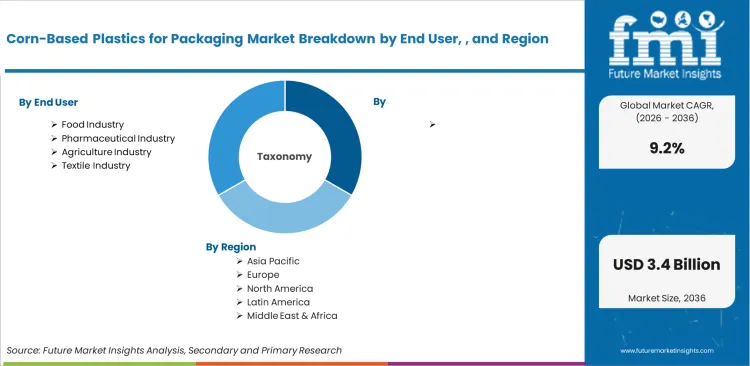
The corn-based plastics for packaging market is segmented by end-user industry, and geographic regions. By end-user industry, corn-based plastics for packaging market is divided into Food Industry, Pharmaceutical Industry, Agriculture Industry, and Textile Industry. Regionally, the corn-based plastics for packaging industry is classified into North America, Latin America, Western Europe, Eastern Europe, Balkan & Baltic Countries, Russia & Belarus, Central Asia, East Asia, South Asia & Pacific, and the Middle East & Africa.
Insights into the Food Industry End-User Segment
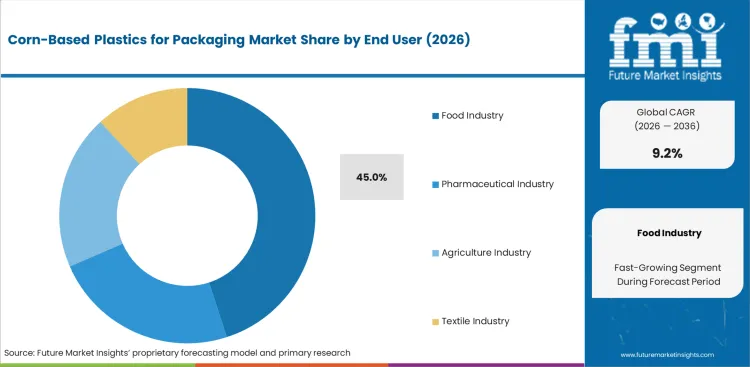
The food industry segment is projected to hold 45.3% of the market revenue in 2025, establishing it as the leading end-use industry. Growth in this segment is being driven by increasing demand for sustainable packaging solutions that meet regulatory requirements and consumer preferences for environmentally friendly products. Corn-based plastics are widely adopted for packaging perishable and processed foods due to their biodegradability, safety for direct food contact, and effective moisture and gas barrier properties.
The ability to produce lightweight, flexible, and customizable packaging has strengthened their adoption in food retail, fast-moving consumer goods, and catering sectors. Growing awareness among consumers regarding plastic pollution and sustainability is influencing manufacturers to transition from conventional plastics to bio-based alternatives.
Additionally, corporate sustainability initiatives and eco-labeling trends are further supporting the preference for corn-based packaging materials As the demand for safe, eco-friendly, and cost-effective packaging solutions continues to rise, the food industry segment is expected to maintain its leading position, supported by ongoing innovation and increasing regulatory compliance in sustainable packaging practices.
Market Overview
Global corn-based plastics for Packaging market: Introduction
Corn-based plastics are primarily a biodegradable group of polymers that can be manufactured from renewable resources. Corn-based plastics are starch-based bioplastics in the form of disposable tableware and carrier bags. Bioplastics have widespread applications in various industries, including the packaging industry.
There are numerous advantages of corn-based plastics in the packaging industry. One of the key factors positively influencing preference for corn-based plastics is that they are 100% biodegradable, which results in less pollution. Another important property possessed by corn-based plastics is that they are carbon neutral which results in reducing the number of greenhouse gases significantly.
Corn-based plastics are free from toxic substances and do not leach harmful substances into the food even at high temperatures. Corn-based plastics are made up of polylactic acid, which is a plastic replacement made from fermented plant starch, and is expected to quickly emerge as a popular alternative to traditional petroleum-based plastics.
As corn-based plastics garner more attention as an environment-friendly alternative to traditional plastics, the global corn-based plastics for packaging market is expected to expand at a healthy CAGR, during the forecast period.
Analysis of Corn-Based Plastics for Packaging Market By Key Countries
.webp "Top Country Growth Comparison Corn Based Plastics For Packaging Market Cagr (2026 2036)")
| Country | CAGR |
|---|---|
| China | 12.4% |
| India | 11.5% |
| Germany | 10.6% |
| Brazil | 9.7% |
| USA | 8.7% |
| UK | 7.8% |
| Japan | 6.9% |
Country-wise Analysis
The Corn-Based Plastics for Packaging Market is expected to register a CAGR of 9.2% during the forecast period, exhibiting varied country level momentum. China leads with the highest CAGR of 12.4%, followed by India at 11.5%. Developed markets such as Germany, France, and the UK continue to expand steadily, while the USA is likely to grow at consistent rates. Japan posts the lowest CAGR at 6.9%, yet still underscores a broadly positive trajectory for the global Corn-Based Plastics for Packaging Market. In 2026, Germany held a dominant revenue in the Western Europe market and is expected to grow with a CAGR of 10.6%. The USA Corn-Based Plastics for Packaging Market is estimated to be valued at USD 494.0 million in 2026 and is anticipated to reach a valuation of USD 494.0 million by 2036. Sales are projected to rise at a CAGR of 0.0% over the forecast period between 2026 and 2036. While Japan and South Korea markets are estimated to be valued at USD 67.7 million and USD 34.6 million respectively in 2026.
Key Players in the Corn-Based Plastics for Packaging Market
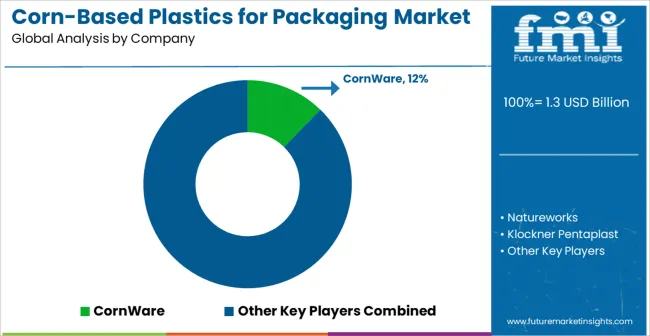
- CornWare
- Natureworks
- Klockner Pentaplast
- Braskem
- NatureWorks
- Novamont
- BASF
- Corbion
- PSM
- DuPont
- Arkema
- Kingfa
- FKuR
- Biomer
- Mitsubishi
Scope of the Report
| Metric | Value |
|---|---|
| Quantitative Units | USD 1.42 Billion to USD 3.42 Billion, at a CAGR of 9.20% |
| Market Definition | Corn-based plastics for packaging are bio-derived polymer materials, primarily polylactic acid (PLA), produced through fermentation and polymerization of corn starch sugars. These materials serve as compostable and bio-based alternatives to petroleum-derived packaging plastics across food containers, wraps, bags, pharmaceutical packaging, agricultural films, and textile packaging applications. |
| Segmentation | End User: Food Industry, Pharmaceutical Industry, Agriculture Industry, Textile Industry |
| Regions Covered | North America, Latin America, Europe, East Asia, South Asia, Oceania, Middle East & Africa |
| Countries Covered | China, India, Germany, Brazil, USA, UK, Japan, and 40 plus countries |
| Key Companies Profiled | CornWare, Natureworks, Klockner Pentaplast, Braskem, NatureWorks, Novamont, BASF, Corbion, PSM, DuPont, Arkema, Kingfa |
| Forecast Period | 2026 to 2036 |
| Approach | Forecasting models apply a bottom-up methodology starting with regional production and trade metrics and projecting adoption rates against demand drivers and regulatory compliance timelines. |
Corn-Based Plastics for Packaging Market by Segments
End-User Industry:
- Food Industry
- Pharmaceutical Industry
- Agriculture Industry
- Textile Industry
Region:
- North America
- USA
- Canada
- Mexico
- Latin America
- Brazil
- Chile
- Rest of Latin America
- Western Europe
- Germany
- UK
- Italy
- Spain
- France
- Nordic
- BENELUX
- Rest of Western Europe
- Eastern Europe
- Russia
- Poland
- Hungary
- Balkan & Baltic
- Rest of Eastern Europe
- East Asia
- China
- Japan
- South Korea
- South Asia and Pacific
- India
- ASEAN
- Australia & New Zealand
- Rest of South Asia and Pacific
- Middle East & Africa
- Kingdom of Saudi Arabia
- Other GCC Countries
- Turkiye
- South Africa
- Other African Union
- Rest of Middle East & Africa
Bibliography
- European Commission. (2025). Packaging and Packaging Waste Regulation (PPWR): Compostable Packaging Requirements. European Commission.
- USA Environmental Protection Agency. (2025). National Strategy to Prevent Plastic Pollution. EPA.
- Food and Agriculture Organization of the United Nations. (2025). Bioplastics and Food Packaging: Global Status Report. FAO.
- Organisation for Economic Co-operation and Development. (2025). Policies for Bioplastics in the Context of a Bioeconomy. OECD.
- NatureWorks LLC. (2025). Ingeo PLA Resin Product Guide and Sustainability Report 2025. NatureWorks.
This bibliography is provided for reader reference. The full Future Market Insights report contains the complete reference list with primary research documentation.
Frequently Asked Questions
How large is the demand for Corn-Based Plastics for Packaging in the global market in 2026?
Demand for Corn-Based Plastics for Packaging in the global market is estimated to be valued at USD 1.42 billion in 2026.
What will be the market size of Corn-Based Plastics for Packaging in the global market by 2036?
Market size for Corn-Based Plastics for Packaging is projected to reach USD 3.42 billion by 2036.
What is the expected demand growth for Corn-Based Plastics for Packaging in the global market between 2026 and 2036?
Demand for Corn-Based Plastics for Packaging is expected to grow at a CAGR of 9.20% between 2026 and 2036.
Which End User is poised to lead global sales by 2026?
Food Industry accounts for 45.0% share in 2026 based on structural demand factors and procurement concentration patterns.
What is driving demand in China?
China leads growth at 12.4% CAGR through 2036, driven by expanding domestic production capacity and end-use procurement volumes.
What is India's growth outlook in this report?
India is projected to grow at a CAGR of 11.5% during 2026 to 2036.
What is Corn-Based Plastics for Packaging and what is it mainly used for?
Corn-based plastics for packaging are bio-derived polymer materials, primarily polylactic acid (PLA), produced through fermentation and polymerization of corn starch sugars. These materials serve as compostable and bio-based alternatives to petroleum-derived packaging plastics across food containers, wraps, bags, pharmaceutical packaging, agricultural films, and textile packaging applications.
How does FMI build and validate the Corn-Based Plastics for Packaging forecast?
Forecasting models apply a bottom-up methodology starting with regional production and trade metrics and cross-validate projections against industry statistics and company guidance.
Preview the report firsthand - request a free sample
Get SampleGet the brochure for pricing and purchase details.
Get PDFTable of Content
- Executive Summary
- Global Market Outlook
- Demand-side Trends
- Supply-side Trends
- Technology Roadmap Analysis
- Analysis and Recommendations
- Market Overview
- Market Coverage / Taxonomy
- Market Definition / Scope / Limitations
- Research Methodology
- Company Annual and Sustainability Reports
- Peer-reviewed Journals and Academic Literature
- Corporate Websites, Product Literature, and Technical Notes
- Earnings Decks and Investor Briefings
- Statutory Filings and Regulatory Disclosures
- Technical White Papers and Standards Notes
- Trade Journals, Industry Magazines, and Analyst Briefs
- Conference Proceedings, Webinars, and Seminar Materials
- Government Statistics Portals and Public Data Releases
- Press Releases and Reputable Media Coverage
- Specialist Newsletters and Curated Briefings
- Sector Databases and Reference Repositories
- FMI Internal Proprietary Databases and Historical Market Datasets
- Subscription Datasets and Paid Sources
- Social Channels, Communities, and Digital Listening Inputs
- Additional Desk Sources
- Expert Input and Fieldwork (Primary Evidence)
- Primary Modes
- Qualitative Interviews and Expert Elicitation
- Quantitative Surveys and Structured Data Capture
- Blended Approach
- Why Primary Evidence is Used
- Field Techniques
- Interviews
- Surveys
- Focus Groups
- Observational and In-context Research
- Social and Community Interactions
- Stakeholder Universe Engaged
- C-suite Leaders
- Board Members
- Presidents and Vice Presidents
- R&D and Innovation Heads
- Technical Specialists
- Domain Subject-matter Experts
- Scientists
- Physicians and Other Healthcare Professionals
- Governance, Ethics, and Data Stewardship
- Research Ethics
- Data Integrity and Handling
- Primary Modes
- Tooling, Models, and Reference Databases
- Data Engineering and Model Build
- Data Acquisition and Ingestion
- Cleaning, Normalisation, and Verification
- Synthesis, Triangulation, and Analysis
- Quality Assurance and Audit Trail
- Market Background
- Market Dynamics
- Drivers
- Restraints
- Opportunity
- Trends
- Scenario Forecast
- Demand in Optimistic Scenario
- Demand in Likely Scenario
- Demand in Conservative Scenario
- Opportunity Map Analysis
- Product Life Cycle Analysis
- Supply Chain Analysis
- Investment Feasibility Matrix
- Value Chain Analysis
- PESTLE and Porter’s Analysis
- Regulatory Landscape
- Regional Parent Market Outlook
- Production and Consumption Statistics
- Import and Export Statistics
- Market Dynamics
- Global Market Analysis 2021 to 2025 and Forecast, 2026 to 2036
- Historical Market Size Value (USD Million) Analysis, 2021 to 2025
- Current and Future Market Size Value (USD Million) Projections, 2026 to 2036
- Y-o-Y Growth Trend Analysis
- Absolute $ Opportunity Analysis
- Global Market Pricing Analysis 2021 to 2025 and Forecast 2026 to 2036
- Global Market Analysis 2021 to 2025 and Forecast 2026 to 2036, By End User
- Introduction / Key Findings
- Historical Market Size Value (USD Million) Analysis By End User , 2021 to 2025
- Current and Future Market Size Value (USD Million) Analysis and Forecast By End User , 2026 to 2036
- Food Industry
- Pharmaceutical Industry
- Agriculture Industry
- Textile Industry
- Food Industry
- Y-o-Y Growth Trend Analysis By End User , 2021 to 2025
- Absolute $ Opportunity Analysis By End User , 2026 to 2036
- Global Market Analysis 2021 to 2025 and Forecast 2026 to 2036, By Region
- Introduction
- Historical Market Size Value (USD Million) Analysis By Region, 2021 to 2025
- Current Market Size Value (USD Million) Analysis and Forecast By Region, 2026 to 2036
- North America
- Latin America
- Western Europe
- Eastern Europe
- East Asia
- South Asia and Pacific
- Middle East & Africa
- Market Attractiveness Analysis By Region
- North America Market Analysis 2021 to 2025 and Forecast 2026 to 2036, By Country
- Historical Market Size Value (USD Million) Trend Analysis By Market Taxonomy, 2021 to 2025
- Market Size Value (USD Million) Forecast By Market Taxonomy, 2026 to 2036
- By Country
- USA
- Canada
- Mexico
- By End User
- By Country
- Market Attractiveness Analysis
- By Country
- By End User
- Key Takeaways
- Latin America Market Analysis 2021 to 2025 and Forecast 2026 to 2036, By Country
- Historical Market Size Value (USD Million) Trend Analysis By Market Taxonomy, 2021 to 2025
- Market Size Value (USD Million) Forecast By Market Taxonomy, 2026 to 2036
- By Country
- Brazil
- Chile
- Rest of Latin America
- By End User
- By Country
- Market Attractiveness Analysis
- By Country
- By End User
- Key Takeaways
- Western Europe Market Analysis 2021 to 2025 and Forecast 2026 to 2036, By Country
- Historical Market Size Value (USD Million) Trend Analysis By Market Taxonomy, 2021 to 2025
- Market Size Value (USD Million) Forecast By Market Taxonomy, 2026 to 2036
- By Country
- Germany
- UK
- Italy
- Spain
- France
- Nordic
- BENELUX
- Rest of Western Europe
- By End User
- By Country
- Market Attractiveness Analysis
- By Country
- By End User
- Key Takeaways
- Eastern Europe Market Analysis 2021 to 2025 and Forecast 2026 to 2036, By Country
- Historical Market Size Value (USD Million) Trend Analysis By Market Taxonomy, 2021 to 2025
- Market Size Value (USD Million) Forecast By Market Taxonomy, 2026 to 2036
- By Country
- Russia
- Poland
- Hungary
- Balkan & Baltic
- Rest of Eastern Europe
- By End User
- By Country
- Market Attractiveness Analysis
- By Country
- By End User
- Key Takeaways
- East Asia Market Analysis 2021 to 2025 and Forecast 2026 to 2036, By Country
- Historical Market Size Value (USD Million) Trend Analysis By Market Taxonomy, 2021 to 2025
- Market Size Value (USD Million) Forecast By Market Taxonomy, 2026 to 2036
- By Country
- China
- Japan
- South Korea
- By End User
- By Country
- Market Attractiveness Analysis
- By Country
- By End User
- Key Takeaways
- South Asia and Pacific Market Analysis 2021 to 2025 and Forecast 2026 to 2036, By Country
- Historical Market Size Value (USD Million) Trend Analysis By Market Taxonomy, 2021 to 2025
- Market Size Value (USD Million) Forecast By Market Taxonomy, 2026 to 2036
- By Country
- India
- ASEAN
- Australia & New Zealand
- Rest of South Asia and Pacific
- By End User
- By Country
- Market Attractiveness Analysis
- By Country
- By End User
- Key Takeaways
- Middle East & Africa Market Analysis 2021 to 2025 and Forecast 2026 to 2036, By Country
- Historical Market Size Value (USD Million) Trend Analysis By Market Taxonomy, 2021 to 2025
- Market Size Value (USD Million) Forecast By Market Taxonomy, 2026 to 2036
- By Country
- Kingdom of Saudi Arabia
- Other GCC Countries
- Turkiye
- South Africa
- Other African Union
- Rest of Middle East & Africa
- By End User
- By Country
- Market Attractiveness Analysis
- By Country
- By End User
- Key Takeaways
- Key Countries Market Analysis
- USA
- Pricing Analysis
- Market Share Analysis, 2025
- By End User
- Canada
- Pricing Analysis
- Market Share Analysis, 2025
- By End User
- Mexico
- Pricing Analysis
- Market Share Analysis, 2025
- By End User
- Brazil
- Pricing Analysis
- Market Share Analysis, 2025
- By End User
- Chile
- Pricing Analysis
- Market Share Analysis, 2025
- By End User
- Germany
- Pricing Analysis
- Market Share Analysis, 2025
- By End User
- UK
- Pricing Analysis
- Market Share Analysis, 2025
- By End User
- Italy
- Pricing Analysis
- Market Share Analysis, 2025
- By End User
- Spain
- Pricing Analysis
- Market Share Analysis, 2025
- By End User
- France
- Pricing Analysis
- Market Share Analysis, 2025
- By End User
- India
- Pricing Analysis
- Market Share Analysis, 2025
- By End User
- ASEAN
- Pricing Analysis
- Market Share Analysis, 2025
- By End User
- Australia & New Zealand
- Pricing Analysis
- Market Share Analysis, 2025
- By End User
- China
- Pricing Analysis
- Market Share Analysis, 2025
- By End User
- Japan
- Pricing Analysis
- Market Share Analysis, 2025
- By End User
- South Korea
- Pricing Analysis
- Market Share Analysis, 2025
- By End User
- Russia
- Pricing Analysis
- Market Share Analysis, 2025
- By End User
- Poland
- Pricing Analysis
- Market Share Analysis, 2025
- By End User
- Hungary
- Pricing Analysis
- Market Share Analysis, 2025
- By End User
- Kingdom of Saudi Arabia
- Pricing Analysis
- Market Share Analysis, 2025
- By End User
- Turkiye
- Pricing Analysis
- Market Share Analysis, 2025
- By End User
- South Africa
- Pricing Analysis
- Market Share Analysis, 2025
- By End User
- USA
- Market Structure Analysis
- Competition Dashboard
- Competition Benchmarking
- Market Share Analysis of Top Players
- By Regional
- By End User
- Competition Analysis
- Competition Deep Dive
- CornWare
- Overview
- Product Portfolio
- Profitability by Market Segments (Product/Age /Sales Channel/Region)
- Sales Footprint
- Strategy Overview
- Marketing Strategy
- Product Strategy
- Channel Strategy
- Natureworks
- Klockner Pentaplast
- Braskem
- NatureWorks
- Novamont
- BASF
- Corbion
- PSM
- DuPont
- Arkema
- Kingfa
- FKuR
- Biomer
- Mitsubishi
- CornWare
- Competition Deep Dive
- Assumptions & Acronyms Used


