

- Market Size (2026)
- USD 470.8 Mn
- Forecast (2036)
- USD 851.1 Mn
- CAGR (2026 to 2036)
- 6.1%
Pneumatic Slide Gates Market Size, Market Forecast and Outlook By FMI
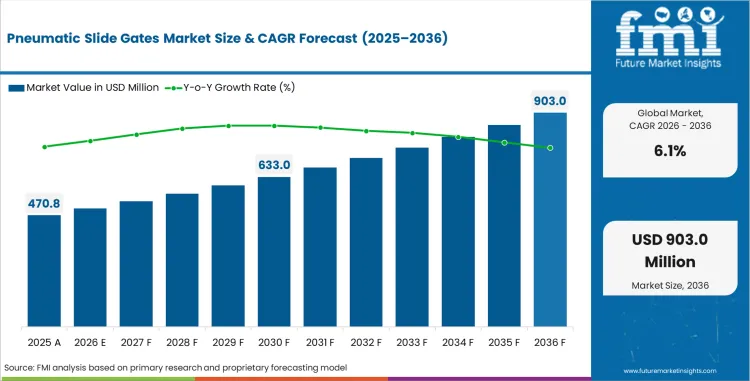
The pneumatic slide gates market was valued at USD 443.7 million in 2025 and are estimated to reach USD 470.8 million in 2026, reflecting steady uptake in bulk material handling environments. Forecasts indicate a CAGR of 6.1% from 2026 to 2036, with revenue expected to reach USD 851.1 million by 2036. Demand is fueled by the increasing requirement for shutoff mechanisms that ensure controlled flow and minimize contamination risks.
Summary of Pneumatic Slide Gates Market
- Market Snapshot
- The pneumatic slide gates market was valued at USD 443.7 million in 2025 and is projected to reach USD 851.1 million by 2036.
- The market is expected to reach a CAGR of 6.1% from 2026 to 2036, creating an additional revenue opportunity of USD 380.3 million over the forecast period.
- Pneumatic slide gates are a specification-driven category where sealing performance, wear resistance, and compatibility with conveying systems are more important than product range, keeping their relevance tied to pneumatic actuation and bulk material handling setups.
- Equipment selection is shaped by hygiene requirements, integration with compressed air systems, performance under abrasive conditions, and the ability to isolate material flow without reducing transfer efficiency.
- Demand and Growth Drivers
- Demand is increasing as powder transfer systems, hopper discharge points, and pneumatic conveying lines require shutoff devices that isolate flow without adding unnecessary cleaning or maintenance effort.
- Stainless steel configurations are gaining adoption in food and sensitive processing environments, where hygienic design and washdown compatibility are required.
- Capacity additions in India and China continue to support demand, as new process lines typically include multiple controlled transfer and isolation points.
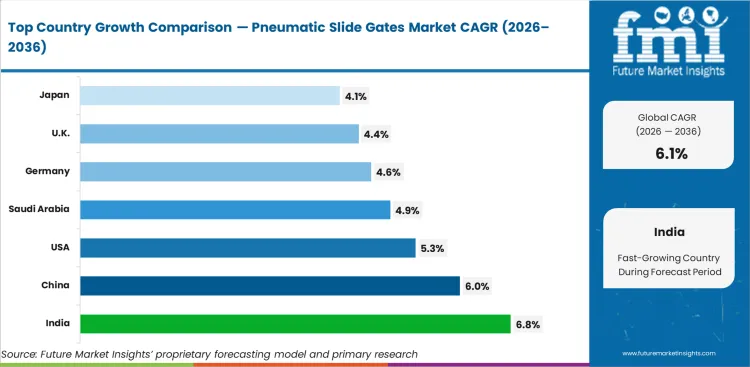
- India is projected to expand at 6.8% CAGR in the pneumatic slide gates market from 2026 to 2036, followed by China at 6.0% CAGR. The United States is expected to record 5.3% CAGR, while Saudi Arabia posts 4.9% CAGR, Germany 4.6% CAGR, the United Kingdom 4.4% CAGR, and Japan 4.1% CAGR over the same period.
- Market expansion remains constrained by longer approval cycles in established plants, where gate selection must closely match material behavior and operating pressure before installation.
- Product and Segment View
- The market is estimated to include knife gates, slide gates, and high-pressure gates manufactured from carbon steel and stainless steel, with close linkage to adjacent valve categories.
- These products are used across food, chemical, cement, and plastics plants where dry material flow must be controlled without shutting down the full system.
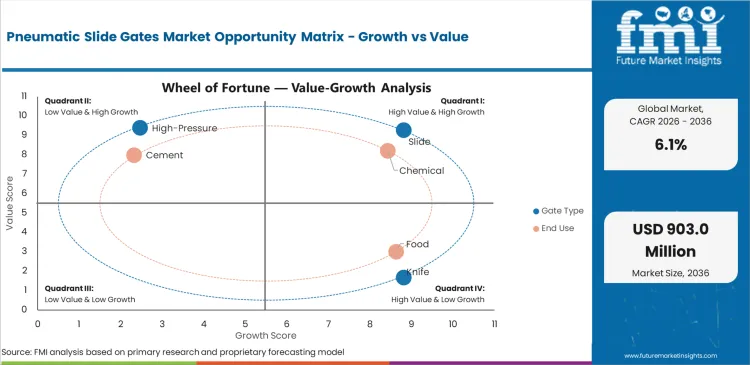
- Slide gates are projected to account for 44.0% share of the gate type segment in 2026, as they support a wide range of standard isolation duties across bulk solids handling lines.
- The chemicals segment is expected to represent 25.0% share of end use in 2026, driven by frequent handling of powders, granules, and additives in enclosed systems.
- Pneumatic actuation is anticipated to hold 73.0% share of the actuation segment in 2026, reflecting compatibility with existing compressed air infrastructure in conveying-intensive operations.
- Stainless steel construction is projected to capture 57.0% share of the material segment in 2026, supported by corrosion resistance, ease of cleaning, and suitability for sensitive processing conditions.
- The scope is estimated to include standalone pneumatic slide gates and related shutoff devices used in hoppers, silos, conveying connections, and discharge lines, while excluding complete conveying systems and liquid-flow valves without a defined solids isolation function.
- Geography and Competitive Outlook
- India, China, and the USA remain the faster-growing national markets among the countries assessed, while Germany, the UK, and Japan provide steadier replacement-driven demand.
- Competition is shaped by application engineering, lead time discipline, wear handling, and integration with material handling integration and automated handling systems projects.
- DMN-WESTINGHOUSE, WAMGROUP, Vortex Global, Coperion, Gericke, AZO, and Bühler remain among the visible participants supplying this category.
Key Takeaways, Market Size, and Forecast
- Pneumatic Slide Gates Market is projected to grow from USD 470.8 million in 2026 to USD 851.1 million by 2036, at a CAGR of 6.1%.
- The Pneumatic Slide Gates Market was valued at USD 443.7 million in 2025.
- By 2036, the Pneumatic Slide Gates Market is expected to be worth USD 851.1 million.
- From 2026 to 2036, the market is projected to expand at a CAGR of 6.1%.
- The market is projected to create an incremental opportunity of USD 380.3 million between 2026 and 2036.
- In 2026, Slide Gates is expected to account for 44.0% of the gate type segment.
- India (6.8% CAGR) and China (6.0% CAGR) are two of the fastest growing markets.
| Metric | Details |
|---|---|
| Industry Size (2026) | USD 470.8 million |
| Industry Value (2036) | USD 851.1 million |
| CAGR (2026-2036) | 6.1% |
Source: Future Market Insights (FMI) analysis and primary research
Plant engineers are evaluating slide gates based on operating conditions rather than basic shutoff function. Equipment selection now depends on pressure handling, sealing performance, cleaning effort, and compatibility with material characteristics. Powders, pellets, and abrasive solids require more precise isolation as conveying systems become denser and hygiene standards tighten. Selection errors often appear later as leakage, cleaning delays, or unstable discharge.
Specification clarity improves adoption and reduces design changes. When operating parameters such as pressure class, material behavior, air supply setup, and cleaning needs are defined early, installation becomes more predictable. This approach reduces late-stage substitutions and supports repeat installations across similar lines.
India is projected to expand at 6.8% CAGR in the pneumatic slide gates market from 2026 to 2036, supported by new processing capacity and additional handling points. China is expected to record 6.0% CAGR over the same period, driven by demand in chemicals and plastics. The United States is anticipated to expand at 5.3% CAGR, while Saudi Arabia is forecast at 4.9% CAGR. Germany is set to grow at 4.6% CAGR, followed by the United Kingdom at 4.4% CAGR and Japan at 4.1% CAGR through 2036. Differences across countries reflect the balance between new installations and replacement-driven demand in established industrial markets.
Segmental Analysis
Pneumatic Slide Gates Market Analysis by Gate Type
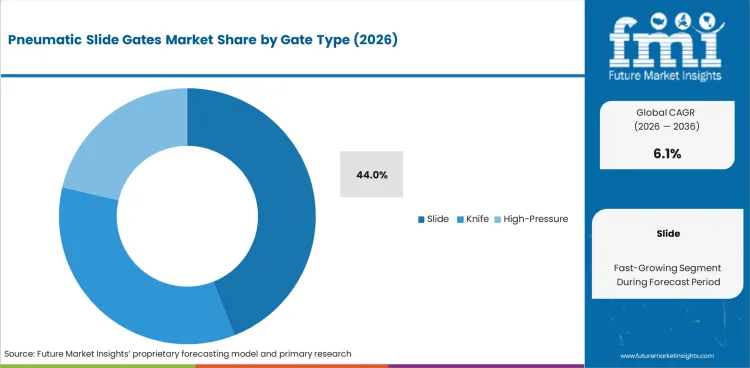
Flow isolation in dry material systems favors equipment that can close reliably without adding unnecessary complexity. Slide gates are expected to account for 44.0% share of the gate type segment in 2026, as they suit standard interception points across hoppers, bins, and conveying transitions where predictable shutoff and manageable wear are required. Knife gates remain relevant in harsher solids handling conditions, while high-pressure gates are used in narrower applications where sealing tolerance and pressure containment are critical. Equipment choice typically stays with slide gates unless operating conditions require a more specialized design. Incorrect selection often leads to sealing issues, material buildup, and higher maintenance effort that affects discharge stability.
- Interception range: Slide Gates cover a wide span of routine shutoff duties, which keeps specification work simpler for plant engineers.
- Pressure fit: High-pressure designs remain important where line conditions make standard gate geometry less dependable.
- Wear exposure: Knife Gates retain value where solids behavior and abrasion create a tougher closure environment.
Pneumatic Slide Gates Market Analysis by End Use
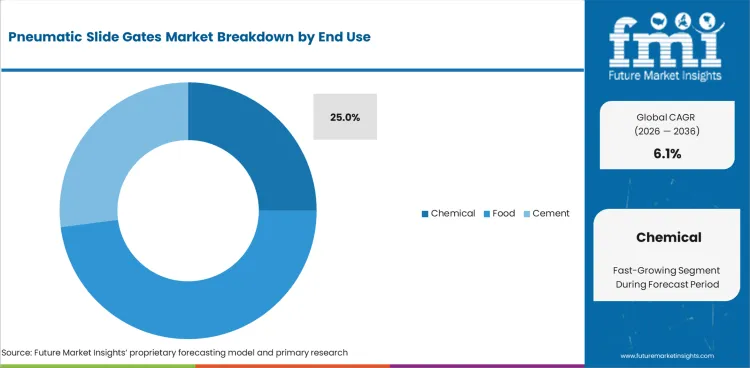
Chemical processing lines put more constant stress on shutoff hardware because powders, additives, and intermediates often move through enclosed systems that cannot tolerate leakage or poor isolation. Chemicals are anticipated to represent 25.0% of the market in 2026, a position tied to frequent transfer steps, tighter containment expectations, and line layouts where controlled discharge matters for both housekeeping and process stability. Cement follows through heavy-duty solids handling needs, while Food and Plastics add demand from cleanliness-sensitive and pellet-handling operations. Use conditions differ sharply across these sectors, so buyers do not treat one gate design as universally suitable. Plants that under-specify shutoff hardware usually absorb the cost through line stoppages, cleanup work, or inconsistent material transfer.
- Containment need: Chemical lines place more value on controlled isolation because leakage can affect both process stability and housekeeping.
- Duty severity: Cement installations keep demand grounded in abrasive solids handling and repeated discharge cycles.
- Clean transfer: Food and plastics users still prioritize shutoff performance where contamination control or pellet flow consistency matters.
Pneumatic Slide Gates Market Analysis by Actuation
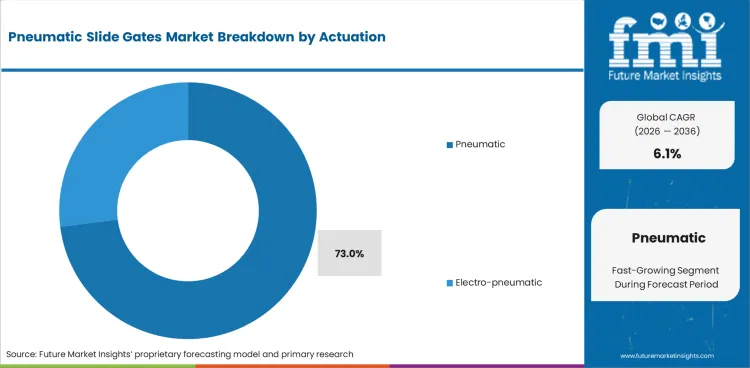
Compressed-air infrastructure is already present in many bulk solids plants, which supports the use of pneumatic actuation without major system changes. Pneumatic systems are expected to account for 73.0% share of the actuation segment in 2026, as they integrate easily with conveying setups, provide quick response in repeated shutoff operations, and align with existing maintenance practices. Electro-pneumatic options remain relevant where tighter control or monitoring is required, particularly in more automated environments. Equipment selection typically stays with pneumatic systems unless process control needs justify additional complexity. Poor alignment between actuation choice and plant control systems can lead to wiring changes, commissioning delays, and added retrofit work.
- Air compatibility: Pneumatic actuation fits plants that already depend on compressed air across transfer and control functions.
- Control layer: Electro-pneumatic variants remain useful where a broader automation setup needs tighter signaling or feedback.
- Commissioning burden: Misalignment between gate choice and control design often shows up late, when installation changes become costlier.
Pneumatic Slide Gates Market Analysis by Material of Construction
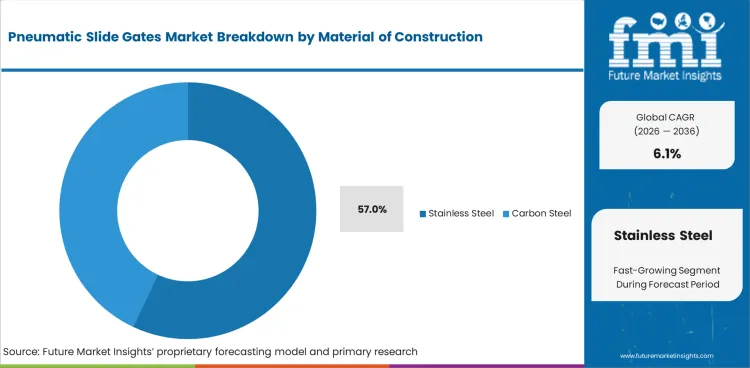
Cleaning burden, corrosion exposure, and product sensitivity carry more weight in material selection than the purchase price gap alone. Stainless Steel is expected to secure 57.0% share in 2026, as buyers in food, chemicals, and other cleanliness-sensitive operations prefer a surface and construction profile that is easier to clean, more resistant to corrosion, and better suited to repeated washdown or controlled handling routines. Carbon Steel remains relevant in less demanding duties where cost discipline and basic mechanical performance matter more than sanitation or corrosion resistance. Material choice often determines maintenance frequency before it changes line speed. Underestimating the service environment can leave buyers dealing with premature wear, harder cleaning cycles, or faster component replacement. Related FMI reading on hygienic equipment helps frame adjacent demand patterns.
- Cleanability: Stainless Steel remains favored where product contact and washdown routines place more pressure on surface condition.
- Corrosion control: Chemical and humidity-exposed settings keep corrosion resistance central to material choice.
- Cost discipline: Carbon Steel retains space where the line environment is less severe and procurement teams prioritize lower upfront spend.
Pneumatic Slide Gates Market Drivers, Restraints, and Opportunities
Process engineers are under pressure to isolate dry material flow without introducing leakage, excess cleaning, or wider system disruption. This supports demand for pneumatic slide gates, as enclosed transfer layouts require shutoff devices that match line conditions and maintenance limits. Buyers in chemicals, food, cement, and plastics evaluate how much interruption, cleaning effort, and sealing risk a system can handle during operation. Demand remains strong where plants need a repeatable isolation solution that can be specified early and applied across similar installations.
Qualification cycles continue to slow purchasing decisions. Operations teams, maintenance groups, OEMs, and project stakeholders must align on pressure requirements, material behavior, construction materials, and actuator compatibility before finalizing selection. This review process reflects the risk of incorrect equipment choice, which often appears after installation through leakage, sticking, or wear. Broad product offerings support suppliers, but application-specific engineering remains essential. Attempts to substitute equipment quickly often extend evaluation timelines once real operating conditions are considered.
Opportunities in the Pneumatic Slide Gates Market
- Standardization: Plants adding new bulk solids lines create repeat demand when engineering teams standardize gate specifications across similar transfer points, which gives suppliers more room to win follow-on orders through consistent execution.
- Sanitary fit: Food and sensitive chemical applications reward suppliers that can position stainless-steel and easier-to-clean designs where hygiene, washdown, and contamination control shape the purchase decision.
- Control upgrades: Automation projects tied to automated handling and integrated conveying layouts create room for electro-pneumatic upgrades where line control needs tighter signaling, feedback, or sequencing discipline.
Regional Analysis
Based on the regional analysis, the Pneumatic Slide Gates Market is segmented into North America, Europe, Asia Pacific, Latin America, and Middle East & Africa across 40 plus countries.
.webp "Top Country Growth Comparison Pneumatic Slide Gates Market Cagr (2026 2036)")
| Country | CAGR (2026 to 2036) |
|---|---|
| India | 6.8% |
| China | 6.0% |
| USA | 5.3% |
| Saudi Arabia | 4.9% |
| Germany | 4.6% |
| UK | 4.4% |
| Japan | 4.1% |
Source: Future Market Insights (FMI) analysis and primary research
Asia Pacific Pneumatic Slide Gates Market Analysis
Factory additions and process-line buildouts keep this region tied more closely to new installation demand than to simple replacement cycles. Buyers here usually enter specification discussions while planning line capacity, which lifts the importance of pneumatic compatibility, local engineering support, and solids-handling fit. FMI analysis indicates that equipment choices in Asia Pacific often sit inside a broader capital decision that also touches conveying hardware, line control, and discharge architecture, linking the category to adjacent spaces such as material handling equipment and bulk handling systems where adjacent flow-control and handling choices influence wider plant design decisions.
- India: India is set to record 6.8% CAGR in the pneumatic slide gates market during 2026 to 2036. Expansion of process industries increases the number of transfer points requiring reliable shutoff control. Procurement teams aim to standardize gate types across multiple lines to simplify maintenance and spare management. Delays in standardization often lead to longer approval cycles once projects scale. Equipment must support repeatable operation under variable material conditions. These factors support steady adoption across new industrial installations.
- China: Scale matters more than novelty in China as large process installations need dependable isolation across many discharge and conveying points. The pneumatic slide gates market in China is projected to grow at 6.0% during the forecast period. Buyers who push for lowest-cost substitutions often carry the risk into maintenance burden and shorter service intervals.
- Japan: Japan reflects a more controlled demand pattern, where replacement and system fit take precedence over expansion. Growth is estimated at 4.1% through 2036, shaped by selective upgrades within established facilities. Operators prioritize gates that integrate seamlessly into existing layouts without requiring structural modification. Reliability and long service intervals remain key evaluation criteria. Procurement cycles tend to be longer due to cautious vendor selection. These factors support steady demand for well-matched and durable solutions.
FMI’s report also covers South Korea, ASEAN countries, Australia, and other Asia Pacific demand centers where buyer decisions often follow broader automation and process-upgrade spending rather than isolated component purchases.
Europe Pneumatic Slide Gates Market Analysis
Specification depth tends to be higher across Europe because buyers spend more time on containment, hygiene, dust handling, and maintenance fit before finalizing line components. That does not always produce faster growth, yet it does produce more deliberate equipment selection and a stronger preference for vendors that can support application-specific design choices. Connections to industrial valves and fluid conveyance where adjacent flow-control and handling choices influence wider plant design decisions.
- Germany: Germany’s pneumatic slide gates market is projected to move at around 4.6% CAGR through 2026 to 2036, supported by engineering-led procurement across industrial sectors. Buyers prioritize correct sizing and material selection during the initial specification stage to avoid future maintenance issues. Equipment that fails to meet durability expectations is often rejected before installation. Operators focus on achieving stable long-term performance rather than short-term cost savings. These factors support demand for technically precise and application-specific gate systems.
- UK: In the United Kingdom, demand is shaped by replacement cycles and targeted process upgrades rather than large-scale expansion. The market progresses at nearly 4.4% CAGR through 2036, reflecting steady but selective purchasing. Buyers balance performance requirements with project budget constraints. Equipment must integrate into existing systems without extending installation timelines. Delays in specification clarity can slow approval processes. These conditions support continued adoption across facilities upgrading material handling infrastructure.
Additional coverage includes France, Italy, Spain, Benelux, and the Nordics, where demand remains linked to process modernization, hygiene expectations, and careful replacement planning rather than aggressive greenfield capacity.
North America and Middle East & Africa Pneumatic Slide Gates Market Analysis
North America combines a large replacement base with selective process upgrades, while Middle East demand often reflects heavier industrial additions in cement and chemicals. Buyers in these regions look closely at lifecycle reliability, service access, and how smoothly a gate can be integrated into an existing material transfer setup. FMI’s view is that the category also intersects with water draw off valves and degassing valves where adjacent flow-control and handling choices influence wider plant design decisions.
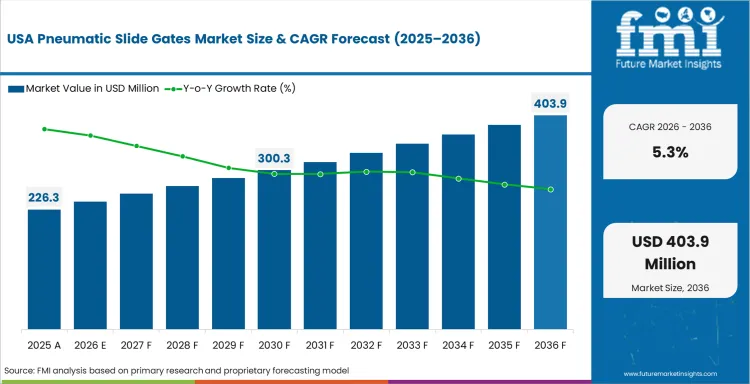
- USA: The pneumatic slide gates market in the United States is anticipated to expand at 5.3% CAGR between 2026 and 2036. Many facilities upgrade shutoff components during maintenance cycles rather than through full system redesign. Operators prioritize gates that reduce leakage and simplify cleaning around transfer points. Delayed replacement often leads to extended operational inefficiencies. Equipment must integrate into existing layouts without disrupting production. These factors support steady demand across industrial processing facilities.
- Saudi Arabia: Industrial buildouts in cement and chemicals give Saudi Arabia a different demand profile from mature replacement-heavy markets. Industry is projected to record a CAGR of 4.9% in pneumatic slide gates during the forecast period. Suppliers that align with project timing and local service expectations have a better chance of securing repeat orders.
FMI’s report further evaluates Canada, Mexico, Brazil, South Africa, GCC demand centers, and other regional markets where capital timing, distributor reach, and maintenance expectations shape supplier performance.
Competitive Aligners for Market Players
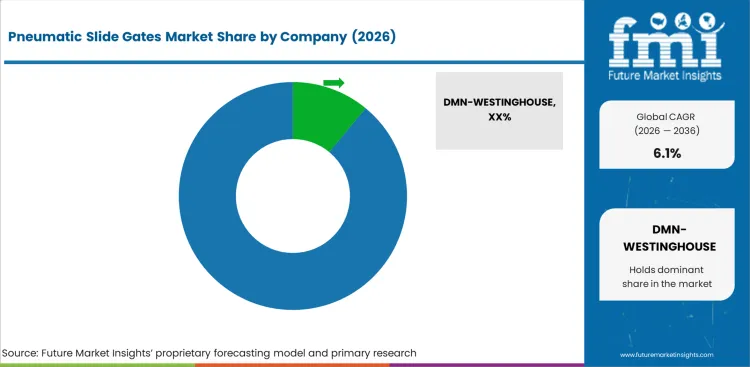
Fragmentation remains a core feature of this market because buyers prioritize application fit and engineering response over brand scale. Suppliers such as DMN-WESTINGHOUSE, WAMGROUP, Vortex Global, Coperion, Gericke, AZO, Bühler, Palamatic Process, Schenck Process, and Flexicon compete on sealing reliability, wear resistance, and delivery consistency. Supplier selection depends on how well they translate material behavior, pressure requirements, and cleaning needs into a workable gate design. While comparisons may extend to broader valve and actuation categories, final selection narrows quickly once operating conditions are defined.
Established suppliers hold an advantage when they combine product range with strong application support, distribution reach, and consistent manufacturing timelines. Buyers place less importance on catalog size if service and specification support are limited. New entrants can compete in specific applications or regional projects but must demonstrate that design, materials, actuator compatibility, and service response perform reliably under actual operating conditions. Equipment is increasingly evaluated as part of overall system performance rather than as a standalone component.
Large industrial users maintain multiple qualified suppliers to avoid dependence on a single source and to retain flexibility in pricing and supply. Suppliers benefit when their products become part of standard plant designs or repeated installations. Market structure is expected to remain fragmented through 2036, as varied application requirements and regional service needs continue to support specialized providers. Growth will favor suppliers that reduce specification uncertainty and improve application clarity rather than those that only expand product portfolios.
Key Players in Pneumatic Slide Gates Market
- DMN-WESTINGHOUSE
- WAMGROUP
- Vortex Global
- Coperion
- Gericke
- AZO
- Bühler
- Palamatic Process
- Schenck Process
- Flexicon
Scope of the Report
| Metric | Value |
|---|---|
| Quantitative Units | USD 470.8 million to USD 851.1 million, at a CAGR of 6.1% |
| Market Definition | Pneumatic slide gates cover mechanical shutoff devices used to isolate, divert, or control the discharge of dry bulk materials in hoppers, silos, bins, and conveying transitions. |
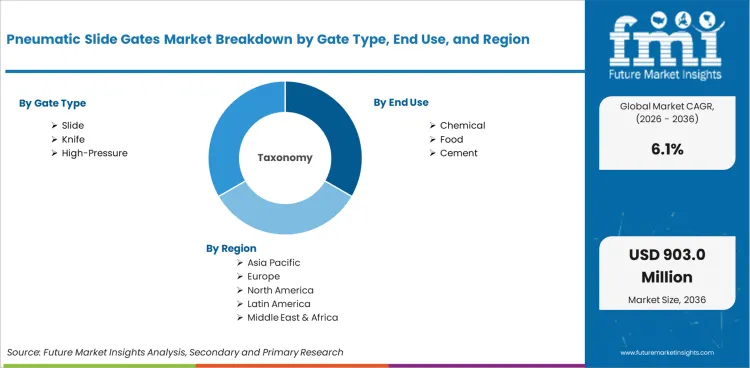
| Gate Type Segmentation | Knife Gates, Slide Gates, High-pressure Gates |
| End Use Segmentation | Food, Chemicals, Cement, Plastics, Other |
| Actuation Segmentation | Pneumatic, Electro-pneumatic |
| Material of Construction Segmentation | Carbon Steel, Stainless Steel |
| Regions Covered | North America, Europe, Asia Pacific, Latin America, Middle East & Africa |
| Countries Covered | USA, Germany, UK, China, India, Japan, Saudi Arabia, and 40 plus countries |
| Key Companies Profiled | DMN-WESTINGHOUSE, WAMGROUP, Vortex Global, Coperion, Gericke, AZO, Bühler, Palamatic Process, Schenck Process, Flexicon |
| Approach | FMI combines primary interviews with process equipment suppliers, engineering participants, and end-use buyers with desk research covering technical catalogs, industrial handling specifications, and trade-linked demand signals. Market sizing is anchored to observable equipment demand across bulk solids handling applications. Forecasts are cross-checked against end-use capacity additions, replacement intensity, and supplier positioning across major geographies. |
Source: Future Market Insights (FMI) analysis and primary research
Pneumatic Slide Gates Market Analysis by Segments
Gate Type:
- Knife Gates
- Slide Gates
- High-pressure Gates
End Use:
- Food
- Chemicals
- Cement
- Plastics
- Other
Actuation:
- Pneumatic
- Electro-pneumatic
Material of Construction:
- Carbon Steel
- Stainless Steel
Region:
- North America
- United States
- Canada
- Europe
- Germany
- United Kingdom
- France
- Italy
- Spain
- Asia Pacific
- China
- Japan
- South Korea
- Taiwan
- Singapore
- Latin America
- Brazil
- Mexico
- Argentina
- Middle East & Africa
- GCC Countries
- South Africa
- Israel
Bibliography
- European Commission. (2026, January). Equipment for potentially explosive atmospheres (ATE
- USA Food and Drug Administration. (2024, April). Current Good Manufacturing Practices (CGMPs) for food and dietary supplements.
- Centers for Disease Control and Prevention. (2024, January). Quantification of airborne dusts from powders.
- Coperion. (2025). Slide gate valve components for food & pharmaceutical. Coperion Food, Health & Nutrition.
- Flexicon. (2025). PNEUMATI-CON pneumatic conveying systems. Flexicon Corporation.
This Report Addresses
- Market size and forecast for pneumatic slide gates from 2025 to 2036.
- Growth outlook by gate type, end use, actuation, and material of construction.
- Country-level growth expectations for seven key national markets.
- Competitive structure and supplier positioning across leading equipment providers.
- Procurement logic behind stainless-steel, pneumatic, and chemical-processing demand patterns.
- Application fit across food, chemicals, cement, plastics, and adjacent bulk solids uses.
- Scope boundaries separating pneumatic slide gates from broader conveying systems and liquid valves.
- Research approach used to size, validate, and interpret the category.
Frequently Asked Questions
How large is the Pneumatic Slide Gates Market in 2026?
Industry value is expected to reach USD 470.8 million in 2026.
What will the market be valued at by 2036?
FMI projects the market at USD 851.1 million by 2036.
What CAGR is projected for the market?
The market is projected to expand at a 6.1% CAGR from 2026 to 2036.
Which gate type segment leads?
Slide Gates lead the Gate Type segment with 44.0% share in 2026.
Which end-use segment leads?
Chemicals lead end use with 25.0% share in 2026 because enclosed powder handling remains frequent in that sector.
Which actuation segment leads?
Pneumatic actuation leads with 73.0% share in 2026, reflecting plant compatibility with compressed-air systems.
What supports market expansion?
New process-line additions and the need for reliable shutoff points in powder handling support demand.
What is the primary restraint?
Longer qualification cycles slow orders when buyers need closer agreement on pressure duty, solids behavior, and material selection.
Which country grows fastest?
India grows fastest among the countries covered, at 6.8% CAGR through 2036.
Why does stainless steel lead by material?
Buyers favor stainless steel where corrosion control, cleaning burden, and product sensitivity carry more weight.
Why do buyers keep choosing pneumatic actuation?
Existing compressed-air infrastructure makes pneumatic systems easier to integrate into bulk solids operations.
How fragmented is competition?
The category remains fragmented, with the leading named company holding 8.2% share.
What does growth look like in China?
China is projected to expand at 6.0% CAGR as process capacity additions continue to support bulk handling equipment demand.
What does growth look like in the U.S.?
The U.S. is expected to register 5.3% CAGR, supported more by upgrades and replacement demand than by broad greenfield expansion.
How is Germany positioned?
Germany is expected to post 4.6% CAGR, with demand shaped by engineering-led selection and careful application matching.
How does the U.K. compare?
The U.K. is expected to grow at 4.4% CAGR, reflecting measured replacement and process-upgrade demand.
What is the outlook for Japan?
Japan is projected at 4.1% CAGR, with procurement staying cautious and replacement-led.
How is Saudi Arabia positioned?
Saudi Arabia is expected to record 4.9% CAGR as cement and chemicals projects continue to support equipment demand.
What is included in market scope?
Scope includes standalone pneumatic slide gates and related shutoff devices used in solids handling systems.
What is excluded from scope?
Broader liquid-flow valves and complete conveying systems sold without a defined solids shutoff component are excluded.
How does FMI size this market?
FMI combines primary interviews, technical desk research, and application-level demand mapping across major end uses and geographies.
Why is this category important in bulk handling systems?
Pneumatic slide gates help isolate material flow, support controlled discharge, and limit maintenance issues tied to poor shutoff performance.
Preview the report firsthand - request a free sample
Get SampleGet the brochure for pricing and purchase details.
Get PDFTable of Content
- Executive Summary
- Global Market Outlook
- Demand-side Trends
- Supply-side Trends
- Technology Roadmap Analysis
- Analysis and Recommendations
- Market Overview
- Market Coverage / Taxonomy
- Market Definition / Scope / Limitations
- Research Methodology
- Chapter Orientation
- Analytical Framework
- Market Structure, Signals, and Trend Drivers
- Benchmarking and Cross-market Comparability
- Market Sizing, Forecasting, and Opportunity Mapping
- Research Design and Evidence Framework
- Desk Research Programme (Secondary Evidence)
- Company Annual and Sustainability Reports
- Peer-reviewed Journals and Academic Literature
- Corporate Websites, Product Literature, and Technical Notes
- Earnings Decks and Investor Briefings
- Statutory Filings and Regulatory Disclosures
- Technical White Papers and Standards Notes
- Trade Journals, Industry Magazines, and Analyst Briefs
- Conference Proceedings, Webinars, and Seminar Materials
- Government Statistics Portals and Public Data Releases
- Press Releases and Reputable Media Coverage
- Specialist Newsletters and Curated Briefings
- Sector Databases and Reference Repositories
- FMI Proprietary Databases and Historical Market Data
- Subscription Datasets and Paid Sources
- Social Channels, Communities, and Digital Listening Inputs
- Additional Desk Sources
- Expert Input and Fieldwork (Primary Evidence)
- Primary Modes
- Qualitative Interviews and Expert Elicitation
- Quantitative Surveys and Structured Data Capture
- Blended Approach
- Why Primary Evidence is Used
- Field Techniques
- Interviews
- Surveys
- Focus Groups
- Observational and In-context Research
- Social and Community Interactions
- Stakeholder Universe Engaged
- C-suite Leaders
- Board Members
- Presidents and Vice Presidents
- R&D and Innovation Heads
- Technical Specialists
- Domain Subject-matter Experts
- Scientists
- Physicians and Other Healthcare Professionals
- Governance, Ethics, and Data Stewardship
- Research Ethics
- Data Integrity and Handling
- Primary Modes
- Research Methods and Reference Sources
- Desk Research Programme (Secondary Evidence)
- Market Data Analysis and Forecast Development
- Data Collection
- Data Review and Validation
- Synthesis, Triangulation, and Analysis
- Research Quality and Validation
- Market Background
- Market Dynamics
- Drivers
- Restraints
- Opportunity
- Trends
- Scenario Forecast
- Demand in Optimistic Scenario
- Demand in Likely Scenario
- Demand in Conservative Scenario
- Opportunity Map Analysis
- Product Life Cycle Analysis
- Supply Chain Analysis
- Investment Feasibility Matrix
- Value Chain Analysis
- PESTLE and Porter’s Analysis
- Regulatory Landscape
- Regional Parent Market Outlook
- Production and Consumption Statistics
- Import and Export Statistics
- Market Dynamics
- Global Market Analysis 2021 to 2025 and Forecast, 2026 to 2036
- Historical Market Size Value (USD Million) Analysis, 2021 to 2025
- Current and Future Market Size Value (USD Million) Projections, 2026 to 2036
- Y-o-Y Growth Trend Analysis
- Absolute $ Opportunity Analysis
- Global Market Pricing Analysis 2021 to 2025 and Forecast 2026 to 2036
- Global Market Analysis 2021 to 2025 and Forecast 2026 to 2036, By Gate Type
- Introduction / Key Findings
- Historical Market Size Value (USD Million) Analysis By Gate Type , 2021 to 2025
- Current and Future Market Size Value (USD Million) Analysis and Forecast By Gate Type , 2026 to 2036
- Slide
- Knife
- High-Pressure
- Slide
- Y-o-Y Growth Trend Analysis By Gate Type , 2021 to 2025
- Absolute $ Opportunity Analysis By Gate Type , 2026 to 2036
- Global Market Analysis 2021 to 2025 and Forecast 2026 to 2036, By End Use
- Introduction / Key Findings
- Historical Market Size Value (USD Million) Analysis By End Use, 2021 to 2025
- Current and Future Market Size Value (USD Million) Analysis and Forecast By End Use, 2026 to 2036
- Chemical
- Food
- Cement
- Chemical
- Y-o-Y Growth Trend Analysis By End Use, 2021 to 2025
- Absolute $ Opportunity Analysis By End Use, 2026 to 2036
- Global Market Analysis 2021 to 2025 and Forecast 2026 to 2036, By Actuation
- Introduction / Key Findings
- Historical Market Size Value (USD Million) Analysis By Actuation, 2021 to 2025
- Current and Future Market Size Value (USD Million) Analysis and Forecast By Actuation, 2026 to 2036
- Pneumatic
- Electro-pneumatic
- Pneumatic
- Y-o-Y Growth Trend Analysis By Actuation, 2021 to 2025
- Absolute $ Opportunity Analysis By Actuation, 2026 to 2036
- Global Market Analysis 2021 to 2025 and Forecast 2026 to 2036, By Material of Construction
- Introduction / Key Findings
- Historical Market Size Value (USD Million) Analysis By Material of Construction, 2021 to 2025
- Current and Future Market Size Value (USD Million) Analysis and Forecast By Material of Construction, 2026 to 2036
- Stainless Steel
- Carbon Steel
- Stainless Steel
- Y-o-Y Growth Trend Analysis By Material of Construction, 2021 to 2025
- Absolute $ Opportunity Analysis By Material of Construction, 2026 to 2036
- Global Market Analysis 2021 to 2025 and Forecast 2026 to 2036, By Region
- Introduction
- Historical Market Size Value (USD Million) Analysis By Region, 2021 to 2025
- Current Market Size Value (USD Million) Analysis and Forecast By Region, 2026 to 2036
- North America
- Latin America
- Western Europe
- Eastern Europe
- East Asia
- South Asia and Pacific
- Middle East & Africa
- Market Attractiveness Analysis By Region
- North America Market Analysis 2021 to 2025 and Forecast 2026 to 2036, By Country
- Historical Market Size Value (USD Million) Trend Analysis By Market Taxonomy, 2021 to 2025
- Market Size Value (USD Million) Forecast By Market Taxonomy, 2026 to 2036
- By Country
- USA
- Canada
- Mexico
- By Gate Type
- By End Use
- By Actuation
- By Material of Construction
- By Country
- Market Attractiveness Analysis
- By Country
- By Gate Type
- By End Use
- By Actuation
- By Material of Construction
- Key Takeaways
- Latin America Market Analysis 2021 to 2025 and Forecast 2026 to 2036, By Country
- Historical Market Size Value (USD Million) Trend Analysis By Market Taxonomy, 2021 to 2025
- Market Size Value (USD Million) Forecast By Market Taxonomy, 2026 to 2036
- By Country
- Brazil
- Chile
- Rest of Latin America
- By Gate Type
- By End Use
- By Actuation
- By Material of Construction
- By Country
- Market Attractiveness Analysis
- By Country
- By Gate Type
- By End Use
- By Actuation
- By Material of Construction
- Key Takeaways
- Western Europe Market Analysis 2021 to 2025 and Forecast 2026 to 2036, By Country
- Historical Market Size Value (USD Million) Trend Analysis By Market Taxonomy, 2021 to 2025
- Market Size Value (USD Million) Forecast By Market Taxonomy, 2026 to 2036
- By Country
- Germany
- UK
- Italy
- Spain
- France
- Nordic
- BENELUX
- Rest of Western Europe
- By Gate Type
- By End Use
- By Actuation
- By Material of Construction
- By Country
- Market Attractiveness Analysis
- By Country
- By Gate Type
- By End Use
- By Actuation
- By Material of Construction
- Key Takeaways
- Eastern Europe Market Analysis 2021 to 2025 and Forecast 2026 to 2036, By Country
- Historical Market Size Value (USD Million) Trend Analysis By Market Taxonomy, 2021 to 2025
- Market Size Value (USD Million) Forecast By Market Taxonomy, 2026 to 2036
- By Country
- Russia
- Poland
- Hungary
- Balkan & Baltic
- Rest of Eastern Europe
- By Gate Type
- By End Use
- By Actuation
- By Material of Construction
- By Country
- Market Attractiveness Analysis
- By Country
- By Gate Type
- By End Use
- By Actuation
- By Material of Construction
- Key Takeaways
- East Asia Market Analysis 2021 to 2025 and Forecast 2026 to 2036, By Country
- Historical Market Size Value (USD Million) Trend Analysis By Market Taxonomy, 2021 to 2025
- Market Size Value (USD Million) Forecast By Market Taxonomy, 2026 to 2036
- By Country
- China
- Japan
- South Korea
- By Gate Type
- By End Use
- By Actuation
- By Material of Construction
- By Country
- Market Attractiveness Analysis
- By Country
- By Gate Type
- By End Use
- By Actuation
- By Material of Construction
- Key Takeaways
- South Asia and Pacific Market Analysis 2021 to 2025 and Forecast 2026 to 2036, By Country
- Historical Market Size Value (USD Million) Trend Analysis By Market Taxonomy, 2021 to 2025
- Market Size Value (USD Million) Forecast By Market Taxonomy, 2026 to 2036
- By Country
- India
- ASEAN
- Australia & New Zealand
- Rest of South Asia and Pacific
- By Gate Type
- By End Use
- By Actuation
- By Material of Construction
- By Country
- Market Attractiveness Analysis
- By Country
- By Gate Type
- By End Use
- By Actuation
- By Material of Construction
- Key Takeaways
- Middle East & Africa Market Analysis 2021 to 2025 and Forecast 2026 to 2036, By Country
- Historical Market Size Value (USD Million) Trend Analysis By Market Taxonomy, 2021 to 2025
- Market Size Value (USD Million) Forecast By Market Taxonomy, 2026 to 2036
- By Country
- Kingdom of Saudi Arabia
- Other GCC Countries
- Turkiye
- South Africa
- Other African Union
- Rest of Middle East & Africa
- By Gate Type
- By End Use
- By Actuation
- By Material of Construction
- By Country
- Market Attractiveness Analysis
- By Country
- By Gate Type
- By End Use
- By Actuation
- By Material of Construction
- Key Takeaways
- Key Countries Market Analysis
- USA
- Pricing Analysis
- Market Share Analysis, 2025
- By Gate Type
- By End Use
- By Actuation
- By Material of Construction
- Canada
- Pricing Analysis
- Market Share Analysis, 2025
- By Gate Type
- By End Use
- By Actuation
- By Material of Construction
- Mexico
- Pricing Analysis
- Market Share Analysis, 2025
- By Gate Type
- By End Use
- By Actuation
- By Material of Construction
- Brazil
- Pricing Analysis
- Market Share Analysis, 2025
- By Gate Type
- By End Use
- By Actuation
- By Material of Construction
- Chile
- Pricing Analysis
- Market Share Analysis, 2025
- By Gate Type
- By End Use
- By Actuation
- By Material of Construction
- Germany
- Pricing Analysis
- Market Share Analysis, 2025
- By Gate Type
- By End Use
- By Actuation
- By Material of Construction
- UK
- Pricing Analysis
- Market Share Analysis, 2025
- By Gate Type
- By End Use
- By Actuation
- By Material of Construction
- Italy
- Pricing Analysis
- Market Share Analysis, 2025
- By Gate Type
- By End Use
- By Actuation
- By Material of Construction
- Spain
- Pricing Analysis
- Market Share Analysis, 2025
- By Gate Type
- By End Use
- By Actuation
- By Material of Construction
- France
- Pricing Analysis
- Market Share Analysis, 2025
- By Gate Type
- By End Use
- By Actuation
- By Material of Construction
- India
- Pricing Analysis
- Market Share Analysis, 2025
- By Gate Type
- By End Use
- By Actuation
- By Material of Construction
- ASEAN
- Pricing Analysis
- Market Share Analysis, 2025
- By Gate Type
- By End Use
- By Actuation
- By Material of Construction
- Australia & New Zealand
- Pricing Analysis
- Market Share Analysis, 2025
- By Gate Type
- By End Use
- By Actuation
- By Material of Construction
- China
- Pricing Analysis
- Market Share Analysis, 2025
- By Gate Type
- By End Use
- By Actuation
- By Material of Construction
- Japan
- Pricing Analysis
- Market Share Analysis, 2025
- By Gate Type
- By End Use
- By Actuation
- By Material of Construction
- South Korea
- Pricing Analysis
- Market Share Analysis, 2025
- By Gate Type
- By End Use
- By Actuation
- By Material of Construction
- Russia
- Pricing Analysis
- Market Share Analysis, 2025
- By Gate Type
- By End Use
- By Actuation
- By Material of Construction
- Poland
- Pricing Analysis
- Market Share Analysis, 2025
- By Gate Type
- By End Use
- By Actuation
- By Material of Construction
- Hungary
- Pricing Analysis
- Market Share Analysis, 2025
- By Gate Type
- By End Use
- By Actuation
- By Material of Construction
- Kingdom of Saudi Arabia
- Pricing Analysis
- Market Share Analysis, 2025
- By Gate Type
- By End Use
- By Actuation
- By Material of Construction
- Turkiye
- Pricing Analysis
- Market Share Analysis, 2025
- By Gate Type
- By End Use
- By Actuation
- By Material of Construction
- South Africa
- Pricing Analysis
- Market Share Analysis, 2025
- By Gate Type
- By End Use
- By Actuation
- By Material of Construction
- USA
- Market Structure Analysis
- Competition Dashboard
- Competition Benchmarking
- Market Share Analysis of Top Players
- By Regional
- By Gate Type
- By End Use
- By Actuation
- By Material of Construction
- Competition Analysis
- Competition Deep Dive
- DMN-WESTINGHOUSE
- Overview
- Product Portfolio
- Profitability by Market Segments (Product/Age /Sales Channel/Region)
- Sales Footprint
- Strategy Overview
- Marketing Strategy
- Product Strategy
- Channel Strategy
- WAMGROUP
- Vortex Global
- Coperion
- Gericke
- AZO
- Bühler
- DMN-WESTINGHOUSE
- Competition Deep Dive
- Assumptions & Acronyms Used


