

- Industry Size (2025)
- USD 813.0 Mn
- Forecast (2035)
- USD 1158.0 Mn
- CAGR (2025 to 2035)
- 3.6%
Demand for Pneumatic Actuator in Japan Forecast and Outlook 2025 to 2035
Demand for pneumatic actuators in Japan is expected to grow steadily, with the industry valued at USD 813.0 million in 2025 and forecasted to reach USD 1,158.0 million by 2035, reflecting a CAGR of 3.6%. A key driver behind this growth is Japan’s increasing emphasis on industrial automation across sectors like manufacturing, robotics, and process control.
Pneumatic actuators are essential for automating operations such as material handling, assembly, and packaging, providing precise and reliable motion control with low maintenance costs. The demand is further supported by the adoption of energy-efficient solutions and Japan’s push toward smart factories, where pneumatic actuators are integral to optimizing efficiency and reducing operational costs.
Quick Stats of the Demand for Pneumatic Actuator in Japan
- Demand for Pneumatic Actuator in Japan Value (2025): USD 813.0 million
- Demand for Pneumatic Actuator in Japan Forecast Value (2035): USD 1,158.0 million
- Demand for Pneumatic Actuator in Japan Forecast CAGR (2025-2035): 3.6%
- Demand for Pneumatic Actuator in Japan Leading Product Type: Rack and Pinion Pneumatic Actuator
- Demand for Pneumatic Actuator in Japan Key Growth Regions: Kyushu & Okinawa, Kanto, Kansai, Chubu, Tohoku, Rest of Japan
- Demand for Pneumatic Actuator in Japan Top Players: SMC Corporation, Elfor Controls Srl., Habonim Industrial Valves & Actuators Ltd., Johnson Controls Inc., Parker Hannifin Corp, ABB Ltd.
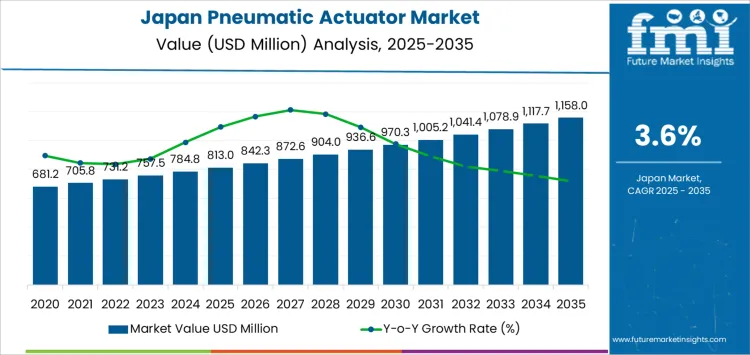
Key players in the Japanese pneumatic actuator industry are crucial in shaping the demand for these systems. Leading companies include SMC Corporation, Elfor Controls Srl., Habonim Industrial Valves & Actuators Ltd., Johnson Controls Inc., Parker Hannifin Corp., and ABB Ltd. SMC Corporation holds a dominant share of 25% in the industry, providing a wide range of advanced pneumatic actuators. These companies are at the forefront of developing innovative actuator technologies, including those that improve performance, durability, and integration with other automation systems. As Japan continues to prioritize technological innovation and energy efficiency in its industrial sectors, these players are driving the growth and adoption of pneumatic actuators, ensuring their pivotal role in Japan’s evolving industrial landscape.
Demand for Pneumatic Actuator in Japan Key Takeaways
| Metric | Value |
|---|---|
| Demand for Pneumatic Actuator in Japan Value (2025) | USD 813.0 million |
| Demand for Pneumatic Actuator in Japan Forecast Value (2035) | USD 1,158.0 million |
| Demand for Pneumatic Actuator in Japan Forecast CAGR (2025-2035) | 3.6% |
Why is the Demand for Pneumatic Actuator in Japan Growing?
The demand for pneumatic actuators in Japan is growing as industries increasingly adopt automation technologies to improve operational efficiency and reduce labor costs. Pneumatic actuators, which convert compressed air into mechanical motion, are widely used in manufacturing, robotics, and process control applications. With Japan’s focus on advancing automation, particularly in sectors like automotive, electronics, and industrial machinery, pneumatic actuators are essential for enabling precise and reliable motion control.
A key driver behind the growth of pneumatic actuators is the ongoing industrial automation trend. As Japan continues to invest in smart factories and advanced manufacturing technologies, there is a rising demand for reliable and cost-effective actuators to automate processes such as assembly, packaging, and material handling. Pneumatic actuators are known for their fast response time, high power-to-weight ratio, and low maintenance requirements, making them ideal for these applications.
The need for energy-efficient solutions is contributing to the growing adoption of pneumatic actuators. These actuators offer a cost-effective alternative to electric actuators in many applications, as they use compressed air, which is widely available and can be generated efficiently. As Japan continues to focus on energy conservation and sustainable industrial practices, pneumatic actuators are increasingly seen as a practical solution. With continued advancements in actuator technology and growing demand for automation, the demand for pneumatic actuators in Japan is expected to rise steadily through 2035.
What is the Segment-Wise Analysis of Demand for Pneumatic Actuators in Japan?
Demand for pneumatic actuators in Japan is segmented by product type, application, and region. By product type, demand is divided into rack and pinion pneumatic actuators, scotch yoke pneumatic actuators, step type elevators, and vacuums, with rack and pinion pneumatic actuators leading at 50%. The demand is also segmented by application, including industrial automation and transportation, with industrial automation accounting for 55%. Regionally, demand spans across Kyushu & Okinawa, Kanto, Kansai, Chubu, Tohoku, and the rest of Japan.
How Does Rack and Pinion Pneumatic Actuator Lead the Demand for Pneumatic Actuators in Japan?
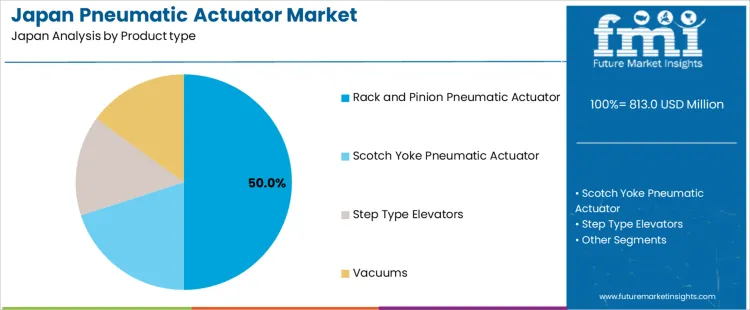
Rack and pinion pneumatic actuators account for 50% of the demand for pneumatic actuators in Japan, driven by their widespread use and efficiency in a variety of industries. These actuators are favored for their robust performance, precise control, and ability to convert rotational motion into linear motion. Rack and pinion actuators are commonly used in applications such as valves, dampers, and industrial automation systems, where reliable, fast, and accurate motion control is essential.
Their design offers high torque output, making them suitable for heavy-duty applications, and they are well-suited for both large and small-scale operations. The increasing demand for automation and advanced control systems in manufacturing and process industries in Japan has contributed to the continued popularity of rack and pinion pneumatic actuators. As industrial automation continues to grow, rack and pinion actuators are expected to remain the dominant product type in the pneumatic actuator industry.
Why Does Industrial Automation Lead the Demand for Pneumatic Actuators in Japan?
Industrial automation accounts for 55% of the demand for pneumatic actuators in Japan, driven by the country's emphasis on enhancing manufacturing efficiency, precision, and safety. Pneumatic actuators are crucial components in industrial automation systems, where they control the motion of machinery, robots, and process equipment with high speed and accuracy. The growing trend toward automated production lines, smart factories, and robotics in Japan’s manufacturing sectors has significantly boosted the demand for pneumatic actuators.
These actuators are particularly valued for their reliability, low maintenance, and ability to operate in harsh environments. As Japan continues to lead in technology and automation in industries such as automotive, electronics, and chemicals, the demand for pneumatic actuators in industrial automation applications is expected to continue rising, making it the dominant application segment in the pneumatic actuator industry.
What are the Key Trends, Drivers, and Restraints in Demand for Pneumatic Actuators in Japan?
Pneumatic actuators devices converting compressed air into mechanical motion are valued for their speed, reliability, compact size, and relative safety compared with hydraulic systems. As companies aim to improve productivity, minimize manual work, and cope with labor shortages, pneumatically actuated systems are increasingly adopted in assembly lines, material handling, valve control, and robotics applications. Increasing competition from electric and electric‑servo actuators (offering finer control and energy efficiency), and higher initial investment or maintenance costs for pneumatic systems compared with simpler mechanical solutions. Material, supply‑chain, or compressed‑air infrastructure requirements can also limit adoption in smaller or cost‑sensitive facilities.
Why is Demand for Pneumatic Actuators Growing in Japan?
Demand is growing because of Japan’s push toward automation triggered by demographic pressures, labor shortages, and rising labor costs. As the workforce shrinks and companies seek to maintain or increase output, automation via actuators and robotics becomes a necessity rather than an option. Pneumatic actuators offer a cost‑effective, robust solution for many automation tasks from simple linear motions to more complex control in manufacturing. Their relative simplicity, ease of maintenance, and safety for repetitive tasks make them attractive for industries needing scalability and reliability. Growth in sectors such as automotive (especially with increasing EV and hybrid vehicle production), food and beverage processing, packaging, and general manufacturing supports demand for these actuators.
How are Technological & Industry Innovations Driving Pneumatic Actuator Demand in Japan?
Technological advances such as better actuator design, miniaturization, improved materials, and integration of sensors or smart control - are making pneumatic actuators more efficient, precise, and easier to integrate into automated systems. Modern pneumatic systems can now be part of "smart factory" setups with IoT‑linked monitoring, predictive maintenance, and safety control. This enhances their appeal in sectors like robotics, food processing, packaging, and automotive. As actuator manufacturers improve energy efficiency and reliability for instance, reducing air leakage, optimizing consumption, or using hybrid pneumatic‑electric systems pneumatic actuators gain ground over older or less‑efficient alternatives. These innovations lower the total cost of ownership and improve adoption potential.
What are the Key Challenges and Risks That Could Limit Pneumatic Actuator Demand in Japan?
Despite promising growth, pneumatic actuators face challenges in Japan. One major competition comes from electric actuators they offer greater precision, lower energy losses (no need for compressed‑air infrastructure), quieter operation, and easier integration in compact, high‑precision systems. For some applications requiring high accuracy or tight control (e.g., robotics, medical devices), electric actuators may be preferred over pneumatic.
Another challenge is the need for compressed‑air infrastructure, which adds cost and maintenance overhead; small manufacturers or facilities may not find this cost‑effective. Environmental and energy‑efficiency pressures may also push firms to adopt cleaner, less energy‑intensive solutions. Finally, rapidly evolving automation standards and integration of smart control means older pneumatic designs may become obsolete unless updated.
What is the Regional Demand Outlook for Pneumatic Actuator in Japan?
| Region | CAGR (%) |
|---|---|
| Kyushu & Okinawa | 4.5% |
| Kanto | 4.1% |
| Kansai | 3.6% |
| Chubu | 3.2% |
| Tohoku | 2.8% |
| Rest of Japan | 2.7% |
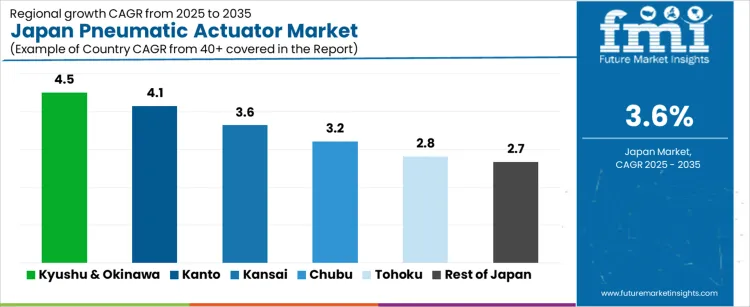
Demand for pneumatic actuators in Japan is growing steadily across all regions, with Kyushu & Okinawa leading at a 4.5% CAGR, driven by the region's growing industrial and manufacturing sectors. Kanto follows with a 4.1% CAGR, supported by the region’s large urban population and demand for automation in various industries. Kansai shows a 3.6% CAGR, fueled by its strong industrial base and focus on technological innovation. Chubu experiences a 3.2% CAGR, with rising demand for automation in manufacturing processes. Tohoku and the Rest of Japan see moderate growth at 2.8% and 2.7%, respectively, as pneumatic actuators continue to gain traction in both urban and rural industrial settings.
How is Demand for Pneumatic Actuators Growing in Kyushu & Okinawa?
Kyushu & Okinawa leads demand for pneumatic actuators, growing at a 4.5% CAGR. The region's industrial growth, particularly in the manufacturing and automotive sectors, is driving this trend. Kyushu’s focus on expanding its industrial base and improving automation in production lines is creating strong demand for pneumatic actuators. Okinawa’s increasing role in the tourism and manufacturing industries also contributes to the adoption of automation technologies, including pneumatic actuators.
As businesses in both Kyushu and Okinawa continue to seek more efficient and precise control in their operations, the demand for pneumatic actuators is expected to grow steadily. Furthermore, as the region's industries focus on improving productivity and reducing labor costs, automation systems powered by pneumatic actuators are becoming integral to achieving these goals, further supporting growth in this sector.
Why is Demand for Pneumatic Actuators Rising in Kanto?
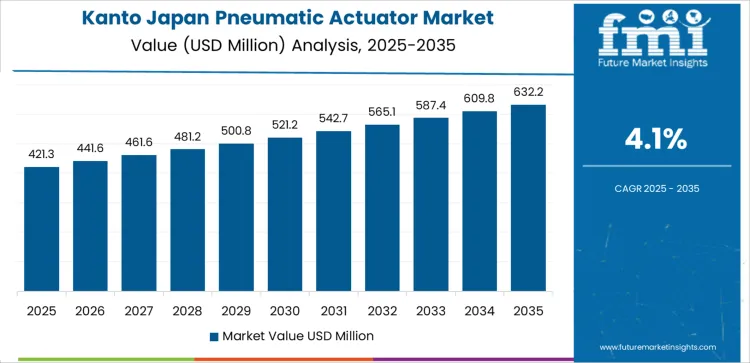
In Kanto, demand for pneumatic actuators is rising at a 4.1% CAGR. The region’s large urban population and its diverse industrial landscape, which includes sectors such as automotive, electronics, and food processing, are key factors driving the demand for pneumatic actuators. As industries in Kanto embrace automation to improve efficiency and precision, the adoption of pneumatic actuators has become increasingly widespread.
Pneumatic actuators are crucial for enhancing productivity and ensuring precise control in manufacturing processes. The region’s focus on technological innovation and industrial development has led to greater demand for automation solutions across various sectors. As Kanto continues to be a hub for industrial activities, the demand for pneumatic actuators is expected to remain strong, supported by both large-scale manufacturing and the growing trend toward automation in the region.
How is Demand for Pneumatic Actuators Expanding in Kansai?
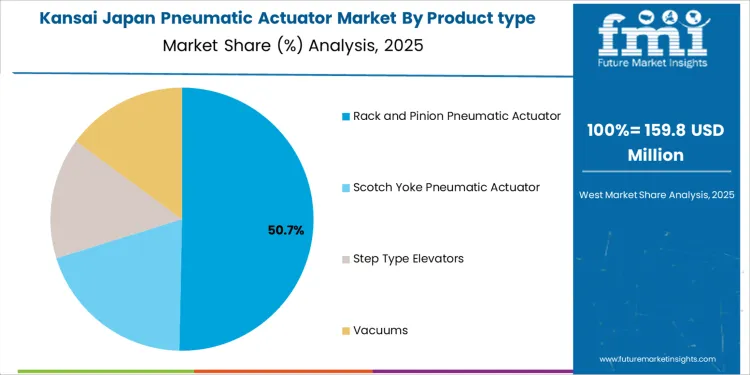
Kansai shows steady demand for pneumatic actuators, with a 3.6% CAGR. The region’s strong industrial base, including sectors such as manufacturing, automotive, and food processing, plays a significant role in driving the demand for pneumatic actuators. Kansai’s focus on innovation and technology has increased the need for automation systems, and pneumatic actuators are an essential component in improving efficiency and precision in industrial processes.
As Kansai’s industries continue to evolve and integrate more automation, the demand for pneumatic actuators is expected to grow steadily. Moreover, the region’s commitment to maintaining competitiveness in manufacturing has led to increased investments in automation technologies, further supporting the adoption of pneumatic actuators. As companies in Kansai seek to improve their operational efficiency and reduce costs, the demand for these systems is expected to continue to rise.
Why is Demand for Pneumatic Actuators Growing in Chubu?
Chubu is witnessing steady demand for pneumatic actuators, growing at a 3.2% CAGR. The region’s strong manufacturing sector, particularly in automotive and machinery production, is a key driver of this growth. As automation becomes increasingly important for improving productivity and reducing labor costs, the adoption of pneumatic actuators is growing. Chubu’s focus on precision engineering and high-tech industries further fuels the demand for pneumatic actuators, which are essential for ensuring accurate control and efficient operations.
The region’s industries are increasingly integrating pneumatic actuators into their production lines to enhance manufacturing processes and boost efficiency. As Chubu continues to modernize its industrial base and embrace automation technologies, the demand for pneumatic actuators is expected to rise steadily, reflecting the broader trend of industrial automation across Japan.
How is Demand for Pneumatic Actuators Expanding in Tohoku?
Tohoku is seeing moderate growth in pneumatic actuator demand, with a 2.8% CAGR. While the region’s industrial activities are smaller compared to major urban centers, there is a steady increase in demand for automation solutions, especially in sectors such as manufacturing and agriculture. As Tohoku’s industries modernize and integrate more automation technologies, the adoption of pneumatic actuators is gradually increasing.
The region’s focus on improving productivity and efficiency in various sectors, along with the rise of smart manufacturing and precision control, is contributing to the growth in demand. Local businesses and manufacturers in Tohoku are adopting pneumatic actuators as part of their efforts to improve operational performance. With the growing awareness of the benefits of automation, the demand for pneumatic actuators is expected to continue rising steadily in Tohoku as industries seek to optimize their processes.
Why is Demand for Pneumatic Actuators Steady in the Rest of Japan?
The Rest of Japan is experiencing steady demand for pneumatic actuators, with a 2.7% CAGR. Although demand is lower compared to urban regions, there is growing interest in automation solutions, especially as industries in rural and smaller cities begin to modernize. As manufacturing processes become more automated, the demand for pneumatic actuators is gradually increasing, particularly in sectors such as agriculture, food processing, and machinery production.
The rise in awareness of the benefits of automation and precision control is helping to drive the adoption of pneumatic actuators in these regions. Local manufacturers are increasingly turning to pneumatic actuators to improve efficiency and reduce labor costs. As businesses across the Rest of Japan adopt more advanced manufacturing technologies, the demand for pneumatic actuators is expected to rise steadily, supported by the broader national trend of automation and industrial modernization.
What Is Driving the Demand for Pneumatic Actuators in Japan and Who Are the Key Players Shaping the Industry?
The demand for pneumatic actuators in Japan is increasing as industries such as manufacturing, automation, and robotics continue to grow and modernize. Pneumatic actuators, which convert compressed air into mechanical motion, are essential components in a wide range of industrial applications, including material handling, control systems, and process automation. As Japan continues to focus on innovation in industrial automation, energy efficiency, and reducing operational costs, pneumatic actuators are becoming increasingly popular due to their reliability, simplicity, and cost-effectiveness. Moreover, Japan’s emphasis on the automation of manufacturing processes and the rise of smart factories are driving the demand for advanced actuator systems that enhance productivity and operational efficiency.
Key players shaping the pneumatic actuator industry in Japan include SMC Corporation, Elfor Controls Srl., Habonim Industrial Valves & Actuators Ltd., Johnson Controls Inc., Parker Hannifin Corp, and ABB Ltd. SMC Corporation leads the industry with a notable share of 25.0%, providing a wide range of pneumatic actuators designed to meet the needs of various industrial sectors. These companies are crucial in developing cutting-edge pneumatic actuators that offer higher performance, durability, and integration with other automation technologies. Their solutions cater to Japan’s high standards for industrial efficiency, product reliability, and technological innovation.
The growth of the pneumatic actuator industry in Japan is further supported by the ongoing advancements in industrial automation and Japan’s commitment to maintaining its position as a leader in technological innovation. As industries increasingly rely on automation for increased productivity and precision, the demand for pneumatic actuators is expected to continue expanding. With a focus on energy efficiency, performance, and automation, pneumatic actuators will remain a critical component in Japan’s evolving industrial landscape.
Key Players in Japan Small Satellites Demand
- SMC Corporation
- Elfor Controls Srl.
- Habonim Industrial Valves & Actuators Ltd.
- Johnson Controls Inc.
- Parker Hannifin Corp
- ABB Ltd.
Scope of Report
| Items | Values |
|---|---|
| Quantitative Units (2025) | USD million |
| Product Type | Rack and Pinion Pneumatic Actuator, Scotch Yoke Pneumatic Actuator, Step Type Elevators, Vacuums |
| Application | Industrial Automation, Transportation |
| Region | Kyushu & Okinawa, Kanto, Kansai, Chubu, Tohoku, Rest of Japan |
| Countries Covered | Japan |
| Key Companies Profiled | SMC Corporation, Elfor Controls Srl., Habonim Industrial Valves & Actuators Ltd., Johnson Controls Inc., Parker Hannifin Corp, ABB Ltd. |
| Additional Attributes | Dollar sales by product type and application; regional CAGR and growth outlook; innovation in actuator technologies; increasing demand for automation in industrial sectors; use in transportation and logistics industries. |
Japan Pneumatic Actuator Demand by Key Segments
Product type
- Rack and Pinion Pneumatic Actuator
- Scotch Yoke Pneumatic Actuator
- Step Type Elevators
- Vacuums
Application
- Industrial Automation
- Transportation
Region
- Kyushu & Okinawa
- Kanto
- Kansai
- Chubu
- Tohoku
- Rest of Japan
Frequently Asked Questions
How big is the demand for pneumatic actuator in Japan in 2025?
The demand for pneumatic actuator in Japan is estimated to be valued at USD 813.0 million in 2025.
What will be the size of pneumatic actuator in Japan in 2035?
The market size for the pneumatic actuator in Japan is projected to reach USD 1,158.0 million by 2035.
How much will be the demand for pneumatic actuator in Japan growth between 2025 and 2035?
The demand for pneumatic actuator in Japan is expected to grow at a 3.6% CAGR between 2025 and 2035.
What are the key product types in the pneumatic actuator in Japan?
The key product types in pneumatic actuator in Japan are rack and pinion pneumatic actuator, scotch yoke pneumatic actuator, step type elevators and vacuums.
Which segment is expected to contribute significant share in the pneumatic actuator in Japan in 2025?
In terms of , application segment is expected to command 0.0% share in the pneumatic actuator in Japan in 2025.
Preview the report firsthand - request a free sample
Get SampleGet the brochure for pricing and purchase details.
Get PDFTable of Content
- Executive Summary
- Japan Market Outlook
- Demand-side Trends
- Supply-side Trends
- Technology Roadmap Analysis
- Analysis and Recommendations
- Market Overview
- Market Coverage / Taxonomy
- Market Definition / Scope / Limitations
- Market Background
- Market Dynamics
- Drivers
- Restraints
- Opportunity
- Trends
- Scenario Forecast
- Demand in Optimistic Scenario
- Demand in Likely Scenario
- Demand in Conservative Scenario
- Opportunity Map Analysis
- Product Life Cycle Analysis
- Supply Chain Analysis
- Investment Feasibility Matrix
- Value Chain Analysis
- PESTLE and Porter’s Analysis
- Regulatory Landscape
- Regional Parent Market Outlook
- Production and Consumption Statistics
- Import and Export Statistics
- Market Dynamics
- Japan Market Analysis 2020 to 2024 and Forecast, 2025 to 2035
- Historical Market Size Value (USD Million) Analysis, 2020 to 2024
- Current and Future Market Size Value (USD Million) Projections, 2025 to 2035
- Y-o-Y Growth Trend Analysis
- Absolute $ Opportunity Analysis
- Japan Market Pricing Analysis 2020 to 2024 and Forecast 2025 to 2035
- Japan Market Analysis 2020 to 2024 and Forecast 2025 to 2035, By Product type
- Introduction / Key Findings
- Historical Market Size Value (USD Million) Analysis By Product type , 2020 to 2024
- Current and Future Market Size Value (USD Million) Analysis and Forecast By Product type , 2025 to 2035
- Rack and Pinion Pneumatic Actuator
- Scotch Yoke Pneumatic Actuator
- Step Type Elevators
- Vacuums
- Y-o-Y Growth Trend Analysis By Product type , 2020 to 2024
- Absolute $ Opportunity Analysis By Product type , 2025 to 2035
- Market Structure Analysis
- Competition Dashboard
- Competition Benchmarking
- Market Share Analysis of Top Players
- By Regional
- By Product type
- Competition Analysis
- Competition Deep Dive
- Assumptions & Acronyms Used
- Research Methodology


