

- Market Size (2026)
- USD 980.7 Mn
- Forecast (2036)
- USD 1707.2 Mn
- CAGR (2026 to 2036)
- 5.7%
How big is Rotary Lasers Market in 2026?
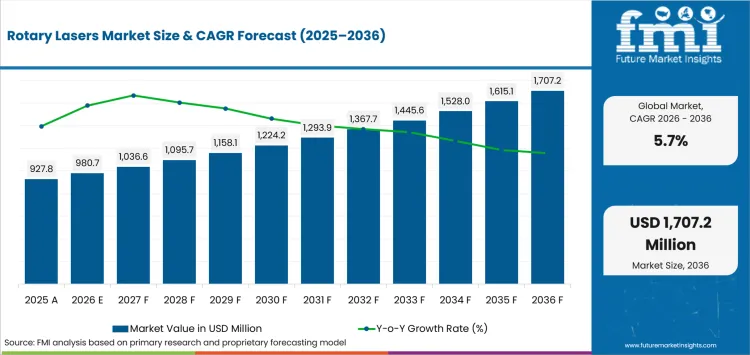
USD 980.7 million in 2026 and USD 1707.2 million by 2036 at a 5.7% CAGR.
Demand for rotary lasers is projected to expand at 5.7% CAGR between 2026 and 2036, increasing valuation from USD 980.7 million in 2026 to USD 1707.2 million by 2036. Site preparation and highway earthwork continue to require portable leveling tools alongside machine-control platforms. The USA Census Bureau reported highway construction spending at a seasonally adjusted annual rate of USD 150.9 billion in June 2026. Large project volumes sustain demand for manual elevation checks and layout work across construction areas where automated guidance is not used continuously.
Growth rates vary by surveying requirements and structure of construction activity. The United Kingdom is forecast to expand at 5.1% CAGR compared with Japan at 4.2%. The Office for National Statistics reported British construction output grew 1.6% in the three months to May 2026. Faster project turnover favors rental access and portable fleets, while longer programmes place more weight on ownership economics and service support for compact construction equipment.
Key Takeaways of Rotary Lasers Market
- Self-leveling rotary lasers are projected to hold 39.0% share in 2026 owing to faster setup.
- By range, 300-600 m systems are estimated to hold 42.0% in 2026 owing to common exterior coverage.
- Standard construction grade is likely to capture 48.0% share in 2026 attributable to routine site tolerances.
- Calibration drift and receiver misuse raise rework risk if crews lack dependable service and disciplined setup.
- Leica Geosystems AG, Topcon Positioning Systems, Inc., Spectra Precision (Precisional LLC), Hilti Aktiengesellschaft, Robert Bosch Power Tools GmbH, DEWALT (Stanley Black & Decker, Inc.), Johnson Level & Tool Mfg. Co., Inc. and STABILA Messgeräte Gustav Ullrich GmbH are active suppliers.
Analyst Perspective
"Rotary laser selection starts with working distance and tolerance before slope functions. Calibration access matters because unchecked references can spread elevation errors across trades."
- Nikhil Kaitwade, Principal Consultant, Future Market Insights
How is the Rotary Lasers Market segmented?
The rotary lasers market is segmented by laser type, range, accuracy class, application, sales channel and region.
The rotary lasers market is segmented by laser type, range, accuracy class, application, sales channel and region. Laser types include self-leveling, dual-slope, manual, grade and green beam rotary lasers. Range covers below 300 m, 300-600 m, 600-1000 m and above 1000 m. Accuracy classes include standard construction grade, high precision grade and machine control compatible. Applications cover site grading, concrete leveling, interior fit-out, excavation or drainage and agricultural leveling. Sales channels include tool retailers, survey dealers, rental companies and direct manufacturer sales.
What role does standard construction grade play within the accuracy class category?
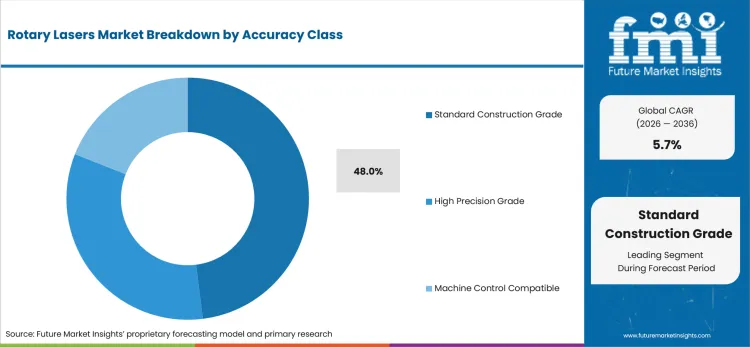
Routine grading and concrete checks need repeatable elevation control without specialist grade functions on every instrument. Higher-precision classes become relevant as tolerance requirements tighten on slope work and active daily construction control checks.
- The accuracy class category is forecast to be led by standard construction grade at 48.0% share in 2026 due to broad suitability for routine site tolerances.
- Hilti’s September 2025 awards announcement listed the PR 400-22 dual-slope rotary laser in the rotary-laser category. The higher-feature tier addresses slope control beyond routine sitework, and power tools and measurement equipment share professional service channels.
How do construction crews evaluate self-leveling rotary lasers?
Automatic leveling reduces manual adjustment as crews shift references across formwork or grading zones. The USA Bureau of Labor Statistics counted 305,000 construction job openings in June 2026. That volume makes labor-saving setup features commercially relevant for crews handling repeated site moves.
- Based on laser type, self-leveling rotary lasers are projected to account for 39.0% in 2026 due to quicker setup during repeated elevation checks.
- Green beam rotary lasers are forecast to expand at 6.3% CAGR through 2036 within the same axis. Their direct-beam visibility helps interior alignment, and laser measuring instruments with receivers remain central to longer exterior checks.
What supports demand for 300-600 m systems within the range category?
A USA Department of Transportation forecast updated in July 2025 described a 1.03-mile Oregon project combining excavation and grading with drainage and paving. Mid-range systems fit work zones like that because receiver coverage can follow grading and drainage without survey-instrument complexity.
- By range, 300-600 m systems are forecast to represent 42.0% in 2026 driven by coverage suited to moving civil-work fronts.
- Contractors can reposition a receiver-based laser as phases change across the work zone and new elevations become active. land survey equipment remains necessary for control networks and higher-order coordinates that rotary references do not replace.
How does site grading shape demand within the application category?
Site grading uses rotating reference planes across cuts and drainage work that changes position throughout a project. Crews reposition receivers as fill levels change and new drainage elevations become active.
- In 2026, site grading is expected to lead application demand with 27.0% share because earthwork crews need repeated grade checks across moving work fronts.
- Portable lasers can share BUILD work fronts as crews verify hubs and finished elevations away from machine sensors. The USA Department of Transportation announced 127 BUILD projects in July 2026 across roadway, transit and other transport infrastructure, including work served by construction equipment attachments and portable grade references.
What are the drivers, restraints and opportunities in the Rotary Lasers Market?
Road and site activity sustains grade-control demand, while calibration constraints limit reliable field use. Machine-guidance integration remains the clearest route for extending portable reference tools across wider construction workflows.
- Driver: Transportation contractors need portable elevation references for moving work fronts that require manual checks beside automated grade-control equipment.
- Restraint: Skilled-worker shortages and uneven calibration discipline can turn simple setup mistakes into costly rework across earthwork and concrete tasks.
- Opportunity: Connected machine-guidance workflows can extend one grade-control method across manual checks and mechanized crews without removing independent elevation verification.
Transportation Awards Keep Grade-Control Work in the Pipeline
New civil packages translate into more excavation and drainage fronts that need portable grade references during field execution. ARTBA reported USD 25.3 billion of transportation projects expected to break ground within 30 to 60 days in May 2026. That near-term award volume gives transportation infrastructure construction dealers and rental fleets a clearer window for stocking grade-control equipment before crews mobilize.
Training and Calibration Shape Field Reliability
Rotary lasers reduce repeated manual leveling, but crews need correct setup and reliable instrument condition. The Associated General Contractors of America reported in August 2025 that 92% of hiring firms had difficulty finding qualified workers. Thin crews raise the cost of training gaps, so clear controls and accessible calibration support matter more than feature count during repeated site moves.
Mixed Control Workflows Extend Rotary-Laser Utility
Portable lasers can complement machine guidance on sites that mix excavators with manual grade checks. Trimble announced Siteworks Machine Guidance for tilt buckets in April 2025, extending guided grading to attachments used for shaping and cleanup. Rotary references can remain the independent field check as smart construction equipment crews hand work between instrumented machines and manual finishers.
Which country CAGRs are profiled in the Rotary Lasers Market?
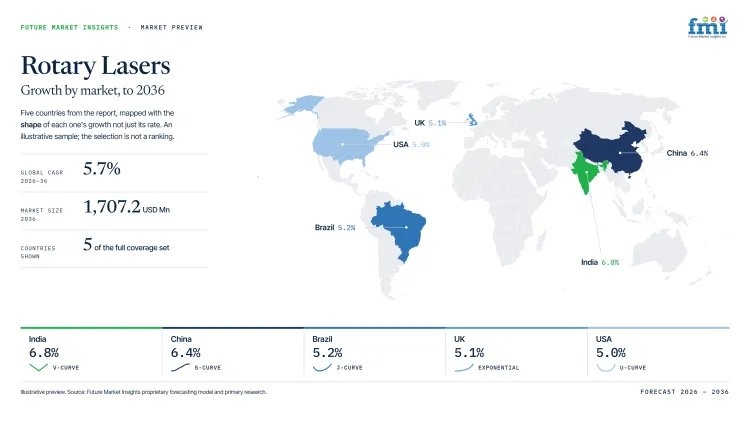
| Country | CAGR |
|---|---|
| Brazil | 5.2% |
| United Kingdom | 5.1% |
| United States | 5.0% |
| Germany | 4.6% |
| Japan | 4.2% |
How do country-level CAGRs compare in the Rotary Lasers Market?
Brazil joins the United Kingdom and United States in an upper group near 5% CAGR. Germany and Japan form a lower pair separated by a gap. The 1.0 percentage-point spread reflects different project cycles more than market scale. Forecast pace does not establish the largest installed base or broadest adoption.
- Brazil’s concession pipeline concentrates grading work along corridors and remote sites.
- British road renewal favors portable instruments rotating between resurfacing and drainage packages.
- USA bridge programs support contractor fleets that depend on broad dealer coverage.
- German road-price inflation raises scrutiny of rework costs and instrument calibration discipline.
- Japan’s dense schedules reward compact tools that minimize repeated setup delays.
Similar CAGRs therefore produce different channel needs because project structures and service expectations vary materially. The full report provides country-level CAGR analysis across North America, Latin America, Europe, East Asia, South Asia, Oceania and the Middle East and Africa.
Country-wise Analysis
- Brazil’s federal highway-concession pipeline concentrates earthwork across long corridors, and the Ministry of Transport reported 35 new concession projects in its November 2025 portfolio for road packages extending beyond major metropolitan service centers nationwide. In Brazil, rotary laser demand is predicted to advance at 5.2% CAGR through 2036, supported by recurring grading and drainage checks as concession packages progress across separate active construction work fronts. Survey dealers and rental fleets can serve projects that shift instruments between crews, but order conversion depends on service coverage and detector range across inland corridors with travel times for repair and calibration support.
- English road renewal moves instruments between resurfacing and drainage packages, and contractors need portable elevation checks without maintaining a permanent survey setup across every subcontract work front during short renewal cycles across English corridors. The United Kingdom’s rotary lasers market outlook is anticipated to advance at 5.1% CAGR over the assessment period, aided by repeat project turnover and rental access across dispersed road packages in regional markets. The Department for Transport said in March 2026 that National Highways plans more than 9,000 kilometres of motorway and A-road resurfacing, letting concrete paving equipment contractors rotate instruments while calibration policies protect rental economics.
- USA contractors work across a dispersed federal and state project base, and the Federal Highway Administration listed 20 eligible states for fiscal 2026 bridge-bundling grants in June 2026 across geographically separated bridge packages. Rotary laser sales in the United States are forecast to expand at 5.0% CAGR by 2036, shaped by grading and concrete crews that need portable references across separate work zones and subcontract packages. National dealer reach keeps replacement receivers and calibration services accessible across large territories, but fragmented fleet ownership can delay standardization unless contractors settle on compatible detectors and control routines for owned and rented instruments.
- German civil contractors face tighter cost scrutiny as road-work prices rise, and the Federal Statistical Office reported road construction prices were 3.7% higher year over year in the first quarter of 2026 nationally. Contractors place more weight on calibration certainty and dependable receivers because repeated grade errors carry higher rework costs across road and drainage packages with strict handover tolerances, warranty obligations and documentation. Adoption of rotary lasers in Germany is estimated to expand at 4.6% CAGR through 2036, supported by routine grade checks although faster volume growth depends on service networks keeping instruments verified without long project interruptions.
- Japanese contractors coordinate dense project schedules with limited room for setup delays, so portable self-leveling instruments fit repeat height checks across concrete and exterior works on tightly sequenced urban sites with established survey routines. Japan is estimated to post 4.2% CAGR over the forecast period, shaped by steady construction order flow and established equipment-distribution channels that can supply replacement detectors and service to major contractors. The Ministry of Land, Infrastructure, Transport and Tourism reported in April 2026 that major-contractor orders rose 12.0% in fiscal 2025, yet rotary-laser orders depend on productivity gains justifying separate devices beside established survey tools.
Who are the notable companies in the Rotary Lasers Market?
Leica Geosystems AG, Topcon Positioning Systems, Inc., Spectra Precision (Precisional LLC), Hilti Aktiengesellschaft, Robert Bosch Power Tools GmbH, DEWALT (Stanley Black & Decker, Inc.), Johnson Level & Tool Mfg. Co., Inc. and STABILA Messgeräte Gustav Ullrich GmbH.
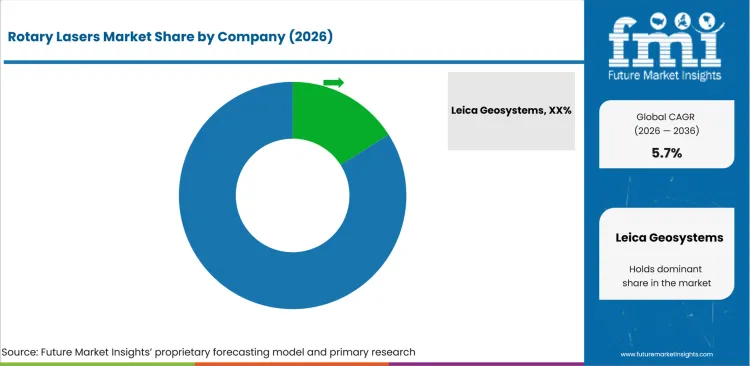
Geospatial grade-control brands and professional-tool platforms compete with specialist leveling manufacturers. Calibration access and receiver compatibility raise entry barriers, and broader surface levelling equipment portfolios support cross-selling into site preparation.
- Leica Geosystems AG, Topcon Positioning Systems, Inc. and Spectra Precision (Precisional LLC) focus on survey and grade-control workflows around construction measurement.
- Hilti Aktiengesellschaft, Robert Bosch Power Tools GmbH and DEWALT (Stanley Black & Decker, Inc.) connect rotary lasers with broader professional-tool service channels.
- Johnson Level & Tool Mfg. Co., Inc. and STABILA Messgeräte Gustav Ullrich GmbH compete with specialist leveling catalogs supported by repair or calibration services.
Competitive Benchmarking: Rotary Lasers Market
| Company | Rotary-Laser Portfolio Depth | Grade and Slope Capability | Service and Channel Depth | Geographic Reach |
|---|---|---|---|---|
| Leica Geosystems AG | High | High | High | Global |
| Topcon Positioning Systems, Inc. | High | High | High | Global |
| Spectra Precision (Precisional LLC) | High | High | High | North America and international dealers |
| Hilti Aktiengesellschaft | High | High | High | Global |
| Robert Bosch Power Tools GmbH | Medium | Medium | High | Global |
| DEWALT (Stanley Black & Decker, Inc.) | Medium | High | High | North America and international tool channels |
| Johnson Level & Tool Mfg. Co., Inc. | High | High | Medium | North America |
| STABILA Messgeräte Gustav Ullrich GmbH | High | High | Medium | Europe, North America and international markets |
Key Developments in the Rotary Lasers Market
- In September 2025, Leica Geosystems AG ended sales of the Rugby CLH rotary laser in Japan. Rugby Manager support continued for existing units and Rugby CLAx became the recommended replacement.
- In June 2025, Spectra Precision (Precisional LLC) opened a USA GL720 and GL722 grade-laser promotion lasting from June 9 to August 31 for authorized-dealer purchases.
- In January 2025, Hilti Aktiengesellschaft announced that it became the only tool manufacturer to offer hand tools, power tools, and equipment all on one cordless battery platform through its Nuron system.
Key Players in the Rotary Lasers Market
Survey and Grade-Control Specialists
- Leica Geosystems AG
- Topcon Positioning Systems, Inc.
- Spectra Precision (Precisional LLC)
Professional Construction Tool Platforms
- Hilti Aktiengesellschaft
- Robert Bosch Power Tools GmbH
- DEWALT (Stanley Black & Decker, Inc.)
Specialist Leveling Brands
- Johnson Level & Tool Mfg. Co., Inc.
- STABILA Messgeräte Gustav Ullrich GmbH
Rotary Lasers Market - Report Scope
| Coverage field | Report scope |
|---|---|
| Market breakdown | By laser type, range, accuracy class, application, sales channel and region. |
| Quantitative Units | Revenue in USD million and CAGR in %. |
| Market Definition | Commercial rotary laser leveling systems and compatible detector-based grade references used across construction, surveying, concrete and land-leveling workflows. |
| Regions Covered | North America, Latin America, Europe, East Asia, South Asia and Pacific, and Middle East and Africa. |
| Countries Covered | Brazil, United Kingdom, United States, Germany, Japan, and 20+ countries included in the full report. |
| Key Companies Profiled | Leica Geosystems AG, Topcon Positioning Systems, Inc., Spectra Precision (Precisional LLC), Hilti Aktiengesellschaft, Robert Bosch Power Tools GmbH, DEWALT (Stanley Black & Decker, Inc.), Johnson Level & Tool Mfg. Co., Inc., and STABILA Messgeräte Gustav Ullrich GmbH. |
| Forecast Period | 2026 to 2036. |
| Approach | Primary and secondary research with market triangulation. |
Rotary Lasers Market - Research Methodology
| Method | Approach |
|---|---|
| Primary Research | FMI analysts gathered input from manufacturers, service providers, technology developers, distributors, end users, procurement teams, and subject-matter experts. Interviews examined purchasing decisions, product or service evaluation, adoption barriers, approval requirements, pricing considerations, and expectations for technical or commercial support. Respondents were also asked what evidence is required before a trial, pilot, or initial order develops into regular purchasing. |
| Desk Research | Desk research covered government statistics, regulatory publications, trade data, industry associations, technical literature, standards, company filings, product information, and official corporate announcements. Sources were reviewed for relevance, publication date, geographic coverage, and consistency with the defined market scope. Claims relating to performance, applications, approvals, capacity, investment, and commercial activity were retained only when supported by credible public evidence. |
| Market Sizing and Forecasting | The market model combined the baseline value with historical performance, segment structure, pricing and volume indicators, adoption levels, company participation, and country-level demand conditions. Forecast assumptions considered economic activity, investment trends, regulatory developments, technology adoption, purchasing cycles, supply availability, and barriers to wider market use. Segment and regional estimates were reconciled before the final market total was calculated. |
| Data Validation | Estimates were checked against multiple independent indicators, including public data, company activity, trade patterns, industry developments, and findings from primary interviews. Validation also tested whether products, services, applications, and company revenues fell within the defined market boundaries. Adjacent categories, unsupported claims, overlapping revenues, and activities without direct market relevance were excluded to reduce double counting and maintain consistency across segments and countries. |
Rotary Lasers Market by Segments
Rotary Lasers Market segmented by Laser Type:
- Self-leveling Rotary Lasers
- Dual-slope Rotary Lasers
- Manual Rotary Lasers
- Grade Lasers
- Green Beam Rotary Lasers
Rotary Lasers Market segmented by Range:
- Below 300 m
- 300-600 m
- 600-1000 m
- Above 1000 m
Rotary Lasers Market segmented by Accuracy Class:
- Standard Construction Grade
- High Precision Grade
- Machine Control Compatible
Rotary Lasers Market segmented by Application:
- Site Grading
- Concrete Leveling
- Interior Fit-out
- Excavation or Drainage
- Agricultural Leveling
Rotary Lasers Market segmented by Sales Channel:
- Tool Retailers
- Survey Dealers
- Rental Companies
- Direct Manufacturer
Rotary Lasers Market by Region:
- North America
- United States
- Canada
- Latin America
- Brazil
- Mexico
- Chile
- Rest of Latin America
- Western Europe
- Germany
- United Kingdom
- Italy
- Spain
- France
- Nordics
- Benelux
- Rest of Western Europe
- Eastern Europe
- Russia
- Poland
- Hungary
- Balkan and Baltic States
- Rest of Eastern Europe
- East Asia
- China
- Japan
- South Korea
- South Asia and Pacific
- India
- ASEAN
- Australia and New Zealand
- Rest of South Asia and Pacific
- Middle East and Africa
- Kingdom of Saudi Arabia
- Other GCC Countries
- Türkiye
- South Africa
- Other African Union Countries
- Rest of Middle East and Africa
Research Sources and Bibliography
- USA Census Bureau. (2026, August 3). Monthly Construction Spending, June 2026.
- Office for National Statistics. (2026, July 16). Construction output in Great Britain: May 2026.
- USA Bureau of Labor Statistics. (2026, August 4). Job Openings and Labor Turnover Survey News Release.
- USA Department of Transportation. (2025, July 22). Procurement Forecast Opportunity-684996-2026-015.
- Hilti North America. (2025, September 8). Hilti Earns Six Pro Tool Innovation Awards for 2025.
- USA Department of Transportation. (2026, July 7). Trump’s Transportation Secretary Sean P. Duffy Invests $1.73 Billion in Infrastructure Across America Supporting Jobs and Big, Beautiful Projects.
- American Road & Transportation Builders Association. (2026, July 2). May Awards Jump to $25.3 Billion.
- Associated General Contractors of America. (2025, August 28). Construction Workforce Shortages Are Leading Cause Of Project Delays As Immigration Enforcement Affects Nearly 1/3 Of Firms.
- Trimble Inc. (2025, April 7). Dig Smarter, Not Harder: Trimble Tech Turns Excavators into Precision Construction Tool.
- Ministério dos Transportes. (2025, November 25). Concessões Rodoviárias 2026.
- Department for Transport. (2026, March 26). Major renewal of ageing English roads delivered with £27 billion investment.
- Federal Highway Administration. (2026, June 29). CHBP - Funding Programs - Management and Preservation - Bridges & Structures - Federal Highway Administration.
- Federal Statistical Office of Germany. (2026, April 10). Construction price indices for civil engineering and maintenance.
- Ministry of Land, Infrastructure, Transport and Tourism. (2026, April 30).
- Leica Geosystems AG. (2025, September). Leica Rugby CLH.
- Spectra Precision. (2025, June 9). Promo Landing.
- Hilti North America. (2025, January 16). Hilti now uniquely offers hand tools, power tools and equipment all-on-one cordless battery platform.
This bibliography is provided for reader reference and is not exhaustive. The full report contains the complete reference list and detailed citations
This Report Answers
- How do the 2026 and 2036 market values translate into equipment demand across recurring grade-control work?
- Which construction conditions keep rotary laser references useful beside machine-control systems?
- Why do self-leveling rotary lasers account for 39.0% of laser-type demand in 2026?
- Why does the 300-600 m range fit recurring exterior grading and drainage work?
- How does standard construction grade shape routine equipment selection on active jobsites?
- Which site-grading tasks produce recurring demand for portable elevation references?
- Why do the five profiled countries follow different rotary laser purchasing and service routes?
- How do specialist leveling brands compete with geospatial and professional-tool platforms?
- Which workforce and calibration conditions limit reliable rotary laser use during project execution?
Frequently Asked Questions
How big is the rotary lasers market in 2026?
The rotary lasers market is estimated at USD 980.7 million in 2026 and is projected to reach USD 1,707.2 million by 2036. Growth is driven by continued demand for elevation control in road grading, concrete work, and general construction applications.
What is the CAGR of the rotary lasers market from 2026 to 2036?
The rotary lasers market is projected to grow at a CAGR of 5.7% between 2026 and 2036. Expansion is supported by ongoing construction activity, equipment replacement demand, and the need for accurate site-leveling solutions.
Which accuracy class is projected to account for 48.0% of the rotary lasers market?
Standard construction grade is projected to account for 48.0% of the market in 2026. Its leading share is driven by widespread use in routine site layout, grading, and leveling tasks that do not require survey-grade precision.
Which laser type is projected to grow at 6.3% CAGR through 2036?
Green beam rotary lasers are projected to grow at a CAGR of 6.3% through 2036. Growth is supported by improved beam visibility, making them well suited for indoor alignment and fit-out applications.
Which companies are active in the rotary lasers market?
Key companies operating in the market include Leica Geosystems AG, Topcon Positioning Systems, Inc., Spectra Precision (Precisional LLC), Hilti Aktiengesellschaft, Robert Bosch Power Tools GmbH, DEWALT (Stanley Black & Decker, Inc.), Johnson Level & Tool Mfg. Co., Inc., and STABILA Messgeräte Gustav Ullrich GmbH. These companies compete through construction-grade laser solutions, professional measurement tools, and site-positioning technologies.
Preview the report firsthand - request a free sample
Get SampleGet the brochure for pricing and purchase details.
Get PDFTable of Content
- Key Takeaways
- Market Size and CAGR
- Top Growth Driver
- Fastest Growing Segment
- Leading Region
- Key Companies
- Emerging Opportunities
- Executive Summary
- Global Market Outlook
- Demand-side Trends
- Supply-side Trends
- Technology Roadmap Analysis
- Analysis and Recommendations
- Analyst Perspective (What is happening? Why now? What should investors know?)
- Key Questions Answered
- How large is the market?
- What is the CAGR?
- What are key trends?
- Which region dominates?
- Who are the leaders?
- Market Overview
- Market Coverage / Taxonomy
- Market Definition / Scope / Limitations
- Research Methodology
- Chapter Orientation
- Analytical Lens and Working Hypotheses
- Market Structure, Signals, and Trend Drivers
- Benchmarking and Cross-market Comparability
- Market Sizing, Forecasting, and Opportunity Mapping
- Research Design and Evidence Framework
- Desk Research Programme (Secondary Evidence)
- Expert Input and Fieldwork (Primary Evidence)
- Tooling, Models, and Reference Databases
- Data Engineering and Model Build
- Quality Assurance and Audit Trail
- Market Background
- Market Dynamics (Drivers, Restraints, Opportunity, Trends)
- Scenario Forecast (Optimistic, Likely, Conservative)
- Impact Analysis
- AI Impact
- Sustainability Impact
- Regulatory Impact
- Technology Impact
- Consumer / Buyer Analysis
- Purchase Drivers
- Adoption Barriers
- Buyer Journey
- Opportunity Map Analysis
- Product Life Cycle Analysis
- Supply Chain Analysis
- Investment Feasibility Matrix
- Value Chain Analysis
- PESTLE and Porter's Analysis
- Regulatory Landscape
- Regional Parent Market Outlook
- Production and Consumption Statistics
- Import and Export Statistics
- Global Market Analysis and Forecast, 2021 to 2036
- Historical Market Size Value (USD Million) Analysis, 2021 to 2025
- Current and Future Market Size Value (USD Million) Projections, 2026 to 2036
- Y-o-Y Growth Trend Analysis
- Absolute $ Opportunity Analysis
- Global Market Pricing Analysis, 2021 to 2036
- Global Market Analysis and Forecast, By Laser Type, 2021 to 2036
- Introduction / Key Findings
- Historical Market Size Value (USD Million) Analysis By Laser Type, 2021 to 2025
- Current and Future Market Size Value (USD Million) Analysis and Forecast By Laser Type, 2026 to 2036
- Self-leveling Rotary Lasers
- Dual-slope Rotary Lasers
- Manual Rotary Lasers
- Grade Lasers
- Green Beam Rotary Lasers
- Self-leveling Rotary Lasers
- Y-o-Y Growth Trend Analysis By Laser Type, 2021 to 2025
- Absolute $ Opportunity Analysis By Laser Type, 2026 to 2036
- Global Market Analysis and Forecast, By Range, 2021 to 2036
- Introduction / Key Findings
- Historical Market Size Value (USD Million) Analysis By Range, 2021 to 2025
- Current and Future Market Size Value (USD Million) Analysis and Forecast By Range, 2026 to 2036
- 300–600 m
- Below 300 m
- 600–1000 m
- Above 1000 m
- 300–600 m
- Y-o-Y Growth Trend Analysis By Range, 2021 to 2025
- Absolute $ Opportunity Analysis By Range, 2026 to 2036
- Global Market Analysis and Forecast, By Accuracy Class, 2021 to 2036
- Introduction / Key Findings
- Historical Market Size Value (USD Million) Analysis By Accuracy Class, 2021 to 2025
- Current and Future Market Size Value (USD Million) Analysis and Forecast By Accuracy Class, 2026 to 2036
- Standard Construction Grade
- High Precision Grade
- Machine Control Compatible
- Standard Construction Grade
- Y-o-Y Growth Trend Analysis By Accuracy Class, 2021 to 2025
- Absolute $ Opportunity Analysis By Accuracy Class, 2026 to 2036
- Global Market Analysis and Forecast, By Application, 2021 to 2036
- Introduction / Key Findings
- Historical Market Size Value (USD Million) Analysis By Application, 2021 to 2025
- Current and Future Market Size Value (USD Million) Analysis and Forecast By Application, 2026 to 2036
- Site Grading
- Concrete Leveling
- Interior Fit-out
- Excavation or Drainage
- Agricultural Leveling
- Site Grading
- Y-o-Y Growth Trend Analysis By Application, 2021 to 2025
- Absolute $ Opportunity Analysis By Application, 2026 to 2036
- Global Market Analysis and Forecast, By Sales Channel, 2021 to 2036
- Introduction / Key Findings
- Historical Market Size Value (USD Million) Analysis By Sales Channel, 2021 to 2025
- Current and Future Market Size Value (USD Million) Analysis and Forecast By Sales Channel, 2026 to 2036
- Tool Retailers
- Survey Dealers
- Rental Companies
- Direct Manufacturer
- Tool Retailers
- Y-o-Y Growth Trend Analysis By Sales Channel, 2021 to 2025
- Absolute $ Opportunity Analysis By Sales Channel, 2026 to 2036
- Global Market Analysis and Forecast, By Region, 2021 to 2036
- Introduction
- Historical Market Size Value (USD Million) Analysis By Region, 2021 to 2025
- Current Market Size Value (USD Million) Analysis and Forecast By Region, 2026 to 2036
- North America
- Latin America
- Western Europe
- Eastern Europe
- East Asia
- South Asia and Pacific
- Middle East & Africa
- Market Attractiveness Analysis By Region
- North America Market Analysis and Forecast, By Country, 2021 to 2036
- Historical Market Size Value (USD Million) Trend Analysis By Market Taxonomy, 2021 to 2025
- Market Size Value (USD Million) Forecast By Market Taxonomy, 2026 to 2036
- By Country
- USA
- Canada
- By Laser Type
- By Range
- By Accuracy Class
- By Application
- By Sales Channel
- By Country
- Market Attractiveness Analysis
- By Country
- By Laser Type
- By Range
- By Accuracy Class
- By Application
- By Sales Channel
- Key Takeaways
- Latin America Market Analysis and Forecast, By Country
- Historical Market Size Value (USD Million) Trend Analysis By Market Taxonomy, 2021 to 2025
- Market Size Value (USD Million) Forecast By Market Taxonomy, 2026 to 2036
- By Country
- Brazil
- Mexico
- Chile
- Rest of Latin America
- By Laser Type
- By Range
- By Accuracy Class
- By Application
- By Sales Channel
- By Country
- Market Attractiveness Analysis
- By Country
- By Laser Type
- By Range
- By Accuracy Class
- By Application
- By Sales Channel
- Key Takeaways
- Western Europe Market Analysis and Forecast, By Country
- Historical Market Size Value (USD Million) Trend Analysis By Market Taxonomy, 2021 to 2025
- Market Size Value (USD Million) Forecast By Market Taxonomy, 2026 to 2036
- By Country
- Germany
- UK
- Italy
- Spain
- France
- Nordic
- BENELUX
- Rest of Western Europe
- By Laser Type
- By Range
- By Accuracy Class
- By Application
- By Sales Channel
- By Country
- Market Attractiveness Analysis
- By Country
- By Laser Type
- By Range
- By Accuracy Class
- By Application
- By Sales Channel
- Key Takeaways
- Eastern Europe Market Analysis and Forecast, By Country
- Historical Market Size Value (USD Million) Trend Analysis By Market Taxonomy, 2021 to 2025
- Market Size Value (USD Million) Forecast By Market Taxonomy, 2026 to 2036
- By Country
- Russia
- Poland
- Hungary
- Balkan & Baltic
- Rest of Eastern Europe
- By Laser Type
- By Range
- By Accuracy Class
- By Application
- By Sales Channel
- By Country
- Market Attractiveness Analysis
- By Country
- By Laser Type
- By Range
- By Accuracy Class
- By Application
- By Sales Channel
- Key Takeaways
- East Asia Market Analysis and Forecast, By Country
- Historical Market Size Value (USD Million) Trend Analysis By Market Taxonomy, 2021 to 2025
- Market Size Value (USD Million) Forecast By Market Taxonomy, 2026 to 2036
- By Country
- China
- Japan
- South Korea
- By Laser Type
- By Range
- By Accuracy Class
- By Application
- By Sales Channel
- By Country
- Market Attractiveness Analysis
- By Country
- By Laser Type
- By Range
- By Accuracy Class
- By Application
- By Sales Channel
- Key Takeaways
- South Asia and Pacific Market Analysis and Forecast, By Country
- Historical Market Size Value (USD Million) Trend Analysis By Market Taxonomy, 2021 to 2025
- Market Size Value (USD Million) Forecast By Market Taxonomy, 2026 to 2036
- By Country
- India
- ASEAN
- Australia & New Zealand
- Rest of South Asia and Pacific
- By Laser Type
- By Range
- By Accuracy Class
- By Application
- By Sales Channel
- By Country
- Market Attractiveness Analysis
- By Country
- By Laser Type
- By Range
- By Accuracy Class
- By Application
- By Sales Channel
- Key Takeaways
- Middle East & Africa Market Analysis and Forecast, By Country
- Historical Market Size Value (USD Million) Trend Analysis By Market Taxonomy, 2021 to 2025
- Market Size Value (USD Million) Forecast By Market Taxonomy, 2026 to 2036
- By Country
- Kingdom of Saudi Arabia
- Other GCC Countries
- Türkiye
- South Africa
- Other African Union
- Rest of Middle East & Africa
- By Laser Type
- By Range
- By Accuracy Class
- By Application
- By Sales Channel
- By Country
- Market Attractiveness Analysis
- By Country
- By Laser Type
- By Range
- By Accuracy Class
- By Application
- By Sales Channel
- Key Takeaways
- Key Countries Market Analysis
- USA
- Pricing Analysis
- Market Share Analysis, 2025
- By Laser Type
- By Range
- By Accuracy Class
- By Application
- By Sales Channel
- Canada
- Pricing Analysis
- Market Share Analysis, 2025
- By Laser Type
- By Range
- By Accuracy Class
- By Application
- By Sales Channel
- Mexico
- Pricing Analysis
- Market Share Analysis, 2025
- By Laser Type
- By Range
- By Accuracy Class
- By Application
- By Sales Channel
- Brazil
- Pricing Analysis
- Market Share Analysis, 2025
- By Laser Type
- By Range
- By Accuracy Class
- By Application
- By Sales Channel
- Chile
- Pricing Analysis
- Market Share Analysis, 2025
- By Laser Type
- By Range
- By Accuracy Class
- By Application
- By Sales Channel
- Germany
- Pricing Analysis
- Market Share Analysis, 2025
- By Laser Type
- By Range
- By Accuracy Class
- By Application
- By Sales Channel
- UK
- Pricing Analysis
- Market Share Analysis, 2025
- By Laser Type
- By Range
- By Accuracy Class
- By Application
- By Sales Channel
- Italy
- Pricing Analysis
- Market Share Analysis, 2025
- By Laser Type
- By Range
- By Accuracy Class
- By Application
- By Sales Channel
- Spain
- Pricing Analysis
- Market Share Analysis, 2025
- By Laser Type
- By Range
- By Accuracy Class
- By Application
- By Sales Channel
- France
- Pricing Analysis
- Market Share Analysis, 2025
- By Laser Type
- By Range
- By Accuracy Class
- By Application
- By Sales Channel
- India
- Pricing Analysis
- Market Share Analysis, 2025
- By Laser Type
- By Range
- By Accuracy Class
- By Application
- By Sales Channel
- ASEAN
- Pricing Analysis
- Market Share Analysis, 2025
- By Laser Type
- By Range
- By Accuracy Class
- By Application
- By Sales Channel
- Australia & New Zealand
- Pricing Analysis
- Market Share Analysis, 2025
- By Laser Type
- By Range
- By Accuracy Class
- By Application
- By Sales Channel
- China
- Pricing Analysis
- Market Share Analysis, 2025
- By Laser Type
- By Range
- By Accuracy Class
- By Application
- By Sales Channel
- Japan
- Pricing Analysis
- Market Share Analysis, 2025
- By Laser Type
- By Range
- By Accuracy Class
- By Application
- By Sales Channel
- South Korea
- Pricing Analysis
- Market Share Analysis, 2025
- By Laser Type
- By Range
- By Accuracy Class
- By Application
- By Sales Channel
- Russia
- Pricing Analysis
- Market Share Analysis, 2025
- By Laser Type
- By Range
- By Accuracy Class
- By Application
- By Sales Channel
- Poland
- Pricing Analysis
- Market Share Analysis, 2025
- By Laser Type
- By Range
- By Accuracy Class
- By Application
- By Sales Channel
- Hungary
- Pricing Analysis
- Market Share Analysis, 2025
- By Laser Type
- By Range
- By Accuracy Class
- By Application
- By Sales Channel
- Kingdom of Saudi Arabia
- Pricing Analysis
- Market Share Analysis, 2025
- By Laser Type
- By Range
- By Accuracy Class
- By Application
- By Sales Channel
- Türkiye
- Pricing Analysis
- Market Share Analysis, 2025
- By Laser Type
- By Range
- By Accuracy Class
- By Application
- By Sales Channel
- South Africa
- Pricing Analysis
- Market Share Analysis, 2025
- By Laser Type
- By Range
- By Accuracy Class
- By Application
- By Sales Channel
- USA
- Market Structure Analysis
- Competition Dashboard
- Competition Benchmarking
- Market Share Analysis of Top Players
- By Regional
- By Laser Type
- By Range
- By Accuracy Class
- By Application
- By Sales Channel
- Emerging Startups
- Innovation Benchmarking
- Competition Analysis
- Competition Deep Dive
- Leica Geosystems
- Overview
- Product Portfolio
- Profitability by Market Segments
- Sales Footprint
- Strategy Overview
- Marketing Strategy
- Product Strategy
- Channel Strategy
- Topcon Positioning
- Trimble Spectra Precision
- Hilti
- Bosch
- DeWalt
- Johnson Level
- Stabila
- GeoMax
- Fukuda
- Leica Geosystems
- Case Studies
- Success Stories
- Recent Developments
- Competition Deep Dive
- Assumptions & Acronyms Used


