

- Market Size (2026)
- USD 3640.8 Mn
- Forecast (2036)
- USD 7715.9 Mn
- CAGR (2026 to 2036)
- 7.8%
How big is the Rotary Steerable System Market?
The Rotary Steerable System Market is projected to grow from USD 3640.8 million in 2026 to USD 7715.9 million by 2036, at a CAGR of 7.8%.
The Rotary Steerable System Market was valued at USD 3,377.37 million in 2025 and is expected to reach USD 3640.8 million in 2026. Revenue is projected to reach USD 7715.9 million by 2036 at a CAGR of 7.8% during 2026 to 2036.
SLB reported in January 2026 that PowerDrive RSS increased rate of penetration by up to 50% on three Oman wells through AI optimization.
Halliburton introduced iCruise Force in October 2024 for longer wells in harsh environments.
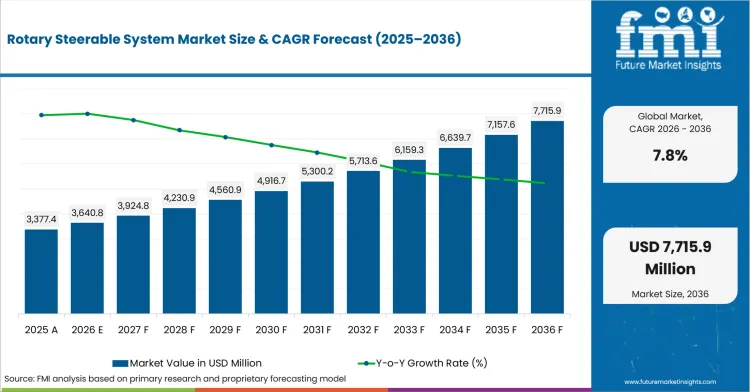
| Metric | Value |
|---|---|
| 2025 Market Size | USD 3,377.37 million |
| 2026 Market Size | USD 3640.8 million |
| 2036 Market Size | USD 7715.9 million |
| Forecast CAGR (2026-2036) | 7.8% |
| Leading System Type | Push-the-bit RSS |
| Push-the-bit RSS Share (2026) | 46.0% |
| Leading Well Type | Horizontal Wells |
| Horizontal Wells Share (2026) | 42.0% |
| Fastest-growing Country | China |
| China CAGR by 2036 | 8.8% |
Summary of the Rotary Steerable System Market
| Market Signal | Commercial Impact |
|---|---|
| Demand and Growth Drivers | Demand for rotary steerable systems (RSS) is increasing as drilling operators seek greater wellbore accuracy, lower drilling risks, and improved operational efficiency across conventional and unconventional wells.
|
| Product and Segment View | Push-the-bit systems, horizontal wells, and oil well applications continue to represent the leading commercial opportunities across the market.
|
| Geography and Growth Outlook | North America and Asia continue to dominate market development through shale drilling, offshore exploration, and expanding upstream investments.
|
| Competitive Landscape | Competition increasingly focuses on downhole reliability, automation integration, and directional drilling expertise.
|
| Analyst Perspective | Rotary steerable systems are evolving from premium drilling equipment into critical well delivery platforms that improve drilling efficiency, well placement accuracy, and overall project economics.
- Nikhil Kaitwade, Principal Consultant at Future Market Insights |
Why is the Rotary Steerable System Market growing?
Operators use RSS to drill longer horizontal wells with smoother boreholes and fewer trajectory corrections. Offshore projects need RSS tools as complex well profiles raise the cost of stuck pipe and extra trips.
- Operators use RSS to drill longer horizontal wells with smoother boreholes and fewer trajectory corrections.
- Offshore projects need RSS tools as complex well profiles raise the cost of stuck pipe and extra trips.
- Shale programs favor automated steering as repeat pad drilling rewards cycle-time gains.
Longer horizontal wells are changing RSS from an optional premium tool into a planning item for many well programs. The United States produced a record 13.6 million barrels per day of crude oil in 2025, according to the Energy Information Administration in March 2026. This output came with high use of horizontal drilling and tight well spacing in major basins. That means operators need smoother trajectories to keep casing runs predictable and completion stages aligned. RSS suppliers benefit when drilling teams treat steering control as a cost-reduction tool across the full well. Complex offshore wells create another demand layer as the cost of delay is higher than on land.
How is the Rotary Steerable System Market segmented?
The Rotary Steerable System Market is segmented by system type, well type, application, end use, sales model, and region.
- With an estimated 46.0% share in 2026, Push-the-bit RSS is expected to retain a notable position in System Type demand through rugged pad steering.
- Horizontal Wells are projected to represent 42.0% of Well Type demand in 2026 with long laterals needing constant correction.
- Oil Wells are anticipated to account for 61.0% of Application demand in 2026 as pay-zone contact drives RSS use.
How does Push-the-bit RSS contribute to the system type category?
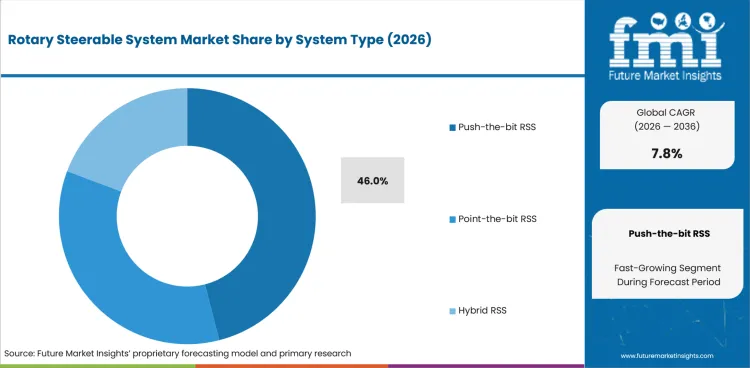
- Push-the-bit RSS is projected to account for a 46.0% share in 2026 as external pads deliver reliable side force in abrasive and high-drag sections.
- Operators often choose push-the-bit tools for harsh onshore intervals because the mechanical steering action is easier to service across repeat shale wells.
What supports demand for Horizontal Wells?
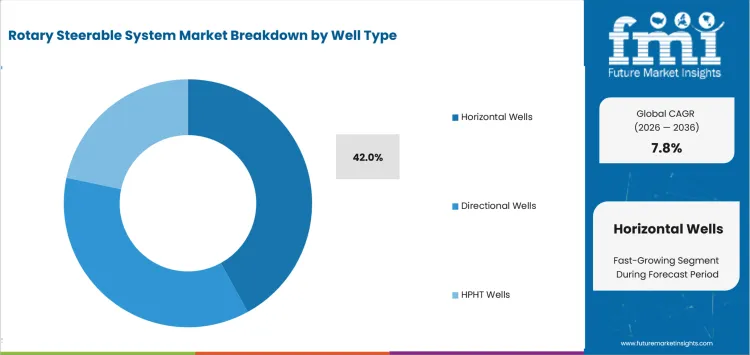
- Horizontal Wells are expected to represent a 42.0% share in 2026 as longer reservoir contact needs smoother wellbore placement and fewer slide corrections.
- Lateral quality affects completion design because casing drag and dogleg severity can limit stage placement in high-volume shale development programs.
How do buyers evaluate Oil Wells within the application category?
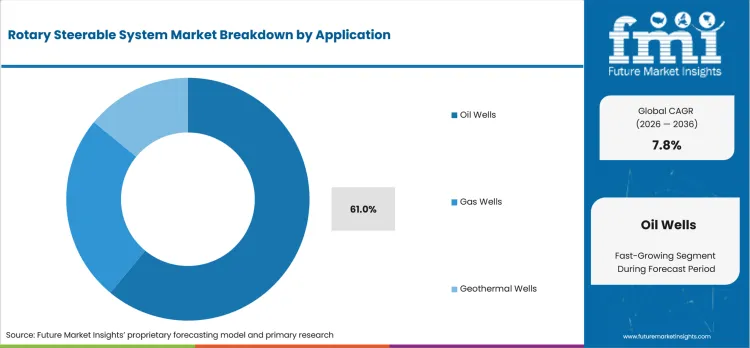
- Oil Wells are anticipated to account for a 61.0% share in 2026 as pay-zone steering has direct value in production economics.
- Buyers in oil projects compare RSS cost against avoided sidetracks since a missed landing zone can weaken well value more than tool rental cost.
What market factors influence demand for Onshore?
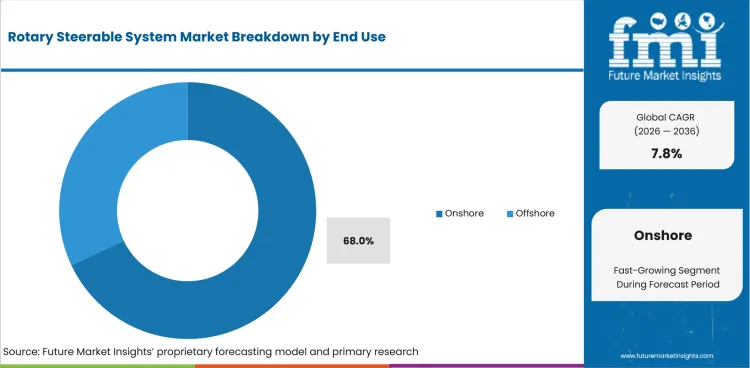
- Onshore is estimated to hold a 68.0% share in 2026 as pad drilling programs reuse RSS workflows across repeated horizontal well designs.
- Shale operators favor RSS tools with fast rig-up processes since repeated wells reward shorter curve sections and repeatable BHA handling.
How does Directional Drilling Service affect the sales model outlook?
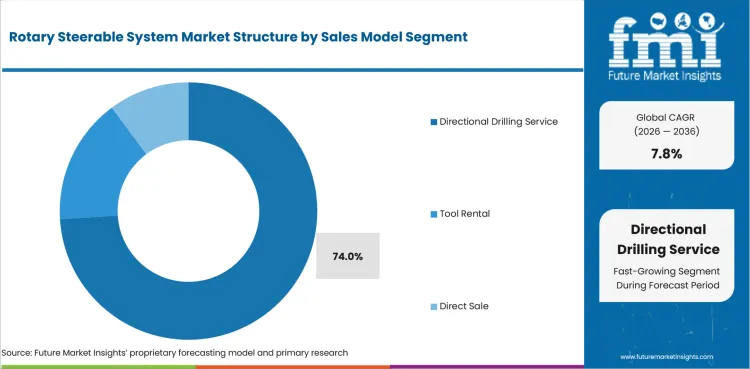
- Directional Drilling Service is projected to account for a 74.0% share in 2026 as steering decisions need trained crews and real-time interpretation.
- Tool rental grows mainly with experienced contractors since most operators avoid taking full downhole steering risk without supplier field support.
What drives and restrains the market?
Driver: Longer laterals increase RSS demand as well plans need continuous steering over wider reservoir contact intervals; restraint: Tool supply remains tight in some regions as specialist electronics and trained field crews limit rapid scaling; opportunity: geothermal wells create an opportunity as deep heat projects move into directional drilling requirements.
The market reflects a balance between the identified demand driver, adoption constraints, and the supplier opportunity outlined below.
- Driver: Longer laterals increase RSS demand as well plans need continuous steering over wider reservoir contact intervals.
- Restraint: Tool supply remains tight in some regions as specialist electronics and trained field crews limit rapid scaling.
- Opportunity: geothermal wells create an opportunity as deep heat projects move into directional drilling requirements.
Lateral Contact Control: RSS demand grows when reservoir exposure becomes a core well economics lever. Operators use continuous rotation to reduce tortuosity and keep the borehole smooth across long laterals. China reported crude oil production of 213 million tonnes and natural gas production of 246.4 billion cubic meters in 2024. The State Council published these figures in January 2025 as offshore and unconventional output gained weight. This scale supports continued drilling complexity and pushes buyers toward steering tools that improve placement accuracy. The implication is clear for suppliers.
ERD Risk: Reduction Extended-reach drilling creates a clear RSS value case since small steering errors can create major casing and torque problems. Buyers in offshore basins compare RSS runs against the cost of stuck pipe, sidetrack work, and lost rig days. Weatherford’s 2026 Magnus Saker technical sheet lists models covering hole sizes up to 18.5 inches. That tool range shows how suppliers are widening RSS coverage for larger hole sections and harsher wells. The practical result is greater demand for full-system assurance across bit, BHA, mud program, and steering control. Operators will pay for tools that lower nonproductive time.
Which factors support expansion?
Commercial expansion is reinforced by the value, workflow, and recurring-demand factors below.
- Revenue is rising as operators push horizontal sections farther and need steering tools that keep wellbore quality within casing limits.
- Offshore wells raise spending per run since deepwater drilling plans need RSS tools with higher reliability and fewer trips.
- Tool rental remains important, but bundled services win most orders as crews manage downhole data and steering decisions.
Which country markets are included in the CAGR comparison?
The selected CAGR comparison covers China (8.8%), India (8.5%), United States (7.9%), Japan (7.2%), and South Korea (7.1%) through 2036.
| Country | CAGR |
|---|---|
| China | 8.8% |
| India | 8.5% |
| United States | 7.9% |
| Japan | 7.2% |
| South Korea | 7.1% |
Source: Future Market Insights analysis.
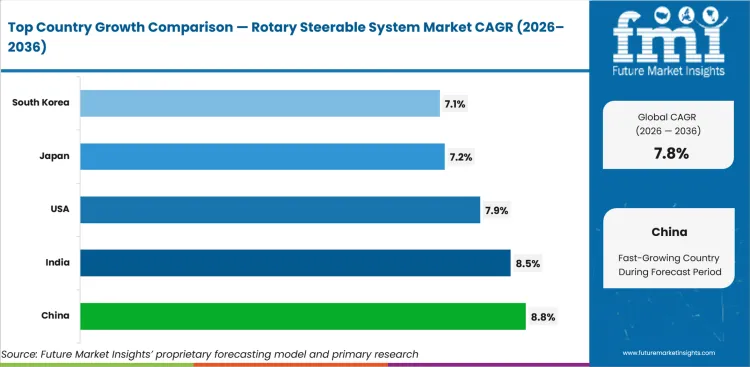
How do country-level CAGRs compare?
- China (CAGR: 8.8%): Offshore ERD and unconventional gas wells support RSS demand in China.
- India (CAGR: 8.5%): Frontier offshore and deepwater exploration create new RSS opportunities.
- United States (CAGR: 7.9%): Permian and Gulf projects keep RSS demand tied to long laterals and complex offshore wells.
- Japan (CAGR: 7.2%): Geothermal drilling and offshore gas work support selective RSS demand.
- South Korea (CAGR: 7.1%): Offshore exploration and subsurface research create limited but high-spec RSS demand.
The global Rotary Steerable System Market is forecast to record a CAGR of 7.8% from 2026 to 2036. The study covers 30+ countries across the report regions.
How is the Rotary Steerable System Market developing in China?
China is projected to record a CAGR of 8.8% through 2036. The country outlook identifies this demand signal: Offshore ERD and unconventional gas wells support RSS demand in China.
Country Market Snapshot
| Country | China |
|---|---|
| Forecast CAGR | 8.8% |
| Demand anchor | Offshore ERD and unconventional gas wells support RSS demand in China. |
| Local proof point | China produced 213 million tonnes of crude oil in 2024. |
| Supply base | CNOOC, PetroChina, and Sinopec shape demand through large drilling programs. |
| Channel signal | State-owned operators drive qualification and field trial access. |
| Restraint | Domestic tool qualification can slow foreign supplier entry. |
| Application mix | Offshore oil, shale gas, and deep gas wells support RSS demand. |
| Company context | Companies active in or serving this market include CNPC, Sinopec Oilfield Service, China Oilfield Services, SLB, and Halliburton. |
Market Outlook
China’s growth outlook is supported by national energy-security targets for technically difficult domestic resources. The State Council reported in January 2025 that natural gas production reached 246.4 billion cubic meters in 2024. Offshore and unconventional reserves were described as primary contributors to production gains. RSS demand grows when operators move into deep gas, offshore ERD, and shale wells. Qualification in China often depends on state-owned operator trials and proven performance under local field conditions.
Key Growth Drivers
- CNOOC offshore ERD projects need RSS tools for long departures and casing reliability.
- Sichuan shale and deep gas wells increase need for high-temperature steering systems.
- State energy security targets support continued domestic drilling investment.
- Offshore ERD and unconventional gas wells support RSS demand in China.
Key Restraints
- Domestic tool qualification processes can lengthen foreign vendor sales cycles.
- Deep formations raise tool failure risk and require stronger field service coverage.
- Domestic tool qualification can slow foreign supplier entry.
Country Market FAQs
What should C-suite teams prioritize in China?
C-suite teams should prioritize qualification requirements, procurement routes, local service coverage, and implementation economics before committing capital or supplier volume.
How should suppliers approach the China market?
Suppliers should align technical evidence, local channel support, and account-specific commercial terms with the buying process used by major customers in China.
What can weaken the business case in China?
Domestic tool qualification can slow foreign supplier entry. Executives should test this exposure during supplier, investment, and rollout reviews.
How is the Rotary Steerable System Market developing in India?
India is projected to record a CAGR of 8.5% through 2036. The country outlook identifies this demand signal: Frontier offshore and deepwater exploration create new RSS opportunities.
Country Market Snapshot
| Country | India |
|---|---|
| Forecast CAGR | 8.5% |
| Demand anchor | Frontier offshore and deepwater exploration create new RSS opportunities. |
| Local proof point | India drilled 741 oil and gas wells in FY 2023-24. |
| Policy context | OALP Round X opened 25 exploration blocks across 191,986.21 square kilometers. |
| Supply base | ONGC and Oil India shape many domestic drilling decisions. |
| Restraint | Price sensitivity affects tool selection in conventional onshore wells. |
| Application mix | Offshore blocks and deep frontier wells support premium RSS demand. |
| Company context | Companies active in or serving this market include ONGC, Oil India, SLB, Halliburton, and Baker Hughes. |
Market Outlook
India is moving from mature domestic production toward a broader exploration push. The petroleum ministry said in August 2025 that OALP Round X offered 25 exploration blocks covering 191,986.21 square kilometers. This acreage creates a larger future well funnel across onshore, shallow-water, deepwater, and ultra-deepwater settings. RSS demand will rise where blocks move from license awards into drilling. Buyer behavior remains cost-aware because many onshore wells can use lower-cost directional tools.
Key Growth Drivers
- OALP acreage expansion increases the pool of future directional drilling projects.
- Offshore stratigraphic wells create demand for better steering and subsurface validation.
- ONGC and Oil India programs can support large service contracts once wells are approved.
- Frontier offshore and deepwater exploration create new RSS opportunities.
Key Restraints
- Cost-sensitive onshore drilling can limit RSS use in simpler wells.
- Frontier blocks need geological proof before operators commit to larger drilling budgets.
- Price sensitivity affects tool selection in conventional onshore wells.
Country Market FAQs
What should C-suite teams prioritize in India?
C-suite teams should prioritize qualification requirements, procurement routes, local service coverage, and implementation economics before committing capital or supplier volume.
How should suppliers approach the India market?
Suppliers should align technical evidence, local channel support, and account-specific commercial terms with the buying process used by major customers in India.
What can weaken the business case in India?
Price sensitivity affects tool selection in conventional onshore wells. Executives should test this exposure during supplier, investment, and rollout reviews.
How is the Rotary Steerable System Market developing in the United States?
The United States is projected to record a CAGR of 7.9% through 2036. The country outlook identifies this demand signal: Permian and Gulf projects keep RSS demand tied to long laterals and complex offshore wells.
Country Market Snapshot
| Country | United States |
|---|---|
| Forecast CAGR | 7.9% |
| Demand anchor | Permian and Gulf projects keep RSS demand tied to long laterals and complex offshore wells. |
| Buyer behavior | Operators compare RSS value against drilling days saved and completion quality. |
| Channel signal | Integrated directional drilling contracts dominate large shale and offshore programs. |
| Supply base | SLB, Halliburton, Baker Hughes, Weatherford, and Scientific Drilling maintain strong local reach. |
| Restraint | Lower rig counts can delay premium RSS runs when oil prices weaken. |
| Application mix | Oil wells support demand across shale benches and deepwater development wells. |
| Company context | Companies active in or serving this market include SLB, Halliburton, Baker Hughes, Weatherford, and NOV. |
Market Outlook
The United States remains a repeatable RSS market because shale operators drill many similar horizontal wells. EIA reported in March 2026 that crude oil production reached 13.6 million barrels per day in 2025. That activity rewards tools that shorten curve drilling and preserve lateral quality. Buyers focus on total well cost instead of the RSS day rate alone. Service contracting in the country favors large integrated providers with field crews across Texas, New Mexico, North Dakota, and the Gulf Coast.
Key Growth Drivers
- Permian operators need RSS for lateral consistency across tightly spaced development wells.
- Gulf of America projects use RSS to reduce exposure to costly offshore downtime.
- Shale drilling teams favor automation-ready tools that link steering decisions with surface systems.
- Permian and Gulf projects keep RSS demand tied to long laterals and complex offshore wells.
Key Restraints
- Rig count softness can push operators toward lower-cost motor assemblies in simpler wells.
- Service pricing pressure remains high when operators demand measurable cycle-time savings.
- Lower rig counts can delay premium RSS runs when oil prices weaken.
Country Market FAQs
What should C-suite teams prioritize in the United States?
C-suite teams should prioritize qualification requirements, procurement routes, local service coverage, and implementation economics before committing capital or supplier volume.
How should suppliers approach the United States market?
Suppliers should align technical evidence, local channel support, and account-specific commercial terms with the buying process used by major customers in the United States.
What can weaken the business case in the United States?
Lower rig counts can delay premium RSS runs when oil prices weaken. Executives should test this exposure during supplier, investment, and rollout reviews.
How is the Rotary Steerable System Market developing in Japan?
Japan is projected to record a CAGR of 7.2% through 2036. The country outlook identifies this demand signal: Geothermal drilling and offshore gas work support selective RSS demand.
Country Market Snapshot
| Country | Japan |
|---|---|
| Forecast CAGR | 7.2% |
| Demand anchor | Geothermal drilling and offshore gas work support selective RSS demand. |
| Local proof point | IEA Geothermal reported around 520 MWe of Japanese geothermal power capacity at end-2024. |
| Policy context | Japan supports geothermal surveys and drilling through JOGMEC. |
| Supply structure | Domestic operators work with global service firms for advanced drilling needs. |
| Restraint | Hot spring rules and long project lead times slow geothermal well approvals. |
| Application mix | Geothermal wells and offshore wells form the main RSS opportunity. |
| Company context | Companies active in or serving this market include INPEX, JAPEX, SLB, Halliburton, and Baker Hughes. |
Market Outlook
Japan’s RSS demand is smaller than its technical need would suggest because project approvals take time. IEA Geothermal reported in August 2025 that Japanese geothermal power plant capacity was around 520 MWe at the end of 2024. This installed capacity shows a real geothermal base that can support deeper drilling services. RSS becomes relevant when developers need well placement in fractured volcanic settings. Oil and gas work remains selective, with domestic production concentrated in limited fields and offshore prospects.
Key Growth Drivers
- JOGMEC support for geothermal surveys lowers early-stage resource risk.
- Volcanic geology creates well placement challenges that favor steerable drilling tools.
- Offshore gas exploration needs high-reliability directional drilling support.
- Geothermal drilling and offshore gas work support selective RSS demand.
Key Restraints
- Hot spring protection rules can delay geothermal drilling permits.
- Domestic hydrocarbon production is limited and cannot support large RSS volume.
- Hot spring rules and long project lead times slow geothermal well approvals.
Country Market FAQs
What should C-suite teams prioritize in Japan?
C-suite teams should prioritize qualification requirements, procurement routes, local service coverage, and implementation economics before committing capital or supplier volume.
How should suppliers approach the Japan market?
Suppliers should align technical evidence, local channel support, and account-specific commercial terms with the buying process used by major customers in Japan.
What can weaken the business case in Japan?
Hot spring rules and long project lead times slow geothermal well approvals. Executives should test this exposure during supplier, investment, and rollout reviews.
How is the Rotary Steerable System Market developing in South Korea?
South Korea is projected to record a CAGR of 7.1% through 2036. The country outlook identifies this demand signal: Offshore exploration and subsurface research create limited but high-spec RSS demand.
Country Market Snapshot
| Country | South Korea |
|---|---|
| Forecast CAGR | 7.1% |
| Demand anchor | Offshore exploration and subsurface research create limited but high-spec RSS demand. |
| Local proof point | KNOC states that Korea has drilled 47 domestic exploration wells so far. |
| Policy context | East Sea exploration frames the country’s upstream drilling discussion. |
| Supply structure | Local upstream activity depends on national oil company programs. |
| Restraint | Limited commercial reserves reduce recurring RSS demand. |
| Application mix | Offshore exploration is more relevant than onshore production drilling. |
| Company context | Companies active in or serving this market include Korea National Oil Corporation, SK earthon, POSCO International, SLB, and Halliburton. |
Market Outlook
South Korea is a selective RSS market with demand tied to exploration campaigns rather than continuous production drilling. KNOC reported in March 2026 that Korea has drilled 47 domestic exploration wells so far. That small well count shows why RSS demand is episodic and tied to specific offshore projects. Suppliers must treat the country as a campaign market. Buyer decisions are influenced by national energy security goals and uncertainty around commercial resource confirmation.
Key Growth Drivers
- East Sea exploration can require high-spec directional drilling in offshore settings.
- KNOC-led projects create demand for proven international drilling service partners.
- Energy security concerns support continued technical review of domestic resources.
- Offshore exploration and subsurface research create limited but high-spec RSS demand.
Key Restraints
- Limited proven reserves weaken recurring RSS demand after exploration phases.
- Political scrutiny can slow funding for high-risk offshore drilling campaigns.
- Market access depends on consistent execution across national oil company tenders and related local channels.
Country Market FAQs
What should C-suite teams prioritize in South Korea?
C-suite teams should prioritize qualification requirements, procurement routes, local service coverage, and implementation economics before committing capital or supplier volume.
How should suppliers approach the South Korea market?
Suppliers should align technical evidence, local channel support, and account-specific commercial terms with the buying process used by major customers in South Korea.
What can weaken the business case in South Korea?
Limited commercial reserves reduce recurring RSS demand. Executives should test this exposure during supplier, investment, and rollout reviews.
Which companies are discussed in the Rotary Steerable System Market?
The preview discusses SLB, Halliburton, Baker Hughes, Weatherford, and NOV among the companies active in this market.
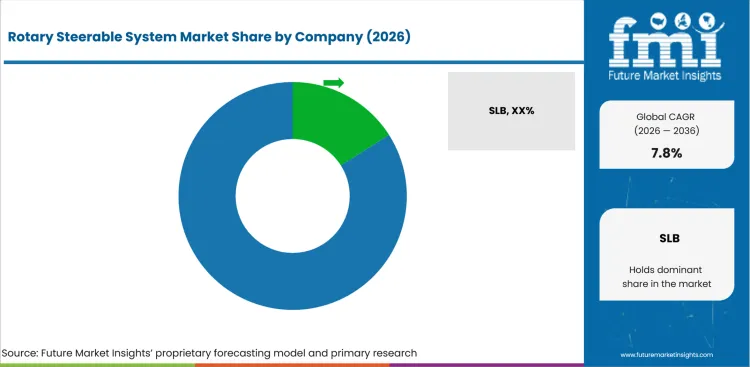
The market is concentrated around global oilfield service firms with deep RSS portfolios and worldwide field crews. Smaller specialists win selective work through tool electronics, directional software, and custom downhole engineering. Entry barriers are high due to qualification cycles, harsh-well proof, and service crew depth.
Automation integration is becoming a stronger differentiator than tool design alone. Established suppliers compete on the ability to deliver steering tools, field crews, and automation support together. SLB and Nabors announced a January 2024 collaboration to integrate drilling automation applications with rig operating systems.
How is competition structured?
Competition reflects differences in specialization, portfolio scope, geographic reach, evidence, and customer access.
The market is led by integrated oilfield service firms and supported by specialist downhole technology providers.
Global Leaders: SLB, Halliburton, Baker Hughes, and Weatherford offer broad RSS portfolios with field crews, digital platforms, and global service centers. Their strength comes from integrated drilling contracts and proven offshore references.
Specialist Technology Providers: APS Technology, Enteq Technologies, and Scientific Drilling compete through downhole electronics, specialist steering systems, and directional drilling knowledge. They are more exposed to project timing but can win when buyers want technical flexibility.
Rig and Automation Integrators: NOV and Nabors influence RSS buying through rig systems, automation platforms, and drilling workflow integration. Their role matters when operators seek smoother links between downhole steering and surface control.
How do selected companies compare?
The selected companies differ in portfolio focus, geographic reach, evidence depth, and channel strength.
| Company | Competitive position |
|---|---|
| SLB | SLB is assessed for drilling-system compatibility, installed-base support, field service, and upgrade capability. |
| Halliburton | Halliburton is assessed for drilling-system compatibility, installed-base support, field service, and upgrade capability. |
| Baker Hughes | Baker Hughes is assessed for drilling-system compatibility, installed-base support, field service, and upgrade capability. |
| Weatherford | Weatherford is assessed for drilling-system compatibility, installed-base support, field service, and upgrade capability. |
| NOV | NOV is assessed for drilling-system compatibility, installed-base support, field service, and upgrade capability. |
What are the key developments in the Rotary Steerable System Market?
- In January 2024, SLB and Nabors announced a collaboration to scale drilling automation solutions. The agreement supports RSS adoption by reducing system integration barriers.
- In October 2024, Halliburton introduced iCruise Force intelligent high-performance motorized RSS. The development targets extended wells and harsh formations where steering control is critical.
- In January 2025, Baker Hughes reported an Eni award using AutoTrak eXact RSS. The contract shows RSS value in mature European developments.
Selected Companies in the Rotary Steerable System Market
Companies referenced in this preview
- SLB.
- Halliburton.
- Baker Hughes.
- Weatherford.
- NOV.
- Nabors Industries.
- China Oilfield Services.
- Sinopec Oilfield Service.
Market Scope & Definition
| Metric | Value |
|---|---|
| Market definition | Rotary steerable systems are downhole steering tools that guide the drill bit while the drill string keeps rotating. The scope includes push-the-bit RSS, point-the-bit RSS, hybrid RSS, related steering electronics, and service packages used in directional wells. |
| Functions covered | Push-the-bit RSS, Point-the-bit RSS, Hybrid RSS |
| Applications covered | Oil Wells, Gas Wells, Geothermal Wells, Other |
| End-use industries | Onshore, Offshore |
| Inclusions | Market scope covers push-the-bit RSS, point-the-bit RSS, hybrid RSS, horizontal wells, directional wells, ERD wells, HPHT wells, oil wells, gas wells, geothermal wells, onshore operations, offshore operations, directional drilling services, tool rentals, and direct sales across 30+ countries. |
| Exclusions | Market scope excludes conventional mud motors, drill bits sold alone, measurement tools without steering capability, casing exit tools, completion tools, workover systems, rig hardware, and general drilling automation software sold without RSS functionality. |
Research Methodology
| Metric | Value |
|---|---|
| Primary Research | FMI analysts reviewed input from drilling contractors, directional drilling providers, oilfield service firms, upstream operators, geothermal developers, and tool rental channel participants. Interviews focused on RSS utilization, run failure risk, service pricing, well type mix, and buyer decision criteria. |
| Desk Research | reviewed official company product information, upstream activity data, government drilling signals, trade association material, and regulator publications. Product scope was checked against RSS system descriptions from SLB, Halliburton, Baker Hughes, Weatherford, and specialist tool providers. |
| Market Sizing and Forecasting | The model combined tool deployment volume, service day pricing, country drilling activity, offshore weight, and well complexity. Segment shares were estimated from typical RSS use patterns across horizontal wells, ERD wells, offshore wells, and service contracts. |
| Market Calibration | Forecasts reflect upstream drilling activity, company portfolio depth, automation launches, and country-level energy programs. Demand is strongest where buyers have enough complex drilling work to support paid RSS runs. |
What does the report cover?
The report covers system type, well type, application, end use, sales model, and region across the 2026-2036 forecast period in 30+ countries.
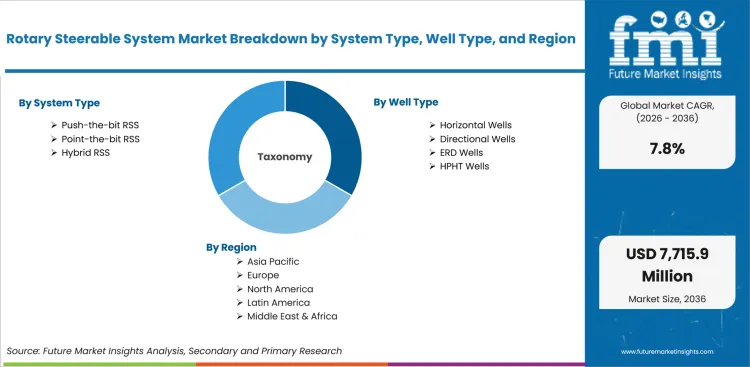
| Metric | Value |
|---|---|
| Periods | Base year 2025; estimated year 2026; forecast period 2026-2036 |
| Quantitative units | USD 3640.8 million in 2026 to USD 7715.9 million by 2036, at a CAGR of 7.8% |
| Segment axes | system type, well type, application, end use, sales model, and region |
| Regions | North America, Europe, East Asia, South Asia and Pacific, Middle East and Africa |
| Countries | United States, United Kingdom, Germany, France, Japan, China, South Korea, India and 30+ countries |
| Companies | SLB, Halliburton, Baker Hughes, Weatherford, NOV, Nabors Industries, China Oilfield Services, Sinopec Oilfield Service, and others |
| Approach | Hybrid bottom-up and top-down methodology using tool demand, service pricing, country drilling activity, and well complexity. |
Market Segmentation Analysis
Segmented by System Type
- Push-the-bit RSS.
- Point-the-bit RSS.
- Hybrid RSS.
Segmented by Well Type
- Horizontal Wells.
- Directional Wells.
- ERD Wells.
- HPHT Wells.
Segmented by Application
- Oil Wells.
- Gas Wells.
- Geothermal Wells.
- Other.
Segmented by End Use
- Onshore.
- Offshore.
Segmented by Sales Model
- Directional Drilling Service.
- Tool Rental.
- Direct Sale.
By Region
- North America.
- United States.
- Western Europe.
- Germany.
- France.
- United Kingdom.
- East Asia.
- China.
- Japan.
- South Korea.
- South Asia and Pacific.
- India.
Research Sources and Bibliography
- 1. USA Energy Information Administration. (2026, March 31). USA crude oil production rose in 2025, setting new record. USA Energy Information Administration.
- 2. North Sea Transition Authority. (2025, October 28). Wells Insights Report 2025. North Sea Transition Authority.
- 3. Bundesverband Erdgas, Erdöl und Geoenergie e.V. (2025, April 24). Bohrtätigkeit. BVEG.
- 4. BRGM. (2024, February 21). Deep geothermal energy in the Paris Region: scientific campaign. BRGM.
- 5. International Energy Agency Geothermal. (2025, August 8). Japan. IEA Geothermal.
- 6. State Council of the People’s Republic of China. (2025, January 28). China’s oil, gas output exceeds 400 million tonnes for first time. The State Council.
- 7. Korea National Oil Corporation. (2026, March 31). Domestic exploration. Korea National Oil Corporation.
- 8. Ministry of Petroleum and Natural Gas. (2025, January 7). Year End Review 2024. Press Information Bureau.
- 9. Ministry of Petroleum and Natural Gas. (2025, August 11). Open Acreage Licensing Policy. Press Information Bureau.
- 10. SLB. (2024, January 11). SLB and Nabors announce collaboration to scale adoption of drilling automation solutions. SLB Investor Center.
- 11. Halliburton. (2024, October 22). iCruise Force intelligent rotary steerable system delivers unmatched power for extended wells. Halliburton.
- 12. Baker Hughes. (2025, January 30). Baker Hughes announces fourth-quarter and full-year 2024 results. Baker Hughes Investor Relations.
- 13. SLB. (2025, February 26). New extended-reach drilling record for CNOOC in the South China Sea. SLB.
- 14. SLB. (2026, January 23). SLB announces fourth-quarter and full-year 2025 results. SLB Investor Center.
- 15. Baker Hughes. (2026, May 26). Baker Hughes extends and expands integrated well construction contract with Petrobras. Baker Hughes Investor Relations.
- 16. Weatherford. (2026). Magnus Saker rotary steerable system. Weatherford.
The bibliography is provided for reader reference and uses primary government, regulator, official trade body, and company-published sources.
This Report Answers
- What is the projected value of the Rotary Steerable System Market in 2026?
- What value is forecast for the Rotary Steerable System Market by 2036?
- What CAGR is forecast for the Rotary Steerable System Market from 2026 to 2036?
- What 2026 share is projected for Push-the-bit RSS within the system type category?
- What 2026 share is projected for Horizontal Wells within the well type category?
- Which demand factors support the Rotary Steerable System Market outlook?
- Which restraints and opportunities affect adoption in the Rotary Steerable System Market?
- How are country CAGR outlooks, including China at 8.8%, compared?
- Which companies and product developments are covered in the competitive analysis?
- What is included in the market scope, and how is the forecast validated?
Frequently Asked Questions
Why should executives track the Rotary Steerable System Market?
Executives should track this market because it can affect capital allocation, supplier strategy, operating risk, and competitive positioning across commercial planning cycles.
What business problem does the Rotary Steerable System Market address?
It helps executive teams judge where customer pain, supplier capability, compliance exposure, and implementation economics justify investment, procurement, or portfolio action.
What should procurement leaders evaluate before selecting suppliers?
Procurement leaders should assess evidence quality, integration fit, service coverage, compliance readiness, total cost of ownership, and supplier execution capability.
What can limit return on investment for buyers?
Return on investment can be limited by low utilization, integration delays, training gaps, unclear ownership, pricing pressure, or weak fit with existing workflows.
How can suppliers build executive confidence?
Suppliers can build confidence by proving implementation speed, risk reduction, support depth, reference use cases, and measurable outcomes for budget owners.
Preview the report firsthand - request a free sample
Get SampleGet the brochure for pricing and purchase details.
Get PDFTable of Content
- Key Takeaways
- Market Size and CAGR
- Top Growth Driver
- Fastest Growing Segment
- Leading Region
- Key Companies
- Emerging Opportunities
- Executive Summary
- Global Market Outlook
- Demand-side Trends
- Supply-side Trends
- Technology Roadmap Analysis
- Analysis and Recommendations
- Analyst Perspective (What is happening? Why now? What should investors know?)
- Key Questions Answered
- How large is the market?
- What is the CAGR?
- What are key trends?
- Which region dominates?
- Who are the leaders?
- Market Overview
- Market Coverage / Taxonomy
- Market Definition / Scope / Limitations
- Research Methodology
- Chapter Orientation
- Analytical Lens and Working Hypotheses
- Market Structure, Signals, and Trend Drivers
- Benchmarking and Cross-market Comparability
- Market Sizing, Forecasting, and Opportunity Mapping
- Research Design and Evidence Framework
- Desk Research Programme (Secondary Evidence)
- Expert Input and Fieldwork (Primary Evidence)
- Tooling, Models, and Reference Databases
- Data Engineering and Model Build
- Quality Assurance and Audit Trail
- Market Background
- Market Dynamics (Drivers, Restraints, Opportunity, Trends)
- Scenario Forecast (Optimistic, Likely, Conservative)
- Impact Analysis
- AI Impact
- Sustainability Impact
- Regulatory Impact
- Technology Impact
- Consumer / Buyer Analysis
- Purchase Drivers
- Adoption Barriers
- Buyer Journey
- Opportunity Map Analysis
- Product Life Cycle Analysis
- Supply Chain Analysis
- Investment Feasibility Matrix
- Value Chain Analysis
- PESTLE and Porter's Analysis
- Regulatory Landscape
- Regional Parent Market Outlook
- Production and Consumption Statistics
- Import and Export Statistics
- Global Market Analysis and Forecast, 2021 to 2036
- Historical Market Size Value (USD Billion) & Volume (Unit) Analysis, 2021 to 2025
- Current and Future Market Size Value (USD Billion) & Volume (Unit) Projections, 2026 to 2036
- Y-o-Y Growth Trend Analysis
- Absolute $ Opportunity Analysis
- Global Market Pricing Analysis, 2021 to 2036
- Global Market Analysis and Forecast, By System Type, 2021 to 2036
- Introduction / Key Findings
- Historical Market Size Value (USD Billion) & Volume (Unit) Analysis By System Type, 2021 to 2025
- Current and Future Market Size Value (USD Billion) & Volume (Unit) Analysis and Forecast By System Type, 2026 to 2036
- Push-the-bit RSS
- Point-the-bit RSS
- Hybrid RSS
- Push-the-bit RSS
- Y-o-Y Growth Trend Analysis By System Type, 2021 to 2025
- Absolute $ Opportunity Analysis By System Type, 2026 to 2036
- Global Market Analysis and Forecast, By Well Type, 2021 to 2036
- Introduction / Key Findings
- Historical Market Size Value (USD Billion) & Volume (Unit) Analysis By Well Type, 2021 to 2025
- Current and Future Market Size Value (USD Billion) & Volume (Unit) Analysis and Forecast By Well Type, 2026 to 2036
- Horizontal Wells
- Directional Wells
- HPHT Wells
- Horizontal Wells
- Y-o-Y Growth Trend Analysis By Well Type, 2021 to 2025
- Absolute $ Opportunity Analysis By Well Type, 2026 to 2036
- Global Market Analysis and Forecast, By Application, 2021 to 2036
- Introduction / Key Findings
- Historical Market Size Value (USD Billion) & Volume (Unit) Analysis By Application, 2021 to 2025
- Current and Future Market Size Value (USD Billion) & Volume (Unit) Analysis and Forecast By Application, 2026 to 2036
- Oil Wells
- Gas Wells
- Geothermal Wells
- Oil Wells
- Y-o-Y Growth Trend Analysis By Application, 2021 to 2025
- Absolute $ Opportunity Analysis By Application, 2026 to 2036
- Global Market Analysis and Forecast, By End Use, 2021 to 2036
- Introduction / Key Findings
- Historical Market Size Value (USD Billion) & Volume (Unit) Analysis By End Use, 2021 to 2025
- Current and Future Market Size Value (USD Billion) & Volume (Unit) Analysis and Forecast By End Use, 2026 to 2036
- Onshore
- Offshore
- Onshore
- Y-o-Y Growth Trend Analysis By End Use, 2021 to 2025
- Absolute $ Opportunity Analysis By End Use, 2026 to 2036
- Global Market Analysis and Forecast, By Sales Model, 2021 to 2036
- Introduction / Key Findings
- Historical Market Size Value (USD Billion) & Volume (Unit) Analysis By Sales Model, 2021 to 2025
- Current and Future Market Size Value (USD Billion) & Volume (Unit) Analysis and Forecast By Sales Model, 2026 to 2036
- Directional Drilling Service
- Tool Rental
- Direct Sale
- Directional Drilling Service
- Y-o-Y Growth Trend Analysis By Sales Model, 2021 to 2025
- Absolute $ Opportunity Analysis By Sales Model, 2026 to 2036
- Global Market Analysis and Forecast, By Region, 2021 to 2036
- Introduction
- Historical Market Size Value (USD Billion) & Volume (Unit) Analysis By Region, 2021 to 2025
- Current Market Size Value (USD Billion) & Volume (Unit) Analysis and Forecast By Region, 2026 to 2036
- North America
- Latin America
- Western Europe
- Eastern Europe
- East Asia
- South Asia and Pacific
- Middle East & Africa
- Market Attractiveness Analysis By Region
- North America Market Analysis and Forecast, By Country, 2021 to 2036
- Historical Market Size Value (USD Billion) & Volume (Unit) Trend Analysis By Market Taxonomy, 2021 to 2025
- Market Size Value (USD Billion) & Volume (Unit) Forecast By Market Taxonomy, 2026 to 2036
- By Country
- USA
- Canada
- Mexico
- By System Type
- By Well Type
- By Application
- By End Use
- By Sales Model
- By Country
- Market Attractiveness Analysis
- By Country
- By System Type
- By Well Type
- By Application
- By End Use
- By Sales Model
- Key Takeaways
- Latin America Market Analysis and Forecast, By Country
- Historical Market Size Value (USD Billion) & Volume (Unit) Trend Analysis By Market Taxonomy, 2021 to 2025
- Market Size Value (USD Billion) & Volume (Unit) Forecast By Market Taxonomy, 2026 to 2036
- By Country
- Brazil
- Chile
- Rest of Latin America
- By System Type
- By Well Type
- By Application
- By End Use
- By Sales Model
- By Country
- Market Attractiveness Analysis
- By Country
- By System Type
- By Well Type
- By Application
- By End Use
- By Sales Model
- Key Takeaways
- Western Europe Market Analysis and Forecast, By Country
- Historical Market Size Value (USD Billion) & Volume (Unit) Trend Analysis By Market Taxonomy, 2021 to 2025
- Market Size Value (USD Billion) & Volume (Unit) Forecast By Market Taxonomy, 2026 to 2036
- By Country
- Germany
- UK
- Italy
- Spain
- France
- Nordic
- BENELUX
- Rest of Western Europe
- By System Type
- By Well Type
- By Application
- By End Use
- By Sales Model
- By Country
- Market Attractiveness Analysis
- By Country
- By System Type
- By Well Type
- By Application
- By End Use
- By Sales Model
- Key Takeaways
- Eastern Europe Market Analysis and Forecast, By Country
- Historical Market Size Value (USD Billion) & Volume (Unit) Trend Analysis By Market Taxonomy, 2021 to 2025
- Market Size Value (USD Billion) & Volume (Unit) Forecast By Market Taxonomy, 2026 to 2036
- By Country
- Russia
- Poland
- Hungary
- Balkan & Baltic
- Rest of Eastern Europe
- By System Type
- By Well Type
- By Application
- By End Use
- By Sales Model
- By Country
- Market Attractiveness Analysis
- By Country
- By System Type
- By Well Type
- By Application
- By End Use
- By Sales Model
- Key Takeaways
- East Asia Market Analysis and Forecast, By Country
- Historical Market Size Value (USD Billion) & Volume (Unit) Trend Analysis By Market Taxonomy, 2021 to 2025
- Market Size Value (USD Billion) & Volume (Unit) Forecast By Market Taxonomy, 2026 to 2036
- By Country
- China
- Japan
- South Korea
- By System Type
- By Well Type
- By Application
- By End Use
- By Sales Model
- By Country
- Market Attractiveness Analysis
- By Country
- By System Type
- By Well Type
- By Application
- By End Use
- By Sales Model
- Key Takeaways
- South Asia and Pacific Market Analysis and Forecast, By Country
- Historical Market Size Value (USD Billion) & Volume (Unit) Trend Analysis By Market Taxonomy, 2021 to 2025
- Market Size Value (USD Billion) & Volume (Unit) Forecast By Market Taxonomy, 2026 to 2036
- By Country
- India
- ASEAN
- Australia & New Zealand
- Rest of South Asia and Pacific
- By System Type
- By Well Type
- By Application
- By End Use
- By Sales Model
- By Country
- Market Attractiveness Analysis
- By Country
- By System Type
- By Well Type
- By Application
- By End Use
- By Sales Model
- Key Takeaways
- Middle East & Africa Market Analysis and Forecast, By Country
- Historical Market Size Value (USD Billion) & Volume (Unit) Trend Analysis By Market Taxonomy, 2021 to 2025
- Market Size Value (USD Billion) & Volume (Unit) Forecast By Market Taxonomy, 2026 to 2036
- By Country
- Kingdom of Saudi Arabia
- Other GCC Countries
- Türkiye
- South Africa
- Other African Union
- Rest of Middle East & Africa
- By System Type
- By Well Type
- By Application
- By End Use
- By Sales Model
- By Country
- Market Attractiveness Analysis
- By Country
- By System Type
- By Well Type
- By Application
- By End Use
- By Sales Model
- Key Takeaways
- Key Countries Market Analysis
- USA
- Pricing Analysis
- Market Share Analysis, 2025
- By System Type
- By Well Type
- By Application
- By End Use
- By Sales Model
- Canada
- Pricing Analysis
- Market Share Analysis, 2025
- By System Type
- By Well Type
- By Application
- By End Use
- By Sales Model
- Mexico
- Pricing Analysis
- Market Share Analysis, 2025
- By System Type
- By Well Type
- By Application
- By End Use
- By Sales Model
- Brazil
- Pricing Analysis
- Market Share Analysis, 2025
- By System Type
- By Well Type
- By Application
- By End Use
- By Sales Model
- Chile
- Pricing Analysis
- Market Share Analysis, 2025
- By System Type
- By Well Type
- By Application
- By End Use
- By Sales Model
- Germany
- Pricing Analysis
- Market Share Analysis, 2025
- By System Type
- By Well Type
- By Application
- By End Use
- By Sales Model
- UK
- Pricing Analysis
- Market Share Analysis, 2025
- By System Type
- By Well Type
- By Application
- By End Use
- By Sales Model
- Italy
- Pricing Analysis
- Market Share Analysis, 2025
- By System Type
- By Well Type
- By Application
- By End Use
- By Sales Model
- Spain
- Pricing Analysis
- Market Share Analysis, 2025
- By System Type
- By Well Type
- By Application
- By End Use
- By Sales Model
- France
- Pricing Analysis
- Market Share Analysis, 2025
- By System Type
- By Well Type
- By Application
- By End Use
- By Sales Model
- India
- Pricing Analysis
- Market Share Analysis, 2025
- By System Type
- By Well Type
- By Application
- By End Use
- By Sales Model
- ASEAN
- Pricing Analysis
- Market Share Analysis, 2025
- By System Type
- By Well Type
- By Application
- By End Use
- By Sales Model
- Australia & New Zealand
- Pricing Analysis
- Market Share Analysis, 2025
- By System Type
- By Well Type
- By Application
- By End Use
- By Sales Model
- China
- Pricing Analysis
- Market Share Analysis, 2025
- By System Type
- By Well Type
- By Application
- By End Use
- By Sales Model
- Japan
- Pricing Analysis
- Market Share Analysis, 2025
- By System Type
- By Well Type
- By Application
- By End Use
- By Sales Model
- South Korea
- Pricing Analysis
- Market Share Analysis, 2025
- By System Type
- By Well Type
- By Application
- By End Use
- By Sales Model
- Russia
- Pricing Analysis
- Market Share Analysis, 2025
- By System Type
- By Well Type
- By Application
- By End Use
- By Sales Model
- Poland
- Pricing Analysis
- Market Share Analysis, 2025
- By System Type
- By Well Type
- By Application
- By End Use
- By Sales Model
- Hungary
- Pricing Analysis
- Market Share Analysis, 2025
- By System Type
- By Well Type
- By Application
- By End Use
- By Sales Model
- Kingdom of Saudi Arabia
- Pricing Analysis
- Market Share Analysis, 2025
- By System Type
- By Well Type
- By Application
- By End Use
- By Sales Model
- Türkiye
- Pricing Analysis
- Market Share Analysis, 2025
- By System Type
- By Well Type
- By Application
- By End Use
- By Sales Model
- South Africa
- Pricing Analysis
- Market Share Analysis, 2025
- By System Type
- By Well Type
- By Application
- By End Use
- By Sales Model
- USA
- Market Structure Analysis
- Competition Dashboard
- Competition Benchmarking
- Market Share Analysis of Top Players
- By Regional
- By System Type
- By Well Type
- By Application
- By End Use
- By Sales Model
- Emerging Startups
- Innovation Benchmarking
- Competition Analysis
- Competition Deep Dive
- SLB
- Overview
- Product Portfolio
- Profitability by Market Segments (Product/Region/Sales Channel)
- Sales Footprint
- Strategy Overview
- Marketing Strategy
- Product Strategy
- Channel Strategy
- Halliburton
- Baker Hughes
- Weatherford
- NOV
- Nabors Industries
- China Oilfield Services
- SLB
- Case Studies
- Success Stories
- Recent Developments
- Competition Deep Dive
- Assumptions & Acronyms Used


