

- Industry Size (2026)
- USD 1.3 Bn
- Forecast (2036)
- USD 5.6 Bn
- CAGR (2026 to 2036)
- 15.8%
Low-Carbon Footprint Formulated Crop Protection Market Forecast and Outlook 2026 to 2036
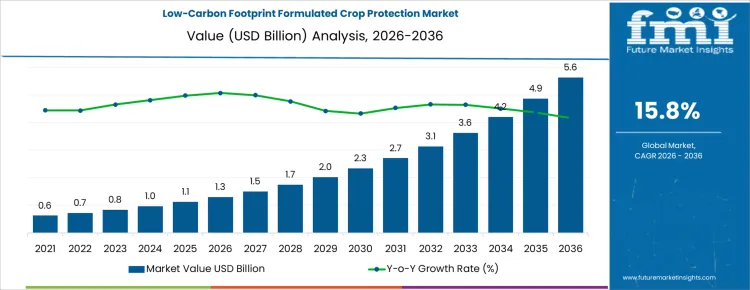
The global low-carbon footprint formulated crop protection market is set to grow from USD 1.3 billion in 2026 to USD 5.6 billion by 2036, at a CAGR of 15.8%. This growth is driven by the increasing demand for eco-friendly and climate-friendly agricultural practices. Among the key segments, low-solvent/water-based formulations lead the market with a 34% share, known for their reduced environmental impact and lower carbon emissions.
These formulations are becoming increasingly popular as farmers shift toward eco-friendlier crop protection solutions. Herbicides hold the largest share in the market, accounting for 36%, due to their widespread use in managing weeds and enhancing crop yields. As eco-consciousness concerns grow, low-carbon footprint herbicides are evolving to meet eco-friendly demands.
Quick Stats for Low-Carbon Footprint Formulated Crop Protection Market
- Low-Carbon Footprint Formulated Crop Protection Market Value (2026): USD 1.3 billion
- Low-Carbon Footprint Formulated Crop Protection Market Forecast Value (2036): USD 5.6 billion
- Low-Carbon Footprint Formulated Crop Protection Market Forecast CAGR: 15.8%
- Leading Formulation Strategy in Low-Carbon Footprint Formulated Crop Protection Market: Low-Solvent / Water-Based Formulations (34%)
- Key Growth Regions in Low-Carbon Footprint Formulated Crop Protection Market: USA, France, Brazil, Germany, Australia
- Key Players in Low-Carbon Footprint Formulated Crop Protection Market: Koppert Cress Protection Solutions, Rovensa Group, Ginkgo Agro Solutions, Hello Nature (Ag Formulations), UPL OpenAg
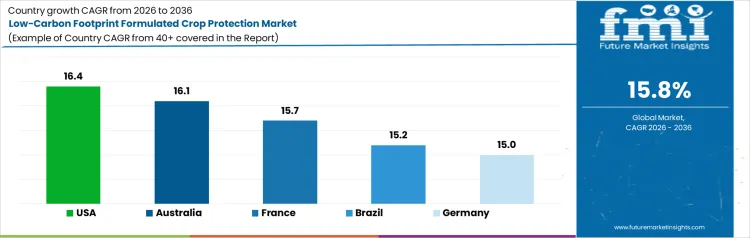
The USA leads with a 16.4% CAGR, driven by the adoption of eco-friendly farming practices and increasing regulatory pressure. Australia follows closely with a 16.1% CAGR, supported by the country's emphasis on reducing carbon emissions in agriculture. France and Brazil are growing at 15.7% and 15.2% CAGR, respectively, due to strong regulatory support for eco-friendly farming practices and Brazil’s large-scale agricultural sector. Germany also shows strong growth at 15.0% CAGR, with a focus on reducing the environmental impact of farming. As global attention on eco-friendly agriculture intensifies, the low-carbon footprint crop protection market is poised for significant growth across these regions.
Low‑Carbon Footprint Formulated Crop Protection Market Key Takeaways
| Metric | Value |
|---|---|
| Industry Value (2026) | USD 1.3 billion |
| Forecast Value (2036) | USD 5.6 billion |
| Forecast CAGR (2026 to 2036) | 15.8% |
How is the Global Low-Carbon Footprint Formulated Crop Protection Sector Advancing?
The global low-carbon footprint formulated crop protection market is growing rapidly as agriculture shifts toward eco-friendly and climate-friendly practices. These crop protection products are engineered to reduce greenhouse gas emissions associated with their manufacture, distribution, and field use. Traditional formulations often involve energy-intensive chemistries or processes that result in higher carbon emissions across their lifecycle. In contrast, low-carbon footprint formulations leverage improved synthesis routes, bio-based ingredients, and optimized supply chains to lower overall carbon impact while delivering effective weed, pest, and disease control.
Demand for low-carbon crop protection solutions is increasing as growers, food brands, and regulators place greater emphasis on reducing the environmental footprint of agricultural production. Eco-consciousness commitments such as carbon neutral goals and reporting requirements are motivating growers to adopt products that align with broader decarbonization strategies in farming operations. These formulations are used across major crop segments including cereals, oilseeds, fruits, and vegetables, helping producers achieve crop protection objectives while supporting emissions reduction targets.
Innovation in formulation technologies such as precision delivery systems, micro-dose chemistries, and bio-based actives will further enhance performance and appeal. Challenges such as demonstrating consistent efficacy across diverse environments, balancing cost competitiveness with eco-consciousness benefits, and educating growers on long-term environmental value may influence adoption rates. Despite these factors, the drive toward low-carbon agricultural inputs will continue to fuel demand for low-carbon footprint formulated crop protection solutions worldwide.
What is the Segment-Wise Analysis for the Global Low-Carbon Footprint Formulated Crop Protection Market?
The global low-carbon footprint formulated crop protection market is segmented by formulation strategy and crop protection type. Low-solvent / water-based formulations lead the market with a 34% share, offering an environmentally friendly alternative to traditional formulations. Other significant formulation strategies include bio-derived & renewable carrier systems, concentrated & dose-reduction formulations, and energy-efficient manufacturing chemistries. In terms of crop protection types, herbicides hold the largest share at 36%, followed by fungicides, insecticides, and seed treatment & soil protectants.
How Do Low-Solvent / Water-Based Formulations Lead the Global Low-Carbon Footprint Formulated Crop Protection Market?
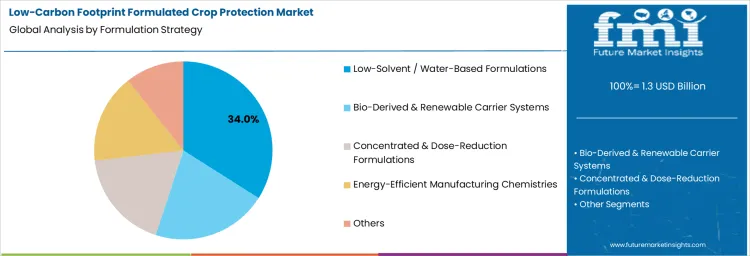
Low-solvent / water-based formulations hold a 34% share in the global low-carbon footprint formulated crop protection market due to their reduced environmental impact and lower carbon emissions during production. These formulations use water or minimal solvents as carriers, decreasing the reliance on volatile organic compounds (VOCs) and reducing air pollution. Water-based products are also safer for workers and the environment, making them increasingly popular as the agricultural industry seeks eco-friendlier and eco-friendly solutions. As regulations and consumer demand for environmentally conscious practices grow, these formulations continue to lead the market.
Why Do Herbicides Hold the Largest Share in the Global Low-Carbon Footprint Formulated Crop Protection Market?
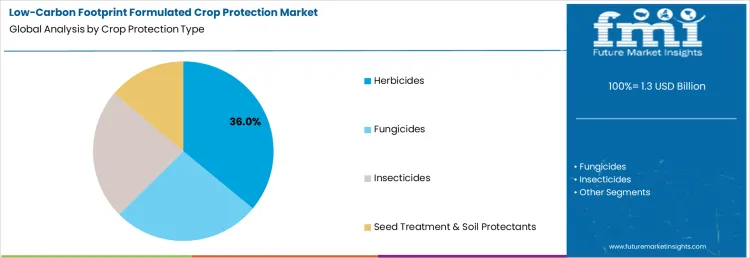
Herbicides hold the largest share of 36% in the global low-carbon footprint formulated crop protection market due to their widespread use in managing unwanted weeds and increasing crop yields. As the demand for eco-friendly and eco-friendly agricultural practices increases, herbicide formulations are evolving to meet these requirements. Low-carbon footprint herbicides are increasingly being developed with environmentally safe carriers and manufacturing processes, aligning with the industry’s push for reduced environmental impact. Their importance in large-scale crop production drives the demand for eco-friendlier herbicide solutions, reinforcing their dominant market share.
How is Eco-Consciousness Reshaping Crop Protection Practices?
The shift towards eco-consciousness in agriculture is driving the demand for low-carbon footprint formulated crop protection solutions. As climate change concerns grow, farmers and agrochemical companies are increasingly focused on reducing the environmental impact of crop protection products. Low-carbon crop protectants are designed to have less environmental impact, utilizing greener manufacturing methods and formulations that minimize carbon emissions throughout their life cycle.
What Are the Key Drivers Behind Low-Carbon Crop Protection Adoption?
The demand for low-carbon crop protection products is being propelled by several key factors, including heightened environmental awareness, stricter regulations on carbon emissions, and the need to meet corporate eco-consciousness targets. With food producers and retailers pushing for reduced carbon footprints throughout the supply chain, growers are adopting low-carbon products that help mitigate greenhouse gas emissions. These formulations also align with regenerative farming practices and carbon credit programs, enabling growers to meet eco-consciousness goals while enhancing crop yields and health.
What Barriers Are Hindering the Transition to Low-Carbon Crop Protection?
Despite the growing trend towards low-carbon products, the transition faces significant barriers. The initial cost of low-carbon formulations tends to be higher due to the eco-friendlier materials and manufacturing processes involved. Some growers are skeptical about the performance of these newer products, especially when compared to traditional chemistries that have proven efficacy under a wide range of field conditions. In regions where cost is a significant factor or awareness of low-carbon benefits is limited, adoption can be slow. Supply chain limitations and a lack of consistent regulatory standards further hinder the transition.
What is the Growth Outlook for the Low-Carbon Footprint Formulated Crop Protection Market by Country?
| Country | CAGR (%) |
|---|---|
| USA | 16.4% |
| France | 15.7% |
| Brazil | 15.2% |
| Germany | 15.0% |
| Australia | 16.1% |
The low-carbon footprint formulated crop protection market is growing rapidly, with the USA leading at a 16.4% CAGR, driven by the increasing demand for eco-friendly crop protection solutions. France follows closely with 15.7%, supported by its strong regulatory push for environmentally responsible agricultural practices. Brazil’s market grows at 15.2%, fueled by its large-scale agricultural sector and the growing adoption of eco-friendly crop protection solutions. Germany’s market grows at 15.0%, as the country focuses on reducing the environmental impact of agricultural inputs while maintaining high productivity. Australia’s market grows at 16.1%, driven by its emphasis on eco-friendly farming and reducing carbon emissions in the agricultural sector.
Why is the USA Leading in the Low-Carbon Footprint Formulated Crop Protection Market?
The USA’s low-carbon footprint formulated crop protection market is growing at 16.4%, driven by the increasing adoption of eco-friendly farming practices and the growing focus on reducing carbon emissions in agriculture. As American farmers strive to improve productivity while minimizing their environmental impact, the demand for low-carbon footprint crop protection solutions is on the rise. These formulated solutions help control pests and diseases effectively while minimizing carbon emissions, aligning with both government eco-consciousness goals and consumer preferences for eco-friendly agricultural products. The USA’s large agricultural base and the increasing regulatory pressure to adopt environmentally responsible farming practices are contributing to the growth of this market. With a focus on reducing the environmental footprint of farming, the demand for low-carbon footprint crop protection products is expected to continue rising, ensuring market expansion.
What is Driving the Growth of the Low-Carbon Footprint Formulated Crop Protection Market in France?
France’s low-carbon footprint formulated crop protection market is growing at 15.7%, supported by the country’s strong commitment to eco-friendly agriculture and food safety. France is one of the leaders in Europe in promoting eco-friendly farming solutions, and there is increasing demand for crop protection products that minimize environmental impact, particularly carbon emissions. With a growing focus on reducing pesticide usage and improving soil health, farmers in France are adopting low-carbon footprint crop protection solutions to enhance eco-consciousness. The French government’s regulations supporting organic farming and environmentally responsible practices further contribute to the demand for these products. As France continues to prioritize eco-consciousness in its agricultural sector, the market for low-carbon footprint formulated crop protection solutions is expected to continue expanding.
How is the Low-Carbon Footprint Formulated Crop Protection Market Expanding in Brazil?
Brazil’s low-carbon footprint formulated crop protection market is growing at 15.2%, driven by the country’s large-scale agricultural operations, particularly in crops like soybeans, sugarcane, and coffee. As Brazil continues to be one of the world’s largest agricultural producers, the need for eco-friendly crop protection solutions is increasing. Low-carbon footprint formulations are becoming more popular as Brazilian farmers seek ways to control pests and diseases while minimizing their environmental impact. With a growing emphasis on reducing deforestation and improving farming eco-consciousness, Brazil’s agricultural sector is increasingly adopting eco-friendly solutions that align with global eco-consciousness trends. As demand for eco-conscious products continues to rise, Brazil is expected to see continued growth in the low-carbon footprint crop protection market.
What is Contributing to the Growth of the Low-Carbon Footprint Formulated Crop Protection Market in Germany?
Germany’s low-carbon footprint formulated crop protection market is growing at 15.0%, supported by the country’s focus on reducing the environmental impact of farming. As part of the European Union’s broader eco-consciousness goals, Germany is leading the charge in adopting eco-friendly agricultural solutions. With the rising pressure to reduce carbon emissions in agriculture, farmers are turning to low-carbon footprint crop protection products that provide effective pest and disease management while minimizing environmental harm. Germany’s strong regulatory environment, combined with consumer demand for sustainably produced food, is pushing the agricultural sector toward eco-friendlier practices. As Germany continues to adopt new technologies and eco-friendly farming practices, the market for low-carbon footprint formulated crop protection products is expected to grow.
What is Driving the Growth of the Low-Carbon Footprint Formulated Crop Protection Market in Australia?
Australia’s low-carbon footprint formulated crop protection market is growing at 16.1%, driven by the country’s commitment to eco-friendly farming practices and the need to reduce the carbon footprint of agriculture. As Australian farmers face increasing challenges related to climate change, such as droughts and extreme weather events, the demand for crop protection solutions that minimize carbon emissions while maintaining crop yields is rising. Low-carbon footprint formulations help Australian farmers effectively manage pests and diseases in a way that aligns with eco-friendly farming goals. With a growing emphasis on reducing environmental impact and improving farming efficiency, the market for low-carbon footprint crop protection solutions in Australia is expected to continue expanding. As agriculture in Australia becomes more focused on eco-consciousness, the demand for these eco-friendly crop protection products will likely grow steadily.
What Are the Key Players in the Low-Carbon Footprint Formulated Crop Protection Market?
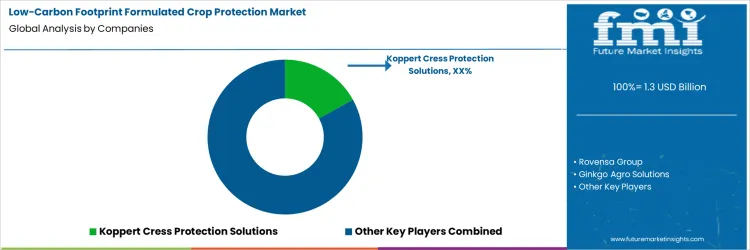
The low-carbon footprint formulated crop protection market is seeing strong competition from companies like Koppert Cress Protection Solutions, Rovensa Group, Ginkgo Agro Solutions, Hello Nature (Ag Formulations), and UPL OpenAg, all of which focus on offering eco-friendly and eco-friendly crop protection solutions. Koppert Cress Protection Solutions is highlighted for its biologically derived crop protection agents that minimize environmental impact while maintaining crop performance. Their brochures emphasize reduced carbon emissions and compatibility with integrated pest management strategies, with clear instructions and field performance data to help growers make informed decisions. Similarly, Rovensa Group focuses on eco-friendly formulations that target emission reduction through effective crop protection without compromising results. Detailed usage guidelines and performance case studies are provided to demonstrate their offerings’ benefits.
Ginkgo Agro Solutions and Hello Nature (Ag Formulations) stand out with their plant-based and bio-innovative solutions that align with the growing demand for low-carbon agriculture. Ginkgo Agro Solutions offers carbon-conscious crop protection products that prioritize environmental safety, supported by trial outcomes and usage instructions. Hello Nature emphasizes plant health products formulated with minimal carbon impact, offering growers an alternative to conventional pesticides while maintaining crop vitality. UPL OpenAg offers low-carbon lines designed to provide both environmental and agronomic advantages, highlighting product eco-consciousness through their marketing materials. They also stress ease of integration with existing farming operations.
Key Players in Low-Carbon Footprint Formulated Crop Protection Market
- Koppert Cress Protection Solutions
- Rovensa Group
- Ginkgo Agro Solutions
- Hello Nature (Ag Formulations)
- UPL OpenAg (Low-Carbon Lines)
- Others
Scope of Report
| Items | Values |
|---|---|
| Quantitative Units (2026) | USD billion |
| Formulation Strategy | Low-Solvent / Water-Based Formulations, Bio-Derived & Renewable Carrier Systems, Concentrated & Dose-Reduction Formulations, Energy-Efficient Manufacturing Chemistries |
| Crop Protection Type | Herbicides, Fungicides, Insecticides, Seed Treatment & Soil Protectants |
| Regions Covered | Asia Pacific, Europe, North America, Latin America, Middle East & Africa |
| Countries Covered | USA, China, Japan, South Korea, India, Australia & New Zealand, ASEAN, Germany, UK, France, Italy, Spain, Nordic, BENELUX, Brazil, Chile, Mexico, Saudi Arabia, Other GCC Countries, Turkey, South Africa, Other African Union |
| Key Companies Profiled | Koppert Cress Protection Solutions, Rovensa Group, Ginkgo Agro Solutions, Hello Nature (Ag Formulations), UPL OpenAg (Low-Carbon Lines) |
| Additional Attributes | Dollar sales by formulation strategy, crop protection type, and region; regional CAGR and growth outlook; distribution channels including precision agriculture platforms, agrochemical formulators, and ag-tech providers; innovation trends in low-carbon footprint formulated crop protection products; competitive positioning of global vs regional suppliers. |
Low-Carbon Footprint Formulated Crop Protection Market by Segments
Formulation Strategy
- Low-Solvent / Water-Based Formulations
- Bio-Derived & Renewable Carrier Systems
- Concentrated & Dose-Reduction Formulations
- Energy-Efficient Manufacturing Chemistries
- Others
Crop Protection Type
- Herbicides
- Fungicides
- Insecticides
- Seed Treatment & Soil Protectants
Region:
- Asia Pacific
- China
- Japan
- South Korea
- India
- Australia & New Zealand
- ASEAN
- Rest of Asia Pacific
- Europe
- Germany
- United Kingdom
- France
- Italy
- Spain
- Nordic
- BENELUX
- Rest of Europe
- North America
- United States
- Canada
- Mexico
- Latin America
- Brazil
- Chile
- Rest of Latin America
- Middle East & Africa
- Kingdom of Saudi Arabia
- Other GCC Countries
- Turkey
- South Africa
- Other African Union
- Rest of Middle East & Africa
Frequently Asked Questions
How big is the low-carbon footprint formulated crop protection market in 2026?
The global low-carbon footprint formulated crop protection market is estimated to be valued at USD 1.3 billion in 2026.
What will be the size of low-carbon footprint formulated crop protection market in 2036?
The market size for the low-carbon footprint formulated crop protection market is projected to reach USD 5.6 billion by 2036.
How much will be the low-carbon footprint formulated crop protection market growth between 2026 and 2036?
The low-carbon footprint formulated crop protection market is expected to grow at a 15.8% CAGR between 2026 and 2036.
What are the key product types in the low-carbon footprint formulated crop protection market?
The key product types in low-carbon footprint formulated crop protection market are low-solvent / water-based formulations, bio-derived & renewable carrier systems, concentrated & dose-reduction formulations, energy-efficient manufacturing chemistries and others.
Which crop protection type segment to contribute significant share in the low-carbon footprint formulated crop protection market in 2026?
In terms of crop protection type, herbicides segment to command 36.0% share in the low-carbon footprint formulated crop protection market in 2026.
Preview the report firsthand - request a free sample
Get SampleGet the brochure for pricing and purchase details.
Get PDFTable of Content
- Executive Summary
- Global Market Outlook
- Demand-side Trends
- Supply-side Trends
- Technology Roadmap Analysis
- Analysis and Recommendations
- Market Overview
- Market Coverage / Taxonomy
- Market Definition / Scope / Limitations
- Market Background
- Market Dynamics
- Drivers
- Restraints
- Opportunity
- Trends
- Scenario Forecast
- Demand in Optimistic Scenario
- Demand in Likely Scenario
- Demand in Conservative Scenario
- Opportunity Map Analysis
- Product Life Cycle Analysis
- Supply Chain Analysis
- Investment Feasibility Matrix
- Value Chain Analysis
- PESTLE and Porter’s Analysis
- Regulatory Landscape
- Regional Parent Market Outlook
- Production and Consumption Statistics
- Import and Export Statistics
- Market Dynamics
- Global Market Analysis 2021 to 2025 and Forecast, 2026 to 2036
- Historical Market Size Value (USD Million) Analysis, 2021 to 2025
- Current and Future Market Size Value (USD Million) Projections, 2026 to 2036
- Y-o-Y Growth Trend Analysis
- Absolute $ Opportunity Analysis
- Global Market Pricing Analysis 2021 to 2025 and Forecast 2026 to 2036
- Global Market Analysis 2021 to 2025 and Forecast 2026 to 2036, By Formulation Strategy
- Introduction / Key Findings
- Historical Market Size Value (USD Million) Analysis By Formulation Strategy , 2021 to 2025
- Current and Future Market Size Value (USD Million) Analysis and Forecast By Formulation Strategy , 2026 to 2036
- Low-Solvent / Water-Based Formulations
- Bio-Derived & Renewable Carrier Systems
- Concentrated & Dose-Reduction Formulations
- Energy-Efficient Manufacturing Chemistries
- Others
- Y-o-Y Growth Trend Analysis By Formulation Strategy , 2021 to 2025
- Absolute $ Opportunity Analysis By Formulation Strategy , 2026 to 2036
- Global Market Analysis 2021 to 2025 and Forecast 2026 to 2036, By Crop Protection Type
- Introduction / Key Findings
- Historical Market Size Value (USD Million) Analysis By Crop Protection Type, 2021 to 2025
- Current and Future Market Size Value (USD Million) Analysis and Forecast By Crop Protection Type, 2026 to 2036
- Herbicides
- Fungicides
- Insecticides
- Seed Treatment & Soil Protectants
- Y-o-Y Growth Trend Analysis By Crop Protection Type, 2021 to 2025
- Absolute $ Opportunity Analysis By Crop Protection Type, 2026 to 2036
- Global Market Analysis 2021 to 2025 and Forecast 2026 to 2036, By Region
- Introduction
- Historical Market Size Value (USD Million) Analysis By Region, 2021 to 2025
- Current Market Size Value (USD Million) Analysis and Forecast By Region, 2026 to 2036
- North America
- Latin America
- Western Europe
- Eastern Europe
- East Asia
- South Asia and Pacific
- Middle East & Africa
- Market Attractiveness Analysis By Region
- North America Market Analysis 2021 to 2025 and Forecast 2026 to 2036, By Country
- Historical Market Size Value (USD Million) Trend Analysis By Market Taxonomy, 2021 to 2025
- Market Size Value (USD Million) Forecast By Market Taxonomy, 2026 to 2036
- By Country
- USA
- Canada
- Mexico
- By Formulation Strategy
- By Crop Protection Type
- By Country
- Market Attractiveness Analysis
- By Country
- By Formulation Strategy
- By Crop Protection Type
- Key Takeaways
- Latin America Market Analysis 2021 to 2025 and Forecast 2026 to 2036, By Country
- Historical Market Size Value (USD Million) Trend Analysis By Market Taxonomy, 2021 to 2025
- Market Size Value (USD Million) Forecast By Market Taxonomy, 2026 to 2036
- By Country
- Brazil
- Chile
- Rest of Latin America
- By Formulation Strategy
- By Crop Protection Type
- By Country
- Market Attractiveness Analysis
- By Country
- By Formulation Strategy
- By Crop Protection Type
- Key Takeaways
- Western Europe Market Analysis 2021 to 2025 and Forecast 2026 to 2036, By Country
- Historical Market Size Value (USD Million) Trend Analysis By Market Taxonomy, 2021 to 2025
- Market Size Value (USD Million) Forecast By Market Taxonomy, 2026 to 2036
- By Country
- Germany
- UK
- Italy
- Spain
- France
- Nordic
- BENELUX
- Rest of Western Europe
- By Formulation Strategy
- By Crop Protection Type
- By Country
- Market Attractiveness Analysis
- By Country
- By Formulation Strategy
- By Crop Protection Type
- Key Takeaways
- Eastern Europe Market Analysis 2021 to 2025 and Forecast 2026 to 2036, By Country
- Historical Market Size Value (USD Million) Trend Analysis By Market Taxonomy, 2021 to 2025
- Market Size Value (USD Million) Forecast By Market Taxonomy, 2026 to 2036
- By Country
- Russia
- Poland
- Hungary
- Balkan & Baltic
- Rest of Eastern Europe
- By Formulation Strategy
- By Crop Protection Type
- By Country
- Market Attractiveness Analysis
- By Country
- By Formulation Strategy
- By Crop Protection Type
- Key Takeaways
- East Asia Market Analysis 2021 to 2025 and Forecast 2026 to 2036, By Country
- Historical Market Size Value (USD Million) Trend Analysis By Market Taxonomy, 2021 to 2025
- Market Size Value (USD Million) Forecast By Market Taxonomy, 2026 to 2036
- By Country
- China
- Japan
- South Korea
- By Formulation Strategy
- By Crop Protection Type
- By Country
- Market Attractiveness Analysis
- By Country
- By Formulation Strategy
- By Crop Protection Type
- Key Takeaways
- South Asia and Pacific Market Analysis 2021 to 2025 and Forecast 2026 to 2036, By Country
- Historical Market Size Value (USD Million) Trend Analysis By Market Taxonomy, 2021 to 2025
- Market Size Value (USD Million) Forecast By Market Taxonomy, 2026 to 2036
- By Country
- India
- ASEAN
- Australia & New Zealand
- Rest of South Asia and Pacific
- By Formulation Strategy
- By Crop Protection Type
- By Country
- Market Attractiveness Analysis
- By Country
- By Formulation Strategy
- By Crop Protection Type
- Key Takeaways
- Middle East & Africa Market Analysis 2021 to 2025 and Forecast 2026 to 2036, By Country
- Historical Market Size Value (USD Million) Trend Analysis By Market Taxonomy, 2021 to 2025
- Market Size Value (USD Million) Forecast By Market Taxonomy, 2026 to 2036
- By Country
- Kingdom of Saudi Arabia
- Other GCC Countries
- Turkiye
- South Africa
- Other African Union
- Rest of Middle East & Africa
- By Formulation Strategy
- By Crop Protection Type
- By Country
- Market Attractiveness Analysis
- By Country
- By Formulation Strategy
- By Crop Protection Type
- Key Takeaways
- Key Countries Market Analysis
- USA
- Pricing Analysis
- Market Share Analysis, 2025
- By Formulation Strategy
- By Crop Protection Type
- Canada
- Pricing Analysis
- Market Share Analysis, 2025
- By Formulation Strategy
- By Crop Protection Type
- Mexico
- Pricing Analysis
- Market Share Analysis, 2025
- By Formulation Strategy
- By Crop Protection Type
- Brazil
- Pricing Analysis
- Market Share Analysis, 2025
- By Formulation Strategy
- By Crop Protection Type
- Chile
- Pricing Analysis
- Market Share Analysis, 2025
- By Formulation Strategy
- By Crop Protection Type
- Germany
- Pricing Analysis
- Market Share Analysis, 2025
- By Formulation Strategy
- By Crop Protection Type
- UK
- Pricing Analysis
- Market Share Analysis, 2025
- By Formulation Strategy
- By Crop Protection Type
- Italy
- Pricing Analysis
- Market Share Analysis, 2025
- By Formulation Strategy
- By Crop Protection Type
- Spain
- Pricing Analysis
- Market Share Analysis, 2025
- By Formulation Strategy
- By Crop Protection Type
- France
- Pricing Analysis
- Market Share Analysis, 2025
- By Formulation Strategy
- By Crop Protection Type
- India
- Pricing Analysis
- Market Share Analysis, 2025
- By Formulation Strategy
- By Crop Protection Type
- ASEAN
- Pricing Analysis
- Market Share Analysis, 2025
- By Formulation Strategy
- By Crop Protection Type
- Australia & New Zealand
- Pricing Analysis
- Market Share Analysis, 2025
- By Formulation Strategy
- By Crop Protection Type
- China
- Pricing Analysis
- Market Share Analysis, 2025
- By Formulation Strategy
- By Crop Protection Type
- Japan
- Pricing Analysis
- Market Share Analysis, 2025
- By Formulation Strategy
- By Crop Protection Type
- South Korea
- Pricing Analysis
- Market Share Analysis, 2025
- By Formulation Strategy
- By Crop Protection Type
- Russia
- Pricing Analysis
- Market Share Analysis, 2025
- By Formulation Strategy
- By Crop Protection Type
- Poland
- Pricing Analysis
- Market Share Analysis, 2025
- By Formulation Strategy
- By Crop Protection Type
- Hungary
- Pricing Analysis
- Market Share Analysis, 2025
- By Formulation Strategy
- By Crop Protection Type
- Kingdom of Saudi Arabia
- Pricing Analysis
- Market Share Analysis, 2025
- By Formulation Strategy
- By Crop Protection Type
- Turkiye
- Pricing Analysis
- Market Share Analysis, 2025
- By Formulation Strategy
- By Crop Protection Type
- South Africa
- Pricing Analysis
- Market Share Analysis, 2025
- By Formulation Strategy
- By Crop Protection Type
- USA
- Market Structure Analysis
- Competition Dashboard
- Competition Benchmarking
- Market Share Analysis of Top Players
- By Regional
- By Formulation Strategy
- By Crop Protection Type
- Competition Analysis
- Competition Deep Dive
- Koppert Cress Protection Solutions
- Overview
- Product Portfolio
- Profitability by Market Segments (Product/Age /Sales Channel/Region)
- Sales Footprint
- Strategy Overview
- Marketing Strategy
- Product Strategy
- Channel Strategy
- Rovensa Group
- Ginkgo Agro Solutions
- Hello Nature (Ag Formulations)
- UPL OpenAg (Low-Carbon Lines)
- Others
- Koppert Cress Protection Solutions
- Competition Deep Dive
- Assumptions & Acronyms Used
- Research Methodology


