

- Industry Size (2025)
- USD 0.7 Bn
- Forecast (2035)
- USD 1.2 Bn
- CAGR (2025 to 2035)
- 5.7%
Demand for Solar Attic Fans in USA 2025 to 2035
The demand for solar attic fans in the USA is valued at USD 0.7 billion in 2025 and is expected to reach USD 1.2 billion by 2035. The forecast CAGR between 2025 and 2035 is 5.7%. Demand is driven by the need to improve attic ventilation efficiency, reduce indoor cooling loads, and lower electricity consumption in residential buildings. Homeowners prefer solar-powered attic ventilation due to zero operational energy use, straightforward installation, and the absence of wiring to household electrical circuits. Rising adoption of sustainable construction materials and localized incentive programs for rooftop renewable solutions also support deployment.
Roof-mounted solar attic fans represent the leading product category, supported by their installation versatility and stronger airflow performance. These units integrate solar panels, low-voltage motors, and durable housings that operate automatically under sunlight. Product improvements include brushless motors, weather-resistant components, and smart controllers that adjust fan output based on attic temperature thresholds.
Demand is highest across West USA, South USA, and Northeast USA. The West records strong penetration due to elevated solar irradiance and energy-efficiency standards. The South experiences long cooling seasons that increase consumer focus on attic heat reduction. The Northeast prioritizes envelope performance upgrades in existing homes and multifamily residences. Key suppliers include Natural Light Energy Systems, QuietCool, iLIVING USA, Broan-NuTone, and Air Vent Inc. Their strategies focus on product durability, airflow optimization, and compatibility with broader residential energy-efficiency improvement programs.
Quick Stats for USA Solar Attic Fans Demand
- USA Solar Attic Fans Sales Value (2025): USD 0.7 billion
- USA Solar Attic Fans Forecast Value (2035): USD 1.2 billion
- USA Solar Attic Fans Forecast CAGR (2025–2035): 5.7%
- Leading Product Type in USA Solar Attic Fans Demand: Roof-Mounted Solar Attic Fans
- Key Growth Regions in USA Solar Attic Fans Demand: West USA, South USA, Northeast USA
- Top Players in USA Solar Attic Fans Demand: Natural Light Energy Systems, QuietCool, iLIVING USA, Broan-NuTone, Air Vent Inc.
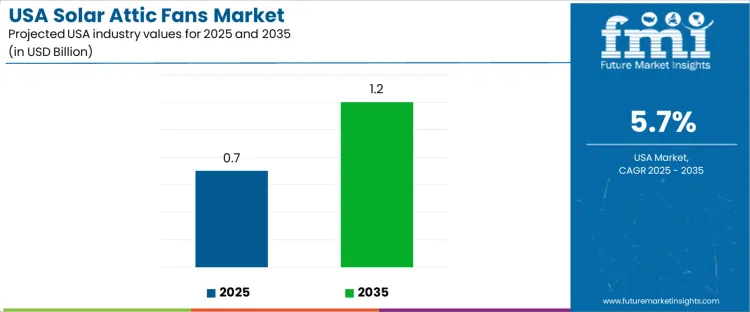
What is the Growth Forecast for Solar Attic Fans Industry in USA through 2035?
Demand for solar attic fans in the United States displays a clear peak-to-trough structure linked to seasonal installation behavior and housing-renovation cycles. Peak demand emerges during warmer months when homeowners focus on attic ventilation to reduce indoor heat load and lower air conditioning use. Retail promotions at home-improvement outlets strengthen these seasonal increases. Rebate availability in selected states also encourages peak-period installations by lowering upfront cost.
Trough periods appear during colder seasons when ventilation upgrades are less of a priority and discretionary spending shifts toward heating systems or indoor fixtures. This seasonal trough remains predictable and does not indicate demand decline in structural terms. Weather variability, such as mild summers or delayed heat waves, can deepen trough duration by reducing urgency to install cooling-support solutions.
Long-term trough limitations are minimized by the product’s role in residential energy-efficiency upgrades across both new construction and retrofit projects. Growth in solar-friendly roofing and rising consumer interest in lowering utility expenses provide a stable floor for annual demand. The result is a recurring cycle with strong peaks in high-temperature months and controlled troughs supported by consistent renovation activity and broader adoption of renewable attic-ventilation solutions in the United States.
USA Solar Attic Fans Key Takeaways
| Metric | Value |
|---|---|
| USA Solar Attic Fans Sales Value (2025) | USD 0.7 billion |
| USA Solar Attic Fans Forecast Value (2035) | USD 1.2 billion |
| USA Solar Attic Fans Forecast CAGR (2025-2035) | 5.7% |
Why is the Demand for Solar Attic Fans in the USA Growing?
Demand for solar attic fans in the USA is increasing because homeowners and building managers seek energy-efficient solutions to reduce heat build-up in attics during hot summer months. Attic heat often raises indoor cooling costs, and solar attic fans help exhaust hot air without tapping into grid power, which lowers electricity bills for many households. Growing interest in energy conservation and green building practices supports installation of solar attic fans in new homes and retrofits. Builders include them in energy-efficient construction plans, and homeowners upgrade older properties to improve ventilation and reduce stress on air-conditioning systems. Government and local incentive and rebate programs for solar and energy-saving installations also encourage purchases.
Installation is relatively simple and does not require rewiring or connection to house electricity, which appeals to DIY homeowners and reduces labour costs. Solar attic fans also contribute to extended roof and insulation lifespan by reducing temperature extremes in attic spaces. Constraints include limited performance on cloudy or shaded roofs, and lower effectiveness in regions with mild climates or moderate summer heat. Initial upfront cost may discourage some homeowners, especially if energy savings are modest. Some buildings have ventilation designs that reduce the benefit of attic fans.
Which Product Types, Materials, and Capacity Ranges Lead Demand for Solar Attic Fans in the USA?
Demand for solar attic fans in the United States is supported by rising focus on home insulation performance and reduction of air-conditioning loads during hot seasons. Adoption is driven by increasing awareness of attic ventilation for moisture prevention, improved indoor comfort, and energy savings in residential buildings. Growth aligns with federal and state incentives for solar-powered products and the expansion of sustainable home renovation projects. Consumers prioritize units offering high airflow delivery, durable weather-resistant construction, and simplified installation without electrical wiring. Uptake is strong in Sun Belt states, where prolonged heat exposure accelerates cooling needs and attic heat buildup.
By Product Type, Roof-Mounted Fans Hold the Largest Share
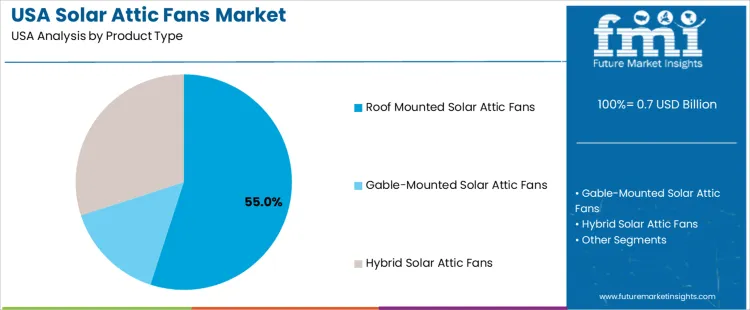
Roof-mounted solar attic fans represent 55.0%, supported by high ventilation effectiveness directly from the roof’s hottest point, enabling significant cooling efficiency improvements in single-family homes. These models support active heat exhaust, helping reduce HVAC energy loads and moisture-related roof degradation. Hybrid solar attic fans hold 30.0%, preferred in regions with fluctuating sunlight and requiring supplemental electrical power to maintain continuous airflow. Gable-mounted fans account for 15.0%, favored for retrofits where existing vents allow quick installation at lower upfront costs. Product type selection aligns with home layout, attic geometry, roof pitch, and operational continuity needs across diverse USA climates.
Key Points:
- Roof-mounted units deliver maximum heat extraction efficiency
- Hybrid models ensure airflow consistency during low sun hours
- Gable units support economical upgrades using existing vent openings
By Material, Aluminum Dominates Demand
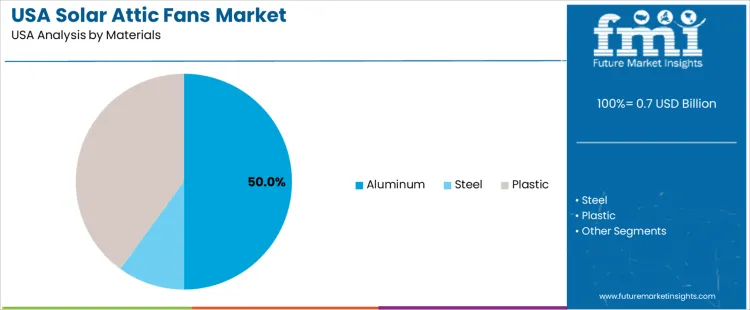
Aluminum units hold 50.0%, driven by lightweight strength, corrosion resistance, and extended durability under high UV and temperature exposure. These features increase suitability for USA coastal zones and areas experiencing severe weather fluctuations. Plastic units represent 40.0%, widely adopted for cost efficiency and lower noise levels, making them popular for DIY homeowner installations. Steel accounts for 10.0%, primarily in heavy-duty, commercial, or industrial attic setups requiring greater structural strength. Material preferences reflect a balance between durability expectations, installation challenges, long-term maintenance, and product affordability for the USA residential sector.
Key Points:
- Aluminum supports weather-resistant, long-life ventilation performance
- Plastic enables budget-friendly and low-noise residential adoption
- Steel is used for limited heavy-duty structural applications
By Capacity, Large Fans Lead Industry Preference
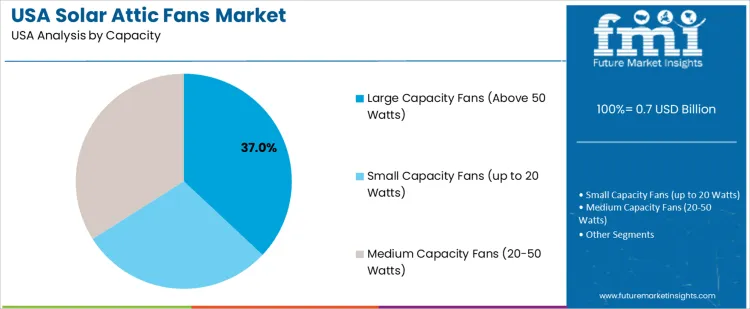
Large-capacity units above 50 watts account for 37.0%, driven by strong demand in warm USA regions where energy savings depend on rapid attic heat removal in large dwellings. Medium-capacity units (20–50 watts) represent 34.0%, supporting average-size suburban homes and moderate climate installations balancing energy output and system cost. Small-capacity fans up to 20 watts hold 29.0%, commonly used in compact attics, sheds, garages, and secondary structures requiring minimal airflow support. Capacity selection is influenced by home size, attic ventilation requirements, regional heat intensity, and consumer goals for energy efficiency improvements.
Key Points:
- High-watt systems serve larger homes in high-temperature states
- Mid-watt fans balance performance with household budget constraints
- Low-watt options focus on smaller spaces and minimal airflow needs
What are the Drivers, Restraints, and Key Trends of the Demand for Solar Attic Fans in the USA?
Growth of residential energy-efficiency improvements, increased focus on attic ventilation and rising homeowner interest in passive cooling drive demand.
In the United States, solar attic fans support ventilation in homes located in hot and humid climates where attic heat buildup increases air-conditioning load and accelerates roof wear. Homeowners in states like Florida, Texas, Arizona and California often install solar attic fans to reduce heat transfer into living spaces and lower utility bills during peak summer months. Energy-conscious property owners pursue upgrades that improve indoor comfort without raising electricity consumption, making solar-powered ventilation appealing because it requires no grid power to operate. Roofing contractors and home-improvement retailers promote attic ventilation as part of broader roofing upgrades, reinforcing consistent demand from both retrofits and new construction.
Upfront cost concerns, inconsistent performance in low-sunlight conditions and mixed consumer awareness restrain demand.
Initial purchase and installation costs exceed those of passive vents, which may discourage homeowners with limited renovation budgets. Solar performance fluctuates with shading and regional sunlight availability, reducing effectiveness in northern or cloudy climates. Some homeowners prioritize visible upgrades such as windows or HVAC replacements, resulting in lower awareness of attic ventilation benefits. These barriers limit widespread adoption outside high-temperature regions.
Shift toward integrated smart controls, increased adoption in retrofit roofing projects and rising emphasis on moisture and mold prevention define key trends.
Manufacturers are offering solar attic fans with thermostats, humidity sensors and variable-speed settings that optimize ventilation based on attic conditions. Roofing replacements triggered by storm damage or aging shingles often include ventilation upgrades, providing a practical installation opportunity. Moisture-prone climates such as coastal regions adopt solar attic fans to manage humidity levels that contribute to attic mold growth and insulation degradation. Retailers expand e-commerce and DIY installation support to reach homeowners seeking straightforward energy-saving improvements. These developments indicate steady, climate-driven demand for solar attic fans across USA residential industries focused on improved comfort and energy savings.
Analysis of the Demand for Solar Attic Fans in the USA by Region
Demand for solar attic fans in the United States is growing as households and commercial buildings seek energy-efficient attic ventilation solutions that reduce heat load and lower air-conditioning consumption. Adoption is influenced by utility cost savings, incentives supporting rooftop solar components, and increased awareness of attic moisture management and roof-life extension. Consumers prefer low-maintenance, self-powered systems without wiring complexity. West USA leads growth at 6.6% CAGR, followed by South USA at 5.9%, driven by heat-intensive climates. Northeast USA reaches 5.2%, while Midwest USA grows at 4.6%, reflecting gradual energy-efficiency upgrades in mixed-climate zones.
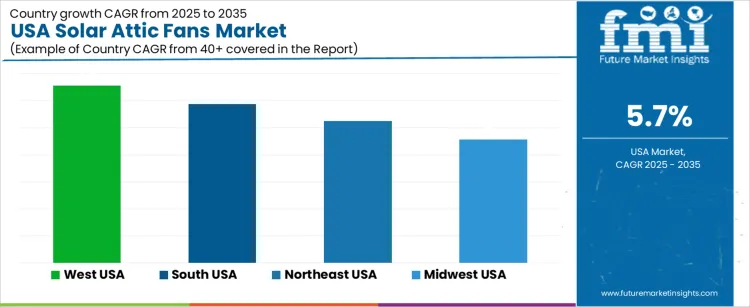
| Region | CAGR (2025-2035) |
|---|---|
| West USA | 6.6% |
| South USA | 5.9% |
| Northeast USA | 5.2% |
| Midwest USA | 4.6% |
How is the West USA driving demand for solar attic fans?
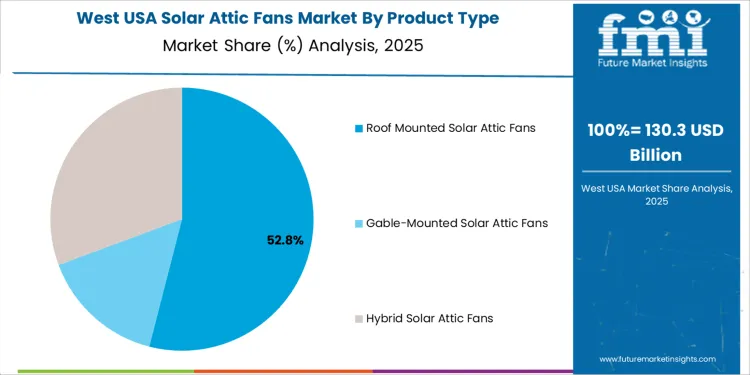
West USA shows 6.6% CAGR, supported by strong solar adoption rates and high attic-heat buildup from prolonged summer conditions across California, Arizona, and Nevada. Homeowners integrate solar attic fans with existing rooftop PV installations to further optimize indoor cooling performance. Contractors promote attic ventilation upgrades as part of broader insulation retrofit programs aimed at reducing HVAC stress and improving living comfort. Local building codes and green-construction standards in drought-prone regions encourage passive cooling systems. Product selection emphasizes brushless motor durability, quiet airflow performance, and fire-resistant housing materials to withstand wildfire-risk zones.
- High solar exposure maximizing operational efficiency
- Attic-cooling needs reducing HVAC energy consumption
- Integration with energy-efficiency retrofit initiatives
- Safety-rated components suitable for wildfire environments
How is the South USA shaping adoption of solar attic fans?
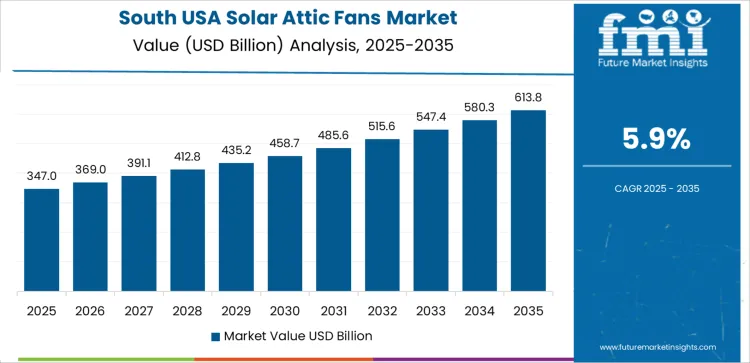
South USA experiences 5.9% CAGR, driven by hot-humid climate zones in Texas, Florida, and Georgia where attic heat and moisture accumulation intensify cooling loads. Residential builders include solar attic fans in upgrade packages to help minimize peak-electricity USAge during long summer seasons. Consumer awareness of mold and roof-deck deterioration encourages prevention-based ventilation choices. Installers bundle attic fans with radiant-barrier improvements and insulation services, enhancing combined savings outcomes. Procurement focuses on corrosion-resistant hardware and strong waterproof sealing to cope with coastal storm exposure and high humidity.
- Hot-humid climate reinforcing heat-mitigation upgrades
- New-construction adoption improving affordability
- Bundled attic-efficiency improvements increasing performance gain
- Coastal durability features guiding product selection
How is the Northeast USA contributing to evolving demand?
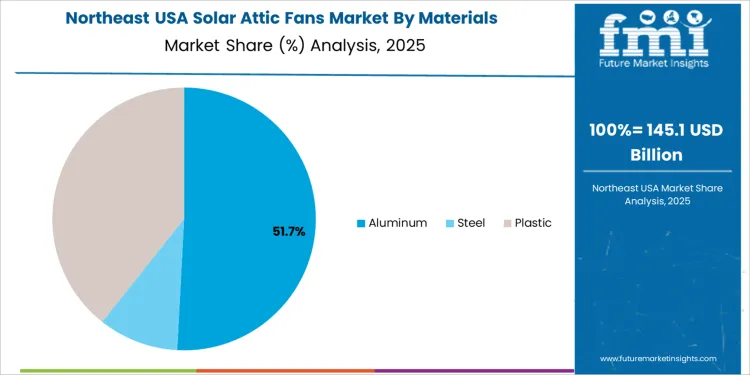
Northeast USA grows at 5.2% CAGR, driven by energy-efficiency incentives and weatherization programs in states including New York, Massachusetts, and New Jersey. Attic ventilation supports better temperature management in mixed-season climates, lowering heating-season condensation risks. Homeowners increasingly adopt solar attic fans as a low-infrastructure option when full rooftop PV is not feasible due to shading or roof-orientation limits. Installers educate customers on replacing failing powered fans with solar-driven units to reduce electricity costs. Buyers seek automated thermostatic and humidistat controls to maintain year-round ventilation accuracy.
- Weatherization programs supporting attic improvements
- Solar ventilation used when PV installation is constrained
- Retrofit replacements eliminating electric fan consumption
- Smart controls improving seasonal ventilation performance
How is the Midwest USA supporting steady adoption?
Midwest USA posts 4.6% CAGR, reflecting incremental upgrades in residential suburbs and older housing stock across Illinois, Ohio, and Michigan. Attic ventilation improvements target reduced cooling loads during increasingly warm summers while mitigating winter ice-dam formation tied to trapped heat. Local utilities include attic-efficiency rebates within energy-savings programs. Installation contractors focus on cost-effective models suitable for steep-slope roof designs common in the region. Product reliability in variable weather, including freeze-thaw cycles and wind uplift, influences specification criteria. Awareness efforts by home-inspection stakeholders encourage preventative attic-ventilation adoption during roof replacements.
- Aging housing stock driving retrofit ventilation needs
- Utility rebates improving purchase justification
- Weather-resilient features supporting lifecycle performance
- Roof-replacement timing creating natural adoption windows
How is competitive advantage structured among providers of solar attic fans in the United States?
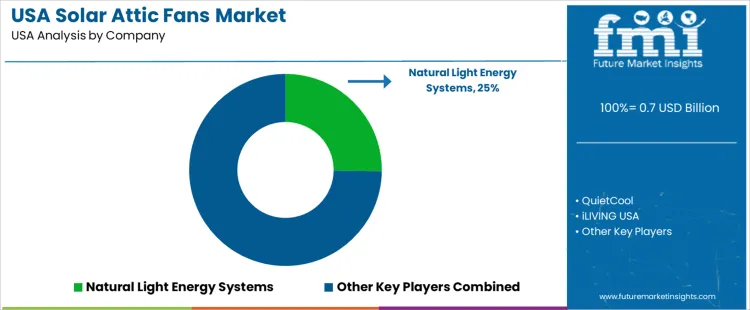
Competitive positioning in the United States solar attic fan segment is defined by installed-base reliability, airflow efficiency under variable sunlight, and strong retailer and contractor channels. Natural Light Energy Systems holds an estimated 25.2%, supported by durable all-metal housings, certified performance ratings, and wide availability through residential roofing and retrofit distributors. Its presence aligns with HVAC energy-reduction goals across sun-belt regions. QuietCool retains strong share through high-capacity ventilation systems designed for quieter operation and flexible mounting. The company benefits from distribution into home-improvement retail and contractor networks that target attic heat-load reduction during summer peaks. iLIVING USA competes through cost-focused models and direct-to-consumer reach, providing entry-level options where budget considerations guide product selection.
Broan-NuTone leverages longstanding rooftop-ventilation expertise integrated with residential building codes and electrician-aligned installer relationships. Participation grows where homeowners prefer recognized electrical brands. Air Vent Inc. reinforces competitive presence through portfolio breadth that combines powered solar units with passive ventilation components, allowing category cross-selling during roofing replacements. Advantage depends on dependable long-term output from integrated photovoltaic modules, ease of installation on diverse roofing structures, and consistent service response. Firms combining verified airflow performance with strong USA channel support maintain the most durable positioning in solar attic ventilation.
Key Players in USA Solar Attic Fans Demand
- Natural Light Energy Systems
- QuietCool
- iLIVING USA
- Broan-NuTone
- Air Vent Inc.
Scope of the Report
| Items | Values |
|---|---|
| Quantitative Units | USD billion |
| Product Type | Roof Mounted Solar Attic Fans, Gable-Mounted Solar Attic Fans, Hybrid Solar Attic Fans |
| Materials | Aluminum, Steel, Plastic |
| Capacity | Large Capacity Fans (Above 50 Watts), Medium Capacity Fans (20–50 Watts), Small Capacity Fans (Up to 20 Watts) |
| Application | Commercial, Industrial, Residential |
| Regions Covered | West USA, South USA, Northeast USA, Midwest USA |
| Key Companies Profiled | Natural Light Energy Systems, QuietCool, iLIVING USA, Broan-NuTone, Air Vent Inc. |
| Additional Attributes | Dollar sales by product type, capacity class, material category, and application segments; regional penetration influenced by climate zones and building ventilation standards; competitive landscape focusing on solar-powered home improvement solutions; adoption trends driven by energy-efficient retrofitting, federal and state incentives, and hybrid-integration in new constructions; growth supported by sustainability mandates and rising electricity costs across the United States. |
USA Solar Attic Fans Demand by Segments
Product Type:
- Roof Mounted Solar Attic Fans
- Gable-Mounted Solar Attic Fans
- Hybrid Solar Attic Fans
Materials:
- Aluminum
- Steel
- Plastic
Capacity:
- Large Capacity Fans (Above 50 Watts)
- Small Capacity Fans (up to 20 Watts)
- Medium Capacity Fans (20-50 Watts)
Application:
- Commercial
- Industrial
- Residential
Region:
- West USA
- South USA
- Northeast USA
- Midwest USA
Frequently Asked Questions
How big is the demand for solar attic fans in USA in 2025?
The demand for solar attic fans in USA is estimated to be valued at USD 0.7 billion in 2025.
What will be the size of solar attic fans in USA in 2035?
The market size for the solar attic fans in USA is projected to reach USD 1.2 billion by 2035.
How much will be the demand for solar attic fans in USA growth between 2025 and 2035?
The demand for solar attic fans in USA is expected to grow at a 5.7% CAGR between 2025 and 2035.
What are the key product types in the solar attic fans in USA?
The key product types in solar attic fans in USA are roof mounted solar attic fans, gable-mounted solar attic fans and hybrid solar attic fans.
Which materials segment is expected to contribute significant share in the solar attic fans in USA in 2025?
In terms of materials, aluminum segment is expected to command 50.0% share in the solar attic fans in USA in 2025.
Preview the report firsthand - request a free sample
Get SampleGet the brochure for pricing and purchase details.
Get PDFTable of Content
- Executive Summary
- USA Market Outlook
- Demand-side Trends
- Supply-side Trends
- Technology Roadmap Analysis
- Analysis and Recommendations
- Market Overview
- Market Coverage / Taxonomy
- Market Definition / Scope / Limitations
- Market Background
- Market Dynamics
- Drivers
- Restraints
- Opportunity
- Trends
- Scenario Forecast
- Demand in Optimistic Scenario
- Demand in Likely Scenario
- Demand in Conservative Scenario
- Opportunity Map Analysis
- Product Life Cycle Analysis
- Supply Chain Analysis
- Investment Feasibility Matrix
- Value Chain Analysis
- PESTLE and Porter’s Analysis
- Regulatory Landscape
- Regional Parent Market Outlook
- Production and Consumption Statistics
- Import and Export Statistics
- Market Dynamics
- USA Market Analysis 2020 to 2024 and Forecast, 2025 to 2035
- Historical Market Size Value (USD Million) Analysis, 2020 to 2024
- Current and Future Market Size Value (USD Million) Projections, 2025 to 2035
- Y-o-Y Growth Trend Analysis
- Absolute $ Opportunity Analysis
- USA Market Pricing Analysis 2020 to 2024 and Forecast 2025 to 2035
- USA Market Analysis 2020 to 2024 and Forecast 2025 to 2035, By Product Type
- Introduction / Key Findings
- Historical Market Size Value (USD Million) Analysis By Product Type , 2020 to 2024
- Current and Future Market Size Value (USD Million) Analysis and Forecast By Product Type , 2025 to 2035
- Roof Mounted Solar Attic Fans
- Gable-Mounted Solar Attic Fans
- Hybrid Solar Attic Fans
- Y-o-Y Growth Trend Analysis By Product Type , 2020 to 2024
- Absolute $ Opportunity Analysis By Product Type , 2025 to 2035
- USA Market Analysis 2020 to 2024 and Forecast 2025 to 2035, By Materials
- Introduction / Key Findings
- Historical Market Size Value (USD Million) Analysis By Materials, 2020 to 2024
- Current and Future Market Size Value (USD Million) Analysis and Forecast By Materials, 2025 to 2035
- Aluminum
- Steel
- Plastic
- Y-o-Y Growth Trend Analysis By Materials, 2020 to 2024
- Absolute $ Opportunity Analysis By Materials, 2025 to 2035
- USA Market Analysis 2020 to 2024 and Forecast 2025 to 2035, By Capacity
- Introduction / Key Findings
- Historical Market Size Value (USD Million) Analysis By Capacity, 2020 to 2024
- Current and Future Market Size Value (USD Million) Analysis and Forecast By Capacity, 2025 to 2035
- Large Capacity Fans (Above 50 Watts)
- Small Capacity Fans (up to 20 Watts)
- Medium Capacity Fans (20-50 Watts)
- Y-o-Y Growth Trend Analysis By Capacity, 2020 to 2024
- Absolute $ Opportunity Analysis By Capacity, 2025 to 2035
- USA Market Analysis 2020 to 2024 and Forecast 2025 to 2035, By Application
- Introduction / Key Findings
- Historical Market Size Value (USD Million) Analysis By Application, 2020 to 2024
- Current and Future Market Size Value (USD Million) Analysis and Forecast By Application, 2025 to 2035
- Commercial
- Industrial
- Residential
- Y-o-Y Growth Trend Analysis By Application, 2020 to 2024
- Absolute $ Opportunity Analysis By Application, 2025 to 2035
- Market Structure Analysis
- Competition Dashboard
- Competition Benchmarking
- Market Share Analysis of Top Players
- By Regional
- By Product Type
- By Materials
- By Capacity
- By Application
- Competition Analysis
- Competition Deep Dive
- Natural Light Energy Systems
- Overview
- Product Portfolio
- Profitability by Market Segments (Product/Age /Sales Channel/Region)
- Sales Footprint
- Strategy Overview
- Marketing Strategy
- Product Strategy
- Channel Strategy
- QuietCool
- iLIVING USA
- Broan-NuTone
- Air Vent Inc.
- Natural Light Energy Systems
- Competition Deep Dive
- Assumptions & Acronyms Used
- Research Methodology


