

- Industry Size (2026)
- USD 540.0 Mn
- Forecast (2036)
- USD 1004.2 Mn
- CAGR (2026 to 2036)
- 6.40%
Under-soil Heating System Market Forecast and Outlook 2026 to 2036
The under-soil heating system market is likely to be valued at USD 540.0 million in 2026 and is projected to reach USD 1,004.2 million by 2036, expanding at a CAGR of 6.4% over the forecast period. From 2026 to 2036, value capture is concentrated less in basic piping or cable supply and more in system design authority, controls, and long-life installation execution that stadium operators cannot afford to rework mid-season. Pricing power is defended by established hydronic brands and specialist contractors through specification lock-in: once a league-grade pitch standard, heat output profile, and control architecture are set, substitutions become operationally risky and warranty-sensitive.
Barriers to entry stay high because performance is judged in real time uniform ground temperature, drainage interaction, and energy draw and failures translate directly into postponements, turf loss, and reputational damage. Fragmentation persists where local installers dominate retrofit work and smaller training sites buy modular electric solutions, but it narrows at the top end as major football venues standardize around proven hydronic packages and service contracts. Margins accrue to controls, commissioning, and lifecycle maintenance more than to commodity components.
Quick Stats for Under-soil Heating System Market
- Under-soil Heating System Market Value (2026): USD 540.0 Million
- Under-soil Heating System Market Forecast Value (2036): USD 1,004.2 Million
- Under-soil Heating System Market Forecast CAGR 2026 to 2036: 6.40%
- Leading Heat Source in Under-soil Heating System Market: Hydronic (Hot Water) Systems
- Leading Application in Under-soil Heating System Market: Football Stadiums
- Key Growth Regions in Under-soil Heating System Market: Asia Pacific, Middle East & Africa, North America, Latin America
- Top Key Players in Under-soil Heating System Market: REHAU, Uponor (GF), Danfoss, nVent, Ebeco, Warmup, DEVI (Danfoss), Polypipe Building Services, Roth Werke, ThermoSoft International
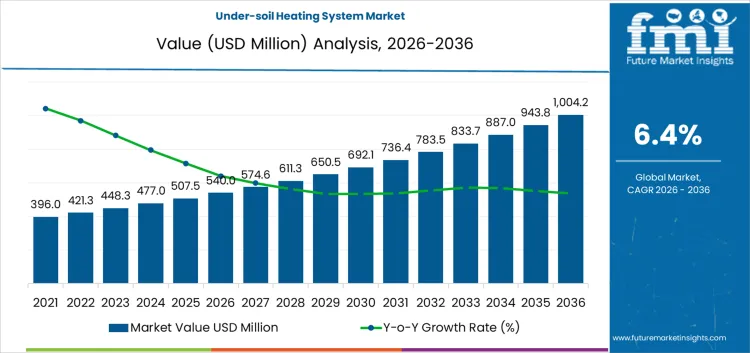
Under-soil Heating System Market Key Takeaways
| Metric | Value |
|---|---|
| Industry Value (2026) | USD 540.0 Million |
| Forecast Value (2036) | USD 1,004.2 Million |
| Forecast CAGR 2026 to 2036 | 6.40% |
How Is the Global Under-soil Heating System Market Advancing?
The global under-soil heating system market is advancing steadily, driven by growing investment in sports infrastructure and the need to maintain playable field conditions in cold and variable climates. Under-soil heating systems are widely installed beneath natural and hybrid turf surfaces to prevent frost formation, improve drainage, and ensure consistent pitch performance during winter and shoulder seasons.
A key driver supporting market growth is the increasing requirement for year-round usability of professional and community sports facilities. Football stadiums, training grounds, and multi-sport venues are adopting under-soil heating to reduce match postponements and minimize turf damage caused by freezing conditions. These systems help maintain grass root health and surface stability, which are critical for player safety and turf longevity.
Technological advancements are further strengthening market adoption. Improvements in heating cable efficiency, hydronic pipe systems, and temperature control mechanisms are enhancing system reliability and energy management. Integration with automated control systems and weather monitoring tools allows operators to optimize heating output based on real-time ground conditions. As sports organizations and facility managers continue to prioritize pitch reliability and operational continuity in challenging climates, the under-soil heating system market is expected to experience stable growth over the forecast period.
What Is the Segment-Wise Overview of the Under-Soil Heating System Market?
The under-soil heating system market is driven by demand for year-round turf playability and professional sports infrastructure. Hydronic (hot water) systems lead with a 58% share, as they provide uniform heat distribution, energy efficiency over large areas, and reliable performance in cold climates. These systems are well suited for permanent installations beneath natural turf. By application, football stadiums account for 54% of demand, reflecting strict requirements to prevent pitch freezing, ensure consistent surface conditions, and avoid match cancellations. Stadium operators prioritize under-soil heating to maintain turf quality during winter seasons.
Why Do Hydronic (Hot Water) Systems Lead the Under-Soil Heating System Market?
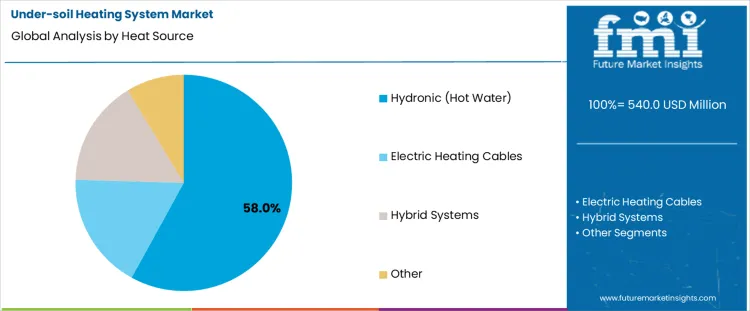
Hydronic under-soil heating systems account for 58% of the market due to their ability to deliver consistent and energy-efficient heat across large turf surfaces. These systems circulate heated water through pipe networks installed beneath the soil, ensuring uniform temperature control and preventing frost penetration. Hydronic solutions are particularly effective for permanent installations where long operational life and stable performance are required. Compared to electric systems, they offer lower operating costs over time, especially when integrated with district heating or waste heat recovery sources. Their scalability makes them suitable for large sports fields and stadiums with intensive usage schedules. As professional sports facilities prioritize reliability, efficiency, and long-term cost control, hydronic under-soil heating systems remain the preferred heat source.
Why Do Football Stadiums Dominate Applications in the Under-Soil Heating System Market?
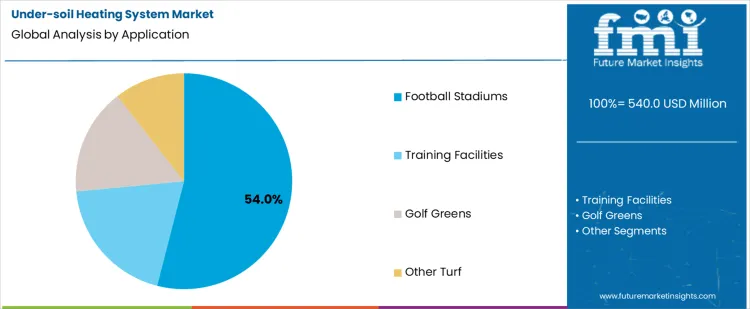
Football stadiums represent 54% of total application demand, making them the largest application segment in the under-soil heating system market. Professional football competitions require consistent turf quality throughout the year, regardless of weather conditions. Under-soil heating systems prevent pitch freezing, support grass root health, and ensure safe playing conditions during winter months. Stadium operators invest heavily in these systems to avoid match postponements, protect broadcast schedules, and meet league standards. Football stadiums typically feature large natural turf areas that require reliable and evenly distributed heat, favoring advanced heating solutions. As professional football continues to expand globally and climate variability increases, demand from stadiums remains the primary driver of under-soil heating system installations.
What Are the Key Dynamics for the Under-Soil Heating System Market?
Under-soil heating systems prevent frost, snow accumulation, and ground freezing, ensuring continuous use of facilities and protecting subsurface infrastructure. Key market dynamics include rising investments in climate-adaptation infrastructure, demand for uninterrupted operations of outdoor venues in winter seasons, and emphasis on safety and performance standards in professional sports and transportation sectors. Technological improvements in heating elements, energy management controls, and integration with environmental monitoring systems enhance system responsiveness and efficiency, making under-soil heating increasingly attractive to planners and facility managers addressing weather-related operational disruptions.
Why Is the Under-Soil Heating System Market Growing?
The under-soil heating system market is growing as extreme weather events and colder seasonal conditions increase the need for reliable ground temperature management. Professional and recreational sports venues require consistent playing surfaces year-round, prompting adoption of under-soil heating to mitigate downtime due to frost and snow. Expansion of airport infrastructure and strict safety protocols for winter operations further support growth, as heated pavements reduce ice formation and improve traction. Advances in energy-efficient heating technologies, such as electric coil systems and hydronic networks with intelligent controls, help reduce operational costs while providing precise temperature regulation.
How Are the Key Drivers Shaping the Under-Soil Heating System Market?
Key drivers shaping the under-soil heating system market include rising demand for climate-resilient infrastructure that can operate effectively in freezing and sub-freezing temperatures. Regulatory frameworks and safety guidelines in the sports, transportation, and municipal sectors are encouraging the integration of heating systems to reduce weather-related risks and liabilities. Technological advancements in sensors, ground temperature monitoring, and automated control systems allow real-time adjustments that optimize energy use and thermal distribution. Expansion of winter sports tourism and upgrading of existing fields and runways in colder regions are also supporting demand. Incorporation of renewable energy inputs and smart grid compatibility into heating system designs is improving energy efficiency and aligning with broader goals of reducing operational energy costs.
What Is the Growth Outlook for the Under-Soil Heating System Market by Country?
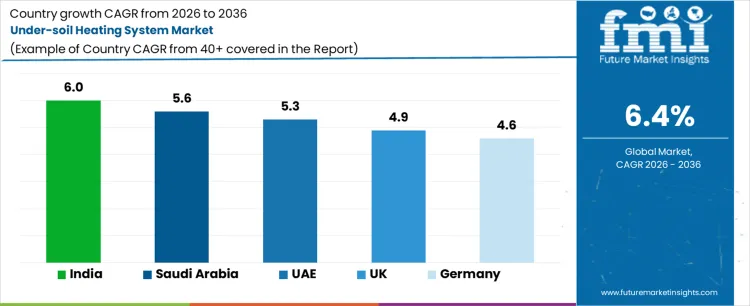
| Country | CAGR (%) |
|---|---|
| India | 6.0% |
| Saudi Arabia | 5.6% |
| UAE | 5.3% |
| UK | 4.9% |
| Germany | 4.6% |
The under-soil heating system market is expanding steadily as sports facilities prioritize pitch reliability and year-round usability. India leads with a 6.0% CAGR, driven by expanding professional sports infrastructure and modernization of stadiums. Saudi Arabia (5.6%) and the UAE (5.3%) follow, supported by premium sports facility development and controlled turf management needs. The UK grows at 4.9%, sustained by winter pitch protection requirements and retrofit demand, while Germany (4.6%) shows stable growth through system upgrades and efficiency improvements. As sports venues increasingly focus on surface quality and operational continuity, demand for under-soil heating systems is expected to remain consistent across these regions.
What Is Driving the Growth of the Under-Soil Heating System Market in India?
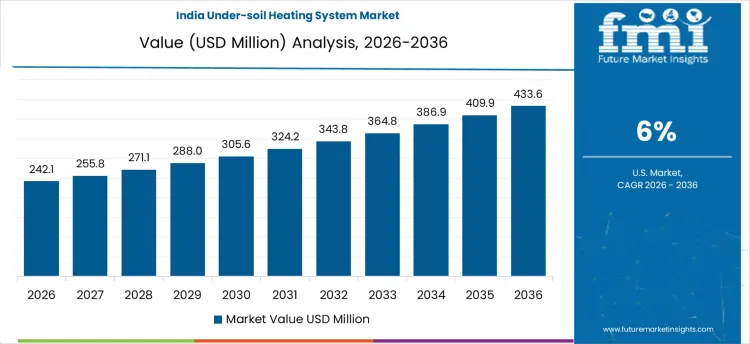
The under-soil heating system market in India is growing at a CAGR of 6.0%, driven by increasing investments in professional sports infrastructure and year-round turf management. Expansion of cricket stadiums, football grounds, and multi-sport academies is creating demand for systems that maintain consistent playing conditions during winter and high-humidity periods. In northern and hilly regions, under-soil heating helps prevent frost damage and excessive moisture accumulation, improving pitch usability. Modernization of existing stadiums for international tournaments and broadcast standards is also supporting retrofit demand. Facility operators are increasingly prioritizing turf durability and reduced match cancellations, which strengthens adoption. In addition, private sports academies and institutional grounds are adopting advanced ground technologies to meet competitive standards. As India continues to invest in organized sports and professional leagues, demand for under-soil heating systems is expected to grow steadily.
How Is the Under-Soil Heating System Market Expanding in Saudi Arabia?
The under-soil heating system market in Saudi Arabia is expanding at a CAGR of 5.6%, supported by large-scale development of premium sports and recreational facilities. While the country experiences high temperatures, under-soil heating adoption in Saudi Arabia and UAE is limited to elite football venues requiring premium turf performance, not widespread climate-related frost prevention and seasonal temperature variations. Major investments in football stadiums, training centers, and international sports venues are driving demand for integrated turf management solutions. Facility operators are adopting heating systems to ensure uniform grass growth, reduce moisture-related damage, and maintain pitch quality for televised events. Government-led sports development initiatives and preparations for global tournaments further support adoption. High expectations for professional-grade playing surfaces are influencing procurement of advanced systems. As Saudi Arabia continues to position itself as a regional sports hub, demand for under-soil heating systems is expected to increase consistently.
What Is Supporting Growth of the Under-Soil Heating System Market in the UAE?
The under-soil heating system market in the UAE is growing at a CAGR of 5.3%, driven by the country’s focus on maintaining premium sports facilities under controlled turf conditions. Although extreme cold is rare, under-soil heating is used to regulate soil temperature, improve root development, and manage moisture during cooler months. Football pitches, golf-adjacent sports grounds, and elite training facilities are key adopters. Stadium operators emphasize consistent turf performance to support international events and year-round usage. Integration of heating systems with automated irrigation and monitoring platforms is further enhancing system value. Strong investment in sports academies and community recreation facilities supports steady demand. As the UAE continues to emphasize quality, aesthetics, and reliability in sports infrastructure, adoption of under-soil heating systems is expected to grow gradually.
How Is the Under-Soil Heating System Market Developing in the UK?
The under-soil heating system market in the UK is expanding at a CAGR of 4.9%, driven by the need to maintain playable pitches during cold, wet winters. Football, rugby, and multi-use stadiums rely on under-soil heating to prevent frozen ground, waterlogging, and match postponements. Professional leagues and broadcast commitments make pitch availability critical, supporting continued investment in heating systems. Many clubs are upgrading legacy installations with energy-efficient and digitally controlled systems to reduce operating costs. Community and training grounds are also adopting smaller-scale solutions to extend playing seasons. Regulatory emphasis on player safety and surface quality further supports demand. While most major stadiums are already equipped, retrofit and efficiency-upgrade projects continue to sustain market growth across the UK.
How Is the Under-Soil Heating System Market Expanding in Germany?
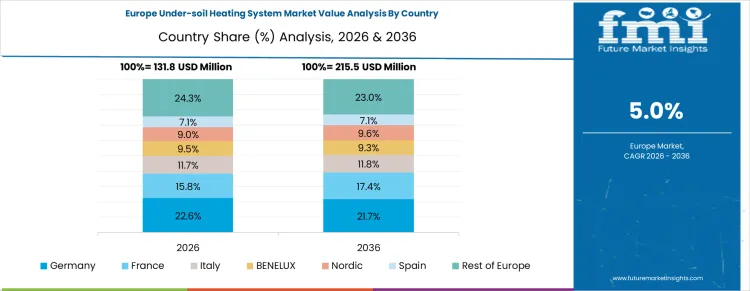
The under-soil heating system market in Germany is growing at a CAGR of 4.6%, reflecting a mature but stable market focused on system upgrades and efficiency improvements. Germany’s football stadiums and professional training facilities widely use under-soil heating to ensure pitch reliability during winter months. Clubs and municipalities are increasingly investing in energy-efficient heating solutions integrated with smart controls to reduce operating costs and emissions. Strong emphasis on turf quality, player safety, and match scheduling supports ongoing maintenance and replacement demand. Adoption is also supported by Germany’s structured sports infrastructure and long-term facility planning. Although new installations are limited, modernization of existing systems continues to drive steady demand. As operators focus on efficiency and performance optimization, the German market is expected to maintain gradual growth.
How Are Companies Competing in the Under-soil Heating System Market?
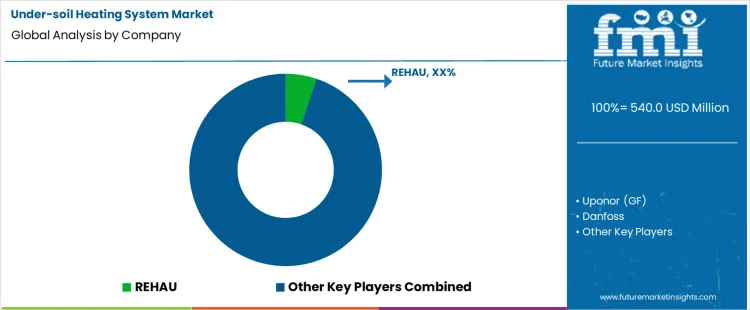
Competition in the under-soil heating system market is driven by temperature uniformity, energy efficiency, system durability, and ease of integration with modern turf and building infrastructure. These systems are used beneath sports pitches, landscaped areas, and specialized outdoor surfaces to prevent frost, maintain playable conditions, and protect turf root zones during cold weather. Companies compete on heating element design, control accuracy, installation depth flexibility, and long-term reliability under continuous seasonal operation. Differentiation increasingly centers on smart control integration, compatibility with renewable heat sources, and reduced lifecycle maintenance rather than upfront system cost alone.
REHAU, Uponor (GF), Danfoss, nVent, Polypipe Building Services, and Roth Werke lead competition through hydronic and electric heating expertise, strong engineering standards, and established contractor networks. REHAU and Uponor differentiate with robust hydronic pipe systems designed for uniform heat distribution and long service life beneath soil and turf. Danfoss and its DEVI brand compete through advanced electric heating cables and precise control solutions, emphasizing temperature accuracy and responsive operation. nVent leverages industrial heat tracing expertise to deliver durable systems suited for demanding outdoor environments, while Polypipe and Roth Werke focus on integrated piping and system reliability.
Ebeco, Warmup compete through installation simplicity, project customization, and local service strength. Ebeco and Warmup differentiate with modular electric heating solutions and user-friendly controls tailored to smaller or retrofit projects. Across the market, competitive advantage is defined by thermal consistency, control intelligence, durability under soil loads, and the ability to deliver reliable surface protection across diverse climate conditions.
Key Players in Under-soil Heating System Market
- REHAU
- Uponor (GF)
- Danfoss
- nVent
- Ebeco
- Warmup
- DEVI (Danfoss)
- Polypipe Building Services
- Roth Werke
- ThermoSoft International
Scope of Report
| Attributes | Description |
|---|---|
| Quantitative Unit (2026) | USD Million |
| Heat Source | Hydronic (Hot Water), Electric Heating Cables, Hybrid Systems, Other |
| Application | Football Stadiums, Training Facilities, Golf Greens, Other Turf |
| Regions Covered | Asia Pacific, Europe, North America, Latin America, Middle East & Africa |
| Countries Covered | China, Japan, South Korea, India, Australia & New Zealand, ASEAN, Rest of Asia Pacific, Germany, United Kingdom, France, Italy, Spain, Nordic, BENELUX, Rest of Europe, United States, Canada, Mexico, Brazil, Chile, Rest of Latin America, Kingdom of Saudi Arabia, Other GCC Countries, Turkey, South Africa, Other African Union, Rest of Middle East & Africa |
| Key Companies Profiled | REHAU, Uponor (GF), Danfoss, nVent, Ebeco, Warmup, DEVI (Danfoss), Polypipe Building Services, Roth Werke, ThermoSoft International |
| Additional Attributes | Dollar sales by heat source and application; regional market size and forecast analysis; growth outlook across major regions; adoption trends for under-soil heating systems in sports and turf management; assessment of installation complexity, energy efficiency requirements, and demand patterns across stadiums, training facilities, golf courses, and managed turf environments. |
Under-soil Heating System Market by Key Segments
Heat Source:
- Hydronic (Hot Water)
- Electric Heating Cables
- Hybrid Systems
- Other
Application:
- Football Stadiums
- Training Facilities
- Golf Greens
- Other Turf
Region:
- Asia Pacific
- China
- Japan
- South Korea
- India
- Australia & New Zealand
- ASEAN
- Rest of Asia Pacific
- Europe
- Germany
- United Kingdom
- France
- Italy
- Spain
- Nordic
- BENELUX
- Rest of Europe
- North America
- United States
- Canada
- Mexico
- Latin America
- Brazil
- Chile
- Rest of Latin America
- Middle East & Africa
- Kingdom of Saudi Arabia
- Other GCC Countries
- Turkey
- South Africa
- Other African Union
- Rest of Middle East & Africa
Bibliography
- European Committee for Standardization. (2024). EN 1264-4 - Water-based surface embedded heating and cooling systems - Installation. CEN.
- International Electrotechnical Commission. (2024). IEC 60335-2-96 - Household and similar electrical appliances - Safety - Part 2-96: Particular requirements for flexible sheet heating elements for room heating. IEC.
- European Committee for Electrotechnical Standardization. (2023). EN 50559 - Electric underfloor heating systems and heating cables - Definitions and requirements. CENELEC.
- Fédération Internationale de Football Association. (2024). FIFA Quality Programme - Handbook of Requirements for Football Turf: Heating, drainage, and surface performance. FIFA.
- International Organization for Standardization. (2023). ISO 11855-2 - Building environment design - Embedded radiant heating and cooling systems - Part 2: Design and dimensioning. ISO.
Frequently Asked Questions
How big is the under-soil heating system market in 2026?
The global under-soil heating system market is estimated to be valued at USD 540.0 million in 2026.
What will be the size of under-soil heating system market in 2036?
The market size for the under-soil heating system market is projected to reach USD 1,004.2 million by 2036.
How much will be the under-soil heating system market growth between 2026 and 2036?
The under-soil heating system market is expected to grow at a 6.4% CAGR between 2026 and 2036.
What are the key product types in the under-soil heating system market?
The key product types in under-soil heating system market are hydronic (hot water), electric heating cables, hybrid systems and other.
Which application segment to contribute significant share in the under-soil heating system market in 2026?
In terms of application, football stadiums segment to command 54.0% share in the under-soil heating system market in 2026.
Preview the report firsthand - request a free sample
Get SampleGet the brochure for pricing and purchase details.
Get PDFTable of Content
- Executive Summary
- Global Market Outlook
- Demand-side Trends
- Supply-side Trends
- Technology Roadmap Analysis
- Analysis and Recommendations
- Market Overview
- Market Coverage / Taxonomy
- Market Definition / Scope / Limitations
- Market Background
- Market Dynamics
- Drivers
- Restraints
- Opportunity
- Trends
- Scenario Forecast
- Demand in Optimistic Scenario
- Demand in Likely Scenario
- Demand in Conservative Scenario
- Opportunity Map Analysis
- Product Life Cycle Analysis
- Supply Chain Analysis
- Investment Feasibility Matrix
- Value Chain Analysis
- PESTLE and Porter’s Analysis
- Regulatory Landscape
- Regional Parent Market Outlook
- Production and Consumption Statistics
- Import and Export Statistics
- Market Dynamics
- Global Market Analysis 2021 to 2025 and Forecast, 2026 to 2036
- Historical Market Size Value (USD Million) Analysis, 2021 to 2025
- Current and Future Market Size Value (USD Million) Projections, 2026 to 2036
- Y-o-Y Growth Trend Analysis
- Absolute $ Opportunity Analysis
- Global Market Pricing Analysis 2021 to 2025 and Forecast 2026 to 2036
- Global Market Analysis 2021 to 2025 and Forecast 2026 to 2036, By Heat Source
- Introduction / Key Findings
- Historical Market Size Value (USD Million) Analysis By Heat Source , 2021 to 2025
- Current and Future Market Size Value (USD Million) Analysis and Forecast By Heat Source , 2026 to 2036
- Hydronic (Hot Water)
- Electric Heating Cables
- Hybrid Systems
- Other
- Hydronic (Hot Water)
- Y-o-Y Growth Trend Analysis By Heat Source , 2021 to 2025
- Absolute $ Opportunity Analysis By Heat Source , 2026 to 2036
- Global Market Analysis 2021 to 2025 and Forecast 2026 to 2036, By Application
- Introduction / Key Findings
- Historical Market Size Value (USD Million) Analysis By Application, 2021 to 2025
- Current and Future Market Size Value (USD Million) Analysis and Forecast By Application, 2026 to 2036
- Football Stadiums
- Training Facilities
- Golf Greens
- Other Turf
- Football Stadiums
- Y-o-Y Growth Trend Analysis By Application, 2021 to 2025
- Absolute $ Opportunity Analysis By Application, 2026 to 2036
- Global Market Analysis 2021 to 2025 and Forecast 2026 to 2036, By Region
- Introduction
- Historical Market Size Value (USD Million) Analysis By Region, 2021 to 2025
- Current Market Size Value (USD Million) Analysis and Forecast By Region, 2026 to 2036
- North America
- Latin America
- Western Europe
- Eastern Europe
- East Asia
- South Asia and Pacific
- Middle East & Africa
- Market Attractiveness Analysis By Region
- North America Market Analysis 2021 to 2025 and Forecast 2026 to 2036, By Country
- Historical Market Size Value (USD Million) Trend Analysis By Market Taxonomy, 2021 to 2025
- Market Size Value (USD Million) Forecast By Market Taxonomy, 2026 to 2036
- By Country
- USA
- Canada
- Mexico
- By Heat Source
- By Application
- By Country
- Market Attractiveness Analysis
- By Country
- By Heat Source
- By Application
- Key Takeaways
- Latin America Market Analysis 2021 to 2025 and Forecast 2026 to 2036, By Country
- Historical Market Size Value (USD Million) Trend Analysis By Market Taxonomy, 2021 to 2025
- Market Size Value (USD Million) Forecast By Market Taxonomy, 2026 to 2036
- By Country
- Brazil
- Chile
- Rest of Latin America
- By Heat Source
- By Application
- By Country
- Market Attractiveness Analysis
- By Country
- By Heat Source
- By Application
- Key Takeaways
- Western Europe Market Analysis 2021 to 2025 and Forecast 2026 to 2036, By Country
- Historical Market Size Value (USD Million) Trend Analysis By Market Taxonomy, 2021 to 2025
- Market Size Value (USD Million) Forecast By Market Taxonomy, 2026 to 2036
- By Country
- Germany
- UK
- Italy
- Spain
- France
- Nordic
- BENELUX
- Rest of Western Europe
- By Heat Source
- By Application
- By Country
- Market Attractiveness Analysis
- By Country
- By Heat Source
- By Application
- Key Takeaways
- Eastern Europe Market Analysis 2021 to 2025 and Forecast 2026 to 2036, By Country
- Historical Market Size Value (USD Million) Trend Analysis By Market Taxonomy, 2021 to 2025
- Market Size Value (USD Million) Forecast By Market Taxonomy, 2026 to 2036
- By Country
- Russia
- Poland
- Hungary
- Balkan & Baltic
- Rest of Eastern Europe
- By Heat Source
- By Application
- By Country
- Market Attractiveness Analysis
- By Country
- By Heat Source
- By Application
- Key Takeaways
- East Asia Market Analysis 2021 to 2025 and Forecast 2026 to 2036, By Country
- Historical Market Size Value (USD Million) Trend Analysis By Market Taxonomy, 2021 to 2025
- Market Size Value (USD Million) Forecast By Market Taxonomy, 2026 to 2036
- By Country
- China
- Japan
- South Korea
- By Heat Source
- By Application
- By Country
- Market Attractiveness Analysis
- By Country
- By Heat Source
- By Application
- Key Takeaways
- South Asia and Pacific Market Analysis 2021 to 2025 and Forecast 2026 to 2036, By Country
- Historical Market Size Value (USD Million) Trend Analysis By Market Taxonomy, 2021 to 2025
- Market Size Value (USD Million) Forecast By Market Taxonomy, 2026 to 2036
- By Country
- India
- ASEAN
- Australia & New Zealand
- Rest of South Asia and Pacific
- By Heat Source
- By Application
- By Country
- Market Attractiveness Analysis
- By Country
- By Heat Source
- By Application
- Key Takeaways
- Middle East & Africa Market Analysis 2021 to 2025 and Forecast 2026 to 2036, By Country
- Historical Market Size Value (USD Million) Trend Analysis By Market Taxonomy, 2021 to 2025
- Market Size Value (USD Million) Forecast By Market Taxonomy, 2026 to 2036
- By Country
- Kingdom of Saudi Arabia
- Other GCC Countries
- Turkiye
- South Africa
- Other African Union
- Rest of Middle East & Africa
- By Heat Source
- By Application
- By Country
- Market Attractiveness Analysis
- By Country
- By Heat Source
- By Application
- Key Takeaways
- Key Countries Market Analysis
- USA
- Pricing Analysis
- Market Share Analysis, 2025
- By Heat Source
- By Application
- Canada
- Pricing Analysis
- Market Share Analysis, 2025
- By Heat Source
- By Application
- Mexico
- Pricing Analysis
- Market Share Analysis, 2025
- By Heat Source
- By Application
- Brazil
- Pricing Analysis
- Market Share Analysis, 2025
- By Heat Source
- By Application
- Chile
- Pricing Analysis
- Market Share Analysis, 2025
- By Heat Source
- By Application
- Germany
- Pricing Analysis
- Market Share Analysis, 2025
- By Heat Source
- By Application
- UK
- Pricing Analysis
- Market Share Analysis, 2025
- By Heat Source
- By Application
- Italy
- Pricing Analysis
- Market Share Analysis, 2025
- By Heat Source
- By Application
- Spain
- Pricing Analysis
- Market Share Analysis, 2025
- By Heat Source
- By Application
- France
- Pricing Analysis
- Market Share Analysis, 2025
- By Heat Source
- By Application
- India
- Pricing Analysis
- Market Share Analysis, 2025
- By Heat Source
- By Application
- ASEAN
- Pricing Analysis
- Market Share Analysis, 2025
- By Heat Source
- By Application
- Australia & New Zealand
- Pricing Analysis
- Market Share Analysis, 2025
- By Heat Source
- By Application
- China
- Pricing Analysis
- Market Share Analysis, 2025
- By Heat Source
- By Application
- Japan
- Pricing Analysis
- Market Share Analysis, 2025
- By Heat Source
- By Application
- South Korea
- Pricing Analysis
- Market Share Analysis, 2025
- By Heat Source
- By Application
- Russia
- Pricing Analysis
- Market Share Analysis, 2025
- By Heat Source
- By Application
- Poland
- Pricing Analysis
- Market Share Analysis, 2025
- By Heat Source
- By Application
- Hungary
- Pricing Analysis
- Market Share Analysis, 2025
- By Heat Source
- By Application
- Kingdom of Saudi Arabia
- Pricing Analysis
- Market Share Analysis, 2025
- By Heat Source
- By Application
- Turkiye
- Pricing Analysis
- Market Share Analysis, 2025
- By Heat Source
- By Application
- South Africa
- Pricing Analysis
- Market Share Analysis, 2025
- By Heat Source
- By Application
- USA
- Market Structure Analysis
- Competition Dashboard
- Competition Benchmarking
- Market Share Analysis of Top Players
- By Regional
- By Heat Source
- By Application
- Competition Analysis
- Competition Deep Dive
- REHAU
- Overview
- Product Portfolio
- Profitability by Market Segments (Product/Age /Sales Channel/Region)
- Sales Footprint
- Strategy Overview
- Marketing Strategy
- Product Strategy
- Channel Strategy
- Uponor (GF)
- Danfoss
- nVent
- Ebeco
- Warmup
- DEVI (Danfoss)
- Polypipe Building Services
- Roth Werke
- ThermoSoft International
- REHAU
- Competition Deep Dive
- Assumptions & Acronyms Used
- Research Methodology


