

- Industry Size (2026)
- USD 232 Mn
- Forecast (2036)
- USD 652.8 Mn
- CAGR (2026 to 2036)
- 10.9%
Industrial-Scale Food Grade rHDPE for Rigid Food Bottles and Closures Market Forecast and Outlook 2026 to 2036
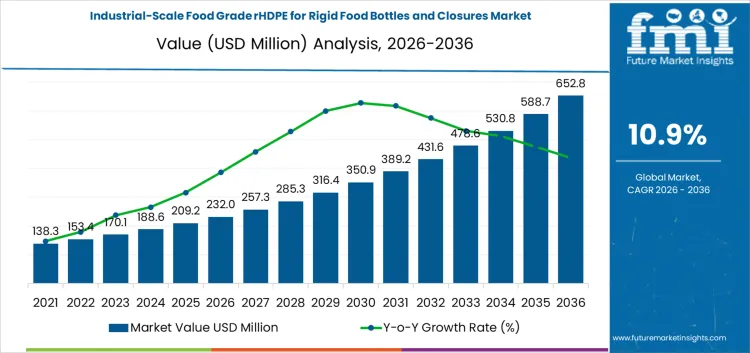
The industrial-scale food grade rHDPE for rigid food bottles and closures market is valued at USD 232 million in 2026 and is projected to reach USD 652.8 million by 2036, reflecting a CAGR of 10.9%. Cost structures during this period are shaped by feedstock consistency, food contact certification costs, and capital intensity tied to large-scale reprocessing lines. Producers operating integrated sorting and decontamination systems achieve tighter cost control. Pricing leverage concentrates among suppliers delivering stable quality volumes to multinational food and beverage groups. Margin formation depends more on long term supply commitments than spot resin price exposure.
Between 2026 and 2036, value capture increasingly favors processors with scale advantages and regulatory alignment across multiple jurisdictions. Investment flows concentrate on assets capable of sustained high utilization rather than incremental capacity additions. Margins strengthen where producers secure contracted feedstock streams and reduce volatility in input pricing. Buyers prioritize supply reliability, audit transparency, and compliance documentation, reinforcing switching barriers. Competitive performance reflects disciplined expansion pacing, efficient capital deployment, and the ability to pass compliance related costs through indexed contracts. Firms emphasizing volume growth without contractual depth face margin compression despite rising demand and broader adoption.
Quick Stats for Industrial-Scale Food Grade rHDPE for Rigid Food Bottles and Closures Market
- Industrial-Scale Food Grade rHDPE for Rigid Food Bottles and Closures Market Value (2026): USD 232 million
- Industrial-Scale Food Grade rHDPE for Rigid Food Bottles and Closures Market Forecast Value (2036): USD 652.8 million
- Industrial-Scale Food Grade rHDPE for Rigid Food Bottles and Closures Market Forecast CAGR (2026 to 2036): 10.9%
- Leading Type in Industrial-Scale Food Grade rHDPE for Rigid Food Bottles and Closures Market: Post-consumer rHDPE pellets
- Key Growth Regions in Industrial-Scale Food Grade rHDPE for Rigid Food Bottles and Closures Market: Asia Pacific, Europe, and North America
- Top Players in Industrial-Scale Food Grade rHDPE for Rigid Food Bottles and Closures Market: Veolia, Berry Global, ALPLA, Plastipak
What is the Growth Forecast for Industrial-Scale Food Grade rHDPE for Rigid Food Bottles and Closures Market Through 2036?
Between 2026 and 2031, the industrial-scale food-grade rHDPE for rigid food bottles and closures market is projected to expand from USD 232 million to USD 373 million, generating an absolute increase of USD 141 million and representing about 33.2% of total forecast growth. This phase is shaped by rising adoption of post-consumer rHDPE pellets, which account for 42% of product grade usage, and strong demand from bottle applications holding a 48% share. Cost structures are influenced by sorting depth, decontamination efficiency, and stabilization additives required for food contact compliance. Value capture favors integrated recyclers supplying consistent pellet quality to large packaging converters.
From 2031 to 2036, the market is expected to grow from USD 373 million to USD 652.8 million, adding USD 285 million and accounting for nearly 66.8% of decade expansion. Growth accelerates as food-contact stabilized and high-melt-flow rHDPE gain wider acceptance across closures, caps, trays, and dispensing components. Margins increasingly concentrate among processors controlling feedstock sourcing, certification workflows, and long-term supply agreements. Competitive strength shifts toward industrial platforms aligned with rigid packaging demand, where firms such as Veolia, Berry Global, ALPLA, Plastipak secure pricing power through reliability rather than volume scale.
Industrial-Scale Food Grade rHDPE for Rigid Food Bottles and Closures Market Key Takeaways
| Metric | Value |
|---|---|
| Market Value (2026) | USD 232 million |
| Forecast Value (2036) | USD 652.8 million |
| Forecast CAGR (2026 to 2036) | 10.9% |
What Scale, Compliance, and Performance Factors Are Driving Industrial Food Grade rHDPE Adoption for Rigid Packaging?
The Industrial-Scale food grade rHDPE for rigid food bottles and closures market develops as packaging producers respond to recycled content mandates and food contact regulations. Historically, food grade rHDPE supply remained constrained by contamination risk, odor carryover, and limited traceability across post-consumer streams. Industrial-Scale operations introduce closed loop sourcing, multi stage washing, deodorisation, and melt filtration to meet bottle and closure specifications. Demand centers on dairy, beverages, condiments, and edible oils, where packaging performance tolerances remain narrow. Resin consistency, color control, and stress crack resistance determine qualification. Value capture shifts toward recyclers capable of delivering audited compliance data, stable volumes, and long term pricing frameworks aligned with converter production planning cycles for industrial packaging procurement decisions globally.
Future expansion is driven by scale economics, retailer specifications, and enforcement timelines rather than voluntary adoption. Brand owners secure multiyear supply agreements to reduce exposure to virgin resin price volatility and compliance penalties. Compared with early capacity built for niche programs, new plants prioritize throughput stability, energy efficiency, and feedstock presorting integration. Cost structures remain sensitive to bale quality, yield loss, and energy inputs, concentrating margins among operators with secured collection networks. Closure applications impose tighter tolerances than bottles, increasing rejection risk and processing cost. Competitive advantage favors recyclers offering validated food contact approvals, consistent lot performance, and integration with converter quality systems across high volume rigid packaging supply chains serving regulated food packaging markets worldwide at scale.
What Factors Are Shaping the Demand for Industrial-Scale Food Grade rHDPE for Rigid Food Bottles and Closures in Terms of Product Grade and Application?
The demand for Industrial-Scale food grade rHDPE for rigid food bottles and closures is segmented by product grade and application. Product grade segmentation reflects differences in feedstock origin, stabilization approach, melt flow behavior, and blending strategy used to achieve food contact compliance. These include post-consumer rHDPE pellets, food contact stabilized grades, high melt flow variants, and virgin blend formulations. Application segmentation reflects where material performance and regulatory exposure are most concentrated, including bottles, closures and caps, trays and tubs, and dispensing components. Segment structure highlights how compliance risk, processing compatibility, and conversion performance shape material selection and offtake patterns across food packaging supply chains.
What Is Driving the Leading Demand for Post-Consumer rHDPE Pellets in Industrial-Scale Food Grade Applications?
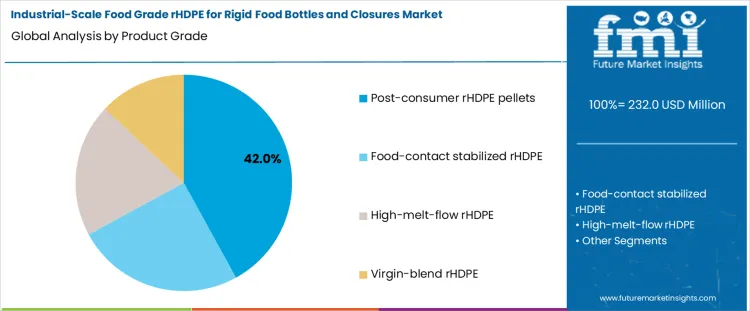
Post-consumer rHDPE pellets account for approximately 42% of total product grade demand, making them the leading material category. This share reflects their role as the primary recycled feedstock capable of meeting food contact requirements at scale. Pelletized form allows controlled sorting, washing, and decontamination before conversion. Industrial users favor pellets due to consistent bulk handling and compatibility with existing extrusion and molding equipment. Their use supports compliance reporting tied to recycled content thresholds.
Demand for post-consumer rHDPE pellets is shaped by availability, auditability, and processing familiarity. Recyclers can document input origin and treatment history with greater precision at pellet stage. Converters benefit from predictable rheology and dosing during high volume production runs. Long term supply contracts favor pellet grades that demonstrate stable quality across batches. The segment maintains leadership because pellets align operational efficiency with regulatory documentation needs across food packaging lines.
Why Do Bottles Represent the Largest Application Segment for Industrial-Scale Food Grade rHDPE?
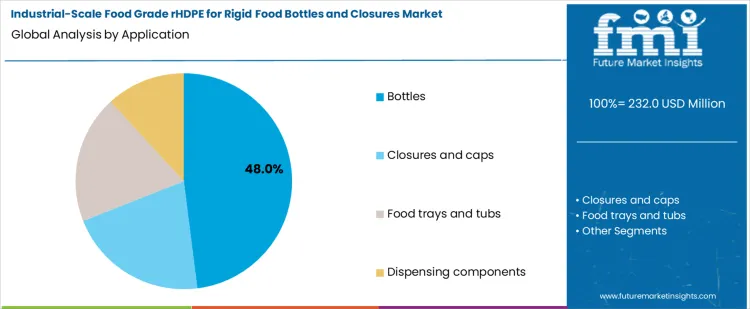
Bottles represent approximately 48% of total application demand, making them the largest end use segment. This position reflects the high volume consumption of rigid food bottles across beverages, condiments, and liquid food categories. Bottle applications face direct regulatory scrutiny due to extended food contact duration and consumer exposure. Manufacturers prioritize compliant rHDPE for bottles to meet recycled content mandates without altering container performance. Blow molding compatibility further concentrates demand in this segment.
Demand concentration in bottles is driven by scale economics and compliance urgency. Bottle production operates at higher throughput than other rigid formats, increasing absolute material demand. Brand owners focus recycled content integration efforts on bottles due to visibility and regulatory pressure. Qualification processes emphasize clarity, stress crack resistance, and barrier consistency. The segment leads because bottles combine large unit volumes with strict compliance requirements, accelerating adoption of food grade rHDPE in this application.
How is Industrial-Scale food grade rHDPE reshaping sourcing decisions for rigid food bottles and closures?
Industrial-Scale food grade rHDPE for rigid food bottles and closures is gaining traction as packaging producers align operations with enforceable recycled content mandates. Demand concentrates where food safety authorities permit recycled polymers under defined process controls. Converters prioritize rHDPE grades offering stable melt flow, odor neutrality, and color consistency to avoid line disruptions. Adoption is strongest in dairy, edible oil, and beverage segments with high volume, standardized packaging formats. Purchasing decisions focus on supply reliability and audit readiness rather than cost leadership. Growth reflects substitution within existing packaging volumes, driven by regulatory thresholds rather than incremental packaging consumption growth.
Why do national recycled content mandates drive investment in Industrial-Scale food grade rHDPE capacity?
The primary driver is country level regulation requiring minimum recycled content in food contact packaging. Brand owners operating locally must secure compliant rHDPE supplies to maintain product approvals. Industrial-Scale plants enable consistent output volumes that small recyclers cannot guarantee. Investments focus on advanced decontamination, closed loop sourcing, and certification alignment with domestic food safety agencies. Local enforcement mechanisms reward suppliers with proven compliance histories. The driver is procurement continuity under regulatory scrutiny. Facilities meeting national standards become preferred suppliers, locking in long term contracts for bottles and closures across regulated food categories.
What operational and commercial barriers limit faster uptake of food grade rHDPE in rigid packaging?
Barriers arise from feedstock quality variability and limited access to high purity post consumer HDPE streams. Collection systems in many regions fail to deliver consistent color and contamination profiles. Food grade processing lines require high capital investment and extended validation timelines. Pricing volatility discourages smaller converters from switching materials. Some filling lines require tooling adjustments to accommodate recycled resin behavior. Certification costs also remain significant. These constraints slow adoption in fragmented packaging markets, where risk tolerance is low and supply disruptions carry high operational penalties for food producers.
How are specification management and supply partnerships evolving in food grade rHDPE markets?
Trends point toward tighter integration between recyclers, converters, and brand owners. Specifications increasingly define acceptable resin windows rather than fixed grades, improving supply flexibility. Long term offtake agreements support capacity utilization and investment recovery. Producers invest in real time quality monitoring to reduce batch variability. Regional sourcing strategies emerge to shorten logistics and simplify audits. Some converters redesign closures and bottles to tolerate higher recycled content without performance loss. The trend emphasizes risk sharing and specification discipline. Competitive advantage increasingly depends on supply stability rather than resin pricing alone.
What is the Demand for Industrial-Scale Food-Grade rHDPE for Rigid Food Bottles and Closures by Country?
| Country | CAGR (%) |
|---|---|
| USA | 7.9 |
| UK | 7.3 |
| China | 9.8 |
| India | 11.4 |
| Brazil | 8.8 |
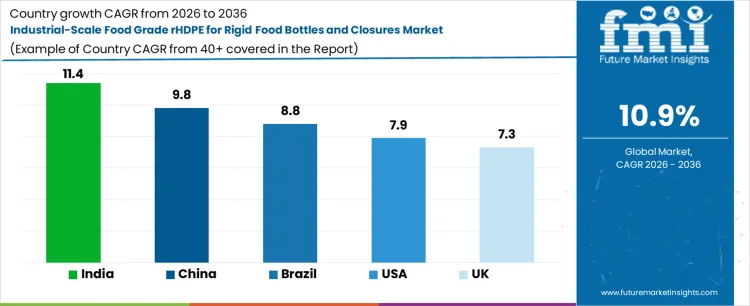
The demand for industrial-scale food-grade rHDPE for rigid food bottles and closures is increasing as converters secure compliant recycled resin for high-volume packaging lines. India leads growth as packaged food consumption rises and domestic recyclers scale decontamination and traceability systems suited for food contact applications. China follows, supported by large integrated packaging operations investing in closed-loop rHDPE supply for bottles and caps. Brazil shows steady expansion as beverage and dairy producers increase recycled content targets within rigid formats. The USA records consistent growth driven by brand commitments and regulatory scrutiny around food-contact compliance. The UK grows at a moderate pace, shaped by established collection systems and gradual capacity expansion for certified food-grade rHDPE production.
How Is Brand-Led Packaging Qualification Expanding Demand for Industrial-Scale Food-Grade rHDPE in the United States?
The industrial-scale food-grade rHDPE market for rigid food bottles and closures in the United States is growing at a CAGR of 7.9%, driven by brand-led qualification programs and tighter specifications for food-contact packaging. Packaging producers are scaling rHDPE usage where material consistency, odor control, and color stability meet internal approval protocols. Investment focuses on upgrading wash, melt filtration, and pelletizing systems to deliver repeatable performance at volume. Demand is concentrated among converters supplying national food and beverage brands that require documented compliance and supply reliability. Growth reflects quality-driven substitution of virgin resin rather than expansion in overall bottle production.
- Brand qualification frameworks shape rHDPE adoption timelines.
- Process investments prioritize consistency over throughput gains.
- Closure applications drive tighter tolerance requirements.
- Long-term supply contracts support industrial-scale deployment.
Why Is Packaging Specification Alignment Supporting Steady Growth in the United Kingdom?
The United Kingdom industrial-scale food-grade rHDPE market for rigid food bottles and closures is expanding at a CAGR of 7.3%, supported by alignment between recyclers, converters, and packaged food producers. Demand is shaped by efforts to integrate recycled content without disrupting existing filling and sealing operations. Recycling plants are investing in enhanced decontamination and color management to meet converter specifications. Procurement remains cautious, favoring suppliers with proven performance at scale. Growth is incremental, reflecting substitution within established packaging formats rather than rapid capacity expansion.
- Converter specifications guide recycler investment priorities.
- Operational compatibility influences rHDPE acceptance.
- Color and odor control remain critical performance metrics.
- Measured procurement supports gradual volume integration.
How Is Export-Focused Packaging Manufacturing Driving Rapid Adoption in China?
China is recording strong expansion in the industrial-scale food-grade rHDPE market for rigid food bottles and closures, with growth at a CAGR of 9.8%, driven by export-oriented packaging manufacturing. Converters supplying regulated overseas markets are increasing demand for certified food-grade recycled resin. Recycling operators are scaling advanced sorting and decontamination processes to support high-volume, compliant output. Demand is concentrated in coastal manufacturing clusters where packaging conversion for international brands is established. Growth is shaped by external compliance expectations rather than domestic food packaging regulation.
- Export market requirements drive industrial-scale rHDPE uptake.
- Packaging converters influence quality benchmarks.
- Advanced decontamination supports volume scaling.
- Manufacturing clusters concentrate demand growth.
Why Is Fast-Moving Consumer Packaging Fueling Market Expansion in India?
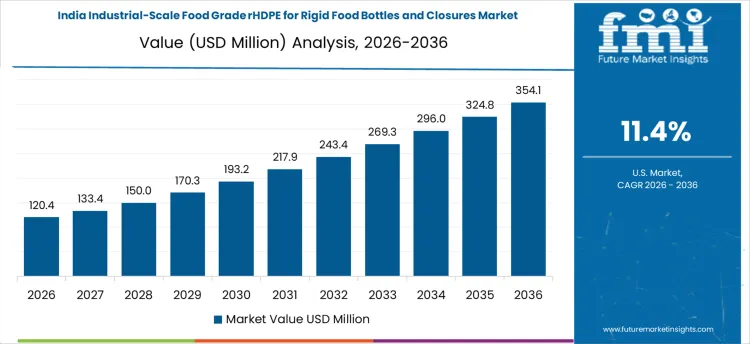
India shows the fastest growth in the industrial-scale food-grade rHDPE market for rigid food bottles and closures, expanding at a CAGR of 11.4%, supported by rapid growth in packaged food and beverage consumption. Brand owners are increasing recycled content integration to align with global sourcing policies. Recycling facilities are scaling capacity while improving output consistency to meet bottle-grade performance requirements. Demand is strongest among organized converters supplying multinational brands. Growth reflects both rising packaging volumes and substitution of virgin HDPE in food-contact applications.
- Packaged food growth increases bottle and closure demand.
- Multinational brand standards accelerate rHDPE adoption.
- Capacity scaling pairs with quality upgrades.
- Organized converters lead early integration.
How Is Packaging Sector Modernization Sustaining Growth in Brazil?
Brazil is experiencing steady growth in the industrial-scale food-grade rHDPE market for rigid food bottles and closures at a CAGR of 8.8%, supported by modernization of the domestic packaging sector. Converters are adopting food-grade rHDPE where supply consistency and pricing support long-term use. Recycling investments focus on improving yield and contamination control rather than rapid capacity additions. Demand is linked to suppliers serving international food brands operating in the region. Growth remains selective, centered on applications where recycled content can be integrated without operational disruption.
- Packaging modernization supports recycled resin uptake.
- Yield improvement drives recycler investment focus.
- International brand presence shapes demand patterns.
- Operational stability governs application selection.
What Is Driving Industrial-Scale Adoption of Food Grade rHDPE for Rigid Food Bottles and Closures?
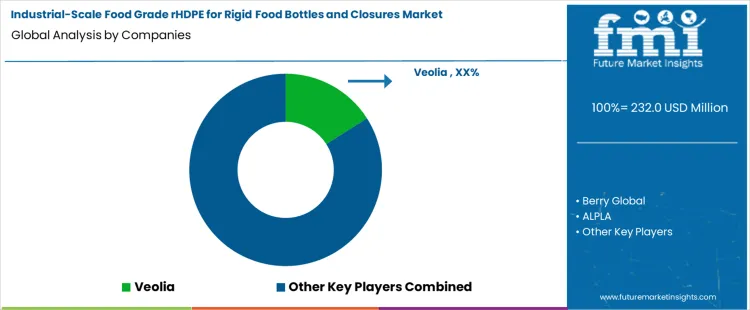
Industrial-Scale demand for food grade rHDPE in rigid bottles and closures is shaped by regulatory compliance, packaging redesign, and converter risk management. Food contact applications require consistent resin purity, odor neutrality, and predictable processing behavior across high speed filling lines. Mechanical recycling systems are optimized around sorting accuracy, advanced washing, and controlled re extrusion to meet these requirements. Supply decisions favor producers capable of delivering traceable material streams aligned with food safety approvals. Firms such as Veolia support this demand through integrated recycling operations that prioritize input control and output consistency. Adoption is driven less by resin price dynamics and more by qualification stability within food packaging supply chains.
Competitive structure reflects tight integration between recycling, packaging conversion, and brand supply commitments. Berry Global and ALPLA embed food grade rHDPE directly into bottle and closure production, reducing variability across material transitions. Plastipak aligns recycled resin sourcing with proprietary preform and container systems to maintain line performance. Smaller regional recyclers remain active through contract manufacturing and captive supply models. Competitive differentiation centers on audit readiness, long term feedstock access, and the ability to maintain food grade compliance across large production volumes without disrupting packaging operations.
Key Players in the Industrial-Scale Food Grade rHDPE for Rigid Food Bottles and Closures Market
- Veolia
- Berry Global
- ALPLA
- Plastipak
Scope of the Report
| Items | Values |
|---|---|
| Quantitative Units (2026) | USD million |
| Type | Post-consumer rHDPE pellets, Food-contact stabilized rHDPE, High-melt-flow rHDPE, Virgin-blend rHDPE |
| Application | Bottles, Closures and caps, Food trays and tubs, Dispensing components |
| Regions Covered | Asia Pacific, Europe, North America, Latin America, Middle East & Africa |
| Countries Covered | United States, United Kingdom, Germany, France, Italy, Spain, China, India, Japan, South Korea, Brazil, and other regulated food packaging markets |
| Key Companies Profiled | Veolia, Berry Global, ALPLA, Plastipak. |
| Additional Attributes | Dollar sales by product grade and application, industrial-scale food-contact certification workflows, feedstock sourcing and sorting depth requirements, decontamination and deodorisation performance criteria, long-term offtake and supply contract structures, integration with rigid food packaging conversion lines and audit-ready compliance systems |
Industrial-Scale Food Grade rHDPE for Rigid Food Bottles and Closures Market Segmentation
Product Grade:
- Post-consumer rHDPE pellets
- Food-contact stabilized rHDPE
- High-melt-flow rHDPE
- Virgin-blend rHDPE
Application:
- Bottles
- Closures and caps
- Food trays and tubs
- Dispensing components
Region
- Asia Pacific
- China
- Japan
- South Korea
- India
- Australia & New Zealand
- ASEAN
- Rest of Asia Pacific
- Europe
- Germany
- United Kingdom
- France
- Italy
- Spain
- Nordic
- BENELUX
- Rest of Europe
- North America
- United States
- Canada
- Mexico
- Latin America
- Brazil
- Chile
- Rest of Latin America
- Middle East & Africa
- Kingdom of Saudi Arabia
- Other GCC Countries
- Turkey
- South Africa
- Other African Union
- Rest of Middle East & Africa
Frequently Asked Questions
How big is the industrial-scale food grade rhdpe for rigid food bottles and closures market in 2026?
The global industrial-scale food grade rhdpe for rigid food bottles and closures market is estimated to be valued at USD 232.0 million in 2026.
What will be the size of industrial-scale food grade rhdpe for rigid food bottles and closures market in 2036?
The market size for the industrial-scale food grade rhdpe for rigid food bottles and closures market is projected to reach USD 652.8 million by 2036.
How much will be the industrial-scale food grade rhdpe for rigid food bottles and closures market growth between 2026 and 2036?
The industrial-scale food grade rhdpe for rigid food bottles and closures market is expected to grow at a 10.9% CAGR between 2026 and 2036.
What are the key product types in the industrial-scale food grade rhdpe for rigid food bottles and closures market?
The key product types in industrial-scale food grade rhdpe for rigid food bottles and closures market are post-consumer rhdpe pellets , food-contact stabilized rhdpe, high-melt-flow rhdpe and virgin-blend rhdpe.
Which application segment to contribute significant share in the industrial-scale food grade rhdpe for rigid food bottles and closures market in 2026?
In terms of application, bottles segment to command 48.0% share in the industrial-scale food grade rhdpe for rigid food bottles and closures market in 2026.
Preview the report firsthand - request a free sample
Get SampleGet the brochure for pricing and purchase details.
Get PDFTable of Content
- Executive Summary
- Global Market Outlook
- Demand-side Trends
- Supply-side Trends
- Technology Roadmap Analysis
- Analysis and Recommendations
- Market Overview
- Market Coverage / Taxonomy
- Market Definition / Scope / Limitations
- Market Background
- Market Dynamics
- Drivers
- Restraints
- Opportunity
- Trends
- Scenario Forecast
- Demand in Optimistic Scenario
- Demand in Likely Scenario
- Demand in Conservative Scenario
- Opportunity Map Analysis
- Product Life Cycle Analysis
- Supply Chain Analysis
- Investment Feasibility Matrix
- Value Chain Analysis
- PESTLE and Porter’s Analysis
- Regulatory Landscape
- Regional Parent Market Outlook
- Production and Consumption Statistics
- Import and Export Statistics
- Market Dynamics
- Global Market Analysis 2021 to 2025 and Forecast, 2026 to 2036
- Historical Market Size Value (USD Million) Analysis, 2021 to 2025
- Current and Future Market Size Value (USD Million) Projections, 2026 to 2036
- Y-o-Y Growth Trend Analysis
- Absolute $ Opportunity Analysis
- Global Market Pricing Analysis 2021 to 2025 and Forecast 2026 to 2036
- Global Market Analysis 2021 to 2025 and Forecast 2026 to 2036, By Product Grade
- Introduction / Key Findings
- Historical Market Size Value (USD Million) Analysis By Product Grade , 2021 to 2025
- Current and Future Market Size Value (USD Million) Analysis and Forecast By Product Grade , 2026 to 2036
- Post-consumer rHDPE pellets
- Food-contact stabilized rHDPE
- High-melt-flow rHDPE
- Virgin-blend rHDPE
- Post-consumer rHDPE pellets
- Y-o-Y Growth Trend Analysis By Product Grade , 2021 to 2025
- Absolute $ Opportunity Analysis By Product Grade , 2026 to 2036
- Global Market Analysis 2021 to 2025 and Forecast 2026 to 2036, By Application
- Introduction / Key Findings
- Historical Market Size Value (USD Million) Analysis By Application, 2021 to 2025
- Current and Future Market Size Value (USD Million) Analysis and Forecast By Application, 2026 to 2036
- Bottles
- Closures and caps
- Food trays and tubs
- Dispensing components
- Bottles
- Y-o-Y Growth Trend Analysis By Application, 2021 to 2025
- Absolute $ Opportunity Analysis By Application, 2026 to 2036
- Global Market Analysis 2021 to 2025 and Forecast 2026 to 2036, By Region
- Introduction
- Historical Market Size Value (USD Million) Analysis By Region, 2021 to 2025
- Current Market Size Value (USD Million) Analysis and Forecast By Region, 2026 to 2036
- North America
- Latin America
- Western Europe
- Eastern Europe
- East Asia
- South Asia and Pacific
- Middle East & Africa
- Market Attractiveness Analysis By Region
- North America Market Analysis 2021 to 2025 and Forecast 2026 to 2036, By Country
- Historical Market Size Value (USD Million) Trend Analysis By Market Taxonomy, 2021 to 2025
- Market Size Value (USD Million) Forecast By Market Taxonomy, 2026 to 2036
- By Country
- USA
- Canada
- Mexico
- By Product Grade
- By Application
- By Country
- Market Attractiveness Analysis
- By Country
- By Product Grade
- By Application
- Key Takeaways
- Latin America Market Analysis 2021 to 2025 and Forecast 2026 to 2036, By Country
- Historical Market Size Value (USD Million) Trend Analysis By Market Taxonomy, 2021 to 2025
- Market Size Value (USD Million) Forecast By Market Taxonomy, 2026 to 2036
- By Country
- Brazil
- Chile
- Rest of Latin America
- By Product Grade
- By Application
- By Country
- Market Attractiveness Analysis
- By Country
- By Product Grade
- By Application
- Key Takeaways
- Western Europe Market Analysis 2021 to 2025 and Forecast 2026 to 2036, By Country
- Historical Market Size Value (USD Million) Trend Analysis By Market Taxonomy, 2021 to 2025
- Market Size Value (USD Million) Forecast By Market Taxonomy, 2026 to 2036
- By Country
- Germany
- UK
- Italy
- Spain
- France
- Nordic
- BENELUX
- Rest of Western Europe
- By Product Grade
- By Application
- By Country
- Market Attractiveness Analysis
- By Country
- By Product Grade
- By Application
- Key Takeaways
- Eastern Europe Market Analysis 2021 to 2025 and Forecast 2026 to 2036, By Country
- Historical Market Size Value (USD Million) Trend Analysis By Market Taxonomy, 2021 to 2025
- Market Size Value (USD Million) Forecast By Market Taxonomy, 2026 to 2036
- By Country
- Russia
- Poland
- Hungary
- Balkan & Baltic
- Rest of Eastern Europe
- By Product Grade
- By Application
- By Country
- Market Attractiveness Analysis
- By Country
- By Product Grade
- By Application
- Key Takeaways
- East Asia Market Analysis 2021 to 2025 and Forecast 2026 to 2036, By Country
- Historical Market Size Value (USD Million) Trend Analysis By Market Taxonomy, 2021 to 2025
- Market Size Value (USD Million) Forecast By Market Taxonomy, 2026 to 2036
- By Country
- China
- Japan
- South Korea
- By Product Grade
- By Application
- By Country
- Market Attractiveness Analysis
- By Country
- By Product Grade
- By Application
- Key Takeaways
- South Asia and Pacific Market Analysis 2021 to 2025 and Forecast 2026 to 2036, By Country
- Historical Market Size Value (USD Million) Trend Analysis By Market Taxonomy, 2021 to 2025
- Market Size Value (USD Million) Forecast By Market Taxonomy, 2026 to 2036
- By Country
- India
- ASEAN
- Australia & New Zealand
- Rest of South Asia and Pacific
- By Product Grade
- By Application
- By Country
- Market Attractiveness Analysis
- By Country
- By Product Grade
- By Application
- Key Takeaways
- Middle East & Africa Market Analysis 2021 to 2025 and Forecast 2026 to 2036, By Country
- Historical Market Size Value (USD Million) Trend Analysis By Market Taxonomy, 2021 to 2025
- Market Size Value (USD Million) Forecast By Market Taxonomy, 2026 to 2036
- By Country
- Kingdom of Saudi Arabia
- Other GCC Countries
- Turkiye
- South Africa
- Other African Union
- Rest of Middle East & Africa
- By Product Grade
- By Application
- By Country
- Market Attractiveness Analysis
- By Country
- By Product Grade
- By Application
- Key Takeaways
- Key Countries Market Analysis
- USA
- Pricing Analysis
- Market Share Analysis, 2025
- By Product Grade
- By Application
- Canada
- Pricing Analysis
- Market Share Analysis, 2025
- By Product Grade
- By Application
- Mexico
- Pricing Analysis
- Market Share Analysis, 2025
- By Product Grade
- By Application
- Brazil
- Pricing Analysis
- Market Share Analysis, 2025
- By Product Grade
- By Application
- Chile
- Pricing Analysis
- Market Share Analysis, 2025
- By Product Grade
- By Application
- Germany
- Pricing Analysis
- Market Share Analysis, 2025
- By Product Grade
- By Application
- UK
- Pricing Analysis
- Market Share Analysis, 2025
- By Product Grade
- By Application
- Italy
- Pricing Analysis
- Market Share Analysis, 2025
- By Product Grade
- By Application
- Spain
- Pricing Analysis
- Market Share Analysis, 2025
- By Product Grade
- By Application
- France
- Pricing Analysis
- Market Share Analysis, 2025
- By Product Grade
- By Application
- India
- Pricing Analysis
- Market Share Analysis, 2025
- By Product Grade
- By Application
- ASEAN
- Pricing Analysis
- Market Share Analysis, 2025
- By Product Grade
- By Application
- Australia & New Zealand
- Pricing Analysis
- Market Share Analysis, 2025
- By Product Grade
- By Application
- China
- Pricing Analysis
- Market Share Analysis, 2025
- By Product Grade
- By Application
- Japan
- Pricing Analysis
- Market Share Analysis, 2025
- By Product Grade
- By Application
- South Korea
- Pricing Analysis
- Market Share Analysis, 2025
- By Product Grade
- By Application
- Russia
- Pricing Analysis
- Market Share Analysis, 2025
- By Product Grade
- By Application
- Poland
- Pricing Analysis
- Market Share Analysis, 2025
- By Product Grade
- By Application
- Hungary
- Pricing Analysis
- Market Share Analysis, 2025
- By Product Grade
- By Application
- Kingdom of Saudi Arabia
- Pricing Analysis
- Market Share Analysis, 2025
- By Product Grade
- By Application
- Turkiye
- Pricing Analysis
- Market Share Analysis, 2025
- By Product Grade
- By Application
- South Africa
- Pricing Analysis
- Market Share Analysis, 2025
- By Product Grade
- By Application
- USA
- Market Structure Analysis
- Competition Dashboard
- Competition Benchmarking
- Market Share Analysis of Top Players
- By Regional
- By Product Grade
- By Application
- Competition Analysis
- Competition Deep Dive
- Veolia
- Overview
- Product Portfolio
- Profitability by Market Segments (Product/Age /Sales Channel/Region)
- Sales Footprint
- Strategy Overview
- Marketing Strategy
- Product Strategy
- Channel Strategy
- Berry Global
- ALPLA
- Plastipak
- Veolia
- Competition Deep Dive
- Assumptions & Acronyms Used
- Research Methodology


