

- Industry Size (2026)
- USD 980 Mn
- Forecast (2036)
- USD 3126.2 Mn
- CAGR (2026 to 2036)
- 12.3%
Odour-Control Technology for High-PCR HDPE Market Forecast and Outlook 2026 to 2036
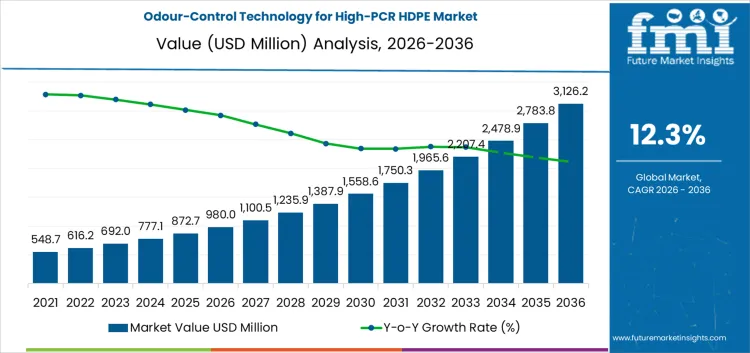
The odour-control technology for high-PCR HDPE market is forecast to advance at a 12.3% CAGR, rising from USD 980 million in 2026 to USD 3,126.2 million by 2036. This market plays a critical enabling role in scaling high-PCR HDPE across consumer-facing packaging, where sensory performance directly affects brand acceptance. As recycled content levels increase, odour mitigation shifts from a corrective measure to a qualification requirement embedded early in material selection and process design. Value is increasingly concentrated in technologies that deliver consistent odour reduction across variable post-consumer feedstocks without disrupting melt behavior, cycle times, or mechanical performance.
Buyers exhibit strong risk aversion, favoring solutions with proven repeatability, regulatory readiness, and compatibility with existing extrusion and molding assets. Once validated, switching costs remain high due to requalification timelines and sensory benchmarking dependencies. Between 2026 and 2036, margin capture is expected to favor additive and process-technology providers that combine chemical efficacy with application engineering and scale-up support, positioning odour-control solutions as a structural prerequisite for commercially viable high-PCR HDPE packaging adoption.
Quick Stats for Odour-Control Technology for High-PCR HDPE Market
- Odour-Control Technology for High-PCR HDPE Market Value (2026): USD 980 Million
- Odour-Control Technology for High-PCR HDPE Market Forecast Value (2036): USD 3,126.2 Million
- Odour-Control Technology for High-PCR HDPE Market Forecast CAGR 2026 to 2036: 12.3%
- Leading Technology in Odour-Control Technology for High-PCR HDPE Market: Adsorptive & Reactive Additives (55% share)
- Key Growth Regions in Odour-Control Technology for High-PCR HDPE Market: Asia Pacific, Europe, North America, Latin America, Middle East & Africa
- Top Key Players in Odour-Control Technology for High-PCR HDPE Market: BASF SE, Clariant AG, Avient Corporation, PolyOne Corporation, ADEKA Corporation, Mitsui Chemicals, Inc., Kingfa Sci. & Tech. Co., Ltd., JLS Additives, Inc.
Odour-Control Technology for High-PCR HDPE Market Key Takeaways
| Metric | Value |
|---|---|
| Odour-Control Technology for High-PCR HDPE Market Value (2026) | USD 980 Million |
| Odour-Control Technology for High-PCR HDPE Market Forecast Value (2036) | USD 3,126.2 Million |
| Odour-Control Technology for High-PCR HDPE Market Forecast CAGR 2026 to 2036 | 12.3% |
How are Performance Qualification and Scale-Up Constraints Driving Demand for Odour-Control Technologies in High-PCR HDPE?
Demand for odour-control technologies in high-PCR HDPE is accelerating as brand owners and converters push recycled content into consumer-facing applications without compromising sensory acceptance. Odour remains a primary barrier to PCR adoption in packaging for household goods, personal care, and select food-adjacent uses. As recycled content percentages rise, converters increasingly rely on targeted odour-mitigation solutions adsorbents, scavengers, and process-integrated treatments to achieve consistent organoleptic performance at commercial scale.
Procurement decisions are shifting from single-additive fixes to system-level solutions. Compounders and converters are evaluating odour-control options based on compatibility with extrusion and molding conditions, impact on mechanical properties, and effectiveness across variable PCR feedstocks. Technologies that can be tuned to specific contamination profiles without increasing cycle times or additive loadings are gaining preference. Suppliers offering application testing, sensory benchmarking, and formulation support are better positioned to shorten customer qualification cycles and secure long-term supply agreements.
Scale and supply assurance are becoming decisive differentiators as volumes ramp. Regional variability in PCR quality is pushing buyers to seek flexible odour-control solutions that perform reliably across sources and batches. Investments in advanced washing, deodorization, and inline treatment are improving outcomes but add complexity to operations. For technology providers and material suppliers, competitive advantage increasingly depends on proven efficacy at high PCR levels, predictable processing economics, and the ability to support rapid customer scale-up positioning odour-control technologies as a critical enabler of high-PCR HDPE adoption over the forecast period.
How Is The Odour-Control Technology For High-PCR HDPE Market Structured By End Use And Technology?
The odour-control technology for high-pcr hdpe market is segmented by end use and technology, reflecting how odor mitigation requirements vary by product category and processing approach. By end use, detergent and homecare packaging leads adoption, driven by high-volume containers where residual odors can affect consumer acceptance. Other end uses include food-contact packaging, premium packaging, mass FMCG, value packaging, and regional converters, each requiring different odor thresholds and processing controls. By technology, adsorptive and reactive additives represent the leading solution set, while degassing and scavenger systems, precision additive dosing, and integrated compounding address odor reduction at different stages of resin preparation and packaging conversion.
Why Does Detergent And Homecare Packaging Lead Odour-Control Demand By End Use?
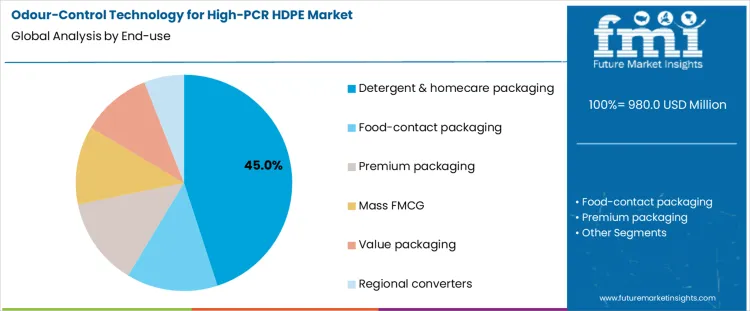
Detergent and homecare packaging accounts for 45% share of the odour-control technology for high-pcr hdpe market because these products are highly sensitive to off-notes that can interfere with fragrance profiles. Large container sizes and thicker wall sections increase the likelihood of odor retention in recycled resin. Brand owners require consistent odor neutrality to protect product identity across retail shelves. High production volumes allow early adoption of odor-control solutions that perform reliably across multiple SKUs. Converters supplying homecare brands prioritize technologies that integrate seamlessly into existing extrusion and blow molding lines. These performance, scale, and brand-protection factors explain why detergent and homecare packaging remains the largest end-use segment.
Why Do Adsorptive And Reactive Additives Dominate Technology Selection?
Adsorptive and reactive additives hold 55% share of the odour-control technology for high-pcr hdpe market because they address odor-causing compounds directly within the polymer matrix. These additives bind, neutralize, or chemically transform volatile molecules during melt processing, delivering consistent results without additional equipment. Converters prefer additive-based solutions due to ease of dosing, compatibility with standard compounding practices, and predictable performance across resin batches. The approach supports high-throughput manufacturing while minimizing process complexity. For additive suppliers, this technology enables standardized formulations and repeat sales to packaging producers. This combination of effectiveness, scalability, and operational simplicity explains their dominance.
What are The Key Market Drivers for Odour-Control Technology in High-PCR HDPE?
The odour-control technology for high-PCR HDPE market is driven by growing use of high post-consumer recycled HDPE in rigid packaging applications especially household cleaners, personal care bottles, and industrial containers where residual odours from recycled feedstocks can compromise product acceptance and brand quality. For additive producers, compounding firms, and resin suppliers, odour mitigation solutions must deliver reliable suppression of volatile compounds without compromising HDPE performance metrics like impact strength, environmental stress crack resistance (ESCR), or processing stability. Supply consistency of high-PCR HDPE, cost competitiveness versus virgin materials, and technical support for converters are central commercial dynamics shaping technology uptake.
How Are Innovation And Formulation Trends Shaping Odour-Control Technology Adoption?
Innovation and formulation trends are shaping adoption of odour-control technologies through advanced additive systems, engineered masterbatches, and tailored compounding approaches. Suppliers are developing odour-targeted additives such as adsorption agents, neutralizers, and encapsulated reactants that can be incorporated during extrusion or compounding to target specific volatile profiles from recycled streams. Enhanced dispersion technologies improve additive integration without degrading mechanical properties. Collaboration between additive specialists and HDPE recyclers enables identification of common odour sources and optimized mitigation strategies. For converters, solutions that integrate seamlessly with existing extrusion lines without significant cycle time impact are especially attractive and support broader adoption.
Why Do Technical, Quality, And Regulatory Challenges Restrain Market Expansion?
Technical, quality, and regulatory challenges restrain the odour-control technology for high-PCR HDPE market. High-PCR HDPE feedstocks vary widely in contaminant profiles, printing residues, and residual odours, creating inconsistency that complicates formulation of universally effective odour-control treatments. Additive systems must not negatively affect HDPE’s key performance properties, as reduced toughness, altered melt flow, or processing instability can deter converters from adoption. Ensuring compliance of odour-control additives with consumer safety and emissions standards adds testing complexity and cost. These challenges require robust quality control, tailored solutions, and extensive demonstration of efficacy-factors that slow broader market penetration.
What is the Country-Wise Outlook for Odour-Control Technology in High-PCR HDPE Applications?
The odour-control technology market for high-PCR HDPE is shaped by rising recycled content mandates, brand acceptance thresholds, and improvements in decontamination and additive chemistry. As PCR content increases, controlling residual odours becomes critical for applications such as packaging, personal care containers, household products, and non-food bottles. Country-level growth differs based on food-contact regulations, recycling infrastructure maturity, and brand sensitivity to sensory performance. Mature markets emphasize validation, consistency, and compliance, while emerging economies focus on rapid capacity build-out and cost-effective solutions. Suppliers offering proven deodorization systems, additive formulations, and process integration support are best positioned to capture opportunities across high-PCR HDPE value chains.
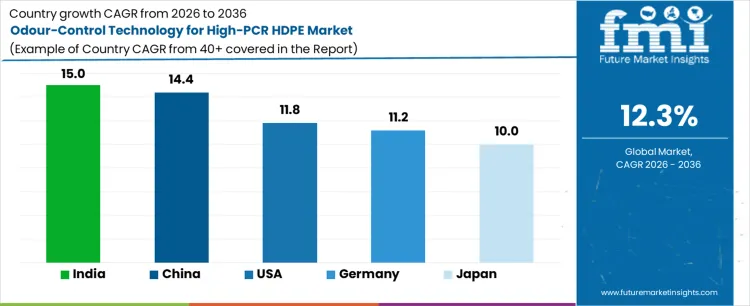
| Country | CAGR (%) |
|---|---|
| India | 15.0% |
| China | 14.4% |
| United States | 11.8% |
| Germany | 11.2% |
| Japan | 10.0% |
How is Germany Advancing High-Quality Odour-Control Adoption for High-PCR HDPE?
Demand for odour-control technology for high-PCR HDPE in Germany is shaped by stringent quality expectations, advanced recycling infrastructure, and strong circular-economy regulation. Growing at a CAGR of 11.2% during 2026-2036, adoption is driven by brand requirements to increase recycled content while maintaining consumer sensory acceptance. Converters and brand owners require deodorization solutions that address residual odours originating from detergents, food residues, and mixed household waste streams. Buyers prioritize repeatability, traceability, and compatibility with both food-contact and non-food packaging standards. Most installations are upgrade-led, with recyclers integrating advanced washing, thermal treatment, vacuum degassing, and additive-based odour-control systems. Qualification cycles are long and validation-intensive, involving pilot trials, sensory panels, and migration testing. Procurement favors suppliers providing proven performance data, regulatory documentation, and long-term technical support. Volumes are moderate, but solution value per installation remains high due to engineering complexity.
What is Fueling Strong Demand for Odour-Control Technology in the United States?
The odour-control technology market for high-PCR HDPE in the United States is expanding at a CAGR of 11.8% during 2026-2036, supported by aggressive sustainability targets and rising consumer scrutiny of recycled packaging. Brand owners seek deodorization solutions that enable higher PCR content without compromising brand perception or shelf appeal. Buyers emphasize scalability, FDA-compliant additives, and compatibility with high-throughput recycling and conversion lines. Adoption is supported by growing investment in advanced mechanical recycling and improved feedstock sorting. Procurement decisions focus on supply security, consistent odour reduction, and technical collaboration rather than lowest-cost solutions. Demand spans packaging, household chemicals, and personal care containers where sensory performance is critical. The United States favors suppliers offering modular odour-control technologies, process integration support, and strong aftersales service. This is a value-driven market where reliability, performance validation, and ability to support nationwide rollouts determine long-term supplier positioning.
How Does Japan Maintain Precision Standards in Odour-Control for High-PCR HDPE?
Sale of odour-control technology for high-PCR HDPE in Japan, growing at a CAGR of 10.0%, reflects a precision-oriented and conservative adoption approach. Japanese converters and brand owners maintain extremely low odour tolerance thresholds, requiring highly controlled deodorization processes. Buyers emphasize process stability, repeatability, and long validation cycles before approving higher PCR usage. Adoption is incremental, often beginning with non-food packaging before expansion into more sensitive applications. Procurement favors suppliers with advanced additive chemistry, strong analytical capabilities, and comprehensive documentation. Volumes remain limited, but quality expectations are among the highest globally. Japan rewards suppliers that deliver predictable odour reduction, minimal material impact, and long-term operational reliability. This market prioritizes technical excellence, consistency, and supplier credibility over rapid scale or cost-driven deployment.
Why is China Emerging as a Major Growth Engine for Odour-Control Technologies in High-PCR HDPE?
The odour-control technology market for high-PCR HDPE in China is expanding rapidly as recycled plastic capacity scales across packaging and consumer goods sectors. Growing at a CAGR of 14.4% during 2026-2036, adoption is driven by policy pressure to increase recycled content and by brand commitments to circular packaging. Recyclers and converters increasingly require deodorization solutions to manage residual odours originating from mixed post-consumer feedstock, detergents, and organic contamination. Buyers prioritize solutions that are cost-effective, scalable, and compatible with high-throughput washing and extrusion lines. Domestic suppliers compete aggressively on price using additive-based and process-integrated technologies, while international providers focus on premium installations requiring higher sensory performance. Qualification timelines are relatively short, allowing faster deployment across new recycling parks. Procurement decisions emphasize throughput, local technical support, and rapid commissioning rather than extensive pilot validation. Adoption is primarily volume-led, with initial focus on non-food packaging, household products, and industrial containers.
How is India Becoming the Fastest-Growing Market for Odour-Control Technology in High-PCR HDPE?
The odour-control technology market for high-PCR HDPE in India is developing rapidly as recycled plastics adoption expands across packaging and consumer goods. Growing at a CAGR of 15.0% during 2026-2036, demand is driven by sustainability commitments, regulatory momentum, and rising brand sensitivity to product odour. Recyclers and converters increasingly integrate deodorization technologies during greenfield project design rather than as retrofits. Buyers emphasize affordability, ease of integration, and effectiveness in handling inconsistent post-consumer feedstock. Additive-based solutions and modular process units gain traction due to lower capital intensity. Procurement decisions remain price-sensitive, yet expectations for performance consistency are increasing as organized retail and branded packaging expand. Adoption initially concentrates on non-food applications such as household containers, personal care packaging, and industrial bottles. Supplier selection is strongly influenced by local technical support, training capability, and ability to scale with capacity expansion. Qualification cycles are shorter than in developed markets, enabling faster rollout.
What Drives Competition in Odour-Control Technology for High-PCR HDPE?
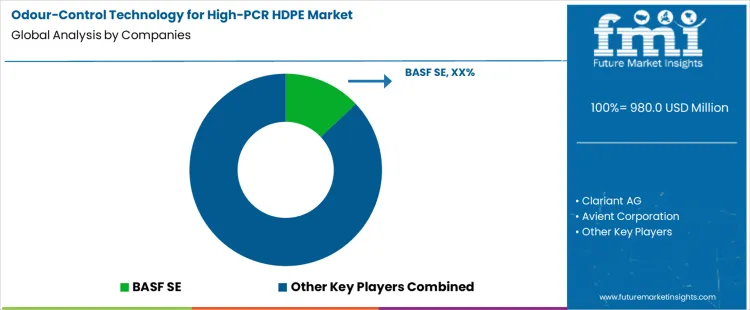
Competition in the odour-control technology for high-PCR (post-consumer recycled) HDPE market is shaped by additive performance, compatibility with recycled resin blends, and documented efficacy in end-use applications as presented in official technical literature. BASF SE positions its odour-control solutions around tailored masterbatches and functional additives that reduce volatile organic compounds (VOCs) in high-PCR HDPE. Product brochures emphasize formulation robustness across bottle grades and consumer packaging segments, with verified odour reduction metrics under accelerated aging tests. Clariant AG competes through specialty additive portfolios documented for enhanced odor neutralization and dispersion in recycled HDPE. Official data sheets highlight compatibility windows and processing temperatures to ensure consistent performance on extrusion and injection lines.
Specialty compounders and colorant experts differentiate through formulation agility. Avient Corporation and PolyOne Corporation offer odour-control masterbatches designed for high-PCR HDPE compounds, with technical materials detailing odour scoring results and impact on mechanical properties such as tensile strength and elongation. Their brochures highlight tailored solutions for caps, containers, and rigid packaging grades where odour masking and binder compatibility are priorities.
Asian and targeted additive suppliers extend competitive differentiation through cost-effective grades and localized technical support. ADEKA Corporation and Mitsui Chemicals, Inc. focus on functional additives documented for processing stability and odor reduction in PCR blends. Kingfa Sci. & Tech. Co., Ltd. and JLS Additives, Inc. emphasize odour-neutralizing solutions with official materials covering odor panel ratings and heat stability profiles. Across suppliers, competitive advantage is established through brochure-verified odour performance, process compatibility, and technical support rather than price alone.
Odour-Control Technology for High-PCR HDPE Market
- BASF SE
- Clariant AG
- Avient Corporation
- PolyOne Corporation
- ADEKA Corporation
- Mitsui Chemicals, Inc.
- Kingfa Sci. & Tech. Co., Ltd.
- JLS Additives, Inc.
Scope of Report
| Attribute | Description |
|---|---|
| Quantitative Unit | USD Million |
| End-use | Detergent & Homecare Packaging, Food-Contact Packaging, Premium Packaging, Mass FMCG, Value Packaging, Regional Converters |
| Technology | Adsorptive & Reactive Additives, Degassing & Scavenger Systems, Precision Additive Dosing, Integrated Compounding |
| Countries Covered | China, Japan, South Korea, India, Australia & New Zealand, ASEAN, Rest of Asia Pacific, Germany, United Kingdom, France, Italy, Spain, Nordic, BENELUX, Rest of Europe, United States, Canada, Mexico, Brazil, Chile, Rest of Latin America, Kingdom of Saudi Arabia, Other GCC Countries, Turkey, South Africa, Other African Union, Rest of Middle East & Africa |
| Regions Covered | Asia Pacific, Europe, North America, Latin America, Middle East & Africa |
| Key Companies Profiled | BASF SE, Clariant AG, Avient Corporation, PolyOne Corporation, ADEKA Corporation, Mitsui Chemicals, Inc., Kingfa Sci. & Tech. Co., Ltd., JLS Additives, Inc. |
| Additional Attributes | Dollar sales by end-use and technology are assessed across high-PCR HDPE packaging applications. The report includes country-level demand assessment, analysis of odor reduction efficiency and sensory compliance, evaluation of additive compatibility and compounding integration, competitive benchmarking of suppliers, and assessment of sustainability-driven adoption across FMCG, food-contact, and homecare packaging value chains. |
Odour-Control Technology for High-PCR HDPE Market
End-use
- Detergent & homecare packaging
- Food-contact packaging
- Premium packaging
- Mass FMCG
- Value packaging
- Regional converters
Technology
- Adsorptive & reactive additives
- Degassing & scavenger systems
- Precision additive dosing
- Integrated compounding
Region
- Asia Pacific
- China
- Japan
- South Korea
- India
- Australia & New Zealand
- ASEAN
- Rest of Asia Pacific
- Europe
- Germany
- United Kingdom
- France
- Italy
- Spain
- Nordic
- BENELUX
- Rest of Europe
- North America
- United States
- Canada
- Mexico
- Latin America
- Brazil
- Chile
- Rest of Latin America
- Middle East & Africa
- Kingdom of Saudi Arabia
- Other GCC Countries
- Turkey
- South Africa
- Other African Union
- Rest of Middle East & Africa
Bibliography
- European Union. (2025). Regulation (EU) 2025/40 of the European Parliament and of the Council of 19 December 2024 on packaging and packaging waste. Publications Office of the European Union.
- Organisation for Economic Co-operation and Development. (2024). Circular economy policy approaches for flexible plastic packaging recycling. OECD Publishing.
- European Food Safety Authority. (2025). Recycling of plastic materials for food contact use: Updated guidance for applicants (EFSA Journal No. 2025; 23(11)). European Food Safety Authority.
Frequently Asked Questions
How big is the odour-control technology for high-pcr hdpe market in 2026?
The global odour-control technology for high-pcr hdpe market is estimated to be valued at USD 980.0 million in 2026.
What will be the size of odour-control technology for high-pcr hdpe market in 2036?
The market size for the odour-control technology for high-pcr hdpe market is projected to reach USD 3,126.2 million by 2036.
How much will be the odour-control technology for high-pcr hdpe market growth between 2026 and 2036?
The odour-control technology for high-pcr hdpe market is expected to grow at a 12.3% CAGR between 2026 and 2036.
What are the key product types in the odour-control technology for high-pcr hdpe market?
The key product types in odour-control technology for high-pcr hdpe market are detergent & homecare packaging, food-contact packaging, premium packaging, mass fmcg, value packaging and regional converters.
Which technology segment to contribute significant share in the odour-control technology for high-pcr hdpe market in 2026?
In terms of technology, adsorptive & reactive additives segment to command 55.0% share in the odour-control technology for high-pcr hdpe market in 2026.
Preview the report firsthand - request a free sample
Get SampleGet the brochure for pricing and purchase details.
Get PDFTable of Content
- Executive Summary
- Global Market Outlook
- Demand-side Trends
- Supply-side Trends
- Technology Roadmap Analysis
- Analysis and Recommendations
- Market Overview
- Market Coverage / Taxonomy
- Market Definition / Scope / Limitations
- Market Background
- Market Dynamics
- Drivers
- Restraints
- Opportunity
- Trends
- Scenario Forecast
- Demand in Optimistic Scenario
- Demand in Likely Scenario
- Demand in Conservative Scenario
- Opportunity Map Analysis
- Product Life Cycle Analysis
- Supply Chain Analysis
- Investment Feasibility Matrix
- Value Chain Analysis
- PESTLE and Porter’s Analysis
- Regulatory Landscape
- Regional Parent Market Outlook
- Production and Consumption Statistics
- Import and Export Statistics
- Market Dynamics
- Global Market Analysis 2021 to 2025 and Forecast, 2026 to 2036
- Historical Market Size Value (USD Million) Analysis, 2021 to 2025
- Current and Future Market Size Value (USD Million) Projections, 2026 to 2036
- Y-o-Y Growth Trend Analysis
- Absolute $ Opportunity Analysis
- Global Market Pricing Analysis 2021 to 2025 and Forecast 2026 to 2036
- Global Market Analysis 2021 to 2025 and Forecast 2026 to 2036, By End-use
- Introduction / Key Findings
- Historical Market Size Value (USD Million) Analysis By End-use , 2021 to 2025
- Current and Future Market Size Value (USD Million) Analysis and Forecast By End-use , 2026 to 2036
- Detergent & homecare packaging
- Food-contact packaging
- Premium packaging
- Mass FMCG
- Value packaging
- Regional converters
- Detergent & homecare packaging
- Y-o-Y Growth Trend Analysis By End-use , 2021 to 2025
- Absolute $ Opportunity Analysis By End-use , 2026 to 2036
- Global Market Analysis 2021 to 2025 and Forecast 2026 to 2036, By Technology
- Introduction / Key Findings
- Historical Market Size Value (USD Million) Analysis By Technology, 2021 to 2025
- Current and Future Market Size Value (USD Million) Analysis and Forecast By Technology, 2026 to 2036
- Adsorptive & reactive additives
- Degassing & scavenger systems
- Precision additive dosing
- Integrated compounding
- Adsorptive & reactive additives
- Y-o-Y Growth Trend Analysis By Technology, 2021 to 2025
- Absolute $ Opportunity Analysis By Technology, 2026 to 2036
- Global Market Analysis 2021 to 2025 and Forecast 2026 to 2036, By Region
- Introduction
- Historical Market Size Value (USD Million) Analysis By Region, 2021 to 2025
- Current Market Size Value (USD Million) Analysis and Forecast By Region, 2026 to 2036
- North America
- Latin America
- Western Europe
- Eastern Europe
- East Asia
- South Asia and Pacific
- Middle East & Africa
- Market Attractiveness Analysis By Region
- North America Market Analysis 2021 to 2025 and Forecast 2026 to 2036, By Country
- Historical Market Size Value (USD Million) Trend Analysis By Market Taxonomy, 2021 to 2025
- Market Size Value (USD Million) Forecast By Market Taxonomy, 2026 to 2036
- By Country
- USA
- Canada
- Mexico
- By End-use
- By Technology
- By Country
- Market Attractiveness Analysis
- By Country
- By End-use
- By Technology
- Key Takeaways
- Latin America Market Analysis 2021 to 2025 and Forecast 2026 to 2036, By Country
- Historical Market Size Value (USD Million) Trend Analysis By Market Taxonomy, 2021 to 2025
- Market Size Value (USD Million) Forecast By Market Taxonomy, 2026 to 2036
- By Country
- Brazil
- Chile
- Rest of Latin America
- By End-use
- By Technology
- By Country
- Market Attractiveness Analysis
- By Country
- By End-use
- By Technology
- Key Takeaways
- Western Europe Market Analysis 2021 to 2025 and Forecast 2026 to 2036, By Country
- Historical Market Size Value (USD Million) Trend Analysis By Market Taxonomy, 2021 to 2025
- Market Size Value (USD Million) Forecast By Market Taxonomy, 2026 to 2036
- By Country
- Germany
- UK
- Italy
- Spain
- France
- Nordic
- BENELUX
- Rest of Western Europe
- By End-use
- By Technology
- By Country
- Market Attractiveness Analysis
- By Country
- By End-use
- By Technology
- Key Takeaways
- Eastern Europe Market Analysis 2021 to 2025 and Forecast 2026 to 2036, By Country
- Historical Market Size Value (USD Million) Trend Analysis By Market Taxonomy, 2021 to 2025
- Market Size Value (USD Million) Forecast By Market Taxonomy, 2026 to 2036
- By Country
- Russia
- Poland
- Hungary
- Balkan & Baltic
- Rest of Eastern Europe
- By End-use
- By Technology
- By Country
- Market Attractiveness Analysis
- By Country
- By End-use
- By Technology
- Key Takeaways
- East Asia Market Analysis 2021 to 2025 and Forecast 2026 to 2036, By Country
- Historical Market Size Value (USD Million) Trend Analysis By Market Taxonomy, 2021 to 2025
- Market Size Value (USD Million) Forecast By Market Taxonomy, 2026 to 2036
- By Country
- China
- Japan
- South Korea
- By End-use
- By Technology
- By Country
- Market Attractiveness Analysis
- By Country
- By End-use
- By Technology
- Key Takeaways
- South Asia and Pacific Market Analysis 2021 to 2025 and Forecast 2026 to 2036, By Country
- Historical Market Size Value (USD Million) Trend Analysis By Market Taxonomy, 2021 to 2025
- Market Size Value (USD Million) Forecast By Market Taxonomy, 2026 to 2036
- By Country
- India
- ASEAN
- Australia & New Zealand
- Rest of South Asia and Pacific
- By End-use
- By Technology
- By Country
- Market Attractiveness Analysis
- By Country
- By End-use
- By Technology
- Key Takeaways
- Middle East & Africa Market Analysis 2021 to 2025 and Forecast 2026 to 2036, By Country
- Historical Market Size Value (USD Million) Trend Analysis By Market Taxonomy, 2021 to 2025
- Market Size Value (USD Million) Forecast By Market Taxonomy, 2026 to 2036
- By Country
- Kingdom of Saudi Arabia
- Other GCC Countries
- Turkiye
- South Africa
- Other African Union
- Rest of Middle East & Africa
- By End-use
- By Technology
- By Country
- Market Attractiveness Analysis
- By Country
- By End-use
- By Technology
- Key Takeaways
- Key Countries Market Analysis
- USA
- Pricing Analysis
- Market Share Analysis, 2025
- By End-use
- By Technology
- Canada
- Pricing Analysis
- Market Share Analysis, 2025
- By End-use
- By Technology
- Mexico
- Pricing Analysis
- Market Share Analysis, 2025
- By End-use
- By Technology
- Brazil
- Pricing Analysis
- Market Share Analysis, 2025
- By End-use
- By Technology
- Chile
- Pricing Analysis
- Market Share Analysis, 2025
- By End-use
- By Technology
- Germany
- Pricing Analysis
- Market Share Analysis, 2025
- By End-use
- By Technology
- UK
- Pricing Analysis
- Market Share Analysis, 2025
- By End-use
- By Technology
- Italy
- Pricing Analysis
- Market Share Analysis, 2025
- By End-use
- By Technology
- Spain
- Pricing Analysis
- Market Share Analysis, 2025
- By End-use
- By Technology
- France
- Pricing Analysis
- Market Share Analysis, 2025
- By End-use
- By Technology
- India
- Pricing Analysis
- Market Share Analysis, 2025
- By End-use
- By Technology
- ASEAN
- Pricing Analysis
- Market Share Analysis, 2025
- By End-use
- By Technology
- Australia & New Zealand
- Pricing Analysis
- Market Share Analysis, 2025
- By End-use
- By Technology
- China
- Pricing Analysis
- Market Share Analysis, 2025
- By End-use
- By Technology
- Japan
- Pricing Analysis
- Market Share Analysis, 2025
- By End-use
- By Technology
- South Korea
- Pricing Analysis
- Market Share Analysis, 2025
- By End-use
- By Technology
- Russia
- Pricing Analysis
- Market Share Analysis, 2025
- By End-use
- By Technology
- Poland
- Pricing Analysis
- Market Share Analysis, 2025
- By End-use
- By Technology
- Hungary
- Pricing Analysis
- Market Share Analysis, 2025
- By End-use
- By Technology
- Kingdom of Saudi Arabia
- Pricing Analysis
- Market Share Analysis, 2025
- By End-use
- By Technology
- Turkiye
- Pricing Analysis
- Market Share Analysis, 2025
- By End-use
- By Technology
- South Africa
- Pricing Analysis
- Market Share Analysis, 2025
- By End-use
- By Technology
- USA
- Market Structure Analysis
- Competition Dashboard
- Competition Benchmarking
- Market Share Analysis of Top Players
- By Regional
- By End-use
- By Technology
- Competition Analysis
- Competition Deep Dive
- BASF SE
- Overview
- Product Portfolio
- Profitability by Market Segments (Product/Age /Sales Channel/Region)
- Sales Footprint
- Strategy Overview
- Marketing Strategy
- Product Strategy
- Channel Strategy
- Clariant AG
- Avient Corporation
- PolyOne Corporation
- ADEKA Corporation
- Mitsui Chemicals, Inc.
- Kingfa Sci. & Tech. Co., Ltd.
- JLS Additives, Inc.
- BASF SE
- Competition Deep Dive
- Assumptions & Acronyms Used
- Research Methodology


