

- Market Size (2026)
- USD 1.0 Bn
- Forecast (2036)
- USD 1.8 Bn
- CAGR (2026 to 2036)
- 6.0%
Urban Timber and Engineered Wood Component Salvage and Reuse in Europe Industry Size, Market Forecast and Outlook By FMI
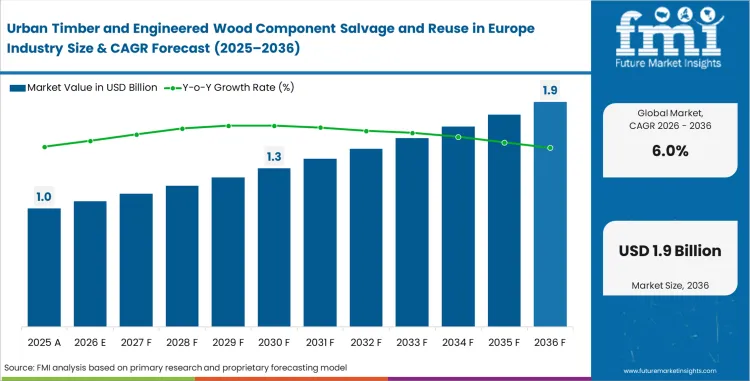
Urban Timber and Engineered Wood Component Salvage and Reuse in Europe industry was valued at USD 0.9 billion in 2025 and is estimated at USD 1.0 billion in 2026. Industry outlook points to a 6.0% CAGR from 2026 to 2036, taking total market value to nearly USD 1.8 billion by the end of 2036. Expansion is supported by stronger urban deconstruction activity and broader acceptance of reclaimed engineered wood in secondary building applications. Market progress now depends less on whether recoverable timber exists in cities and more on whether that material can be removed, sorted, and verified in a form that downstream buyers are willing to use.
Summary of Urban Timber and Engineered Wood Component Salvage and Reuse in Europe Industry
- The market is forecast to reach USD 1.8 billion by 2036.
- The market is expected to grow at a CAGR of 6.0% from 2026 to 2036.
- The market was estimated at USD 0.9 billion in 2025.
- Market value is expected to reach USD 1.0 billion in 2026.
- Building Deconstruction is anticipated to lead the source stream segment with a 46.0% share in 2026.
- Selective Deconstruction is projected to remain the leading recovery method with a 42.0% share in 2026.
- Structural Timber is expected to account for 31.0% share in 2026, making it the leading wood form segment.
- Particleboard Furnish is likely to lead engineered output with a 34.0% share in 2026, while Residential use is expected to account for 37.0% and Panel Producers are projected to represent 29.0% of buyer-group demand.
- Country-level growth is strongest in Denmark at 7.4% CAGR, followed by the Netherlands at 7.1%, Italy at 6.9%, and Spain at 6.7% through 2036.
Key Takeaways, Market Size, and Forecast
- Urban Timber and Engineered Wood Component Salvage and Reuse in Europe Industry is projected to increase from USD 1.0 billion in 2026 to USD 1.8 billion by 2036, at a CAGR of 6.0%.
- The urban timber and engineered wood component salvage and reuse in Europe industry was valued at USD 0.9 billion in 2025.
- By 2036, the Urban Timber and Engineered Wood Component Salvage and Reuse in Europe Industry is expected to be worth USD 1.8 billion.
- The industry is likely to expand at a CAGR of 6.0% during 2026 to 2036.
- The forecast indicates an incremental opportunity of around USD 0.8 billion.
- In 2026, Building Deconstruction is expected to account for 46.0% of the source stream segment.
- Denmark (7.4%) and the Netherlands (7.1%) are two of the fastest growing markets.
Urban Timber and Engineered Wood Component Salvage and Reuse in Europe Industry Key Takeaways
| Parameter | Details |
|---|---|
| Market value (2026) | USD 1.0 billion |
| Forecast value (2036) | USD 1.8 billion |
| CAGR (2026 to 2036) | 6.0% |
| Estimated market value (2025) | USD 0.9 billion |
| Leading source stream | Building Deconstruction |
| Leading recovery method | Selective Deconstruction |
| Leading wood form | Structural Timber |
| Leading engineered output | Particleboard Furnish |
| Leading end use | Residential |
| Leading buyer group | Panel Producers |
| Fastest-growing country | Denmark |
| Key Companies Profiles | Kronospan, EGGER, Sonae Arauco, Pfleiderer, Stora Enso, and binderholz |
Source: Future Market Insights (FMI) analysis, based on proprietary forecasting model and primary research
Project owners, demolition contractors, and reuse channels give timber recovery greater weight earlier in site planning. That change is commercially important because wood with reuse potential carries value before it enters the mixed waste stream. Recovery outcomes depend on strip-out sequencing, grading discipline, contamination control, and pre-arranged outlet access. Only a portion of material generated from urban assets reaches the market in reusable condition, which keeps waste wood recycling closely linked to the pace and quality of this sector. Volume alone does not secure market expansion. Consistency in recovered material, buyer confidence in grading, and predictable off-take remain the factors that determine whether timber moves into reuse streams or drops into lower-value recovery routes.
Recovery economics improves when salvage planning is built into the demolition scope from the outset. Pre-agreed handling routines and clearer end-market alignment help widen reuse options and support better value realization. Denmark is projected to expand at a CAGR of 7.4% through 2036, followed by the Netherlands at 7.1%. Italy is expected to register 6.9% and Spain 6.7%, while Germany is likely to record 6.1%, compared with 5.9% for France and 5.6% for Sweden, where progress still depends on grading discipline, project suitability, and local reclaimed-wood demand.
Salvage Economics Depend on Sorting Quality
The commercial viability of urban timber reuse in Europe is not decided at demolition; it is decided at sorting. Mixed construction and demolition waste still represents one of the EU’s largest waste streams, and the Commission notes that construction and demolition waste accounts for more than one-third of all waste generated in the EU. That matters because salvage operators only capture structural value when wood is separated early, contaminants are controlled, and provenance is preserved. Poor site segregation pushes material down the value ladder into low-grade recycling or energy recovery instead of reuse or remanufacture. For buyers, the practical takeaway is clear: access to reusable timber and engineered wood components is less a supply question than a recovery-system question. The strongest opportunities sit with contractors, deconstruction specialists, and processors that can guarantee graded, traceable output rather than irregular reclaimed stock.
Standards Gaps Still Limit Structural Reuse
A recurring buyer question is whether reclaimed timber can move from architectural feature material into mainstream structural use. In Europe, that shift is still constrained by assessment, grading, and conformity pathways rather than by the physical existence of reusable material. Recent policy work on timber reuse highlights that structural members can be extracted from buildings and reused, but often need processing, remanufacture, or reassessment before being placed back on the market. The business implication is important: firms that solve inspection, grading, testing, and specification will hold more margin than firms competing only on reclaimed volume. In this industry, technical assurance is the market-access lever. Until reuse-grade standards and accepted conformity routes become easier to apply, structural salvage will remain selective, project-led, and skewed toward specialist partners with engineering credibility.
Segmental Analysis
Key Facts About Segments
- Planned dismantling keeps Building Deconstruction ahead of other source streams, and it is expected to account for 46.0% share in 2026.
- Material value is usually protected at the point of removal, which is why Selective Deconstruction is projected to represent 42.0% share in 2026.
- Reclaimed beams, joists, and other load-bearing sections give recovery firms the clearest resale logic, leaving Structural Timber expected to account for 31.0% share in 2026.
- Industrial board routes remain commercially important because they can absorb variation at scale, and Particleboard Furnish is likely to hold 34.0% share in 2026.
- Shorter delivery distances, renovation-linked demand, and more flexible specification needs keep Residential applications in the leading end-use position, with 37.0% share expected in 2026.
- Scale in this market still depends on buyers who can absorb volume consistently, which leaves Panel Producers projected to represent 29.0% share in 2026.
Urban Timber and Engineered Wood Component Salvage and Reuse in Europe Industry Analysis by Source Stream
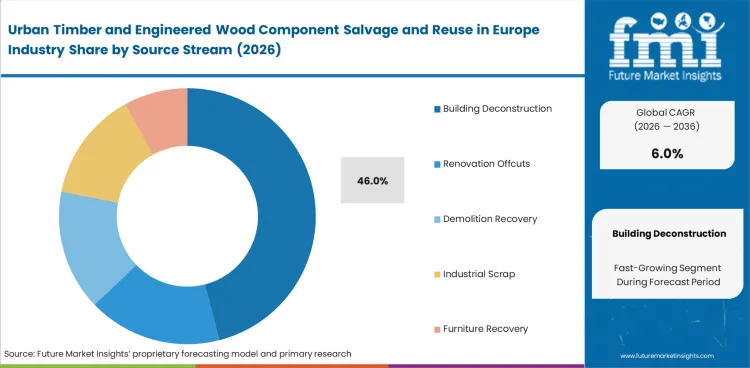
Building deconstruction is expected to account for 46.0% share in 2026 because planned dismantling gives this market its most dependable feed base. Older urban assets release beams, joists, flooring, and joinery in larger and more traceable lots than scattered scrap streams, which makes matching supply to downstream demand more practical. Renovation offcuts and furniture recovery still matter, but they rarely offer the same volume of stability when buyers need reusable timber at scale. Recovery firms also benefit from staged strip-outs because contamination stays lower, and grading becomes easier before material reaches the yard. That operating logic often sits close to project environments shaped by demolition equipment, where extraction orders have a direct effect on salvage quality. Mixed inflow can still support lower-value outlets, yet it tends to narrow down the reuse path once traceability and clean separation begin to weaken. Recovery performance improves when feed enters the chain in a condition that preserves size, history, and resale confidence from the start.
- Traceability edge: Building-led recovery gives buyers clearer material history and reduces doubt during grading and resale.
- Volume stability: Larger lots from planned deconstruction make supply easier to match with repeat industrial or project demand.
- Contamination control: Cleaner separation protects reuse value, while mixed recovery often pushes wood into lower-value outlets.
Urban Timber and Engineered Wood Component Salvage and Reuse in Europe Industry Analysis by Recovery Method
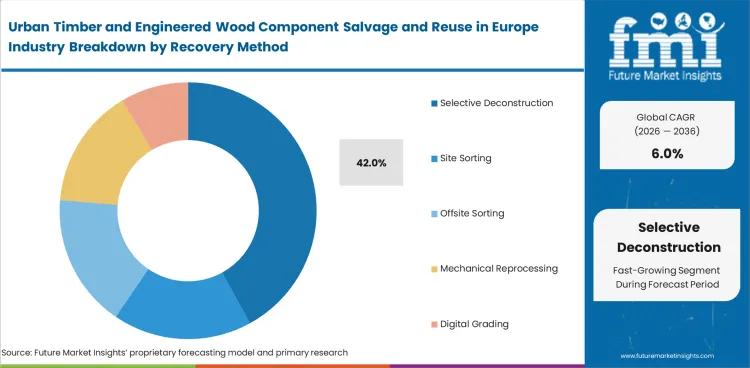
Material value in this industry is usually decided at the point of removal rather than after the wood reaches a sorting yard. Selective deconstruction is projected to represent 42.0% share in 2026 because reusable timber loses value quickly once demolition mixes it with plaster, metal, coatings, and broken debris. Site sorting and offsite sorting still serve useful roles, but they work best when disassembly has already protected piece quality and usable dimensions. Recovery teams choose selective methods when resale value matters, when grading time matters, and when downstream buyers are unwilling to accept avoidable uncertainty. That same logic explains why wood recycling equipment fits this market more as a support layer than as a substitute for careful removal. Projects that skip disciplined extraction usually end with more handling, more loss, and fewer components suitable for direct reuse or engineered remanufacture. Recovery economics stay stronger when dismantling preserves condition early instead of depending on later sorting to rescue damaged material.
- Disassembly discipline: Careful dismantling protects usable dimensions and keeps more wood inside higher-value channels.
- Sorting yield: Cleaner material at the start makes every later sorting step more productive and less expensive.
- Reuse readiness: Buyers commit more easily when extraction methods already support grading confidence.
Urban Timber and Engineered Wood Component Salvage and Reuse in Europe Industry Analysis by Wood Form
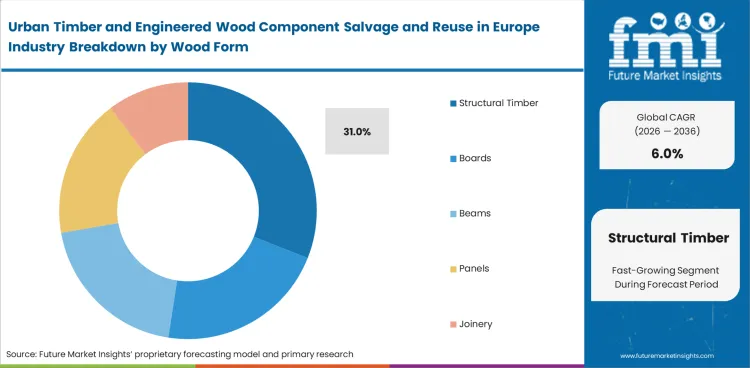
Load‑bearing members carry the clearest value signal in reclaimed timber because buyers can assess both size and intended function without much guesswork. Beams, joists, and other primary building elements give recovery firms more room to reuse, resize, or remanufacture material before it falls into lower‑grade outlets. Structural timber is expected to account for 31.0% share in 2026, reflecting the stronger resale logic attached to larger recoverable sections with visible reuse potential. Boards and panels remain useful, though they move more quickly into lower-margin channels when composition or surface condition is unclear. Joinery and smaller formats add niche value, but they do not offer the same combination of volume, dimensional recovery, and downstream flexibility. Interest in timber construction also reinforces demand for larger secondary members that can support remanufacturing or visible reuse. Value retention improves when wood form is identified correctly at intake, since misclassification often leads to unnecessary downgrading later in the recovery chain.
- Load value: Larger pieces give buyers more room to reuse, resize, or remanufacture without losing core value.
- Dimension recovery: Recoverable length and section size widen the number of practical downstream applications.
- Joinery limits: Smaller crafted elements can sell well in niche channels, but they do not anchor industrial scale.
Urban Timber and Engineered Wood Component Salvage and Reuse in Europe Industry Analysis by Engineered Output
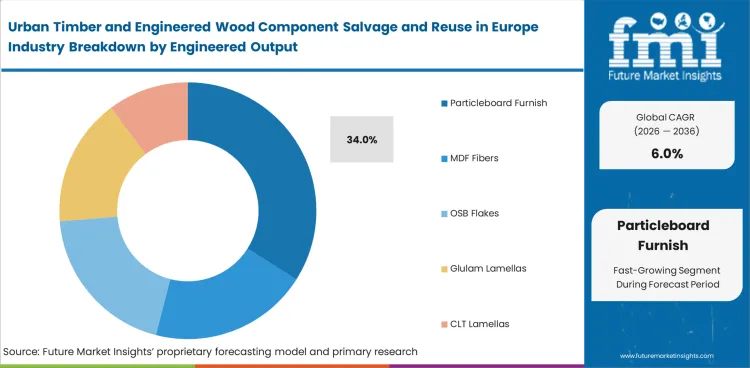
Secondary wood needs an outlet that can absorb variation without rejecting large incoming volumes, which is why industrial board routes remain central to this market. Panel producers value recovered timber when contamination, moisture, and sizing are managed well enough to fit repeatable furnish requirements. MDF fibers, OSB flakes, and lamella recovery still matter, but each tends to depend on tighter feed discipline and narrower conversion conditions. Particle board furnish remains the leading engineered output because scale forms first around the route that is both established and reasonably tolerant of recovered material variation. With 34.0% share expected in 2026, it continues to lead the segment for that reason. Linkage with particle board demand strengthens this position because recovered wood can move into a large manufacturing base once quality stays within workable limits. Suppliers that fail to control those limits often see output slide down the value ladder before it reaches a buyer prepared to pay for better-grade secondary fiber.
- Furnish pull: Board makers provide a dependable outlet for larger volumes of recovered wood.
- Panel fit: Particleboard absorbs secondary raw material more easily than routes requiring tighter form of control.
- Residue absorption: Lower-grade recovered fractions still find use here, keeping overall recovery economics workable.
Urban Timber and Engineered Wood Component Salvage and Reuse in Europe Industry Analysis by End Use
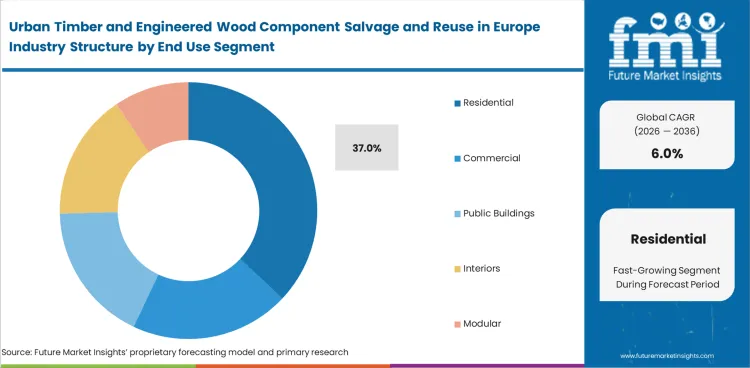
Urban reuse becomes easier to commercialize when demand stays close to renovation cycles, local design work, and shorter delivery distances. Residential applications provide that fit because smaller projects can absorb reclaimed timber in visible and flexible ways without the same approval burden seen in larger commercial jobs. Commercial and public projects still offer showcase value, but they usually involve longer matching cycles and stricter specification review before material is accepted. Modular routes also create opportunities when dimensions, timing, and consistency align with offsite production needs. Connection with modular & prefabricated construction matters here because some reclaimed timber can fit factory-led building logic when grading is reliable, and supply is predictable. Residential applications are likely to make up 37.0% of total share in 2026 for those reasons. End-use performance improves when reclaimed wood is directed into applications that suit its real condition and availability, rather than forcing it into design settings that create avoidable redesign effort.
- Renovation cycle: Residential work gives reclaimed wood a steady path because retrofit projects keep appearing across urban markets.
- Specification ease: Smaller and more flexible jobs make reclaimed material easier to use without long approval loops.
- Interior carryover: Visible interior applications help secondary wood enter projects even when structural reuse is not the first step.
Urban Timber and Engineered Wood Component Salvage and Reuse in Europe Industry Analysis by Buyer Group
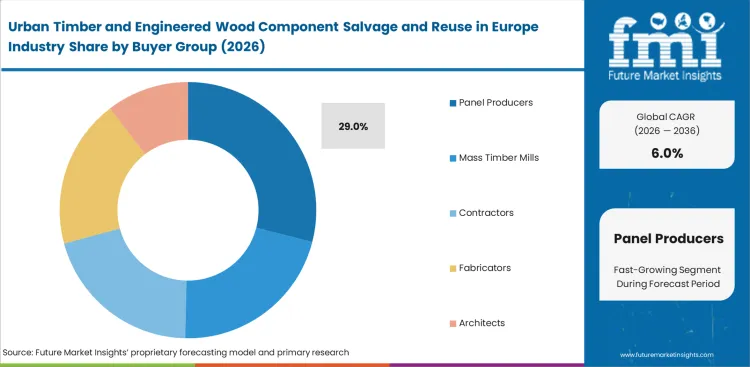
Scale in this industry still comes from buyers that can absorb recovered timber in blended, repeatable, and industrially practical forms. Panel producers remain important because they can take larger recovered volumes than most project-based users once wood is sorted into workable quality bands. Mass-timber mills, fabricators, and contractors still matter, yet many of them need tighter dimensional control, stronger traceability, or clearer end-use matching before they commit to secondary inputs. That difference explains why reconstituted wood routes remain commercially important even while direct reuse continues to gain attention. Buyers with broader tolerance keep material moving through the market, whereas narrower buyers improve value only at the top end. Panel producers are expected to represent 29.0% share in 2026 because consumption scale and blend tolerance give them the strongest recurring off-take role. Sales performance stays stronger when recovery firms recognize which buyer type can absorb volume reliably, and which one will only participate when grading standards are much tighter.
- Consumption scale: Large board producers keep demand steadier because they absorb more volume than most project buyers.
- Blend tolerance: Industrial users accept wider input ranges once contamination and sizing stay within workable limits.
- Quality gate: More selective buyers can pay better, but they usually require stronger grading and clearer material history.
Urban Timber and Engineered Wood Component Salvage and Reuse in Europe Industry Drivers, Restraints, and Opportunities
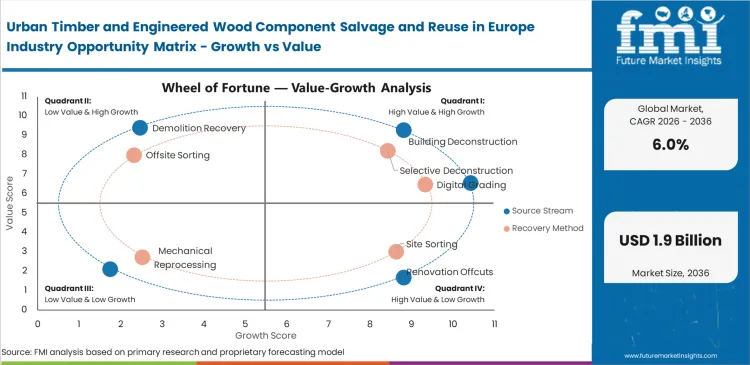
Project owners and building contractors face a more direct decision about timber value at the start of demolition than they did a few years ago. Mixed removal clears sites quickly, yet it also destroys part of the resale value that circular construction now tries to keep in use. Recovery-led planning works better when wood is identified early, separated early, and moved toward buyers who already know how they want to use it. That shift supports demand because salvage and reuse stop being side activities and become part of the commercial plan, especially where timber logistics and local resale routes make secondary material easier to move.
Quality doubt still slows adoption more than the simple lack of interest. Recovered wood can look usable and still create hesitation when grading; contamination checks and supply consistency are not handled well enough for the intended end use. That issue occurs because recovery firms, contractors, and end buyers do not always work to the same timing or quality standard. Better sorting and stronger pre-sale matching help, yet they do not remove the burden of proving that material is fit for reuse, and that keeps part of the industry inside lower-value channels.
Opportunities in the Urban Timber and Engineered Wood Component Salvage and Reuse in Europe Industry
- Urban retrofit loops: Reuse becomes easier when city renovation programs keep generating recoverable timber close to end users who can absorb it quickly.
- Regional grading hubs: Secondary wood gains value when specialist yards sort, test, and channel material before buyers spend time on their own inspection.
- Panel feed links: Manufacturers that connect recovery operations with stable industrial outlets improve off-take certainty and reduce the risk of stranded material.
Regional Analysis
Key Facts About Country
- Circular building practice and stronger site-level recovery planning give Denmark the strongest growth profile in this study. Urban timber and engineered wood component salvage and reuse demand in Denmark is expected to rise at a CAGR of 7.4% through 2036.
- Shorter movement between city projects, sorting yards, and resale channels keeps the Netherlands on a faster expansion path. The country is projected to record 7.1% CAGR over the forecast period.
- Existing industrial routes for secondary wood help Italy convert recovered timber into commercially usable output. Market growth in Italy is expected to run at a CAGR of 6.9% through 2036.
- Urban redevelopment in larger cities improves recovery economics in Spain, where cleaner salvage streams are gaining practical downstream outlets. Through 2036, Spain is likely to post 6.7% CAGR in this market.
- A deeper industrial wood base gives Germany solid demand support even though expansion is more measured than in faster-moving countries. Demand across Germany is projected to increase at 6.1% CAGR by 2036.
- Public and commercial interest in reclaimed wood remains present in France, but execution still depends on cleaner flows and better project matching. France is expected to register 5.9% CAGR through 2036.
- Timber familiarity supports the industry in Sweden, although salvage-led reuse still moves through a narrower commercial route than in the stronger-growth countries. Sales in Sweden are forecast to expand at a CAGR of 5.6% during the assessment period.
Based on the regional analysis, the Urban Timber and Engineered Wood Component Salvage and Reuse in Europe Industry is segmented into Northern Europe, Western Europe, and Southern Europe across 40 plus countries. Recovery potential does not rise in a straight line across the region because site practice, grading confidence, resale routes, and downstream wood demand are not equally mature from one country to another.
.webp "Top Country Growth Comparison Urban Timber And Engineered Wood Component Salvage And Reuse In Europe Industry Cagr (2026 2036)")
| Country | CAGR (2026 to 2036) |
|---|---|
| Denmark | 7.4% |
| Netherlands | 7.1% |
| Italy | 6.9% |
| Spain | 6.7% |
| Germany | 6.1% |
| France | 5.9% |
| Sweden | 5.6% |
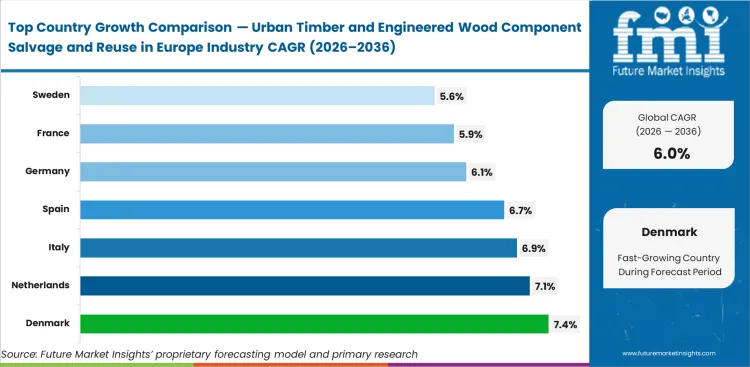
Source: Future Market Insights (FMI) analysis, based on proprietary forecasting model and primary research
Northern Europe Urban Timber and Engineered Wood Component Salvage and Reuse in Europe Industry Analysis
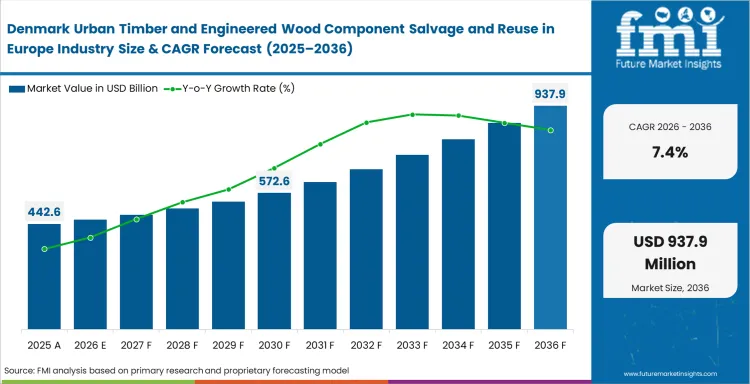
Northern Europe moves on reuse when project discipline and policy direction point in the same way. Denmark shows what happens when circular building ideas move past discussion and become part of normal site planning. Sweden still has strong timber credentials, yet direct salvage and secondary engineered use follow a slower path when recovery channels are less coordinated. FMI links this regional pattern with modular construction activity because offsite and circular building methods often reward cleaner and more predictable recovered inputs.
- Denmark: Urban retrofit work, public discussion around circular building, and stronger willingness to treat recovered timber as a usable input all push Denmark ahead of the regional pack. Demand for urban timber and engineered wood component salvage and reuse in Denmark is anticipated to rise at a CAGR of 7.4% from 2026 to 2036, and that pace reflects better alignment between recovery planning and end use rather than simple demolition volume. Recovery firms benefit when projects separate material before it is mixed with general site waste. Cleaner lots shorten grading time and make resale easier. Buyers who wait for a fully standardized supply may miss near-term access to the best local material streams.
- Sweden: Timber remains familiar in Swedish construction, yet reclaimed supply still moves through a more careful and narrower route than in the fastest-growing markets. Project teams often need clearer matching between recovered material, grading outcome, and end-use fit before demand scales. Urban timber and engineered wood component salvage and reuse in Sweden is expected to grow at a CAGR of 5.6% during the assessment period, with progress shaped by how quickly recovery practice turns into repeat business instead of isolated projects. Supply is present, though commercial flow stays more selective. That keeps growth positive but less forceful than Denmark.
FMI’s report includes Norway, Finland, and Iceland within the wider Northern Europe view. Country performance across that group depends less on wood availability and more on whether recovered material can move through grading, resale, and project approval without losing time. Where that sequence remains slow, secondary wood still struggles to compete with simpler virgin supply.
Western Europe Urban Timber and Engineered Wood Component Salvage and Reuse in Europe Industry Analysis
Western Europe combines the region’s deepest industrial wood base with a mixed pace of reuse execution. The Netherlands advances faster because circular construction ideas are turning into clearer urban recovery practices. Germany offers scale and downstream buying power, while France adds demand but moves more carefully when grading discipline and project fit are less certain. A large part of the commercial pull in this region still comes from panels, interiors, and furniture demand that can absorb recovered wood more steadily than purely showcase reuse.
- Netherlands: Dense urban redevelopment and stronger circular building language give the Netherlands a better starting point for turning recovered wood into a planned input instead of a niche material. Recovery chains benefit from shorter movement between city projects, sorting yards, and resale routes. That is why the country is set to record a CAGR of 7.1% in urban timber and engineered wood component salvage and reuse segment over the forecast period. Commercial traction improves when material can stay local and reach buyers quickly. Projects that rely on long and uncertain handling lose part of that advantage.
- Germany: Industrial capacity gives Germany one of the strongest demand bases in Europe, even though growth sits below the fastest-moving countries. Panel producers, engineered wood users, and broader manufacturing outlets give recovered material more than one route into paid use. Urban timber and engineered wood component salvage and reuse demand across Germany is projected to increase at 6.1% CAGR by 2036 because scale supports the industry even when direct reuse pathways are not always the quickest to expand. Material that misses one channel can often still find another. That flexibility supports stability more than speed.
- France: Public and commercial projects create interest in reclaimed wood, yet wider uptake still depends on how well supply can be matched with usable specification and timing. Recovery gains value when material arrives clean and sorted, but mixed flows slow buyer confidence and extend approval work. France is likely to post a CAGR of 5.9% in urban timber and engineered wood component salvage and reuse industry by 2036, which points to steady improvement rather than a fast break from current practice. Demand remains real. Execution still decides how much of that demand can be converted into repeat buying.
FMI’s report also covers Belgium, Austria, Switzerland, Luxembourg, and the neighbouring Western Europe segment not listed in the table above. Common regional strength comes from a broad downstream wood economy. Common regional limit comes from uneven coordination between site recovery and buyer requirements.
Southern Europe Urban Timber and Engineered Wood Component Salvage and Reuse in Europe Industry Analysis
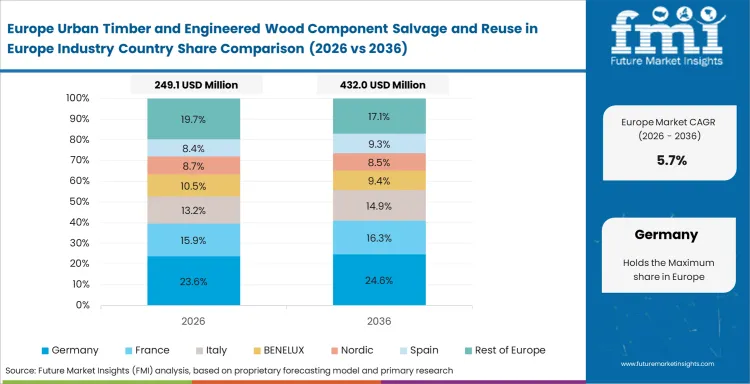
Southern Europe gains strong recovery of economics in secondary wood yet reuse value still depends on how far the material can move beyond basic recycling. Italy and Spain both show room for growth because recovered wood already has a place in broader industrial use. Direct reuse and higher-value remanufacture improve when grading quality and project timing hold up under commercial pressure. Links with woodcore panel and other board-related demand help support volume even when project-led reuse stays selective.
- Italy: Secondary wood already has a stronger economic route in Italy than in many slower-moving markets, and that helps reclaimed supply stay commercially visible. Project work, panel demand, and recovery know-how support a broader base for reuse and remanufacture. Italy is projected to witness 6.9% CAGR in urban timber and engineered wood component salvage and reuse from 2026 to 2036, with the figure reflecting the country’s ability to connect recovered wood with practical industrial use. Higher value reuse still needs cleaner grading and better matching. Volume logic is already in place.
- Spain: Recovery economics remain supportive in Spain, though the move from general recycling toward higher-value salvage still depends on project quality and downstream fit. Urban redevelopment in larger cities gives the industry a stronger base where recovered timber can be sorted and sold with less delay. Through 2036, urban timber and engineered wood component salvage and reuse in Spain is expected to grow at a CAGR of 6.7% because usable recovery streams are improving, and buyers have practical routes for secondary wood. Growth still slows when material history is unclear. Confidence in grading remains central to wider adoption.
FMI’s report covers Portugal, Greece, and additional Southern European countries beyond the leading table entries. Regional upside comes from the fact that recovered wood already has market routes. Regional restraint comes from the harder task of lifting that material into cleaner and more valuable applications.
Competitive Aligners for Market Players
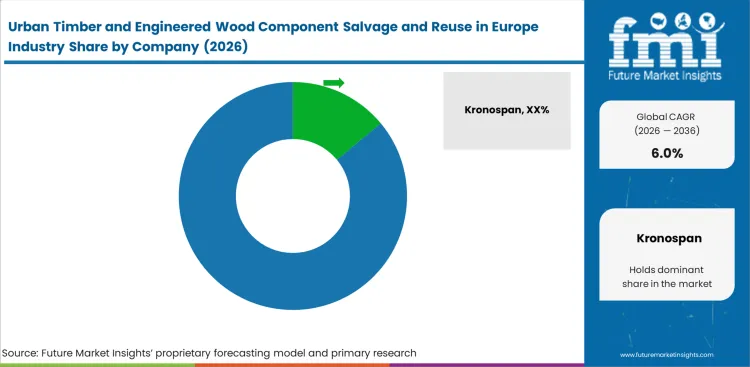
Consistency in supply and execution remains a stronger differentiator than sheer scale in this market. Buyers tend to favor participants that already operate close to established industrial processing routes, where recovered wood can be absorbed in stable and repeatable volumes. Panel-oriented manufacturers such as Kronospan and EGGER benefit from this position, as their operating models are designed to manage variability in recovered input while maintaining predictable off-take. Their proximity to large, standardized end uses allows them to remain in reliable counterparties even when feedstock quality fluctuates across projects.
A different competitive dynamic applies to players closer to engineered wood and higher-value applications, where material quality, grading accuracy, and physical form become critical. Companies such as Stora Enso and binderholz are often evaluated on how effectively recovered wood can be routed into specification-led uses that preserve higher value. In parallel, earlier-stage recovery specialists influence outcomes well before material enters formal supply chains.
Across the market, large buyers avoid reliance on a single recovery pathway, as feedstock availability, timing, and location can change rapidly. This keeps competitive conditions relatively open, despite the advantages held by established participants with mature processes and trusted relationships. Looking ahead to 2036, competitive intensity is expected to shift toward integrated partnerships that link on-site recovery, sorting operations, and downstream users into cohesive supply models. Participants who connect these steps seamlessly are better positioned to defend margins and retain value, while those treating recovery, grading, and resale as isolated activities are likely to face increasing pressure.
Key Players in Urban Timber and Engineered Wood Component Salvage and Reuse in Europe Industry
- Kronospan
- EGGER
- Sonae Arauco
- Pfleiderer
- Stora Enso
- binderholz
Scope of the Report
| Metric | Value |
|---|---|
| Quantitative Units | USD 1.0 billion to USD 1.8 billion, at a CAGR of 6.0% |
| Market Definition | Urban timber and engineered wood component salvage and reuse covers the recovery, grading, resale, remanufacture, and secondary use of reclaimed wood and wood-based components generated from buildings, interiors, and urban renovation activity in Europe. Scope is limited to recovered wood flows that retain reuse or engineered conversion value. |
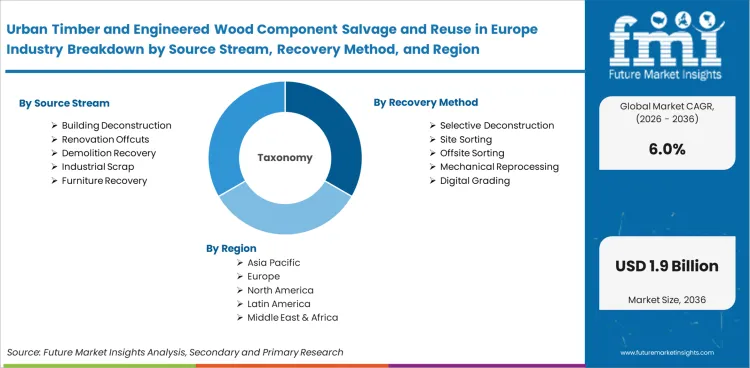
| Source Stream Segmentation | Building Deconstruction, Renovation Offcuts, Demolition Recovery, Industrial Scrap, Furniture Recovery |
| Recovery Method Segmentation | Selective Deconstruction, Site Sorting, Offsite Sorting, Mechanical Reprocessing, Digital Grading |
| Wood Form Segmentation | Structural Timber, Boards, Beams, Panels, Joinery |
| Engineered Output Segmentation | Particleboard Furnish, MDF Fibers, OSB Flakes, Glulam Lamellas, CLT Lamellas |
| End Use Segmentation | Residential, Commercial, Public Buildings, Interiors, Modular |
| Buyer Group Segmentation | Panel Producers, Mass Timber Mills, Contractors, Fabricators, Architects |
| Regions Covered | Northern Europe, Western Europe, Southern Europe |
| Countries Covered | Denmark, Netherlands, Italy, Spain, Germany, France, Sweden, and 40 plus countries |
| Key Companies Profiled | Kronospan, EGGER, Sonae Arauco, Pfleiderer, Stora Enso, binderholz |
| Approach | FMI combined primary interviews across recovery, panel, and construction value chains with desk analysis of circular construction policy, timber reuse literature, and company disclosures. Market sizing was anchored in the commercial movement of salvageable and reusable wood flows rather than total demolition waste volume. |
Source: Future Market Insights (FMI) analysis, based on proprietary forecasting model and primary research
Urban Timber and Engineered Wood Component Salvage and Reuse in Europe Industry Analysis by Segments
Source Stream:
- Building Deconstruction
- Renovation Offcuts
- Demolition Recovery
- Industrial Scrap
- Furniture Recovery
Recovery Method:
- Selective Deconstruction
- Site Sorting
- Offsite Sorting
- Mechanical Reprocessing
- Digital Grading
Wood Form:
- Structural Timber
- Boards
- Beams
- Panels
- Joinery
Engineered Output:
- Particleboard Furnish
- MDF Fibers
- OSB Flakes
- Glulam Lamellas
- CLT Lamellas
End Use:
- Residential
- Commercial
- Public Buildings
- Interiors
- Modular
Buyer Group:
- Panel Producers
- Mass Timber Mills
- Contractors
- Fabricators
- Architects
Region:
- Western Europe
- Germany
- France
- Netherlands
- Belgium
- Austria
- Switzerland
- Luxembourg
- Northern Europe
- Denmark
- Sweden
- Norway
- Finland
- Ireland
- Iceland
- Southern Europe
- Italy
- Spain
- Portugal
- Greece
- Malta
- Cyprus
- Eastern Europe
- Poland
- Czech Republic
- Hungary
- Romania
- Slovakia
- Bulgaria
- Croatia
- Slovenia
- Estonia
- Latvia
- Lithuania
Bibliography
- Cabrero, J. M., Ottenhaus, L.-M., Palma, P., & Attia, S. (2025). Disassembly and reuse in tall timber buildings: Advancing circular construction practices.
- Godina, M., Gowler, P., Rose, C. M., Wiegand, E., Mills, H. F., Koronaki, A., Ramage, M. H., & Shah, D. U. (2025). Strategies for salvaging and repurposing timber elements from existing buildings in the UK.
- Haakonsen, S. M., Tomczak, A., Izumi, B., & Luczkowski, M. (2024). Automation of circular design: A timber building case study.
- Ikenze, N., Rizos, V., & Nipius, L. (2024). Improving waste wood circularity in the EU: Classification frameworks and policy options.
- Kiesnere, G., Atstaja, D., Cudecka-Purina, N., & Susniene, R. (2024). The potential of wood construction waste circularity.
This bibliography is provided for reader reference. The full FMI report contains the complete reference list with primary source documentation.
This Report Addresses
- Market intelligence decisions across reclaimed structural timber, recovered engineered wood inputs, and urban salvage recovery channels.
- 2026 to 2036 market sizing and value forecasts based on primary interviews and recovery-pathway modelling.
- Growth opportunity mapping across Source Stream, Recovery Method, Wood Form, Engineered Output, End Use, and Buyer Group.
- Segment and regional outlook covering Building Deconstruction, Selective Deconstruction, Structural Timber, Particleboard Furnish, Residential use, and Panel Producers.
- Competition assessment across grading reliability, recovery discipline, off-take stability, industrial absorption capacity, and buyer trust.
- Demand evaluation linked to salvage planning, material matching, downstream industrial use, and circular construction adoption.
- Regional interpretation across Northern, Western, and Southern Europe, including Denmark, Netherlands, Italy, Spain, Germany, France, and Sweden.
- Commercial framing for investors, manufacturers, recovery firms, and construction participants assessing reclaimed wood value retention.
Frequently Asked Questions
What is the current size of the urban timber and engineered wood component salvage and reuse in Europe industry?
FMI estimates the urban timber and engineered wood component salvage and reuse in Europe industry at USD 1.0 billion in 2026.
How large is the urban timber and engineered wood component salvage and reuse in Europe industry expected to become by 2036?
The market is projected to reach USD 1.8 billion by 2036.
What is the expected CAGR for the urban timber and engineered wood component salvage and reuse in Europe industry?
FMI expects the market to expand at a 6.0% CAGR from 2026 to 2036.
What is driving growth in the urban timber and engineered wood component salvage and reuse in Europe industry?
Growth is being supported by tighter focus on material recovery, wider use of selective deconstruction, and rising interest in circular construction across Europe.
Which source stream leads the urban timber and engineered wood component salvage and reuse in Europe industry?
Building deconstruction remains the leading source stream because it offers larger recoverable timber volumes and better access to reusable structural wood.
Why does selective deconstruction matter in this market?
Selective deconstruction matters because usable timber value depends on careful removal, cleaner separation, and better material matching before reuse or reprocessing.
Which wood form holds the strongest position in this market?
Structural timber leads because it carries higher reuse value and fits directly into reclaimed building material demand.
Why does particleboard furnish important in engineered wood reuse across Europe?
Particleboard furnish remains important because a large share of recovered wood still moves into industrial board applications where absorption capacity is stronger.
Which end use is creating the most demand in the urban timber and engineered wood component salvage and reuse in Europe industry?
Residential use remains a major demand center as renovation activity, and lower-carbon building choices keep reclaimed wood relevant in housing projects.
Who are the main buyers in the urban timber and engineered wood component salvage and reuse in Europe industry?
Panel producers, mass timber manufacturers, contractors, and fabricators are among the main buyer groups shaping demand for recovered wood inputs.
Which European countries are showing the strongest outlook for this market?
Denmark, the Netherlands, Italy, and Spain show a stronger outlook, while Germany, France, and Sweden remain important demand centers with steady market potential.
What does this report cover in the urban timber and engineered wood component salvage and reuse in Europe industry?
This report covers market size, forecast, source streams, recovery methods, wood forms, engineered outputs, end uses, buyer groups, regional outlook, and competitive assessment across Europe.
What does this report cover in the urban timber and engineered wood component salvage and reuse in Europe industry?
This report covers market size, forecast, source streams, recovery methods, wood forms, engineered outputs, end uses, buyer groups, regional outlook, and competitive assessment across Europe.
Preview the report firsthand - request a free sample
Get SampleGet the brochure for pricing and purchase details.
Get PDFTable of Content
- Global Market Outlook
- Demand-side Trends
- Supply-side Trends
- Technology Roadmap Analysis
- Analysis and Recommendations
- Market Overview
- Market Coverage / Taxonomy
- Market Definition / Scope / Limitations
- Research Methodology
- Chapter Orientation
- Analytical Lens and Working Hypotheses
- Market Structure, Signals, and Trend Drivers
- Benchmarking and Cross-market Comparability
- Market Sizing, Forecasting, and Opportunity Mapping
- Research Design and Evidence Framework
- Desk Research Programme (Secondary Evidence)
- Company Annual and Sustainability Reports
- Peer-reviewed Journals and Academic Literature
- Corporate Websites, Product Literature, and Technical Notes
- Earnings Decks and Investor Briefings
- Statutory Filings and Regulatory Disclosures
- Technical White Papers and Standards Notes
- Trade Journals, Industry Magazines, and Analyst Briefs
- Conference Proceedings, Webinars, and Seminar Materials
- Government Statistics Portals and Public Data Releases
- Press Releases and Reputable Media Coverage
- Specialist Newsletters and Curated Briefings
- Sector Databases and Reference Repositories
- FMI Internal Proprietary Databases and Historical Market Datasets
- Subscription Datasets and Paid Sources
- Social Channels, Communities, and Digital Listening Inputs
- Additional Desk Sources
- Expert Input and Fieldwork (Primary Evidence)
- Primary Modes
- Qualitative Interviews and Expert Elicitation
- Quantitative Surveys and Structured Data Capture
- Blended Approach
- Why Primary Evidence is Used
- Field Techniques
- Interviews
- Surveys
- Focus Groups
- Observational and In-context Research
- Social and Community Interactions
- Stakeholder Universe Engaged
- C-suite Leaders
- Board Members
- Presidents and Vice Presidents
- R&D and Innovation Heads
- Technical Specialists
- Domain Subject-matter Experts
- Scientists
- Physicians and Other Healthcare Professionals
- Governance, Ethics, and Data Stewardship
- Research Ethics
- Data Integrity and Handling
- Primary Modes
- Tooling, Models, and Reference Databases
- Desk Research Programme (Secondary Evidence)
- Data Engineering and Model Build
- Data Acquisition and Ingestion
- Cleaning, Normalisation, and Verification
- Synthesis, Triangulation, and Analysis
- Quality Assurance and Audit Trail
- Market Background
- Market Dynamics
- Drivers
- Restraints
- Opportunity
- Trends
- Scenario Forecast
- Demand in Optimistic Scenario
- Demand in Likely Scenario
- Demand in Conservative Scenario
- Opportunity Map Analysis
- Product Life Cycle Analysis
- Supply Chain Analysis
- Investment Feasibility Matrix
- Value Chain Analysis
- PESTLE and Porter’s Analysis
- Regulatory Landscape
- Regional Parent Market Outlook
- Production and Consumption Statistics
- Import and Export Statistics
- Market Dynamics
- Renovation Offcuts
- Demolition Recovery
- Industrial Scrap
- Furniture Recovery
- Y-o-Y Growth Trend Analysis By Source Stream , 2021 to 2025
- Absolute $ Opportunity Analysis By Source Stream , 2026 to 2036
- Global Market Analysis 2021 to 2025 and Forecast 2026 to 2036, By Recovery Method
- Introduction / Key Findings
- Historical Market Size Value (USD Million) Analysis By Recovery Method, 2021 to 2025
- Current and Future Market Size Value (USD Million) Analysis and Forecast By Recovery Method, 2026 to 2036
- Selective Deconstruction
- Site Sorting
- Offsite Sorting
- Mechanical Reprocessing
- Digital Grading
- Selective Deconstruction
- Y-o-Y Growth Trend Analysis By Recovery Method, 2021 to 2025
- Absolute $ Opportunity Analysis By Recovery Method, 2026 to 2036
- Global Market Analysis 2021 to 2025 and Forecast 2026 to 2036, By Wood Form
- Introduction / Key Findings
- Historical Market Size Value (USD Million) Analysis By Wood Form, 2021 to 2025
- Current and Future Market Size Value (USD Million) Analysis and Forecast By Wood Form, 2026 to 2036
- Structural Timber
- Boards
- Beams
- Panels
- Joinery
- Structural Timber
- Y-o-Y Growth Trend Analysis By Wood Form, 2021 to 2025
- Absolute $ Opportunity Analysis By Wood Form, 2026 to 2036
- Global Market Analysis 2021 to 2025 and Forecast 2026 to 2036, By Engineered Output
- Introduction / Key Findings
- Historical Market Size Value (USD Million) Analysis By Engineered Output, 2021 to 2025
- Current and Future Market Size Value (USD Million) Analysis and Forecast By Engineered Output, 2026 to 2036
- Particleboard Furnish
- MDF Fibers
- OSB Flakes
- Glulam Lamellas
- CLT Lamellas
- Particleboard Furnish
- Y-o-Y Growth Trend Analysis By Engineered Output, 2021 to 2025
- Absolute $ Opportunity Analysis By Engineered Output, 2026 to 2036
- Global Market Analysis 2021 to 2025 and Forecast 2026 to 2036, By End Use
- Introduction / Key Findings
- Historical Market Size Value (USD Million) Analysis By End Use, 2021 to 2025
- Current and Future Market Size Value (USD Million) Analysis and Forecast By End Use, 2026 to 2036
- Residential
- Commercial
- Public Buildings
- Interiors
- Modular
- Residential
- Y-o-Y Growth Trend Analysis By End Use, 2021 to 2025
- Absolute $ Opportunity Analysis By End Use, 2026 to 2036
- Global Market Analysis 2021 to 2025 and Forecast 2026 to 2036, By Buyer Group
- Introduction / Key Findings
- Historical Market Size Value (USD Million) Analysis By Buyer Group, 2021 to 2025
- Current and Future Market Size Value (USD Million) Analysis and Forecast By Buyer Group, 2026 to 2036
- Panel Producers
- Mass Timber Mills
- Contractors
- Fabricators
- Architects
- Panel Producers
- Y-o-Y Growth Trend Analysis By Buyer Group, 2021 to 2025
- Absolute $ Opportunity Analysis By Buyer Group, 2026 to 2036
- Global Market Analysis 2021 to 2025 and Forecast 2026 to 2036, By Region
- Introduction
- Historical Market Size Value (USD Million) Analysis By Region, 2021 to 2025
- Current Market Size Value (USD Million) Analysis and Forecast By Region, 2026 to 2036
- North America
- Latin America
- Western Europe
- Eastern Europe
- East Asia
- South Asia and Pacific
- Middle East & Africa
- Market Attractiveness Analysis By Region
- North America Market Analysis 2021 to 2025 and Forecast 2026 to 2036, By Country
- Historical Market Size Value (USD Million) Trend Analysis By Market Taxonomy, 2021 to 2025
- Market Size Value (USD Million) Forecast By Market Taxonomy, 2026 to 2036
- By Country
- USA
- Canada
- Mexico
- By Source Stream
- By Recovery Method
- By Wood Form
- By Engineered Output
- By End Use
- By Buyer Group
- By Country
- Market Attractiveness Analysis
- By Country
- By Source Stream
- By Recovery Method
- By Wood Form
- By Engineered Output
- By End Use
- By Buyer Group
- Key Takeaways
- Latin America Market Analysis 2021 to 2025 and Forecast 2026 to 2036, By Country
- Historical Market Size Value (USD Million) Trend Analysis By Market Taxonomy, 2021 to 2025
- Market Size Value (USD Million) Forecast By Market Taxonomy, 2026 to 2036
- By Country
- Brazil
- Chile
- Rest of Latin America
- By Source Stream
- By Recovery Method
- By Wood Form
- By Engineered Output
- By End Use
- By Buyer Group
- By Country
- Market Attractiveness Analysis
- By Country
- By Source Stream
- By Recovery Method
- By Wood Form
- By Engineered Output
- By End Use
- By Buyer Group
- Key Takeaways
- Western Europe Market Analysis 2021 to 2025 and Forecast 2026 to 2036, By Country
- Historical Market Size Value (USD Million) Trend Analysis By Market Taxonomy, 2021 to 2025
- Market Size Value (USD Million) Forecast By Market Taxonomy, 2026 to 2036
- By Country
- Germany
- UK
- Italy
- Spain
- France
- Nordic
- BENELUX
- Rest of Western Europe
- By Source Stream
- By Recovery Method
- By Wood Form
- By Engineered Output
- By End Use
- By Buyer Group
- By Country
- Market Attractiveness Analysis
- By Country
- By Source Stream
- By Recovery Method
- By Wood Form
- By Engineered Output
- By End Use
- By Buyer Group
- Key Takeaways
- Eastern Europe Market Analysis 2021 to 2025 and Forecast 2026 to 2036, By Country
- Historical Market Size Value (USD Million) Trend Analysis By Market Taxonomy, 2021 to 2025
- Market Size Value (USD Million) Forecast By Market Taxonomy, 2026 to 2036
- By Country
- Russia
- Poland
- Hungary
- Balkan & Baltic
- Rest of Eastern Europe
- By Source Stream
- By Recovery Method
- By Wood Form
- By Engineered Output
- By End Use
- By Buyer Group
- By Country
- Market Attractiveness Analysis
- By Country
- By Source Stream
- By Recovery Method
- By Wood Form
- By Engineered Output
- By End Use
- By Buyer Group
- Key Takeaways
- East Asia Market Analysis 2021 to 2025 and Forecast 2026 to 2036, By Country
- Historical Market Size Value (USD Million) Trend Analysis By Market Taxonomy, 2021 to 2025
- Market Size Value (USD Million) Forecast By Market Taxonomy, 2026 to 2036
- By Country
- China
- Japan
- South Korea
- By Source Stream
- By Recovery Method
- By Wood Form
- By Engineered Output
- By End Use
- By Buyer Group
- By Country
- Market Attractiveness Analysis
- By Country
- By Source Stream
- By Recovery Method
- By Wood Form
- By Engineered Output
- By End Use
- By Buyer Group
- Key Takeaways
- South Asia and Pacific Market Analysis 2021 to 2025 and Forecast 2026 to 2036, By Country
- Historical Market Size Value (USD Million) Trend Analysis By Market Taxonomy, 2021 to 2025
- Market Size Value (USD Million) Forecast By Market Taxonomy, 2026 to 2036
- By Country
- India
- ASEAN
- Australia & New Zealand
- Rest of South Asia and Pacific
- By Source Stream
- By Recovery Method
- By Wood Form
- By Engineered Output
- By End Use
- By Buyer Group
- By Country
- Market Attractiveness Analysis
- By Country
- By Source Stream
- By Recovery Method
- By Wood Form
- By Engineered Output
- By End Use
- By Buyer Group
- Key Takeaways
- Middle East & Africa Market Analysis 2021 to 2025 and Forecast 2026 to 2036, By Country
- Historical Market Size Value (USD Million) Trend Analysis By Market Taxonomy, 2021 to 2025
- Market Size Value (USD Million) Forecast By Market Taxonomy, 2026 to 2036
- By Country
- Kingdom of Saudi Arabia
- Other GCC Countries
- Turkiye
- South Africa
- Other African Union
- Rest of Middle East & Africa
- By Source Stream
- By Recovery Method
- By Wood Form
- By Engineered Output
- By End Use
- By Buyer Group
- By Country
- Market Attractiveness Analysis
- By Country
- By Source Stream
- By Recovery Method
- By Wood Form
- By Engineered Output
- By End Use
- By Buyer Group
- Key Takeaways
- Key Countries Market Analysis
- USA
- Pricing Analysis
- Market Share Analysis, 2025
- By Source Stream
- By Recovery Method
- By Wood Form
- By Engineered Output
- By End Use
- By Buyer Group
- Canada
- Pricing Analysis
- Market Share Analysis, 2025
- By Source Stream
- By Recovery Method
- By Wood Form
- By Engineered Output
- By End Use
- By Buyer Group
- Mexico
- Pricing Analysis
- Market Share Analysis, 2025
- By Source Stream
- By Recovery Method
- By Wood Form
- By Engineered Output
- By End Use
- By Buyer Group
- Brazil
- Pricing Analysis
- Market Share Analysis, 2025
- By Source Stream
- By Recovery Method
- By Wood Form
- By Engineered Output
- By End Use
- By Buyer Group
- Chile
- Pricing Analysis
- Market Share Analysis, 2025
- By Source Stream
- By Recovery Method
- By Wood Form
- By Engineered Output
- By End Use
- By Buyer Group
- Germany
- Pricing Analysis
- Market Share Analysis, 2025
- By Source Stream
- By Recovery Method
- By Wood Form
- By Engineered Output
- By End Use
- By Buyer Group
- UK
- Pricing Analysis
- Market Share Analysis, 2025
- By Source Stream
- By Recovery Method
- By Wood Form
- By Engineered Output
- By End Use
- By Buyer Group
- Italy
- Pricing Analysis
- Market Share Analysis, 2025
- By Source Stream
- By Recovery Method
- By Wood Form
- By Engineered Output
- By End Use
- By Buyer Group
- Spain
- Pricing Analysis
- Market Share Analysis, 2025
- By Source Stream
- By Recovery Method
- By Wood Form
- By Engineered Output
- By End Use
- By Buyer Group
- France
- Pricing Analysis
- Market Share Analysis, 2025
- By Source Stream
- By Recovery Method
- By Wood Form
- By Engineered Output
- By End Use
- By Buyer Group
- India
- Pricing Analysis
- Market Share Analysis, 2025
- By Source Stream
- By Recovery Method
- By Wood Form
- By Engineered Output
- By End Use
- By Buyer Group
- ASEAN
- Pricing Analysis
- Market Share Analysis, 2025
- By Source Stream
- By Recovery Method
- By Wood Form
- By Engineered Output
- By End Use
- By Buyer Group
- Australia & New Zealand
- Pricing Analysis
- Market Share Analysis, 2025
- By Source Stream
- By Recovery Method
- By Wood Form
- By Engineered Output
- By End Use
- By Buyer Group
- China
- Pricing Analysis
- Market Share Analysis, 2025
- By Source Stream
- By Recovery Method
- By Wood Form
- By Engineered Output
- By End Use
- By Buyer Group
- Japan
- Pricing Analysis
- Market Share Analysis, 2025
- By Source Stream
- By Recovery Method
- By Wood Form
- By Engineered Output
- By End Use
- By Buyer Group
- South Korea
- Pricing Analysis
- Market Share Analysis, 2025
- By Source Stream
- By Recovery Method
- By Wood Form
- By Engineered Output
- By End Use
- By Buyer Group
- Russia
- Pricing Analysis
- Market Share Analysis, 2025
- By Source Stream
- By Recovery Method
- By Wood Form
- By Engineered Output
- By End Use
- By Buyer Group
- Poland
- Pricing Analysis
- Market Share Analysis, 2025
- By Source Stream
- By Recovery Method
- By Wood Form
- By Engineered Output
- By End Use
- By Buyer Group
- Hungary
- Pricing Analysis
- Market Share Analysis, 2025
- By Source Stream
- By Recovery Method
- By Wood Form
- By Engineered Output
- By End Use
- By Buyer Group
- Kingdom of Saudi Arabia
- Pricing Analysis
- Market Share Analysis, 2025
- By Source Stream
- By Recovery Method
- By Wood Form
- By Engineered Output
- By End Use
- By Buyer Group
- Turkiye
- Pricing Analysis
- Market Share Analysis, 2025
- By Source Stream
- By Recovery Method
- By Wood Form
- By Engineered Output
- By End Use
- By Buyer Group
- South Africa
- Pricing Analysis
- Market Share Analysis, 2025
- By Source Stream
- By Recovery Method
- By Wood Form
- By Engineered Output
- By End Use
- By Buyer Group
- USA
- Market Structure Analysis
- Competition Dashboard
- Competition Benchmarking
- Market Share Analysis of Top Players
- By Regional
- By Source Stream
- By Recovery Method
- By Wood Form
- By Engineered Output
- By End Use
- By Buyer Group
- Competition Analysis
- Competition Deep Dive
- Kronospan
- Overview
- Product Portfolio
- Profitability by Market Segments (Product/Age /Sales Channel/Region)
- Sales Footprint
- Strategy Overview
- Marketing Strategy
- Product Strategy
- Channel Strategy
- EGGER
- Sonae Arauco
- Pfleiderer
- Stora Enso
- binderholz
- Kronospan
- Competition Deep Dive
- Assumptions & Acronyms Used


